Excerpt
First pages of the volume, freely accessible.
Page 1
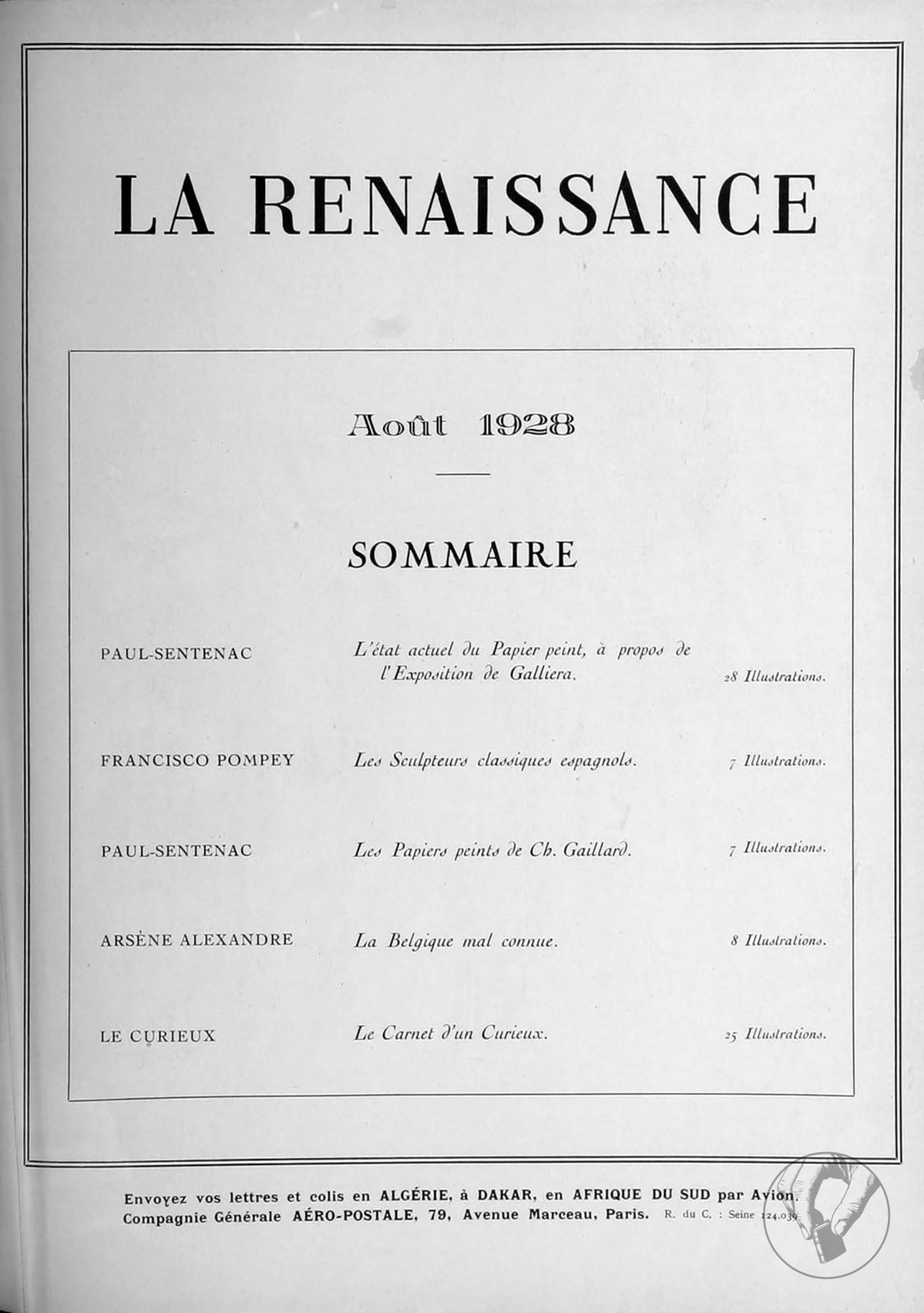
LA RENAISSANCE
Août 1928
SOMMAIRE
Auteur
---
Titre
---
Illustrations
---
PAUL-SENTENAC
---
L'état actuel du Papier peint, à propos de l'Exposition de Galliera.
---
28 Illustrations
---
FRANCISCO POMPEY
---
Les Sculpteurs classiques espagnols.
---
7 Illustrations
---
PAUL-SENTENAC
---
Les Papiers peints de Ch. Gaillard.
---
7 Illustrations
---
ARSÈNE ALEXANDRE
---
La Belgique mal connue.
---
8 Illustrations
---
LE CURIEUX
---
Le Carnet d'un Curieux.
---
25 Illustrations
---
Envoyez vos lettres et colis en ALGÉRIE, à DAKAR, en AFRIQUE DU SUD par Avion.
Compagnie Générale AÉRO-POSTALE, 79, Avenue Marceau, Paris. R. du C.: Seine 124.039
Page 2
Jeanne Lanvin
Couture, Mode, Fourrures, Lingerie
22, Faubourg Saint Honoré, Paris.
Page 3
L'ÉTAT ACTUEL DU PAPIER PEINT
A PROPOS DE L'EXPOSITION DE GALLIERA
par PAUL-SENTENAC
---
MODÈLE EN Omm50 DE LARGE COMPOSITION DE MADE-MOISELLE SUZANNE FONTAN DES ATELIERS PRIMAVERA (GRANDS MAGASINS DU PRINTEMPS DE PARIS)
CE MODÈLE EST ÉDITÉ ET IMPRIMÉ PAR LA SOCIÉTÉ FRANÇAISE DES PAPIERS PEINTS FONDÉE EN 1881
137, RUE DU FG SAINT-DENIS PARIS
---
Depuis 1900, le papier peint a parcouru une étape plus importante dans la voie de l’originalité et du modernisme qu’il ne l’avait fait pendant toute la moitié du xixe siècle et le début du xxe. Durant cette longue période, d’importants perfectionnements ont été réalisés dans l’industrie, mais ils ont porté uniquement sur l’outillage mécanique. Le caractère artistique demeurait tout à fait négligé. On ne demandait au papier peint que des réussites de trompe-l’œil. Nous nous étonnons aujourd’hui qu’un Charles Blanc, doublement académicien, ait pu, dans sa grammaire des Arts Décoratifs, écrire l’apologie d’une production parvenant à imiter à la perfection « l’éclat de la soie et du satin, l’apprêt de la moire, le poli des glaçures céramiques, l’épaisseur des broderies au crochet, le relief des velours de Gênes, les gaufrures profondes du cuir d’Espagne, les bombements d’une étoffe capitonnée. » etc. C’était là un papier peint digne d’encadrer, en cette terne époque de 1880, un mobilier de faux style.
On pouvait bien alors, sans crainte d’être traité de vieille perruque, avoir le regret de cet art jeune, personnel en sa naïveté, des dominotiers, qui composaient des papiers peints, des almanachs et autres objets en se servant de bois gravés colorés, au patron. A l’aide de moyens simples, avec la planche gravée imprégnée de couleur au tampon, ces artisans-artistes obtenaient des papiers peints à l’ornementation florale très variée, et même des ensembles, avec des colonnes ou des panneaux représentant des paysages chinois. Les paravents, utilisés souvent sous les règnes de Louis XV et de Louis XVI, étaient aussi recouverts de ces tapisseries
Since 1900 wall-paper has covered much more important stages in the way of originality and modernism than that covered in the entire last half of the XIXth Century and the beginning of the XXth. During this long period, important developments were realized in industry, but they were related solely to the mechanical elements of its manufacture. The artistic element was altogether neglected. One asked nothing of wall-paper but successful imitation of other fabrics. We find it almost incredible today that a man like Charles Blanc, doubly academician, could have written in his Grammar of the Decorative Arts the defense of a production which came near imitating perfectly the effect of silk and of satin, the surface of watered silk, the polish of ceramic ware, the depth of crochet work, the relief of Genoa velvet, the deep waffle-iron effect of Spanish leather, the convexity of padded stuff and still we will not waste time in recounting such things. That was a wall-paper quite worthy to frame, in that dull epoch of 1880, example of a style which was only an imitation, itself.
One might well have regretted then, without fear of being treated as a bewigged old-timer, that young art, personal in its naiveté, which made up the wall-papers, almanachs and other objects, bringing into service carved wood colored in pattern.
With the aid of simple means, with the engraved plate wet with colors by the buffer, these artisan-artists worked out wall-papers of a highly varied floral decoration and even general effects, with strips or panels representing Chinese landscapes. So a little room received a decoration in harmony with the arrangement of the walls. The screens often used in the reign of Louis XV and Louis XVI were covered with such tapestry paper. We know that at the end of the XVIIIth Century, makers like Réveillon brought the art of wall-paper to a high degree of perfection, as well in the taste and elegance of motives as in the carefulness of technique. Under the Restoration and Louis-Philippe, the good traditions continued and certain large gray tapestry effects those of the Cupid and Psyche series in 26 breadths, or the Italian campaigns, constitute veritable pictures of bold conception, artistic successes in spite of difficulties.
In the middle of the XIXth Century, the tapestry paper which had continued the tradition of large design, up to that time, with a freedom savoring of the ancient regime, lost the qualities of art. On the contrary, as
Page 4
LA RENAISSANCE
MODÈLE EN 0m72 DE LARGEUR. — COMPOSITION DE STÉPHANY, 1er PRIX DU CONCOURS, PATRONNÉ PAR LA SOCIÉTÉ D'ENCOURAGEMENT À L'ART ET À L'INDUSTRIE. — CE MODÈLE EST ÉDITÉ ET IMPRIMÉ PAR LA SOCIÉTÉ FRANÇAISE DES PAPIERS PEINTS, (FONDÉE EN 1881). 137, FAUBOURG SAINT-DENIS, PARIS.
MODÈLE DE 0m72 DE LARGEUR. — COMPOSITION DE STÉPHANY, 1er PRIX DU CONCOURS, PATRONNÉ PAR LA SOCIÉTÉ D'ENCOURAGEMENT À L'ART ET À L'INDUSTRIE. — CE MODÈLE EST ÉDITÉ ET IMPRIMÉ PAR LA SOCIÉTÉ FRANÇAISE DES PAPIERS PEINTS, (FONDÉE EN 1881). 137, FAUBOURG SAINT-DENIS, PARIS.
Page 5
LA RENAISSANCE
en papier. On sait qu'à la fin du XVIIIe siècle, des fabricants, comme Réveillon, portèrent à un haut degré de perfection, aussi bien dans le goût et l'élégance des motifs que dans le soin de la technique, l'art du papier peint. Sous la Restauration et Louis-Philippe, les bonnes traditions se continuèrent et certaines grandes tentures en grisaille, celles de la série de Psyché et Cupidon en 26 lés ou des Campagnes d'Italie ont constitué de véritables tableaux d'une conception hardie, réussites artistiques en dépit des difficultés.
Au milieu du XIXe siècle, le papier de tapisserie, qui avait jusqu'alors continué les traditions de taille large, de franchise savoureuse de l'ancien régime perd ses qualités d'art. Par contre, ainsi que nous l'avons indiqué, l'outillage va se modifier, et d'importantes transformations seront opérées grâce à quoi la production deviendra plus rapide et plus intense: 1842 demeure une date marquante dans l'industrie du papier peint. C'est à cette époque que l'on substitue à la planche et au rouleau l'impression mécanique. Le premier qui appliqua ce procédé fut Isidore Leroy.
Le dispositif de la nouvelle machine à imprimer consiste, comme pour la toile, en un tambour de fort diamètre qui entraîne le papier et assure l'impression par contact des cylindres gravés (un par couleur) alimentés en couleur par un drap sans fin trempant dans une auge. Au début, les cylindres étaient de cuivre ou de bois gravés en relief. Actuellement, on se sert de cylindres we have shown, the machinery is about to be changed and important modifications are in process, thanks to which production will become more rapid and more intensified. A marked date in the wall-paper industry is 1842. That is the epoch when mechanical production was substituted for the engraved plate. The first who applied this process was Isidore Leroy.
Arts Decoratifs, a definition of the machine for making the tapestry rolls. The nature of the new machine for printing consists, like that for printing cloth fabric, of a drum of large diameter which carries the paper and makes the impression by contact with engraved cylinders (one for color), the color being applied by cloth wet in a tray. At first, the rolls were of wood cut in relief. Now, cylinders are used made of plates of soft copper which follow the lines of the original design. The sections marked by those copper plates are furnished with felt filled with the liquid coloring, which is communicated to the paper. Each machine prints many colors at the same time. In this way there are twelve-color machines in the modern industry. Improvements achieved in the mechanical department of wall-paper making have placed the French industry in the first rank.
The great movement toward collaboration between the artists and the manufacturers which preceded the 1925 Exposition was necessary and the climax of that was a revival of the tapestry paper and a return to the artistic element of which the industry has been so long
Page 6
LA RENAISSANCE
SOCIÉTÉ DESFOSSÉ ET KARTH. — DAMAS MODERNE. — IMPRESSION MACHINE.
COMPOSITION DE H. STÉPHANY.
SOCIÉTÉ DESFOSSÉ ET KARTH. — DAMAS MODERNE. — IMPRESSION SOIE.
COMPOSITION DE RUEPP.
Page 7
LA RENAISSANCE
PAUL GRUIN — DAMAS SANA.
COMPOSITION PAR LE STUDIO D'ART.
PAUL GRUIN. — DAMAS. — REPRODUCTION D'UNE SOIERIE DE LA MAISON DUCHESNE ET BINET.
COMPOSITION DE BAESCHLIN
Page 8
LA RENAISSANCE
constitués par des lamelles de cuivre souple, qui suivent les traits du dessin original. Les secteurs, délimités par ces lamelles, sont garnis à l’intérieur de feutres s’imprégnant de matière colorée et la communiquant au papier. Chaque machine imprime plusieurs couleurs à la fois. C’est ainsi qu’il y a chez les industriels modernes des machines à seize couleurs. Les perfectionnements réalisés dans l’outillage mécanique pour la fabrication de la tenture murale ont placé l’industrie française au premier rang.
Il a fallu le grand mouvement de collaboration, entre les artistes et les industriels, qui a précédé l’Exposition de 1925 et a trouvé en elle son couronnement, pour amener une rénovation du papier de tapisserie et lui rendre le caractère d’art dont il était resté dépourvu pendant trop longtemps. C’est pourquoi la floraison actuelle qui s’étalait dans les claires galeries de Galliera n’a pas atteint tout d’un coup ce riche épanouissement. Il y a eu des éclosions partielles de bourgeons, des branchettes qui s’enfleurissaient de-ci, de-là. Le modern style tourmenté de 1900 fut comme un bourgeon séché sur la plante. Trois ans plus tard, la frise au pochoir se développa tout autour de la pièce à tapisser, au-dessous du plafond et couronnant une tenture d’une tonalité unie. Puis le papier peint profita des hardiesses de coloris que les Ballets Russes mirent à la mode. Vers cette époque, le papier peint et la toile imprimée sont devenus en quelque sorte frère et sœur. C’est la même machine qui sert à la fabrication de l’une et de l’autre, et ce sont des motifs d’inspiration tout à fait voisine qui les décoront. Parfois le même cylindre gravé sera employé pour le papier et pour la
PAUL GRUIN. — LA ROSE MODERNE. COMPOSITION DE LUCIEN RIGET.
deprived. That is why the present harvest that is spread through the bright rooms of the Galliera show did not come to its rich fulfilment all of a sudden. There have been partial openings of buds, branches that blossomed, here and there. The restless modern style of 1900 was like a dry bud on the plant. Three years later, the patterned frieze was developed, to run all around the room, from floor to ceiling and crowning the covering with a unified tone. Then wall-paper profited by the boldness of coloring which the Russian Ballet brought into fashion. At about that time, wall-paper and printed fabric became in a way brother and sister. The same kind of machine is used to make them both, and the motives which inspire their decoration are altogether related. Sometimes the same engraved cylinder will be employed for paper and for cloth. In the mean time independent artists have tried their hand at creating compositions for wall-paper.
Many of them have contributed to a renewal of the original use of wood blocks. Is it not strange that the influence of some of these innovators should not be exercised above all, outside of mechanical manufacture, toward a return to the process of the engraved plate of other days? So tradition was renewed with the designers and the dealers of the old regime.
The fact should be noted, in passing, that printing from the plate is done upon the paper with the aid of a press. By this method truly artistic results were obtained, but they were expensive in comparison with the results of mechanical fabrication. So, whether for the sake of economy
Page 9
PAUL GRUIN
HYMNE A LA NATURE
DÉCOR OBTENU PAR LA COMBINAISON D'ÉLÉMENTS DE LA COLLECTION PAUL GRUIN, À PARIS.
LE ROSIER DE MAI
DÉCOR OBTENU PAR LA COMBINAISON D'ÉLÉMENTS DE LA COLLECTION PAUL GRUIN, À PARIS.
Page 11
LA RENAISSANCE
VASE CHINOIS.
COMPOSITION DE BAESCHLIN.
ANCIENS ÉTABLISSEMENTS M. GAILLARD.
JET D'EAU FLEURI.
COMPOSITION POL RABB.
DAMAS MODERNE.
COMPOSITION DE CROZET.
toile. Entre temps, des artistes indépendants s'étaient essayés à créer des compositions pour des papiers peints. Plusieurs d'entre eux avaient contribué à rénover la xylographie originale. Aussi n'est-il pas étonnant que l'action de ces quelques novateurs se soit exercée surtout, en dehors de la fabrication mécanique, dans un retour aux procédés d'autrefois à la planche. Ainsi la tradition était renouée avec les imagiers et les dominotiers de l'ancien régime. Le bouquet bigarré des Ballets Russes s'est alors fané, et l'on constate chez les décorateurs de tentures une recherche de tonalités adoucies des gris, des bistres, des nuances saumon; en progressant dans cette voie, ils s'appliquent tout naturellement à se borner à des harmonies générales en plusieurs nuances d'une même couleur.
Ces diverses tendances, ces différentes innovations n'ont pas été perdues dans la renaissance artistique du papier de tapisserie telle qu'elle s'est manifestée au Musée Galliera. A l'heure actuelle, le papier peint fabriqué à la machine, avec un rendement inten-
or because the taste of the artists were in harmony with this, the number of colors was limited to two or three tones. The variegated bouquet of the Russian Ballets is faded and among the designers of wall-paper patterns there is a tendency toward tonalities softened by greys, bistres, shades of salmon; progressing in that direction, they naturally sought to limit themselves to general harmonies in many shades of the same color.
These diverse tendencies, these different innovations, have not been lost in the artistic renaissance of tapestry paper as it is shown at the musée. At the present moment, wall-paper made by machinery with an intensive rendering, is enhanced by the decorative imagination of artists at the same time that it gets the benefit of decided improvements, particularly in the quality of the paper as well as in that of the colors. Although the names of the creators of design remained unknown, as they should, a few years ago, they figure today as men of rank in the catalogues, beside the names of the