Page 1
CIMAISE ART ET ARCHITECTURE BIMESTRIEL N° 144 PRESENT DAY ART AND ARCHITECTURE F : 40 ISSN 0009-6830
First pages of the volume, freely accessible.
CIMAISE ART ET ARCHITECTURE BIMESTRIEL N° 144 PRESENT DAY ART AND ARCHITECTURE F : 40 ISSN 0009-6830
Dans le cadre de la Foire Internationale d'Art Contemporain Daniel Gervis présente au Grand-Palais BENGT OLSON GALERIE DANIEL GERVIS 34 RUE DU BAC PARIS 7 261 11 73
--- GALERIE MARBACH Kramgasse 54, CH-3000 Berne 8 (Suisse) Tél. 031-22 42 05/59 18 60 --- 19 septembre - 20 octobre AUGUST PUIG huiles sur toile et huiles sur papier 1950 - 1979 44 images, huiles sur papier 1966 d’après le poème « Cris vers Rome » 1929/30 de Federico Garcia Lorca --- 24 octobre - 24 novembre 79 SERGE CHARCHOUNE œuvres choisies 1943-1970 huiles et gouaches --- Zoumboulakis Galleries --- GUDRUN VON LEITNER recent paintings and drawings october 1979 --- 20 Kolonaki Sq., Tel. 3608.278 • 7 Kriezotou St., Tel. 3634.454, Athens ---
Galerie Bellint 28 bis, boulevard Sébastopol - 75004 Paris Tél. 277.38.46 - 278.01.91 BRYEN 3 octobre - 3 novembre HELLMAN 7 novembre - 1er décembre en permanence : peintures de - Bazaine - Bellmer - Braque - Bryen - Bertholle - Boumeester - Debré - Downing - Droulers - Fagniez - Goetz - Kijno - J.F. Koenig - Lanskoy - La Serna - Luc Peire - Pelayo - Poliakoff - Salvado - Seiler sculptures de - Fenosa - Feraud - Dietrich Mohr - Subira-Puig FIAC 1979 Grand-Palais, Paris 19 - 28 octobre --- Galerie Kutter 17, rue des Bains, Luxembourg tél 2.35.71 septembre ROGER BISSIERE octobre MICHEL F. VAN OVERBEEKE œuvres récentes novembre COLLECTION 7 décembre JOSEPH PROBST œuvres 1958-1962
CIMAISE ART ET ARCHITECTURE ACTUELS PRESENT DAY ART AND ARCHITECTURE 26° ANNÉE - N° 144 Octobre-novembre-décembre 1979 Directeur-Rédacteur en Chef : Jean-Robert Arnaud Conseiller artistique : John Franklin Koenig Secrétaire général : René Barzilay Administration-Rédaction : 8, rue Récamier, Paris-7e. Tél. : 544-04-82 Impression : Société Mondiale d’Impression, 3, rue Maurice-Loewy, Paris-14e. Tél. : 327.15.40 Prix --- ce numéro : --- France --- 40 F --- Etranger --- 50 F --- Abonnement --- 6 numéros : --- France --- 180 F --- Etranger --- 240 F --- C.C.P. Cimaise 5542.39 --- Couverture de John-Franklin Koenig --- Etude --- Paule Gauthier --- Les phénomènes artistiquesà l’ère électronique et atomique (II)Artistic phenomenas of the electronicand atomic age (II) --- Visites d'ateliers --- Claude Bouyeure --- WhankiL’infini au carréThe infinite squared --- Daniel Marchesseau --- J.F. KoenigPoints d’histoire sur papiers collésHistorical markings on pasted papers --- Paule Gauthier --- Gudrun Von LeitnerLa « nouvelle objectivité »The « new objectivity » --- José Pierre --- Sur deux peintures de YoshikoAbout two paintings of Yoshiko --- André Pieyre de Mandiargues --- Yoshiko --- Paule Gauthier --- Yannis GrammaticopoulosUn art suggestifde notre « coexistence cosmique »A suggestive art of our« cosmic coexistence » --- 4 Prochain numéro : 10 décembre 1979
Les phénomènes artistiques à l'ère électronique et atomique II. — L’ART DE L'HOMME MODERNE par Paule GAUTHIER AVANT-PROPOS Pour aborder l’impact des sciences et des techniques sur l’ART MODERNE, j’ai rappelé dans un précédent article (Cimaise, n° 141) ce que l’ART a été au cours des temps, son sens fondamental et son rôle historique. ROLE PRIMORDIAL et SPÉCIFIQUE, source et synthèse des pratiques, l’art embrasse et dépasse techniques et croyances — telle la philosophie grecque née de la forme plastique sculpturale — alors, « la conséquence de toute activité artistique était une CIVILISATION ». Aujourd’hui cette tendance semble s’inverser, en liaison avec une crise politique, et sous le poids des forces scientifiques. Malgré les efforts, l’art reste marginal, décor et non plus base de la société. N’est-il plus ce qui reste après la mort d’un système, « une connaissance supérieure et éternellement vivante » ? Pour répondre, il fallait ressaisir la cohésion interne et la nécessité de toute civilisation valable (voir n° 141)... « Cette civilisation, pour la réaliser, il faudrait des énergies d’art prodigieuses pour refaire une unité pour briser et stopper l’instinct de connaissance » ! Au bord de la catastrophe atomique... du chaos économique... « l’intérêt général exige de nouveau une autorité qui maîtrise le savoir ». MAITRISE de PHILOSOPHE, et non celle d’un dictateur (). LA QUESTION restant : « MAITRISER l’instinct de connaissance AU PROFIT d’une RELIGION ou d’une CIVILISATION ESTHÉTIQUE ? » ESTHÉTIQUE () — substantif de construction devenu QUALITÉ, à laquelle il faudrait rendre la lucide matérialité de l’équilibre grec. Comme par la force des choses, MARCUSE () a compris la nécessité de restituer à la QUALITÉ LE GOUVERNEMENT DU MATÉRIALISME. De fait, seul le parfait équilibre de ces deux pôles (matériel/idéal - spirituel/sensual) pourrait faire naître une nouvelle civilisation. A l’art de créer les formes (qualité/quantité) d’une société faite pour l’Homme — la masse est une abstraction, seul les individus existent — sociétés d’Hommes nantis du pouvoir et de la liberté de se réaliser dans un destin valable. POSSIBLE si « comme chez les Grecs tout devenait vie », IMPOSSIBLE si « comme chez nous tous reste à l’état de connaissances » (). Le modèle grec () est là pour nous assurer du pouvoir réel des constructions esthétiques et de la matérialité de la pensée artistique. LES CIVILISATIONS ARTISTIQUES FACE AUX TECHNIQUES Car l’art n’est pas né « d’un geste gratuit pour orner un vase ou une grotte » ; l’art est né d’une nécessité intérieure, pour échapper à l’état de sujétion au milieu. Il en est venu au monde des formes spécifiques capables de délivrer l’homme de son angoisse ; et de l’arbitraire vécu, en lui rendant la finalité de l’action. On l’a vu (mon article n° 141), les formes fonctionnelles et techniques, armes/ustensiles/outils se sont développées par ailleurs... Tandis que la forme --- Artistic phenomenas of the electronic and atomic age II) ART OF MODERN MEN by Paule GAUTHIER FOREWORD To approach the impact science and technique on modern Art, I recalled in a previous article (Cimaise No. 141) what Art meant during the course of time, its historic role... PRIMORDIAL AND SPECIFIC ROLE, a source and synthesis of customs, Art combines and overpowers techniques and believes, such as the greek philosophy born from the plastic sculptural form—and so “the consequence of every artistic activity is a CIVILISATION.” To-day this tendency seem to be the opposite, in liaison with a political crisis and under the weight of scientific forces. Even all the efforts, Art remains marginal, a decor and not a structure of society any more. Isn’t there anything left after the ending of a system, “a superior and eternally lasting knowledge?” as ananswer, we had to restore the internal cohesion and the necessity of every valuable civilisation (No. 141). “To be able to form this civilisation, stupendous Art energies would have to be found, to reform a unity, to shatter and stop the instinct of knowledge.” On the fringe of an atomic catastrophy... of economic chaos... “The general interest demands an authority which controls knowledge” Mastership of the PHILOSOPHER and not that of a dictator (*). The question remains: "To MASTER the instincts of knowledge to the profit of a RELIGION or to the profit of an AESTHETIC CIVILISATION?" AESTHETIC, substantive of a construction which has become quality, to which should be given back the materialistic lucidity of greek equilibrium. By the force of things: MARCUSE () understood the necessity to restitute to Quality, THE GOVERNING IDEAS OF MATERLIALISM. Thereby, only the perfect equilibrium of these two poles (material/ideals - spiritual/ sensual), could bring to life a new civilisation. It is up to art to create the structures (quality and quantity) of a society made for MAN. The mass is an abstraction, only the individual exists—a society of MAN who have in their possession the power and the liberty to materialise in a worthwhile destiny. It is only POSSIBLE if “like in the case of the Greeks where everything became life”, IMPOSSIBLE if “like in our case everything stays in a state of knowledge.” The Greek model () is there to secure us, of the real power of aesthetical constructions and of the material quality of artistic thinking. THE ARTISTIC CIVILISATIONS CONFRONTED TO TECHNIQUES Because Art was not born “of a careless and free stoke to ornate a vase or a grotto”; Art is born from a deep and internal necessity to escape the middle state of bondage and servitude. Specific ways have come to life, capable of delivering man from his anguish and of the lived arbitraries, by giving him back the finality of his actions. We have seen (my article No. 141), the functional forms and techniques
artistique ouvre accès aux grandes figures de la civilisation devenues par combinaisons ou hybridations : quatre conceptions fondamentales du monde. J'en ai donné les grandes orientations dans l'article précédent. La création artistique s'est imposée, à l'homme, pour assurer son équilibre psychique et régler la conduite de sa démarche. Formes d'adaptation au milieu donc, pour se reconnaître d'abord pour se différencier ensuite. Des traces repères devenus symboles et signes, la civilisation artistique, est l'indice d'une (parenté) communauté spirituelle. C'est la langue d'un mode d'emploi de la vie. Des symboles géométriques aux images-magie, ces créations formelles si efficaces, ont correspondu aux attitudes de l'Homme, face à la vie, et à une compréhension graduelle de la NATURE. En passant par son refus, pour trouver en lui-même des formes d'adaptation, base de la genèse de la forme abstraite. Ces attitudes fécondes, modèles d'action, sont si fondamentales qu'elles sont toujours utilisées. Instrument d'investigation et forme d'une « connaissance supérieure et éternellement vivante » ; la civilisation artistique ne s'est jamais confondue avec les techniques d'une époque. Autrement, la sculpture serait née à l'âge de la pierre taillée... Ainsi peut s'expliquer la permanence des formes : pictural linéaire et plastique, expression abstraite et figurative, image symbolique et représentative, etc. VISION DU MONDE ET NON ART VISUEL (), l'Art n'évolue pas avec les techniques, mais il les fait évoluer. Pas plus que l'Art Abstrait Oriental n'a été tué par l'invention de la poudre, l'Art Gothique n'a pas été tué par l'imprimerie ! DU GOTHIQUE A LA RENAISSANCE DE L'ART MODERNE Après celui des Hommes de l'ère Primitive/Orientale/Classique, dernière étape des civilisations fondamentales, le monde gothique disparaît. L'ART GOTHIQUE — FRANÇAIS par excellence, dirait Elie FAURE qu'il serait plaisant d'opposer à WORRINGER (), quant aux prétentions d'un art (racial) national () — après avoir débouché sur la « Commune Occidentale » et les « Grandes Cathédrales », ruiné par les guerres et les appétits de castes, l'Art Gothique est arrivé à bout de souffle... L'Architecture Ogivale n'a pas été tuée, comme l'a soutenu V. HUGO, par l'invention de l'Imprimerie () qui a à peine hâtée sa mort.» QUINZE ANS PLUS TOT, MASACCIO et VAN EYCK avaient ouvert les voies à la peinture individuelle. DÉMARCHE qui annonçait la SUBSTITUTION de l'ENQUÊTE INDIVIDUELLE à l'élan populaire () spontané. A cette décomposition de l'unité architecturale correspondait l'esprit d'analyse qui commençait à diviser le corps social. Libérant avec l'expression individuelle l'essor irrésistible de la SCULPTURE/PEINTURE/MUSIQUE/LITTÉRATURE... Ce passage, de l'expression collective à l'expression individuelle, n'avait rien de nouveau, Egypte/Grece/Chaldée/Inde... ont connu ces rythmes socio-culturels. Ce n'est pas un hasard si l'Italie, en guerre civile depuis plus de deux siècles, a introduit la première les FERMENTS de LIBERTÉ ET DE RAISON. Reprenant EURIPIDE PRAXITÈLE SOCRATE... pour détruire les dernières résistances du monde féodal. Tandis que MONTAIGNE ERASME RABELAIS jouaient vis-à-vis de ce monde en décomposition, le même rôle que celui des philosophes grecs vis-à-vis du monde ancien. « Séparant définitivement le Monde Occidental du Monde Moderne », le monde des croyances du monde des sciences. LE MONDE MODERNE est celui d'un Homme réconcilié avec la NATURE dont il est weapons / ustensils / tools, which have developed since... While the artistic form opens an access to the main pillars of civilisation, which has become by combination or hybridation: four fundamental conceptions of the world. I gave the general orientaitons in a preceding article. Artistic creation has imposed itself, to man, to secure his psychic balance and rule the conduct of his enterprises. An in-between adaptation form serving first to find oneself and then to deferentiate oneself. Identification marks which have become symbols and signs, the artistic civilisation, is an indication (affinity) of the spiritual community. It is the language of a "direction for use" of life. Geometrical symbols with magical-images, its formal creations so worthwhile, in regards to life, and towards a steady understanding of NATURE. Going through a refusal to find in itself a form of adaptation, the basis of the origins of abstract form. These fruitful attitudes, a model of action to take, are so fundamental that they are always being used. An investigating instrument and a form of "a superior knowledge - forever living";the artistic civilisation never confused itself with the techniques of an era. Otherwise, sculpture would have been born during the stone age... The permanence of form can thus be explained: linear and plastic pictures, abstract and figurative expressions, symbolic and representative images, etc. Vision of the world and visually NON ART. (*) Art does not evolute with techniques, but it makes them evolute. Oriental Art was not killed with the invention of powder nor Gothic Art by Printing. FROM GOTHIC TO THE REBIRTH OF MODERN ART The Gothic World dissapears after the Primitive/Oriental/Classic era of MAN, the last stage of the fundamental civilisations. Gothic Art, FRENCH in the highest sense of the word, Elie Faure would say and idea which would be interesting to oppose to that of Worringers (*) in regards to the pretention of a national (racial) art — after having emerged on the "Occidental Commune" — and the "Great Cathedrals" ruined by the wars and the greed of different castes, Gothic Art is out of breath... "Ogival Architecture was not killed, as V. Hugo maintained, by the invention of Printing, which hardly hastened its death." Fifteen years before, Masaccio and Van Eyck, had open the doors to individual painting. A step that announced the substitution of the individual search from the general spontaneous trend. (*) To this breaking up of the architectural unity is linked the spirit of analysis which started to divide the social body. Freeing by individual expression the irresistible progress of SCULPTURE/PAINTING/MUSIC/LITERATURE... This change from collective expression to individual expression was nothing new. Egypt/Greece/ Chaldea/India... had known these socio-cultural rhythms. It is not by a mere chance that Italy, being in a state of civil war for more than two centuries, was the first to introduce the leaven of liberty and reason. Recalling EURIPIDE, PRIXITÈLE, SOCRATE... to destruct the last strongholds of feudalism. MONTAIGNE, ERASME, RABELAIS, reacted in the same way faced with this world in destruction, the same role played by the Greek philosophers faced with the ancient world. "Once and for all seperating the Oriental World from the Modern World." A sphere believing in the science world. The modern world is one where man is reconciled with Nature, whom he has become the master. With the REBIRTH of this critic thought, remains modern Greeks, an INDIVIDUAL painting, but an object-
devenu le maître. Avec la RENAISSANCE de cette pensée critique, il reste des Grecs modernes UNE PEINTURE INDIVIDUELLE mais objective, trait d'union entre les besoins présents et futurs des hommes. MICHEL - ANGE / RUBENS / REMBRANDT... sont plus que les savants/philosophes... des « SYMPHONIES QUI PORTENT LES RYTHMES NOUVEAUX D'UNE FUTURE SYNTHÈSE SOCIALE » ! Ces équilibres (collectif ou individuel) s'exercent aussi bien dans le temps que dans l'espace. Car l'équilibre de ces forces contradictoires n'est jamais une force statique mais une tendance vers un équilibre toujours devenant avec des instants de répit (temps de l'œuvre d'art). Impossible à maintenir mais impossible d'en effacer l'espérance, et avec le désir d'atteindre ce repos, le pressentiment de le perdre ! L'ART MODERNE FACE AUX SCIENCES Connaissant cette loi de la DYNAMIQUE de L'ÉQUI LIBRE SOCIAL dont le but est devenu la communion entre les hommes, comment n'a-t-on jamais pu en préserver la stabilité ? La réponse est la VIE, essentiellement mouvement, ou action, la maintenir dans des structures rigides mènerait à la stagnation. Sauf si l'organisme social pouvait s'adapter spontanément au milieu économique et moral qui évolue sans cesse par les découvertes venues d'ailleurs ; et surtout PAR L'ÉGOISME d'une CASTE, d'une CLASSE, d'un GROUPE QUI ACCAPARE L'ACTION DES AUTRES A SON PROFIT. MAIS en faisant pencher déjà la balance vers un nouvel équilibre. Si GIOTTO est apparu comme le prototype de formes contradictoires fondues dans une unité plastique, l'ESPACE ouvert (cadre de l'action) reste étroit. Pour en parfaire la conception, il a fallu deux renaissances et une révolution, pour passer de la « veduta » de la Renaissance à la « scénologie » Néo-classique. En effet, la première renaissance (13-14e siècle) est restée SYMBOLISTE, rivée à des formes fixes, à des dogmes, donc opposée à l'effort de LIBÉRATION de l'INDIVIDU, dont la nécessité d'expression implique la libération des modèles de contraintes, et pour l'artiste, celle de se dégager du style iconique ou symboliste. La seconde renaissance (15/16e siècle), plus ouverte au monde extérieur, tout en donnant la priorité à « l'esprit critique » a essayé de le conjuguer avec le Christianisme. Une ambiguïté contradictoire, elle n'a pas été surmontée ! Les philosophes grecs modernes n'imposaient pas de croyances, conviaient à la SAGESSE, pas à la vertu. De fait, la passion du rationalisme et de la liberté l'emportera, elle mène à la liberté artistique et au Triomphe des SCIENCES. LA RENAISSANCE A ÉTÉ LA DERNIÈRE DES CIVILISATIONS ARTISTIQUES, c'est-à-dire la dernière fois où la civilisation prend sa SOURCE dans les Arts plastiques, et où l'artiste joue un rôle déterminant. Il est vrai, la Renaissance avorte dans des formes éblouissantes mais impuissantes déjà minées par le doute (VINCI). A partir de DESCARTES et pendant tout le SIÈCLE des LUMIÈRES, avec l'ESSOR des SCIENCES NATU-RELLES, le PHILOSOPHE prendra la relève et puisera désormais ses sources dans ces sciences. « Il dis-cerne le nécessaire et l'artiste doit réaliser ». LA PHILOSOPHIE RATIONALISTE devait conduire à la RÉVOLUTION FRANÇAISE, soutenue par les RYTH-MES DE LA MUSIQUE ALLEMENDE, empreinte de cet esprit français. ENSEMBLE elles vont sonner le glas des théocraties et des aristocraties. La musique plus que la peinture, dans ce cas, a été déterminante, l'OREILLE RENAIT (). ive one, an hyphen sign between the present and future needs of Man. MICHAEL ANGELO, RUBENS, REMBRANDT... are above the erudite/philosophers... “Symphonies that carry new rythms of a future social synthesis.” These equilibriums (collective or individual) take place in time as well as in place. Because the equilibrium of opposing forces is never a static force, but a tendency towards an everlasting search of balance, with a breathing space (time for the work of art). Impossible to maintain, but also impossible to erase in the hope of reaching — and with the desire to reach this peace/rest with a forewarning note of loosing it! MODERN ART CONFRONTED TO SCIENCE Knowing the law of “Dynamics of Social Balance,” whose aim has become the communication between Man, how come we have not been able to preserve its stability? The answer is in LIFE, essentially movement or action; if we were to maintain its rigorous structures, we would be aiming towards stagnation. Except if, the “social organisms” could spontaneously adapt itself, to the moral and economical state, which itself continuously evolves, by influence of foreign discoveries, and above all by the egoism of a caste, of a social class, of a group that claws up the action of others to its benefit, BUT the scale is already, by such, finding a new equilibrium. If GIOTTO came through as “the prototype of contradictory forms mingled into a plastic unity,” the OPEN SPACE (structure of the action) remains NARROW. To round of this conception, two “revivals” and one revolution was necessary, to go from the “veduta” of the Renaissance to the “Scenology” of Neo Classism. In fact, the first revival (13th/14th century) remained SYMBOLICAL, riveted to non-moving forms, to dogmas so opposed to the liberation of the Individual, where the necessity of expression implies a liberation of the contradictory models, and for the artist, to liberate himself from the iconic or symbolic style. The second Renaissance (15th/16th century), more open to the exterior world, but also giving a priority to the “critical mind,” tried to congregate itself with christianism. A contradictory ambiguity which has not been mastered! The modern Greek philosophers did not impose believes, but urged towards wisdom and not vertu. And from this the passion of rationalism and liberty will win over, which brings us to the artistic liberty and the Triumph of Sciences. The Renaissance has been the last of Artistic Civilisations, that is to say the last time where civilisation took its sources from plastic Arts and where the artist played a determining role. It is true, that the Renaissance miscarried itself in dazzling forms, but powerless forms, already the prey of doubt (Vinci). As from Descartes and during all the century of Enlightened Ones, with the booming of Sciences, the philosopher will take over, and from then on will find his sources from the sciences. “He discerns the necessity and the artist has to do the realisation.” The Rationalist Philosophy, will bring us to the French Revolution, helped by the Rythms of German Music, a stamp of the French spirit. Together they will make the bell toll for the theocracies and the aristocracies. Music in this case has been more determining than painting. The Rebirth of Listening. (*)
Après l'échec de l'HUMANISME nouveau, avec le cri de BEETHOVEN et le « Criticisme » de KANT, la Science va perdre quelque empire et les Arts reprendre quelques droits. En bref, on a fini par comprendre qu'une civilisation, ne peut être basée sur le savoir en négligeant sentiments et instincts. POURTANT, le ROMANTISME sera débordé et absorbé par le MATÉRIALISME DIALECTIQUE la philosophie scientiste de K. MARX, plus épris de justice, d'efficacité que de sentimentalité. MÊME dans l'opposition, le marxisme a dirigé et dirige les principales révolutions de notre siècle. NON SANS RÉSISTANCE ()... MAIS avec les échecs on a compris aujourd'hui () que LES FORCES OFFERTES PAR LA SCIENCE SONT SI PUISSANTES DANS LES MAINS DES VIOLENTS PARCE QU'ELLES N'ONT NI FORMES NI SENS. ELLES PEUVENT ÊTRE UTILISÉES PAR N'IMPORTE QUI A N'IMPORTE QUELLE FIN ! De toute façon, en cette fin de siècle, penseurs, créateurs, savants, et les scientifiques eux-mêmes, ONT PERDU l'initiative et la finalité de leurs œuvres(). Ce sont des pions, le pouvoir est ailleurs. L'ART est une STATION-SERVICE, un décor... Par le capital impliqué et les forces offertes, les sciences appliquées, avec la TECHNOLOGIE électronique ou atomique et l'INGÉNIEUR, TRIOMPHENT ensemble aux mains des gouverneurs et gouvernants liés à une technocratie fonctionnariste, servis par la force d'inertie de bureaucrates irresponsables. Pouvoir de fait amplifié par propagation ! En bref, la TECHNOLOGIE accroît elle-même ses forces par les médias qui en découlent, entre autres, par la TÉLÉVISION (conjugaison électronique de l'audio-visuel)... D'où le constat du sociologue McLuhan : « Il suffit de faire pour déterminer un type de civilisation ». P. GAUTHIER. A suivre : L'ART CONTEMPORAIN FACE A LA TECHNOLOGIE SCIENTIFIQUE. --- WORRINGER/NIETZSCHE/ELIE FAURE : ceux qui ont fait l'analyse la plus affinée des rapports de l'ART (en tant que formes plastiques) et de la CIVILISATION (finalité de l'action artistique) conforment les bases irréfutables (par superposition) de cet essai. Maîtrise de philosophe : comme le préconisait NIETZSCHE, précision indispensable à une œuvre si falsifiée. Esthétique : civilisation pour laquelle je penche évidemment. MARCUSE : H.M qui vient de mourir au moment où j'écris ces lignes — philosophe marxiste. « ... tout reste à l'état de connaissances », a dit Nietzsche, mais dans les citations, ce qui importe, c'est de comprendre objectif et principe, et non le nom de l'auteur, celui-ci reprenant ses devanciers. Le modèle grec : et non le « monde grec », dont on ne peut ignorer les bases esclavagistes. L'art propose, les hommes disposent. Art (racial) national : Worringer prétendait que l'art Gothique est spécifiquement allemand. Les mythes de la nation et de la race sont nés au 19e siècle, on en connaît les ravages, et il faut regretter que les trois maîtres précités se soient laissés prendre par ces inepties (thèses historiquement et scientifiquement fausses). Il n'y a pas de races pures, ni de traits, ni de couleurs raciales, encore moins une nation ou une région raciale. Art visuel : notion à approfondir dans le prochain article. Oreille renait : j'en souligne le rôle important pour la suite. Non sans résistance : allusion aux diverses tendances philosophiques nées après le marxisme. Compris aujourd'hui : par les marxistes eux-mêmes (tel Marcuse). Perdu la finalité de leurs œuvres : les inventions scientifiques servent des intérêts divers et contradictoires, depuis bien longtemps ; mais aujourd'hui l'initiative de la recherche, n'appartient plus aux chercheurs (groupes d'études dirigés politiquement). After the failure of the New Humanism, with the cry of BEETHOVEN, and the criticisms of KANT, Science will loose a few empires, and Art gain back some of its rights. In brief, we had understood, finally, that a civilisation cannot be built on knowledge alone while sentiments and instincts are neglected. However, Romanticism will be overwhelmed with and absorbed by Dialectic Materialism, the scientific philosophy of K. Marx much more taken over by justice, by efficacy, than sentimentality. Even in opposition, Marxism has ruled and rules the main revolutions of our century. Not without resistance though. (*) But with the failures, we have understood today (*) THAT THE FORCES OFFERED BY SCIENCE ARE SO STRONG WHEN IN THE HANDS OF THE “VIOLENT” BECAUSE THESE FORCES DO NOT HAVE ANY FORM OR SENSE. THEY CAN BE USED BY EVERYONE TO ANYONE’S FINALITY. In any case during the end of this century, thinkers, creators, the well learned and the scientists themselves have lost the initiative and the finality of their works. (*) They are foot-soldiers, the power is somewhere else. Art is a service station, a decor... With the capital implied, the powers that are offered, the applied sciences, with the electronic or atomic technology together with the engineers, they triumph in the hands of governors and the governing ones linked to a functional technocracy, helped by the force of inertia of irresponsible bureaucrats. Power thus amplified by propagation. In short, technology increases its own forces, by the resulting medias, amongst others, by television (a combination of electronics and audio-visual)... Thus the constat of the sociologist McLuhan: “One only has to do to determine a type of civilisation.” P. GAUTHIER. To be continued: “Contemporary art confronted with scientific technology.” (*) NOTES: Worringer, Nietzsche, Elie Faure: are the ones who have done the most refined analysis on the relationships of arts (in the plastic-form sense) and Civilisation (finality of the artistic action) conforming to the irrefutable basis (by superimposition) of this essay! Mastership of the philosopher: as Nietzsche preconised it, an indispensable precision to a work so falsified. Aesthetic: a civilisation for which I am all for, evidently. Marcuse: H.M. who passed away while I was writing this article — a marxist philosopher. “Everything stays in a state of knowledge,” said Nietzsche, but in quotation what is important is to understand the aim and the principal and not the name of the author, the latter taking up from his precursors. The Greek model: And not the “Greek World” of which we cannot ignore the “slavery” fondations. Art proposes, men disposes. Visually non-art: A notion which will be expanded in the next article. A national (racial) art: Worringer pretended that Gothic Art was specifically German. The Myths of a nation and of a race was born during the 19th century, and we do know the havoc it caused, and we should regret that the three masters, mentioned above, were influenced by these ineptitudes (historically and scientifically false arguments). A pure race, does not exists, nor does racial colours or facials, and even less a nation or a racial region. The rebirth of Listening: I underline this for what will follow. Not without resistance though: allusion to the different philosophical tendencies born from Marxism. We have understood today: by the Marxist themselves (such as Marcuse). Have lost the finality of their works: Since long ago scientific inventions serve different and contradictory interests but today the initiative towards research, does not anymore belong to the research worker (group studies directed politically).
North-West. 1965. Huile sur toile, $70 \times 50$ inches. KIM WHANKI claude bouyeure L'INFINI AU CARRE Le cercle solaire tomba à l'Ouest, tangent à l'horizon. C'est ainsi que Kim Whanki le contempla des rives de l'Atlantique en arrivant à New York. Il le confondit avec le cercle Tao. Tao, la force universelle, opposition et combinaison de la lumière et de l'ombre, du principe mâle et femelle, de l'immobilité et du mouvement. Whanki dispersa le soleil en éclats ; THE INFINITE SQUARED The sun's circle was slipping away in the West, tangent to the horizon. That's the way Kim Whanki contemplated it from the shores of the Atlantic, when he arrived in New York. He confused it with the Tao circle. Tao: the universal force, opposition and combination of the light and the shadow, of the male and female fundamental principle, of the immo-
Mild moon. 1968. Huile sur toile, $40 \times 34$ inches le prit dans des câbles fins et illustra ainsi un des piliers de la philosophie taoïste : le Ming, lumière qui pénètre, divise, recompose l'unité à l'infini. Peu de peintres asiatiques ont été aussi proches de la peinture occidentale tout en réussissant à préserver avec constance le patrimoine atavique. Il vient en France en 1956. Son séjour n'excède guère trois années. Il regagne la Corée natale. Pour la quitter bientôt définitivement. S'en va à New York où il travaille dix ans avant de mourir. bility and the movement. Whanki shattered the sun into splinters; he captured it in small wires and illustrated in doing so, one of the pillars of the taoist philosophy: the Ming, a penetrating light which divides and recombines Unity with Infinity. Few Asian painters have been able to be so close to occidental painting while at the same time being able to constantly preserve their atavistic heritage. He came to France in 1956 and his stay merely lasted three years. He then went back to his native land — Korea — which he soon definitely left for New
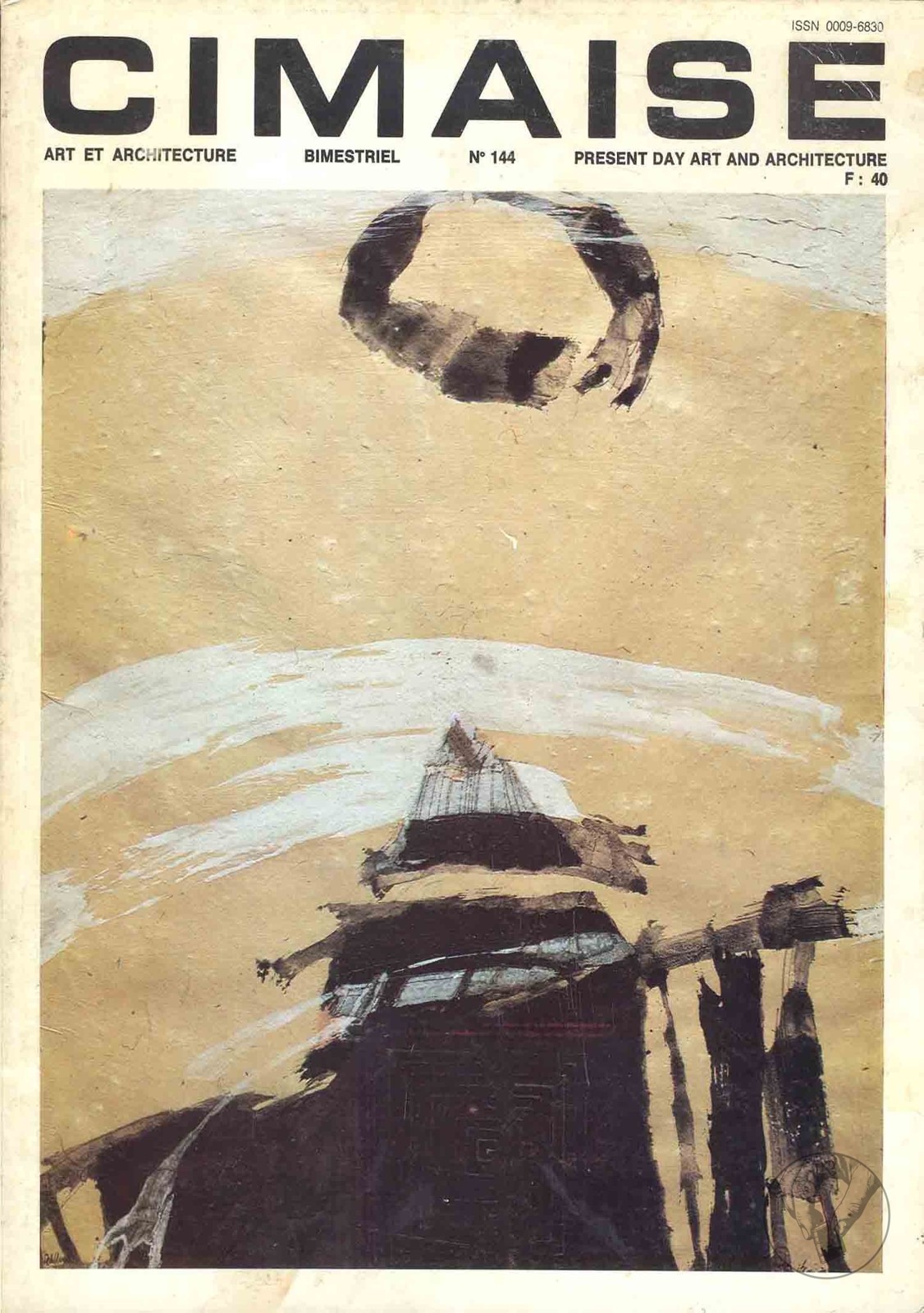
Ce numéro de Cimaise, revue d'art et d'architecture actuels, explore l'impact des sciences et des techniques sur l'art moderne. L'article principal, par Paule Gauthier, analyse l'évolution de l'art depuis les civilisations antiques jusqu'à l'ère électronique et atomique, questionnant le rôle de l'artiste dans la société contemporaine. Le numéro présente également des expositions d'artistes tels que Bengt Olson, August Puig, Serge Charachoune, Bryen, Hellman, et des tapisseries contemporaines.