Page 1
CIMAISE ISSN 0009-6830 ART ET ARCHITECTURE BIMESTRIEL N° 145 PRESENT DAY ART AND ARCHITECTURE F : 40
First pages of the volume, freely accessible.
CIMAISE ISSN 0009-6830 ART ET ARCHITECTURE BIMESTRIEL N° 145 PRESENT DAY ART AND ARCHITECTURE F : 40
Garache 24 janvier - 29 février 1980 Galerie Maeght 13 rue de Téhéran, Paris 8 Adami Arakawa Bazaine Braque Pol Bury Calder Chagall Chillida Fiedler Garache Giacometti Kemeny Kienholz Lindner Miró Monory Palazuelo Rebeyrolle Riopelle Steinberg Tal-Coat Tàpies Titus-Carmel Ubac Bram van Velde --- GALERIE KUTTER Luxembourg décembre - janvier JOSEPH PROBST peintures 1958-1962 février JAMES COIGNARD peintures - sculptures mars ZAO WOU-KI peintures - aquarelles avril JOSEP GUINOVART peintures 17, rue des Bains, tél. 235 71
à paraître “RELIEVES” album de 4 lithographies de JOHN-FRANKLIN KOENIG tiré sur les presses de l’imprimerie Clot Bramsen et Georges à Paris 5 exemplaires H.C. 6 exemplaires marqués K.O.E.N.I.G., chacun accompagné d’un collage original. 30 exemplaires numérotés. Prix de souscription : 3.500 F. GALERIE ERVAL 16, rue de Seine, 75006 Paris Tél. 354 73 49 --- GALERIE MARBACH Kramgasse 54, CH-3000 Bern 8 Tel. 031 22 42 05/59 18 60 JEAN BROISSON Huiles sur toile, aquarelles, gouaches pastels, dessins, tapisseries 1964-1979 16 janvier-23 février 1980 ouvert du mardi au vendredi, de 14 h à 18 h 30 ; le samedi de 10 h à 12 h et de 14 h à 17 h
CIMAISE ART ET ARCHITECTURE ACTUELS PRESENT DAY ART AND ARCHITECTURE 27e ANNÉE - N° 145 Janvier-février 1980 --- Directeur-Rédacteur en Chef : Jean-Robert Arnaud Conseiller artistique : John Franklin Koenig Secrétaire général : René Barzilay Secrétaire de rédaction : Luis Lemos Administration-Rédaction : 8, rue Récamier, Paris-7e. Tél. : 544-04-82 Impression : Société Mondiale d’Impression, 3, rue Maurice-Loewy, Paris-14e. Tél. : 327.15.40 --- Prix --- ce numéro : --- France --- 40 F --- Etranger --- 50 F --- Abonnement --- 6 numéros : --- France --- 180 F --- Etranger --- 240 F --- C.C.P. Cimaise 5542.39 --- Couverture de Vieira da Silva --- Etudes --- Paule Gauthier --- Les phénomènes artistiques à l’ère électronique et atomique (III) --- Artistic Phenomenas of the electronic and atomic age --- Jean Laude --- Vieira da Silva --- L’unique obligation qu’est la peinturePainting as a unique obligation --- Gérard Xuriguera --- Pazzi --- Portrait d’un sculpteurPortrait of a Sculptor --- Tony Duvert --- Hastaire --- Scènes d’intérieur --- Jean-Jacques Lévêque --- Jacques Brachet --- Claude Bouyeure --- Antone Heyboer --- Le temps réinventéReivented time --- Livres --- Jean-Robert Arnaud --- Chronique des livres --- Etudes-Monographies-Revues --- Prochain numéro : 15 mars
LES ARTS PLASTIQUES A L'ÈRE ÉLECTRONIQUE 3. Arts modernes et technologies audio-visuelles INTRODUCTION RÉCAPITULATIVE Pour comprendre, l’impact des technologies et des sciences sur l’Art Moderne, visé dans sa signification et son existence, j’ai cerné et analysé dans le temps et l’espace, la situation des arts plastiques (Cimaise, n°s 141/144) vis-à-vis des connaissances. Ce rappel, du rôle historique de l’Art et de son sens spécifique, a permis de montrer qu’en fait il ne se trouvait pas dans une situation nouvelle. En effet, depuis que l’homme invente, ses créations (1) artistiques (dessins, peintures, sculptures...) coexistent avec des techniques fonctionnelles diverses (armes, outils, ustensiles), soit avec d’autres pratiques du Savoir. Et, on l’a vu, on ne saurait expliquer sa teneur par le degré de technicité atteint, comme les dessins du paléolithique, par la pierre taillée ou polie, ou plus tard par la découverte du métal, les peintures de l’âge du fer, etc. En bref, synthèse des pratiques, l’Art s’est imposé comme un mode d’emploi de la vie, pour « échapper à l’état de sujétion au milieu », à la nature et, en second lieu, aux systèmes des sociétés. Mais, s’il n’est à confondre ni avec les croyances, ni avec les techniques ou les connaissances d’une époque, l’Art en est partie intégrante comme élément déterminant, d’où cette ambiguïté constante entre art/techniques/science, souvent mal comprise. Et cause de la dégradation de son rôle primordial, qui était de rendre à l’homme la finalité de son action, en lui attribuant sens, valeur et assurance, soit à terme de déterminer une Civilisation (stricto-sensus), c’était alors le but de toute activité artistique. On a pu ramifier, les axiomes de cette recherche fondamentale en quatre types de civilisations, en correspondances avec les attitudes essentielles de l’homme face à la vie, donnant accès à quatre principales conceptions (2) du monde. Lesquelles convergent avec les figures fondamentales du langage plastique, la plus ancienne langue du monde, et la seule universelle. C’est de cet extraordinaire héritage qu’il importe de ne plus perdre les clés (3) et, sous le symbolisme formel, la signification de l’action réelle impliquée, au cours des temps devenue : l’art abstrait géométrique de l’Homme Primitif — a-naturaliste et subjectif, avec ses tables de rapports stables, a permis le passage de l’état de chaos à la notion de cosmos. L’art naturaliste représentatif de l’homme classique — objectif et idéaliste, par son harmonie entre nature et raison — a établi les prémisses de --- THE PLASTIC ARTS IN THE ELECTRONIC ERA 3. Modern Art and audio-visual technology RECAPITULATORY INTRODUCTION In order to understand, the impact of science and technology on modern art, related in it’s signification and it’s existence, I have encircled and analysed in time and space, the situation of the plastic arts (« Cimaise » n°s 141/144) in relation to learning. This reminder of the historic role of art and of it’s specific sense, has made it possible to show that, in fact, it did not find itself in a new situation. As it happens, as long as man has invented, his artistic creations (1) (drawings, paintings, sculptures...), coexist with diverse functional techniques (weapons, tools, utensils), or with other practices of learning. And, as we have seen, we are not able to explain it’s strength by the degree of technicality attained, as examples, the drawings of paleolithic man, by carved or polished stone, or later by the discovery of metal/the paintings of the iron age, etc. In brief, synthesis of practices, art has imposed itself as a set of directions for use in life, in order to “Escape from the restrictions of social classification,” from nature, and secondly from social systems. But, it is neither to be confused with beliefs nor with techniques, nor the learning of an epoch; art is in part integrant as a determining element, from whence that constant ambiguity between art/techniques/science, often ill-understood. And the cause of the degradation of it’s primeval role, which was to render to man the finality of his action, by attributing him with a sense of Value and Assurance. And so, to determine, in due time, a civilization (in the strict sense), was thus the aim of all artistic activities. One has been able to branch out the axioms of this Fundamental Research, into four types of civilization, in correspondence with the essential attitudes of man confronted by life, giving access to four principle conceptions (2) of the world which converge with the Fundamental Figures of the plastic language, the Oldest Language in the World, and the only universal one. It is important to never again lose the keys (3), to this Extraordinary Heritage, nor those to the signification of the implicated real action beneath the formal symbolism. During the course of passing time. The Geometric Abstract Art of primitive man — a naturalistic and subjective, with it’s tables of stable relations, has made possible the journey from the state of chaos to the idea of the cosmos. The Naturalistic, Representative Art of classical man-objective and idealistic, by it’s harmony between nature and
l'art moderne et de la Civilisation Occidentale, marque la rupture avec le Monde des croyances. L'art abstrait de l'homme oriental — d'une subjectivité raffinée et savante, par son détachement des contingences matérielles — a donné les concepts des fondements des grandes religions (éternité/rédemption...). L'art abstrait hybride de l'Homme Gothique a conjugué un art géométrique savant et lyrisme mystique, et instauré une synthèse réaliste d'accord social ! Tour à tour basé sur l'introspection et l'observation, si l'on a bien compris ce périple humaniste, on en pourra déduire les motifs des renaissances formelles. Recours aux formes abstraites dès que l'homme aura besoin de certitudes qui ne dépendent que de lui ; et, au contraire, retours, avec la soif de liberté et d'expériences critiques, aux renaissances des formes naturalistes de l'Art Moderne. Parallèlement à ce jeu de permutations entre : instinct et raison, subjectivité et objectivité, le dégagement de la relativité du rôle de l'art et de la nature de la connaissance supérieure ainsi instaurée. Comme l'artiste va se sentir lié à son propre doute, et à sa capacité d'en surmonter les conflits. Ainsi, l'œuvre magistrale, mais bifi de du Vinci, lutte entre rationalisme et christianisme, par son échec même est le plus haut symbole de ce déchirement. Devenu la marque d'une rupture entre art et sciences. DIFFÉRENCE ENTRE ART/SCIENCES/TECHNIQUES OU UN CERTAIN COMPLEXE Si une « civilisation artistique » n'est jamais née ou morte, du fait du stade de technicité atteint (concept « a posteriori » et actuel), puisqu'elle en est la source et la synthèse. Mais comme le montre l'histoire, et qui se déduit du précédent, par ses doutes et son incapacité à se réaliser. Son rôle s'estompe, comme on l'a vu pour le Gothique, non pas tué par l'imprimerie, mais par des causes extérieures, telles que guerres et appétits de castes... Alors que « chez les anciens tout devenait vie », à partir du Monde Moderne « tout va rester à l'état de connaissances ». Ainsi s'explique (incapacité de se concrétiser) la régression de l'Art, au moment de l'essor des sciences naturelles, qu'il a pourtant contribué à faire naître. A partir du triomphe du rationalisme (qu'il a établi), le philosophe se fie aux sciences, il « discerne et l'artiste réalise ». L'Art, dans sa finalité, devient affaire de connaisseurs et de collectionneurs nantis, et, au niveau de la collectivité, se réduit à des fonctions illustratives ou décoratives. Il faudra attendre Kant, et d'innombrables échecs de l'humanisme scientiste, pour comprendre que, malgré la puissance des forces offertes par les sciences, elles n'ont ni formes ni sens. Pour ceux subjugués par cette puissance, cette conclusion est loin de s'imposer à l'évidence. C'est le moment de se demander ce qu'est cette « Méthode » technique propre (?) aux scientifiques, qui semble leur avoir donné une priorité dans la recherche et à leurs œuvres un droit intrinsèque de domination. reason, having established the premises of modern art and of the western civilization, marks the rupture with the world of beliefs. The abstract art of oriental man — of a refined and erudite subjectivity, but it's detachment from material contingencies, has given the concepts of the foundations of the great religions (eternity/redemption...). The Hybrid Abstract Art of Gothic man — has combined erudite, geometric art and mystic lyricism, and established a realistic synthesis of social agreement. Based in turn on introspection and observation, if you have properly understood, this periplus of the humanist, you will be able to deduce from it the motives for the formal revivals. Recourse to the abstract forms when man has need of certainties, which depend only on him; and on the contrary, recourse, with the thirst for liberty and critical experiences, to the revival of the naturalistic forms of modern art. Parallel to this game of permutation between: instinct and reason, subjectivity and objectivity, the desengagement of the relativity of art's role and of the nature of the superior learning thus established. So the artist is going to feel linked to his own doubt, and to his capacity to surmount the conflicts of this doubt. Thus the masterful yet Desected work of Da Vinci, struggling between rationalism and christianity, is, because of it's very check-mate, the highest symbol of this tearing asunder. Become the mark of a rupture between art and science. DIFFERENCE BETWEEN ART/SCIENCE/TECHNIQUE OR A CERTAIN COMPLEX So, an « artistic civilization » is never born and never dies, in the sense of the degree of technicality achieved (concept both a posteriori and actual) since it is the source and the synthesis of it. But as history shows, and this may be deduced from the precedent, by it's doubts and it's Incapacity be realized. It's role becomes blurred, as one have seen with Gothic Art, which wasn't destroyed by the printing-press but because of outside causes, such as wars and caste appetites... Whilst "in the time of the ancients all became life," starting with the modern world, all is going to stay in the state of knowledge. This explains (incapacity to put in concrete form) the decline of art, at the time when Natural science is progressing, although art has contributed to it's birth. As from the triumph of rationalism (which it has established), philosophy relies on science, it "discerns and the artist realises." Art in it's finality, becomes the affair of connoisseurs and of rich collectors, and at the level of collectivity, is reduced to illustrative and decorative functions. It was necessary to wait until Kant, and countless failures of scientific humanism, in order to understand that in spite of the power of the forces offered by science, they have neither form nor sense. Even though subdued by this power, this conclusion is far from intruding upon the evidence. It is time to ask oneself, what is this “method,” personal technique (?) of the scientists, which seems to have given them a priority in research and an intrinsic right of domination to their works ?
Si le scientifique s'est illustré par l'art de se servir de la « Méthode », l'Art de Penser est le même pour tous, il ne faudrait pas l'oublier, y compris pour le plus ignare des sujets. Donc, ce n'est pas dans l'approche technique de la recherche qu'il y a une différence, mais dans la finalité du projet. On le sait, ou devrait le savoir, l'artiste travaille sous « l'empire d'une émotion (4) ou d'une détresse particulière (5) ». C'est précisément ce type de subjectivité qui a été élagué du champ d'investigation scientifique, oubliant par là l'ordre subjectif des opérations logiques (6) inscrites, entre autres, depuis l'aube de l'humanité dans l'art géométrique abstrait ! En bref, on doit retenir que si l'art, par cette appréhension globale du monde, parle une langue plus dense et émet des propositions complexes (double sujet attribut...), il est aussi plus riche et plus proche de la vie de l'homme. Et, par ce précédent, on peut comprendre comment il a souvent anticipé sur les sciences (7). Ce sont les scientifiques, en ne négligeant plus sentiments et instincts, qui reprendront les positions de l'artiste. Ainsi, A. Conte, père de la sociologie, pensait, ou peu s'en faut, que penser sous l'empire de la sentimentalité et de l'imaginaire était le fait de débiles. Depuis, la tendance s'est inversée (nihil du « cogito ») avec Bergson, Freud... et surtout les cybernéticiens qui programment hasard et imagination, etc. Tandis que les mathématiciens délaisse les équations fonctionnelles au profit des équations imaginaires ! Ces retournements laissent à prévoir une future technique globale d'approche de la vie du fait du scientifique. Et, à cause de son bilan, loin d'être aussi positif qu'on ne se plaît à le croire. Trois siècles d'études de la matière nous laissent sur un espace illimité (indéfini), rempli d'une substance où l'homme perd son identité (8), Sans pouvoir conjuguer sciences et assurances, par ses technologies capables de nous ramener au chaos primitif (ou définitif). Dans ce cas, on se demande pourquoi, et à quel titre, sinon le goût du pouvoir et de la puissance, à défaut d'un goût exigeant pour freiner cet appétit de connaissances, on somme l'artiste d'abandonner ses valeurs de croissance, lesquelles sont toujours allées dans le sens de la beauté et de l'humanité, à l'encontre de « la connaissance pour la connaissance », qui reste le fait du scientifique. Lequel, par la réussite de ses expériences, exerce un extraordinaire pouvoir de fascination, jusqu'à faire oublier ses inventions les plus monstrueuses (9) et faire croire qu'il est le seul détenteur d'une connaissance valable. Comme le dirait Picasso, « il n'y a pas que l'art, il y a la peinture ». TECHNOLOGIES AUDIOVISUELLES, RECHERCHES ET ARTS PLASTIQUES AU « CENTRE DE LA RECHERCHE SCIENTIFIQUE » Pendant trois jours (16/17/18 novembre 1979) s'est tenu au C.N.R.S. un colloque international sur les rapports arts/sciences et technologies, que je viens d'évoquer. Proposés en ces termes : Le rôle du If the scientist has become famous through the art of using the “method,” the art of thinking is the same for all, it should not be forgotten, even by the most uneducated of subjects. So it is not in the technical approach of research that there is a difference, but in the finality of the project. One knows it, one should know it, the artist work under “the Empire of an emotion (4) or of a particular distress.” (5) It is precisely this kind of subjectivity, which has been pruned from the field of scientific investigation, forgetting here and there the subjective order of logical operations (6), inscribed amongst others, since the dawn of humanity in abstract, geometric art ! In brief, one must remember that it Art, through this global apprehension of the world, speaks a language which is more dense and emits complex propositions (double subject predicate...), it is also richer and closer to the life of man. And through the precedent, one may understand how it has often encroached upon science (7). It would be the scientists, by no longer neglecting sentiments and instincts, who would take back the place of the artist. Thus, A. Comte, father of sociology, very nearly thought that to think under the pressure of sentimentality and the imaginary was the strong point of the sub-intelligent. Since then, the tendency has been reversed (nihilism of “cogitation”) with Bergson, Freud... and above all the cyberneticians who program chance and imagination, etc., whilst the mathematicians desert functional equations to the profit of imaginary equations ! These turnings give the opportunity to foresee a future global technique of approach to life as seen by the scientist. And, because of it's past record, far from being as positive as one likes to believe it to be. Three centuries of studying the matter, leave us in an unlimited space (indefinite) filled with a substance in which man loses his identity (8). Without being able to combine science and assurance, by it's technologies it is capable of leading us to primitive (or ultimate) chaos. In this case one wonders why, and by what right, if not the taste for power and for authority, for want of an exacting inclination to restrain this appetite for knowledge, one summons he artist to abandon his values of growth, which have always gone in the direction of beauty and of humanity, in the opposite direction to “learning for learning’s sake” which remains the way of the scientist. Who, through the success of his experiences, exercises an extraordinary power of fascination, to the point of making one forget his most monstrous inventions (9), and making one believe that he is the sole possessor of a sound knowledge. As Picasso once said “there is not only art, there is painting.” AUDIOVISUAL TECHNOLOGY, RESEARCH AND PLASTIC ARTS IN “THE MIDST OF SCIENTIFIC RESEARCH” For three days (16/17/18 november, 1979), an international symposium was held at the C.N.R.S., on the relations art-science and technology which I have just evoked. Subjects on these terms: The role of the
cinéma et de la télévision comme moyens d'accès à la connaissance et à la culture artistiques - Les techniques de l'image et l'approche scientifique (?) de l'œuvre d'art - Présentation et représentation des arts plastiques à la télévision - Lecture et re-création - L'artiste médiatisé : idéal inaccessible ? - L'appropriation de l'outil audiovisuel par les plasticiens. Ceci étant le programme d'une seule journée, auquel on ajoutait des projections illustratives. On se doute que l'ampleur du sujet marquait l'impossibilité de pouvoir en débattre sérieusement et, d'autre part, la manière même de poser le problème l'imposait résolu. A savoir, l'artiste est médiatisé et ce n'est pas un idéal inaccessible. Devant un parterre choisi de représentants de l'audio (ou « audieux ») visuel, du cinéma (les meilleurs), de la télévision et de la vidéo, supervisés par les spécialistes du C.N.R.S. membres de l'I.N.A. ou pas, mais aussi des gens de l'U.N.E.S.C.O., sans compter le S.E.R.D.A.F., enfin, très peu de représentants des arts plastiques (artistes critiques, directeurs de galeries ou de musées, etc.), beaucoup de professeurs (10). La séance, cependant, avait bien débuté, par un beau discours du président (ex-directeur de l'U.N.E.S.C.O.) qui était une mise en garde contre tout esprit de supériorité, face au sous-développement technologique de certains pays, tout de même capables de participer à la création. En fait, langue de diplomate, c'est au bout d'une journée et demie que les tigres en voie de développement ont révélé leur but. Il s'agissait de nous mettre devant un fait accompli incontestable. Le marché de l'audiovisuel, artistique ? Il ne marche pas, il n'est pas aimé, voire méconnu, et contesté ; enfin, et surtout, il se vend mal ou pas du tout au niveau de la vidéo. D'où un débat en vue d'une meilleure commercialisation, séance à laquelle je me suis dispensée d'assister, n'ayant rien à offrir dans ce cadre. Mais, à cause de l'urgence que crée cette situation de fait, je ne veux pas rester sur une note pessimiste ou une critique négative, devant la dégradation des notions d'art et de civilisation, corrélative au fait audiovisuel et à son audience. Il faut engager les artistes comme les critiques, dans la voie au moins de la vidéo (11), pour que naisse rapidement un contre-courant susceptible d'aborder la recherche artistique dans sa vérité. Il s'agit moins de faire de la promotion hâtive que d'imprimer une certaine forme de réflexion sur les œuvres et sur la finalité artistique. Car, de tout ce que nous avons vu, et du débat confus qui s'ensuit, en ne cessant jamais de dériver de la notion de film d'art à celle de film sur l'art, il reste que les images audiovisuelles proposées étaient soit ennuyeuses (Restany dixit à l'I.N.A.), ou une image banale (Cueco), soit détournée de sa fonction fondamentale (P. Gauthier), et en dehors de l'analyse plastique (Argan), etc. Ce qui ne signifie pas que tout était mauvais, notamment les rapports vie/art (films sur Bouts et Monory); simplement, jamais le colloque porté sur les lois de la recherche artistique et ses corrélations humanistes. cinema and of the television as means of access to knowledge and to artistic culture ! - The techniques of the image and the scientific (?) approach of the work of art - Presentation and representation of the plastic Arts on the television - Reading and re-creation - The mediated artist: inaccessible ideal ? - The adaptation, by the artist devoted to plastic art, of the audiovisual tool. This being the program of a single day, to which were added illustrating projections. One suspects that the extensiveness of the subject pointed out the impossibility of being able to debate seriously on it, and, moreover, the very manner of posing the problem declared it resolved. To wit, the artist is mediated and this is not an inaccessible ideal. Before a chosen audience in the pit, representatives of the audio (or audious-odious) visual of the cinema (the best) of the television and video, were supervised by the specialists of the C.N.R.S. whether or not members of the I.N.A., but also people from the U.N.E.S.C.O. not counting the S.E.R.D.A.F..., in short, very few representatives of the plastic arts (artist-critics, heads of galleries or museums, etc), many professors (10). The meeting had, however, started off well, with a fine speech by the chairman (ex-head of the U.N.E.S.C.O.), which was a call to mount guard against any feeling of superiority towards the technological under-development of certain countries, even so capable of participation in creation. In fact, language of diplomats, it was after one and a half days that the Tigers in the process of development revealed their aim. It was a question of confronting us with an incontestable, accomplished fact, the progress of, artistic (?), audiovisual. It is not progressing, it is disliked, nay, slighted and contested; finally and above all it sells badly or not at all at the level of video (11). Hence a debate in the aim of a better commercialization, a meeting from which I abstained, having nothing to offer in this setting. But because of the urgency that this situation in fact creates, I do not want to dwell on a pessimistic note, or on a negative criticism in the face of the degradation of the notions of art and civilization, correlative to the subject of audiovisual and to it's audience. One must engage artists as critics, at least of the direction taken by video, so that a counter-current, capable of treating artistic research toothfully, may be brought rapidly into being. It is less a question of hasty promotion as one of communicating a certain form of reflection on the works and on the art Artistic Finality. For from all that we have seen, and from the confused debate which ensued, whilst never ceasing to branch off from the idea of the artistic film to that of the film about art; it remains that the audiovisual images proposed were either boring (Restany said to the I.N.A.), or the image was banal (Cueco), or diverted from it's fundamental function (P. Gauthier), and beyond plastic analysis (Argan), etc., which does not signify that everything was bad, notably the relationship life/art (for Bouts and Mongory); it's simply that the study never dealt with the laws of artistic research and it's humanist correlations.
Mais cette contrefaçon d'art, dépourvue d'esprit critique, ne pourrait exister si l'histoire de l'art (assise sur les caractères) n'avait pris de vitesse l'histoire de la critique d'art (inscrite dans la notion opératoire), dont elle devrait être fonction. Il manque toujours des analyses d'art comparé (12) interdisciplinaire (cinéma/télévision/vidéo et arts plastiques)... Enfin, on ne s'est pas posé la question du public, que veut-on en faire : un amateur, un collectionneur, un consommateur ? Non, il ne suffit pas de « faire pour déterminer une civilisation », comme je l'écrivais dans le préambule de ces études, reprenant une mise en garde du sociologue McLuhan, mais c'est ce qui arrivera si nous laissons faire, ceux qui confondent civilisation artistique et faits et gestes quotidiens : les violents. L'homme de demain sera un critique en tout domaine, ou aura une existence passive, en proie au complexe de la « scientite technorisée » ! Une démangeaison de plus en plus envahissante ! La compréhension de cet illusionnisme de puissance va démarquer les hommes qui cherchent une civilisation nouvelle de ceux qui ne veulent que la continuation de la situation actuelle, mais, même dans ce cas, peut-elle résister longtemps ? Paule GAUTHIER. N.B. - Pour la compréhension totale de ce dernier article, il serait souhaitable de relire ou de lire mes articles précédents sur le même sujet. C'est-à-dire en tenant compte du contexte, car ce n'est pas un hasard s'ils sont basés sur l'avis d'un critique d'art, d'un historien (psychologue) et d'un philosophe. Même si leur confrontation soulève des questions restées sans réponse... J'en suis consciente, mais, comme le dirait mon directeur : « dans la presse, c'est comme ça ou se taire » ! J'ai choisi de ne pas me taire et de suggérer. Mais c'est ainsi qu'il faut lire (lecture synchrone et diachronique, à défaut, dirait Sartre, on ne sait plus lire) ! C'est aussi le sens de toutes mes études et essais, dans le cadre d'une meilleure évolution de la critique d'art. (1) Inventions/créations : Il convient de les distinguer en art, la création s'adressant à l'esprit, sans fonction extérieure. (2) Conceptions : Ramenées à quatre, toute autre recouperait ces fondamentales, ne serait-ce que par hybridation. (3) Les clés : Nous en avons perdues beaucoup, nous les récupérons peu à peu. (4) Empire d'une émotion : disait Duchamp, qui préconisait la conservation de toute œuvre de ce type, même née d'une mauvaise émotion. (5) Empire de la détresse : disait Nietzsche du philosophe. (6) Opération logico... : nées de l'extension de l'abstraction subjective. (7) L'art anticipe : il faudrait un livre pour en rappeler la teneur... (8) L'homme perd son identité : matière semblable pour tous les corps aminés, comme vous et moi ou un bout de bois, c'est pareil. (9) Inventions monstrueuses : dont les armes et d'innombrables théories néfastes (dont le racisme, notamment pendant tout le XIXe siècle). (10) Professeurs : trop souvent arbitres du système scientifique, et pas loin de penser qu'ils sont les seuls héritiers ! (11) Vidéo : de plus en plus accessible (moins chère). Beaubourg et le musée de la Ville de Paris... diffusent et enregistrent. (12) Art comparé : j'ai eu la surprise de voir repris mon dada préféré dans les formes préconisées (il y a pas mal de plagiaries) dans mon étude sur l'autonomie de l'art/critique d'art, mais comme chose réalisée, en fait, elle n'existe pas, la critique d'art comparée et analogique, ou interdisciplinaire. A bon entendeur salut ! But this counter-fashioning of art, devoid of the tendency to criticize, could not exist if the history of art (based on engenics) hadn't quickly laid hold of the history of the criticism of art (inscribed in the operative notion), of which it would have to be a function. It still lacks analyses of comparative art (12) interdisciplinary art (cinema/television/video and plastic arts). Finally, one has not questioned oneself about the public, what does one want to make of them: devotees, collectors, consumers? No, it is no enough to "create in order to determine a civilization," as I wrote in the preamble to these studies, resuming a call to keep watch by the sociologist McLuhan, but it is this that would happen if we didn't stand in the way of who confuse artistic civilization and everyday occurrences and actions, the violent ones. The man of to morrow will be a critic in every field, or will have a passive existence, devoured with the "Complex of the Scientist-technocrat"! An itch spreading further and further! The comprehension of this illusion of power, is going to take out the men who seek a new civilization, from those who only want the continuation of the present situation, but even in this case can it hold out for long? Paule GAUTHIER. N.B. - For the total comprehension of this final article, it would be desirable to re-read or to read my previous articles on the same subject. That is to say in taking the context into account, for it isn't a coincidence if they are based on the advice of an art critic, of a historian (psychologist) and of a philosopher. And if the way in which they have been collated raises questions which are yet to be answered, I am aware of this, but, as my director would say, "in the press it is either that or keep quiet," I have chosen not to keep quiet and to make suggestions. But it is thus that one must read (synchronous and diachronic reading, somethings lacking Sartre would say, one no longer knows how to read). It is also the opinion of all my studies and essays, in the planning of a better evolution of the criticism of art. NOTES : (1) Inventions/creations: it is suitable to distinguish between them in art, creation appealing to the mind without an external function. (2) Conceptions: reduced to four, any other would divide up these fundamentals, if only of hybridization. (3) The keys: We have lost many of them, we will recover them by degrees. (4) Empire of an emotion: said Duchamp, who recommended the conservation of all works of this kind, even those born of a bad emotion. (5) Empire of detress: said Nietzsche of the philosopher. (6) Logical operations: born of the extension of subjective abstraction. (7) Art encroaches: it would take a book to explain how far. (8) Man loses his identity: Matter similar for all bodies, such as you and I, or a piece of wood, it's the same, so they say. (9) Monstruous inventions: such as weapons and innumerable, fatal theories (amongst them racism/notably during the whole of the 19th century). (10) Professors: are too often arbiters of the scientific system and are not far from thinking to they are the only heirs! (11) Video: more and more obtainable (less expensive). Beaubourg and Le Musée de la Ville de Paris diffuse and record. (12) Comparative art: I have had the surprise of seeing my pet subject in highly recommended forms (there are quite a few plagiarists) in my study on the independence of art/criticism of art, but as an achieved thing, compared and analogical, or interdisciplinary criticism of art doesn't in fact exist. If the cap fits, wear it!
VIEIRA DA SILVA ou l’unique obligation qu’est la peinture par Jean Laude > Eu sou o silencio. Eu provoco-o. > Eu jogo no ilimite. > Je suis le silence. Je le harcèle. > Je joue dans l’illimité. > Antonio Ramos Rosa > (trad. Roger Munier) ... cette incertitude, ce labyrinthe terrible... (1) Tout au long d’un entretien radiodiffusé (1957), Maria Helena Vieira da Silva choisit d’évoquer des souvenirs, ou son rapport à la musique, de dire son incertitude humaine et d’artiste, ce labyrinthe terrible que, maintes fois, elle peindra. Elle veille à ne pas s’engager sur les voies périlleuses des définitions, des pétitions de principes, de la théorie. Plus tard, elle dira à Guy Weelen n’avoir d’autre système que l’absence de système (2). Cette méfiance qu’elle oppose à son propre discours, elle n’est pas sans la retourner à ses commentateurs éventuels. En 1936, elle s’insurgeait déjà, devant João Gaspar Simões, à la pensée qu’un tableau pût avoir une autre interprétation que celle que lui donnait l’art de peindre (3). « LES DRAPEAUX », 1939, huile sur toile, $80 \times 140$ cm Coll. Kunstsammlung Nordrhein-Westfalen, Dusseldorf. (Photo Joubert) “I am silence. I harass it. I play in the unlimited.” ...“this incertitude, this terrible labyrinth... (1) During the entire duration of a radio broadcast in 1957, Maria Helena Vieira da Silva, chose to evoke memories of either her relationship with music or of her human and artistic incertitude, that “terrible labyrinth” she would paint many times. She took care not to enter into the perilous pathways of definitions, of petitions of principle and theory. Later, she was to tell Guy Weelen that her only system was an absence of system.(2) This suspicion she feels concerning her own discourse has been turned by her against her possible commentators. Already, in 1936, she flared up, before Joao Gaspar Simões at the idea that a picture could have any other interpretation than that given to it by the art of painting.(3) Writing about the painting of Vieira da Silva implies, therefore, from the outset, that any discourse exceeding painting itself be refused. In these times of penitence and contrition in which we live, such a proposition could be considered scandalous—if scandal were still possible, for the best of theoretical reasons (but the best of these best reasons are still
Ecrire sur la peinture de Vieira da Silva implique donc, d'entrée de jeu, que soit refusé tout discours qui excéderait la peinture même. En ces temps de pénitence et de contrition, qui sont les nôtres, une telle proposition pourrait, s'il se pouvait encore, faire scandale : pour les meilleures raisons théoriques qui soient (mais les meilleures de ces meilleures raisons sont encore très vagues, et désincarnées, ou des sophismes), n'a-t-on point vu le discours sur la peinture qui, déjà, proliférerait dangereusement depuis un siècle (au point que Renoir protesta qu'un tableau pouvait sortir sans sa bonne) se substituer à la peinture et l'évacuer, pour rester seul maître du terrain. Je remarquerai, incidemment, que, tout lucide et « démystificateur » qu'il se donna, ce discours s'est bien gardé d'exercer sa lucidité à son propre endroit, et de se « démystifier » lui-même. J'ajouterai que, de transgressions en transgressions, il arrive un moment où il n'y a plus rien à transgresser, sinon la transgression. Et que, se retournant, l'avant-garde retourne à l'académisme. La peinture de Vieira da Silva exige un autre renoncement : celui d'écrire poétiquement sur ce qui fut peint. Non point qu'au sens général qu'a pris le mot, et qui subsiste, ce qui fut peint ne soit pas poésie : ce mot est l'un des premiers qu'énonce René de Solier, en 1956 (4), et il l'est à juste titre, car dans un tableau de Vieira da Silva, dans sa texture, ce qui inviterait au poème est la réponse même à cette invite. S'il est vrai qu'une peinture donne accès à autre chose que soi, elle ne nous y conduit que par ses voies propres ; elle ne nous y introduit qu'avec les moyens qui sont, intranscriptibles, les siens. Vieira da Silva dit qu'à son arrivée, à Paris, en 1928, elle était plus avancée en musique qu'en peinture : connaissant très bien Debussy, elle n'avait pas encore dépassé les sous-impressionnistes. Elle dit aussi : parfois, je ne suis pas très sûre si j'écoute ou si je vois (5). Selon Pierre Schneider, le rôle de la musique, chez Vieira da Silva, n'est pas simple affaire de motifs, d'équivalences : il est de surmonter la contradiction. Car, seule, parmi les arts, elle est à la fois séquence (perspective) et présence (frontalité). La suite des notes précises se fond en une totalité. Le problème de Vieira da Silva serait celui-ci, que la musique l'aide à résoudre : traverser la surface, tout en s'y inscrivant (6). Peu après la guerre, Wols, qui appréciait beaucoup son œuvre, lui demanda pourquoi, alors que la peinture contemporaine tendait à se stabiliser dans les effets de surface, elle avait ré-introduit la perspective, Vieira da Silva répondit : parce que personne ne s'y intéressait plus (7). Ecartons les explications par le désir d'aller à contre-courant, de refaire en sens inverse le chemin de la peinture : on ne retourne pas en arrière, mais on déplace les références, on redistribue autrement les acquis. Ces déplacements, cette redistribution portent en eux-mêmes un sens (8). Peut-être, à l'origine, y a-t-il un regard autre posé sur les Joueurs de Cartes, de Cézanne : ces deux petits bons-hommes qui n'arrêtent pas de battre les cartes, de jouer... c'était la clef pour passer derrière un mur apparemment sans issue. Et puis, il y a le Saint-Sébastien de Mantegna, qui est au Louvre (9). A dire vrai, les rapports de Vieira da Silva avec la perspective ne sont pas des plus simples. Comme il fallait s'y very vague and disembodied: or else sophisms), had we not seen the discourse on painting which, already, for a century, proliferated dangerously (to the degree that Renoir protested that a picture could go out without its maid), substituting itself for painting and evacuating it, to remain the sole master of the terrain. I would like to note, incidentally, that, with all its lucidity and demystification, this discourse took care to avoid lucidity concerning itself, and of “demystifying” itself. I will add that, from one transgression to another, the time comes when there is nothing left to transgress, if not transgression. And that, in an about-face, the vanguard returns to academism. The painting of Vieira da Silva requires another renunciation: that of writing poetically of what was painted. Not in that general meaning which has come to be attached to the word, and which subsists, that which was painted is not poesy: this word is one of the first articulated by René de Solier, in 1956, (4), and correctly so, for in a picture by Vieira da Silva, in its texture, that which would invite a poem is the very response to this invitation. If it is true that a painting gives access to something other than the self, it leads us there only by its own pathways; it introduces us therein only by means which are beyond transcription, its own means. Vieira da Silva says that, upon her arrival in Paris in 1928, she was more advanced in music than in painting: knowing Debussy very well, she had not yet gone beyond the under-impressionists. She says as well: “Sometimes, I’m not very sure whether I’m hearing or whether I am seeing.” (5) According to Pierre Schneider, the role of music in the case of Vieira da Silva, “is not a simple matter of themes, of equivalents: it is one of surmounting contradiction. Because, alone among the arts, it is both sequence (perspective) and presence (frontality). The series of definite notes melts into a totality.” This, then, is Vieira da Silva’s problem, and music helps her solve it: crossing the surface, while inscribing oneself upon it. (6) Shortly after the end of the war, Wols, who greatly appreciated her work, asked her why, when contemporary painting tended to become stabilized in surface effects, she reintroduced perspective. And Vieira da Silva answered: because nobody is interested in it any longer. (7) Let us put aside the explanation of a desire to go against the current, to walk along the pathway of painting in the opposite direction: nobody returns to the past, but one changes the position of references, one redistributes the acquisitions. These displacements, these redistributions, carry within themselves a meaning. (8) Perhaps, at the outset, a different look was taken at the Cézanne Card Players: those two men who never stop competing at cards, at playing... this may have been the key to cross a wall that seemed to have no opening. And then, there is Mantegna’s Saint-Sebastian, which hangs in the Louvre. (9) To tell the truth, the relations between Vieira da Silva and perspective are not all that simple. As we might have expected, they are not systematic: they are to be found only within determined series. And research is not limited to linear perspective alone. Vieira da Silva does not always carry on research in an orthodox manner, if orthodoxy exists in matter, other than in the Traités.)
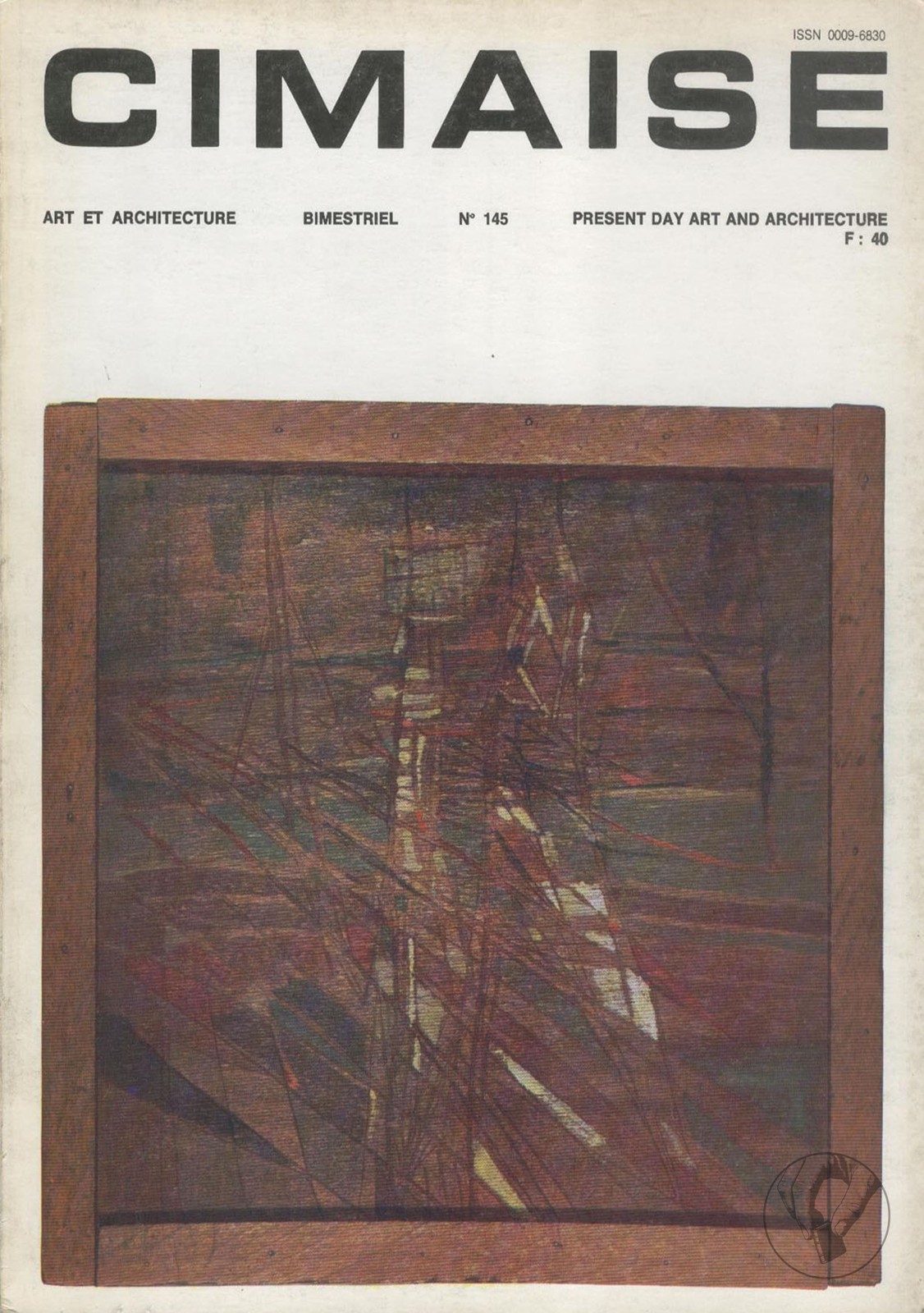
Ce numéro de la revue Cimaise, daté de janvier-février 1980, présente une exposition consacrée à Garache à la Galerie Maeght. Il inclut également des annonces pour des expositions à la Galerie Kutter et des publications à venir, notamment un album de lithographies de John-Franklin Koenig. L'ouvrage contient des articles sur l'impact des technologies audio-visuelles sur l'art moderne, ainsi que des critiques d'expositions et de livres.