Page 1
revue de l'art actuel ÉDITIONS troisième série numéro 3 janvier-février 1956 Soulages
First pages of the volume, freely accessible.
revue de l'art actuel ÉDITIONS troisième série numéro 3 janvier-février 1956 Soulages
Galerie de France 3 Faubourg Saint-Honoré, Paris 8, téléphone Anjou 69-37 --- à partir du 20 janvier 10 jeunes peintres de l’Ecole de Paris Appel, Barbarigo, Calliyannis, Corneille, Guerrero, Kallos, Levée, Maryan, Rezvani, Vaïto --- à partir du 3 février Jean Le Moal --- à partir du 28 février Coutaud, Gischia, Labisse, Léger, Pignon Décors et costumes à l’occasion de la parution du livre d’Hélène Parmelin « Cinq peintres et le théâtre »
Cimaise revue de l'art actuel 34 rue du Four, Paris 6 Directeur: J. R. Arnaud Rédacteur en chef: Herta Wescher Secrétaire général: John Koenig Rédaction: J. Alvard, R.V. Gindertael, M. Ragon, C.H. Sibert La rédaction reçoit sur rendez-vous Abonnement (8 numéros) 1.400 frs - Par avion: 2.300 frs 34, rue du Four, Paris 6, téléphone Littré 40-26 C.C.P. Librairie Sélection Paris 5542.39 Diffusion: Allemagne: Horst Beck, Hoedingen ueber Uberlingen, Bodensee PS ch A Karlsruhe (Bd) 43328 Argentine: Editorial Victor Leru, Cangallo 2233, Buenos-Aires Autriche: Arnulf Neuwirth, Paracelsusgasse 8, Vienne 3 Belgique: Jean Milo, 28 rue de l’Arbre Bénit, Bruxelles C.C.P. Jean Milo, Bruxelles 1591.50 Danemark: Meiners Kunstforlag, Peder Skansgade 5 Copenhagen Grande-Bretagne: Alec Tiranti Ltd, 72 Charlotte Street London W1 Japon: Meiji-Shobo, Surugadai, Kanda Tokyo Norvège: J.W. Cappelen Sortimentebokhandel Oslo Suède: Eric H. Olson, Upplandsgatan 3, Stockholm, 10 23 77 Suisse: E. Genton, «L’Entr’acte», rue du Lion d’or 4, Lausanne, C.C.P. II 144-56 U.S.A.: Wittenborn and Co, 30 East, 57th Street, New-York 22 M. Flax 10846 Lindbrook Drive, Los Angeles 24 --- Sommaire Couverture de Soulages Textes anglais 4 Brancusi, the inaccessible by R.V. Gindertael 6 At the school of Paris by Herta Wescher 7 Soulages by Michel Ragon Textes français: 9 Brancusi, l’inaccessible par R.V. Gindertael 16 A l’Ecole de Paris par Herta Wescher 17 Soulages par Michel Ragon Peintres et sculpteurs d’aujourd’hui: 22 John Koenig par Herta Wescher 25 Les expositions par Julien Alvard, René Déroudille, R.V. Gindertael, Michel Ragon, Herta Wescher 32 Bibliographie Textes anglais 33 John Koenig by Herta Wescher --- A nos lecteurs A la parution, au mois de novembre, du premier numéro de la troisième série de Cimaise, nos lecteurs ont pu juger des améliorations que nous avons apportées à la présentation de notre revue. Agrandissement du format, resté cependant à des dimensions maniables, afin de permettre une mise en pages plus agréable, augmentation du nombre et du format des clichés, impression plus soignée, enfin traduction intégrale en anglais des articles principaux pour atteindre plus largement un public international. Malgré toutes ces transformations, le prix de vente est resté très accessible : 1.400 francs pour l’abonnement d’un an (comprenant 8 numéros); prix du numéro : 200 francs. A ceux de nos abonnés, qui ont reçu notre lettre de rappel et n’y ont pas encore répondu, nous demandons, s’ils continuent à porter à notre revue l’intérêt qu’ils lui ont déjà manifesté, de bien vouloir renouveler au plus tôt leur abonnement à partir du numéro qui leur conviendra. A nos lecteurs au numéro, nous demandons de s’abonner; ils nous marqueront ainsi leur appui et leur adhésion personnelle. Pour que Cimaise puisse continuer à s’améliorer, il faut que le nombre de nos abonnés augmente, que son audience s’élargisse encore. L’accueil réservé au premier numéro de la troisième série nous donne bon espoir d’être entendu. Tout règlement peut être fait par chèque bancaire, ou par versement au nom de : Librairie SELECTION, compte chèque postal, Paris 5542.39, ou à l’un de nos représentants à l’étranger. Nous comptons sur l’adhésion de chacun. CIMAISE
Complete translation of the main articles tranglations by J.-F. Koenig Brancusi, the inaccessible (page 9) “It is hazardous and daring to venture into the world of Brancusi,” wrote Roger Vitrac. For a long while now, I have been trying to get further into the work of Brancusi, and each time I do, just at the moment when I try the slightest explanation, even with the aid of his commentators, and solely for my benefit, a profound feeling of discouragement comes over me. In no manner or degree has the distance been reduced between this work and myself. It maintains exactly the same remoteness, the same retreat it had when I received its first revelation, and I remain constantly distant, in front faculty or sense affroths it, or from what angle it is viewed, of its dazzling but inaccessible evidence. No matter what this work keeps itself integral, impenetrable, indivisible. Just as the polished bronze, which constitutes the last state of the sculptures of Brancusi plays with the light, the work takes the lights of our thought and the movements of our emotion, and thrusts them into its form and volume only to reject them as far away as possible, scattering them in all directions. Not only does it escape from all possible analysis, all definition, but it refuses also to be situated temporally. Doubtless, it was accomplished at a certain time, in determined surroundings, which are ours, but even though it participates in their determination, we would seek in vain to discover the exact terms of its intimate relations. When the doors of the studio of the Impasse Ronsin close upon him and his works, the solitary partriarch belongs only to his realm of wisdom; he ceases to move about in our world, and to undergo as do we others, the measures of time and of space. Thus, at the end of vain trials, I cannot confide anything except the defeat of my experiments. Following the expedient method, I first tried to situate the origins of the work of Brancusi, to fix the conditions, if not the reasons, of its beginnings. But I must admit that this first trial for conquest only brought me back to Brancusi himself. One must say of him as of Cézanne, as concerns the preservation of his integrity: “Nobody ever got their claws into him.” The first years Born in 1876 in the village of Petsani, in Rumania, on the slopes of the Carpathians, Brancusi shows still today solid stubbornness and the instinctive mistrust, in other words the pride, of the noble peasant race of his country. He arrived in Paris on the eve of the 14th of July, 1904, thus 28 years old, and already a grown man. And on the other hand his studies at the School of Arts and Trades of Craiova, and afterwards the School of Fine Arts of Bucarest, where his vocation and natural craftsman’s competence had brought him, had certainly, even before his departure, given him the possession of all of the basic elements of the sculptor’s trade. When he began to work in Paris, no master had much left to teach this young artist, who had by-passed the years of apprenticeship; neither Professor Mercier at the Beaux-Arts, where he made a brief entry before arriving at the 30-year-old age limit, nor Rodin, of whom he refused to be the pupil, in spite of the admiration that he continues to manifest exclusively for the master-Rodin being for him “the only sculptor” after the archaics and the egyptions. “Nothing grows on the big trees,” Brancusi told the persons who had intervened to have him accepted in Rodin’s studio, even though his consent had already been given. The dead period of transition that took place at this time at least incited him to rid himself precisely of the practices of a sculpture which exhausted its last resources in tradition, or strived to revive itself by extrinsic means. In 1904, Rodin was at the height of his glory and Bourdelle, still more deliberately imbibed by traditionalism and carried away by an extra-plastic lyricism, began to have his own renown. Impressionism was also at its end, but the 19th century still survived in the first years of our 20th. That summer, Matisse was at Saint-Tropez with Cross and Signac to wring the neck of their doctrinary system, but the Fauves were not to begin to growl until the next year, before causing the Salon d’Automne to boil over in 1906. For that matter, this wild outburst had only to do with the destiny of painting; one can already verify that it lends itself more easily than three-dimensional plastic art to analytical studies, to verifications of hypotheses, and to the speculative impetuosities which accompany the birth of new theories and new directions. (These incidences at this moment could neither encounter nor incline the ways of sculpture.) Besides, it is manifest that the “natural” elaboration (in all points irreducible to common measure) of the art of Brancusi became singularly accomplished, and was never directed except through his own reflection, with the exception of the more or less systematic proceedings which the different currents, successive or simultaneous, traced in his period. As to the rare elective affinities that Brancusi could consider as reconcilable with his spirit of ferocious independence, it is hardly probable that these encounters took place at the very beginning of his stay in Paris, and one cannot well see what they could concretely bring him, except perhaps the confirmation of the virtues and the advantages of solitude and of uncompromise that he saw in similar dispositions: such as the imperturbable innocence of the Douanier Rousseau to whom he rendered a touching homage several years later in forgetting for a few
hours his great, growing work, to take up once more his artisan’s chisel to modestly carve the inscription for a tombstone. He also found friendly the non-conformism of Erik Satie, and that, absolute to the point of negation, of Marcel Duchamp. Even one of his first comrades, Modigliani, who was, I believe, in London where he consecrated himself almost exclusively to sculpture, was only to arrive in Paris two years after Brancusi. Recently, on the occasion of the first retrospective show of the work of Brancusi, grouping 59 sculptures and 10 drawings, organized and presented by Mr. James Johnson Sweeney at the Solomon R. Guggenheim Museum, of which he is the active director, and afterwards at the Philadelphia Art Museum, the American poet and writer, William Carlos Williams, certainly a well-documented exegetist, stated the fact of the influence of Modigliani on the great sculptor. This influence is the only one that one could risk never to find, and above all, it draws its likelihood only from a certain, but completely superficial conformity in a few works, of the possible sameness of certain preoccupations, and by the mutual adoption of the discipline of direct cutting, in a time when it was completely unusual. It seems to me to be more exact to think that the comradeship of the two young artists was an occasion for an exchange and an emulation which respected their essential divergencies. The rare known pieces of Modigliani (for several were abandoned, unfinished, in the courtyards of his studios) in fact make evident a primary research for a style which conciliated the mannerism of the details with the schematism of the form in the block, and the refinement of the modelling with the roughness of the shaping-out; whereas the works of Brancusi which are contemporary with them, or to my knowledge even preceded them, showed on the contrary a will to attain a unity, and certify the great purpose of Braucusi to embrace the problem of sculpture in its complete specificity. Let’s recall rather the fact that around 1908, Brancusi had already broken with the old order of sculptural meaning, which was naturalist or idealist, principally from concern for anthropomorphic realism, and of the simulation of the living form which, in his mind, at each attempt, transformed the “beefsteak” of the model into a corpse. By an almost instinctive disposition of his thought, by “interior necessity,” Brancusi thrust the roots of his art into the most secret part of primitive spirituality, and aspiring towards a universal wisdom, “was brought to ask once more the philosophical problem of the relations of the spirit and the body,” and to “intervene in this obscure philosophical debate in order to bring his solution to the state of art which is, according to him, indeed this union of the soul with the body, the communication of thought with space,” as his compatriot V.G. Paleolog has well specified. Themes and materials Others before me have established the chronology and the topography of the work of Brancusi, even though, in reality, it is almost impossible to mark the limits of the periods and even to separate clearly one realization from another, for what is first important is the whole of the work, and it is thus indivisible, no matter what its progression may be. But also, each of the unities which constitute it contains miraculously the totality. Nonetheless, let’s accept the one that Mr. Paleolog calls the Rumanian cycle, that is to say the group of his youthful works immediately attached to the spiritual and cultural autochthonal values, to which belong the works such as “The Wisdom of the Earth,” “The Ancient Figure,” “The Kiss,” and “The Prayer.” This period came to a close in 1908 with the realisation or the illumination which permitted Brancusi to accomplish his revolution, and render to the act of the sculptor its primitive meaning and dignity. One can consider that it was afterward, between 1910 and 1916, that Brancusi (we would like to say) conceived (if he himself hadn’t insisted that the greatest merit of his work was that it had been lived rather than thought out or reflected upon), or at least he had founded his plastic world. The principal themes, which he hasn’t ceased to develop, to perfect, to sublimate, all become manifest in this brief lapse of time: that of the ovoid—the seed of life or thought, with the “New Born” of 1911, the first metamorphosis of the “Head of a Child” previous to 1910, or that of the “Sleeping Muse” of 1910; that of the upthrust, with the bird “Maestra” of 1912; that of the column, with the caryatid of 1915 and perhaps the first fragments of the column without end; the complementary one of architecture with (abstract) sculpture in stone, of the same year—this architectural theme which was to result in the group erected in 1938 at Targu Jiu, Rumania, comprising the monumental gate, the table of the twelve apostles, and the column without end (in metal) thirty meters high; in the same order of conception, the temple of “Delivery,” which was to have been built in India by the Maharadjah of Kapourtala, to shelter the “Golden Bird,” but which remained only a project; and no less important, the feminine theme or the bust, with the “Narcissus” of 1914, and the first “Princess X” of 1916, from which was to proceed the different “Mademoiselle Pogany,” the “Blond (or White) Negress,” and the “Sophisticated Girl.” Doubtless, different forms still appeared, such as that of the “Fish,” but isn’t this another form of the upthrust, in the horizontal sense. And doubtless, still others participate in several themes at the same time, such as the “Leda” of 1927, or the “Miracle,” also known as the “White Seal” of 1936; or even the “Flying Turtle” of these last years. If some works, in between times, distinguish themselves distinctly from this close association of themes and their technical evolution—such as “Adam and Eve” 1921, “Socrate” (1923, during the period of his relations with Erik Satie, who composed his own “Socrate”), and even more unusual by their structure, the “Prodigal Son” (1925), or the “Sorceress” (1929)—one must find here not only the artistic conscience, respectful of the natural characteristics of the material (wood, and even sometimes old wood), but also the preoccupation of seaching for the harmonious accord between the essence of the materials and the work done in architypical or even primary forms, keeping latent the secular marks. This permanent signification of the human act of fabrication is the one which guided the hand of the sculptor when he cut or constructed his ordinary useful objects; his benches, his block-stools, his fireplaces, or his ovens. It is this that wouldn’t let him consider one of his works as finished until he had erected a special pedestal with which it became a unit, creating from the ground up (“everything must begin with the earth,” Brancusi liked to repeat) towards the sky, a new architectural order. The “Figure” in oak, of 1921, the large “Caryatid” put together only a few years ago, and the “King of Kings,” as the coupled “Adam and Eve,” attain even the perfect identity with architectural order and human structure. It is closely in function with the material, that Brancusi asked and answered, with a stupefying regularity, the question of the relations between thought and form, a problem by which the awakening of the conscience manifests itself when the duality of the homo sapiens and the homo faber coincides or even melts together in the artist.
In 1910, as soon as Brancusi had realized the vanity of an imitative representation of the living flesh of the human body, and had abandoned the modelling of potter’s clay, he found that sculpture had been brought back to its reality as a phenomena of worked matter. Recognizing in the existence of art this “communication of thought with space,” Brancusi situated the debate of his creative instinct between his thought and the raw material, and his exaction for “ascetic integrity” made him adopt the difficult test of direct cutting. If, as we have already seen, artisanal tradition could familiarly direct the working of wood to liberate the possible forms, it was, on the contrary, in reaction to the habits of the figure-carvers devoted solely till then to copying plaster casts or in the setting-up or enlarging of models, that Brancusi came to try himself with stone or marble, to examine their substance, and bring to the surface the moving forms and the spiritual powers buried in the inert block. Doubtless, the elucidation defines the physical situation; in the purpose of Brancusi, light as far as a relational term came to take on such an importance that the order of the factors was inversed, and the work took form in order to render evident the light that it emitted. One might even say that light really became the principal material in the work of Brancusi. In observing well the successive aspects that we can find avowed in the traces of the work of Brancusi, and bringing back, a bit arbitrarily, the experience of the sculptor to the problem of light, we may think that he first tried to resolve it by eliminating from the volume the unevenness, the changes in plan, the interruptions which would hamper the solutions for the continuity of the light; in other words, by abolishing the shadows on the surface of the form. But the first results remained rather negative. Undoubtedly, the sculpture thus refined no longer resorbed the light which, always remaining exterior, could flow along the surface and follow all the contours. But this didn’t satisfy Brancusi, who wanted really to make his sculpture “a source of light.” The irradiation had to be heightened, and he applied himself in bringing to a point of perfection the smoothing down of his marble pieces in order to let them receive and reflect light. Almost immediately, using his marble pieces for the prototypes of metal sculptures, he was brought to “invent” his own technique in bronze or polished copper, by which he attained an unequaled degree of reverberation, to the point where it is almost impossible to have a decent photograph of these works, the only thing that shows up on the plate being the outburst of the luminous rays which cause all forms to disappear. One can imagine the austere rigor of such work, and Roger Vitrac could correctly talk about “an activity requiring (a precision) even to the thousandth of a millimeter,” after which “between the next to the last and the last contour, there isn’t even the trace left of a puff of whiting.” But did Brancusi ever consider that the last contour had ever been found? Sometimes he grumblingly consented to abandon to one of his admirers a certain state, but wouldn’t he rather have kept his hand on his complete work in order to bring it farther along on the way towards the sublime, which he realized was inaccessible. Thus, since 1916, he has never ceased to start to work again on the same themes which, after this date, become difficult to check on, or to date their insensibly modified versions. It is also in this sense that in the retreat of his studio, Brancusi ceased to feel the measures of time and space of our world. Today’s meaning Since this work, to a certain degree, does not refuse communication with us, and is given to us, I would nonetheless like to try to clarify its meaning in this precise moment of ours. For a very long while, one had to consider it as absolutely intemporal, and strictly closed in on itself, irreducible to the esthetic concepts of its period. Even its extreme purity, and its refusal of naturalistic figuration could not deceive anyone about its intentions, different from the preoccupations which brought about the discovery of the existence of “abstract” plastic art, which, for that matter, Brancusi personally always refused to admit. Nonetheless, a certain by-passing of the contradictory opposition which abstract orthodoxy stirred up, and the search for a new and meaningful artistic expression accompanied by a new realisation of things, seems to me to make apparent the up-to-dateness of the work of Brancusi, and even though it doesn’t take in all of its meaning, nonetheless gives it an exemplary sense, in direct relation to the new conditions of the accomplishment of the esthetic act, otherwise known as the “poetic” experience. Apart from everyone else of his time, Brancusi had recognized the importance of the human act in founding the work of art, and insisted, as I have said, on the merit of his work for having been lived, scorning the concepts and the petitions of principles, but above all, in this vital act of “fabrication” which, even if it is pushed to its extreme consequences, nonetheless does not aim solely towards a formal perception. The material is worked on in order to attain its transcendence, without letting us decide if Brancusi attempts and succeeds in materializing in a natural substance the immaterial spirituality of the entities which dominate his thought, or if he dematerializes this substance in order to liberate, in the form of living light, the secret thought which is hidden in its depths. It may seem surprising that in an art that refuses the transcription of perceptible data, the value of the form remains intimately and exclusively based on the experiences of the living organisms which exist. This anomaly characterizes for that matter, by the non-conformism of Brancusi, the crucial point of the revolution—we might better say returning—which he accomplished in the movement of statuary art. The return to the beginnings, by means of this creative instinct, enabled him to find the attitude which corresponded with the awakening of the primitive conscience and the first human act of fabricative intervention to bring forth “another form” in the volume or the surface of a material, to give a meaning to the unformed matter, after this consciousness had received the revelation of the body of a man or an animal in the irregularity of the stone of the morsel of flint. The exemplary value of the sculpture of Brancusi is to have been the first to find again the original sense of the artistic act, and to have regenerated it in our opinion, after many centuries of debasement, in giving back its fundamental dignity. The relations of man with the world, and the world with man also recovered their natural dignity and their mythical expression. I will not hide from myself the fact that this explanation is circumstantial and precarious, and that soon the inaccessible Brancusi will take his distances again, in the safety of the legendary veil which has been woven around him, and that he will remain definitely obstinate to historical classification and logical commentaries. But let’s not regret it. The legend of art will always be more beautiful than its history. Its myths and its secrets will survive long after the best ordered realities have died. R.V. Gindertael
At the School of Paris (page 16) After twenty years of absence, I went back home. We talked about painting. I was shown a lot of photos and catalogs, and I tried to put things in order a bit, to separate the past from the present, the serious research from the idle talk. I was asked questions pell-mell to provoke my explanations, which seemed in the end to be evidently accepted. At least, people said to me: “You really can make things out clearly, where did you learn how to do that?” And I wanted badly to reply: “At the School of Paris,” thinking that I came from a good school. The artists from all different countries who come to Paris rarely think about looking for a school or an academy where they can find precise instruction. Nor do they consider, for the most part, going to see one of the great masters, to try to become his student or disciple. On the contrary, they are enticed by the mass of the thousand and one artistic adventures which are possible here. And even those who come to settle down here only because the light of Paris can’t be found elsewhere, receive, in working here, a formation which is often decisive. And it is a result of this school of Paris whose different branches of learning comprise, for example, self-control, the respect for one’s craft, the interest in the research of others, etc. It is exactly the multiplicity of the tendencies that come together at this spot that gives it this pedagogical importance. The constant confrontation of divergent works obliges the artist who wants to find his way to look at all of them closely, and in trying to discover the intentions of others, he often arrives in clarifying his own way. Certainly, we don’t mean that he must accept the bargain-basement labels which help in making classifications, whose values, in the present-day situation, are constantly being placed in question, but rather to find the way upstream to the numerous springs from which flow the riches of artistic creation. In attributing to the Paris School the instructive capacities capable of guiding the painter in his research, I am thinking much less of the present-day solutions which might be imposed upon him that the traditional qualities of French art, which inevitably intervene in the general judgement, from which the artist cannot easily escape. Julien Alvard will kindly excuse me for coming back to this famous “sense of form” which for the foreigner seems unquestionable; I will nonetheless admit that one might ask oneself what the young generation, opposed to all formalism, might well draw from it. However, the opportunities aren’t lacking to be able to state that in the first years of their arrival in France, many artists bow before this formal discipline which is striking in the art of the country, although they take the risk of momentarily losing their personal style. But finally, their own mode of expression comes out only more firm after such a trial period which forces them to take account of the means used, and to consciously study the plastic vocabulary in order not to stutter, but to express oneself in a clear and concise manner. Even in an “informal” art there is, in spite of the dilettantism that swarms under this coverlet, something to learn for an attentive observer. A young German painter, claiming himself to be a part of the “tachist” network, admitted to me that he only came to see recently in Paris how many effects of his paintings, of which he was so proud, appeared superficial to him when he encountered a deeper investigation of similar subjects in visiting the shows in Paris. He attributes this deepening to the more intense and constant work that he sees among the French painters, to this tenacity with which they pursue the same problem by which they finish in enriching their conceptions from the inside, without having to call for help from technical tricks. Of course, such an opinion only concerns the authentic works, and I don’t ignore that these make up a slight minority in the midst of a vast production à la mode which, in France, is as insignificant as it is elsewhere. But to the excesses which take place in the type of abstract art that is called expressive, still is to be found this instinctive aversion of the French for the pathetic and for sentimental exhibitionism. In this, the sense of moderation is on equal footing with a personal reserve which may have a salutary influence on certain juvenile enthusiastic persons who take delight in the profusion of their daily emotions. Let’s not forget either, as an essential factor of the Parisian setting, the good comradeship, much more remarkable among the young artists than with their great elders. How many times has a painter who I am visiting called my attention to the work of another, often of a completely different tendency; something which I have rarely seen in other countries. The interest that each has for the efforts of the others is often very sincere, and the exchange of views aids in clarifying the ideas of everyone. Finally, the School of Paris in so far as an anonymous group of all the artists living in the capital, leaves to each individual a complete liberty to keep to himself as long as he desires, allowing him to declare himself for a group or a dogma only when he feels it necessary. At the entrance to this school, nobody asks you for your birth certificate, nor passport, or certificates obtained elsewhere. It’s up to you to know how to impose yourself on others, to transform a modest student of the School of Paris into one of its important masters. Herta Wescher --- Soulages (page 17) In 1947, the Salon des Indépendents revealed a new painter to us: Pierre Soulages. We were struck by the monumental character of the paintings that he presented, by the somber tonalities from which emerged a line, signing the canvas from top to bottom. It is quite possible that Soulages may have been marked, in the beginning, by his friendship with Hartung and Schneider. These three painters, who were at that time linked together by certain mutual esthetic researches, have not ceased for that matter to give proof of this sympathetic, though unusual, attachment. Showing together at the Galerie Lydia Conti, they found themselves together again at the Galerie Carré. It is rare for one of them to take part in a show without the presence of the other two. And this, in spite of the fact that a generation separated Soulages from his elders. He has accomplished the feat of catching up with them, and becoming their equal. Skipping a generation is a rare thing. Many people will be surprised to learn that Soulages was born in 1919, especially since the maturity of his work and its renown are those of an “elder”. I flatter myself for having written in the review PARU, in July 1949, on the subject of the first one-man show of Soulages, that he was the “strongest and surest personality” among the young abstract artists of the time. The future quickly showed me that he was one of the strongest and surest personalities of the art of our time, aside from any question of age. Better yet, his influence on numerous young painters is considerable, and he even has fervent disciples.
However, Soulages has had no one-man show in France since 1949. But on the other hand, the Kootz Gallery of New York consecrates him a show each year. Birch of Copenhagen, Gimpel of London, and Stangl of Munich also have shown a group of his works. From the effect of the simplicity of his means, and the austerity of his colors, the work of Soulages may seem to vary only slightly. But this would mean that one had looked at it badly. As with all the artists who have a personal style, I see, on the contrary, in the work of Soulages, an extremely subtle progression, and the renewal of his personal “writing”. His painting works through its texture, and the differences between the textures count a good deal. Chinese writing may seem just as monotonous to the eyes of the occidentals. Nonetheless, no one sign resembles another. This allusion to chinese writing reminds me that much ado is now being made on the subject of a Pacific School, influenced by Japanese calligraphy, and which seems to be influencing certain Parisian galleries in its turn. This well-known-devotion to the “sign” noisily exclaimed by numerous young artists: it seems to me that in the heart of the School of Paris, Pierre Soulages had already expressed it (as had Hartung) well before the news of the Pacific School arrived. I don’t know if Pierre Soulages was influenced by the calligraphy of the Far East. It well may be that it is only a question of involuntary reminiscences and accidental encounters. Today’s art is full of many similar happenings. It may well be rather that, born in a celtic region, Soulages may have been struck by the signs engraved on the menhirs. (In passing, even more so than Japanese writing, the calligraphy of Tobey resembles that of certain menhirs.) Besides, Soulages told me: I had the chance of having beneath my eyes, from the age of 13 or 14 on, prehistoric stones with abstract signs, and the romanesque tympan of Conques. Brought up in Rodez, in a family that was distant from the arts, the first works which impressed me were romanesque. Since then, I haven’t changed my tastes. Romanesque art is at the origin of my work.” “To these references, you must add certain stained-glass windows, notably those of Chartres and Bourges... Yes,” he concluded in summing up, “I was especially marked by the romanesque sculptors, window-painters and architects.” And as I asked Soulages if he admitted certain influences or affinities with other contemporary artists, he replied: “The most important lesson in contemporary art is not to be found, as it is often thought, with the painter-theoreticians who have had a certain historical role, but rather by the painters who lived their painting before thinking about illustrating their theories.” The references that Soulages mentioned seem, in fact, to be the keys to his work. But there are no formal relations between his paintings and the things he loves. These relations are more profound. He is drawn by primitive and romanesque art for certain reasons which outreach the likenesses between the leaden framework of the stainedglass windows, the beams of the timber-work, and the forms in some of his paintings. For the same reasons, he is only slightly interested in the arts which exist having as their principal values elegance and grace. Among the rather over-simplified explanations of his painting, people have tried to say that it recalled timber frameworks, or sometimes an organ. But in such case, it is not only an organ, but the pause in the organ’s music. And it is through this transmutation that this painting is abstract and not naturalistic, just as these comparisons cannot be, for that matter, anything else but approximations. However, Soulages accepts readily references to nature. The substance of his paintings makes you think of the things of the earth, old walls, old wood, old rags; in other words living matter. “I love,” he says himself, “old wood, ancient walls, rusty iron. I love the materials that change, time trapped by matter.” If Soulages admits his taste for the romanesque sculptors, he has also, in common with sculptors in general, the love of tools. The instruments that he uses in his painting would almost merit in themselves a special article. Certain ones he has made himself. There are wood scrapers, knives, tools of bookbinders, beekeepers, and tanners, blades of ordinary and of two-handed planes. These instruments, led astray from their real use, are neighbors with enormous plaster-knives and tiny, extremely refined, chinese brushes. And as he often places the canvas on the floor in painting, he has made himself brushes which are a yard long. This passion for tools links up well with this earthy, even rustic side which is in Pierre Soulages. And this rusticity is bound in with the sensorial characteristics of the matter of his paintings that we spoke of earlier. *** An uninitiated person said to me one day in looking at a drawing done by Soulages in 1947: “It looks like the connecting-rods of locomotives in motion.” This was evidently a false reference to nature, but the impression wasn’t absolutely stupid. There is sometimes in the violent tracing of certain drawings of Soulages something of the jerky movement of the machine, “the spirit of motor-force” as one might say in the “savage language”, as one speaks of the “spirit of fire”. But the work of Soulages has neither the polish nor the coldness of the machine, and even less so its mechanical precision. It has nonetheless something urbane or industrial about it, because it situates itself in our time, as the romanesque paintings were of their time. An american critic even went so far as to talk of a “Pittsburgh palette”, in relation to the colors of Soulages. It is true that the palette of Soulages, where the colors are suggested rather than brought to their paroxysm, as was the case with the Fauves, may lead you to think of an industrial town. But I believe that it is this, and yet at the same time a general attitude of the painter. He tends to “interiorize” color as he does movement; and the refusal of movement, as of color, seems to me to be rather a choice of esthetic means which reveal his personal poetics. In his book, “Du Baroque”, Eugenio d’Ors made the difference between the worlds of the forms which are heavy, and those which fly. The latter pertained to the baroque; it is evident that the forms of Pierre Soulages belong to the first category. His often gigantic compositions are to be linked with the laws of monumental movements. His taste for architecture gave him a sense of impeccable composition. His black, angular, robust tracing dominates the other colors which most often are brought to the limit of grey tones, and play with the warm and cold tones, and even the muffled colors. He keeps the character of his substance nonetheless rather brilliant in order to obtain a deepness in the somber tones. But let’s not be led astray! Though they seem apparently rigorous, the compositions of Soulages do not take their departure from a given scheme. They obey impulses, and even chance. The painter for that matter resumes his manner of working by this tense formula: (continued on page 33)
Brancusi, l'inaccessible par R.V. Gindertael Brancusi: (de gauche à droite) Torse de jeune homme, 1925, cuivre poli, Collection Roché; Tête, 1925, marbre blanc, Collection Levin; Miracle, 1936 (?) marbre, Collection de l'artiste; Caryatide, bois, Collection de l'artiste; Poisson, bronze, Collection Rodman; Le baiser, 1908, pierre, Collection Arensberg. Exposition The Solomon R. Guggenheim Museum > «Il est hasardeux et téméraire de s'aventurer dans le monde de Brancusi», a écrit Roger Vitrac. Depuis longtemps, je m'efforce d'approcher davantage l'œuvre de Brancusi et, chaque fois, au moment d'en tenter la moindre explication, fût-ce à travers ses commentateurs et pour mon seul profit, me saisit un sentiment de profond découragement. D'aucune manière et dans nulle mesure, la distance ne s'est jamais réduite entre cette œuvre et moi. Celle-ci maintient exactement l'éloignement, le recul avec lequel j'en ai reçu la première révélation et je reste constamment distant, face à son évidence éblouissante mais inaccessible. Quelle que faculté, quel que sens l'aborde, et sous quel qu'angle que ce soit, cette œuvre se garde intégrale, impé-
nétrable, indivisible. Comme le fait de la lumière le bronze poli dans lequel se constitue souvent le dernier état des sculptures de Brancusi, l'œuvre s'empare des lueurs de notre esprit et des mouvements de notre émotion, les enfouit en sa forme et son volume et, aussitôt, les rejette au plus loin en les éparpillant dans toutes les directions. Non seulement, elle échappe à toutes les analyses, à toutes les définitions, mais elle se refuse aussi à une mise en situation temporelle. Sans doute a-t-elle été accomplie à une certaine époque, dans un milieu déterminé, qui sont les nôtres, mais, bien qu'elle participe à leur détermination, nous chercherions en vain à découvrir les termes exacts des rapports qui la rattachent intimement. Lorsque les portes des ateliers de l'impasse Ronsin se referment sur lui et sur ses œuvres, le patriarche solitaire n'appartient qu'à sa sphère de sagesse; il cesse de se mouvoir dans notre monde et d'en éprouver comme nous les mesures de temps et d'espace. Ainsi donc, au terme de vaines tentatives, je ne puis confier que la défaite de mes expériences. Les années initiales Suivant la méthode expédiente, j'ai cherché d'abord à situer les origines de l'œuvre de Brancusi, à fixer les conditions, sinon les raisons, de son initiative. Mais je dois avouer que ce premier essai de réduction m'a déjà ramené à Brancusi seul. On doit dire de lui ce que Cézanne exigeait pour préserver son intégrité : « Personne ne lui a mis le grappin dessus. » Né en 1876 dans un village de Roumanie, à Petsani, sur les pentes des Carpathes, Brancusi trahit toujours aujourd'hui le solide entêtement et l'instinctive méfiance, en un mot la fierté de la noble race montagnarde de son pays. Il était arrivé à Paris la veille du 14 juillet 1904, âgé donc de vingt-huit ans, c'est-à-dire déjà un homme fait; et d'autre part ses études à l'Ecole des Arts et Métiers de Craiova et ensuite à l'Ecole des Beaux-Arts de Bucarest où l'avaient fait envoyer sa vocation et son habileté manuelle, l'avaient certainement, avant son départ de Roumanie, mis en possession de tous les éléments de base du métier de sculpteur. Lorsqu'il commença à travailler à Paris, aucun maître n'avait plus grand-chose à apprendre au jeune artiste qui avait dépassé le terme des années d'apprentissage, ni le professeur Mercier aux Beaux-Arts où il fit un bref passage jusqu'à la limite d'âge des trente ans, ni Rodin dont il refusa d'être l'élève malgré l'admiration qu'il lui portait et qu'il continue à lui manifester exclusivement — Rodin étant pour lui « le seul sculpteur » après les archaïques et les égyptiens. « Rien ne pousse sur les grands arbres », avait répondu Brancusi aux personnes qui étaient intervenues pour le faire admettre dans l'atelier du maître qui y avait acquiescé. Au cours des premières années de son séjour, Paris ne pouvait faire à Brancusi aucune proposition de concept ou de procédé nouveaux, ni d'exemple. Le temps mort d'une transition qui s'y marquait précisément a pu, tout au plus, l'inciter à se débarrasser précipitamment des habitudes d'une sculpture qui épuisait les dernières ressources d'une tradition ou qui s'évertuait à la revivifier par des moyens extrinsèques. En 1904, Rodin était à l'apogée de sa gloire et Bourdelle, plus délirément encore imbu de traditionalisme et emporté par un lyrisme extra-plastique, entrain dans la sienne. L'impressionnisme aussi était finissant, mais c'est le xix° siècle qui se survivait encore dans les premières années de notre xx°. Cet été là, Matisse était à Saint-Tropez avec Cross et Signac pour tordre le cou à leur système doctrinaire, mais les Fauves ne devaient commencer à rugir que l'année suivante avant de mettre en effervescence Brancusi: «L'ancienne figure», 1906-8, pierre, Collection The Art Institute of Chicago. Exposition the Solomon R. Guggenheim Museum
Brancusi: «Le roi des rois», antérieur à 1920, bois, Collection de l'artiste. Exposition the Solomon R. Guggenheim Museum
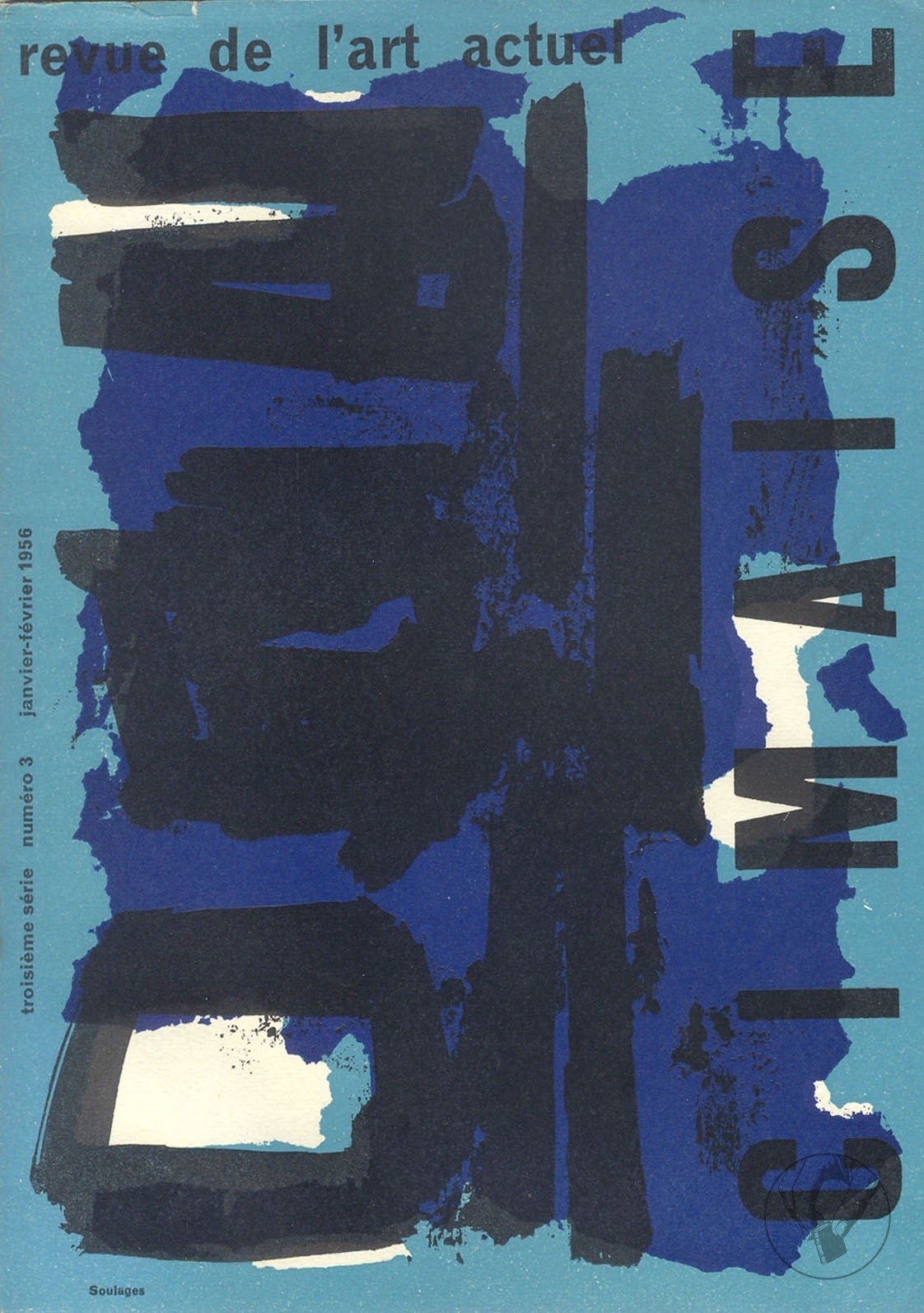
La revue "Cimaise" présente son numéro de janvier-février 1956, troisième série, numéro 3. Cet ouvrage met en avant l'artiste Soulages en couverture et dans plusieurs articles. Il aborde également des sujets tels que Brancusi, l'École de Paris, et présente des critiques d'expositions et une bibliographie. La revue détaille ses efforts pour améliorer sa présentation et atteindre un public international, tout en maintenant un prix accessible.