Page 1
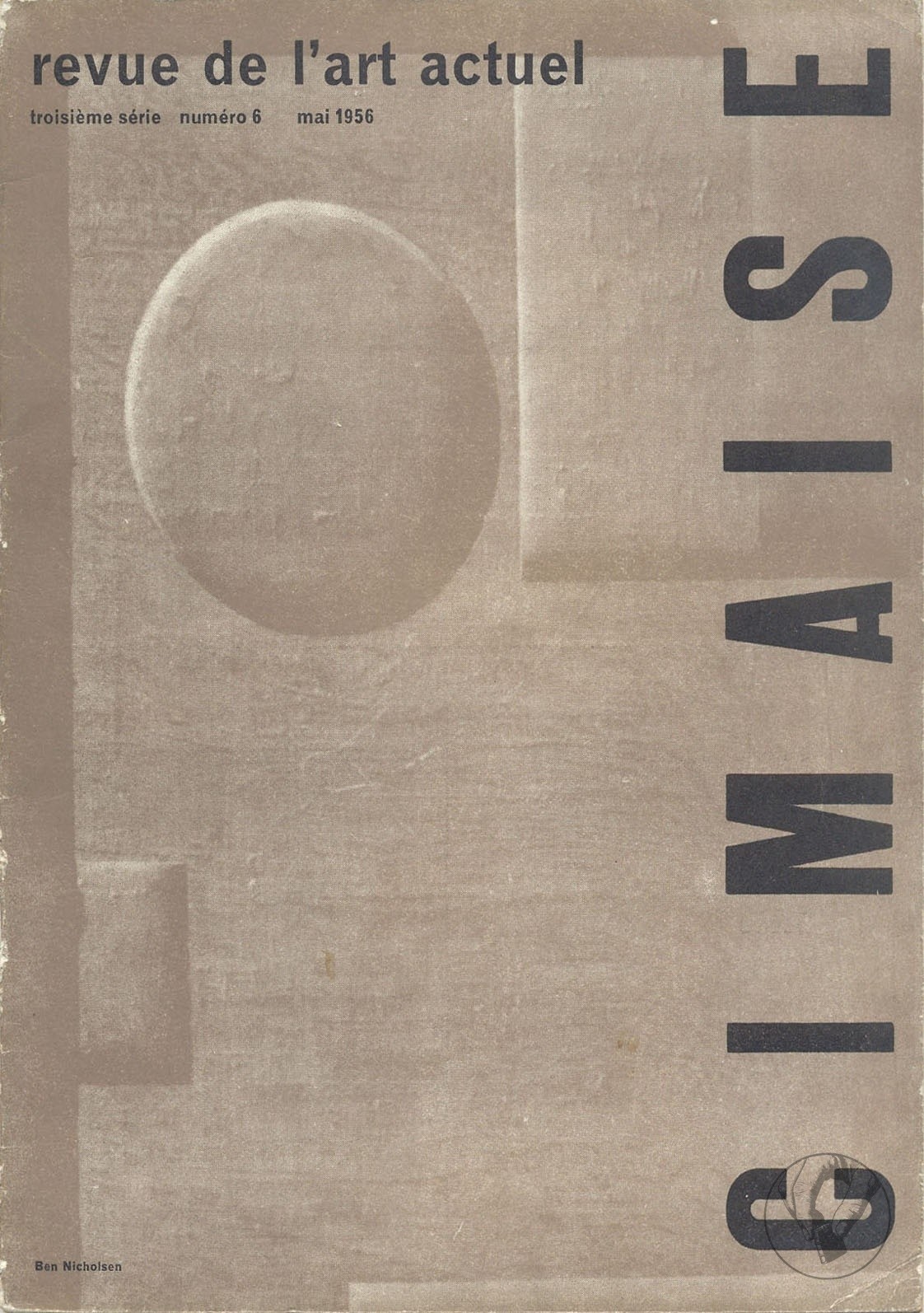
revue de l'art actuel troisième série numéro 6 mai 1956 LISIMAIS Ben Nicholsen
First pages of the volume, freely accessible.
revue de l'art actuel troisième série numéro 6 mai 1956 LISIMAIS Ben Nicholsen
Galerie de France 3 Faubourg Saint-Honoré, Paris 8, téléphone Anjou 69-37 Manessier œuvres récentes juin --- Galerie Louis Carré 10 avenue de Messine, Paris 8 --- Mathieu expose du 18 mai au 10 juin --- Borès peintures récentes jusqu’au 9 juin --- Galerie Rive Droite 82 faubourg Saint-Honoré, Paris 8, Anjou 02-82 peintures --- Gromaire : «Paris» 10 peintures 10 aquarelles du 15 juin au 14 juillet --- Galerie Pierre 2 rue des Beaux-Arts (angle rue de Seine) Paris 6 gouaches ---
Sommaire Couverture de Ben Nicholson Textes anglais 3 Ben Nicholson by Herta Wescher 4 Art and science by Gyorgy Kepes 5 Karskaya by Herta Wescher Textes français 7 Ben Nicholson par Herta Wescher 11 La visibilité de la création artistique par Hundertwasser 14 L’art et la science par Gyorgy Kepes 20 Karskaya par Herta Wescher 22 Informations 23 Les expositions par Herta Wescher, R. V. Gindertael, Julien Alvard Michel Ragon et Pierre Restany --- Cimaise revue de l’art actuel 34 rue du Four, Paris 6 Directeur: J.R. Arnaud Rédacteur en chef: Herta Wescher Secrétaire général: John Koenig Rédaction: J. Alvard, R.V. Gindertael, M. Ragon, C. H. Sibert La rédaction reçoit sur rendez-vous Abonnement (8 numéros) 1.400 frs - Par avion: 2.300 frs 34, rue du Four, Paris 6, téléphone Littré 40-26 C.C.P. Librairie Sélection Paris 5542.39 Diffusion: Allemagne: Horst Beck, Hoedingen ueber Uberlingen, Bodensee PS ch A Karlsruhe (Bd) 43328 Argentine: Editorial Victor Leru, Cangallo 2233, Buenos-Aires Autriche: Arnulf Neuwirth, Paracelsusgasse 8, Vienne 3 Belgique: Jean Milo, 28 rue de l’Arbre Bénit, Bruxelles C.C.P. Jean Milo, Bruxelles 1591.50 Danemark: Meiners Kunstforlag, Peder Skramsgade 5, Copenhagen Grande-Bretagne: Alec Tiranti Ltd, 72 Charlotte Street, London W1 Japon: Meiji-Shobo, Surugadai, Kanda Tokyo Norvège: J.W. Cappelen, Sortimentebokhandel, Oslo Suède: Eric H. Olson, Upplandsgatan 3, Stockholm, 10 23 77 Suisse: E. Genton, «L’Entr’acte», rue du Lion d’or 4, Lausanne, C.C.P. II 144-56 U.S.A.: Wittenborn and Co, 30 East, 57th Street, New-York 22 M. Flax 10846 Lindbrook Drive, Los Angeles 24 --- Complete translation of the main articles translation by J.-F. Koenig Ben Nicholson by Herta Wescher (p. 7) For Ben Nicholson, painting is a vital function, just as breathing, walking, seeing. His works take form from day to day in an uninterrupted sequence that even until today show no slackening of intensity. If he talks to you about his recent canvases, he thinks of those done last week, those of the past month almost belonging already, according to him, to an historic period. Late in the evening of his arrival in Paris, he was anxious to finish a bit of work, that had only been interrupted nonetheless by a single day of travelling. And when he says this, with him you don’t feel any fanaticism, nor the feverish obsession of a tormented mind, but rather the common-sense of a man who has made a plan of living for himself according to his needs, who has imposed an interior and exterior self discipline on himself, adapted to his strength. His natural condition is that of living in the country, away from the city, of limiting his meetings with friends as well as taking part in artistic manifestations. Of the 150 painters who live around him in the bay of St. Ives, he frequents only a small number; as to shows, in London or elsewhere, he sees almost none, leaving to chance the task of providing him, from time to time, with some happy surprises or encounters. It is thus as a voluntary hermit that he follows his path, accepting all the consequences of such isolation. There inevitably results from this a certain uniformity in his work, compensated by the ultimate refinement of style due to the concentration paid to the well-defined task. At the beginning of his career, Nicholson chose the constitutive elements of his art once and for all. They may be divided into figurative and non-figurative groups. The first, taking familiar objects such as jars and bottles for models, refers itself to cubism, for he underwent its influence in Paris. The second group of elements, straight lines, and circles and squares, derives from Mondrian’s neoplasticism. Nicholson in no way denies his “forefathers,” joking about the quarrels for priority, and telling the good story on this subject: “Mondrian was accused of having stolen the straight line from Vantongerloo (or vice versa), Marlow Moss of having stolen par llel lines from Mondrian, and I was reproached for having stolen the circle from Sophie Taeuber-Arp. Well, of course, I preferred to steal a circle, for I could put it under my arm, while I would have trouble getting out the door with parallel lines.” To his way of thinking, figurative and non-figurative art don’t exclude one another, but quite on the contrary, complete each other, making of art the image of man drawing his inspiration from the two sources that are open to him:— the spiritual and the sensual. What his eyes communicate to him, Nicholson retains through his drawings, such as those made during all his life through the deep desire to keep a contact with the outside world, to profit in the fresh inspiration that nature so generously offers to him. The rhythms of the lines hidden in the formations of the fields, the structures that an architec- ACORG_3#132
ture imposes on a landscape, he discovers everywhere during his voyages, but the view from his window over the bay of Cornwall also is always new. On the other hand, the search for the transcendent values, expressed through the measures and proportions of forms and geometric lines, gives birth to purely abstract compositions that are repeatedly inserted into the different periods of his painting. The relief is his favorite means for this; from 1934 on he has given us the purest kind of works: circles and squares inscribed on white surfaces. In his painting, the essential part of his work, the two factors of the real and the unreal are linked through a complete interpenetration. The still life serves here as a basic theme which allows him to impregnate his autonomous constructions of plane surfaces and lines with reflections of ordinary life. In the heart of their abstract transpositions, the still lives keep their immanent presence, and at the same time situate themselves in a precise place, indicated by the table on which they are placed, by a window opening out into a background. The objects are disposed as in projections, their cross sections being assembled in horizontal and vertical order, opposed to any linear perspective that would limit space. Often, a half of a goblet, or only the handle of a jar, takes place of the complete object that has lost all of its importance in this language of significant values. In the sensitive lines of his drawings, the contours, convex or concave, bring secret movements to the stability of the co-ordinates. The colors give to these compositions their personal climate, reflecting the changing mood of the hours of the day, as well as the seasons of the year, showing the light of the cities and of the lands, although we are unable to identify any detail. Nicholson has a palette possessing all of the mildest and bitterest of ingredients, and he knows better than any other person how to determine their proportions in order to achieve audacious combinations. The scale of color used before, giving to his paintings the transparency of glass, has recently become warmer, concentrated around earth-brown tones, and of a strangely shining dull texture. The uniform light tones have given place to subtle gradations, and the shadows of the various textures come forth from the scraped and polished paint. Isorel, replacing the canvas, is used on both sides, both smooth and rough, and is frequently covered with a transparent white layer that veils the indicated outlines. The nervous graphic treatment of swirling lines contrasts with the snowy and marbled surfaces, flaked often as with falling petals. In spite of this manifold variety of tactile values, these compositions appear even more concentrated than ever, each one endowed with a specific character, of a tender and melancholy poetry. The essential transformation of forms and colors that have become matter and light, perceptible in the painting, is expressed in a more delicate manner in the present reliefs. Here, also the variation of textures is used in order to animate the surfaces; the hardness of the cardboards is contradicted by the softness of the tones covering them, and the sharp appearance of certain plane surfaces becomes less certain through the use of little splashes scattered haphazardly one over the other. By the most simple of formal means:—prudently slanted straight lines, rectangles changed into trapezoids, thin slabs placed one on top of the other in millimetred levels—Nicholson suggests themes of touching intimacy. At the same time in keeping himself away from the clamour of the world, he has kept his ears tuned to the sound waves vibrating in the ether, to a point where even silence speaks to him. Herta Wescher. --- Art and science 1) by Gyorgy Kepes (p. 14) In the thought of the seventeenth century are the seeds of the widely held belief that art and science are polar opposites, mutually exclusive in aims, methods and results. The view that quantitative, measurable attributes of things are real and that direct sensory experience is unreal and untrustworthy leads quite logically to a value judgment favorable to science and unfavorable to art. The one becomes approved for its rationality and precision, the other distrusted as subjective, unstable and prelogical. This distinction, which Galileo drew, was an intellectual necessity for the development of the exact sciences. But the separation of art and science in our minds is no longer useful and will not bear close scrutiny. History shows us that these creative human activities are interdependent, no matter which of the two times emphasize more strongly. Each achieves stronger growth when nourished by the other. Notably, the renewal of scientific inquiry that flowered in the achievements of the past five centuries was led by great painters, sculptors and architects of the Renaissance. The work of Masaccio, Alberti, Pollaiuolo, Leonardo and Dürer was as much systematic inquiry into the structure of the natural world as it was artistic creation. Their concrete and communicable vision of natural order proved as fateful for the development of science as for the development of art; it can be called art or science with equal validity. In our day, the artist and the scientist are almost never the same person—a circumstance which obscures but does not alter the connection between art and science. Art and science are ordering activities of the human mind. Through sifting and organizing the order relations impressed on us by our senses, they distill our significant experience and bring us insight into the order relations of nature. Science attempts to discern order relations in nature, making verifiable statements about nature’s processes. Data are set out in terms of measured quantities; and the found order is expressed in conceptual structures. Image-making is basic for art. It is basic for science, too, defining goals, delimiting fields for study and providing sense models which anticipate the corresponding scientific statements of order relations. On the image-making level, the difference between pre-scientific and pre-artistic perception of order is a difference of attitude, an attention to structure, on the one hand, to the felt quality of experience, on the other. There is no need for these attitudes to exclude each other. Structures can be understood and qualities felt in a single, balanced perception of order, in an experience which has characteristics of scientific and artistic activity both. This balance is also possible on complex levels; one and the same set of created symbols can evoke an intense emotional response to the richness of its sensed patterns and convey an idea of logical structure. Images are the starting point of all our thinking and feeling. Of a feeling of warmth, the smell of milk, the touch of hands, the looming of features, the child compounds a unified picture of the mother. Image-making—the integration of sense data into a coherent experience of something—is thinking and feeling on the most elementary level. Through images we participate in the world, responding emotionally to its sensible qualities and rhythms. --- 1) Article from the forthcoming book The New Landscape in Art and Science Paul Theobald & Co.
At nearly all times, some men have produced work which combines profoundly moving patterns of sense with a profound perception of mathematical order. Bach, in music and Poussin, in painting, present us with grandly patterned sense models of a Cartesian world. But, East and West, the trend of centuries has brought imbalance of intellect and feeling. The East has, in the main, moved in one direction, the West in another. The anatomy of the world preoccupies us in the West; our culture centers upon objective understanding of substance, forces and structures, to the impoverishment of our subjective appreciation of patterns and rhythms. The East has concerned itself less with the world’s structure than with its physiognomy, and has institutionalized, as the West has not, highly developed appreciation of its harmonies, its tastes and flavors. Today, with all lands knit together by new tools of communication and worldembracing economic patterns, it has become possible more than ever to exchange attitudes as well as ideas. A more fundamental interchange of Western structural discipline and Oriental emotional discipline could contribute to a cultural equilibrium—on a higher level, this time, with a heightening of our ability to understand the world and read its significance. The Far Eastern discipline of sensibilities grew out of the feeling that men lived most fully by opening themselves to the universal rhythm of Nature, becoming one with trees and stones and animals. Nature was approached and entered through rapt contemplation of its forms. The story is told that Rykku, the Japanese master of the tea ceremony, instructed his son to clean the garden before the arrival of guests. Inspecting the immaculately finished result, he said to the youth, “This is not the way,” and shook a tree so that leaves fell in a free pattern across a path. Thus, the man-made structural order of the garden was joined with the natural order of living forms. In the West, the visualization of our experience has been looked at mainly as the fashioning of representations of nature, likenesses of the things around us. This is the Aristotelian tradition; and, particularly since the Renaissance, it has been assumed that fidelity to the optical appearance of objects is the only means of artistic description of reality. Nevertheless, at all times master works of art have transcended mere representation; and during the past seventy-five years Western art has shifted toward ideas and methods corresponding to this Far Eastern vision. What the artist Piet Mondrian lately called the “liberated and universal rhythm distorted and hidden in the individual rhythm of limiting forms,” the great pioneers of modern art have tried to make visible. Today artists more often depict the inner world of man than the likeness of particular objects, making visible and external their experience of connection with the world around them. But the general public, most scientists included, still assumes that art is naturalistic representation. Because our modern specialization so often separates artist and scientist, neither is fully aware of the profundity of the other’s work. Most scientists feel that conceptual thinking has transcended the power of visualization. Immersed in the tradition that visualization is static representation of objects. Recognition that visualization is much more than this can provide a spur to their thinking that they now deny themselves. Artistic expression comes to conclusions similar to those of science, finding idioms for the description of processes and relations. Scientists are aware of the role of what they call “intuition” in the creative process whereby they integrate their data into new expressions of order. They are often aware, also, of the closeness of their creative thoughts to visual and artistic thinking—they “look forward” to certain types of results; they “design” their experiments and their apparatus. Their procedure in presenting results, however, gives us no hint of this. We are shown logical steps by which knowledge can be verified; we are not shown the deep workings of human minds. Mathematicians who build new spaces and physicists who find them in the universe can profit from study of the pictorial and architectural spaces conceived and built by men of art. The finite universe of late medieval times found a pictorial counterpart in the limited, shallow, “abstract” spaces of Giotto. Stage by stage, art kept pace with developing cosmological concepts until, in the Italian Renaissance, the artists became the cosmologists themselves. Of all artists, the Greeks alone reveal space conceptions limited by Euclidian geometry. The past seven centuries have given us the “symbolic” space of the Flemish masters; the “rational” space of fifteenth century Renaissance Italy, deep and clear; the “ideal” space of Raphael and the High Renaissance, in which a clear foreground, continuing the spatial characteristics of the world in which the observer finds himself, converges upon a spatially mysterious, other-worldly realm beyond; the soaring, levitational space of Gothic cathedrals; the poised and balanced spatial volumes of the High Renaissance church of San Biago at Montepulciano; the “exploding” space of the German Baroque at Vierzehnheiligen; the pervasive space of the Impressionists, dissolving all solid form; the laminated, timebound space of the later Cubists. We have accumulated so vast and complex a store of scientific knowledge today that we need a new kind of science to describe essential motifs of the whole in a unity. Art can make an important contribution by providing insights into structural correspondence common to the various disciplines of science but ignored because science, of necessity, has isolated and limited its fields and objectives. Modern science expands the area of generalization; discrete terrains are linked in common formulations. The larger the areas that are brought into the same scale and meaning, the more important becomes awareness of form relationships; we focus less and less on the facts themselves and more and more upon their interconnection. Thus, in its evolution, science approaches art. Gyorgy Kepes Karskaya by Herta Wescher (p. 20) You’ll always find the door open when you go Karskaya’s place. You go up the staircase worn by use, leading up from the courtyard of one of these old houses, whose spacious extent can hardly be guessed at, when you see one of them in coming up the narrow Rue St-Jacques. It’s a romantic street where some noble old façades, inserted in between the shops and poor lodgings, evoke the long suite of generations that have lived in this quarter, neighboring the Sorbonne. When you’ve passed through Karskaya’s door, this perfume of french urban tradition melts away before the strange, dense atmosphere of another world, into which you are introduced by a pathway full of creeping vines, that seem to grow in their natural habitat. Then you penetrate into a curious labyrinth of rooms, furnished in a heterogeneous and surprising fashion: drawings of renowned artists, photos and books, small art objects such as this indo-chinese sculpture of a seated couple with their backs turned to you, because Karskaya has had enough of seeing their faces.
You also discover a curious gate made of forged iron, a ghostly separation of filigree that she put up herself between two rooms, in order—she says—to keep the noise out. From time to time, she feels the desire to apply herself to manual tasks in order to embellish her surroundings: to paint her ceiling, or construct a large table whose iron legs she dug up Lord knows where. On the wall, a beautiful tapestry made after the design of the artist; and piled up on the floor or scattered a bit all over are quantities of different materials, ready to serve in her collages—materials that she gathers in the street, or out in the country, soiled papers or torn-down posters, strings, ribbons, splinters of wood and bits of leather. On each visit, you come across something new that no one except her ever took for an element capable of bringing a contribution to a work of art. Perhaps you will find on the work-table an assemblage of strange mosaics that she in the process of making, each of them having a particular character: melancholy messages or astonishing images, tightly-woven fabrics, or hidden writings. All of these compositions, as improvised as they might be in the beginning, are carefully elaborated—elements changed, harmonies established, accents of color added—before being finally determined. Then the different materials are transformed into factors of expression, their specific substances being distilled into tone values that nonetheless remain discreetly impregnated with remembrances of the real world. What is valid for the collages, is valid for the paintings, the gouaches, and the drawings as well. Each of Karskaya’s works shows the decision that was taken, the battle that may be won or lost when she engages herself in art. Her mastery of technical means is well-known, and she applies herself with the furious obstinacy of the good craftsman who wants his work to be solid. She knows that the inner balance of the compositions must be established in order to keep the improvisations from crumbling into vagueness, and the themes suggested by the slightest of indications of form and color are always linked to vigorous structures. This discipline alone permits her to advantageously show her fine sensitivity in the nuances of tone that in the end determine the radiance of her painting. Karskaya’s canvases are often created in series, for they take place through certain pictorial ideas whose transposition she seeks through multiple and simultaneous variations. Her imagination often turns about concrete subjects, of things seen in faraway countries, in a special light, of which only she remembers the outlines or the color scale. Such souvenirs live, latent, in her memory, only to reappear suddenly before her eyes. Then she throws overboard this spiritual ballast through the means of vehement sketches that become crystallized almost by themselves alone during the process of working, which is intense and conscious. Sometimes too, her need for communication attaches itself to poetic themes surpassing all spoken syntaxe. Lately, it was the series of “Unanswered Letters” that are read and seen as heart-rending calls sent out to the world to try to shake off its indifference. Over the impasto grounds of the canvases, signs are written, categorical or nervous, in strips or dispersed spots of color, held together nonetheless by the sorrowful harmony of the tones. The blacks and the greys dominate, chanting the most somber of scales; however, blues and yellows may creep in among them, softening the tragic aspect, brightening it with a sudden gayness, that comes from her confidence in the happy conclusion to all dramas. Karskaya’s art is a passionate art, directed by a spirit of rebellion against the commonplace and the gratuitous, by the mind of a searcher who is not contented with easy answers, and sure of the existence of riches that are hidden everywhere, waiting only to be brought to light. Artistic activity plays an essential role in her life, for it is this that has helped to overcome the throwbacks of fortune, in assuring her the necessary independence, even if it were gained at the expense of her personal happiness. To maintain the value of her creative work, she requires much of herself, destroying readily everything that doesn’t satisfy her completely. She goes through periods of discouragement and self-doubt that cause her to be inactive up until the moment when her creative will gains her again, showing her a new way. Her character doesn’t facilitate her relations with other people. Her extreme frankness delights itself in an unconcerned agressiveness, and one must be aware of her qualities of sincerity in order not to be hurt by it. In talking of her russian compatriots, she describes their peculiar character in order to explain her own to us: the ability to be at the same time roguish and candid, mistrustful and confident. One feels with her an exceptional open-heartedness, but at same time a certain prudence in order to keep from throwing herself away on others. On her expressive face, often strained and tormented, a smile is always ready to break out, and the tyrannical maxims that she loves to pronounce, turn almost inevitably into gay banter. I was amused the other day to hear her friends salute her with “Hello, cossack,” and I secretly gave her nickname of “pony of the steppes,” finding with her this untiring energy that surpasses that of the stronger races; the joy of galloping, but also the taste of the wind over the vast expanses that probably blew around her cradle, and tinged her skin both on the outside and the inside. Herta Wescher --- Editions Delf 2 rue des Lyonnais, Paris 5, Port-Royal 66-32 L’art non-figuratif non-objectif par Auguste Herbin. 140 p., nombreuses planches en noir et en couleurs. Prix 2.700 frs L’origine de l’œuvre par J.M. Gay. Prix 950 frs Collection Prisme: Auguste Herbin par René Massat. Texte en français et en anglais, avec de nombreuses planches. Prix: 1000 frs Edgard Pillet par Julien Alvard. Texte en français et en anglais, avec de nombreuses planches. Prix: 600 frs Béothy par Michel Seuphor Texte en français, anglais et allemand. 40 reproductions. Prix 1000 frs
Ben Nicholson par Herta Wescher Pour Ben Nicholson, peindre est une fonction vitale comme respirer, marcher, regarder. Ses œuvres naissent au jour le jour, dans une suite ininterrompue qui jusqu'aujourd'hui ne montre aucun relâchement dans l'intensité. S'il vous parle de ses toiles récentes, il pense à celles faites la semaine dernière, celles du mois passé appartenant pour lui presque déjà à une étape historique. Tard dans la soirée de son arrivée à Paris, il s'est inquiété de reprendre son travail, coupé cependant par une seule journée de voyage. Mais quand il le dit, on ne sent en lui aucun fanatisme, ni l'obsession fièvreuse d'un esprit tourmenté, mais plutôt le bon-sens d'un homme qui s'est fait un plan de vie selon ses besoins, qui s'impose une discipline, extérieure et intérieure, appropriée à ses forces. La condition naturelle est pour lui de vivre à la campagne et non en ville, de limiter les rendez-vous des amis aussi bien que les participations à des manifestations artistiques. Des cent cinquante peintres qui, avec lui, habitent la baie de Saint-Yves, il ne fréquente qu'un petit nombre; des expositions, à Londres ou ailleurs, il ne visite presqu'aucune, laissant aux circonstances le soin de lui procurer, de temps à autre, quelques rencontres ou surprises heureuses. C'est donc en solitaire décidé qu'il suit son chemin, assumant les conséquences d'un tel isolement. Il en résulte inévitablement une certaine uniformité de son œuvre, compensée par l'ultime raffinement du style dû à la concentration sur une tâche bien déterminée. Les éléments constitutifs de son art, Nicholson, au début de sa carrière, les a choisis une fois pour toutes. Ils se partagent entre les réseaux figuratifs et non-figuratifs. Les premiers, visant des objets familiers, pots et bouteilles surtout, se réclament du cubisme, dont il a subi l'influence à Paris. Les seconds éléments, lignes droites, cercles et carrés, dérivent d'un néoplasticisme mondrianien. Nicholson ne nie ment ses ascendances, se moquant des querelles de priorité, pour raconter à ce sujet l'anecdote jolie : « On a accusé Mondrian d'avoir volé la ligne droite à Vantongerloo (ou vice-versa), Marlow Moss d'avoir volé les lignes parallèles à Mondrian, on m'a reproché d'avoir volé le cercle à Sophie Taeuber-Arp. Bien
Ben Nicholson : « Graffito » peinture, 1955, 60 x 36 photo Studio St Yves
sûr, j'ai préféré voler un cercle que j'ai pu prendre sous mon bras, alors qu'avec des lignes parallèles je n'aurais guère pu passer la porte. » Dans sa conception, le figuratif et le non-figuratif ne s'excluent pas, mais, au contraire, se complètent pour faire de l'art l'image de l'homme puisant aux deux sources qui s'ouvrent à lui, du spirituel et du sensuel. Ce que les yeux lui communiquent, Nicholson le retient en des dessins, tels qu'il les a faits à chaque moment de sa vie dans un désir profond de garder le contact avec le monde extérieur, de profiter des inspirations fraîches que la nature lui offre si généreusement. Les rythmes de lignes cachés dans la formation des terrains, les structures qu'une architecture impose au paysage, il les découvre partout au cours de ses voyages, mais aussi toujours de nouveau dans la vue de sa fenêtre sur la baie du Cornwall. L'autre côté, la recherche des valeurs transcendantes, exprimées dans les mesures et les proportions de formes et de lignes géométriques, donne suite à des compositions purement abstraites, qui s'intercalent, à intervalles répétés, dans l'évolution de sa peinture. Le relief en est le champ d'exploitation préféré, dont il a tiré, dès 1934, les œuvres les plus pures : des cercles et carrés inscrits sur des surfaces blanches. Dans sa peinture, partie essentielle de son œuvre, les deux facteurs du réel et de l'irréel sont liés en une entière interpénétration. La nature morte y sert comme thème et lui permet d'imprégner des reflets de la vie ses constructions autonomes de plans et lignes. Au sein de leurs transpositions abstraites, ces natures mortes gardent une présence immanente, tout en se localisant en un endroit précis, indiqué par la table sur laquelle elles sont posées, par une fenêtre qui s'ouvre au fond. Les objets sont disposés dans un sens de projection, leurs coupes transversales étant assemblées en ordre horizontal ou vertical, opposé à toute perspective linéaire qui limiterait l'espace. Souvent, la moitié d'un gobelet, l'anse seule d'un pot tiennent lieu de la totalité de l'objet qui a perdu toute importance dans ce langage de valeurs significatives. Dans les traits fins du dessin, les contours, convexes ou concaves, apportent des mouvements secrets dans la stabilité des coordonnées. Les couleurs donnent à ces compositions leur climat particulier, reflétant l'atmosphère changeante des heures du jour comme des saisons de l'année, rendant la lumière de villes et de pays, sans que nous retrouvions aucun détail identifiable. Nicholson possède dans sa palette les ingrédients les plus doux et les plus âcres qu'il sait doser comme personne d'autre en des combinaisons audacieuses. Les gammes de couleurs qui, autrefois, donnaient à ses peintures une clarté de verre, sont récemment devenues plus chaudes, concentrées sur des tons brun terre, d'une matité étrangement luisante. Les légères teintes unies ont fait Ben Nicholson : « Nightsade », peinture, 1955, 37x48 in. (Photo Studio St Ives)
place à de subtiles dégradation et des ombres de textures variées sortent de la pâte frottée et grattée. L'isorel, remplaçant la toile, est utilisée de ses deux côtés, lisse et rude, couverts volontiers d'une couche blanche, transparente, qui voile les contours indiqués. Le graphisme nerveux de lignes tourbillonnantes contraste avec des surfaces floconnées, marbrées, tachées parfois comme par des pétales tombantes. En dépit de cette multiplicité des valeurs tactiles, ces compositions apparaissent plus ramassées que jamais, chacune portant sur un caractère spécifique, d'une poésie tendre et mélancolique. La transformation essentielle de formes et couleurs devenues matières et lumière, saisissable dans la peinture, s'exprime d'une manière plus délicate encore dans les reliefs d'aujourd'hui. Ici, également, la variation des textures est appelée à animer les surfaces; la dureté des cartons est contredite par la douceur des tons qui les enrobent, l'allure nette de certains plans est mise en doute par des petites éclaboussures hasardeusement dispersées sur d'autres. Par les moyens formels les plus simples, lignes droites prudemment inclinées, rectangles changés en trapèzes, minces plaques posées l'une sur l'autre en des nivellements au millimètre. Nicholson suggère des thèmes d'une intimité émouvante. Tout en s'écartant des bruits du monde, il a gardé les oreilles sensibles aux ondes sonores vibrant dans l'éther, le silence même est devenu pour lui hautement significatif. Herta Wescher Ben Nicholson : Tiegseal, relief, 1956, Photo Studio St Ives
La visibilité de la création transautomatique par Hundertwasser 1) Puisque un tableau transautomatique correspond à des films individuels qui sont seulement en partie ou jusqu'à certains points plus ou moins avancés réalisables par le public observateur, on peut facilement et presque avec précision définir la proportion « momentanée » ou mieux : les proportions de la visibilité et de l'invisibilité de l'œuvre. Les proportions de cette visibilité sont variables et diverses sur beaucoup d'aspects difficiles à expliquer et dépendent premièrement du degré de capacité visuelle de l'observateur. Par exemple : visible 2 % veut dire presque invisible pour le grand public, visible 10 % par les parents de l'artiste, visible 13 % par un critique défavorable, 20 % par le marchand, 32 % par un critique favorable, visible 67 % par un ami d'élite étranger, 70 % par l'artiste même, 80 % par l'acheteuse au moment de l'acquisition et 100 % par la même encore devenue propriétaire, à l'heure actuelle, en tenant compte que ces 100 % peuvent naturellement se vérifier plus tard comme les seuls 50 % de la visibilité absolue qui est une sorte d'intégral ou équation de probabilité. Dépendent deuxièmement des artistes, dont il y en a des phénoménals, qui sont très capables de faire déjà maintenant des œuvres qui sont situées au delà du transautomatique et qui sont d'abord parfaitement invisibles, même pour les observateurs les plus calés, d'ailleurs par l'artiste même aussi — ce sont des œuvres plantées d'avance, mis à notre disposition future comme Lao-Tse et le Vieux Testament sont nos disponibilités du passé. Dépendent troisièmement du temps, comme déjà indiqué, quand on procède à l'établissement des proportions de visibilité. Dépendent du lieu comme il y en a des villes arriérées et des pays sous-développés au point de vue de l'aptitude visuelle, etc., etc... On pourrait très bien, si on voudrait, et si cela ne serait pas une méthode trop dictaturale, mettre par exemple dans l'entrée des gares de Vienne, Varsovie, Lisbonne, du Caire, etc..., des indicateurs concernant les visibilités moyennes atteintes dans ces villes. Ça pourrait se faire en statistiques de pourcentage qui pourraient correspondre à des listes de ismes pour une orientation générale bien qu'elles ne sont nulle- ment précises et doivent être savamment complétées et reprises. (Entre le cubisme et l'automatisme, par exemple manquent au moins 15 termes précis remplaçant les descriptions vagues connues). Cela aiderait beaucoup le bon voyageur. La visibilité du vrai tableau augmente ainsi dans la cadence du temps au sein d'une bonne société et se détériore jusqu'à l'invisibilité au milieu d'une autre qui devient mauvaise. Fausses œuvres peuvent très bien obtenir fausse visibilité dans fausse société. Il y a le cas des peintures de Van Gogh qui étaient obstinatement invisibles pour ses contemporains. S'ils sont « bien visibles » maintenant pour nos contemporains, cela ne veut toujours pas dire que ses peintures sont bonnes puisque pour ces mêmes nos contemporains les œuvres transautomatiques et mêmes automatiques qui ont été fait expressément pour eux, restent dans le brouillard le plus absolu, c'est-à-dire, ce n'est pas à eux de décider si les peintures de Van Gogh sont bonnes. Cela me met toujours en colère. Ce phénomène de la visibilité relative se peut expliquer aussi autrement. Chaque création transautoma-tique possède, en dehors des couches diverses de fond, de peinture et de vernis, encore des couches et des membranes innombrables de « sécurité », divers dans leur consistance et plus ou moins pénétrables et qui peuvent même parfois empêcher complètement la visibilité de l'œuvre pour certaines personnes (élévées sans la création obligatoire) ou sous l'analphabétisme visuelle. Chaque membrane correspond à une image du film individuel. La visibilité dépend donc du nombre des membranes que la personne observateur est à même de perforer. Chaque fois après l'enlèvement d'une membrane qu'on croyait la dernière, l'œuvre change souvent complètement la signification, ça veut dire son véritable aspect et on ne s'aperçoit tout d'abord pas qu'il en reste encore des couches d'un nombre infini à perforer, mais en tout cas elle s'accroît (respectivement diminue) en importance et en visibilité. Ces couches et ces membranes de l'œuvre qui représentent une nouvelle dimension, la dimension de la perception et de la vision, créatives, bien entendu sont perforées et découvertes par les « Ismes », dont peu seulement sont connus ou mis en paroles, qui signifient rien d'autre que les degrés de succession des vraies consciences, visuelles et autres, jusqu'à maintenant atteintes par l'individu. --- 1) Autrichien, l'auteur a écrit directement en français ce texte dont nous avons respecté les « singularités de forme » pour lui conserver toute sa vigueur.
La revue d'art actuel "Cimaise" présente dans ce numéro des articles sur Ben Nicholson, l'art et la science, et Karskaya. Les textes sont disponibles en anglais et en français. Le numéro inclut également des informations sur les expositions d'art contemporain à Paris.