Page 1
revue de l'art actuel quatrième série numéro 1 septembre-octobre 1956 LE SAINIS CINEMATIQUE
First pages of the volume, freely accessible.
revue de l'art actuel quatrième série numéro 1 septembre-octobre 1956 LE SAINIS CINEMATIQUE
Galerie de France 3 rue du Faubourg-Saint-Honoré, Paris 8, Anjou 69-37 --- Hartung œuvres récentes novembre-décembre
Galerie Stadler 51 rue de Seine, Paris 6, Danton 91-10 Structures en devenir Accardi, Capogrossi, Damian, Enard, Fontana, Gerdur, Claire Falkenstein, Mathieu, Serpan, Tobey, vernissage le 16 octobre Bryen vernissage le 16 novembre --- Galerie Denise René 124 rue la Boétie, Paris 8, Elysées 93-17 Tinguely peintures cinétiques vernissage le 19 octobre --- Galerie La Hune 170 boulevard Saint-Germain, Paris 6, Littré 35-85 4 graveurs brésiliens Fayga Ostrower Edith Behring Arthur Luiz Piza Joad Luiz Chaves octobre --- Lucien Durand 19 rue Mazarine, Paris 6, Danton 25-35 Tabuchi octobre Boille novembre Longobardi décembre en permanence: Busse, César, Dmitrienko, Ravel ---
Cimaise revue de l'art actuel 34 rue du Four, Paris 6 Directeur: J. R. Arnaud Rédacteur en chef: Herta Wescher Secrétaire général: John Koenig Rédaction: J. Alvard, R.V. Gindertael, M. Ragon, P. Restany La rédaction reçoit sur rendez-vous Abonnement (8 numéros) 1.400 frs - Par avion: 2.300 frs 34, rue du Four, Paris 6, téléphone Littré 40-26 C.C.P. Librairie Sélection Paris 5542.39 Diffusion: Allemagne: Horst Beck, Hoedingen ueber Uberlingen, Bodensee PS ch A Karlsruhe (Bd) 43328 Argentine: Editorial Victor Leru, Cangallo 2233, Buenos-Aires Autriche: Arnulf Neuwirth, Paracelsusgasse 8, Vienne 3 Belgique: Jean Milo, 28 rue de l’Arbre Bénit, Bruxelles C.C.P. Jean Milo, Bruxelles 1591.50 Danemark: Meiners Kunstforlag, Peder Skramsgade 5, Copenhagen Grande-Bretagne: Alec Tiranti Ltd, 72 Charlotte Street, London W1 Japon: Meiji-Shobo, Surugadai, Kanda Tokyo Norvège: J.W. Cappelen, Sortimentebokhandel, Oslo Suède: Eric H. Olson, Upplandsgatan 3, Stockholm, 10 23 77 Suisse: E. Genton, «L’Entr’acte», rue du Lion d’or 4, Lausanne, C.C.P. II 144-56 U.S.A.: Wittenborn and Co, 1018 Madison Ave, New-York 21 M. Flax 10846 Lindbrook Drive, Los_Angeles 24 2 --- Sommaire Couverture de Staritsky Textes anglais 5 Hans Hartung by R.V. Gindertael 6 The Venice Biennal by Herta Wescher 8 Van Haardt by Julien Alvard Textes français 9 Hans Hartung par R.V. Gindertael 18 La Biennale de Venise par Herta Wescher Peintres et sculpteurs d’aujourd’hui: 25 Van Haardt par Julien Alvard 28 Sugai par Michel Ragon 30 Premier festival de l’art d’avant-garde par Michel Ragon 34 Les expositions par Julien Alvard, R.V. Gindertael, René Déroudille, René Laubiès, Pierre Restany, Michel Ragon, Herta Wescher Textes anglais 41 Sugai by Michel Ragon 41 The first Festival of Avant-Garde Art at the «Unité d’habitation Le Corbusier», Marseille by Michel Ragon Dans notre prochain numéro, consacré à l’art actuel américain, vous pourrez lire les études suivantes: - La peinture actuelle aux Etats-Unis par Dore Ashton - La sculpture actuelle aux Etats-Unis par Goldwater - Situation des galeries de New-York par K.B. Sawyer - Jackson Pollock, 1912-1956, par K.B. Sawyer - Influence de la peinture américaine sur l’Ecole de Paris par Julien Alvard - Influence de l’Ecole de Paris sur les peintres américains par Herta Wescher Et comme dans chaque numéro: actualité, informations, bibliographie --- Galerie 93 93 rue du Faubourg-Saint-Honoré, Paris 8, Balzac 07-21 Doméla tableaux en relief, aquarelles du 9 au 30 novembre
Translations of the main articles by J.-F. Kønig --- Hans Hartung by R.V. Gindertel To claim to discover Hartung, or to claim to allow him to be discovered - seemingly this is a paradox. Hartung, the unknown? What a paradox! For Hartung is famous, his mastery is exemplary, and his renown is universal. Certainly the last ten years have been those where public recognition has been made of Hartung’s personality. However, what do we really know about him? Generally, very little, and especially in Paris, where only one personal show has been held, at the Galerie Lydia Conti, in 1947! You will perhaps be astounded, it is nonetheless a true fact. Without a doubt, Hartung has remained present in the life of the School of Paris through his participation in several groups, and by his annual paintings sent to the different Salons. In 1950, a very luxurious album, containing a thorough study by Madeleine Rousseau and an explanation by Dr. Domnick, was consecrated to him in Germany, but this edition has remained practically unknown. Then articles in the big art reviews sanctioned his celebrity, and at the same time he had numerous shows in foreign countries. Can one claim, however, that these dispersed occasions for information allowed everyone to become perfectly acquainted with the breadth and the meaning of Hartung’s work, in all of the phases of his evolution? Already, we must keep in mind the ignorance of the fact that his first public manifestation, after the war, in 1947, came after a long period of 25 years of an almost occult effort, pursued in an indifferent milieu (or one, at this moment, little disposed to understand it); doesn’t this distort, in many peoples’ minds, not only Hartung’s historical situation, but still more the original movement of his creative procedure, and because of this, its deep meaning? It is certain that this ignorance, more or less voluntary, has allowed curious inversions as to priorities and merits. Also, if Hartung, even though he has just reached fifty, belongs (by the fact of circumstances that placed him, in the beginning, in close proximity with the “inventors” of abstract art) to the generation that immediately followed them, that was the first to find before them the accomplishment of an emancipation of the means of art liberated from a close dependence on nature (after the initial intentions of Kandinsky), it is a mistake to situate him strictly in the filiation of the first “abstracts”. We know that when their example was revealed to him, he received only a confirmation of the good foundations for a pure pictorial expression of which he had already spontaneously elaborated the fundamental proceedings and principles. For that matter, this elaboration is immediately quite clear in his first drawings, using ink spots or watercolor, traced in 1921-22 (he was still in high-school in Dresden), very often in his notebooks of an unattentive schoolboy, or on vacation. For the most part, these drawings were already almost completely disinterested in representation as an interpretation of forms in nature. His first youthful, almost childhood experiments, preceding all knowledge of abstract works of his elders, show him not only as situated by his own means in the new field of an exploration of plastic expression, but also giving himself over to certain effusions, or certain vehemencies that the recent “significancies of the informal”, and certain “tachists” use systematically today. He preoccupied himself constantly in imposing on the non-consciousness of affectivity (of which these pictorial liberties are the manifestation) the control of his reason, or at least the directive impulses of voluntary intentions, just as he has always submitted the automatism of his mechanical or psychic movements to the test of consequent reflection, or reasoned readjustment. The dialectics that he will follow and develop progressively henceforth between spontaneity and thought, should not mask the fact that at the origin of the act of painting, Hartung placed his confidence in the instinctive gesture, in place of any conceptual justification. This refusal of concepts, as well as the refusal of “any figure named or accepted by geometricians”, in which René de Solier has so rightly seen the characteristics of Hartung’s painting - refusals coming in corollary with the renouncement of figurative descriptions recognized as useless - distinguish absolutely the art of Hartung from that of the first abstract painters, and situate him at the origin of a new situation of the artist accomplishing the act of painting. All during his development, in each step of his evolution, these principles have allowed Hartung to direct himself with certainty, and preserve his authentic dispositions from external solicitations. This strict exaction, consistent with his internal, powerful logic, - it well seems that his first sketches revealed to him its necessity. To my way of thinking, these sketches clarify the whole of his work. We cannot show them too much interest. Unhappily, his youthful drawings and all of his production that followed them until the war are almost completely unknown. In this period, few occasions were given to Hartung to show, and perhaps he didn’t even wish it. In the years when the abstract movement made its first, rather confused departure in Paris, with the group Abstraction-Création, formed in part by neophytes, Hartung, who hadn’t been anything else than abstract for ten years already, wasn’t invited to its shows, and he had to wait for the second manifestation of the first Réalités Nouvelles, at the Galerie Charpentier, in 1939, in order to be modestly represented here. Who remembers still that between times he showed in 1936 at the Galerie Pierre, with Kandinsky, Arp, Hélion, and Paalen? - certainly not those whose interests are to forget it. When one has the occasion to see the works (they must be called so, even though their support was, for a long while, small loose leaves) of Hartung’s beginnings, one is not only surprised to state the spontaneous appearance of an unusual expression and of entirely adequate means, but also to discover very quickly, if not the themes, at least the constant elements of the themes that Hartung has developed up until today. The successive study of these works is rich in instruction. But we must limit ourselves here to the analysis of a few of them, within the possibilities of illustration of this article. Let us look first at these two drawings of 1922, side by side. The first is still clearly “figurative”; the disposition of the ink spots effected by the artist (who already delighted in giving expressive accentuations that were foreign to the subject) remained determined by general morphology, and by certain details of the subject. This drawing, in an “expressionist” manner, differs nonetheless from the conception of the german expressionists that the young Hartung knew at the time, just as it is distinct from the dramatized interiority of the works of Rembrandt that the beginner had studied closely, to the point of interpreting certain engravings. It is separate from them in that the expression of the internal existence of the artist no longer remains tributary to an identification to the subject. On the contrary, the expressive movement of the drawing only distorts in the measure where it forgets the
object-pretext, and liberates itself from it; it will no longer be anything else but the graphic imprint of the active emotional gesture, and it becomes so in the second drawing, that is nothing else than a dynamic structure, for Hartung had realized what his aspiration was to be and had acknowledged the uselessness of the external point of departure at the same time as that of its identification by the spectator. For a short while Hartung alternated the two exercises, but soon he no longer preoccupied himself with anything else except the testing of the direct powers of the act of drawing, and of developing and varying the elaboration of the elements, and of the figures of the movements thus engendered, and to begin to their organization. The drawings in black chalk of 1924 correspond to this period; doubtless almost all of them were done, says Hartung, in 2 or 3 days, during the Christmas vacation, in the year of his graduation from high-school. Then Hartung confined himself to studies of traditional painting, for 2 or 3 semesters, first in Leipzig, and then at the Academy of Fine Arts in Dresden. But he didn’t cease to continue to explore, for himself, the possibilities of an abstract idiom. For that matter, by the use of water-color, he had already associated with his first graphic essays the test of color, and we can see him progressively developing the expressivity of the spot, and accentuating the discursive decision of the linear tracing, binding the intimacy of their relations, and trying to specify their situation by tonal values. Thus, while perfecting at the same time his technical knowledge (he had spent several months in Munich in 1928, in order to learn engraving, which, as we know, he has brought these last few years, to an independent and complete means of expression), Hartung pursued the realization of his own being, and of his situation in the artistic period. But a deep interiorization is natural and necessary to him. Thus the revelation of cubism, that he received on his arrival in Paris, during the winter of 1926-27, only finds a repercussion in his paintings of 1932; and he only wished to retain, as things proper to him, certain bases of the constitution of a pictorial space that contained strictly the inscribed expressive factor. He perhaps profited also by cubism in that it showed him that he was incompatible to closed and substantially static forms. His repulsion for that which is static has for that matter an essential importance in the art of Hartung. In consequence of his singular leaning that brought him to identify his individual dynamism with the forces of the world, we must well admit (even without speaking of the influence that he has exerted, directly or indirectly, on his contemporaries, or on the young generation) that he was the first to express in his work, by the spontaneous act, and by the transfer of psychic states and impulses into matter, the dominion of forces that has substituted itself to the world of forms in order to furnish our knowledge with a new definition, and a new representation of our universe, and at the same time, another possibility of identification between the being and the world. The choice of means, and the mutations that he caused to undergo the norms of pictorial technique, are in the highest degree the consequences of the substitution of forces for forms (in their traditional meaning). I don’t doubt that this will already be clearly seen in the suite of works that illustrate these pages, but let’s not forget that there exist hundreds of others, without counting all of those that were lost or destroyed, and that only the ensemble can allow one to know the amplitude and the variety of the graphic invention that from the repertoire in which, today still, Hartung recognizes his “internal world”. One remarks in his work some (unexpected?) recurrencies of certain constants. In studying (much too succinctly - I am aware of this) the birth of Hartung’s work, I have only been able, and have only desired, to prepare the introduction to the master works. I would reproach myself if, after this fragmentary explanation, I left the impression that the work of Hartung remained simply the visual field of a “coming-to-date” of the most driving energies of psychic or physical nature, that is to say of movements or gestures, as one might name them. If, in consequence of the transformations of aspect that have come about since him, the definitions of painting, admitted up until now, no longer convene exactly to describe Hartung’s canvases, each of the latter is nonetheless, and much more so, the result of a complete act, of an ensemble of fabricating movements joined in concert in the unity of the work. I will not conclude more explicitly, for the sequel of this study must yet be written. R.V. Gindertael The Venice Biennal by Herta Wescher (abridgement) If on the opening day at Venice, several critics considered that this Biennal was weaker than those preceding it, personally I didn’t exactly share their feeling of deception. The monstrous parade that this exposition is, where 34 nations participate, doesn’t pretend to be an avant-garde salon. The choice of those who show is confided to official commissions with very different tastes, which inevitably leads to a disheartening mixture. The critic thus has as his sole pleasure that of discovery, fruitful here as everywhere. However, a manifestation that is repeated every two years should be obliged to reveal the signal progress of artistic evolution in this lapse of time, and on this point we remained famished. This Biennal gave only a general impression of the confused situation in which art has been since the war, without highlighting the innovating tendencies of the present moment, which in Paris, are of notable importance. If before, the exposition was centered around a theme (for example, surrealism, two years ago), this year, complete liberty was left to the organisers for the choice of works to be presented. The major part of them didn’t profit in this, which would have allowed them clear decisions, but delighted in giving a pell-mell mixture so fatiguing to the visitor. The rare exceptions merit thus to be remarked especially; before all, the swiss pavilion, consecrated to non-figurative sculpture, proved the intelligence and courage of those responsible. The 17 artists grouped here came from the very diverse currents that join up in today’s movement, that on the whole tends toward the destruction of the stable and enclosed form, and the integration of the sculpture into space. The breath of fresh air that welcomed the visitor to the swiss pavilion, lingered on in the clear architecture of the venezuelan pavilion. In the same group was to be found the new japanese pavilion, a sort of large cube placed on piles, with a glass roof, and concrete walls framed by bands of brick. But the artists called to present the art of the Far East, had, almost all of them, passed their apprenticeship in Europe; this was quite visible in their works. The american pavilion distinguished itself by a definite program. The Art Institute of Chicago organised it, and grouped paintings of all tendencies - realist, naïve, expressionist, non-figurative, etc., under the theme of “The American Artist paints the City”.
The main part of the other nations had limited the number of their artists, chosen among the diverses tendencies with a care for objectivity that often masked a lack of courage and a lack of position. The French pavilion, especially, reflected the concessions that were made to the different reigning tastes, be they asserted or not. Certainly there was nothing to say against the central hall consecrated to Villon, whose authentic work, faithful to itself, well merited the 1st prize for painting. (In principle, however, it would seem preferable that this Biennal prize serve to encourage a young artist, rather than crowning one of the best-known veterans, to whom an honor might be awarded under a different form.) Also, the essential tendencies of Paris were not included in the pavilion. Contrarily, Germany had reserved the principal part for artists of the middle generation, who have an official role in the country. In the English pavilion, the interest was placed principally on the three rooms of the sculptures of Chadwick, that were shown in an admirable manner, winning him the 1st prize in sculpture. Since 1951, the year of the earliest works shown, his style has undergone a remarkable evolution. His taste for the bizarre has given place to a discreet lyricism that animates particularly the abstract forms of the grouped figures, linked one with the other in a supple play of leaning and straightening. As concerns the painting, one didn’t find here, after the fashion of the french pavilion, any trace of non-figurative art. One wondered who would be able to find a new current in today’s painting in the cancuses shown - except a type of person like the critics who brought out Bernard Buffet in France. The realism of these paintings, of expressionist, social or romantic trends, has its antecedents in the beginning of this century, or at the end of the last, without bringing the slightest new thing. If they are to be taken as innovators, then it is a mistake to shriek as it has been done in front of the canvases in the russian pavilion, as depressing as it was. It presented, for that matter, exclusively canvases glorifying the life of the worker, the heroes of the factory, technical progress, etc., all of them bathed in the rosy light of the dawn or the sunset. If one is to believe this exposition, then nothing has changed in the URSS in the realm of art, which has remained, for twenty years now, totally submitted to propaganda. On the contrary, a change of way revealed itself in the polish and yugoslav pavilions, that the critics saluted with a bit too much unwarranted warmth, taking the good intentions for good results. One could state the return into an international framework that, with both of them, manifested itself in a wakening interest for the laws of form, although they were applied still in figurative subjects. Seeking to re-tie the broken cord, artistic evolution was taken up again on a pre-war level, coming back to post-expressionist tendencies of german influence, or post-cubist of french influence. The things sent by Israel were hardly further along, actually, than these two East-Europe countries. Clearly anti-formal, their painting - landscapes, scenes of life - varied only in the human interpretation; more naïve or more expert, more archaic or more up-to-date. The Austrian pavilion also offered this year a rather retrospective aspect, showing the expressionistic currents that the long period of isolation caused to persist. With the stone sculptures, the monumental style of Wotruba dominated, but some young artists showed works of wood, iron, and plaster, reflecting research in more supple and airy forms. In going through all of these pavilions, one perceived, in the end, very little of this dynamic forward push of today’s art, supposedly common to all countries, of which there is so much talk made in Paris, as well as New-York. Outside of the Americans already mentioned, only the young Italians revealed an evolution identical to that which takes places in Paris. But in the immense Italian building, you had to undergo about 50 rooms full of all possible kinds of horrors and banalities - among which the recent pathetic and baroque painting of de Chirico attained the culminating point - before arriving at the few personal shows of the abstract painters that were rewarding. Here, the research approached almost decidedly the essential part of the School of Paris, and it was quite instructive to study the specific qualities due to the diverse personalities of the artists and the specific climate of the country. Afro, who won the priere for painting of the City of Venice, has a place aside, with a non-conformist painting that escapes from all definition. In the realm of sculpture, the best surprise came from Consagra, who has developed his style very consequently, with his “Colloquies”. Among the other nations, Belgium gave itself the merit of presenting a good choice of its young painters of different tendencies. The good hopes that were awakened in the entry to the spanish pavilion, by the canvases of Feito and Tapiès, were not confirmed by the rest. Of the nations who haven’t their own building, Canada was to be remarked by several artists having a common leaning towards magic, taking abstraction on its unreal side. A spirit of interest in technique was mingled with an imagination nourished in exotic sources, animating the south-african group. As to the retrospective shows, mingled in almost everywhere in the network of the Biennal, that of Juan Gris was as boring as that of Mondrian fascinating. The first was presented by a historical suite without accents - and yet there are so many accents in the work of this artist! - the other profited by an extremely lively hanging, limiting justly the number of the works, grouping them in a fashion to make us follow the painting, slowly denuded, as a dramatic account. The Dutch pavilion showed as a historic parallel, the work of van der Leck, companion of the work of Mondrian since the other war, who in 1917 had come already to purely geometric compositions. The decorative element contained in this painting, gains more and more during the years, and the interrupted lines, of a certain vibrancy in the early works, finally approaches embroidery. Other works in the same pavilion showed the continuation of a neo-plastic spirit in the country, whereas the rigid tendencies were clearly on the way to disappear in the ensemble of the Biennal. The opposing expressionist tendencies which, on the contrary, are in full recrudescence, draw the interest toward the pioneers, and the German pavilion’s main attraction is the presentation of the work of Nolde, one of expressionism’s great promoters. His early canvases have a vehemence of color that reduce the forms to simple schemas. This vigor calmed down during his long life, but Nolde never abandoned his initial goals. The watercolors of his late years, with careful colors, found the generous approbation of the critics who, in the main part, seemed shocked by the brutality of the old canvases. However their importance took on its full strength in comparison to the retrospectives of the Belgian Rik Wouters and the Austrian Gerstl, who remain much more encircled by tradition. The saddening insignificance of the paintings of H. Shjerfbeck were even more deceiving in that they filled completely the Finnish pavilion, a “prefab” built by Alvar Aalto. In summing up, the impressions left by the Biennal show that there is no reason to doubt the vigor of the progressive
tendencies that are manifest all over the world; however, it would seem preferable to create a central organization, that would have a certain power over the national commissions, thus allowing this forward movement to be shown more clearly, and to give, by all possible means, a character of unity to this international manifestation. Herta Wescher Van Haardt by Julien Alvard The dynamic conception of art, or the portrait of empty space. A: By a symbol we usually mean the representation of moral things by perceptible things: a dove is a symbol of peace, for example. Must one believe that painting represents, or gives the sensation of empty space? V.H.: I have indeed come to feel recently that painting might well be the least inexact image of empty space, that is to say, of the Whole. To imagine the world swallowed up in Space, is also to conceive it as the Whole. In making me, as you say, feel empty space, painting - my painting in any case - leads me to identify myself through it, primarily with the Whole. We are between the earth and the sky, the vital force that we represent is a conscious activity in the void. A: That might lead one to think of a suicide of the imagination. V.H.: I don't believe so, because we don't have to do here with an anguished mind; and when I consider it, the sentiment of the void does not put my instinct of conservation to the test. On a more general plan, the void implies a contradiction between “yes” and “no”. It is a communion of opposite poles that together make up the Whole. Earth-sky, dream-life, rhythm-figure, the physical expression constituted by the rhythm, the spiritual imagination contained in the colored figure. A: You seem to consider rhythm and figure as an inseparable binomial. Is this an indirect fashion of speaking of form? Or rather, does the figure play, according to you, the role of the form? V.H.: The figure is for me the color detached from the form, wheras the form is the work considered in its entirety. A manifestation of something living, biological. A: If I understand you well, you make the form the contrary of its classical definition. It is no longer the immutable and definable element in a painting, but a world of opportunities that defies analysis and offers itself as a unit. But isn't there in your painting, in this aggregate of rhythm-figure, something that pushes you precisely towards a glimpse of this void? V.H.: I believe, for that matter, that in my most recent paintings, the peculiar body of the “rhythm-figure” links up intrinsically with the empty space of the surface. A: The surface thus suggests unlimited space. V.H.: To me, the surface might rather be the materialization of unspaciousness, and of timelessness. On, or rather, in this surface, rhythm and figure unite. To my way of thinking, the conception that says that the painting must cover the surface is old-fashioned. A.: But didn't you say on this subject, that the surface of the canvas was merely the enclosed field where the special game of painting took place; but that in reality, this surface had no dimension. Being exclusively a sacred place, it didn't postulate any dimensional law for the forms that were to be found there. Its limits would not thus only be arbitrary, but merely concepts of the mind, and this enclosed field would in fact be an unlimited space. V.H.: With only this nuance, nonetheless: That by the force of things, in creating a kind of pictorial symphony, I find the “dosage”, and consequently, the boundaries. It is for that matter these questions of relations between rhythm, figures, and surfaces that led me to foresee the void. A.: On the whole, relations suspended in nothingness. V.H.: That I don't believe. Empty space being the Whole is not nothingness. Remember what we once said about silence as an element that was even palpable and sonorous in the musical presence of Webern, Boulez, and Stockhausen. If the necessity of covering up doesn't exist, the “silence” of the surface takes play nonetheless as a sensitive reality. What the surface contains or sustains is a relation between the painted-gesture - as Bayser says about my rhythm - and the dream. The surface is the gong, the tuning fork. Rhythm and figure join together as two inseparable elements. The rhythm as a terrestrial element, vital and sensual; the figure as a hymn to the sun, as a principal that is apparently opposite, rather spiritual. A.: If I understand you well, the surface is “sonorousal” - as you say; thus it must also be matter! V.H.: One might say, I think, that it is this silence that makes up an integral part of the work. It is color, verb in poetry, sound in electronic music. It is also one of the cases of Metamorphosis, of which we have often spoken. A.: But isn't there a contradiction between the incorporation into the painting of the “sonorousal” silence of the surface, and the void that it is supposed to represent. V.H.: That is possible. Creation being the quintessence of antihazards, it doesn't fear contradiction. I feel only disgust for systems, prating, and any doctrine. We dismiss, perhaps by a necessity to get rid of them, these vomits of intelligence. We only want to stir up ideas. This, I think, is the role of all art, in any case it is the task of the visual art. It is I who fall the first under the influence, under the direct action of my paintings. The classic example of this state of things is evidently Cézanne. A.: You mean that Cézanne as a painter stops up the horizon as soon as you take him as Cézannism, wheras he is a powerful stimulus for reflections on art. V.H.: Yes, painting as painting becomes degenerate. But thought as a stimulant plays forcefully its role as a medium in the tide of ideas. A.: Does that bring about each time a broadening of the mind, I mean a gain and a new experience? V.H.: It is difficult to affirm this. In my mind, it is the same man who painted the walls of Lascaux, and the Bibemus Rocks. These two works create the future possibilities. They engender, but do not indicate the approach towards stability. A.: People have often said that avant-garde painting was an art “ahead” of its time, and that it was assimilable only in later periods. In supposing that this is true - but it has been reprated so much that it mustn't be true any more - it is possible that there might be something stable in what it means, that the Rhodesian rupestral paintings and the Montagne Sainte-Victoire are unintelligible signs in beginning, but they leave their intelligibility as an inheritance. V.H.: The notion of the sign bothers me for it supposes precisely, after a short or long delay, understanding: it excludes the vision, and direct perception. The sign comes as a medium term between myself and my painting, thus between me and
Hartung : Dessin, 1921 Hans Hartung par R. V. Gindertael Prétendre découvrir Hartung, et plus encore prétendre à le faire découvrir, voilà qui semblerait un non-sens. Hartung, cet inconnu? Quel paradoxe! Mais Hartung est célèbre; sa maîtrise est exemplaire et sa renommée est universelle. Certainement les dix dernières années ont été celles de la reconnaissance publique de la personnalité de Hans Hartung. Pourtant que connaît-on vraiment de lui? Généralement fort peu de choses, et surtout à Paris où n’a été organisée jusqu’ici qu’une seule exposition personnelle de ses peintures, à la Galerie Lydia Conti… en 1947! On s’en étonnera peut-être; c’est pourtant un fait exact. Sans doute, ensuite, Hartung est resté présent dans la vie de l’Ecole de Paris, par sa participation à quelques groupes et ses envois annuels à l’un ou l’autre Salon. En 1950, un très luxueux album, contenant une étude approfondie par Madeleine Rousseau et une explication du Dr Domnick, lui a été consacré en Allemagne, mais cette édition est restée pratiquement confidentielle. Ensuite des articles dans les grandes revues d’art ont sanctionné sa célébrité, tandis que ses expositions se multipliaient à l’étranger. Peut-on soutenir, cependant, que ces occasions dispersées d’information ont permis à chacun de connaître parfaitement l’étendue et la signification de l’œuvre de
Hartung : Dessin, 1922
Hartung : Dessin, 1922
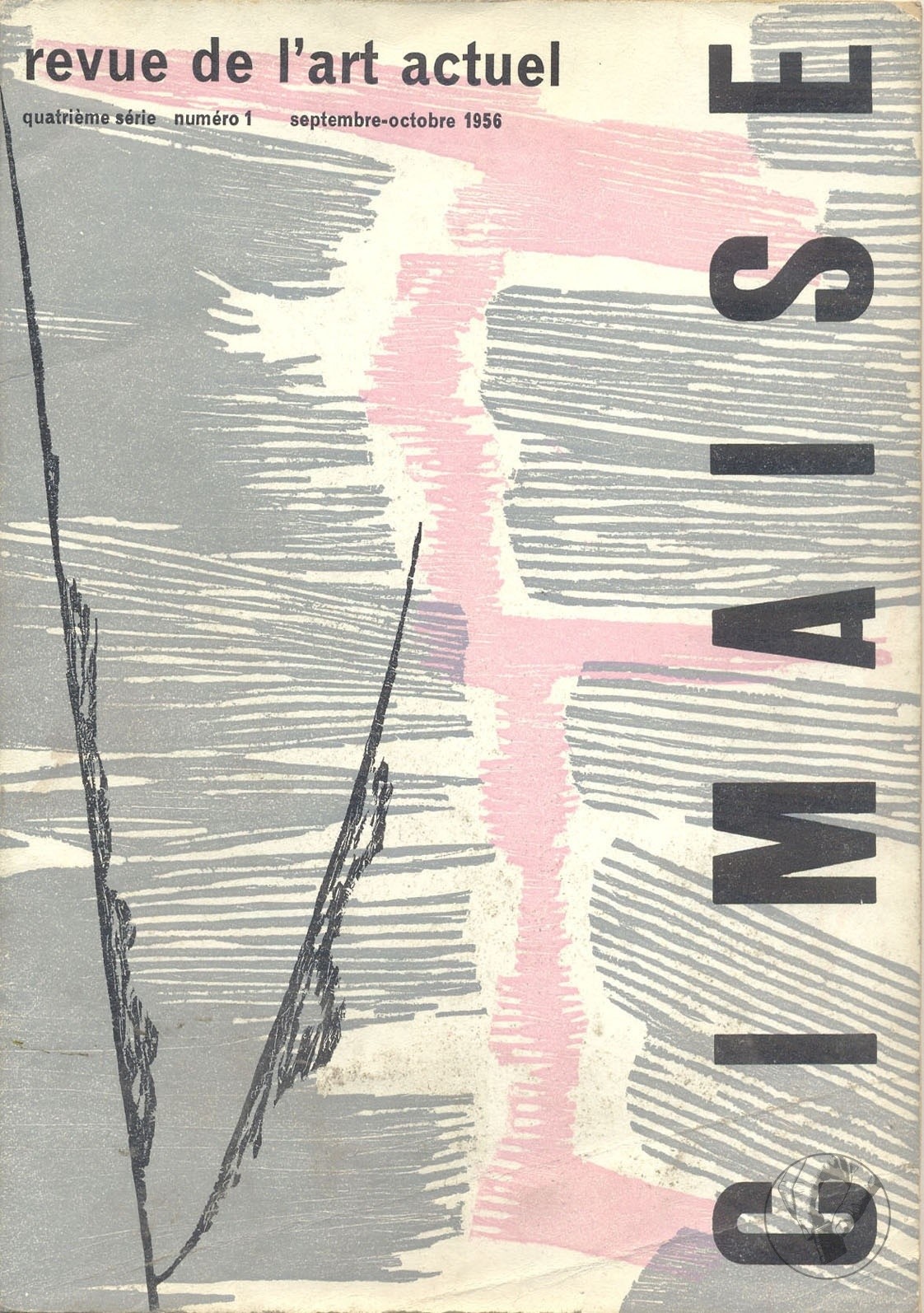
La revue "Cimaise" présente dans ce numéro des articles sur l'art actuel, notamment sur Hans Hartung, la Biennale de Venise, et les peintres Van Haardt et Sugai. Elle inclut également des critiques d'expositions et des informations sur l'actualité artistique. Le prochain numéro sera consacré à l'art américain.