Page 1
revue de l'art actuel troisième série numéro 4 mars 1956 EIMAISE
First pages of the volume, freely accessible.
revue de l'art actuel troisième série numéro 4 mars 1956 EIMAISE
Galerie de France 3 Faubourg Saint-Honoré, Paris 8, téléphone Anjou 69-37 --- Soulages peintures récentes du 13 mars au 10 avril
Cimaise revue de l'art actuel 34 rue du Four, Paris 6 Directeur: J. R. Arnaud Rédacteur en chef: Herta Wescher Secrétaire général: John Koenig Rédaction: J. Alvard, R.V. Gindertael, M. Ragon, C.H. Sibert La rédaction reçoit sur rendez-vous Abonnement (8 numéros) 1.400 frs - Par avion: 2.300 frs 34, rue du Four, Paris 6, téléphone Littré 40-26 C.C.P. Librairie Sélection Paris 5542.39 Diffusion: Allemagne: Horst Beck, Hoedingen ueber Uberlingen, Bodensee PS ch A Karlsruhe (Bd) 43328 Argentine: Editorial Victor Leru, Cangallo 2233, Buenos-Aires Autriche: Arnulf Neuwirth, Paracelsusgasse 8, Vienne 3 Belgique: Jean Milo, 28 rue de l’Arbre Bénit, Bruxelles C.C.P. Jean Milo, Bruxelles 1591.50 Danemark: Meiners Kunstforlag, Peder Skansgade 5 Copenhagen Grande-Bretagne: Alec Tiranti Ltd, 72 Charlotte Street London W1 Japon: Meiji-Shobo, Surugadai, Kanda Tokyo Norvège: J.W. Cappelen, Sortimentebokhandel, Oslo Suède: Eric H. Olson, Upplandsgatan 3, Stockholm, 10 23 77 Suisse: E. Genton, «L’Entr’acte», rue du Lion d’or 4, Lausanne, C.C.P. II 144-56 U.S.A.: Wittenborn and Co, 30 East, 57th Street, New-York 22 M. Flax 10846 Lindbrook Drive, Los Angeles 24 --- Sommaire Couverture de James Guitet Textes anglais Page --- Title --- The complexe of the Paris School by R.V. Gindertael --- Poliakoff by Michel Ragon --- It’s Diderots turn to talk by Julien Alvard --- Reichel by Herta Wescher --- Corneille by Michel Ragon --- Textes français: Page --- Title --- Le complexe de l’Ecole de Paris par R.V. Gindertael --- Serge Poliakoff par Michel Ragon --- La parole est à Diderot par Julien Alvard --- Hans Reichel par Herta Wescher --- Corneille par Michel Ragon --- Informations --- Les expositions Page --- Title --- Arp --- Survoltage académique --- Abandon du centre de gravité --- Francis --- Aquarelles et gouaches --- Coppel, Karskaya, Koenig --- Jeunes peintres --- Anthoons --- Viseux, Wexler, Loubchansky, Mucha --- Les arts en France et dans le monde --- Dumitresco --- Bruxelles, Mannheim, Bibliographie ---
Give (or have someone give you) a subscription to Cimaise the review of today’s art the only review in the world completely consecrated to the art of our time you will be up to date on avant-garde art its tendencies its spirit its manifestations you will show us your interest in backing us up and you will aid our effort in subscribing Subscription one year (8 numbers) 4 dollars payment can be made by your personal check, by international money order, or through our local correspondent --- Complete translation of the main articles translation by J.-F. Koenig The complex of the Paris School$^{(1)}$ (p. 9) My friends of the editorial staff of CIMAISE have insisted on giving me the last word in our little internal debate on the “Paris School”. I ought to be grateful to them, since the person who talks the last always has an advantage. But this is true only when the first ones have not exhausted the subject, and there remains something to say on the question. Now, completing each other very closely, the views of Julien Alvard, Michel Ragon, and Herta Wescher (1) have turned around it completely, leaving me nothing to add, all the more so since in understanding them well underneath their personal way of looking at things, their ideas are in agreement. The one that I might express in my turn would hardly be any different. Furthermore, I find that it is unnecessary to resume the opinions already put forth, in concluding. Must one conclude, for that matter?—that is to say, answer, as concerns the Paris School, the alternative: to be or not to be, when for that matter its situation and its merit are exactly those of never being to a sufficient point, which allows it constantly to become. Keeping account of all that has been said for or against it, and to explain its contradictions, there has come to my mind this definition of the School of Paris: > “Complex (as well in the meaning of “composed of unities of different types,” as that of “an association of ideas, sentiments, and unconscious or repressed memories”) whose first manifestation recalled by history goes back to the reign of Charles VI, but which was only invented and named by André Warnod five centuries later, during its largest expansion that followed the first World War.” In fact, the present exposition of painted manuscripts of France, at the Bibliothèque Nationale, has just recalled to us the presence of numerous provincial and foreign artists in the parisian ateliers. The commentary of the catalog insists on the fact: “The Paris of Charles VI (1380-1422) is a melting-pot that mixes with the French elements the afflux come from the Low Countries and Italy. This movement, which began in the middle of the 14th century, takes on such breadth that it finishes by giving us an impression of a brilliant, though disordered activity.” The classification of the works of this period is, for that matter, made under the heading: Paris and International Art. This impression and this heading: weren’t they also those of the art of the School of Paris between the two wars, and aren’t they even better adaptable to the effervescent artistic activity of contemporary Paris. Nonetheless, since the 15th century, one must acknowledge that the conditions for a centralization in Paris have changed, for it is certainly no longer the demand for manual labor, nor the favor of magnificent patrons of the arts that provokes the incessant immigration of artists from all the countries of the world. We know, or think that we know the reasons for this; they have already been underlined in the preceding articles, without their being equally valid or sufficient to justify this attraction of Paris, and its power to retain most of those who came here one day, in spite of the winds and the tides. (1) See CIMAISE, Serie III, Nos. 1, 2, 3.
Didn't we see, after the wide dispersion that took place with the invasion of 1940, the regrouping take place, and the empty places become full again with an extraordinary rapidity, and this all in spite of the worst possible material conditions that ever existed? It well seems nonetheless that for some time now that his privilege of Paris was, if not deliberately denied, at least fought with a certain amount of acrimony. To the point where objectively we could be led to ask ourselves if the supremacy of Paris as a world crossroads of the arts, if the mission that Paris had assumed for quite some time, in directing and regulating the talent and the creative genius of the artists come from all the horizons, if the universality of the School of Paris and its impulse could still be considered today as realities. Nonetheless, the young provincial and foreign artists arrive as numerous, if not more numerous, than in the past, to put themselves to the test of Paris. Why? I have tried hard, in the course of friendly conversations with a certain number of these adopted parisians, to make out the motives of their march on Paris, and their definitive establishment here. I heard rarely a clear response of logical reasoning. Each one expressed rather a sentiment of inevitable fatality. To live, to work in Paris, went without saying: “That was the only thing to do... you knew in advance that you couldn’t form yourself, or broaden yourself except in Paris...” And did you find in Paris the things that you expected? “I found something different, but better, and Paris made me different, too”—or—“different to the point of being disillusioned by it, for there are too many bad painters, but then, that’s a good thing.” Why Paris? “But it’s because you’re free here in your work, in your expression, free to keep out of things, or free to find the crowd again, and confront yourself with them when you feel it necessary.” Why Paris? “Because you had to get away, had to escape from yourself.” Why Paris, when everything is better elsewhere? One can’t claim that its attraction still comes directly from the prestige of a French art and a French tradition, and it really seems, on the contrary, that most of the artists of Paris refer themselves more readily to the works, the theories, and the teachings of foreign artists and movements (such as Kandinsky, Malewitch, Mondrian, Klee, the Stijl, the Bauhaus, Expressionism, Constructivism, the Pacific School, etc., of which the museums and galleries of Paris propose less examples than the public and private collections of other countries) than the direct influence of the French masters, for they themselves are often better and more abundantly represented, for all of the contemporary period, in the museums outside of France. It is nonetheless not impossible that a new perception of painting might take place in front of certain French works, but that is another question. Why Paris? Perhaps because here you can keep your hopes up right until the end. Everywhere else you must make a career for yourself, and become successful rapidly. Paris is perhaps the only place in the world where you can be a failure and live happily, for here, it’s never too late. I know everything that people reproach Paris and its school of being, misusing all the meanings of the word with the most perfect bad faith, and most often with the bad conscience of those who don’t have the courage to burn the bridges, and to live dangerously at their sole risks and perils, and who allow their regrets to become rancid, for the want of having dared. For a complex never avows itself. R.V. Gindertael --- Poliakoff (p. 10) Born in Moscow in 1906, Serge Poliakoff came to Paris in 1923, stayed in London from 1935 to 1937, and the next year, back in Paris, made his debut as an abstract artist. His friendship with Kandinsky, Robert Delaunay, and Otto Freundlich, has left no influence in his work. Doubtless, the encounter with these pioneers hastened his passage from figurative to non-figurative painting. In any case, his paintings of 1939 show already the sketch of his present constructions, the same taste for reds and yellows, and the tendency to make colors vibrate. It is nonetheless only in 1949, after a voyage to Denmark, that his style began to attain the maturity which has brought about his present-day success. Poliakoff’s painting is nonetheless not an easy painting. While Bazaine, for example, owes his celebrity above all to this taste for impressionism that become popular eighty years too late, Poliakoff continues neither cubism nor impressionism. Expressionism has nothing to do with him. Perhaps, at the most, one might find some antecedents with the Fauves, but he flees from pure color in any case. His personal universe has no trace of a souvenir of known forms. No reference to nature is to be seen in his canvases. His world is that of silence and “pure painting.” However, Poliakoff has nothing in common with the neoplastic or other geometrical abstract painters who use flat color. His thin paint is nonetheless of an extreme sensitivity which renders curiously sensorial this work which owes nothing to organic forms. This is the miracle of Poliakoff: the ability to make silence vibrate. I asked him about his tastes: “The great period for me,” he said, “is that of the primitives especially the Italians. I have always loved Cimabue, Giotto, and Simone Martini. I like also the Flemish School. Impressionism, notably with Seurat and Gauguin, gave me a great shock. Then there are Klee and Juan Gris...” To a certain degree, Poliakoff might be a painter of the same family as Juan Gris. They don’t resemble one another in any way by the forms that they use. But both of them have the same concern of deprivation; they have the same economy of means, and are emotive painters in spite of the character of their painting. Juan Gris is also, next to the thunderous outcry of Picasso, a silent man. But with Gris, Poliakoff names Klee, and Klee is at the antipodes of Juan Gris. But the thing is that Poliakoff loves fantasy. His painting is light and poetic. It curiously allies rigor and grace. When Poliakoff begins a painting, he draws first, directly on the canvas, the scaffolding which corresponds, he says, to “his own golden number.” Then he lets himself go, to seek the values, and this work brings him to modify considerably his original composition. He paints by means of successive layers, at the most three or four, mixing his colors on a piece of glass. We can note this particularity: the following painting is always the continuation of the one being worked on, until the idea which set off the series is used up. Thus the painter always composes several paintings which go together, forming a kind of symphony. Is Poliakoff, perhaps, like Schneider, influenced by music? No. Poliakoff, who for a long time had for a second occupation the job of a guitar-player, still relaxes through music, but for him it is a matter of two separate activities. He doesn’t admit the question of a “support” in talking of his painting. Nothing. Just silence.
Perhaps he might be more touched by architecture? or sculpture? He admits: “I could use my forms for sculptures. But they are before all a plastic poem. I was shown in Brittany certain forms of rocks which resembled those that I paint. I was astounded to see that these rocks had taken the forms that I use. No external influence takes part in my painting. If I had stayed in a cave all my life, I would have painted the same thing.” All this does not mean that Poliakoff shows us a devitalized painting, quite on the contrary. He has always searched to express life. For 10 years he did nudes à la Vélasquez, and if today all figuration and any remembrance of figuration have been banished from his work, he seeks nonetheless that which is human, through the sensitive form and the vibration of color. Through the fact that Poliakoff only speaks a rather rudimentary french, people often say that he is a naive painter. Certain persons who, for a long while, busied themselves in keeping him in the shadows, have propagated this legend. Poliakoff is nonetheless quite cultivated. Even when he played the guitar in a night club, he always read for two hours before going to sleep, and he continues to do so. Recently, he read all of Balzac in russian. Modern life, and modern scientific discoveries also interest him immensely. He found Einstein very passionate reading. But let’s insist again that all this has nothing to do with his personal work, and that this is of little interest except for a way of seeing the man, and through this, his work. He works, with great regularity, five or six hours a day. He is completely indifferent to comfort when he’s working. He said: “Big room, little room, easel, no easel, enough space for seeing the painting at a distance or not, not important...” He paints, for that matter, equally well with the painting placed flat on a table, or vertically on an easel. In his conversation, the word “form” seems to haunt him. He often speaks of “cosmic forms.” He says also: “It’s the surrounding space that makes the form.” His forms, never brutal, but clearly cut off from the rest of the painting, are aired by wide spaces. The superpositions, and very subtle transparencies, animate this space. One will not be astounded to know that during two years (1946-1948), he was absorbed by a camyeu technique. But his monochromatic canvases themselves came from the red and yellow which remain his favorite colors, or in any case, those most often-used. Replying to Julien Alvard for the album “Témoignages pour l’Art Abstrait,” Poliakoff expressed again this obsession of forms: “Abstract art is a different technique from that of figurative art, especially for the composition. In fact, with abstract art, the values of shading no longer count. One no longer knows where the background is. All the parts of the composition can take part as forms. Turn by turn, they are either major forms or minor forms, or if you prefer, in order not to have any ambiguity with musical expression, they are either principal forms or secondary forms.” Linked for years with a gallery specialized in geometrical abstraction, Poliakoff played there the part of the poor relative. The role of the art critic is vain and ridiculous enough in itself to allow him at least the only pleasure that the militants can permit themselves: to show that you were a good prophet. I flatter myself for having written in my essay “Expression et Non-Figuration” of 1948, that Poliakoff was “the best element, and the most finished personality among the painters linked with the Galerie Denise René.” To put forth such a thesis at that time seemed to be absolutely lunatic, for most of the critics only “discovered” Poliakoff beginning with the big success of his show at the Palais des Beaux-Arts of Brussels, in company with Gilioli, in 1953. As for the “geometricals,” Poliakoff confided to R.V. Gindertael: “I felt that geometry wasn’t good for my painting. And I have never had a system. I am contented simply in observing certain rules which aid me in finding the balance of my compositions.” He also told Julien Alvard (“Témoignages pour l’Art Abstrait”): “After Braque and Picasso, the decline of figurative painting has taken place. They deformed the outside world, and killed it as a sickness would; one had to get away from it, we couldn’t do anything else. The forms were worn out. So we began to seek farther inside, the eyes began to look for new forms in space and in the cosmos... Now, I am in my own personal cosmos...” At the period when geometrical abstraction and pure colors were à la mode, Poliakoff showed his “dirty” paintings. They did have a neglected look, but they were nonetheless a sane reaction to the “ripolin” style. They took part in his search for this vibration of light matter to which he has come today with a grand brio. The Russian emigration which in the preceding generation gave a present to Paris of Chagall, Soutine, Pougny, and Kandinsky, gave us still Lanskoy, Staël, Charchoune, and Poliakoff. And also several flashes of Chapoval, prematurely deceased. If Lanskoy and de Staël (as their elder, Soutine) distinguish themselves by the magnificence of their matter, Poliakoff is more secret, all in nuances. His extremely simple forms are animated only by subtle tonalities. Such a renouncement causes Poliakoff to balance himself continuously on a tightrope, and his successes are unequal. But in this not easily explainable realm where color alone becomes an element of delight, one can dare to say that he is a genius. Michel Ragon It’s Diderot’s turn to talk (p. 16) The Diderot that we know is the defender of sensitivity. His name, tied in with that of Greuze, remains rather sadly linked with a more pale expression of a return to nature. We have remarked in his Salons the superabundant and descriptive commentaries of the betrothed of the village, and the unnatural sons. The genre painting that he defends places the joys of the family in the heart of the most tear-catching melos. Now there is a Diderot who doesn’t like Greuze, who prefers Chardin, and puts Rembrandt above all else, a Diderot in whom the theoretician and amateur are on the level with the greatest of happenings in art. This clairvoyance was not given to him simply as the privilege of taste come to its maturity. One can follow throughout all of the writings of Diderot, not only those where we have to do with the question of painting, but even those which treat the theatre and music, a general debate on the foundations of art, animated by an unquenchable curiosity. His first esthetic writings go back to around 1750. He is writing out the Chapter “Beauty” for the Encyclopedia. Dide-
rot, at that time, only knows painting superficially: his pages therefore are before all the work of a theoretician. One can see by what follows that his thought is, from this time on, of a great assurance and an astounding perspicacity. Many modern critics could, for that matter, admire his liberalism and wideness of view. “When one requires that the general notion of beauty is proper to all beautiful beings, does one speak only of those who wear this epithet here and now, or of those who were called beautiful at the birth of the world, those called beautiful five thousand years ago, three thousand leagues away, and those one will name so in the coming centuries; of those that we have seen so in childhood, in mature years, and in old age; of those who are subjects of admiration with civilized races, and of those who charm savages. The truth of this definition, shall it be local, particular, and momentary, or will it concern all beings, in all times, all men, in every place. ...Put beauty in the perception of proportions, and you will have the history of its progress since the birth of the world up until today; choose for a differential character of that which is beautiful in general, any other quality that you wish, and your notion will find itself suddenly concentrated in a point in space and time. The perception of the proportions is thus the foundation of beauty; thus it is the proportions that one designated in all languages, under an infinity of different names, all of which only indicate the different types of beauty.” (Treatise on Beauty.) Mixed up in the disputes of his period, Diderot is hence forced to take a position. It is on the subject of the dispute of the buffoons that he will make himself the advocate of nature. And what a nature! Temperament, character, attitude, cry: judge yourself by what he puts into the mouth of the Nephew of Rameau: “Singing is an imitation, through sounds, with a scale invented by art or inspired by nature—as you will—either by the voice or with an instrument, of the physical noises or the accents of passion; and you will see that in changing here the expressions that must be changed, that the definition will apply exactly to painting, to eloquence, to sculpture, or to poetry. ...It is up to the animal cry of passion to dictate to us the right line. The expressions must be put pressed close together; the phrase must be short, the sense must be curt and suspended, the musician must be able to dispose of the whole, and of each if its parts, to leave out a word or to repeat it, to add one that he might need, to turn it inside out if needs be, like an octopus, without destroying it. ...We must have exclamations, interjections, suspensions, interruptions, affirmations, negations; we call, we invoke, we cry out; we moan, and weep, and laugh wholeheartedly. No wit, no epigrams, no pretty thoughts; that is too far from simple nature. And let’s not think that the player’s way of acting, with his bombastic speeches, can serve as a model for us—far from it! We must have something more energetic, less mannered, more truthful. The simple discourses, the common voices of passion are all the more necessary to us in that the language will be more monotonous, will have less accent. The animal cry, or that of the empassioned man, will give it this.” (The Nephew of Rameau.) This animal cry, isn’t it singularly near to the instinctive gesture, to the reflex action, to the emotional shock which have broken over painting since several years now? But if Diderot places himself as an extremist of sensitivity, he knows perfectly well the perils of such an esthetic position. He will uphold with a dazzling brio, in the Paradox on the Player, the rights and the advantages of a clear head against the dangers of a generalized sensitivity. “It is not that pure nature does not have its sublime moments; but I believe that if there is someone who is sure to grasp and conserve their sublimeness, it is he who will have already felt them through his imagination or his genius, and will render them cold-bloodedly. However, I will not deny that we have to do here with a kind of mobility of the feelings which is acquired or artificial; but if you ask me my opinions on this, I believe that it is almost as dangerous as natural sensitivity. ...It would be a singular abuse of words to call sensitivity this faculty to render all natures, even to the ferocious natures. Sensitivity, according to the only accepted expression that one has been able to give until now to this term is, it seems to me, this disposition that is the companion of the weakness of the organs, following the mobility of the diaphragm, of the vivacity of the imagination, of the delicacy of the nerves, which leans us to sympathize, to quiver, to admire, to fear, to become worried, to weep, to faint, to succour, to flee, to cry out, to lose one’s reason, to exaggerate, to scorn, to disdain, to lack any precise idea of the right, the good, and the beautiful; to be unjust, to become crazy. Multiply the sensitive souls, and you will multiply in the same proportion the good and evil actions of all kinds, with praise and condemnation carried to excess.” (Paradox on the Player.) Thus, after all, are intelligence and reason almighty? Diderot knows better than to claim this, and in the Treatise on Beauty, makes an extremely refined analysis of the notion of nature, where, in placing himself on a higher plane, he finally declares that it is really difficult to distinguish the works of art from those of nature, since it is wise to acknowledge the products of nature in art, and mutually, the intuitions of art in the realm of nature. “The thing of beauty is not always the work of an intelligent cause: movement often establishes, either in a being taken independently, or between several beings compared among themselves, a prodigious multitude of surprising relations. The cabinets of natural history offer a great number of examples of this. The relations are thus the results of fortuitous combinations, at least as far as we are concerned. Nature imitates with the utmost ease, in a hundred examples, artistic productions: and one might well ask (though I won’t claim that the philosopher who was cast by a tempest on the shores of an unknown island had the right to cry out, at the sight of some geometrical figures: “Courage, my friends, here are footsteps of men!”) how very necessary it would be to remark the relations in a being to have the complete certainty that he is the work of an artist; on what occasion a single fault in the symmetry would prove more that the whole given sum of the proportions; what does the time needed for the act of the fortuitous cause have to do with the relations observed in the produced effects; and if, with the exception of the works of the Almighty, there are cases where the number of the relations can never be compensated by that of the initial acts.” (Treatise on Beauty.) After all, what does he ask of art if it is not to live in a close symbiosis with nature. He gives a striking example of this in the “Essay on Painting,” through an architectural idea which seems extravagant. Asking himself what should be the disposition of a great place of Paris, today’s Place de la Concorde, and at the time the Place Louis XV, there came
into his mind the following project. “If I had the right to lay out the Place Louis XV where it is, I would have known better than to cut down the forest. I would have preferred that all its somber deepness be seen between the columns of a great peristyle.” One cannot better show, at a period where the problem of urbanism had not as yet taken up the question of a contact with nature, the prophetic preoccupations which amount to an aesthetics of “raw art,” touching on one of the greatest concerns of our period. Diderot is perhaps not the man who is for the full authority of nature, but he believes that art must be before all living imagination. Julien Alvard Reichel (p. 18) On coming into Reichel’s place, one always has the impression of being in the antechamber of a sanctuary where visitors are not allowed. You find yourself in a simple, ordinary room, different from others only because of the strange mosaic of the little paintings hung on the walls. The big window looks out onto the court and the blind alley which leads out to the street, whose noises break into the calm of the house, though you cannot see it. Inside, order reigns. The small objects are well arranged in order to leave a free place on the long table where, nonetheless, you cannot succeed in surprising the artist at work. You are surprised when he admits that he works during the day and not at night, but that is about all that you can learn about him. He doesn’t refuse to clarify himself, but rather, he doesn’t very well realize what happens when his painting seizes hold of him. He waits for the moment of complete concentration, of a clear vigilance where the real world melts away from around him, and another opens before him. Then, he only has to give his intuition free rein in order to let the images become composed almost by themselves. He doesn’t even know if it is the colors or the lines which begin the subject, both of them obeying a vision, both total and limited. Perhaps the scale of the tones is more voluntary, the tracing of the lines more unconscious; but the latter can afterward circumscribe determined forms, known objects, while the former, on the contrary, disperse themselves into the most fleeting of nuances. The first established element convokes the others, which present themselves in a fascinated suite which the artist nonetheless keeps well in control, watching over the communication of all the values. Each painting is finished in one sitting, during which Reichel uses up all his drive, in order to give to his subject the highest possible intensity, knowing well that he will be unable to take it up again another day, in another spirit. When, the next day, he looks at the result, the distance is already large enough between him and his work to allow him to be his own objective judge. That he likes to frames his best successes in order to hang them among the others seems to prove the final detachment which has taken place. The pictorial world of Reichel is difficult to describe because the explainable and the unexplainable mingle together without any frontier line at all. One might say that the first five days of the Creation repeat themselves constantly; the separation of the light and the shade of the sky from the earth and the waters, and the creation of the mineral, vegetable and animal kingdoms. But one finds no traces of the sixth day. It is not that man is absent from it, but he lives here clothed in a cape that renders him invisible, and under which he remains in secret communication with all the creatures. From this lost paradise, Reichel has kept a language of images where several vocables are used again and again, such as the bird and the fish, the flower and the moon, the eye and the heart: symbols of life, of his desires and his hopes, of the consoling and disturbing powers. They appear in the most varied of constellations, sometimes in a dominating manner, often submedged by the whirlwind of the elements that surround them. All of this universe is in a perpetual metamorphosis, each form engenders another, each futile line can take on a deep meaning. The scintillating crystals reflect the swarming of the microcosmos; stones that seem polished by brooks become large starlike flowers; in the bottom of the shells, leaves and eyes peer out upon the spectator. At each moment, the distinct contours can expand, allowing the content to dodge away, to evaporate. Fantastic beings are born, strange wraiths awaken, but at the same time, the artist doesn’t seem to insist upon their determination, which he accepts rather than decides. Reichel doesn’t invent, but rather follows the force of his imagination. There is, nonetheless, in all this abandon, a deep need of order, which in different periods has manifested itself in different manners. The works that Reichel did while still in Germany show an accentuated constructive tendency, cultivated at the time by the Bauhaus School; it led towards compositions with very strict planes, in which the irreal subjects underwent rather categorical schematizations. When he arrived in Paris in 1928, this framework loosened up, and quickly became dispersed. But to replace this, Reichel found even in nature some exact models: spider webs, honey-combs, the structures of pine-trees, the spirals of snails; discoveries which are never exhausted in the repeated drawings, but whose slight sampling help to form, by means of fine webs slid in between the colors, screens placed in unlimited space. And also the façades, with their lighted or flower-framed windows give marvelous pretexts for ordered compositions, for divided walls which, in reality, are only there in order to separate the outside from the inside, the cosmos from the human universe. Today, Reichel leaves aside the figurative subjects, expressing himself by the immediate relations between forms and colors. He composes his paintings by simple colored squares, where a graphic treatment inscribes certain slashed curves, and violent spots sound the alarm. The contours ravel out, the colors run. Geometric order no longer gives the slightest support to these fragile constructions which evoke dry-built walls of stone; the wind whistles between the cracks, announcing the storm that menaces all the shores of our existence. The more the perceivable objects disappear from this painting, the more its mystery becomes poignant. The tenderness of the colors themselves that the artist lends to his most melodious themes—small clouds floating in the transparent air, the clearing of the weather that drives away the mist—does not deceive one about the tragic note that sounds here. Perhaps, all the poetry that we take pleasure in finding in this work is only the curtain drawn before the abyss, a curtain that is torn open more and more. And perhaps this magician-painter forces himself to enchant the spirits of darkness only because of his fear to be devoured by them? The technique of water-color singularly suits this multiple imagination, keeping his fabulous subjects from becoming too heavy, allowing the softening of the too-precise contours. For years now, Reichel has used it almost exclusively, with a (continued on page 34)
Le complexe de l'Ecole de Paris par R.V. Gindertael Mes amis de la rédaction de «Cimaise» ont voulu que j'ai le dernier mot dans notre petit débat interne sur «L'Ecole de Paris». Je devrais leur en savoir gré, puisque celui qui parle le dernier a l'avantage. Mais ce n'est vrai que lorsque les premiers n'ont pas épuisé le sujet et qu'il reste quelque chose à dire sur la question. Or, se complétant très étroitement, les points de vue de Julien Alvard, Michel Ragon et Herta Wescher(1) en ont fait le tour complet et ne me laissent rien à ajouter, d'autant plus qu'à les bien comprendre sous des angles particuliers leurs idées concordent entre elles. Celle que je pourrais exprimer à mon tour ne différerait pas non plus. Je trouve inutile au surplus de résumer les opinions émises, pour conclure. Faut-il conclure, d'ailleurs? c'est-à-dire répondre pour l'Ecole de Paris à l’alternative : être ou ne pas être, alors que justement sa situation et son mérite sont de n'être jamais assez pour devenir constamment. Compte tenu de tout ce qui a été dit pour ou contre elle, et pour expliquer ces contradictions, il m'est venu à l'esprit cette définition de l'Ecole de Paris : «Complexe (aussi bien dans le sens de «composé d'unités de différentes espèces», que dans celui de «association d'idées, de sentiments, de souvenirs inconscients ou refoulés») dont la première manifestation retenue par l'histoire remonte au règne de Charles VI, mais qui ne fut inventé et nommé par André Warnod que cinq siècles plus tard, au cours de sa plus forte expansion qui suit la première guerre mondiale. » En effet, l'actuelle exposition des manuscrits à peintures en France du xiii° au xvi° siècle, à la Bibliothèque Nationale, vient de nous remettre en mémoire la présence de nombreux artistes provinciaux et étrangers dans les ateliers parisiens. Le commentaire du catalogue insiste sur ce fait : «Le Paris de Charles VI (1380-1422) est un creuset qui mêle aux éléments français l'afflux des Pays-Bas et de l'Italie : ce mouvement, commencé dès le milieu du xiv° siècle, prend une telle ampleur désormais qu'il en résulte pour nous l'impression d'une activité brillante mais confuse.» Le classement des œuvres de cette époque est d'ailleurs fait sous la rubrique : Paris et l'Art international. Cette impression et cette rubrique ne furent-elles pas aussi celles de l'art de l'Ecole de Paris entre les deux guerres et ne s'adaptent-elles pas mieux encore à l'effervescence activité artistique du Paris contemporain? Cependant, depuis le xv° siècle, il faut reconnaître que les conditions d'une centralisation à Paris ont changé, car ce n'est certainement plus une demande de main-d'œuvre ni la faveur de mécènes magnifiques qui provoque l'incessante immigration des artistes de tous les pays du monde. Nous en connaissons ou croyons connaître des raisons qui ont été soulignées dans les précédents articles, sans qu'elles soient également valables et suffisantes pour justifier cette attirance de Paris et son pouvoir de retenir la plupart de ceux qui y sont venus un jour, et cela contre vents et marées. N'a-t-on pas vu, après la grande dispersion devant l'invasion de 1940, le regroupement se faire et les vides se combler avec une rapidité extraordinaire et en dépit des pires conditions matérielles qui furent jamais? Il semble bien cependant que, depuis quelques temps, ce privilège de Paris soit, sinon délibérément nié, du moins combattu avec quelque acrimonie. Au point qu'objectivement, nous pouvons être amené à nous demander si la primauté de Paris, carrefour mondial des arts, si la mission que Paris a longtemps assumée en orientant et en régularisant le talent et le génie créateur d'artistes venus de tous les horizons, si l'universalité de l'Ecole de Paris et son impulsion peuvent encore aujourd'hui être considérées comme des réalités. Cependant, les jeunes artistes provinciaux et étrangers viennent aussi nombreux, sinon plus que par le passé, se mettre à l'épreuve de Paris. Pourquoi? J'ai bien tenté, au cours d'une conversation amicale avec un certain nombre de ces Parisiens d'adoption, de connaître les mobiles de leur marche vers Paris et de leur établissement définitif. Je n'entends guère de réponse nette d'ordre logique. Chacun exprimait plutôt un sentiment d'inéluctable fatalité. Vivre, travailler à Paris, cela allait de soi : «Il n'y avait que cela à faire... on savait d'avance qu'on ne pourrait se former, s'épanouir qu'à Paris...» Avez-vous trouvé à Paris ce que vous attendiez? «Je l'ai trouvé différent, mais en mieux, et Paris m'a fait différent aussi», ou bien «diffèrent au point d'en être déçu. il y a trop de mauvais peintres, mais c'est une chance.» Pourquoi Paris? «Mais parce qu'on y est libre dans son travail, dans son expression, libre de s'isoler, libre aussi de retrouver le plus grand nombre et de se confronter quand il le faut...» Pourquoi Paris? «Parce qu'il fallait partir, sortir de soi-même...» Pourquoi Paris, alors que tout est mieux ailleurs? On ne peut prétendre que l'attriance vienne encore directement du prestige d'un art français et d'une tradition française et il semble bien qu'au contraire la plupart des artistes de Paris se réfèrent plus volontiers aux œuvres, aux théories et aux enseignements d'artistes et de mouvements étrangers (tels Kandinsky, Malewitch, Mondrian, Klee, ou Stijl, Bauhaus, expressionnisme, constructivisme, école du Pacifique, etc., dont les musées et galeries de Paris proposent moins d'exemples que les collections publiques et privées d'autres pays) qu'à l'influence directe des maîtres français, eux aussi souvent mieux et plus abondamment représentés, pour toute la période moderne, dans les musées de l'étranger. Il n'est pas impossible cependant qu'une nouvelle prise de conscience de la peinture ne se fasse devant certaines œuvres françaises, mais cela c'est une autre question. Pourquoi Paris? Peut-être parce qu'on y peut garder l'espoir jusqu'au bout. Partout ailleurs, il faut faire carrière et réussir vite. Paris n'est-il le seul lieu du monde où l'on puisse être un raté et vivre heureux, parce qu'ici il n'est jamais trop tard? Je sais tout ce que l'on reproche à Paris et à son «école», en jouant de tous les sens du mot avec la plus parfaite mauvaise foi et le plus souvent avec la mauvaise conscience de ceux qui n'ont pas eu le courage de couper les ponts et de vivre dangereusement à leurs seuls risques et périls et qui laissent rancier le regret de ne l'avoir pas osé. Un complexe ne s'avoue jamais. --- (1) Voir «Cimaise», 3° série, n°s 1, 2 et 3.
Poliakoff : peinture, 1938, 65x54. Exposée à la Galerie Le Niveau, Paris, décembre 1938 ph. Marc Vaux
Serge Poliakoff 1) par Michel Ragon Né à Moscou, en 1906, Serge Poliakoff vint à Paris en 1924, séjourna à Londres de 1935 à 1937 et, l'année suivante, de retour à Paris, fit ses débuts de peintre abstrait. Son amitié avec Kandinsky, Robert Delaunay et Otto Freundlich n'a laissé aucune influence sur son œuvre. Sans doute, la rencontre de ces pionniers a-t-elle précipité son passage du figuratif à l'abstrait. En tout cas, ses peintures de 1939 montraient déjà une esquisse de ses constructions actuelles, un même goût des rouges et des jaunes, une tendance à faire vibrer les couleurs. Ce n'est toutefois qu'en 1949, après un voyage au Danemark, que son style commença à atteindre cette maturité qui fait son actuel succès. La peinture de Poliakoff n'est pourtant pas une peinture facile. Alors que Bazaine, par exemple, doit surtout sa célébrité à ce goût de l'impressionnisme qui est devenu populaire avec quatre-vingts ans de retard, Poliakoff ne continue ni le cubisme, ni l'impressionnisme. L'expressionnisme ne le touche aucunement. Peut-être, à la rigueur, pourrait-on lui reconnaître des antécédents chez les fauves, mais il fuit en tout cas la couleur pure. Son univers particulier ne porte la trace d'aucun souvenir de formes connues. Aucune référence à la nature n'est discernable sur ses toiles. Son monde est celui du silence et de la «peinture pure». Poliakoff n'a toutefois rien à voir avec les néo-plasticiens et autres abstraits géométriques aux couleurs plates. Sa pâte mince est néanmoins d'une extrême sensibilité qui rend curieusement sensorielle cette œuvre qui ne doit rien aux formes organiques. C'est là le miracle de Poliakoff de faire vibrer le silence. Je l'ai interrogé sur ses goûts : «La grande époque pour moi, me dit-il, ce sont les primitifs, surtout les Italiens. J'ai toujours aimé Cimabué, Giotto et Simone Martini. J'aime également l'Ecole Flamande. L'impressionnisme, notamment Seurat et Gauguin, m'a donné un grand choc. Ensuite, il y a Klee et Juan Gris...» Dans une certaine mesure, Poliakoff serait bien un peintre de la même famille que Juan Gris. Ils ne se ressemblent aucunement par les formes qu'ils emploient. Mais ils ont tous deux un même souci de dépouillement, ils usent d'une même économie de moyens, ils sont émotifs malgré le caractère de leur peinture. Juan Gris, c'est aussi, à côté de la tonitruance de Picasso, un silencieux.Mais, avec Juan Gris, Poliakoff cite Paul Klee et Klee est aux antipodes de Gris. Seulement Poliakoff aime aussi la fantaisie. Sa peinture est légère et poétique. Elle allie curieusement la rigueur et la grâce. Lorsque Poliakoff commence un tableau, il dessine d'abord directement sur la toile un échafaudage qui correspond, dit-il, «à son propre nombre d'or». Ensuite il se laisse aller, cherche les valeurs et ce travail l'amène parfois à modifier considérablement sa composition initiale. Il peint par couches successives, trois ou quatre au plus, mélangeant ses couleurs sur une plaque de verre. Notons cette particularité que le prochain tableau est toujours une continuation du premier, jusqu'à l'épuisement de l'idée qui a déclenché la série. Le peintre compose ainsi toujours plusieurs tableaux qui marchent ensemble et forment comme une symphonie. Poliakoff serait-il, comme Schneider, influencé par la musique? Non. Poliakoff, qui a longtemps exercé le second métier de guitari-te, se repose encore par la musique, mais pour lui ce sont deux activités séparées. Il ne veut pas qu'il soit question d'un «support» au sujet de sa peinture. Rien. Le silence. --- 1) Texte extrait de «L'Aventure de l'Art Abstrait», ouvrage à paraître aux Editions Robert Laffont.
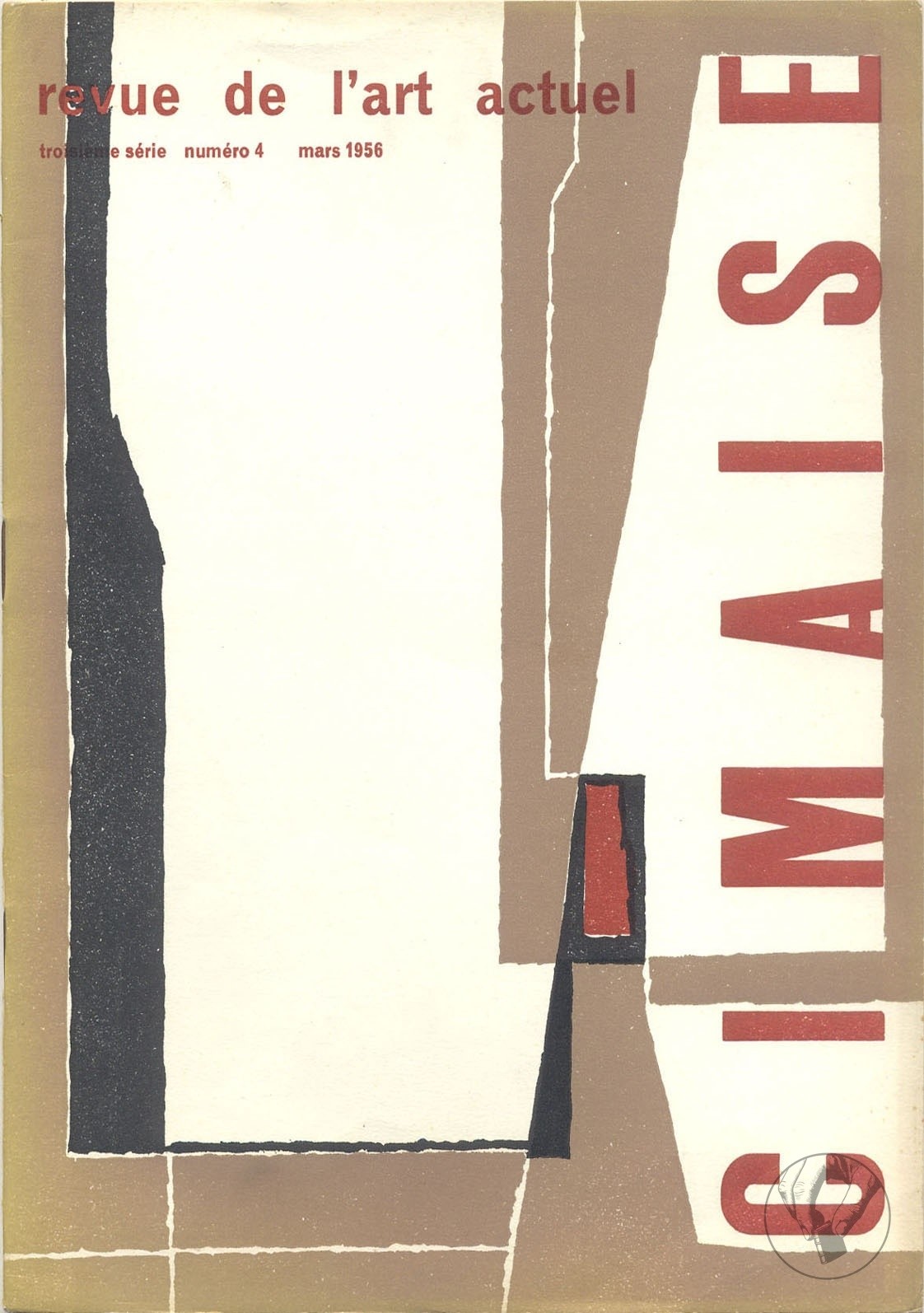
La revue "Cimaise" présente dans ce numéro des articles sur l'art actuel, notamment sur le "complexe de l'Ecole de Paris" analysé par R.V. Gindertael, ainsi que des études sur les peintres Poliakoff et Reichel. Le numéro aborde également des textes sur Diderot et des critiques d'expositions d'artistes contemporains.