Page 1
revue de l'art actuel troisième série numéro 2 décembre 1955 LES MAMAIS Oscar Gauthier
First pages of the volume, freely accessible.
revue de l'art actuel troisième série numéro 2 décembre 1955 LES MAMAIS Oscar Gauthier
Cimaise revue de l'art actuel 34 rue du Four, Paris 6 Directeur: J. R. Arnaud Rédacteur en chef: Herta Wescher Secrétaire général: John Koenig Rédaction: J. Alvard, R.V. Gindertael, M. Ragon, C.H. Sibert La rédaction reçoit sur rendez-vous Abonnement (8 numéros) 1.400 frs - Par avion: 2.300 frs 34, rue du Four, Paris 6, téléphone Littré 40-26 C.C.P. Sélection Paris 5542.39 Diffusion: Allemagne: Horst Beck, Hoedingen ueber Uberlingen, Bodensee PS ch A Karlsruhe (Bd) 43328 Argentine: Editorial Victor Leru, Cangallo 2233, Buenos-Aires Autriche: Arnulf Neuwirth, Paracelsusgasse 8, Vienne 3 Belgique: Jean Milo, 28 rue de l’Arbre Bénit, Bruxelles C.C.P. Jean Milo, Bruxelles 1591.50 Danemark: Meiners Kunstforlag, Peder Skansgade 5 Copenhagen Grande-Bretagne: Alec Tiranti Ltd, 72 Charlotte Street London W1 Norvège: J.W. Cappelen Sortimentebokhandel Oslo Suède: Eric H. Olson, Upplandsgatan 3, Stockholm; 102 277 Suisse: E. Genton, «L’Entr’acte», rue du Lion d’or 4, Lausanne, C.C.P. II 144-56 U.S.A.: Wittenborn and Co, 30 East, 57th Street, New-York 22 M. Flax 10846 Lindbrook Drive, Los Angeles 24 --- Sommaire Couverture: linogravure de Oscar Gauthier 3 Textes anglais 9 Art du XXe siècle par Weruer Haftmann 12 Vieira da Silva C.H. Sibert 17 L’école de Paris se porte bien par M. Ragon 18 Alfred Reth par R.V. Gindertael Peintres et sculpteurs d’aujourd’hui: 22 Laubiès par Julien Alvard 24 Informations 25 Les expositions par Julien Alvard, René Déroudille, R.V. Gindertael, Michel Ragon, Herta Wescher 32 Bibliographie 33 Textes anglais --- A nos lecteurs A la parution, au mois de novembre, du premier numéro de la troisième série de Cimaise, nos lecteurs ont pu juger des améliorations que nous avons apportées à la présentation de notre revue. Agrandissement du format, resté cependant à des dimensions maniables, afin de permettre une mise en pages plus agréable, augmentation du nombre et du format des clichés, impression plus soignée, enfin traduction intégrale en anglais des articles principaux pour atteindre plus largement un public international. Malgré toutes ces transformations, le prix de vente est resté très accessible : 1.400 francs pour l’abonnement d’un an (comprenant 8 numéros); prix du numéro : 200 francs. A ceux de nos abonnés, qui ont reçu notre lettre de rappel et n’y ont pas encore répondu, nous demandons, s’ils continuent à porter à notre revue l’intérêt qu’ils lui ont déjà manifesté, de bien vouloir renouveler au plus tôt leur abonnement à partir du numéro qui leur conviendra. A nos lecteurs au numéro, nous demandons de s’abonner; ils nous marqueront ainsi leur appui et leur adhésion personnelle. Pour que Cimaise puisse continuer à s’améliorer, il faut que le nombre de nos abonnés augmente, que son audience s’élargisse encore. L’accueil réservé au premier numéro de la troisième série nous donne bon espoir d’être entendu. Tout règlement peut être fait par chèque bancaire, ou par versement au nom de : Librairie SELECTION, compte chèque postal, Paris 5542.39, ou à l’un de nos représentants à l’étranger. Nous comptons sur l’adhésion de chacun. CIMAISE
Complete translations of the main articles translation by J.-F. Koenig Art of the Twentieth Century (p. 7) Art of the twentieth century! The century of the greatest adventure that men have ever undertaken, whose limits one cannot foresee, and which might well surpass human possibilities. Something has come forth which has modified, with a disquieting rapidity, the foundations of our knowledge, our vision of the perceptible world, and destroyed our faith in a possibility of an agreement between theory and experience. The secular structures, and the social and national hierarchies have suddenly crumbled, and the desire for a new form of social life has been manifested by the means of great and terrible wars. To this overwhelming power of the public cause which found (in a significant manner, especially among the western powers) how to manage the most unstable, the most dangerous, the most dynamic of all the possible syntheses between the desire for liberty and the feeling of anguish—that is to say, Democracy; to this terrific power corresponds, on spiritual grounds, an evolution in which are concealed energies of an even more explosive power: “One of the dreams that God has in contemplating himself.” (Benn) Thus we see a manifestation of a need that affirms itself for the revision of the position of man towards himself, and his relations with himself. This revision modifies fundamentally, even to the ineffable, the image that one had of man and of the universe. Formidable perspectives. Through clondy, nebulous, vanishing spirals, calculations discover a universe in constant extension, at the speed of light, and we are obliged to acknowledge that all our notions, even to the most essential ones, which are like the very fabric of our being—such as Time and Space—are subject to the law of relativity. The notion of substance has been impaired by that of the Field of Force, and notions of Energy, Probability, etc., replace that of the stability of matter. All of this surpasses the given bases of our senses, and throws our logic and our imagination into extensive new lines. It is not solely our conception of the perceptible world that we find so strongly shaken. Our notion of human nature is also found to be endangered through the intervention of psychoanalysis. Man can be compared to an iceberg; only its summit floats above the surface, while the remainder plunges down into the obscure sea of the subconscious, guided by mysterious currents. And immediately the duality of Man-Nature also disappears—this element which was in the foundations of humanist thinking. Thus man finds himself integrated into nature to which he belongs rather by his vegetative and subconscious life, from which he draws information (we might call this an “orphic” process), that his conscious mind renders useful. “Parallel to nature,” or “just as in nature” are passwords of modern esthetics. Much more than an image Modern thought associates the data of intelligence with that of intuition. Its methods are characterised by a wide liberty and the greatest possible liberation from any preconceived idea; this however does not take place without a certain feeling of anguish. It is from this basis of thought that modern art builds itself. One could not conceive it as independent of the mass of spiritual activities. It expresses, in part, a certain attitude in relation to man and his environment. This environment, its appearances, its reality, its components, have always been the themes of the artist, whose view remains the principal means of investigation; and for that matter, the “image” sufficed for a long while to express all that was important to man. But what takes place when we begin to find in the substance and the aspect of objects a complexity which was hidden until now; when our interrogation of them takes a new line, when even their objectivity becomes a doubtful subject in our minds, whose intuition and knowledge have been exercised in this doubt? What takes place when the river that flows under my window no longer appears with its ordinary aspect of glittering reflections and waves, but in the mystery of its flowing; and when a tree no longer stirs my sensitivity except by the biological secret of its growth. What takes place when our glance, endowed with a new penetration, searches beyond the habitual appearances, for the mechanics of development, of an evolution, of a transformation, and when these aspects impress us more, and thus necessitate their expression. In other words, what takes place when the interest stirred up by the view of a river, a tree, a flower, crystallises around a vocabulary which attaches itself to the dynamic part of their life: the flow, the growth, the flowering? Now, these shifts of interest are forced upon us by the clearer perception of the relations between our knowledge and that of reality. It is thus that certain works of art have for a title the name of an object which seems at first completely foreign to the spirit of the work. It is because this name prepared us formerly to see the habitual outlines of the object, whereas now the artist has translated his emotion, stirred by a deeper, broader, and more complete reality than only those of the formal appearances. The force of the relation which has been established between the object and the artist has enabled him to interpret his emotion in a work where the appearances are transformed. We no longer have to do with a field of flowers, but with the mystery of germination; and in place of the image of a lake, we have rather the splendor of the light, and also perhaps the joy of living, or the melancholy of a souvenir. Nor is a tree or a rock in a southern landscape, but rather the happiness of a unique hour when emotion penetrates the heart of the painter in the presence of the tree and the rock. It is no longer the image of the Holy Virgin, but the sublimation of a sentiment of piety and of meditation, such as, in bygone days, the calm rocking of the whimsical and absurd images of the litany of Saint Lawrence burst forth from a pious heart. Meditations and souvenirs To express the deepening and growing complexity of our knowledge, we have had to create new procedures and methods, another vocabulary and another technique, all of which we must know how to harmonise and to put to work in order to finally prepare our arrival in a reflective state. The same as with poets and musicians, who by dint of manipulating prosody and counterpoint, bring themselves to a point of acute receptivity.
The focussing, the assimilation, and the application of these means require a sharpened plastic intelligence. The modern work of art demands this clear intelligence, and at the same time, a profound intuition. This is its striking, and inherent particularity; and nonetheless, this is what inspires so much mistrust, for on one hand this art is infinitely intellectual (as far as the means are concerned), and on the other hand, infinitely meditative (as concerns the content). Thus, essentially, modern painting is an art conceived in the studio. It does not develop at the sight of a landscape, but rather works itself out in the studio, in the lonely cell, and requires a laborious manipulation of the elements that memory and meditation furnish it; it is a work done in the shadow of Mnemosyna, who was, according to the ancients, the mother of the Muses. A painter is concerned with a manipulation of memories when he puts into his canvas his perceptions, which in the beginning were successive, thus imposing a character of simultaneity on them; and also, when he renders more complex a phenomena of nature, which in fact presented itself under the most simple aspect. Today, every painter knows this method, but the result he obtains from it varies of course with each painter, and is naturally worth what the artist is worth. Now, these changes, in the pictorial transposition of nature, which go from expressive transfiguration to constructive elaboration and abstract symbolism, are in close poetic relation with this new world which is the source of our scientific thought, and of our general conceptions of reality. Thus, their origin is the same. To this is added the fact that our experience and reflections have led us to the conviction, considered today as being a certainty, that just as the realities of our physical environment can be transformed and can serve as a support for a manifestation of our inner life, the absolute and abstract forms created by our wit and sensitivity can serve as a support and can acquire the weight of reality: that is to say that our mind can integrate them into the experimental part of reality. Thus we arrive at the experience that man cannot take except from himself. Thus we are given the ability, with the aid of a purely plastic means, to draw forth into the light the messages hidden in the depths, covered up by our daily existence, and to render these messages perceptible: this is something that figurative painting could only do through the means of metaphors. Thus appurtenances succeed in showing themselves, instance becomes fixed, the canvas becomes a blackboard on which are found written the indefinable messages created by our anguish or our passions, by happiness or the peace of mind. The possibilities are numberless, and have a much wider scope than what one usually means in talking of “expression.” They allow themselves to be organised into subtle concerted phrases, which suffice in themselves, that have their own laws, and a specific structure; and from this geometry one can develop a whole series of harmonious propositions. One can thus arrive at a rediscovery of figuration, the recreated figure can, for the painter, mark the unique hour where the twilight of the orphic state suddenly brightens. In fact, the informative power of modern painting is illimited, it extends from the simple harmonic accord, passing through the experience of inner existence, even to the interpretation of the whole perceptible universe. The division, so remarkable today, between “figurative” and “abstract” is nonsense: modern art, in fact, comprises both of them. When one thinks about the liberty that modern art possesses, one can state that it is a type of liberty directed towards a constant renewal. For that matter, the validity of its past is guaranteed by a group of logical, precise, and well articulated arguments, whereas its future is nowise engaged, and conceals all of its possibilities, remaining essentially unpredictable. One should recall the words of Picasso: “I don’t seek, I find,” which expresses rather exactly the modern methods of artistic creation. “To seek” implies the idea of a goal more or less obscurely sounded, and thus one possesses already a knowledge of this goal. “To find” means that one is open to everything, to all knowledge, even to chance, and an enthusiastic acceptance of all that is offered to you. The modern work of art appears to us as an unlimited adventure in a totally unknown land; each modern work is a testimony of this. “The artist knows an infinity of things, but he doesn’t know them until afterwards,” says Paul Klee. The artist is at the extreme point of things; before him is the chaotic and shapeless mist which comes before the dawn; he advances, groping with his antennas, to transform it, when the right moment comes, into a presence. Werner Haftmann (Extract from a conference given at the opening of “Documenta”, an international modern art show, at Kassel, Germany.) Vieira da Silva (p.10) Vieira da Silva appears to us with the aspects of a lovely and dark-haired woman, slow-speaking and slow-moving, with eyes that both captivate you and reject you. A vast studio is her domain, where one finds (as if one had known them always), the dark corners and false perspectives, a ceiling in whose limits the eye is lost. Immediately an impression of dizziness takes hold of you, springing from the contradictory lines, the divisions of shade and light. After several moments of that type of conversation where each one remarks the gestures of the other, becomes familiar with him, or lays for the other the nets of preferences and dislikes, I felt the desire to know Vieira da Silva better. But, a painter above all, though she could tell you about herself, she would rather have you understand by looking at her paintings. We know about her recent works through the shows that she has had in Paris since her return here in 1947. Her camayeu in red-yellow or green-grey tones, sometimes blue-grey, is not unknown to us. Nor for that matter is her strange graphism, put on flatly, giving to the trace both its dynamic value as a line and its surface thickness. The tracings, with Vieira da Silva, fill also a double function: the architecture of the canvas, they are also the dark framework, specifying the always rigorous, if not simple composition. This painting without curves, almost completely made up of vertical and horizontal set-offs, usually on a broad surface, is often lit by a striking white which opens a kind of door. How is it that Vieira da Silva has access this so personal universe of a labyrinth inside a broken mirror?—a canvas of 1935, “The Room” reveals this to us. It seems impossible not to find here the prefiguration of her present art, of this manner both synthetical and meticulous, where the landmarks flee away, and the paths are crossed. Vieira da Silva confesses a secret
tenderness for this canvas where she found, after having painted it, the realisation of her childhood dreams. This room, a universe shut on three sides, without windows, is lit (as the stage of the theatre is by the foot-lights) by the studio’s lamp. Converging lines lead us to a high wall of beige-grey tones. Strange transparent partitions stretch the chamber instead of insuring its immobility and its solidity, and on the contrary, contribute in heightening the impression of contingency. As if it were not only a room, but the expression of all the rooms where one feels oneself both imprisoned and yet free, shut away from the glances of others. Its strange nakedness, the light tracings of the partitions, the absence of furniture, of objects (except for a tiny blue and red electric train, stopped for that matter, but in which—Vieira da Silva confided this to me—she once got aboard) seem, if one only looks at the canvas long enough, a dangerous mirror of emptiness. Now, the attraction of empty space, within this world bound by the law of gravity, by the three dimensions, by the rains and the sun,—Vieira da Silva says that she has always felt it, been submitted to it to the point of dizziness. She walks through a dead city, bristling with obstacles that oblige her to find her way through her own traps. This labyrinth, both terrifying and reassuring, even if it infallibly leads toward a distant end beyond which one can feel that there is nothing more, is also, because of its difficulties, its barriers, its detours, a guarantee. It is not so easy to toss oneself up over a bridge, or to wander, as the painter dreamed to do during her childhood, in the space that separates the cliffs from the sea. And probably this inner path followed by Vieira da Silva is more important, in the pictorial translation that she makes of it, than the uncertain exit she might find at its end. When Vieira da Silva talks about herself, all of her sentences begin with “when I was a child...”. And when she was a child, it was during the war. That of 1914-18. She lived in a perpetual obsession of the war, whose image according to her, by one of the subtle linkings peculiar to children, mingled with those that the Apocalypse suggested to her during the readings that her mother and her aunt made of it each evening. In her imagination, cities, and black and white horses came forth from the shadows where the trumpets of the Last Judgement blasted. Then she went to bed, and through the shutters of her room, the street-lights came, tracing a peculiar pathway, to dance upon the walls. Then came the voyages, her arrival in Paris in 1928 where she worked furiously with Friesz, Léger, and with the engraver Hayter. In 1930, she marries the hungarian painter Arpad Szenes, and the voyages begin again. From 1933 on, her first shows at Jeanne Bucher’s. When the war came again, Vieira da Silva found herself in Rio de Janeiro. She encounters here many europeans, refugees from all countries, and her obsession grasps hold of her again. In 1942, a refugee polish woman tells her of her flight from Warsaw during the siege, striking so vividly the artist’s imagination that in a few days Vieira da Silva brushed one of her most admirable canvases, “The War.” This astounding evocation participates in the manner of the “primitives” (people often mention Paolo Ucello to her), and carries to its highest degree the force of expression that certain non-objective works can attain. In this canvas, entirely in red and yellow tones, with certain gray variations and some black accents, everything meets in a harmony in the very heart of the conflict. Human bodies, some thrown on top of others, some against others, dispose themselves in a composition that never ceases to be plastic, as if, beyond the concern of veracity, of pity, the lines and groups of lines, without a will for representation, could mean something more intense than a face too realistic to be able to show the pain, the horror and the annihilation of a war. Pressed one against the other, these bodies do not express the confusion any more than does the setting, the ceiling of this strange tunnel where so many frightened people are grouped. In this picture, run through by curious lines of force (close to certain futurist realisations), the white horse, out of her childhood dreams and nightmares, makes a supreme effort, a final leap. If, in the work of Vieira da Silva, “The Room” and “The War” are clearly figurative works, the canvases that she has been showing us for some years now, after the first paintings of 1935, belong to the non-figurative world. In that which concerns her, it seems impossible to use the term abstract, for her procedure is entirely different from that which leads to deliberate abstraction. Without a preconceived system for the composition of her canvases, Vieira da Silva finds herself engaged, each time she begins to work, in an adventure of which she is not only the author, but also the go-between and the spectator. By the delicacy of her sensitivity, from which she often suffers, she makes herself the agent between her emotions, her vision of the outside world, and ourselves. Vieira da Silva seemed to me to be prodigiously attentive to other people, to their sincerity, their suffering, their happiness. Her non-objective work is not only a translation of herself, but also a relation between herself and the outside world. Between the others, their complexity, and the canvas. Something that certain other painters have tried to express, the emotive value of lines, of their direction on the canvas, the introduction of time in the combination of space-surface,—she finds it by instinct. But not through tranquillity. Vieira da Silva seems a prey to a kind of anguish, and affected by a world of fluctuations, suffocations, and contradictions. And it is perhaps the violence of this anguish that gives to her entire work this sincerity, too evident for one not to be touched by it. Fully belonging to our era of struggle, speed, and indecision, but also that of ultimate frankness, Vieira da Silva, the “invisible stroller” (this is the name of a canvas of 1950), leads us with a glance, lays and denounces the traps in her spider-webs and her rooms with multiple but walled-in exits. Her detailed graphism, her vanishing lines, her returns, the subtle shades of the colors that she uses, betray a sharp perception of the realities of our time, and also a special gift of transposition. But in this art cut in sections, the solidness of the composition always allows us to reach solid ground again. C.H. Sibert The school of Paris has its cheek of tan (p.15) Julien Alvard declared in our last number that: “There is no School of Paris; to talk of it is to talk about nothing.” Certainly, a large part of the art critic’s trade consists precisely in talking about nothing. So I would like to accept the challenge of our friend Julien, and will try to prove that there really is a School of Paris still. As we know, the term of the “School of Paris” first served in designating the cosmopolitan artists, for the most part jewish, who made up rather what might be called the School of Mont-
parnasse (Soutine, Modigliani, Kikoine, Kisling, Foujita, etc.). But even though the term of “School of Paris” has been used restrictively for a group of artists of Montparnasse, this doesn’t hinder us from re-taking the term and giving it its more general application, at the same more consistent with its etymology. The School of Paris is a state, or rather the result of the fact that since the triumph of Impressionism in Paris, this city has remained one of the most active and prolific centers of “damned” and living art. Picasso, Chagall, Max Ernst, Miro, Juan Gris, are not french painters, but they are rightly, along with the french-born Matisse, Léger, Braque, etc., among the painters of the School of Paris. The foreign painter, as well as the provincial painter, who has studied his Humanities, who discovers living art on the banks of the Seine, becomes a painter of the School of Paris. Thus, today the former swiss Schneider, as the former german Hartung, the north-african Atlan as well as the rhodesian Soulages, the russian Poliakoff like the breton Deyrolle, are all painters of the School of Paris. Let us be quite clear on the subject: the School of Paris is not a style (as was for example in the past the School of Pont Aven), but rather the result of multiple confrontations, accumulations of experiments, the meltingpot of living art for a half-century almost without interruption. This is why (and Julien Alvard underlined it with reason) the expression of “cartesian climate” applied in regard to the artists of the School of Paris is absurd. “French moderation” is a proverbial idiom as well known as that of “la furia francese,” “french wantonness,” “french jokes,” “french fleckleness,” “french insubordination,” etc. All of them rather contradictory “French qualities.” But if each man has within him numerous contradictions, how should a nation escape being burdened down with them? France is the country of Descartes, certainly; but at the same time it is also that of Pascal. And I was even told that the Marquis de Sade, Gérard de Nerval, Rimbaud, Berlioz, and Antonin Artaud were as french as Molière! So I don’t exactly see, as concerns French arts and literature, what proves that French genius lies in its “moderation.” It is true that the french middle-class has a taste for moderation, and that it succeeded, through its official writers and its salaried professors, in revealing this image of a middle-class France, both “moderate” and reassuring. But were the men of 1789 reassuring? Or those of the 1st Empire? And those of 1848? And those of the “Commune” of 1870? If, after Impressionism, Cubism is a manifestation of the School of Paris, two great contemporary movements nonetheless were born and developed outside of our frontiers: Expressionism in Germany and Flanders, Abstract Art in Russia and Germany. If the Soviet Government hadn’t changed its policy towards the Fine Arts, if the Nazis hadn’t persecuted the avant-garde artists in Germany and the countries placed under its influence, the School of Paris might have exhausted itself with the last cubists or “fauves”, while the living art centers would have remained Moscow and the Bauhaus. But drawn as if by a sort of geographical fatality, a large number of these persecuted artists retreated to Paris. If it is impossible to consider Kandinsky, for example, as one of the artists of the School of Paris because all of his art was already defined when he arrived on the banks of the Seine, if the abstract artists of the first abstract generation are artists of the School of Moscow, or the School of Dessau or Weimar, the second abstract generation grew up in Paris and it is not an imposture to find in it the new phase of the School of Paris. The different group shows hung under this title (Galerie de Babylone, Galerie Craven, and just recently the Galerie Charpentier) with about the same non-figurative artists, are significant of this evolution: the School of Paris consists today of Manessier, Pignon, Bazaine, Hartung, Soulages, Schneider, Atlan, Poliakoff, Deyrolle, Vieira da Silva, Estève, etc. Also today there is a new generation of all sorts of nationalities who work in Paris: there is Doucet, the frenchman as well as Keenig, an american; Rezvani, a persian, and Corneille, a dutchman; Pichette and Laubiès, Lapoujade and Dmitrienko. The School of Paris has an extraordinary faculty of absorption. It registers and digests all that comes to it from the five parts of the world and transmutes this into a unique and multiform (but rather indefinable really) art, but one in which you can always find the mark of Paris. This absorbed and digested art influences in turn the national artists who, in turn... Yes, the School of Paris has its cheek of tan. Michel Ragon Alfred Reth (p.16) In the frame of the series of shows consecrated by the Galerie de l’Institut to the “remembrance of the heroic epoch” of cubism, a retrospective show of the work of Alfred Reth finally gives a justified consecration to this great, though ignored artist. Mr. Waldemar George finds himself obliged to qualify him so, in answer to the “scepticism of a public incapable of discovering the true values”, and renders evident his association to this rehabilitation by the publication of a very pertinent study of this work. The heroic epoch of cubism, that of the crucial years from 1907 to 1914, —we are quite able to see it clearly today, and Reth’s experiments of this time bring us an unquestionable confirmation — is strictly contemporary and solidary with other enterprises, which in upsetting the former conceptions of art, led to the “complete rupture with the habits of traditional figuration”, and from which “the direct optical study of the outside world that humanity had imposed as a goal for its painters and sculptors since the Renaissance, ceased to be an incentive for them,” as one of the most empassioned and actives witnesses of the period, Mr. Daniel-Henry Kahnweiler, expressed it. The fact that cubism, within the limits of its principal esthetics (elaborated, for that matter, à posteriori) should have seemed to fall short, and that a certain number of its adepts became repentant; also the fact that the cubist painters “were realistic painters, and that the whole cubist enterprise tried precisely to find a more real figuration”, may have succeeded in misleading us, kept us from finding in cubism the same profound reasons which animated in many places and in different ways a whole generation of artists, bringing about the installation of an “introverted” art, after six centuries of an “extroverted” art. This is Mr. Kahnweiler again who formulates this definition of the great plastic revolution of the beginning of the 20th century, an excellent formula in that it underlines “the meaning” of cubism in its beginnings, nowise separating it from
the other inward-turning experiments which, on different bases, were simultaneously developing elsewhere. As much by his reflections and his writings as by his works, Reth elucidates for us this situation of the first hours of cubism of which he was a part, even though, by the inclination of his mind and character or by the course of circumstances, he remained solitary, and was never directly linked up with either the group of cubists of Montmartre, nor that of Montparnasse where he nonetheless worked since his arrival in Paris in 1905. His paintings and drawings spaced out between 1908 and 1914, that we have just been able to see again thanks to this show, bring to life before our eyes, by all of their characteristics, the exciting period of the first “mental” works of Horta de Hebro, of l’Estaque, and La Roche-Guyon or the Bateau-Lavoir. The synthetical structure of the landscapes and the figures in “Nude men with horses” painted by Reth in 1909, after a series of studies drawn in 1908, and the “Women Bathing” of 1911, are already in fact the same as those of the “Old Castle” of Braque or the “Woman with a Mandolin” of Picasso, and are not second to them in any way in the solidity of the pictorial qualities nor by the interest of their determination. One should even acknowledge that in this comparison, Reth affirms a more deliberate will for the liberation of the form. Thus his “Still Life” of 1910, and his enhanced drawing “Study for a Still Life” of 1912, by their simplification and rigor, attain a degree of abstraction that the other cubist painters didn’t approach until much later. Besides, from 1908 on, in the drawings and sketches which prepared his compositions, Reth had traced rhythmic and cadenced diagrams, completely liberated from the fortuitous aspects of the outside world. One day, when he leafed through with me a notebook of this period, there were certain colored studies where it seemed to me that I could perceive through their orthogonal geometrisation that they gave notice, even at that time, of neoplastic principles. I believe that the experimental research of Reth, favored by a natural inclination towards meditation and the extremely clear realization that accompanied them, enlarged the intentions and possibilities of cubism for him, in the limits in which the temporal and circumstantial movement situated them. Didn’t he state to me (Témoignages pour l’Art Abstrait, 1952): “Certainly, the cubists moved rapidly toward abstraction, and without a doubt the final step would have been taken much sooner if the war of 1914 hadn’t taken place.” Undoubtedly, he generalised by modesty or by his liberal views, but this tendency toward abstract art is evident with him from this moment on, and he accomplished it perfectly later on, as did other heterodox cubist painters, such as Delaunay, Mondrian and Herbin. Certainly, he found himself, at a certain time, inclined to refuse a narrow cubist orthodoxy, which according to him, was already by-passed even at the moment when it was elaborated and became a theory; we can find proof of this in his formal and spatial researches rendered concrete in his already completely non-figurative drawings, which are contemporary with his cubist paintings, and even preceded them, since the drawings of “relations between straight and curved lines” date from 1908 and 1910. We cannot better know his authentic proccupations during the first years of cubism than by referring ourselves to the reflections that he wrote to present and explain his works on the occasion of the show that Herwurth Walden, after a visit to Paris, organised for him in February 1913, in the halls of his review, “Der Sturm”, in Berlin, and which grouped 80 works. I feel it necessary to reproduce completely, in order not to deform it, this declaration which constitutes a most important document of the period, and which I can certify is authentic: “My painting of Varengeville (1909) is the one that I consider in the end as my first real work. It was created in a period when I blindly followed my instinct without having any recourse to the control of the mind. But the artist arrives necessarily at a point where he must begin to work consciously. I had shown the No. 5 (Composition with Nude) at the Salon d’Automne. In these large halls, with a different lighting than the one that I personally would have preferred for it, it made the most unhappy sort of impression on me. I found it weak in color and in composition. No. 6 (Composition with Nude) was the answer that I gave to it at the Salon des Indépendants; it was exactly opposite to the previous one. This canvas represented a great change in my work.” “I perceived that it would be false to interpret what people usually call the “character” of objects, for example the elongated form of the neck of a bottle and its relation to the exact proportions of the thick body of the bottle; or the wide trunk of a tree in opposition to its fine, spread branches; the proportion between the large body and the small neck of a man.” “From this time on, I created only compositions. I applied myself to show essentially the relations between the various masses. The problem consisted in finding the absolute universality of the form, and at the same time making it appear, in each particular case, as unique and personal, by the interplay of the order of the relations.” “Each time that the examination of my work left me unsatisfied and I tried to render evident the single thing that seemed to have an expressive value, I found well determined relations in the forms.” “Artists who work seriously very often encounter, after a great struggle, such relations between the forms, but in the fear of appearing as pure theoreticians of reason, they customarily keep their discoveries and their secret rules to themselves.” “I believe that the conscientious worker should have the right to express himself, and thus I would like openly to discuss the numerical relations between the forms which are familiar to me.” “We have to do here with the proportion beween 2 and 7. I believe that in examining the great art of the primitives the same proportions can be found. I don’t think that the roots of art vary very much with time. I have rather the opinion that the art of our time isn’t different from the great art of former times by its quality, but rather because of the obligation of the artist to consciously apply his knowledge, a knowledge which was perhaps instinctive with the primitive master, guided and protected from mistakes solely by the imperatives of religion and the cultural customs of his time.” “From this period came the paintings No. 14 to 24 (all of them of 1911 and among which are to be found principally the compositions with nude figures and horses in a landscape, and a single portrait, perhaps that of the “Seated Girl” which is presented in the show at the Galerie de l’Institut. — R.V.G.). But I found that even these pictures were too directly reliant on material nature.” “I have the opinion that art is not in competition with nature by the atmosphere, the psychology, the sensation, but that the task of art is to express in space the representation that the mind of man has of things. Just as a pictorial poetry or music, or a literary or musical painting cannot exist, it goes as well that every trial for a mixture or deviation of the arts leads to
absurdity, and thus it is that the act of production and that of creation have the same roots in man. Thus, there is a moment in the plastic arts which corresponds with nature.” “Poetry and music take their point of departure from time. The time faster doesn’t seem to have a role in the plastic arts, but this only seems so. It must be admitted that it is absolutely impossible to take in a painting with a single glance, as it is commonly believed. Instinctively, the view of the canvas starts from a certain point, and runs over the image in a given time. Only the illusion of a naturalistic painting with its perspectives tries to deny the evidence of this fact.” “An important task of the artist is to guide the eye of the spectator. In the paintings Nos. 32-36 (all of them entitled “Vorstellung nach einer harmonie”, and among which are to be found the two versions of the “Restaurant Hubin”), I have consciously tried to construct for our view, simply by the relations between the forms, this point of departure in time.” “Here reappears the purely spiritual parallel, the true linking between plastic art and its relations in objective nature. In nature, this undetermined and floating something that we call atmosphere, or the tonality of the landscape, may be that which causes a human figure, a living organism to appear. The same as in the world of our paintings, vaguely tinted masses rather than precisely contoured forms heighten the meaningful constructive elements of our conceivable world.” “I believe that the realisation in the creative field of the immense difference that separates art from nature, can alone truly free art from its isolated position in our time, and give it a true function in our life.” It is just a short time after this, in 1914, that Reth showed his cubist works in the Galerie Berthe Weill, along with Metzinger. Soon came the war, and his mobilisation followed by his discharge came to interrupt his work. When he took it up again, the heroic period of art is finished for everyone, and “the spirit of our research was disorientated,” says Reth; “we had to come back quite a bit, or even start back at zero.” For his part, while still obtaining inspiration from daily sights, he took up simultaneously again the course of his trials in syntheses and geometrisations, and cut off practically from cubism, he brought them progressively closer to abstraction, but without ever losing sight of the fact that “essentially, non-figurative art is the same thing as figurative art;” that is to say, that both modalities bring about the satisfaction of the needs for creation which is in man. Man remains always the same as he was a thousand years or a millenary ago, and his condition is always that of existing in the world of nature. Thus, “the latter, in non-figurative art, even without our desiring it, or thinking about it, will always exist in our sub-conscious mind, well-hidden. Running through non-figuration, by forms and colors, a relation will always exist with nature, of which we are a part. Thus we must consider that in non-figurative art as well as in just art, it is the personality with all of its characteristics which is expressed, and this expression of the individual is even the essential part of his work.” After the period of an expression of a double source, visibly composite, but constrained by very strict geometrical laws, which continued until about 1928; after still another period, relatively short of “constructivism” which began in 1935,—both of these periods attached and cut through by rhythmic works — finally began, in 1944, Reth’s great present-day period of the “harmonies of materials” where, because of his concern to avoid any imitation, he was led to use diverse materials in fragments, or even ground up in order to keep from separating the color from the material. Today, with the same integrity and the same free spirit, this artist, 71 years old, pursues his work without the slightest faltering. Doubtless, at different times, homage has been paid to his talent and his personality, and his place has been marked in the historic shows on cubism, but we must state today that what has been granted to him has always unjustly been measured out. Reth has thus undergone the fate of the unwonted discoverers and the truly revolutionary creators; he is among those for whom the effectual acts count, and who scorn the publicity or scandalous gestures that draw attention. It is really difficult to modify anything at all in the established systems and the acquired reputations; however the history of art, and principally that of contemporary art, it seems to me that they should be revised, or even completely gone over from top to bottom, since the evolution which continues opens not only new perspectives toward the future, but also modifies at the same time all of the previous co-ordinations; and the works which are just being finished call again into question, for better or for worse, all of the works which have preceded them. R.V. Gindertael Laubiès (p.20) It is a thrilling and critical moment for the artist when he shows his pictures. Laubiès doesn’t do it with charm, nor with modesty, nor with raging extravagance. He thickens the atmosphere with a flying squadron of negligent and rapid words which are destined to insidiously boycott ideas and to sow wild oats in the sacred woods. Reflection is with him in the state of reflex. In painting, it is like having the double of a personage appear. The problem turns itself inside out like a glove, and everything directs itself in the opposite way: here we have the reflex which is in a reflective state. One discovers him listening for the most fleeting of things: with him, it is not a love of passing time, but the most direct means of access to musing. Rapid and slow, his painting is an art of an indefinitely suspended, dilated instant. There remains this fearful question of avant-garde in which one can no longer very well distinguish the sharpshooters from the pioneers, or the outlaws from the exploiters. LAUBIÈS: Even in my unhappy state, I have been lucky to have never been known as a painter “of our time,” or “tachist,” vehement, paroxystic, axiomatic, or anything else. ALYARD: Hasn’t anyone nonetheless tried to “situate” you? After your numerous show’s inside and outside? L.: I’ve shown 36 times in 13 different countries, not counting the Associated States who owe me a big retrospective show. “Situating” me has always been a peculiar feat; I can give you several examples of it: “Type of compromise,” “flagrant incompetence,” “exploited hazards,” “the frenzy of Laubiès finds pleasure in the most dangerously colored vomits,” “we cannot tolerate this general neglect,” “brutal expression of schizophrenia,” “how can we define the plastic ideal of Laubiès who is content in hatching with disordered lines a ground of color,” “as for Laubiès, it’s sad and nasty to say, but his canvases make you think of alvine evacuations, liquid (continued on page 33)
Art du XXe siècle par Werner Haftmann Art du xx° siècle! Siècle de la plus grande aventure que les hommes aient jamais entreprise, dont on n'entrevoit pas les limites, et qui pourraient bien dépasser les possibilités humaines. Quelque chose a surgi qui a modifié avec une effarante rapidité les fondements de notre connaissance, notre représentation du monde sensible et détruit notre foi en une possibilité d'accord de la théorie avec l'expérience. Les séculaires structures et hiérarchies sociales et nationales se sont soudainement écroulées, et le désir d'une nouvelle forme de vie sociale s'est affirmé à travers de grandes et terribles guerres. A cette bouleversante puissance de la chose publique qui sut, d'une manière significative — tout particulièrement parmi les puissances occidentales —, se ménager la plus instable, la plus dangereuse, la plus dynamique de toutes les synthèses possibles entre le désir de liberté et le sentiment d'angoisse, je veux dire la démocratie; à cette terrible puissance correspond, sur le plan spirituel, une évolution qui recèle des énergies d'une encore plus grande puisance explosive : « Un des songes de Dieu se contemplant lui-même. » (Benn). Et voici que se manifeste un besoin de révision de la position de l'homme envers lui-même et de ses rapports avec lui-même. Cette révision modifie fondamentalement, et jusqu'à l'ineffable, l'image qu'on se faisait de l'homme et de l'univers. Formidables perspectives. A travers les nébuleuses spirales en fuite, le calcul découvre un univers en constante expansion, à la vitesse de la lumière, et nous sommes obligés de reconnaître que toutes nos notions, même les plus essentielles, qui sont comme le tissu même de notre être, telles le temps et l'espace, sont soumises à la loi de relativité; la notion de substance a été entamée par celle de champ de force, et les notions d'énergie, de probabilité, etc. remplacent celle de stabilité de la matière. Tout cela dépasse les données immédiates de nos sens et lance notre logique et notre imagination sur de larges voies nouvelles. Ce n'est pas uniquement notre conception du monde sensible qui se trouve ainsi fortement ébranlée. Notre notion de la nature humaine se trouve elle aussi compromise par l'intervention de la psychanalyse. L'homme est comparable à un iceberg dont seul le sommet surnage et le reste plonge dans l'océan obscur de l'inconscient que guident de mystérieux courants. Et du coup disparaît aussi la dualité homme-nature, notion qui était à la base de la pensée humaniste. L'homme se trouve ainsi intégré à la nature auquel il appartient par sa vie végétative et par son subconscient dont il retire des informations (on pourrait appeler cette voie «orphique») que sa conscience rendent utilisables. «Parallèlement à la nature» ou «Telle la nature» sont des mots de passe de l'esthétique moderne
Bien plus qu'une image La pensée moderne associe les données de l'intelligence à celles de l'intuition. Ses méthodes sont caractérisées par une grande liberté et un affranchissement aussi grand que possible de toute idée préconçue, ce qui ne va pas sans un certain sentiment d'angoisse. C'est à partir de cette position de la pensée que l'art moderne s'éclife. On ne saurait le concevoir comme indépendant de l'ensemble des activités spirituelles. Il exprime, en partie, une certaine attitude par rapport à l'homme et à son milieu. Ce milieu, ses apparences, sa réalité, ses composantes, ont toujours été les thèmes de l'artiste dont incontestablement la vue reste le principal moyen d'investigation; et en fait, l’«image» a longtemps suffi pour exprimer tout ce qui importait dans l'homme. Mais que se passe-t-il lorsque nous commençons à déceler dans la substance et l'aspect des objets une complexité jusqu'à présent cachée, lorsque l'interrogation que nous leur adressons prend un tour nouveau, lorsque leur objectivité même devient un objet de doute pour notre esprit dont l'intuition et la connaissance se sont exercées à ce doute. Que se passe-t-il lorsque la rivière qui coule sous ma fenêtre ne m'apparaît plus sous son aspect banal de miroitement et de vagues mais par le mystère de son écoulement; et que l'arbre ne remue ma sensibilité que par le secret biologique de sa croissance. Que se passe-t-il lorsque notre regard, doué d'une pénétration nouvelle, cherche au delà des apparences habituelles le mécanisme d'un développement, d'un devenir, d'une transformation, et que ce soient ces aspects-là qui s'imposent à notre esprit et qui demandent à être exprimer. En d'autres mots, que se passe-t-il lorsque l'intérêt soulevé en nous par la vue d'une rivière, d'un arbre, d'une fleur, se cristallise autour d'un vocabulaire qui s'attache à la dynamique de leur vie : écoulement, croissance, floraison. Or, ces déplacements d'intérêt nous sont imposés par une prise de conscience plus nette du rapport entre nos connaissances et la réalité. C'est ainsi que certaines œuvres d'art portent comme titre un nom d'objet qui paraît au premier abord tout à fait étranger au contenu de l'œuvre. C'est que ce nom nous préparait à voir les contours habituels de l'objet tandis que l'artiste traduisait une émotion provoquée par une réalité plus profonde, plus vaste et plus complète que celles des seules apparences formelles. La force de la correspondance qui s'était établie entre l'objet et l'artiste a traduit son émotion dans une œuvre qui métamorphose les apparences. Il ne s'agit plus d'un pré fleuri mais du mystère de la germination; et l'image du lac, c'est la magnificence de la lumière, et aussi peut-être la joie de vivre ou la mélancolie d'un souvenir. Ce n'est plus un arbre et un rocher parmi un paysage du Midi, mais le bonheur d'une heure unique où l'émotion pénètre le cœur du peintre devant
l'arbre et le rocher. Ce n'est plus une image de la sainte Vierge mais la sublimation d'un sentiment de piété et une méditation, comme jadis jaillissait d'un cœur pieux le berce- ment des bizarres et absurdes images de litanies de saint Laurent. Méditations et souvenirs Pour exprimer l'approfondissement et la croissante complexité de nos connaissances, il nous a fallu créer des procédés, des méthodes, un vocabulaire, une technique, qu'il faut savoir mettre en œuvre, et harmoniser cet ensemble pour enfin préparer l'acheminement vers la réflexion. Tels les poètes et les musi- ciens qui à force de manipuler la prosodie et le contrepoint se haussent à une sphère de réceptivité aiguë. La mise au point, l'assimilation et la mise en œuvre de ces moyens exigent une intelligence plastique aiguisée. L'œuvre d'art moderne exige cette intelligence lucide et en même temps une profonde intuition. C'est là sa particularité saillante, qui lui est naturelle et, néanmoins, inspire tant de défiance; d'une part cet art est infiniment cérébral (pour ce qui est des moyens) et, d'autre part, infiniment méditatif (pour ce qui est du contenu). Donc, par son essence, la peinture moderne est une peinture d'atelier. Elle ne prend pas son essor à la vue d'un paysage, elle s'élabore dans un atelier, dans une cellule; et demande une laborieuse manipulation des éléments que le souvenir et la méditation lui fournissent; c'est un travail à l'ombre de Mnemosyne qui pour les anciens était la mère des muses. C'est d'une manipulation de souvenirs dont il s'agit quand un peintre fixe sur sa toile des perceptions qui, à l'origine, étaient successives, et leur impose ainsi un caractère de simul- tanéité ou, encore, quand il rend complexe un phénomène de la nature qui en fait se présentait sous l'aspect le plus simple. Tous les peintres connaissent aujourd'hui cette technique, mais le parti qu'ils en tirent varie de peintre à peintre et vaut naturellement ce que vaut l'artiste. Or, ces changements dans la transposition picturale de la nature, qui vont de la transfi- guration expressive à l'élaboration constructive et au symbo- lisme abstrait, sont en étroite relation poétique avec ce monde nouveau qui est aussi la source de notre pensée scientifique et de nos conceptions générales de la réalité. L'origine en est donc la même. A cela s'ajoute le fait que l'expérience et la réflexion nous ont amenés à la conviction, aujourd'hui considérée comme acquise, que tout comme les réalités de notre milieu physique peuvent se transformer et servir de support à une manifestation de la vie intérieure, les formes absolues ou abstraites créées par notre esprit et notre sensibilité peuvent servir de support et acquérir le poids de la réalité : c'est-à-dire que notre esprit peut les intégrer au domaine expérimental de la réalité. Nous arrivons ainsi à l'expérience que l'homme ne peut rien tirer que de lui-même. Il nous est donc donné de pouvoir tirer à l'aide de moyens purement plastiques les messages cachés dans les couches profondes que recouvre la vie journalière, de les mener à la lumière, et de rendre ces messages perceptibles, ce qui, dans la peiture figurative ne pouvait se faire qu'à l'aide de métaphores. Des appartenances arrivent ainsi à se mani- fester, l'instantané arrive à se fixer, la toile devient le tableau noir sur lequel s'inscrivent les indéfinissables images créées par notre angoisse ou nos passions, par le bonheur ou la paix de l'âme. Les possibilités sont innombrables et dépassent le cadre de ce qu'on désigne communément comme «expression», elles se laissent organiser en de fines phrases concertantes qui se suffisent à elles-mêmes, et qui ont leurs propres lois et une structure spécifique; et de cette géométrie on peut développer tout un ensemble de propositions harmonieuses. On peut aboutir ainsi à une redécouverte de la figuration, la figure recréée peut marquer, pour le peintre, l'heure unique où la pénombre de l'état orphique s'éclaire soudainement. En fait, la puissance informative de la peinture moderne est illimitée, elle s'étend du simple accord harmonieux, en passant par l'expérience de la vie intérieure, jusqu'à l'interprétation de l'univers visible. La division, si répandue de nos jours, en «figuratifs» et «abstraits» est un non-sens, la peinture moderne comprend en fait l'un et l'autre. Lorsqu'on réfléchit à la liberté dont jouit l'art moderne, on constate qu'il s'agit d'une liberté dirigée vers un renouvellement constant. En effet, la validité de son passé lui est garantie par un ensemble d'arguments logiques, précis et bien articulés, tandis que son avenir n'est engagé en rien et recèle toutes les possibilités, il est essentiellement imprévisible. On pense au mot de Picasso: «Je ne cherche pas, je trouve» qui exprime assez exactement les méthodes de travail artistiques modernes. «Chercher» implique l'idée d'un but plus ou moins obscurément pressenti, il porte donc déjà en soi une connais- sance. «Trouver» veut dire être ouvert à tout, à toute connais- sance, fût-elle le hasard, et une acceptation enthousiaste de tout ce qui s'offre à vous. L'œuvre d'art moderne apparaît comme une aventure sans limites dans un pays totalement inconnu, chaque œuvre moderne en témoigne. «L'artiste sait infiniment de choses, mais il ne les sait qu'après», dit Paul Klee. L'artiste est à l'extrême pointe : devant lui se trouve le brouillard chaotique, obscur, informe qui précède l'aurore, il avance en tâtonnant de ses antennes pour le transformer, le moment venu, en une présence. Werner Haftmann (Extrait de la conférence prononcée lors de l'inauguration de Documenta, exposition internationale d'art moderne, Kassel, Allemagne.)
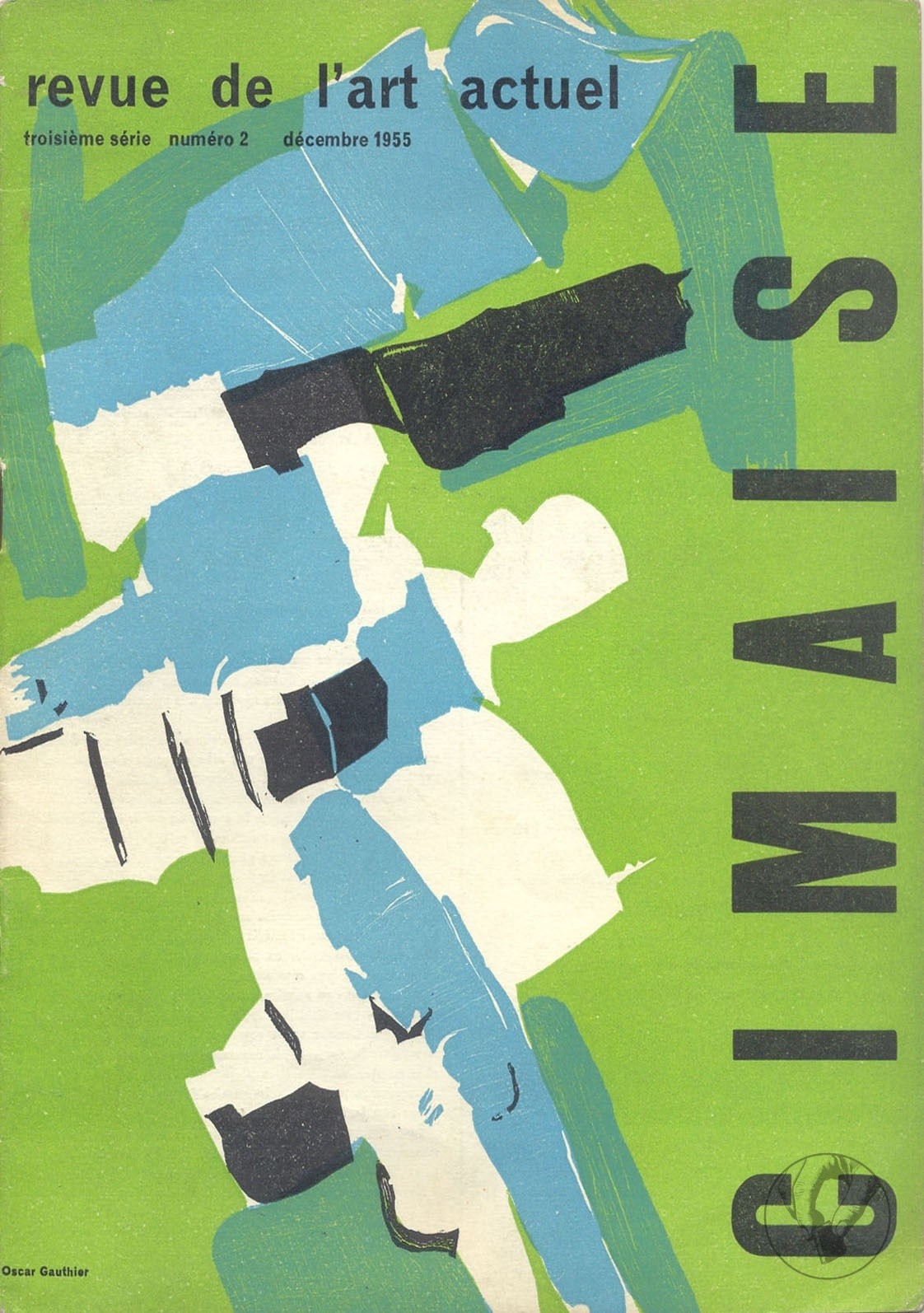
La revue "Cimaise" présente son numéro de décembre 1955, troisième série, numéro 2. Cet ouvrage explore l'art actuel, avec des articles sur l'art du XXe siècle, des analyses d'artistes comme Vieira da Silva et Alfred Reth, ainsi que des informations sur les expositions et la bibliographie.