Page 1
revue de l'art actuel troisième série numéro 1 octobre-novembre 1955 ESIMS
First pages of the volume, freely accessible.
revue de l'art actuel troisième série numéro 1 octobre-novembre 1955 ESIMS
Cimaise revue de l'art actuel 34 rue du Four, Paris 6 Directeur: J.R. Arnaud Rédacteur en chef: Herta Wescher Secrétaire général: John Koenig Rédaction: J. Alvard, R. V. Gindertael, M. Ragon, C.H. Sibert La rédaction reçoit sur rendez-vous Abonnement (8 numéros) 1.400 frs - Par avion: 2.300 frs 34, rue du Four, Paris 6, téléphone Littré 40-26 C.C.P. Sélection Paris 5542.39 Diffusion: Allemagne: Horst Beck, Hoedingen-Ueber, Uberlingen, Bodensee Allemagne, C.C.P. Karlsruhe (Bd) 43328 Argentine: Editorial Victor Leru, Cangallo 2233, Buenos Aires Autriche: Arnulf Neuwirth, Paracelsusgasse 8, Vienne 3 Belgique: Jean Milo, 28 rue de l’Arbre Bénit, Bruxelles C.C.P. Jean Milo, Bruxelles 1591.50 Danemark: Meiners Kunstforlag, Peder Skansgade 5 Copenhagen Grande-Bretagne: Alec Tiranti Ltd, 72 Charlotte Street London W1 Norvège: J. W. Cappelen Sortimentebokhandel Oslo Suède: Eric H. Olson, Upplandsgatan 3, Stockholm, 102 277 Suisse: E. Genton, «L’Entr’acte», rue du Lion d’or 4, Lausanne, C.C.P. II 144-56 U.S.A.: Wittenborn and Co, 30 East, 57th Street, New-York 22 M. Flax 10846 Lindbrook Drive, Los Angeles 24 --- A nos lecteurs Avec ce première numéro de la troisième série commence la troisième année de Cimaise. Ainsi que nous l’avons annoncé dans notre numéro de juillet, nous avons agrandi notre format, tout en le laissant à des dimensions maniables, afin de permettre une mise en page plus aisée. D’autre part, nos clichés sont plus grands et plus nombreux. Enfin, ayant décidés de publier en anglais et intégalement les articles principaux, nous avons, une nouvelle fois, augmenter le nombre de nos pages. Nous pensons que cette publication en anglais nous permettra d’augmenter assez considérablement le nombre de nos lecteurs dans les pays étrangers qui manifestent à l’égard de notre revue un intérêt chaque jour grandissant. Malgré toutes ces améliorations, le prix de vente reste très accessible. Le montant de l’abonnement pour un an (huit numéros) est porté uniformément à 1400 F, le prix du numéro est de 200 F. Nous demandons à nos abonnés dont l’abonnement expirait en juillet de le renouveler au plus tôt, afin que nous puissions leur adresser ce numéro. Nous leur demandons aussi, s’ils veulent nous aider, de nous apporter d’autres abonnements, c’est de leur nombre que dépend la force d’une revue. Un lecteur abonné est bien plus précieux qu’un autre, par l’appui constant de son adhésion personnelle et de sa fidélité. Le nombre de nos abonnés s’accroissant, nous pourrons améliorer encore la qualité de notre revue et étendre ainsi son crédit. Tous règlement peut être fait par chèque bancaire ou par versement au nom de SELECTION au compte chèque postal Paris 5542-39, ou à l’un de nos représentants à l’étranger. Nous comptons sur l’adhésion de chacun. CIMAISE --- Sommaire Couverture: linogravure de Barré 3 Textes anglais 7 L’art abstrait en Espagne par C.L. Popovici 10 Paris sans école par Julien Alvard Peintres et sculpteurs d’aujourd’hui: 12 Camille Bryen par Julien Alvard 14 Huguette-Arthur Bertrand par R.V. Gindertael 16 Voyage en Allemagne de l’Ouest, par Herta Wescher 19 Y a-t-il un problème actuel des salons? par R.V. Gindertael 20 Panorama estival par Herta Wescher 24 L’actualité par René Déroudille, Gerd Heninger, Michel Ragon, Herta Wescher 28 Informations 29 Bibliographie 31 Textes anglais --- Vient de paraître Fomalhaut poèmes de Romain Weingarten eaux-fortes de Camille Bryen éditions Falaize C.C.P. Georges Fall Paris 8277.48 format 17 x 22 9 exemplaires sur Hollande Van Gelder avec cinq gravures en noir et une suite sous emboîtage 25.000 fr. 47 exemplaires sur pur fil d’Arches avec cinq gravures en noir 8.000 fr. --- Vient de paraître Propos sur la peinture actuelle par R. V. Gindertael Un volume de 42 pages in-16 raisin: 6 portraits, 12 reproductions. Prix 200 fr. publié à l’occasion de l’exposition Six peintres actuels Istrati, Kolos-Vary, Moser, Nallard, Vulliamy, Wendt à la Galerie Craven 5 rue des Beaux-Arts, Paris 6, Danton 94-98 (jusqu’au 19 novembre) Distributeur: Librairie Arnaud, 34 rue du Four, Paris — C.C.P. Sélection Paris 5542.39
Complete translations of the main articles translation by J.-F. Koenig --- To our readers With the October number, we begin our 3rd year of CIMAISE. As we already had announced in our July number, we have enlarged our format, still keeping it in an easily-handled size, in order to give a more agreeable presentation. Also, we have again added new pages: seeing the growing interest that CIMAISE has met in the english-speaking countries, or those where english is more readily understood than french, we have made a considerable effort in translating all of our main articles, and giving them to you not as “digests” but completely unabridged. In spite of our new improvements, the price remains almost the same as before. For a subscription of 1 year (8 numbers) the price has been uniformly brought to 1,400 francs in all countries, and the price of a single number is only 200 francs. We would like to ask all our subscribers of last year, whose subscriptions stopped in July, to renew them as soon as possible, so we can send off this new number. We will permit ourselves to ask them also to kindly aid us in bringing in new subscriptions, for it is with them that a review has its basis. A subscriber is a more prized reader than another, by the constant aid of his personal interest and by his faithfulness. With the increase in your number, we will again be able to improve the quality of the review, thus further establishing its repute, and that of the art that we all defend. The payment may be made by your personal check, or through the post-office to the account of SELECTION, C.C.P. Paris 5542.39, or, outside of France, through one of our dealers. We hope that we can count on you. CIMAISE. --- The situation of abstract art in Spain by C.L. Popovici (p.7) It is rather paradoxical that Spain has not as yet revealed an important abstract art when you realize that it was the Spanish who contributed to a decisive point in the renewal of today’s art. But Spain is itself a paradox, and if you do not consider it in this way, you risk not understanding it at all. Art historians have the habit of putting a hasty and summary label on spanish art: Realism. But when one thinks of Greco, Velasquez or Goya, one would have a hard time pasting this label onto their work. It is true that there is a large sector, and especially in religious art, which follows the Renaissance tradition and its imagery has a deep sence of reality; however this doesn’t mean that this is a “speciality” of spanish art. It is also true that today there exists in Spain (and for that matter, everywhere) an abundant production of realistic art. Indeed, those who defend it speak in the name of tradition. However if this were true, the only solution would be to burn the Prado — as Papini wanted to do several decades ago with the Italian museums. In reality, the culprit is not the Prado — for the person who knows how to look it is a wonderful lesson in painting — but rather what might be called “pradism”: genius reduced to the scale of the artisan, or better still, the academism which results from purely formal imitation, external and lacking completely in artistic substance. However, the question has been asked. Let’s try to answer it. Contemporary Spain, beginning with the century, wavers between two contrary positions: “casticismo” which proclaims the autarchy of all the spanish values and reduces the universal to Spanish; and opposite it, a europeanism that desires an integration of these values into the whole christian world, that is to say the expansion of that which is spanish towards the universal. On one side, we have Unamuno; on the other, Ortega y Gasset. The fact is that where art is concerned, Spain has methodically refused to take part in the modern experiences. Spanish art of today verifies once more the almost-forgetten truth: there is no renewal without the “milieu” that will permit it. As long as Spain kept her back turned to Europe, and kept herself locked up in “tradition” and “casticismo”, you never heard anything mentioned about an art that responded to the inevitable exactions of the present day. Historical Spanish art owes its fabulous existence precisely to this “milieu” which allowed the incorporation of foreign values, and their adaptation to the “specific” character of the country. Romanesque, gothic, and baroque had their spanish variations of worldwide importance. But if Spain as a social entity closed her eyes to the experiments that the artistic world of the occident made after the fall of Impressionism, in return, the spaniard as an individual did not resign himself to tradition. It must be said that the spanish are anxious and curious. These are precisely the preliminary conditions for any inventor. Picasso, Juan Gris, Picabia, Julio Gonzalez, Gargallo, Mirò, invented the new forms that we all know. If they are genial, they were also lucky to understand at the right time what the function of the artistic “milieu” that is Paris means for modern art (as had Kandinsky, Mondrian, Brancusi, and Ernst, among others). However, they did not lose their personality. On the contrary, they brought it up to date, and gave it its maximum artistic efficacy. In renewing art, they marked it with a bit of Spain. A rather curious destiny brought about the return of modern spanish art to its home after the fascinating adventures of its pioneers. The rhythm of history, the means of diffusion of this history (with all of its processions of changes and innovations) are in our time irresistible. There is not a single traditionalism that can remain unmoved. We are, from now on, spectators of a kind of universalisation of mankind. What might have seemed an absurdity only a few years ago is today a possibility. And one of these possibilities is precisely the presence of abstract art in Spain. It is entirely natural that the guardian angels of this beginning of abstraction in Spain were the experiments made by the Spanish in Paris... and of course, those of Kandinsky, Mondrian, and Brancusi. To try to establish the typology of the present situation in Spain is a difficult task because of the instability and the more or less experimental stage in which we find the artists concerned. It seems nonetheless certain to me that these artists are following a path leading to pure abstraction (non-objective and non-figurative), coming from more realistic or surrealistic forms. One can consider that from now on this movement is converging towards a sort of “constant” for spanish abstract art. The only useful description of this state of things seems to me a report made rather at random, without taking account of a rigid criterion. The chapter on painting — the most voluminous — has as its leader Palazuelo, who now occupies one of the first places in abstract art. I don’t need to present him, for he is too well known in Paris. (It would be rather more necessary to present him in Madrid.) Showing regularly in Paris are: Lago, whose strictness and simplicity of the nobly colored surfaces is cut by a sober graphism, which marks them with an imperceptible movement; Feito, who on a sensitive and
refined background plays with a capricious interlacing of sinewy writing; Sempere, full of inventions, defies all sorts of techniques from “pointillist” collages, to oils. In Spain, I will begin by bringing to mind Bernal, who we may consider as being the first of those who “crossed the line”. Tapies with his fantastic canvases, abstracto-surrealistic, vividly and precisely colored; Valdivieso, abstract and figurative at the same time, extremely simple and refined, controls a transparent matter, using almost geometric surfaces poised in a classic calm; Mampasso practices a vividly colored “tachism” (reds, yellows, blues) with an almost sensual and very luminous material; Stubbing has attacked large canvases, which are completely “informal”, with ochres and earth colors in perpetual convulsion, the whole thunderstruck by merciless reds; Maria Droc shows a sensitive pictorial matter, and expresses herself with sometimes geometrical, sometimes fanciful forms, but is always purely abstract; Dely Tejero gives notice of a poetical fantasy, where surrealistic motifs make a graceful invasion — pure and lively color characterises his plastic medium; Laguna, after many types of research, has come to a somber abstraction where his tragic and passionate tonalities often seem to be inspired by the black period of Goya. There is also Laguardia, Perez Piqueros, and Cigueros, who work with large, well-ordered spots of color, “cut” by a vigorous graphism describing calm forms; and Clavó, who tries his hand at mosaics. Rivera is taking on large compositions in an attempt to dominate plastic space. Luge limits himself to refinements of color ornated with surrealistic symbols. Millares plays with the same elements, but with sharper accents. Sauras, Gabino, Tharrats, Molesun honorably complete this catalog of painters, conceived perhaps in too brief terms. It is just to recognize that the “old man” of abstraction in Spain is the sculptor Ferrant, whose renown has crossed the borders. After having passed through several esthetic periods, he has come to what I would call a “static-mobility”, where several pieces are articulated in strange and changing compositions, completely abstract. The chapter on sculpture must include also Carlos Ferreira who, although influenced by Brancusi, also unfolds his forms without the slightest geometric construction; Oteiza, who hesitates between a synthetic representation and a rather varied but always powerful abstraction; Serra, who brings into mind Gargallo, is turning towards a radical geometric expression; Chillida, whose works seem to be inspired by Gonzalez, has nonetheless a peculiar and poetic sense in his wire constructions; and Suzana Polac, whose abstractions show a strong influence of south-american folk-art. By dint of force, with all the shows, conferences, books, and critics (Del Amo, Cirlot, Vivanco, Sanchez Camargo, Cirici Pellicer, Arostegui, Father Roig), and thanks also to the efforts of the Museum of Contemporary Art of Madrid, today abstract art has been brought into question, and already makes a part of the “instantaneous reality” of the cultural and artistic “milieu” of Spain. I am sure that the new generation not only will be able to continue the experiments begun elsewhere, nor simply to incorporate them into their works, but also will bring novel solutions of decisive worth for the future of this art. Thus-spanish individualism will be integrated into the universal amplification which I already mentioned. C. L. Popovici P.S. The “Fernando Fe” Gallery of Madrid has just recently shown some new young abstract artists among whom I would like to mention the sculptor Azpiazu, and the painters Canogar and Ubeda (already known in Paris), Basterrechea, Guilermo Delgado, Perrales, Zambrana and Jésus Laorden. --- School’s out for Paris by Julien Alvard (page 10) This School of Paris is like the Arlésienne, everyone talks about it, nobody has ever seen it. One would think that it was born like Dulcinea de Tobosa, out of the imagination of a certain number of Don Quixotes whose Sancho Panzas are extremely clever in passing this respectable manle quickly onto the shoulders of whoever is adroitly posed up on the pedestal, whether the pretext be a “summing up” or some sort of group. But in spite of the obstinacy of the individuals presenting a list of painters under this banner, there is nonetheless no School of Paris, and they are strictly talking about nothing. It is entirely evident that Paris profits much more by what is delivered to the door than what it bestows in advantages in return for the instruction received. It is always ridiculous to contest with someone his origin, especially after he has accepted a “world-wide vocation”, as the concierges are like to say; he is no longer likely to bargain about his nationality:—the reputation of Paris is not founded on civic status. Besides, this has nothing to do with the question. Really everything is a complete misunderstanding when such a concept is allowed to take form, though it be merely by complaisance, when precisely in Paris the new schools are abolished as soon as they try to deposit their birth certificate. That there have been since the Impressionists so many contradictory and antagonistic movements proves to what a point the myth of Paris is incompatible with the notion of a School. There is in the issue of a movement an instant of reason where the approximative date and the more striking aspects are able to be fixed and defined. None of these instants of reason must survive and all must constantly come back to the origin. Descarte’s Wise Virgins One will perhaps say that it has no longer anything to do with a School properly so-called. That it is a long time since anyone believed in the virtues of education; that if one must define the parisian influence it has more to do with the cartesian climate and the idea of moderation that... which... I have nothing to say about those who affirm that Descartes personifies both France and Reason. This is a sort of truism which makes even the most peaceful of characters bark. Above all, the idea of “French moderation” gives a particularly creamy picture of the mediocrity and imbecility of this unhappy country. It is more the opinion of the baker boy told by the grocer’s wife to the goose girl. One should nonetheless have the right to ask why these frenchmen so smitten with reason never have been able to come to an agreement on adopting on all circumstances the most sensible solution. There must be in any case one, for the eyes of Reason, otherwise all comes tumbling down.. Apparently this country swarms with antagonistic reasons with particularly stubborn views and which feel lath to capitulate even in the name of superior interests, and as by chance, in general the most insane ideas have the most success. There exists rather a sentiment of distrust particularly in regard to the great men who are generally held in poor esteem, also the sense of the ridiculous which turns away the alleged grandeurs; this french moderation decidedly does not work by the metric system. Let us add for memory that the cult of originality and the sense of social oppression have been pushed so far that the slightest collective infatuation is interpreted as a depravation and an attack on individual personality.
The Whole Town’s Talking It isn’t easy under these conditions to cultivate peacefully one’s little reputation. In truth, Paris is an open city, open to the point of indifference. It is thus that we commonly see the madmen trample down the sages. Here the adventurers are fondled and flattered more than anyone else. But it is clear to see that they are excellent bit players for a theatre where the major roles must before all amuse the spectators. As for the artistic resources, they are rather slim. Paris offers neither the best museums nor the best galleries, far from it. And there is no lack of people who will affirm that in this field the french are less than nothing. The public authorities consider, with the sanction of a particularly narrow-minded middle-class, that it is entirely needless to encourage the current trend of imposition. So much so that the Museum of Modern Art of a country which otherwise chirps with lovely tremolos about its reputation, extorting rather nice profits from it, is forced to insure its existence with a budget which would lead the most bemired enterprise of France to bankruptcy. As for the patrons of the arts, the picture is disheartening! With the exception of a handful of barefoot boys who have a hard time as it is to find enough to keep a bird alive, and who cut the grains of rice in two to keep the buddies from starving, you can count on the fingers — of only one hand — the few persons who try to bring a bit of material aid to the artists. The rotten french middle-class with its characteristic “Nana” tastes, it patronises Martine Carol and apes the 18th century marquises in buying Renoirs, Corots and Fragonards each one more fake than the other. At least, perhaps Paris remains the city of consecration? One would ask by what mystery, seeing that so many means of diffusion are in a precarious state and condemned by all that is written. You must see it to believe it. Not only the shows cause generally no sensation, but a crusade must be started in order to convince a critic to write about whit he’s seen. You’re still lucky if you’re dispatched in three lines somewhere between the Stock Exchange and the Death notices. Besides, you mustn’t condemn the critics; when an article is longer than 15 lines nobody reads it. ou must take it or leave it; what is said, and what is repeated count much more than what is written: the best organised publicity is impotent to disarm the sweet tongues. On the whole, a catastrophic situation, and which legitimately gives you something to think about. In France however, one wouldn’t dream of it: these things have been in this state for so long now that there is no reason not to leave them that way. But in other countries, the tendency toward commercial estimations and a certain chauvinistic optimism lead towards an evaluation of the chances of survival of the myth of Paris. It is hence that about everywhere they’re lighting up the japanese lanterns getting ready for the joyful arrival of the funeral ceremony. “Background Paris, Foreground New York” writes superbly Mr. Thomas Hess, who esteems that from now on, thanks to lyric abstraction, the american virtues are going to be highly appreciated on the market. How could it be otherwise when, as he sees it, Paris is just a vast necropolis comparable to the Rome of 1800, when the last blazes of Tiepolo and Guardi passed by. Mr. Hess seems not to be aware that Ingres and Delacroix preserved in France a certain reminiscence of Italian art and that abstract expressionism before it changed its citizenship to american had nonetheless some relations in Germany. Diderot Painting in general and present painting in particular keep on asking those 64 dollars questions at each moment, putting at stake about everybody’s skin, and you must be quick-witted to keep going. It is here that Paris begins to be interesting. This town is unconscious of reputations, and there are hardly any authorized voices (it’s only the authorities who believe that they exist). However this is not solely a manifestation of a deplorable tendency for destroying even before having created; it is also, nonetheless, the expression of an interest that is never determined and which is constantly bringing up the question again on everything. This situation is not new. Intellectual questions always have had much success in France. It is for this reason that interest in painting only developed slowly. Even in the 17th century the interest of the undertaking wasn’t seen, as it wasn’t numbered among the adornments of the mind. The art of imitation or of magnificence—there is nothing there except a desire to please, and its sole recall suffices to dry up Pascal’s joyful tears. It is to Diderot that we must give the merit of having introduced the discussion on painting. If he has only a few original ideas in the beginning, he at least knows how to impassion the debate by the vehemence that he throws into his quarrels. Also with music, he takes sides with the Bouffons, who represent in his mind the struggle for an art of expression, the same when he makes himself, with regard to painting, the champion of nature, or more exactly, of natural movement. Several years later, he is sonorously finding fault with sensitivity: he is disgusted with Greuze, he has become the friend of Chardin, he is one of the rare persons who at the time perceived the enormous grandeur of Rembrandt. The thing which characterizes the contribution of Diderot is a way of discussing without dever refusing anything that would come into his mind, even if his argument were to perish by it. He is not contented solely with writing—he wants people to listen to him: you see him everywhere, in the salons, in the cafes, in the street. He is an untiring divulger. Actually, he gives the first draft for what is to become the most attractive side of Paris. In introducing a modern criticism, he opens the way to modern painting. Diogene’s Barrel The animation caused by Diderot has lost nothing of its spirit: the movement is there. Reputations are quickly made, and are undone even more rapidly. It doesn’t suffice to make lovely phrases or to throw roses; one must attack, propose and answer. Beauty, good taste, seriousness are constantly knocked about, jostled and run over. Nothing resists, neither the facilities of fashion, nor the prestige of trends, nor the graveness of philosophy. More than that, the undertaking sweeps away all the other considerations, and a blinding atmosphere is created which allows the passing—by of the worst of conditions: sordid garret rooms, dirty hotels, undrinkable brews, back-shop swindles, nasty tricks, delusions of persecution. Evidently Diderot didn’t foresee Saint-Germain-des-Prés, the right to dishonor, the possessed, all the Dostoïevsky atmosphere come to contribute to the triumph of the spirit over ugliness. But he amply aided in creating this intemporal space where everyone has the right to discover his Diogene barrel, to establish himself in it, and to lead, right up to the end, the most extraordinary careers of failures. J. A.
1st P.S. A new document for the evidence: the painter Calcagno joins the shrugs of his shoulders to the circumstantial appreciations of Mr. Hess. Begged by “Time” magazine to give his estimations on his woeful parisian experiences, Calcagno specified that “today a growing number of U.S. expatriates are coming home convinced that there is no longer much contemporary European painting worth the compliment of imitation (sic)”. That on the other hand the obstacles erected by the french against the group show of his brother Left-Bank expatriates were so considerable that they were obliged to organise it themselves, for finally “the french sponsors backed out”. Calcagno seems to forget that it is because of the internal (and eternal) quarrels of the group that not only the French sponsors but also the American sponsors were dissuaded from giving their aid. Let’s recall, on the contrary, that it was thanks to a french director of a french gallery that this show nonetheless took place. Drawing his conclusion, Calcagno esteems that as far as Paris is concerned: “In another hundred years it will be just another dead museum city.” 2nd P.S. Sensational events arrive at a terrific pace: with the latest news it seems that Vienna is going to take New York’s place in a few days. Bryen by Julien Alvard (page 12) If there is one familiar figure known among the citizens of the Left Bank, it is certainly that of Bryen. The resources of his wit and the picturesque of his discourse make him one of the most appreciated of interlocutors. But the audacities of the painter are no less astounding than those of the poet. Even long before the war he was mixed up with all sorts of the most obstinately cross-grained of movements and experiments, and even then asserted the rights of an anti-painting indifferent to the senses and to good sense, spitting and spouting all the biggest fish of the period. The deliberate orientation of his art towards the free spot and the exploded sign since the end of the war, his independence as regards to expression and meaning, in the accepted logic of his poetic conceptions, make him one of the most original creators of the new decade. Bryen is always ready to talk. The detours of his thought equal those of his ramblings. When I met him, he happened to be in a serious mood. I took advantage of it. C.B. The appearance of the face of Christ on Veronica’s veil implies the gesture of Veronica applying her veil to Christ’s face. Before it can be symbolical, the reality of creation postulates the organic reality of the act. It is difficult to detach the psychological from that which animates it: the works are incarnated in the organic. One may agree with Malraux when he considers that all paintings grow out of painting, but we mustn’t forget that this work is done from the inside, by the painter, and that the influence of art on artists is not different from the biological processus of the mutation of species, which takes place from the inside. C. B. You know that I do not consider myself as one of the born abstract painters. I came to this type of painting by a defiguration of reality. At a given moment, human measure dissolves into the organic experience, and one must take the risk of dehumanisation. I don’t think that there is in the absolute any difference or hierarchy between a Joconda, a dog’s dream, or the thought of a chrysanthemum. Painting is first a creation, then a revelation. It is no longer a definition or a meaning, and even less so an expression. Expression is made for lemons, in painting it is only vulgarity. To me, there is even something quite contradictory between abstract and expression. For I cannot at all see why a painter who looks for a means of expression would give up figuration, which is one of his most effective means. What is interesting in abstract art is that it leads to a revelation, a recreation. There is an optimism in this phenomena of abstraction that manifests in a way the disinterested pleasure of being alive. It doesn’t prop itself up on the obvious structures of reality, that’s true; but you mustn’t forget that there are many clandestine and hidden things in everyday life. One can hence say that this painting has to do with clandestine reality and thanks to it we are in the presence of things that don’t exist. J. A. In the quantity of these things that don’t exist, do you include the spot and the sign? C. B. In general, if one attaches more importance to the psychic note than to the critical note, as is frequently the case in the Occident, it is the color or the spot which finds itself in favor (Rembrandt, Turner, the Venitians). All the more so if we are concerned with the inexpressible reality that we talked about a while ago. Besides, the spot lends itself naturally to the diversity of life. It doesn’t deny its natural evolution when it explodes, whereas the line, which is identified with that of a fixation, resists this type of mutation by the initial incision from which it proceeds. What is interesting with the sign is that it ceases to be muscular thanks to a certain bursting. J. A. Does it seem to you that the meaning of these signs is a deception of profoundness? C. B. The meaning is of secondary interest to me, for it limits the creative act to its historical duration, whereas experience has shown us so many examples of these signs which have known the most fabulous careers (the runic signs, for example) even though the why and wherefore of there existence has been unknown since millenaries. Their vacuity, their illegibility do not constitute an enigma that the future will be able to dissolve. The promise of an appearance or reappearance of the link with reality does not necessarily establish a guarantee that it will take place. J. A. Are we not then to be concerned with today’s exploded signs, on condition of not being liable for the debts in excess of the assets? C. B. One is obliged to state that communication, in the common meaning of the word, is established at the moment when the work, unintelligible in the beginning, becomes vulgarized and then degenerates. This is the reason why I became interested in the manifestation of the verb without meaning. J. A. Of the verb and consequently the word as in Heperille éclaté? In this sense today’s painting which moves from the inside towards the outside justifies the present preoccupations of an organic art, and makes evident, far more so that figurative painting, this particular character of art. C. B. Heinz and Villeglé exploded one of my phonetic poems by means of a fluted glass. Here I entered a very exciting realm, for humanist mechanics, in this case photography, joined up with abhumanist mechanics in so far as it embodies the vacant for the mind. It is rather encouraging to state that certain people can exploit mechanics in order to create something more open, and that a crack could be made in the circle of the termite’s nest, just at the spot where one would the least expect it. (continued on page 31)
Tapies: Peinture, 1955 (Photo Mas) L'Art abstrait en Espagne par C.L. Popovici Il est bien paradoxal que l'Espagne n'ait pas encore donné un grand art abstrait quand on pense que ce sont les Espagnols qui ont contribué dans une mesure décisive au renouvellement de l'art actuel! Mais l'Espagne est en elle-même un paradoxe et si on ne la voit pas comme tel, on risque de ne plus la voir du tout! Les historiens d'art ont l'habitude de mettre une étiquette un peu hâtive et sommaire sur l'art espagnol : réalisme. Mais quand on pense à Greco, Velazquez ou Goya, on pourrait difficilement accrocher cette étiquette à leur œuvre. Il est vrai qu'il y a un grand secteur et surtout dans l'art religieux où, par une tradition de la Renaissance, l'imagerie a un profond sens de la réalité, mais cela ne veut pas dire qu'elle soit une « spécialité » de l'art espagnol. Il est vrai aussi qu'il existe encore en Espagne (comme un peu partout d'ailleurs) une abondante production d'art vériste. Ceux qui la défendent parlent justement au nom de la tradition. S'il en était ainsi, l'unique solution serait de brûler le Prado, comme voulait le faire il y a quelques dizaines d'années, Papini avec les Musées d'Italie. En réalité le coupable n'est pas le Prado qui, pour celui qui sait voir est une extraordinaire leçon de peinture, mais ce que l'on pourrait appeler le « pradisme » : le génie réduit à l'échelle de l'artisan, ou si vous voulez, l'académisme qui en est sorti, imitation purement formelle, extérieure et dénuée de toute substance artistique. Mais la question reste quand même posée. Tâchons de l'expliquer. L'Espagne contemporaine, celle qui commence avec ce siècle, oscille entre deux contraires : le « casticismo » qui proclame l'autarcie de toutes les valeurs espagnoles, voir l'universel réduit à l'espagnol, et à rebours, l'euro péisme qui veut l'intégration de ces valeurs à l'« oecumène », voir l'ampliation de l'espagnol à l'universel. D'une part, Unamuno; de l'autre, Ortega y Gasset. Le fait est qu'en matière d'art, l'Espagne s'est refusée méthodiquement à participer à l'expérience de l'art
Ferrant: «Métamorphose du personnage dans son athmosphère», 1953 actuel. L'art espagnol d'aujourd'hui vérifie encore une fois une vérité presque oubliée : il n'y a pas de renouvellement sans un « milieu » qui le permette. Tant que l'Espagne a tourné le dos à l'Europe et s'est enfermée dans la « tradition » et le « casti- cismo », on n'a pas pu parler d'un art qui réponde aux exi- genees inévitables de l'heure actuelle. L'art historique espagnol doit sa fabuleuse existence précisément à ce « milieu » qui a permis l'incorporation des valeurs étrangères et leur adaptation au « spécifique » de ce peuple. Le roman, le gothique, le baroque ont eu des variations espagnoles d'une portée tout à fait universelle. Mais si l'Espagne en tant qu'être social a fermé les yeux aux expériences auxquelles le monde artistique de l'Occident se livrait après la chute de l'impressionnisme, en revanche l'Espa- gnol en tant qu'être individuel ne s'est pas résigné à la tradi- tion. Il faut le dire : l'Espagnol est extrêmement inquiet et curieux. C'est précisément la condition préalable de tout inven- teur. Picasso, Juan Gris, Picabia, Julio Gonzalez, Gargallo, Miró ont inventé les nouvelles formes que nous connaissons tous. S'ils ont du génie ils ont eu aussi la chance de comprendre à temps ce que signifie pour l'art actuel la fonction du « milieu » artistique qu'est Paris (tout comme Kandinski, Mondrian, Brancusi, Ernst, pour n'en rappeler que quelques- uns). Pour cela ils n'ont pas perdu leur personnalité. Au contraire, ils l'ont actualisée et lui ont rendu son maximum d'efficacité artistique. En renouvelant l'art, ils l'ont marqué même d'un peu d'espagnolisme. Un bien curieux destin a voulu que l'art espagnol soit de retour chez lui après la fascinante aventure de ses pionniers. Le rythme de l'histoire, les moyens de « diffusion » de cette histoire (avec tout son cortège de changements et d'innovations) sont de nos jours irrésistibles. Il n'y a plus de traditionalisme qui puisse rester inamovible. On assiste d'emblée à une espèce d'universalisation de l'homme. Ce qui aurait paru, il y a seulement quelques années, une absurdité est aujourd'hui une possibilité. Et une de ces possibilités est précisément la présence de l'art abstrait en Espagne. Il est tout naturel que les parques tutélaires de ce début de l'abstraction en Espagne soient les expériences qui ont été faites par les Espagnols à Paris. Il ne faut pas oublier aussi la part d'un Kandinski, d'un Mondrian ou d'un Brancusi. Essayer d'instituer une typologie de l'actuelle situation de l'art abstrait en Espagne est une tâche bien difficile, vu l'instabilité et le stade trop expérimental dans lequel se trouvent les artistes qui s'y sont lancés. Ce qui me paraît certain c'est que ces artistes suivent un processus vers l'abstraction absolue (non objectif et non figuratif partant des propositions en quelque sorte réalistes ou bien surréalistes) on pourrait considérer d'ores et déjà ce mouvement convergent comme une espèce de « constante » de l'abstractisme espagnol. L'unique description utile de cet état de choses me semble plutôt un compte rendu fait un peu au hasard et sans tenir compte d'un criterium rigide. Le chapitre peinture — le plus volumineux — comprend comme chef de file Palazuelo qui occupe maintenant une des premières places dans l'art abstrait. Il est trop connu à Paris pour qu'il ait besoin de ma présentation. (Une semblable présentation serait nécessaire plutôt à Madrid.) A Paris exposent régulièrement Lago dont la rigueur et la simplicité de ses surfaces noblement colorées sont tranchées par un sobre graphisme qui leur imprime un imperceptible mouvement : Feito qui sur une matière sensible, raffinée, fait jouer de capricieux entrelacs de nervures; Sempere qui, plein d'invention, s'attaque à des techniques très variées depuis un collage pointilliste jusqu'à l'huile.
En Espagne, je commence par rappeler Bernal qu'on peut considérer comme l'un des premiers à avoir « passé la ligne ». Tapies avec ses toiles fantaisistes, abstracto-surréalistes, vivement et précieusement colorées. Valdivieso, abstrait et figuratif, en même temps extrêmement simple et raffiné, domine une matière transparente, dont les surfaces presque géométriques s'équilibrent dans un calme classique, dirais-je. Mampasso professe un tachisme vivement coloré (jaunes, rouges, bleus) avec une matière presque sensuelle et très lumineuse. Stubbing aborde de grandes toiles, totalement « informes » avec des ocre et des terres en perpétuelle convulsion, le tout foudroyé par des rouges sans merci. Maria Droc qui fait preuve d'une matière picturale sensible, s'exprime par des formes parfois géométriques, parfois fantaisistes, mais toujours dans le pur abstrait. Dely Tejero dénonce une fantaisie poétique où des motifs surréalistes font une gracieuse irruption. Un coloris vif et pur caractérise sa matière plastique. Laguna est arrivé après maintes recherches à un sombre abstractisme où ses tons tragiques et passionnés semblent parfois inspirés par la période noire de Goya. J'ajouterais Laguardia, Perez Piqueros et Ciruelos avec des grandes taches bien ordonnées, fortement colorées et « coupées » par un vigoureux graphisme qui décrit des formes calmes. Clavó essaie l'art difficile de la mosaïque. Rivera aborde la grande composition dans un effort pour dominer l'espace plastique. Luque se limite à des raffinements de couleur, ornés de symboles surréalisants. Millares joue sur les mêmes éléments mais avec des accents plus aigus. Sauras, Gabino, Tharrats, Molesun complètent honorablement ce catalogue des peintres, conçu peut-être en termes trop brefs. Il est juste de reconnaître que le « doyen » de l'abstraction en Espagne est le sculpteur Ferrant, dont la renommée a dépassé les limites du pays. Après avoir passé par divers « stages » esthétiques il est arrivé à ce que je pourrais appeler un « mobilisme-statique » où diverses pièces s'articulent dans de changeantes et étranges compositions, purement abstraites. Le chapitre sculpture compte aussi Carlos Ferreira qui, bien qu'un peu marqué par Brancusi, déploie aussi des formes sans aucune construction géométrique, Oteiza qui oscille entre un figura-tivisme synthétique et un abstractisme assez varié mais toujours puissant. Serra qui fait songer à Gargallo se dirige vers un géométrisme radical. Chillida dont les travaux semblent inspirés par Gonzalez, a quand même un sens propre et poétique dans ses constructions de fils métalliques. Enfin, Suzana Polac, dont l'abstractisme accuse une forte impression de folklore sud-américain. A force d'expositions, de conférences, de livres, de critiques (Del Amo, Cirlot, Vivanco, Sanchez Camargo, Cirici Pellicer, Arostegui, le R.P. Roig, etc.) et aussi grâce aux efforts qu'a fait le Musée National d'Art Contemporain de Madrid, l'art abstrait est aujourd'hui mis en question et constitue déjà une « donnée immédiate » du « milieu » artistique et culturel d'Espagne. Je suis persuadé que cette nouvelle génération d'artistes abstraits pourra non seulement continuer les expériences faites ailleurs, non seulement les incorporer, mais encore apporter des solutions inédites et d'une portée décisive pour l'avenir de cet art. Ainsi l'individualisme espagnol sera poussé de nouveau vers une de ces ampliations universelles auxquelles j'ai fait déjà allusion. C.-L. Popovici P.S. — La Galerie « Fernando Fé » de Madrid vient d'exposer tout récemment de nouveaux jeunes abstraits parmi lesquels je dois mentionner les noms du sculpteur Azpiazu et des peintres Canogar et Ubeda (déjà connus à Paris), Basterrechea, Guilermo Delgado, Perrales, Zambrana et Jesús Laorden. Rivera : « Albaicin », peinture
Paris sans école par Julien Alvard Cette Ecole de Paris est comme l'Arlésienne, tout le monde comme la Dulcinée du Toboso de l'imagination d'un certain nombre de Don Quichotte dont les Sancho Pança sont fort en parle; personne ne l'a vue. C'est à croire qu'elle est née habiles à faire glisser d'épaules en épaules ce manteau respectable sous prétexte de bilans ou de groupements adroitement juchés sur ce piédestal. Mais quelle que soit l'obstination de certains à présenter une liste de peintres sous cette bannière, il n'y a pas d'Ecole de Paris et c'est parler pour ne rien dire. De toute évidence Paris fait bien plus son profit de ce qu'on vient lui apporter à domicile qu'il ne dispense les bienfaits de son enseignement. Il est toujours ridicule de disputer quelqu'un à son pays d'origine et si l'on accepte une vocation mondiale, pour parler comme les concierges, ce n'est pas pour marchander sur la nationalité : la réputation de Paris n'est pas fondée sur l'état civil. Du reste la question n'est pas là. C'est vraiment n'avoir rien compris à ce qui se passe ici que de laisser prendre corps, ne fut-ce que par complaisance, à un pareil concept, quand précisément on ne cesse à Paris de détruire les Ecoles dès qu'on les soupçonne de vouloir déposer leur acte de naissance. Qu'il y ait eu depuis l'impressionnisme tant de mouvements contradictoires et antagonistes prouve à quel point le mythe de Paris est incompatible avec la notion d'Ecole. Il y a dans l'aboutissement d'un mouvement un instant de raison qui permet d'en fixer la date approximative et d'en définir les traits les plus saillants. Aucun de ces instants de raison ne doit survivre et il faut que tout revienne incessamment au limon. Les rosières de Descartes On me dira qu'il ne s'agit plus d'Ecole proprement dite; qu'il y a beau temps que personne ne croit plus aux vertus de l'enseignement; que s'il fallait définir l'influence parisienne, c'est bien plus au climat cartésien et au sens de la mesure qui... que... Je n'ai rien à dire de ceux qui estiment que Descartes personnifie à la fois la France et la raison. C'est un genre de vérité première qui donne envie d'aboyer aux esprits les plus pacifiques. Brochant sur le tout, la « mesure française » donne un tableau particulièrement gratiné de la médiocrité et de l'imbécilité de ce malheureux pays. C'est vraiment l'opinion de la porteuse de pain rapportée par l'épicière à la gardeuse de dindons. On serait pourtant en droit de se demander pourquoi ces Français si férus de raison n'ont jamais pu se mettre d'accord pour adopteren toutes circonstances la solution la plus sensée. Il faut cependant bien qu'il y en ait une aux yeux de la raison sinon tout le système est par terre. Apparamment ce pays fourmille en raisons antagonistes particulièrement entêtées dans leurs vues et qui répugnent à capituler fut-ce au nom des intérêts supérieurs et comme par hasard ce sont en général les idées les plus folles qui ont le plus de succès. Sentiment de méfiance plutôt particulièrement à l'égard des grands hommes qui sont en général très mal vus, sens du ridicule aussi qui détoure aisément des prétendues grandeurs, cette mesure française ne marche décidément pas avec le système métrique. Ajoutons pour mémoire qu'on a poussé si loin le culte de l'originalité et le sens de l'oppression sociale que le moindre engouement collectif y est ressenti comme une dépravation et une atteinte à la personnalité. Toute la ville en parle Il n'est pas facile dans ces conditions de cultiver en paix sa petite réputation. A la vérité Paris est une ville ouverte, ouverte jusqu'à l'indifférence. C'est ainsi qu'on y voit couramment les fous piétiner les sages. Les aventuriers y sont plus qu'aucun autre choyés et adulés. Mais il faut bien voir que ce sont d'excellents figurants pour une scène où les premiers rôles doivent avant tout amuser la galerie. Pour ce qui est des ressources artistiques elles sont minces. Paris n'offre ni les meilleurs Musées ni les meilleures galeries, tant s'en faut. Et il ne manque pas de gens pour prétendre que sur ce point les Français sont au-dessous de tout. Les pouvoirs publics considèrent avec l'approbation d'une bourgeoisie particulièrement bornée qu'il est tout à fait inutile de gaspiller de l'argent à encourager la fumisterie actuelle. Si bien que le Musée d'Art Moderne d'un pays qui par ailleurs glousse avec des trémolos sur sa réputation et en tire d'assez jolis profits, est contraint d'assurer son existence avec un budget qui mènerait à la faillite l'entreprise la plus crottée de France. Côté mécénat, le tableau est accablant! A l'exception d'une poignée de va-nu-pieds qui ont à peine les moyens de faire vivre un oiseau et coupent les grains de riz en deux pour empêcher de crever leurs copains, on compte sur les doigts d'une seule main les quelques personnes qui s'efforcent d'apporter une aide matérielle aux artistes. L'infecte bourgeoisie française, elle, avec le goût Nana qui la caractérise, patronne Martine Carol et
singe les marquises du XVIIIe siècle en achetant des Renoir, des Corot et des Fragonard tous plus faux les uns que les autres. Du moins Paris reste-t-elle la ville des consécration! On se demande d'ailleurs par quel mystère, tant les moyens de diffusion sont précaires et mis au ban de tout ce qui s'écrit. Il faut le voir pour le croire. Non seulement les expositions ne font généralement pas sensation, mais c'est la croix et la bannière pour décider un critique à parler de ce qu'il a vu. Encore bien beau quand on vous expédie en trois lignes entre la Bourse et les avis de décès. On ne saurait d'ailleurs donner tort aux critiques, dès qu'un article dépasse quinze lignes personne ne le lit. Il faut en prendre son parti, ce qui se dit et ce qui se répète compte beaucoup plus que ce qui s'écrit : la publicité la mieux organisée est impuissante à désarmer les bonnes langues. Une situation catastrophique en somme, et qui pourrait légitimement donner à réfléchir. En France on n'y songe même pas : les choses en sont là depuis si longtemps qu'il n'y a pas de raison pour que ça ne continue pas. Mais en d'autres pays, la tendance aux appréciations commerciales et un certain optimisme chauvin portent à évaluer les chances de survie du mythe de Paris. C'est ainsi qu'un peu partout dans le monde on allume déjà les lampions en prévision du joyeux événement de cette pompe funèbre. « Background Paris, Foreground New-York », écrit superbement M. Thomas Hess qui estime que désormais, grâce à l'abstraction lyrique, les vertus américaines vont faire prime sur le marché. Comment pourrait-il en être autrement quand, à ses yeux, Paris n'est déjà plus qu'une vaste nécropole comparable à la Rome de l'an 1800, passés les derniers feux de Tiépolo et de Guardi. M. Hess semble ignorer qu'Ingres et Delacroix ont conservé en France un certain souvenir de l'art italien et que l'expressionnisme abstrait avant d'être spécifiquement américain n'est pas sans quelques rapports avec l'Allemagne. Diderot La peinture en général et la peinture actuelle en particulier pose à chaque instant des problèmes qui mettent en jeu la peau d'un peu chacun et il faut beaucoup de présence d'esprit pour s'en tirer. C'est là que Paris commence à devenir intéressant. Cette ville ignore les réputations et il n'y a guère à ses yeux de voix autorisées que dans l'esprit des autorités. Ceci n'est pas seulement la manifestation d'un déplorable penchant à détruire avant même que d'avoir édifié, c'est aussi l'expression d'un intérêt qui ne se fixe jamais et remet perpétuellement tout en question. Cette situation n'est pas nouvelle. Les choses de l'esprit ont toujours eu beaucoup de succès en France. C'est la raison pour laquelle l'intérêt pour la peinture ne s'y est développé que tardivement. Jusqu'au XVIIe siècle on ne voit pas l'intérêt de l'entreprise, elle ne compte pas au nombre des ornements de l'esprit. Art d'imitation ou de magnificence il n'y a rien là-dedans qui ne vise qu'à plaire et sa seule évocation suffit à sécher les pleurs de joie de Pascal. C'est à Diderot que revient le mérite d'avoir introduit la discussion sur la peinture. S'il a peu d'idées originales au début, il sait déjà passionner le débat par l'impuissance qu'il met dans ses querelles. De même qu'en musique il prend parti pour les Bouffons qui représentent à ses yeux la lutte pour un art d'expression, de même il se fait en peinture le champion de la nature ou plus exactement du mouvement naturel. Quelques années plus tard, il fait le retentissant procès de la sensibilité : il est dégoûté de Greuze, il est devenu l'ami de Chardin, il est un des rares à son époque à saisir l'énorme grandeur de Rembrandt. Ce qui caractérise l'apport de Diderot, c'est une façon de discuter sans jamais rien refuser de ce qui lui vient à l'esprit quand bien même sa thèse dut-elle en périr. Il ne se contente pas d'écrire, il a besoin qu'on l'écoute : on le voit partout, dans les salons, dans les cafés, dans la rue. C'est un divulgateur inlassable. Il fait véritablement le brouillon de ce qui va devenir le côté le plus attrayant de Paris. En introduisant une critique moderne, il fraye la voie à la peinture moderne. Le Tonneau de Diogène L'animation créée par Diderot n'a rien perdu de son entrain : le mouvement est là. Les réputations se font vite, elles se défont plus rapidement encore. Il ne suffit pas de faire des phrases et de jeter des fleurs, il faut encore attaquer, proposer, répondre. Beauté, bon goût, sérieux sont à tout instant heurtés, bousculés, débordés. Rien n'y résiste, ni les facilités de la mode, ni le prestige des tendances, ni la gravité de la philosophie. Bien plus, l'entreprise l'emporte sur toute autre considération. Il se crée une atmosphère d'avenglement qui permet de passer sur les pires à-côtés : chambres de bonne sordides, hôtels malpropres, consommations imbuvables, filouterie des arrières-boutiques, goujaterie des procédés, délire de persécution. Evidemment Diderot n'avait pas prévu Saint-Germain-des-Prés, le droit au déshonneur, les possédés, tout l'atmosphère Dostoïewski venu concourir au triomphe de l'esprit sur la laideur. Mais il a largement contribué à créer cet espace intemporel où chacun a le droit de découvrir son tonneau de Dio-gène, de s'y installer et d'y mener jusqu'au bout les plus extraordinaires carrières de ratés. $1^{\text {er }}$ P.S. — Nouvelle pièce au dossier : le peintre Calcagno joint ses haussements d'épaules aux appréciations circonstanciés de M. Hess. Prié par la revue « Time » de donner ses appréciations sur sa douloureuse expérience parisienne, Calcagno précise que « actuellement un nombre croissant de « U.S. Ex-Patriotes » reviennent chez eux convaincus qu'il n'y a plus beaucoup de peinture en Europe qui vaille la peine d'être imitée (sic) ». Que d'autre part les obstacles mis par les Français à l'exposition collective de ses frères expatriés de la Rive Gauche ont été tels qu'ils se sont vus contraints d'organiser eux-mêmes leur propre exposition. « les responsables français les ayant laissé tomber ». Calcagno semble oublier que c'est à cause de leurs querelles internes que non seulement les responsables français, mais les responsables américains ont été découragés de leur donner leur appui. Rappelons par contre que c'est grâce à un directeur de galerie français que cette exposition a quand même eu lieu. En conclusion, Calcagno estime qu'en ce qui concerne Paris « dans une centaine d'années ce ne sera plus qu'une ville musée morte comme tant d'autres ». $2^{\text {e }}$ P.S. — Les événements se précipitent : aux dernières nouvelles, il paraît que c'est maintenant Vienne qui va remplacer New-York.
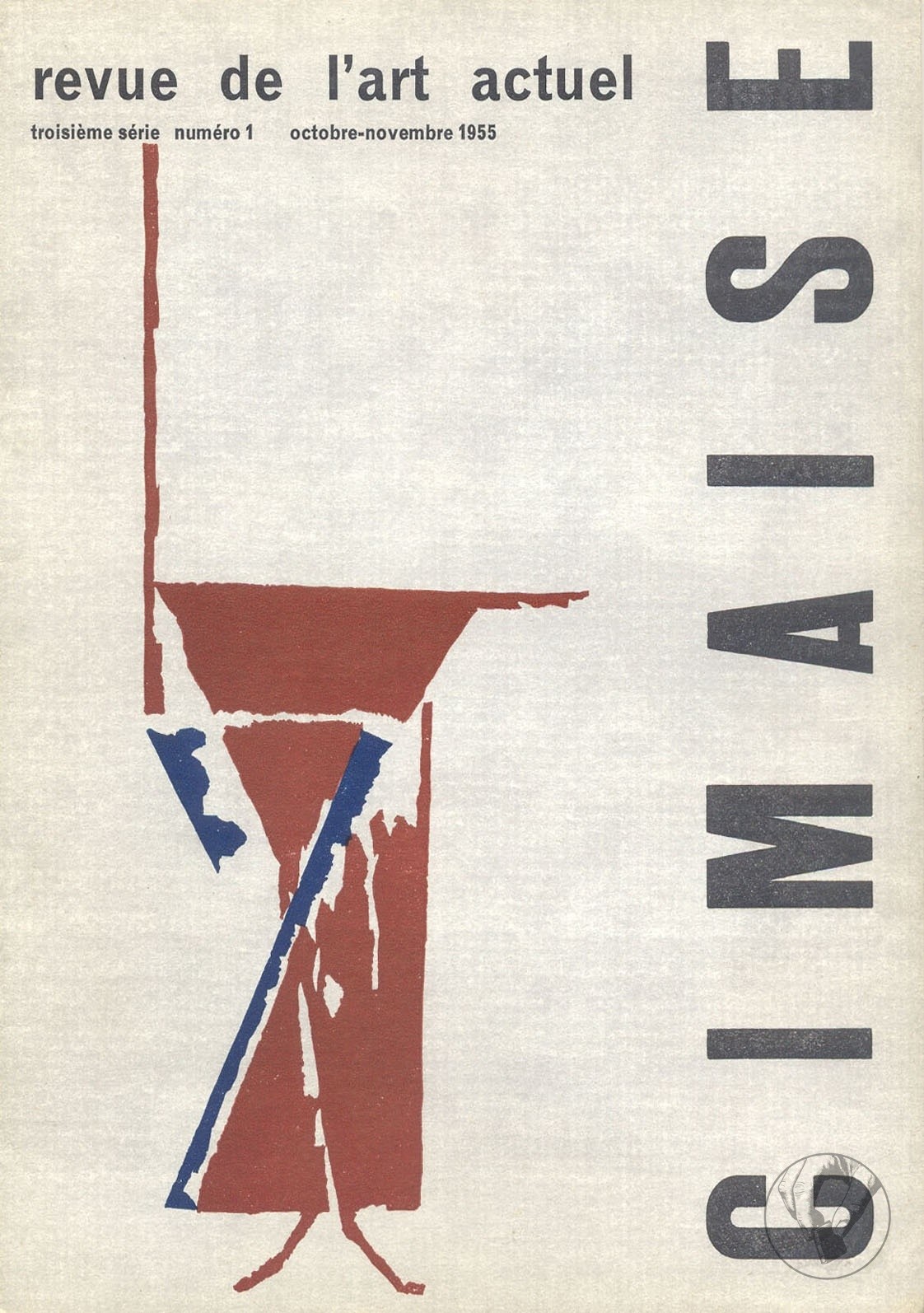
La revue "Cimaise" entame sa troisième année avec un nouveau format agrandi et plus de pages, incluant des traductions intégrales des articles principaux en anglais pour élargir son lectorat international. Malgré ces améliorations, le prix reste accessible. L'éditorial souligne l'importance des abonnements pour la pérennité et l'amélioration de la qualité de la publication.