Extrait
Premières pages de l'ouvrage, en accès libre.
Page 1
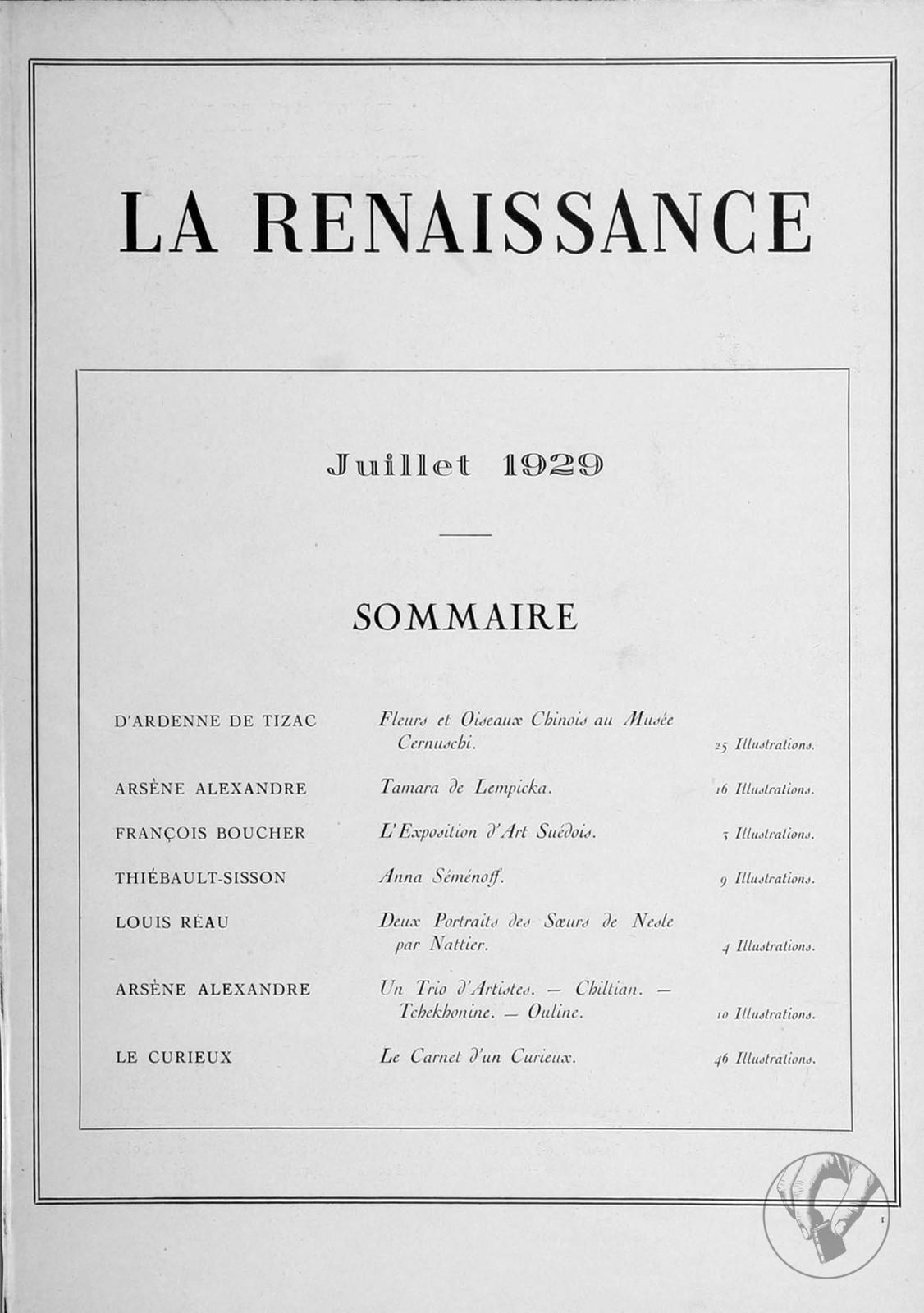
LA RENAISSANCE
Juillet 1929
---
SOMMAIRE
D’ARDENNE DE TIZAC
---
Fleurs et Oiseaux Chinois au Musée Cernuschi.
---
25 Illustrations.
---
ARSÈNE ALEXANDRE
---
Tamara de Lempicka.
---
16 Illustrations.
---
FRANÇOIS BOUCHER
---
L’Exposition d’Art Suédois.
---
7 Illustrations.
---
THIÉBAULT-SISSON
---
Anna Séménoff.
---
9 Illustrations.
---
LOUIS RÉAU
---
Deux Portraits des Sœurs de Nesle par Nattier.
---
4 Illustrations.
---
ARSÈNE ALEXANDRE
---
Un Trio d’Artistes. — Chiltian. — Tebekbonine. — Ouline.
---
10 Illustrations.
---
LE CURIEUX
---
Le Carnet d’un Curieux.
---
46 Illustrations.
---
Page 2
FLEURS ET OISEAUX CHINOIS AU MUSÉE CERNUSCHI
par H. D'ARDENNE DE TIZAC
FIG. 1. — A. — OISEAUX AFFRONTÉS. — JADE ROUILLÉ. — ÉPOQUE HAN.
IIe SIÈCLE AVANT J.-C. — IIe SIÈCLE APRÈS J.-C. — COLLECTION LOO.
B. — CORMORAN. — JADE VERT. — ÉPOQUE HAN. — COLLECTION MICHEL CALMANN.
C. — OIE. — JADE JAUNE. — ÉPOQUE HAN. — COLLECTION LOO.
---
En choisissant la Fleur et l'Oiseau comme thèmes de sa 12e Exposition des Arts de l'Asie au Musée Cernuschi, la Municipalité de Paris abordait un des domaines les plus vastes de l'esthétique extrême-orientale ; peu d'objets y sont dépourvus d'un motif de fleur ou d'oiseau.
Fleurs et oiseaux se retrouvent, d'autre part, dès l'origine de l'art de l'Empire du Milieu. Sur plusieurs vases de l'époque néolithique on peut voir, en effet, un motif floral, encore assez vague sur la poterie de notre fig. 4, mais qui apparaît beaucoup plus nettement sur certains exemplaires que possède le Musée de Stockholm; il convient d'ajouter toutefois, que ce type de poterie, qui s'est installé il y a cinq mille ans dans le Nord-Ouest de la Chine (provinces actuelles du Ho-Nan et du Kan-Sou), a totalement disparu sans laisser aucune trace dans le courant des siècles qui se sont succédé. La fleur n'a jamais joué en Chine qu'un rôle purement décoratif, et c'est à ce seul titre qu'on la retrouve à
In choosing the Flower and the Bird as themes of its 12th exhibition of the Arts of Asia at the Musée Cernuschi, the Municipality of Paris entered one of the most vast domains of Far Eastern aesthetics; few objects are lacking in a flower or bird motive.
Flowers and birds are found, besides, from the origin of the art of the Middle Kingdom. On many vases of the neolithic period may be seen, indeed, a floral motive, again, vague enough on the pottery of our figure 4, but shown much more clearly on certain examples possessed by the Museum of Stockholm; it should be added always that this type of pottery, which was in existence five thousand years ago in the Northwest of China (the present provinces of Ho-Nan and of Kan-Sou), has totally disappeared without leaving any trace, in the course of the centuries that came after. The flower never played any other than a purely decorative role in China, and it is only in this classification
Page 3
LA RENAISSANCE
FIG. 2. — BRONZE. — ÉPOQUE TCHÉOU. — XIIe-IIIe SIÈCLE AVANT J.-C.
COLLECTION JOSEPH HOMBERG.
partir de notre ère, sur les différents objets qu’a enfantés l’imagination chinoise.
Tout au contraire, l’oiseau, s’il a paru, lui aussi, dès les temps primitifs, se maintint constamment à travers l’évolution des bronzes, des poteries et des jades ; c’est qu’il répondait à une signification profonde. L’oiseau et le dragon sont arrivés ensemble en Chine : l’un symbole yin de l’été et de l’élément sec ; l’autre, symbole yang du printemps et de l’élément humide. Sérieusement établis dans les croyances primitives, ces deux motifs forment la partie la plus importante de toute l’ornementation des objets rituels anciens. Nous trouvons l’oiseau stylisé et enroulé sur lui-même, contre le flanc des bronzes de l’époque Tcheou (XIIe-IIIe siècle avant J.-C.) (fig. 3). Le voici sous forme d’une applique de meuble de la même époque : l’œil occupe tout le centre de la tête ; la crête, les ailes, les griffes, la queue sont stylisés au point de devenir de véritables schémas (fig. 5). La magnifique
that one finds it, up to our era, on the different objects created by Chinese imagination.
On the other hand, the bird, if it has also appeared, from primitive times, finds a place continually through the evolution of bronzes, of potteries and of jades, in Chinese art ; that is because it answers to a profound significance. The bird and the dragon arrived together in China : the one, yin, symbol of summer and of the dry element ; the other, yang, symbol of spring and of the most element. Seriously established in primitive beliefs, these two motives from the most important part of all ornamentation of ancient ritual objects. We find the bird conventionalized and used repeatedly on the side of bronzes of the Tcheou period (XIIth to IIIrd Centuries B.C.) (fig. 3). There it is, in the form of an inlay of furniture of the same epoch : the eye occupies all the middle of the head ; the crest, the wings, the claws, the tail are conventionalized to the point of becoming veritable formulas (figure 5). The magnifi-
Page 4
LA RENAISSANCE
FIG. 3. — BRONZE. — ÉPOQUE TCHÉOU.
XII°-III° SIÈCLE AVANT J.-C.
COLLECTION DU MUSÉE CERNUSCHI.
tête de la fig. 2 montre combien la fantaisie et le sentiment décoratif savaient s'accorder avec le souci de la nature chez certains fondeurs et ciseleurs des anciens temps. Si l'œil, en effet, occupe encore ici une place qui étonne, si la crête est stylisée comme une aigrette de casque, si une excroissance inattendue orne le bec de ce qui fut sans doute un perroquet, on doit reconnaître que cette tête singulière présente un réalisme assez accusé. C'est une autre stylisation que montrent les oiseaux du splendide bronze de M. Wan-
FIG. 4. — POTERIE NÉOLITHIQUE.
III° MILLÉNAIRE AVANT J.-C.
COLLECTION DU MUSÉE CERNUSCHI.
cent head of figure 2 shows how fancy and decorative feeling may harmonize with the love of nature, in the work of certain makers of castings and sculptors of ancient times. If the eye, indeed, here takes up an astonishing amount of space, if the crest is conventionalized like the top of a helmet, if an unexpected excrescence adorns the beak of what was doubtless a parrot, it should be understood that such a singular head shows a sufficiently evident realism. It is an another kind of conventionalization that is shown in the birds of the
FIG. 5. — APPLIQUE DE BRONZE. — ÉPOQUE TCHÉOU. — XII°-III° SIÈCLE AVANT J.-C.
COLLECTION DAVID WEILL.
Page 5
LA RENAISSANCE
FIG. 6. — COUTEAU RITUEL. — JADE BRULÉ. — ÉPOQUE TCHÉOU. — XIIe-IIIe SIÈCLE AVANT J.-C.
COLLECTION CULTY.
nieck et de la hache de fer de M. Homberg. L'oiseau de l'époque Tcheou n'a pas uniquement décoré le métal, le voici encore formant un poignard rituel en jade de la même époque (figure 6).
L'art des Han (IIe siècle avant J.-C., IIe siècle après J.-C.), abandonnant la signification cosmique de l'oiseau, lui restitua une apparence plus naturelle, tout en lui gardant un style serré ; des oiseaux se trouvent en grand nombre parmi les jades mortuaires de cette époque. L'oiseau et le cormoran des figures de la page 316 en donnent quelque idée. Quant aux deux perroquets affrontés de la figure 1, leur intention décorative est encore plus accusée. Ce n'est pas splendid bronze of M. Wannieck and of the iron axe of M. Homberg. The bird of the Tcheou period did not decorate metal alone, here it is forming a ritual poignard in jade of the same period (figure 6).
The art of the Hans (IInd Century B. C., IInd Century A. C.), abandoning the cosmic meaning of the bird, restored a more natural appearance, while retaining a confirmed style; birds are found in great number among the mortuary jades of this period. The bird and the cormorant of figures of the page 316, give some idea of this. As for the two parrots confronting each other in figure 1, — their decorative purpose is still more evident. It is not only in jade that the Han
FIG. 7. — OISEAU À TÊTE HUMAINE. — TERRE CUITE. ÉPOQUE WEI. — V° SIÈCLE.
COLLECTION WANNIECK.
Page 6
LA RENAISSANCE
FIG. 8. — TAPIS DE LAINE. — ÉPOQUE K'ANG-HI. — XVIIe SIÈCLE. — COLLECTION MICHON.
FIG. 9. — PLAQUE D'ÉMAIL CLOISONNÉ. — ÉPOQUE MING. — XVIe SIÈCLE. — COLLECTION JOSEPH HOMBERG.
Page 7
LA RENAISSANCE
Page 321
Figure 10 - VéLOURS BROCHÉ. — ÉPOQUE K'ANG-HI.
Collection d'ESPINAY
Figure 11 - BOITE LAQUE ET NACRE.
ÉPOQUE K'ANG-HI. — COLLECTION VEVER
Figure 12 - PLAT, TERRE CUITE ÉMAILLÉE.
3 COULEURS.
ÉPOQUE T'ANG-HI. — VIIe-Xe SIÈCLE.
COLLECTION MICHEL CALMANN
Figure 13 - CANARDS DANS LES ROSEAUX.
PEINTURE SUR SOIE. — ÉPOQUE YUAN.
XIVe SIÈCLE. — COLL. BOUASSE-LEBEL
Page 8
LA RENAISSANCE
seulement en jade que l'époque Han a représenté des oiseaux ; ses tombes contiennent de nombreux coqs en terre cuite ou vernissée de vert.
Si nous poussons jusqu'à l'époque Wei (ve siècle), un assez grand nombre de statuettes en terre cuite peinte reproduisent des formes d'oiseaux. L'exposition du Musée Cernuschi en présente un assez grand nombre, notamment une vasque en forme d'oiseau chimérique entouré de petits personnages, des canards, des coqs, et d'étonnants animaux composés, tel que cet oiseau à tête humaine de notre figure 7.
Une des révélations de l'exposition actuelle, pour le public et même pour bien des amateurs, sera la poterie de l'époque T'ang (viie-xe siècle), telle qu'elle apparaît d'après les plats de la collection Michel Calmann. Cette poterie n'était assurément pas inconnue de certains autres collectionneurs, tels que MM. Joseph Homberg, Hollier-Larousse et Larcade, qui en ont prêté différentes pièces au Musée Cernuschi ; mais l'imposant ensemble de M. Calmann retient l'attention par le nombre, la qualité et la variété des objets qui le composent. Aucun mot ne peut traduire la force et la délicatesse d'une composition certainement touchée par des influences d'Asie centrale, et que l'artiste a réalisée à l'aide de cet émail si mince et si robuste, à la craquelure très fine, où dominent les tons principaux du jaune, du vert et du bleu, et que les Chinois n'ont jamais pu retrouver même au moment de la perfection la plus raffinée de leur céramique (figure 12).
A côté des bronzes, des jades, et des poteries, l'exposition Cernuschi présente un certain nombre de peintures : les unes, comme la splendide page de lotus et de canards
FIG. 14. — AIGLE. — PEINTURE SUR SOIE. ÉPOQUE SONG. — XIIe SIÈCLE. COLLECTION FREYSSINET.
epoch represented birds : its tombs contain many cocks in terra cotta or with a green glaze.
If we go on to the Wei period (Vth Century), a large enough number of painted terra cotta statuettes reproduce bird forms. The exhibition at the Musée Cernuschi offers a sufficiently large number, notably a fountain basin in the form of an imaginary bird surrounded by little figures, ducks, cocks, and amazing animals, like that bird in our figure 7, having a human head.
One of the revelations of the present exhibition, for the public and even for art lovers, will be the pottery of the T'ang epoch (VIIth-Xth Centuries), as it appears from the platters of the Michael Calmann collection. This pottery was surely not unknown to certain other Collectors, like Messrs. Joseph Homberg, Hollier-Larousse and Larcade, who have loaned various pieces of it to the Musée Cernuschi ; but the impressive group of M. Calmann holds attention by the number, the quality and the variety of the objects that compose it. No word can express the force and the delicacy of a composition certainly affected by the influence of Central Asia, and which the artist carried out with the help of that enamel so thin and so strong, at the crackled state very fine, in which the dominant tones are yellow, green, and blue, and which the Chinese have never been able to recapture, even at the moment of the most refined perfection of their ceramic ware (figure 12).
Along with bronzes, jades and potteries, the Cernuschi exhibition offers a certain number of paintings : some, like the splendid example of lotus and of ducks owned by M. Henri Vever, or like the powerful eagle
Page 9
LA RENAISSANCE
de M. Henri Vever ou comme l'aigle si puissant de la collection Freyssinet (figure 14) se rattachent étroitement au style vigoureux et sobre de l'époque Song (xiiie siècle). A la même tradition, appartiennent deux peintures des collections Jules Strauss (figure 15) et Freyssinet, représentant chacune un cygne lié par un faucon, ainsi que les canards dans les roseaux de la collection Bouasse-Lebel (figure 13); un très grand nombre d'autres peintures d'une valeur décorative robuste ou délicate, ornent-les salles du musée.
Une salle tout entière est consacrée à l'art des émaux cloisonnés. Sur un fond qui va du bleu sombre aux teintes de la turquoise la plus pâle, des motifs animaux ou floraux se développent somptueusement en couleurs vertes, jaunes, blanches, rouges, dont la force éclatante ou sourde sait se jouer sans jamais laisser place à une dissonance ou à une brutalité; qu'il s'agisse de vases, de plats, de canards brûle-parfums (figure 23), de boîtes ou de plaques de lit, comme celle de notre figure 9, l'artiste usant du même procédé, a su tantôt traduire un motif décoratif très limité, tantôt représenter au contraire de véritables paysages avec des cours d'eau, des bois ou des montagnes.
Le lit monté de la collection Héliot révèle l'usage des plaques qui n'arrivent souvent que séparées chez les importateurs. Les cloisonnés, qui n'occupent pas moins de seize vitrines à l'exposition Cernuschi, datent pour la plupart de l'époque Ming (xvie siècle). De la même époque sont deux paires de grandes tuiles faitières en forme de phénix extrêmement décoratifs, émaillés en bleu, jaune et vert (figure 16).
En même temps que de grands paravents de Coromandel, quelques beaux tapis sont présentés, notamment une grande pièce décorée de trois faisans sur un rocher, au milieu de fleurs (figure 8); une composi-
FIG. 15. — CYGNE LIÉ PAR UN FAUCON. PEINTURE SUR SOIE. — STYLE DE L'ÉPOQUE SONG COLLECTION JULES STRAUSS.
of the Freyssinet collection (figure 14) are closely related to the vigorous and sober style of the Song epoch (XIIth Century). To the same tradition belong two paintings of the Jules Strauss (figure 15) and the Freyssinet collections, each representing a swan with a falcon, as well as the ducks in the reeds, of the Bouasse-Lebel collection (figure 13); a very large number of other paintings of decorative value, strong or delicate, adorn the museum halls.
One room is wholly devoted to the art of cloisonné enamel. On a base that runs from dark blue to the palest turquoise tints, animal or floral motives are worked out sumptuously in colors, green, yellow, white, red, of which the flashing force or heavy weight exerts its power without ever giving place to a discord or a crude effect; whether it be vases, platters, ducks, incense-burners (figure 23), boxes or parts of a bed, like that of our figure 9, the artist, using the same method, has been able to express at times a very limited decorative motive, sometimes representing, on the other hand, veritable landscapes, with water courses, woods or mountains.
The mounted bed of the Héliot collection shows the use of panels which come often only in separate form, at the importers' houses. The cloisonné enamels, which take up not less than sixteen glass cases in the Cernuschi exhibition, date for the most part from the Ming epoch (XVIth Century). From the same period are two pair of large tiles in the form of very decorative phoenixes, enameled in blue, yellow and green (figure 16)
Together with large screens of Coromandel are offered some beautiful rugs, notably a large piece decorated with three pheasants on a rock in the middle
Page 10
LA RENAISSANCE
FIG. 16. — PHÉNIX. — TERRE CUITE ÉMAILLÉE. — ÉPOQUE MING.
COLLECTION RAUFAST.
tion libre et pourtant soutenue, des teintes justes et variées, une matière si délicate que la laine semble être de la soie ; enfin, la chaleur du ton général, d'un blond roux font, de ce tapis, un exemplaire d'intérêt exceptionnel. Un très beau morceau de velours broché (figure 10) donne l'idée de ce qu'étaient les riches étoffes à l'époque « classique » de l'art chinois.
Parmi les objets de curiosité, on peut citer un admirable coffre, laque et nacre, appartenant à Mme Lucien Sauphar, et une boîte décorée de même (figure 11) de la collection Henri Vever, une série de boîtes en laque rouge de Pékin, un curieux écran et des coiffures de cérémonie entièrement ornées de plumes de martin-pêcheur.
Si nous abordons la céramique dite classique, c'est certainement à la collection de M. Edouard Noetzlin qu'il faut d'abord rendre visite. Elle occupe plusieurs vitrines ; on y admire une splendide potiche verte de l'époque Ming, qui n'a son équivalent ni dans la collec-
of flowers (figure 8) : a composition free in style and yet well sustained, of true and varied tints, on material so delicate that the wool seems to be silk, moreover the general warmth of tone, of reddish gold, makes of this rug an example of unusual interest. A very beautiful piece of brocade velvet (figure 10) gives the idea of what rich fabrics were like in the “ classic ” period of Chinese art.
Among the curiosities, may be mentioned an admirable lacquer and mother-of-pearl jewel case belonging to Mme. Lucien Sauphar, and a decorated box of the same sort (figure 11) from the collection of Henri Vever, a series of boxes of red lacquer from Pekin, a curious screen and ceremonial headdresses entirely adorned with feathers of the king-fisher.
If we touch on the ceramic ware called classic, certainly we should go first to the collection of M. Edouard Noetzlin. It occupies several glass cases ; there one admires a splendid green pot of the Ming
Page 11
LA RENAISSANCE
325
FIG. 17. — En haut à gauche.
IBIS
PORCELAINE BLANCHE A DÉCOR VERT
ÉPOQUE K'ANG-HI.
COLLECTION DE Mme LA COMTESSE DE SAINT-LÉON.
FIG. 18. — En haut à droite.
PERROQUET JADE VERT
COLLECTION DE Mme LA PRINCESSE AMÉDÉE DE BROGLIE.
FIG. 19. — En bas à gauche.
PORCELAINE A FOND NOIR.
ÉPOQUE K'ANG-HI.
COLLECTION NŒTZLIN.
FIG. 20. — En bas à droite.
AIGLE.
PORCELAINE BLANCHE.
COLLECTION HELIOT.