Extrait
Premières pages de l'ouvrage, en accès libre.
Page 1
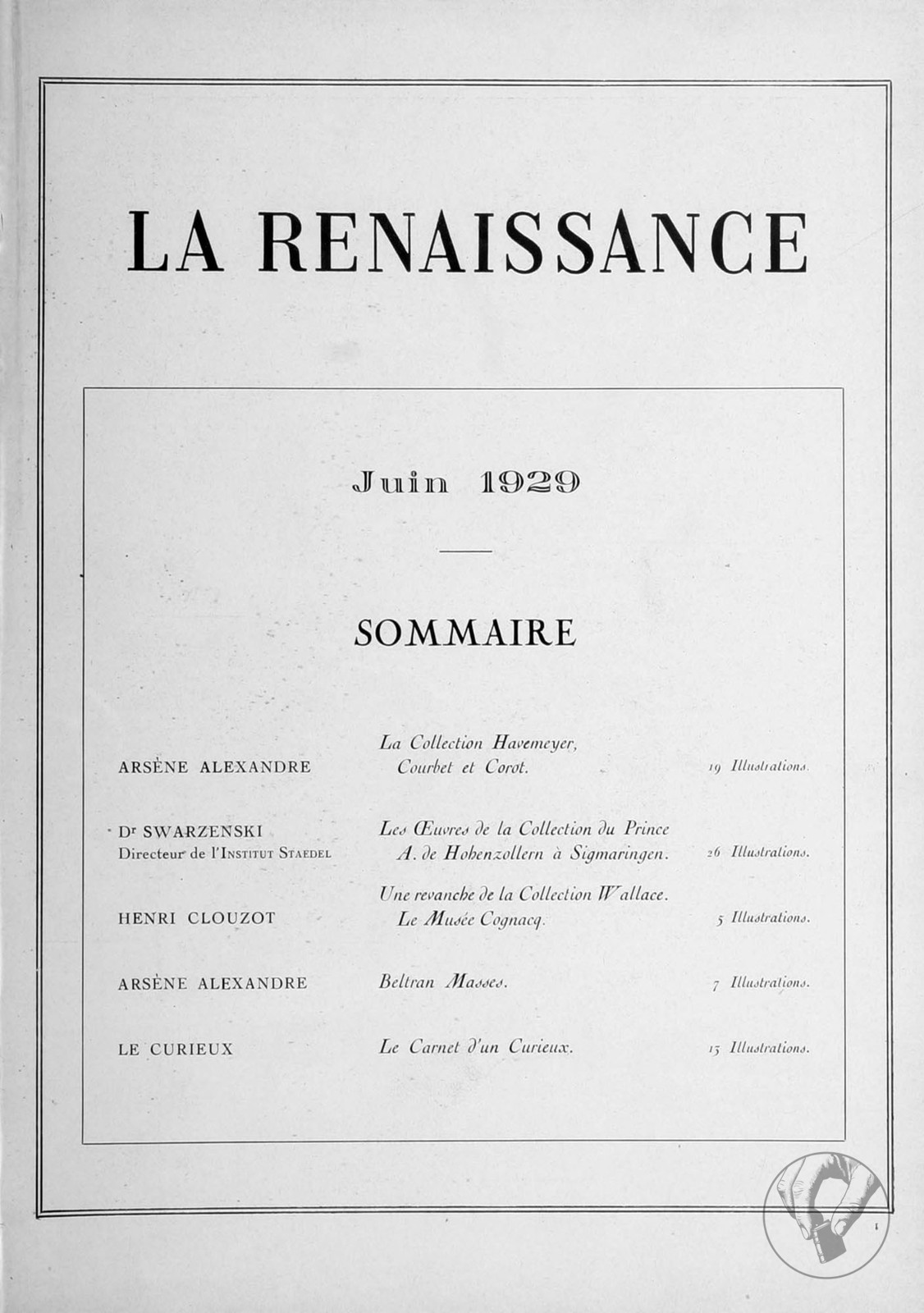
LA RENAISSANCE
---
Juin 1929
SOMMAIRE
ARSÈNE ALEXANDRE
---
La Collection Havemeyer,Courbet et Corot.
---
19 Illustrations.
---
Dr SWARZENSKIDirecteur de l’INSTITUT STAEDEL
---
Les Œuvres de la Collection du PrinceA. de Hohenzollern à Sigmaringen.
---
26 Illustrations.
---
HENRI CLOUZOT
---
Une revanche de la Collection Wallace.Le Musée Cognacq.
---
5 Illustrations.
---
ARSÈNE ALEXANDRE
---
Beltran Masses.
---
7 Illustrations.
---
LE CURIEUX
---
Le Carnet d’un Curieux.
---
15 Illustrations.
---
Page 2
GUSTAVE COURBET.
CHIENS DE CHASSE.
Page 3
LA COLLECTION HAVEMEYER
PREMIÈRE ÉTUDE PAR ARSÈNE ALEXANDRE COURBET ET COROT
Cet hiver la Directrice de La Renaissance avait la joie de recevoir la plus illustre collectionneuse d'art aux États-Unis, Mme Havemeyer. Celle-ci venait à Paris faire une des rapides et intenses visites qu'en grande amie de la France elle aimait à se ménager. Nous étions heureux, quelques-uns des appréciateurs de cette femme supérieure, de nous trouver autour de notre Directrice, pour lui faire accueil. Le surlendemain Mme Havemeyer assistait, chez Pleyel, à un récital du grand pianiste Alfred Cortot. Elle était accompagnée de M. Joseph Durand-Ruel, et avec cette jeunesse d'admiration qu'elle avait conservée dans un âge avancé, elle nous disait le prix qu'elle attachait à toutes les manifestations de l'esprit en France. Avant de quitter la salle du concert, elle nous invitait cordialement à revenir à New-York où elle retournait deux jours après, admirer les collections que nous avions eu la consolation de visiter, lors d'une mission aux heures tragiques de 1916.
A la voir si paisible, si vénéralement rayonnante, nous ne pouvions nous douter que ce n'était pas un au revoir que nous échangions. La Renaissance comptait bien quelle viendrait encore à Paris plus d'une fois, dans notre atmosphère qui lui était et à qui elle était si sympathique.
Mais pouvions-nous, non plus, penser que Joseph Durand-Ruel de qui le nom était quasi-inséparable de celui d'Havemeyer devait aussi, peu de jours après elle, être l'objet de nos profonds regrets ? L'aîné des héritiers de celui qui avait été pour M. et Mme Havemeyer le conseiller clairvoyant et fidèle pendant de longues années, était devenu à son tour ce que l'on pourrait appeler le dépositaire des traditions et des amitiés qui heureusement sont conservées et transmises dans la maison, pour la plus grande dignité de l'art français, disparaissait lui aussi, et prématurément, avec un stoïcisme affable.
Nous devions ce double hommage avant d'entreprendre quelques études sur cet ensemble extraordinaire qu'a été la collection Havemeyer. M. Georges et M. Pierre Durand-Ruel, le frère et le fils de celui qui fut notre ami, nous ont mis à même de faire passer sous les yeux de nos lecteurs, les sommets de cette chaîne de chefs-d'œuvre qu'était la collection au moment où nous l'avions connue en 1916 et plus tard encore quand notre Directrice la visita lors de ses voyages aux États-Unis.
Ces œuvres dominatrices parlent avec trop d'éclat par elles-mêmes pour que nous les accompagnions de
This winter the Directress of La Renaissance had the pleasure of receiving the most illustrious woman art collector of the United States, Mrs. Havemeyer. She came to Paris to make one of the rapid and concentrated visits which, as a great friend of France she loves to arrange. We were happy, a few of those who appreciate that woman of quality, to find ourselves about our Directress, to welcome her. The day after, Mrs. Havemeyer was present, at Plegel's, at a recital of the great pianist Alfred Cortot. She was accompanied by M. Joseph Durand-Ruel, and with that youthfulness of enthusiasm that she has kept through the years, she told us how much value all the manifestations of the spirit of France had for her, and before leaving the concert hall, she invited us cordially to come once more to New York, where she returned two days later, to enjoy the collections which we had the consoling experience of seeing, when on a mission, during the tragic hours of 1916.
Seeing her so peaceful, so venerably radiant, we could not have imagined that we were conversing with one whom we should not see again. La Renaissance counted on her returning again to Paris more than once, to our atmosphere which was sympathetic to her, as she was to us.
Neither could we think that Joseph Durand-Ruel whose name was almost inseparable from that of Havemeyer, would become, a few days after her, the object of our profound regrets. The oldest heir of him who had been for Mr. and Mrs. Havemeyer the far-sighted and faithful counsellor, during long years, became in his turn what might be called the depositary of traditions and of friendships which fortunately are preserved and transmitted in that house, for the greatest dignity of French art, he also as, prematurely, with an affable stoicism.
We owe this double homage, before undertaking some studies of that extraordinary ensemble, the Havemeyer collection. M. Georges and M. Pierre Durand-Ruel, the brother and the son of him who was our friend, have enabled us to bring under the eyes of our readers the high points of that chain of masterpieces that composed the collection at the moment when we knew it in 1916 and still later when our Directress visited it on one of her trips to the United States.
These dominating works speak for themselves with
Page 4
LA RENAISSANCE
GUSTAVE COURBET. — FEMME NUE.
très longs commentaires. Nous n'avons plus à apprendre, puisque cela a été publié dans tout le monde civilisé, qu'une partie considérable de la collection a été léguée au Metropolitan Museum, qui offre ainsi un chapitre capital de l'histoire de l'art français au xixe siècle.
Mais avant, nous devons encore dire quelques mots qui feront comprendre pourquoi cette collection était si belle. C'est parce que Mme Havemeyer, sous des dehors simples et calmes, était un esprit singulièrement ardent et enthousiaste. C'est en profonde connaissance de cause et en sincère passion qu'elle avait continué et magnifiquement augmenté les richesses d'art qu'elle et son mari avaient commencé de recueillir — de conquérir est plus exact — depuis peu d'années avant 1883. Mais son ardeur ne se bornait pas à remplir sa maison de pièces capitales. Elle se dépensait en propagande, et entre autres une de ses conférences sur Degas fut un modèle de justesse. Enfin, comment omettre ce trait quoiqu'il soit en dehors de la question d'art ? elle avait pris aussi éloquemment le parti de la cause féminine aux États-Unis. Voilà toute l'explication de la vie et de l'œuvre : elle tient dans un mot : la conviction.
too much force to require very long comment from us. We do not need to make news of what was published throughout the civilized world, the fact a large part of the collection was left to the Metropolitan Museum, which thus becomes, as it were, the capital of the history of XIXth Century French art.
But first, we ought to explain, in a few words, why this collection was so beautiful. It is because Mrs. Havemeyer, under a simple and calm exterior, was a singularly ardent and enthusiastic spirit. It was in profound understanding of the cause and in a real passion for it that she continued and magnificently added to the wealth of art that she and her husband had begun to collect — to conquer is more exact — a few years before 1883. But her ardor was not limited to filling her house with works of the first order. She spent herself in propaganda and, among others, one of her talks on Degas was a model of truth. Finally, how can that trait, however it be applied, be put outside the field of art? She took as eloquently the part of woman's rights in the United States. There is all the expression of life and of achievement : it may be put in a word : conviction.
Page 5
LA RENAISSANCE
GUSTAVE COURBET. — LA FEMME A LA VAGUE.
La collection Havemeyer était trop nombreuse et trop diverse pour que nous en tracions un tableau d'ensemble qui ne pourrait faire que l'objet d'un livre. Ce sera ici une sorte de florilège, cueilli dans les principaux parterres de cet Eden artistique. L'esprit général s'en dégagera quand nous aurons sans méthode rigoureuse terminé notre choix.
Pourquoi ne commencerions-nous pas par deux des plus grands peintres du xixe siècle, qui se trouvent former une harmonie, un équilibre, plutôt qu'un contraste, encore qu'ils paraissent si opposés, c'est-à-dire Corot et Courbet ? « Vérité et poésie » selon la parole de Goethe, à la condition qu'on ne perde jamais de vue qu'il n'y a pas de vérité sans poésie, ni de poésie sans vérité. Nous en voyons ici les plus beaux témoignages et Courbet le premier se trouvait pris à son propre piège, qui se croyait créateur d'une religion à rebours, celle de cette abstraction, de cette chimère, de cette impossibilité : le réalisme.
Il n'y a pas de réalisme parce que rien n'est réel. Que peut-on imaginer de plus romantique, presque de plus romance que cette souple et robuste Femme au perroquet de qui la chevelure s'étend comme une onde ?
The Havemeyer collection was too extensive and too varied to be wholly described in an article, for it is enough to fill a book. This will be only the culling of a few flowers picked from the chief beds of that artistic garden of Eden. The general spirit will be shown when we have finished, without too much formality, our personal choice.
Why not begin with two of the greatest painters of the XIXth Century, who are found here forming a harmony, a balance, rather than a contrast, although they seem so unlike, that is to say, Corot and Courbet? “Truth and poetry”, according to the word of Goethe, on condition that one never lose sight of the fact that there is no truth without poetry, nor poetry without truth. We see here the most beautiful proofs of this and Courbet, the first, finds himself caught in his own trap, the man who thought himself creator of a religion of rebellion, of that abstraction, of that chimera, of that impossibility : realism.
There is not realism, because nothing is real. What could be imagined more romantic, almost of romance itself, than that supple and strong Femme au Perroquet, whose hair falls like a wave? She might as
Page 6
LA RENAISSANCE
GUSTAVE COURBET. — LA FEMME AU PERROQUET.
GUSTAVE COURBET. — FEMME AU BAIN.
Page 7
LA RENAISSANCE
GUSTAVE COURBET. — LE RUISSEAU DU PUITS NOIR.
GUSTAVE COURBET. — LES BICHES.
Page 8
LA RENAISSANCE
COROT. — FEMME COUCHÉE.
Elle aurait été aussi bien « Sarah la Baigneuse » ou la « marchesa d’Amaëgui ». Aussi cette splendide plébéienne pouvait, sans contestation, loger sous le même toit, c’est-à-dire chez Mme Havemeyer, que les princesses de rêve recrutées par le bon Corot dans quelque rue de Saint-Denis.
Pareillement, la Femme au miroir que j’aime infini-
well have been “Sarah la Baigneuse” or the “marchesa d’Amaegui”. Also that splendid plebeian might, without debate, lodge under the same roof, that is to say Mrs. Havemeyer’s, as the dream princesses recruited by the good Corot in some street of Saint-Denis.
Likewise the Femme au miroir that I would like for
COROT. — L’AGE D’OR.
Page 9
LA RENAISSANCE
COROT. — ITALIENNE.
COROT. — JEUNE FILLE.
COROT. — FEMME ACCOUDÉE.
COROT. — RÊVERIE.
Page 10
LA RENAISSANCE
COROT. — NYMPHE COUCHÉE AU BORD DE LA MER.
ment mieux appeler de son nom légendaire de la Belle Irlandaise, est d'une magnifique extravagance, que jamais le plus effréné romantique n'aurait osé se permettre. Non pas seulement pour cette hypertrophique toison, mais aussi pour tout ce qu'elle possède des caractères d'une héroïne, d'une « femme fatale » et passionnée. O naïf et grand Courbet qui n'admettait pas que le peintre représentât des anges !
Mais il est trois nus de la collection bien plus significatifs encore que la Femme au perroquet en tant qu'expressifs de la poésie naturelle que Courbet nommait, à contre-sens, réaliste. La première de ces incarnations est celle que nous voyons, les bras repliés au-dessus de la tête, les seins saillants, le reste du corps immergé et caressé par le clapotis des vagues. Il est étrange de constater qu'elle suggère toute la poésie de la mer, telle que l'on conçue les poètes du Nord. Son regard est celui que l'on pourrait prêter à la Sirène d'Andersen. Tant l'instinct de Courbet s'élevait au-dessus de ses grosses lubies !
La seconde est cette grande Baigneuse qui, se tenant à une branche, avance un pied timide dans l'eau que l'on devine si froide ! Celle-là est une riche image de la poésie forestière. Enfin, lourde et plantureuse fille de campagne, avec ses branches de pommier, Galatée sans pommes et se contentant des fleurs sans avoir envie de fuir vers les saules, la troisième est une audacieuse et better to call by her legendary name, the Belle Irlandaise, is of a magnificent extravagance, such the maddest romantic would never have dared to permit himself. Not only by this over-tropical head of hair, but also by all that she possesses of the traits of a heroine, of a “fatal woman”, and a woman of passion. O naive and great Courbet who would not admit that the painter portrayed angels!
But there are three nudes in the collection for more significant even than the Femme au perroquet in so much that is expressive of natural poetry, which Courbet named, in opposition, realistic. The first of these incarnations is the one we see with hands clasped above the head, breasts standing out, the rest of the body immersed and caressed by the moving waves. It is strange to fell that she suggests all the Poetry of the sea, as the poets of the North have conceived it. Her look is that which could be lent to Andersen’s Siren. All the instinct of Courbet lifted him above his whimsical theories !
The second is that large Baigneuse, who, lingering to a branch, puts a timid foot in the water which one feels is cold! She is a rich image of forest poetry. Finally, the heavy and fullfleshed country girl, with her apple branches, Galatea without apples and satisfying herself with blossoms without showing any desire to run toward the willows, the third is a bold and unforgettable incar-
Page 11
LA RENAISSANCE
COROT. — MÈRE ET ENFANT.
inoubliable incarnation de la Terre.
La puissance picturale de Courbet s'affirme encore dans ces trois belles pages : les Biches si confortablement tapies sous la roche neigeuse ; le Ruisseau du Puits noir, avec ses roches suintantes, ses arbres amphibies, cette eau qui court et s'étale partout où elle peut : et les Chiens de chasse dont on entend le grognement hostile, précurseur de la bataille pour le lièvre mort ; et quelle belle profondeur de la forêt !
Nous voici maintenant en tête-à-tête
COROT. — ITALIENNE.
nation of the Earth.
The pictorial power of Courbet is proven again in these three memorable pieces : the Biches so comfortably lying on the snowy rock ; the Ruisseau du Puits noir, with its oozing rocks, its amphibious trees, the water that flows and spreads wherever it may : and the Chiens de Chasse whose hostile growling is heard, precursor of the battle over the dead hare ; and what lovely forest deeps!
Here we are, now, face to face with the Corot “nymphs”, at least, so he called