Extrait
Premières pages de l'ouvrage, en accès libre.
Page 1
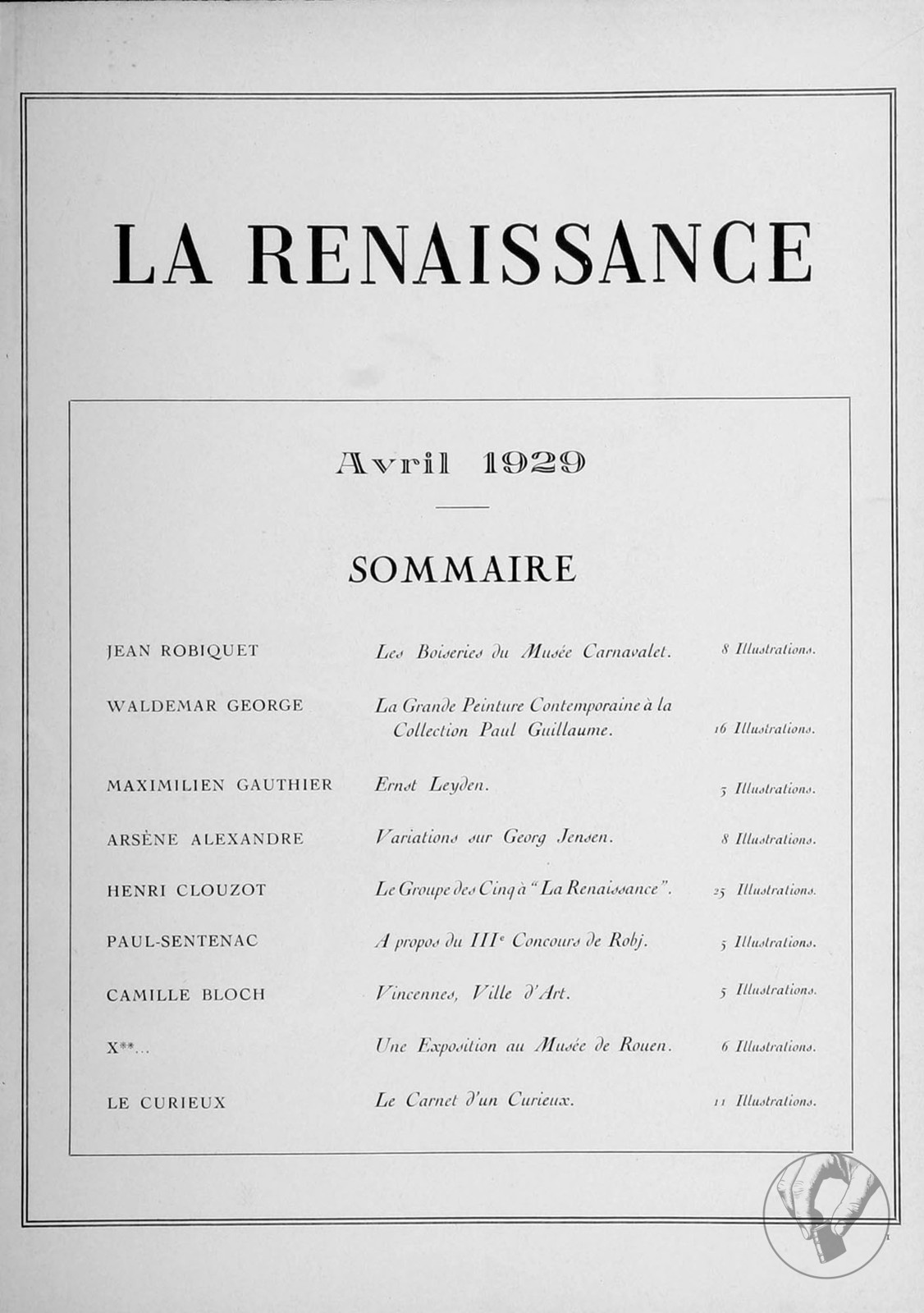
LA RENAISSANCE
Avril 1929
SOMMAIRE
JEAN ROBIQUET
---
Les Boiseries du Musée Carnavalet.
---
8 Illustrations.
---
WALDEMAR GEORGE
---
La Grande Peinture Contemporaine à la Collection Paul Guillaume.
---
16 Illustrations.
---
MAXIMILIEN GAUTHIER
---
Ernst Leyden.
---
5 Illustrations.
---
ARSÈNE ALEXANDRE
---
Variations sur Georg Jensen.
---
8 Illustrations.
---
HENRI CLOUZOT
---
Le Groupe des Cinq à “La Renaissance”.
---
25 Illustrations.
---
PAUL-SENTENAC
---
A propos du IIIe Concours de Robj.
---
5 Illustrations.
---
CAMILLE BLOCH
---
Vincennes, Ville d’Art.
---
5 Illustrations.
---
X**...
---
Une Exposition au Musée de Rouen.
---
6 Illustrations.
---
LE CURIEUX
---
Le Carnet d’un Curieux.
---
11 Illustrations.
---
Page 2
PANNEAUX ET ENCADREMENT DE GLACE PROVENANT DE L'HOTEL DES STUART D'AUBIGNY
SITUÉ, AVANT 1867, RUE SAINT-HYACINTHE-SAINT-MICHEL, AUJOURD'HUI RUE MALEBRANCHE.
DÉBUT DU XVIIIe SIÈCLE.
Page 3
LES BOISERIES DU MUSÉE CARNAVALET
DESSUS DE PORTE FAISANT PARTIE DE LA BOISERIE DE L'HOTEL DES STUART D'AUBIGNY.
DÉBUT DU XVIIIe SIÈCLE.
«Comme Madame de Sévigné avait de belles boiseries!» s'exclament parfois les visiteurs de Carnavalet, même dans les salles — franchement Louis XVI — où la légende évoque le souvenir du chevalier de Fersen.
Si ces personnes trop crédules consultent l'ouvrage qui vient de paraître sur les décorations du vieux Musée, leur religion sera vite éclairée. Sans doute Madame de Sévigné, malgré toute sa finesse d'esprit, ne s'est-elle jamais piquée de découvrir les styles un siècle d'avance. Il est même probable que notre grande hôtesse serait fort étonnée, si elle revoyait son ancienne demeure aménagée comme elle l'est à présent et servant désormais de refuge à tant de boiseries parisiennes qui viennent y prendre leurs invalides.
A vrai dire, il reste fort peu de choses de l'aménagement intérieur que la marquise a pu connaître : la pièce que nous appelons le Salon Sévigné ; quelques lambris modestes dans la galerie qui précède ; des corniches d'un joli dessin dans les chambres de l'abbé de Coulanges... Et voilà tout l'héritage du dix-septième siècle.
C'est la ville de Paris qui eut le mérite, deux cents ans plus tard, d'entreprendre, si l'on peut dire, le reboi-
“What beautiful woodwork Madame de Sévigné had!” exclaim the visitors to Carnavalet, sometimes, even in the rooms — clearly Louis XVI — in which the tradition recalls the memory of the chevalier de Fersen.
It these too credulous persons consult the present work, their worship will be quickly clarified. No doubt Madame de Sévigné, in spite of all her refinement of spirit, would have been amazed to discover the styles a century ahead of time. It is very probable that our great hostess would be very much astonished if she saw once more her old home refurnished as it is at present and serving as a later refuge for so much Parisian woodwork that comes there as to a hospital.
To tell the truth, there is little left of the interior decoration that the marquise could have known: the room that we call the Sévigné salon; a few modest wainscotings in the gallery that precedes it; some cornices of pretty design in the rooms of the abbé de Coulanges... That is all the inheritance of the seventeenth century.
Page 4
LA RENAISSANCE
sement de Carnavalet. Les travaux qui s'exécutèrent un peu avant 1889, pour l'installation du Musée dans les annexes de l'hôtel, dotèrent ces galeries nouvelles de deux ensembles : la chambre à coucher et la salle à manger que Lebrun et Perrier avaient peintes pour l'hôtel de La Rivière-Villedeuil, place Royale ; et le charmant salon de musique de l'hôtel Stuart d'Aubigny, épave de la rue Gay-Lussac. Le manque de place empêcha malheureusement nos arrière-prédécesseurs de multiplier ces sauvetages qui eussent pu être si abondants, à une époque où un vent de démolition soufflait sur le vieux Paris et y exerçait tant de ravages.
Il fallut attendre l'année 1897 et le transfert de la bibliothèque Carnavalet à l'hôtel Le Pelletier-Saint-Fargeau pour gagner un peu de terrain et pouvoir envisager de nouvelles présentations de boiseries dans les locaux demeurés vides.
Tel fut le programme dont s'inspira notre maître et ami Georges Cain, dès le début de sa conservation. Il arrivait à point nommé pour donner la mesure de son goût, et lancer la formule, très originale pour l'époque, d'un musée où les tableaux allaient venir s'accrocher non plus sur des murs quelconques, mais sur des boiseries de style, valant elles-mêmes comme œuvres d'art.
Ce procédé d'exposition qui est maintenant si répandu, constituait alors une trouvaille, aucun de nos établissements d'art ne l'ayant encore employé. Il ne faut donc pas s'étonner que le public ait été séduit par une semblable innovation et ait vite appris le chemin de la « Carnavalette » rajeunie.
Si le principe était excellent, son application demeurerait toutefois très limitée, les premiers aménagements en question n'ayant porté que sur trois salons : les boiseries Régence provenant de l'hôtel de Broglie, les panneaux assez disparates qui décoront l'ancienne chambre de Charles de Sévigné, et, dans le cabinet voisin, le petit boudoir de laque jaune, peint à la manière de Pillement, qui reste l'une des perles du Musée.
En 1914 seulement, ce premier fonds put se corser de trois présentations nouvelles : le salon dit de Mazarin, emprunté à l'hôtel de Colbert-Villacerf, rue de Turenne, une chambre polychrome Louis XV, originaire de la rue de Fleurus, et une autre, de style Louis XVI, évadée de la rue de Grenelle. En comptant ces dernières venues, le nombre des salles de boiseries qu'on pouvait montrer au public, quelques mois avant la guerre, s'élevait à dix exactement.
Mais à ces richesses connues s'ajoutaient des trésors cachés. Depuis longtemps déjà, la ville de Paris avait pris la sage habitude de nous laisser cueillir, dans la démolition de ses immeubles, tous les éléments susceptibles de trouver place à Carnavalet, en vue d'agrandissements futurs. Et ces dépouilles constituaient, au plus pro-
It is the city of Paris that deserves the credit, two hundred years later, of undertaking, if it can be so described, the refurnishing of Carnavalet. The work that was done a little before 1889, toward the rearrangement of the Museum in the annexes of the house, added the new extensions of the two parts : the bedroom and the dining room which Lebrun and Perrier had painted fot the house of La Rivière-Villedeuil, place Royale : and the charming music-room of the Stuart d'Aubigny house, on the rue Gay-Lussac. Lack of room unfortunately hindered our predecessors from multiplying such rescues which might have been so plentiful at a period when a wind of destruction blew over old Paris and resulted in so much waste.
It was necessary to wait until 1897 and the transfer of the Carnavalet library to the Le Pelletier-Saint-Fargeau building to secure a little space and to be able to plan the new placing of woodwork in the empty dwelling.
Such was the program that inspired our master and friend Georges Cain from the beginning of his work as curator. He came at the right moment to give proof of his taste and to work out the formula, very original for that period, of a Museum in which the pictures should be hung not on nondescript walls, but on woodwork of a marked style, that has a value of its own as a work of art.
This method of exhibiting which is now so widespread in use was then a discovery, none of our art institutions having tried it yet. It is not surprising that the public was attracted by such an innovation as quickly found its way to the “Carnavalette” whose youth was renewed.
If the principle was excellent, its application remained always very limited, the first refurnishing in question being done in three rooms only : the Regency woodwork from the de Broglie mansion, the mixed panels that decorated the old room of Charles de Sévigné, and, next to that, the little boudoir in lake yellow, painted in the style of Pillement, which remains one of the pearls of the Museum.
Not until 1914 were there funds for three new installations : the hall named Mazarin, borrowed from the Colbert-Villacerf house, rue de Turenne, a polychrome Louis XV chamber, coming from the rue de Fleurus and another in Louis XVI style, brought from the rue de Grenelle. Counting these last comers, the number of rooms refitted with woodwork that could be shown to the public, some months before the war amounted to exactly ten.
But to these evident riches were added hid treasures. For a long time, the city of Paris had observed the wise custom of letting us select, in the tearing down of its buildings, all material that could be used at Carnava-
Page 5
DÉCORATION EN STUC PEINT (PANNEAUX ET ENCADREMENT DE GLACE) A SUJETS CHINOIS, PROVENANT DE L'HOTEL DE LARIBOISIÈRE SITUÉ AUTREFOIS RUE DE BONDY ET DÉMOLI APRÈS 1871. ÉPOQUE LOUIS XV.
Page 6
BOISERIE PROVENANT DE L'ANCIEN COLLEGE DES PREMONTRÉS DE LA RUE HAUTEFEUILLE,
DÉMOLI EN 1878 POUR L'AGRANDISSEMENT DE LA FACULTÉ DE MÉDECINE.
ÉPOQUE LOUIS XV.
Page 7
BOISERIE PROVENANT DE L'HOTEL BRULART DE GENLIS, SITUÉ QUAI CONTI ET ACQUIS PAR LA VILLE DE PARIS EN 1912.
ÉPOQUE DE LA RÉGENCE.
GRILLE DE BALCON PROVENANT DE L'ANCIEN CABINET DE PHYSIQUE DU ROI LOUIS XV A PASSY.
Page 8
LA RENAISSANCE
fond de nos caves, un extraordinaire bric-à-brac de panneaux sculptés. de ferronneries, de cheminées, de carrés de parquets, toute une admirable réserve dans laquelle nous allions, un jour, pouvoir puiser à pleines mains.
L’achèvement de bâtiments neufs, escompté depuis si longtemps, mais que la guerre retarda forcément de plusieurs années, ne nous permit de commencer ce travail de fouilles qu’aux approches de 1922. Dans son purgatoire souterrain, notre collection de boiseries n’avait rien perdu pour attendre. Plusieurs apports récents venaient, au contraire, de l’enrichir d’une façon inespérée.
L’achat des salons de Conflans, l’attribution au Musée des merveilles de l’hôtel Brûlart de Genlis, l’annonce de l’arrivée prochaine des lambris de la rue Matignon et de ceux de la rue Laffitte, autant de circonstances heureuses qui nous mettaient en possession d’une vingtaine de boiseries à distribuer dans la maison, pour la rendre belle et souriante.
Restait à trouver le moyen de reconstituer ces ensembles en les altérant le moins possible, de dresser nos décors de chêne dans des pièces pour lesquelles ils n’avaient pas été conçus, d’accorder tant bien que mal la hauteur des panneaux avec celle des plafonds, les mesures des chambranles avec celles des portes et des fenêtres, bref de combiner entre les murs et les boiseries un honnête mariage de raison qui pût donner l’illusion d’un mariage d’amour.
Ce résultat, on le devine, ne fut pas obtenu sans peine. Parfois une différence de quelques centimètres faisait échouer tout un projet ; il fallait recommencer l’équipement d’un salon pour une cheminée qui n’était pas dans l’axe, pour deux glaces qui se balançaient mal. Et, le mètre en main, nous nous demandions comment certaines personnes pouvaient affronter les problèmes de la quatrième dimension, quand les exigences des trois premières nous donnaient déjà tant de soucis...
Heureusement le puzzle est un jeu où la patience finit toujours par avoir le dernier mot. On découvre fatalement la bonne combinaison, ne serait-ce qu’après avoir épuisé toutes les mauvaises... Et plus les tâtonnements ont été laborieux, plus la réussite cause de joie.
Telle fut un peu l’histoire des aménagements de Carnavalet, durant cette période agitée où nos futures galeries changèrent si souvent de visage. Grâce à Dieu, depuis quatre ans, les boiseries en mal de placement ont repris une vie sédentaire. Elles ont retrouvé la joie et la tranquillité qui conviennent à des aïeules.
Classées à peu près par époques et réparties en deux familles — les pièces de chêne ciré et les pièces de boiseries peintes, — elles occupent désormais, de part et d’autre de l’escalier de Luynes, tout le premier étage de nos bâtiments neufs qui forme la suite naturelle des appartements Sévigné.
En dehors de la valeur d’art que représente un tel let, with a view to future additions. And these scraps kept in our lowest cellars, constituted an extraordinary hodge-podge of carved panels, of ironwork, of mantelpieces, of bits of flooring, an altogether admirable reserve into which we should one day delve and come out with full hands.
Erection of new buildings, so long anticipated, but which the war forcibly delayed for years, did not permit us to begin this work of development until nearly 1922. In its subterranean purgatory, our collection of woodwork had lost nothing by the delay. On the contrary, many recent additions came to enrich it in a way unhoped for.
The purchase of the salons of Conflans, the turning over to the Museum of the marvels of the Brulart de Genlis house, the news of the coming arrival of the wainscot of the rue Matignon and of those of the rue Laffitte, such fortunate circumstances put us in possession of some twenty bits of woodwork to distribute through the house, to render it beautiful and smiling.
It remained to find the means of adapting these materials with as little change as possible, to place our oak decorations in rooms for which they had not been made, to harmonize without distorting the height of the panels with that of the ceilings, the length of the door casing and window frames with that of the doors and windows, in a word, to make an honest marriage of convenience between the walls and the woodwork which should give the effect of a marriage of love.
This result, it may be imagined, was not achieved without effort. Sometimes a difference of a few centimetres spoiled a whole plan; it was necessary to begin the arrangement of a room all over for a mantel which was not where it belonged, for two mirrors which were out of balance. And metre stick in hand, we asked ourselves how certain people could take up the fourth dimension when the demands of the original three caused us so much anxiety...
Happily the puzzle is a game where patience ends always by having the last word. The right combination is inevitably found, even if it comes only after one has tried all the wrong ones... And the more trying the experiments, the more joyous is final success.
This is the story of the refurnishing of Carnavalet, during that troubled period when our future galleries were so often changed. Thank God, for the last four years now, the woodwork that was so difficult to place has settled down to a sedentary life. It has found again the satisfaction and tranquillity that go with the life of our grandfathers.
Classified by periods and divided into two families—the waxed oak and the painted woodwork—they finally were distributed on one side or the other of the Luynes stairway, through all the first floor of our new buildings, which
Page 9
DESSUS DE PORTE, PANNEAUX ET ENCADREMENT DE GLACE
PROVENANT D'UNE BOISERIE DE L'HOTEL BRULART DE GENLIS,
SITUÉ QUAI CONTI ET ACQUIS PAR LA VILLE DE PARIS EN 1912.
ÉPOQUE LOUIS XV.
Page 10
PARTIE SUPÉRIEURE D'UN PANNEAU FAISANT PARTIE D'UNE BOISERIE QUI SE TROUVAIT RUE SAINT-DOMINIQUE
DANS L'HOTEL DE BROGLIE, DÉMOLI SOUS LE SECOND EMPIRE POUR LE PERCEMENT DU BOULEVARD SAINT-GERMAIN.
ÉPOQUE DE LA RÉGENCE
Page 11
LA RENAISSANCE
ensemble et de la riche documentation que les spécialistes viennent y puiser, cette variété de décors est particulièrement précieuse dans un musée comme le nôtre, où la couleur locale, l'illusion du milieu ancien, jouent un rôle important. Sur les panneaux de ces salons que le temps a dorés de sa patine, le moindre bibelot prend du relief, le moindre portrait, le moindre document deviennent plus évocateurs.
Et puis quand tout gravite, chez nous, autour de l'idée parisienne, quand elle est notre sujet même, n'est-ce pas une étrange bonne fortune que de disposer d'une toile de fond si bien adaptée à la pièce que nous avons à mettre en scène ?
Quels que soient leur âge et leur style, les boiseries de Carnavalet ont une origine commune : elles sont nées dans notre ville, elles ont paré nos vieux hôtels, elles ont été sculptées par des artisans de chez nous ; ce sont des Parisiennes de Paris.
Et voilà peut-être pourquoi nous leur trouvons tant de saveur. Elles incarnent le goût raffiné de générations qui précédèrent la nôtre. Par toutes les fibres de leur bois, elles tiennent au noble et grand passé dont la tradition nous est chère.
JEAN ROBIQUET,
Conservateur du Musée Carnavalet.
form the natural completion of the Sévigné apartments.
Beside the art value that such a collection represents, and the store of information which specialists go there to find, this variety of decoration is particularly precious in a museum like ours, where the local colour, the effect of the old surroundings, play an important role. On the panels of these salons, which time has decorated with its patina, the least bibelot stands out in relief, the smallest portrait, the most unimportant detail, help to conjure up the past.
And then when all gravitates, in this place, toward the Parisian conception, when that is our very theme, is it not a strange piece of good fortune that brings to us a canvas that is well adapted to the room we have at our disposal?
Whatever be their age and their style, the pieces of woodwork at Carnavalet have a common origin: they were born in our city, they have adorned our old houses, they were carved here by our artisans: they are Parisians of Paris.
And that is why, perhaps, we find them so much to our liking. They incarnate the refined taste of the generations that precede our own. By all the fibres of their wood, they cling to the noble and grand past whose tradition is dear to us.
JEAN ROBIQUET,
Conservateur du Musée Carnavalet.
DÉTAIL D'UN PANNEAU DE LA BOISERIE PROVENANT DE L'HÔTEL DE BRULART DE GENLIS. ÉPOQUE LOUIS XV.