Extrait
Premières pages de l'ouvrage, en accès libre.
Page 1
CE QUI MANQUE AU LOUVRE
L'ÉCOLE ANGLAISE
WHAT IS LACKING AT THE LOUVRE -- THE ENGLISH SCHOOL
J. F. BULLOZ
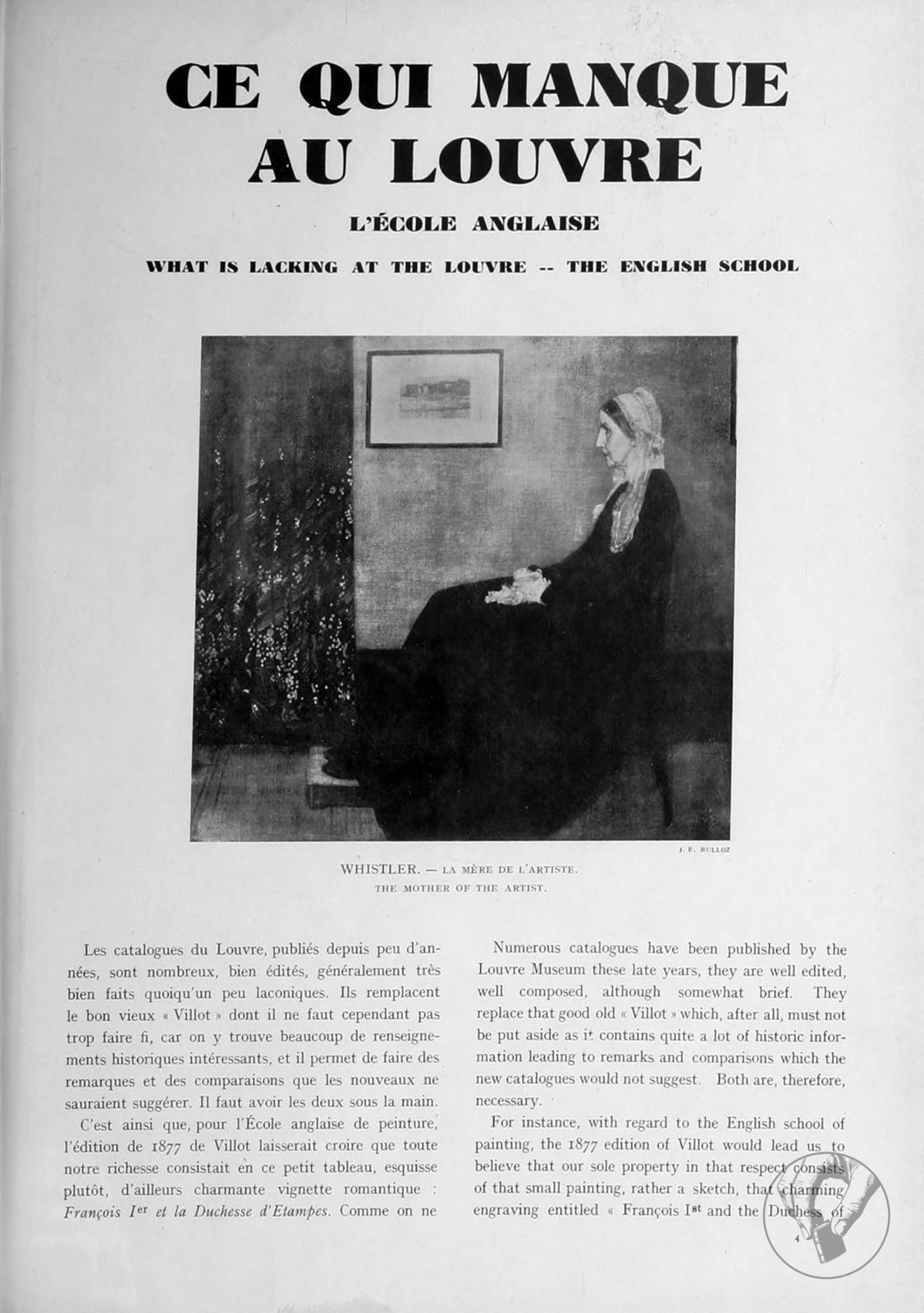
WHISTLER. — LA MÈRE DE L’ARTISTE.
THE MOTHER OF THE ARTIST.
Les catalogues du Louvre, publiés depuis peu d’an- nées, sont nombreux, bien édités, généralement très bien faits quoiqu’un peu laconiques. Ils remplacent le bon vieux « Villot » dont il ne faut cependant pas trop faire fi, car on y trouve beaucoup de renseigne- ments historiques intéressants, et il permet de faire des remarques et des comparaisons que les nouveaux ne sauraient suggérer. Il faut avoir les deux sous la main.
C’est ainsi que, pour l’École anglaise de peinture, l’édition de 1877 de Villot laisserait croire que toute notre richesse consistait en ce petit tableau, esquisse plutôt, d’ailleurs charmante vignette romantique : François Ier et la Duchesse d’Etampes. Comme on ne
Numerous catalogues have been published by the Louvre Museum these late years, they are well edited, well composed, although somewhat brief. They replace that good old « Villot » which, after all, must not be put aside as it contains quite a lot of historic information leading to remarks and comparisons which the new catalogues would not suggest. Both are, therefore, necessary.
For instance, with regard to the English school of painting, the 1877 edition of Villot would lead us to believe that our sole property in that respect consists of that small painting, rather a sketch, that charming engraving entitled « François Ist and the Duchess of
Page 2
LA RENAISSANCE DE L'ART FRANÇAIS ET DES INDUSTRIES DE LUXE
J. HOPPNER — JEUNE FEMME ET JEUNE GARÇON.
YOUNG WOMAN AND YOUNG BOY.
pouvait raisonnablement faire de ce seul tableau une section à part, il était simplement inscrit dans l’École française, entre Jean-Jacques Boissieu et François Boucher, et nous croyons nous souvenir que, visiteur passionné du Louvre en tunique de collégien, nous le goûtions fort dans le Salon Carré.
Pourtant, depuis 1873, nous étions plus riches que cela sans l’être guère. C’était une année faste, et qui permettait, d’après le départ, d’espérer une assez complète moisson. Un excellent donateur, M. John Wilson, avait donné les tableaux suivants :
L’admirable Baie de Weymouth où Constable a si bien fait sentir l’approche de la tempête sur la grève ;
Un autre beau Constable, l’Arc-en-Ciel.
La même année un autre Constable : Le Cottage, acheté à la vente du Marquis de La Rochebrune faisait déjà un appréciable trio. En 1877, M. Lionel Constable, fils du grand paysagiste, offrait au Musée la brillante petite vue d’Hampstead Heath. En 1881 le tableau intitulé The Glebe Farm, excellente page également, était acheté à la vente John Wilson, ci-dessus nommé, par le journal l’Art, qui le donnait au Musée.
Ce n’était qu’un assez mince commencement. Mais l’année 1881 sembla vouloir donner un élan nouveau à la peinture anglaise dont on commençait à s’entretenir. On recommençait, plutôt ; car au temps de Delacroix bui admirait Constable et Bonnington, et parlait avec
JOHN OPIE. — LA FEMME EN BLANC.
WOMAN IN WHITE.
Etampes ». As it was impossible to have a section for this painting alone, it has been classified under the French school between Jean-Jacques Boissieu and François Boucher, and we ourselves have a recollection of a time, when still as a school-boy, we visited the « Salon Carré » which we appreciated particularly.
However, since, the year 1873 we were not as poor as that, although not rich. That year was a fruitful, one and its beginning was promising of a fairly good harvest. Mr. John Wilson, a donor, had presented the Museum with the following paintings :
The admirable Bay of Weymouth, in which Constable has made us feel the approach of the tempest on the beach ; another beautiful Constable, The Rainbow. In the same year, still another Constable The Cottage purchased at the sale of the Marquis de la Rochebrune, thus making three paintings by that famous artist. In 1877, Mr. Lionel Constable, the son of the great landscape-painter, offered to the Museum the small sight of Hampstead Heath. In 1881, the painting called The Glebe Farm, also an excellent composition, was acquired at the John Wilson sale, above alluded to, by the “ Art ”, that made a gift of it to the Museum. But in that year 1881, the English painting seems to spring forward and begins to make itself known.
People deal with it, or rather start over again,
Page 3
LA RENAISSANCE DE L'ART FRANÇAIS ET DES INDUSTRIES DE LUXE
999
JOSHUA REYNOLDS.
PORTRAIT DE FEMME — PORTRAIT OF WOMAN.
DON DE Mme L. STERN.
délices du « ravissant Gainsborough » et qui avait été rendre visite à Wilkie, on s'était déjà aperçu que les Anglais savaient peindre.
En cette année 1881 donc, avaient lieu la vente Wilson et diverses autres; et par acquisition ou donation entraient au Louvre ces œuvres-ci :
L'Abreuvoir, aimable tableau de mœurs de Mulready ; le Portrait (bien compassé) de lord Whitworth, par Lawrence ; la Vieille gouvernante, de Bonnington, cette rude esquisse si en dehors de la manière du spirituel jeune homme ; la Halte, de Morland, agréable scène, mais qui n'est pas des plus significatives de l'École ; Frère et sœur, de Beechey (vente Wilson) ; enfin la Femme en blanc, de John Opie (même vente).
Le robuste type d'Invalide de la marine, par Raeburn, qui avait été adjugé 7.300 francs à la vente de la Rochebrune, entrait au Louvre en 1880, par suite de la vente Laurent Richard, pour le prix seulement de 2.400 francs. Cette baisse n'impliquait pas forcément une défaveur nouvelle de l'École ; indifférence peut-être ; ou concession faite à l'État. Mais toujours est-il que la première ardeur s'était refroidie. Insuffisante pour créer une véritable collection, suffisante à peine pour constituer une amorce, elle ne procéda plus que lentement et par caprice.
Mais pendant les intervalles de ces caprices, la valeur des Reynolds, des Gainsborough, des Raeburn, des for, Delacroix who admired Constable, used to speak with delight of that « ravishing Gainsborough », he had visited Wilkie, and upon the whole, it was admitted that the English knew how to paint.
The Wilson and other sales took place in that year 1881, and either through acquisitions or donations, the following pictures entered the Louvre :
The Watering-Place, quite a charming country-folk painting, by Mulready ; the Portrait of Lord Whitworth, by Lawrence ; the Old Governess, by Bonnington, quite an apre sketch, very different from the customary manner of the witty young man ; The Halt, by Morland, an agreeable composition but not one of the most significant paintings of the School ; Brother and Sister, by Beechey (Wilson sale), and finally, The Woman in white, by John Opie (same sale).
That sturdy type of The Invalide of the Marine, by Rochebrune, which had been awarded 7.300 francs at the Rochebrune sale, entered the Louvre in 1880 for the low price of 2.400 francs following upon the Laurent Richard sale. This decrease in price did not purport that the School had fallen into discredit. Was this to be attributed to neglect, was it a concession made to the State? No one can ascertain, but be it what it may, the first enthusiasm went. The works were hardly sufficient to constitute a valuable collection, and from that time on, were rather looked upon as “entice-
FRANCIS COATES.
PORTRAIT DE FEMME. — PORTRAIT OF WOMAN.
DON DE M. ERNEST MAY.
Page 4
1000
LA RENAISSANCE DE L'ART FRANÇAIS ET DES INDUSTRIES DE LUXE
CL. GIRAUDON
LAWRENCE. — J.-J. ANGERSTEIN ET SA FEMME.
J.-J. ANGERSTEIN AND HIS WIFE.
Romney, pour ne pas parler des Turner, et de bien d'autres Maîtres qui les précédèrent, montait considérablement.
Un « ami du Louvre » qui était jovial (et qui avait cru avoir des raisons de l'être), se donna un jour le plaisir de paraître magnanime, puis tout aussitôt de causer une fausse joie. Il offrit un Turner qui fut installé triomphalement dans la grande Galerie. On chercherait vainement à s'échauffer sur ce faux diamant. Toutefois, piano, piano, nous sommes arrivés à posséder, réparties dans trois salles, quarante-six peintures, quelques aquarelles, et provisoirement une vitrine de miniature, prêtée par M. Doisteau, donnant ainsi un exemple qui n'a pas encore été suivi. Mais il ne faut pas désespérer.
Est-ce l'absolue pauvreté ? Pas tout à fait, car il y a dans le nombre de fort belles pièces. Est-ce la richesse ? Il s'en faut de beaucoup.
Que de lacunes en effet ! Laissons de côté, si l'on veut, Hogarth, très grand peintre non seulement dans ses scènes de mœurs, connues et classées, mais aussi dans
CL. GIRAUDON
HENRY RAEBURN. — PORTRAIT DU CAP. HAY OF SPOT.
PORTRAIT OF CAPT. HAY OF SPOT.
ments " and the School progressed but slowly and by bounds.
In the meantime, however, the value of the Reynolds, the Gainsboroughs, the Raeburns, the Romneys, without mentioning Turner and many other masters having preceded them, was rising considerably.
A Ami du Louvre, of a jolly nature—and who thought he could joke at the expense of others—caused at first much enthusiasm, which was, however, to be followed by a real deception: He offered to the Museum a Turner, the painting was immediately installed in the big Gallery, but unfortunately it turned to be a false one.
Little by little, we now possess, divided into three rooms, forty-six paintings of the English School, some water-colours, and a show-window of miniatures which has been lent by M. Doisteau, thus giving an example which, up to now, has not been followed. But let us have confidence.
Is this “poverty” in the true sense of the word? Not quite so. We possess magnificent pieces. May
Page 5
LA RENAISSANCE DE L'ART FRANÇAIS ET DES INDUSTRIES DE LUXE
1001
JOSHUA REYNOLDS. — GEORGIANA, DUCHESSE DE DEVONSHIRE.
COLLECTION HUNTINGTON.
TYPE DE PORTRAIT ANGLAIS COMME IL EN FAUDRAIT AU LOUVRE.
ENGLISH PORTRAITS SUCH AS THE "LOUVRE" WOULD REQUEST.
Page 6
1002 LA RENAISSANCE DE L'ART FRANÇAIS ET DES INDUSTRIES DE LUXE
CL. GIRAUDON
J. RUSSEL. — L'ENFANT AUX CERISES.
THE CHILD WITH CHERRIES.
ses grands portraits qui sont la gloire de certains éta-
blissements nationaux, hospices, etc. On ne peut guère
songer à en voir traverser le « Channel ».
Mais de Reynolds, tout d’abord, nous avons bien le
charmant Master Hare, et la vive esquisse donnée par
Mme L. Stern, mais l’un n’est pas très représentatif du
Maître, et l’autre n’est en somme qu’une très précieuse
esquisse.
Gainsborough n’est représenté en tout et pour tout,
que par les paysages de la donation Lacaze qui ne peu-
vent, même en ce sens, donner une idée du grand et
« ravissant » sorcier de grâce.
Le portrait de Romney par lui-même est assez mé-
diocre, et, pour important qu’il soit, celui de Sir John
Stanley ne renseigne que sur le caractère général de
l’art anglais, mais nullement sur l’ami de Lady Hamil-
ton. Le Musée qui n’a pas un Romney en blanc et bleu
n’a pas de Romney.
Lawrence est le troisième de la Trinité des grands
portraitistes, mais par sa sécheresse distinguée, ou sa
distinction sèche, le troisième à une assez longue dis-
tance. M. et Mme Angerstein, sans être aussi séduisants
qu’une de ses rêveuses à papillottes peut, à la rigueur,
suffire, puisque nous avons un beau et important por-
trait dessiné, qui vaut certes cette peinture.
Raeburn, lui, est très bien et très largement représenté.
Moins par notre Invalide, commémoratif des obscurs
BONNINGTON. — FRANÇOIS 1er ET LA DUCHESSE D’ÉTAMPES.
FRANÇOIS 1st AND THE DUCHESS OF ÉTAMPES.
we then consider ourselves rich in this respect ? — By
no means.
There are many gaps to fill. Even if we put aside the
famous Hogarth, — whose country-folks compositions
are well-known and classified as are also his portraits, of
which certain national institutions and hospitals are so
proud of, — it is not be hoped that other works by this
celebrated master will ever cross the Channel.
Let us then consider Reynolds. We possess of him
the charming Master Hare and a sketch, a gift of Madame
L. Stern, but the first is not quite representative of the
art of the master, and the second is but a very fine
sketch.
Gainsborough, in all, is represented by the sole land-
scapes coming from the Lacaze donation and these
cannot give an idea of that ravishing artist, called « the
witch of grace ».
The portrait of Romney by himself is rather poor,
and as to the important one of Sir John Stanley, if it
contributes to give us indications on the general cha-
racter of the English painting, it furnishes no data on
the friend of Lady Hamilton. A museum which does
not possess « a white and blue Romney » cannot pretend
to have Romneys.
Lawrence, the third of the trinity of great portraitists,
through his distinguished stiffness — or harsh distinc-
tion — stands at a fairly good distance from the other
Page 7
LA RENAISSANCE DE L'ART FRANÇAIS ET DES INDUSTRIES DE LUXE
1003
débuts de l'Angleterre au Louvre; que par le magistral Captain Hay of Spott, le net et cependant si attachant groupe de Mrs. Maconochie et de son bébé, enfin Miss Anna Moore. Si tous les Maitres britanniques figuraient chez nous avec cette importance le présent article aurait moins de raison d'être.
two. Mr. and Mrs Angerstein are certainly not as attractive as is one of his dreamers with curl-papers ; but it suffices since we have a beautiful drawing which is worth this painting.
Raeburn is largely represented by a good many of his works, not to the same extent by his Invalide that
BONNINGTON. — LE COLLEONE A VENISE.
THE COLLEONE AT VENISE.
GOUACHE.
Turner, nous l'avons vu, est plus que manquant. Si un miracle ne se produit pas (notez qu'un miracle est toujours possible, et même probable), il faudra longtemps encore traverser l'eau pour avoir l'idée de ce prestidigitateur qui a exercé sur la peinture moderne, l'impressionniste particulièrement, une influence incalculable.
Influence semblable à celle que Constable eut sur notre grande École de Fontainebleau. C'est pourquoi, à côté des louables petits Constable de notre collection un grand et même plusieurs grands spécimens de ce paysagiste, si pénétrant et si divers, seront toujours les bienvenus.
Honorables sans plus sont nos John Opie, Beechey recalls the not brilliant debuts of England to the Museum, but by the masterly Captain Hay of Spott, the so attractive group of Mrs. Maconochie and her baby, and Miss Anna Moore. If all the English masters were represented on the same scale, this article would not need be written.
As to Turner, he is not represented at all, and unless a miracle occurs — (after all miracles are always possible and even probable !) we shall have for still a long time to come to cross the Channel if we want to realize what was the art of that fascinating artist who exercised on modern painting, especially on impressionism, an incalculable bearing.
His influence may be compared to that of Constable
Page 8
1004
LA RENAISSANCE DE L'ART FRANÇAIS ET DES INDUSTRIES DE LUXE
Russell, Hodges ; mais nous les changerions volontiers pour un seul très beau tableau, et nous pourrions donner par-dessus le marché le grand portrait de la Reine Charlotte, par Ramsey et l'horriblement sec Lamartine, de Phillips.
Hoppner trouverait grâce dans cette transaction, car of our School of Fontainebleau. This is the reason why, apart from the smaller though praiseworthy paintings of our collection, several specimens of these landscapes, so impressive and so sharp, would always be welcome.
Honourable, but nothing more, are our John Opies,
BONNINGTON. — LE PARC DE VERSAILLES.
PARK OF VERSAILLES.
ses deux portraits et surtout la Comtesse d'Oxford sont de la quintessence britannique.
Quant au paysage anglais, sauf Constable, et sans refrain de jérémiades pour Turner, il est certain que l'honorable Wilson qui, d'ailleurs, a sa raison d'être en qualité d'intermédiaire dans l'évolution, serait très heureusement complété par quelques beaux Crome bien rissolés.
Les pastellistes et aquarellistes tels que Cosway, Chiney, Downmann, etc., qui ont, depuis peu d'années, fini par occuper dignement la critique et les collectionneurs, auraient une salle tout entière, ce ne serait pas excessif. Malgré le manque de place, auquel il faut bien espérer que l'on remédiera un jour, on les logerait bien... si on les avait !... Heureusement M. Ernest May donna le très séduisant Coates reproduit ici.
Benjamin West, Wilkie, l'ingénieux Sotthard, le mystique William Blake, bien d'autres encore finiraient bien par compléter le peu de peinture de chevalet que nous avons pour tout potage avec notre Morland Beecheys, Russels, Hodges, but we would readily exchange them against one fine painting, and further give over and above the bargain the portrait of Queen Charlotte and that of Lamartine — so stiff — by Phillips.
Hoppner, however, would not be part of the transaction, as his two portraits, especially The Countess of Oxford are of British quintessence.
Dealing with English landscaping, making an exception of Constable and abstaining from repeating what we wrote above regarding Turner, it is certain that we should like to add to the works of Wilson, — who, as an intermediary, marks the evolution — some fine Cromes.
Pastellists and aquarellists such as Cosway, Chiney, Downmann, etc. with whom the critic and collectors have been busy these late years — should be given a room to themselves, which would not be exaggerated. Despite the lack of space, which will be remedied to one of these days, we would find means of housing them... were they in our possession ! Fortunately, Mr. Ernest May has donated the fine Coates, which we
Page 9
LA RENAISSANCE DE L'ART FRANÇAIS ET DES INDUSTRIES DE LUXE
1005
et notre Mulready, qui sont de gentilles choses.
Mais à quoi bon prolonger cette énumération et ces regrets ? Le temps est comme on dit, galant homme, et on peut espérer beaucoup de lui. Combien de musées — comme de gens — ont débuté pauvrement et se sont enrichis ! Cette richesse-là ne serait point scandaleuse.
reproduce in this issue. Benjamin West, Wilkie, the ingenious Sotthard, the mystical William Blake, should make up for our deficiency in easel-painting, although we already have some nice one by Morland and Mulready.
But to what avail these regrets ? Time is gallant,
CL. GIRAUDON
CONSTABLE. — LA BAIE DE WEYMOUTH.
BAY OF WEYMOUTH.
Et il arriverait, alors, un jour où les Anglais modernes, dont heureusement le Luxembourg est assez bien pourvu, devenant à leur tour des Maîtres consacrés par l’« épreuve des âges », comme le dit la devise de la National Gallery, viendraient rejoindre leurs grands aînés. Whistler (plutôt Anglais à notre avis qu’Américain), malgré la pancarte du Louvre serait leur glorieux intermédiaire.
La France aurait à ce moment une collection digne d’elle, supérieure même à celle des autres Musées du continent.
A la condition toutefois... Dieux ! qu’il est difficile d’être complètement satisfait ! — à la condition que, d’ici là, nous pussions nous être procuré de beaux Millais, Rossetti, Burne-Jones et autres préraphaëlistes… pendant qu’ils ne valent encore que quelques centaines de mille francs…
Attendons, avec confiance les miracles, puisque nous y croyons.
ARSÈNE ALEXANDRE.
and much is to be hoped from it. So many people started poorly in life and became rich ! and there would be no scandal in this prosperity !
If such were the case, the modern English painters — who fortunately are fairly well represented at the Luxembourg — becoming time-hallowed masters through the trial of ages, according to the motto of the « National Gallery », would come to join their elders, and then Whistler would stand as their glorious intermediary.
Thus France would have a worthy collection, even superior to that of the other continental museums. This on a condition — good God ! we are hard to please ! — that we may until then purchase some fine Millais, Rossettis, Burne-Jones and other « pre-raphaelists » when they are still costing but a few hundred thousand francs…
Let us wait confidently for miracles, since we have faith in them.
ARSÈNE ALEXANDRE.
Page 10
BOUTET DE MONVEL
PEINTRE DE LIGNES
PAINTER OF LINES
PORTRAIT DE Mme SERGE ANDRÉ.
PORTRAIT OF Mme SERGE ANDRÉ.
A Paris, devant les arbres anciens d’un parc, dans une vieille demeure prédestinée où vécut Ingres, après son séjour en Italie, M. Bernard Boutet de Monvel travaille. Malgré notre époque de tumulte, il ne renonce pas plus aux recherches de la stylisation qu’il ne sacrifie son respect pour la tradition. Contrairement à l’attitude de trop nombreux artistes d’aujourd’hui, son œuvre n’assène pas un coup de poing d’une violence factice : elle salue loyalement, avec une franchise victorieuse.
Le peintre compose ses tableaux avec la précision d’un architecte. Son œil construit la réalité, la coordonne avec persévérance. Ses portraits du Prince Sixte de Bourbon, du Maréchal Lyautéy, sont bien équilibrés, comme les paysages qu’il a rapportés de France, d’Espagne et du Maroc, ou ses panneaux décoratifs qui ornent la maison de Mlle Jane Renouardt. Sous couleur d’abstraction l’artiste ne néglige pas la ressemblance : plutôt que de dégager l’essence des choses ou des êtres, comme le cubisme a essayé de le faire, M. Boutet de Monvel s’efforce de les immobiliser sous leur aspect le plus élégant.
In an ancient Parisian mansion, where Ingres used to live after his return from Italy, before the old trees of a park, you may see M. Bernard Boutet de Monvel at work.
In spite of the agitated time we live in, he pursues a studied and refined art and does not sacrifice to tradition. Contrary to the attitude of too many artists of this day, his work does not imply to strike a violent but fictitious blow : it sends a loyal salute, a frank and victorious greeting.
He composes his pictures with the precision of an architect; his eye perceives the reality and builds steadily. His portraits of Prince Sixte de Bourbon, of Maréchal Liautey are well poised as are also the landscapes he brought back from France, Spain or Morocco, also the panels which decorate the house of Mlle Jane Renouardt.
M. de Monvel does not neglect the likeness on the pretext of being abstract, and rather than seeking for the essence of things and individuals — as cubism
Page 11
LA RENAISSANCE DE L'ART FRANÇAIS ET DES INDUSTRIES DE LUXE
1007
L'artiste a fréquenté Chantilly, où l'atmosphère s'harmonise avec les souvenirs historiques de l'Ile de France et les habitudes sportives de la société anglaise. Les amazones juchées de biais sur leur cheval se promènent en forêt tandis que les lads, les jockeys s'en- pretended to do — he tries to fix them in their most elegant form.
M. de Monvel went frequently to Chantilly; there he has lived in the surrounding of the historical souvenirs of the Ile-de-France, and has also associated with
CL. VIZZAVONA
PORTRAITS DE MM. JEAN BOUSSINGAULT ET DE SEGONZAC.
PORTRAITS OF MESSRS JEAN BOUSSINGAULT AND DE SEGONZAC.
trainent sur les champs de courses. Les bungalows du golf avoisinent la grille du château du Duc d'Aumale où sont gardées, loin de la lumière, les miniatures qui ornent le livre d'heures du Duc de Berry. A l'époque du recueillement, avant de commencer son œuvre, un peintre ne pouvait qu'être sensible à ces influences contradictoires.
La netteté anglo-saxonne de sa conception ne lui fait pas sacrifier au charme de l'anecdote : autour de Mme Serge André, en habit de chasse à courre, le paysage évoque les lévriers, jadis en vogue, et résonne des hallalis d'avant-guerre. Les portraits de M. Boutet de Monvel prolongent une mode, l'ennoblissent au point d'en faire une tradition.
Le désir d'éviter la surcharge, la précision du regard imposent quelque austérité aux contours. Préservées de toute incertitude, les formes ne dépouillent rien de leur beauté. Si les silhouettes perdent un peu de leur souplesse, si la courbe cède la place à la ligne, la ressemblance n'est pas moins réelle et c'est tout au plus un the sporting habits of the English society. He saw sportswomen riding in the forest, while lads and jockeys had their training on the race-course, also golf bungalows located quite close to the castle of the Duke of Aumale, which houses the miniatures of the prayerbook of the Duke of Berry.
There is no doubt that, when meditating upon the course to follow, a painter could not but feel those contrary influences.
The anglo-saxon conception of his vision does not lead him to sacrifice to the charm of the anecdote: for instance, you may remark the portrait of Mme Serge André, dressed up as a huntress, in which the landscape evokes those greyhounds formerly so "à la mode" and the echo of the hallalis of pre-war times. The portraits by M. de Monvel are the prolongation of a fashion, ennobled to the point of becoming a tradition.
The precision of the conception, the desire to avoid overloading gives austerity to the general outline. It may be that his silhouettes lose some of their supple-