Extrait
Premières pages de l'ouvrage, en accès libre.
Page 1
MEMLING CHEZ REYNOLDS
---
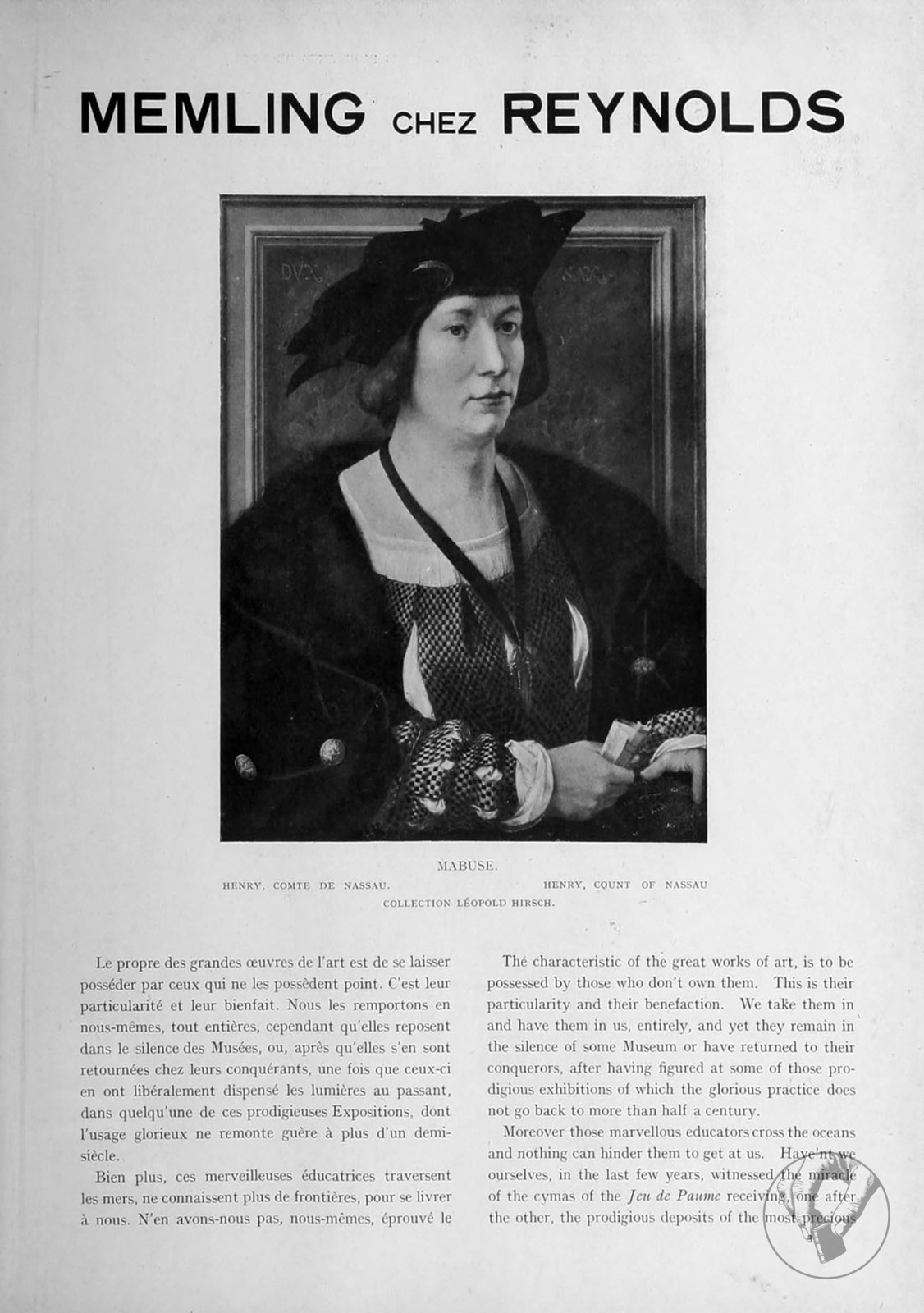
MABUSE.
HENRY, COMTE DE NASSAU. HENRY, COUNT OF NASSAU
COLLECTION LÉOPOLD HIRSCH.
Le propre des grandes œuvres de l’art est de se laisser posséder par ceux qui ne les possèdent point. C’est leur particularité et leur bienfait. Nous les remportons en nous-mêmes, tout entières, cependant qu’elles reposent dans le silence des Musées, ou, après qu’elles s’en sont retournées chez leurs conquérants, une fois que ceux-ci en ont libéralement dispensé les lumières au passant, dans quelqu’une de ces prodigieuses Expositions, dont l’usage glorieux ne remonte guère à plus d’un demi-siècle.
Bien plus, ces merveilleuses éducatrices traversent les mers, ne connaissent plus de frontières, pour se livrer à nous. N’en avons-nous pas, nous-mêmes, éprouvé le
Thé characteristic of the great works of art, is to be possessed by those who don’t own them. This is their particularity and their benefaction. We take them in and have them in us, entirely, and yet they remain in the silence of some Museum or have returned to their conquerors, after having figured at some of those prodigious exhibitions of which the glorious practice does not go back to more than half a century.
Moreover those marvellous educators cross the oceans and nothing can hinder them to get at us. Have’nt we ourselves, in the last few years, witnessed the miracle of the cymas of the Jeu de Paume receiving, one after the other, the prodigious deposits of the most precious
Page 2
62 LA RENAISSANCE DE L'ART FRANÇAIS ET DES INDUSTRIES DE LUXE
miracle en ces dernières années, lorsque les cimaises du Jeu de Paume ont, tour à tour, reçu le prodigieux dépôt de ce que les Maîtres hollandais et flamands ont créé de plus précieux, ou, lorsque le Petit Palais, grâce à Henry Lapauze, nous offrit l’ensorcellement des grands portraits et des tapisseries de Goya ? Le public anglais et ceux d’entre nous qui pourront, cette saison, traverser cette Manche que les aéros ont rendue si étroite et le change si immense, vont connaître un semblable et peut-être encore un plus complet enchantement.
L’Exposition, en effet, qui est l’annuelle et solennelle révélation des Old Masters, ouverte à partir du 8 janvier à la Royal Academy, offre, à l’étude et au rêve, un ensemble de chefs-d’œuvre de l’École flamande du xve au xviiie siècle. Seul, un animateur comme Sir Joseph Duveen, pouvait, avec ses collaborateurs et ses amis, réaliser ce tour de force de créer un spectacle d’une étonnante nouveauté avec des éléments à ce point consacrés.
Ainsi, Londres se montrera maîtresse en cet art des Expositions magistrales dont nous rappelions, à l’instant, la moderne mais relativement récente origine. Elles ne remontent guère, disions-nous, à plus d’un demi-siècle. C’est, en effet, en 1871 qu’avait lieu, à Burlington House, la première de ces Expositions des « Maîtres anciens », fêtes graves et splendides, recueillies, on dirait presque religieuses et qui se succédèrent, d’année en année, avec la régularité des saisons, mais de saisons qui ne seraient jamais que bienfaisantes et fécondes. Nous ne pouvons, pour notre part, nous rappeler sans émotion celles auxquelles nous avons jadis assisté, dans le silence sacré de ces petites salles, dépositrices de si grandes choses. Les deux dernières, pour nous, ne furent
creations of the Dutch and Flemish Masters, or when the Petit Palais, thanks to Henry Lapauze, has shown us the bewitching portraits and tapestries by Goya. The English public and those among us who will be able to cross the Channel during the Season — this Channel which the aeroplanes made for us so narrow and the exchange so immense — will know a similar, or perhaps a more complete enchantment.
The exhibition which is one of the annual and solemn revelations of Old Masters, is opened to the public since January 8, at the Royal Academy, and it offers for the study and dream an ensemble of masterpieces of the Flemish Schools, from the 15th to the 17th century. It is only a man like Sir Joseph Duveen who was able, with his assistants and friends, to realize this feat of skill, in creating a spectacle of astonishing novelty with elements so universally conceded as true.
Thus, London will appear a master in the art of arranging these very imposing exhibitions of which we have just recalled the modern and relatively recent origin. They do not go back to more than half a century. It was indeed in 1871, that, at Burlington House, took place the first of these exhibitions of « Old Masters ». These exhibitions were grave and splendid feasts, contemplative, and, one would almost say, religious; they succeeded themselves from one year to another with the regularity of seasons, seasons that would only be beneficent and fecund. Personally, we can not recall without emotion these exhibitions which we have once visited, in the sacred silence of those small rooms in which were deposited such big works. The two last ones at which we assisted, were the exhibitions of the works of Rembrandt in 1899 and of Van Dyck in 1900.
HANS MEMLING.
CHRIST BÉNISSANT. CHRIST BLESSING.
COLLECTION MRS. HAMILTON RICE.
Page 3
LA RENAISSANCE DE L'ART FRANÇAIS ET DES INDUSTRIES DE LUXE
rien moins que celles de Rembrandt en 1899 et de Van Dyck en 1900. Hélas ! l'homme désire toujours, et la destinée n'accorde que quand il lui plaît. Force nous est donc, en ce moment, d'imager ce que ces mois d'hiver vont absorber de lumière, entre les nobles murailles du Palais où Reynolds professa, où tant de merveilles défilèrent inépuisablement.
Merveilles, dont maintes, sans doute, furent, depuis, dispersées à travers les deux mondes, et dont quelques-unes sont revenues, comme de féeriques oiseaux migrateurs, sous le ciel où elles avaient été déjà, au cours de ces cinquante-six années.
Un trait capital de la présente Exposition, c'est qu'y prennent part les Collections Royales de Belgique; quelques grandes Collections des États-Unis, et, gage de notre amitié, notre propre trésor du Louvre.
La seule énumération des ouvrages prêtés, et encore rien que des pages capitales, serait le plus éloquent des comptes rendus. Nous céderons toutefois au plaisir d'en commenter un petit nombre, en conformité avec l'idée que peut donner, de la manifestation, le présent article.
D'abord les envois d'Amérique. Le fait lui-même est significatif. Les États-Unis sont, à notre époque, à même de procurer, à la vieille Europe, des révélations sur ses propres gloires, ou du moins, de contribuer à leur célébration par de tels « voyages d'œuvres » qui eussent jadis semblé du domaine chimérique.
En tête de ce cortège, voici le magnifique Christ Bénissant, de Memling (Collection de Mrs. Hamilton Rice). Il appartint au Roi Manoël de Portugal. On sait combien de chefs-d'œuvre de la grande École flamande essaimèrent dans la Péninsule ibérique, expédition qui était beaucoup plus difficile et longue, alors, que de nos jours d'Amérique en Angleterre. Cette pièce, admirable de puissance dans le calme, et de majesté dans la pureté, est comme une prière initiale pour cette grande cérémonie d'art et de pensée. De Memling encore figurent à Alas ! the human being always desires and the destiny only fulfils those desires when it pleases her. We are therefore obliged to see, only with our imagination, all the splendors on the walls of the palace, in which Reynolds was teaching, and in which so many marvels passed inexhaustibly before our eyes.
Marvels of which many, no doubt, have been dispersed since, all through the universe and of which some came back — like those fairylike migratory birds — to the countries in which they have already been in the course of the last fifty six years.
The principal characteristic of the present exhibition,is, that are taking part in it, the Royal Collections of Belgium, some important Collections of the United States, and as a mark of our friendship, riches from the Louvre. The enumeration of the works lent, even if confined only to the most important ones, would be one of the most eloquent accounts of them. We will however take the pleasure to comment a small number of them and thus give an idea of the exhibition, in the present article.
We will first speak of the works which came over from America. The fact in itself is significant. The United States are actually able to procure to old Europe, revelations on her own treasures, or at least to contribute to celebrate them, in sending them over, which formerly would have seemed unbelievable to arrive at.
To start with, there is the magnificent Christ Blessing by Memling, forming part of the Collection of Mrs Hamilton Rice, and formerly belonging to the king Manoël of Portugal. We know how many masterpieces of the great Flemish School were swarming to the Iberian Peninsula, of which the expedition lasted longer and was more difficult than one, at present times, from America to England. This painting, so wonderfully powerful in its calm and so full of majesty is like an initial prayer for this great manifestation of art
JACQUES DARET.
LA PRÉSENTATION AU TEMPLE.
DONATION EDWARD TUCK.
PRESENTATION TO THE TEMPLE.
GIFT EDWARD TUCK.
Page 4
LA RENAISSANCE DE L'ART FRANÇAIS ET DES INDUSTRIES DE LUXE
l'Exposition deux volets de retable (Collection E. Edwards), Saint Christophe et Saint Etienne.
Un des plus grands, après Memling et les Van Eyck, est ce Roger van der Weyden, de qui la gloire fut si éblouissante au Jeu de Paume. Les États-Unis n'en ont pas envoyé moins de cinq à Piccadilly. Un Portrait de jeune fille (Collection Rockfeller) ; Une Vierge (Collection Archer Huntington, précédemment à Rodolphe Kann) ; Portrait de Michelle de France (Collection Rockfeller, précédemment au Baron Maurice de Rothschild) ; Portrait de Lionelle d'Este (Collection Friedsam, précédemment à M. Kleinberger) ; enfin le si beau Portrait de femme provenant du Château d'Essau et appartenant à l'Hon. Andrew Mellon, dont La Renaissance de l'Art français publia une reproduction sur la couverture de son numéro de mars 1926. Il n'est pas, dans nos souvenirs du moins, de plus pure, de plus insinuante, deplus parfaite image. L'intensité d'expression que le Christ de Memling nous donne avec ses yeux limpides et forts, grands ouverts, cette effigie nous la communique avec ses yeux pensivement baissés. Ce dessin précis et pourtant insaisissable, ce modelé en pleine lumière par nuances imperceptibles, mais profondément calculées ! L'art des temps modernes a pu chercher et trouver autre chose ; mais il n'a pu conserver ces secrets.
Sir Joseph Duveen a prêté cet autre superbe portrait de Henry, Comte de Nassau (ancienne Collection Alfred de Rothschild) qui ne le cède guère en perfections techniques aux précédents. Mabuse, ce grand Maître, égal à ses prédécesseurs quand il s'agit d'un morceau à accomplir et d'un caractère à pénétrer, a rendu, à merveille,
and of thought. By Memling also are two wings of an altarpiece representing Saint Christopher and Saint Stephen and belonging to the Collection of Mr. E. Edwards.
One of the great masters after Memling and the Van Eycks, is Roger van der Weyden whose glory was so resplendent at the Jeu de Paume. The United States sent over not less than five paintings by him to Piccadilly. Among them is a Portrait of a Young Girl from the J. D. Rockefeller Collection; a Madonna formerly in the Rodolphe Kann and now in the Archer Huntington Collection ; Portrait de Michelle de France formerly in the Baron Maurice de Rothschild and now in the Rockfeller Collection ; Portrait de Lionelle d'Este which came from Mr. Kleinberger to the Friedsam Collection ; and finally the beautiful Portrait of a Lady coming from the Château d'Essau and belonging to the Hon. Andrew Mellon of which the Renaissance de l'Art Français has given a reproduction in her number of March 1926. We can not recall a more pure, a more penetrating and a more perfect picture. The intensity of expression which we notice in the Christ by Memling emphasized by the wide open, limpid eyes, is equally noticeable in this portrait in which the eyes are pensively cast down. Its precise though delicate drawing, its modeling in full light, showing imperceptible gradations is not to be found any more in modern art which lost the masterly secrets, all in searching and finding something else.
Sir Joseph Duveen has lent another marvellous portrait, the one of Henry, Count of Nassau, formerly in the Alfred de Rothschild Collection, which equals the
MOSTAERT.
PORTRAIT OF JOOS VAN BRONCKHORT. GIFT EDWARD TUCK PETIT PALAIS.
PORTRAIT DE JOOS VAN BRONCKHORT. DONATION EDWARD TUCK PETIT PALAIS.
Page 5
LA RENAISSANCE DE L'ART FRANÇAIS ET DES INDUSTRIES DE LUXE
sous ce somptueux costume, la forte placidité flamande, avec le sentiment de puissance que donne la richesse.
Les États-Unis contribuent encore avec les belles œuvres suivantes : Une Madone, de Gérard David, avec deux anges, à M. Otto Kahn ; une Marquise de Vere, aussi de Mabuse, à Mrs. S. Scott, une Adoration du Christ enfant, à M. Henry Goldman, par Peter Christus, et du même Maître, un Saint Jérôme, au Musée de Détroit. Ce riche Musée a prêté également une œuvre du « Maître de la Légende de Sainte Lucie » qu'il sera bien intéressant de comparer avec les panneaux prêtés à l'Exposition par l'église Saint Jacques de Bruges, prototype d'une série d'œuvres d'un charmant contemporain de Memling.
Terminons une liste si brillante par ces peintures qu'il aurait été bien tentant de commenter : Une madone avec des anges, d'Isenbrandt, à M. Kleinberger, provenant de la Collection du Dr James Simon (Berlin) ; Francesco Duc de Mantoue, par Rubens (Collection H. Goldmann) ; Jean de Nassau, par Van Dyck (Collection Mrs Emery), enfin une Scène bacchique de Brouwer (Collection Michaël Friedsam).
Comme cet article n'est point une étude sur l'École qui compte tant et de si illustres historiens, mais seulement un bref aperçu d'une manifestation qui ne se reproduira plus de sitôt, si elle le fait jamais, il semblera, au lecteur, qu'il est préférable de faire reporter la part qu'y ont prise chacune des quatre grandes sources plutôt que de procéder en groupant les Maîtres. Et voici donc après les Etats-Unis, celle de Londres. Van Eyck avec les Trois Marie de Sir Herbert Cook. Roger van der Weyden, de nouveau, avec la Descente de Croix au Comte de Powis. Matsys avec le célèbre Ægidius de lord Radnor. Memling et un non moins illustre retable, au Duc de Devonshire, et Une Madone appartenant à Sir Joseph Duveen. On trouve, ci-contre, la above cited works in technical perfections. Mabuse, the great master, equal to his predecessors when he had to penetrate a character and to transpose it on canvas, has marvellously rendered the strong Flemish placidity, mingled with the sentiment of power acquired by wealth.
The United States further contribute to the exhibition by the following works : A Madonna with two angels by Gérard David belonging to Mr. Otto Kahn ; a portrait of Anne Marquise de Vere by Mabuse and belonging to Mrs. S. Scott ; an Adoration of Christ Child by Petrus Christus to Mr. Henry Goldman, and by the same master a Saint Gérôme from the Detroit Museum. This rich Museum has lent also a work by the Master of the Legend of Saint Lucy, which it will be interesting to compare with the panels lent by the Church of Saint Jacques of Bruges, which is a prototype of a series of works by a charming contemporary of Memling.
We are going to finish this brilliant list by the enumeration of some paintings which it would be so tempting to comment on : A Madonna with Angels by Isenbrandt, formerly in the Collection of Dr James Simon in Berlin and now belonging to Mr. Kleinberger ; Francesco Duke of Mantua by Rubens from the H. Goldman Collection ; Jean de Nassau by Van Dyck, belonging to Mrs Emery ; and finally Boors drinking and smoking by Brouwer from the Michael Friedsam Collection.
As this article is not at all a study on the School, on which so many illustrious historians have written, but only a brief survey of a manifestation which will not occur again for some time, it will be preferable for the reader to know the part of the four principal sources, from which the exhibition drew her elements, rather than to have a grouping of the Masters. After the United States comes London with the Three Marys by Van Eyck, belonging to Sir Herbert Cook. By Roger van der Weyden, The Descent from the Cross from the Collection
VAN DYCK.
PORTRAIT DE SCAGLIA.
EX-COLLECTION SIR GEORGE HOLFORF.
PORTRAIT OF SCAGLIA.
Page 6
LA RENAISSANCE DE L'ART FRANÇAIS ET DES INDUSTRIES DE LUXE
reproduction de cette œuvre admirable de gravité et de sentiment maternel.
Albert Bouts, Mabuse, Antonio Moro figurent, respectivement, avec le Buisson ardent (à M. Léopold Hirsch), le Portrait de Jean Carondelet et la Mère de la Reine Marie d'Ecosse, tous deux de la même Collection. Que d'études à faire de ces nobles joyaux ! Pour les Maîtres plus rapprochés de nous, Rubens, avec une belle Mise en Croix, Van Dyck avec les portraits de Scaglia (provenant de Sir George Holford) et des Lords John et Bernard Stuart (à Lady Louis Mountbatten, pièce superbe ayant précédemment brillé dans les Collections Ernest Cassel, Joseph Duveen et Comte de Darnley) terminent ce chapitre anglais sur une note de vivante splendeur.
La Belgique ne pourrait être en retard dans une solennité où triomphent la gloire et la générosité de ses fils ainés. La liste abrégée de son apport est suffisamment éloquente.
Quatorze œuvres du Musée de Bruxelles, parmi lesquelles : La petite Pieta, de R. Van der Weyden ; La Chute d'Icare, du vieux Breughel ; et la toujours surprenante esquisse de Rubens, du Martyre de Sainte Ursule ; en outre, sept spécimens capitaux de l'art moderne. Du Musée d'Anvers, deux panneaux de Van Eyck ; et deux de Gérard David. Ces deux derniers, vont, pour un temps, compléter le triptyque de la National Gallery, le Calvaire, de la Collection Layard. Du Musée de Bruges, La Femme de Jan Van Eyck et la Mort de la Vierge, de Van der Goes. Et que d'autres merveilles des Musées de Tournay, de Liège, et le Mar-
of Count de Powis and from the one of Lord Radnor the famous Aegidius. Memling is also represented with his famous altarpiece belonging to the Duke of Devonshire and with a Madonna belonging to Sir Joseph Duveen. We give here a reproduction of this admirable work full of gravity and of maternal sentiment.
Albert Bouts, Mabuse, Antonio Moro are represented with the Burning bush the Portrait of Jean Carondelet and Mother of Mary Queen of Scots all forming part of the Collection of Mr. Léopold Hirsch. Concerning the masters nearer to us, there is Rubens with his beautiful Erection of the cross, Van Dyck with his portraits of Scaglia coming from the Collection of Sir George Holford and his Lords John and Bernard Stuart, formerly in the collections of Ernest Cassel, Sir Joseph Duveen and Count of Darnley and actually in the one of Lady Louis Mountbatten. These pictures terminate splendidly the chapter on the sources coming from England.
Belgium could not stay behind, in a solemnity in which the glory and the generosity of her ancestors are so triumphant.
The Brussels Museum is represented by fourteen paintings among which are : The small Pieta by Roger Van der Weyden ; The fall of Icarus by Breughel the Old, and the astonishing sketch by Rubens, the Martyrdom of Saint Ursula. There are also seven most important examples of modern painting. The Antwerp Museum shows two panels by Van Eyck and two others by Gérard David, which, for a time, will complete the Triptych from the National Gallery, representing the Calvary and formerly in the Layard Collection. The
HANS MEMLING.
LA VIERGE ET L'ENFANT. THE VIRGIN AND CHILD. COLLECTION SIR JOSEPH DUVEEN.
Page 7
LA RENAISSANCE DE L'ART FRANÇAIS ET DES INDUSTRIES DE LUXE
tin Van Nieuwenhoven, de l'hôpital Saint-Jean, à Bruges! Encore faudrait-il mentionner la part des Collections particulières, et Dieu sait (le Dieu de Van Eyck, de Memling et de Rubens) si elles sont riches en trésors. Enfin, note triomphale, ce joyau sans prix le Reliquaire de Charles le Téméraire du Musée Diocésain de Liège.
Bruges Museum is represented by Jean Van Eyck's Wife and by the Death of the Virgin by Van der Goes. And how many other marvels coming from Tournay, or Liège! One would have also to mention the part taken in the exhibition by private Collections so rich in treasures and surprises. And last but not least that
VAN DER GOES.
LA MORT DE LA VIERGE.
DEATH OF THE VIRGIN.
MUSÉE DE BRUGES.
On comprendra que nous nous citons en dernier la contribution de notre Louvre, et le sentiment de réserve, qui nous fera sobre de commentaires. Celui-ci ne prête pas moins de six œuvres, parmi lesquelles le Saint Jérôme, de Patinir, don de Sir Joseph Duveen. Mais nous nous montrerons toutefois moins laconique en ce qui concerne deux belles pages reproduites ici : le Portrait de Joos van Bronckhort, par Mostaert ; la ravissante Présentation au Temple, de Jacques Daret, si bien équilibrée comme composition, si vivante d'expression et d'une exécution si prestigieuse, page importante entre maintes du point de vue de l'histoire des échanges d'idées et des techniques entre la France et les pays flamands, puisqu'on sait que ce grand peintre tournaisien travailla longuement à Arras et à Lille. — On comprend que nous y insistions particulièrement lorsqu'on lira que toutes deux font partie de la donation Edward Tuck au Petit Palais, et que celle-ci fut un des derniers actes auxquels demeure associé le nom d'Henry Lapauze.
ARSÈNE ALEXANDRE.
GÉRARD DAVID.
LES SAINTES FEMMES.
THE HOLY WOMEN.
MUSÉE D'ANVERS.
marvellous jewel the Reliquary of Charles le Téméraire from the Diocesan Museum at Liège.
One will understand our reasons to cite ourselves at the end upon the contribution of the Louvre, with not less than six paintings among which Saint Jérôme by Patinir, gift of Sir Joseph Duveen. However we will show ourselves less laconical concerning the two paintings here reproduced : the Portrait of Joos Van Bronckhort by Mostaert and the Presentation to the Temple par Jacques Daret so well balanced in its composition, so full of expression and so enchanting It is an important piece from the historical point of view of exchange of ideas and of techniques, between France and Flanders, for as we know this great artist from Tournai worked for a long time in Arras and in Lille. One will understand our having spoken more at length on the last two paintings knowing that they come from the Petit Palais, forming part of the donation of Edward Tuck, one of the last donations with which the name of Henry Lapauze remains associated.
ARSÈNE ALEXANDRE.
Page 8
BOLDINI DE FERRARE
BOLDINI OF FERRARE
Italianissime. Toute la prestesse, toute la graciosia, les pizzicatti de la femme, — de la femme élégante, s'entend. Car, au seul domaine de la femme élégante s'arrête le champ de ses investigations. L'empire de Boldini comme, hélas! celui de tant de portraitistes, commence à l'atelier de couture et trouve tout de suite ses frontières au salon. Tantôt, c'est au salon du soir, tantôt c'est au salon du jour, mais ce n'est jamais qu'un salon... Jadis, Winterhalter allait jusqu'au jardin, jusqu'au parc. Boldini s'y est refusé. Non pas qu'il n'ait su peindre ou même qu'il n'aurait aimé peindre des feuillages, des troncs d'arbres et l'eau dormante des bassins, que les peintres donnent comme accompagnement discret au sourire attristé ou complaisant des belles dames et même des autres. Mais il n'en eut pas le temps et préféra se tenir à ces fonds de satin gris ou d'antilope pâle, qui mettent en valeur les roses de la chair et la gamme sobre ou éclatante des coloris de la parure.
Tous les après-midi de sa vie, Boldini les a donc passés dans son atelier, occupé à peindre des visages et des étoffes, sans jamais regarder à travers les vitres s'il neigeait ou si les platanes du boulevard Berthier s'étaient couverts de feuilles. Il n'a point voyagé ou, s'il l'a fait, c'était pour son métier de portraitiste, — j'allais écrire : pour son commerce, — passant d'un atelier à un autre, d'un modèle à un autre, d'un modèle, auquel il prêtait même sourire, même regard diabolique et minaudier, même extravagante nervosité dans l'attitude, même fond nuance « flanc de biche », exagérant à plaisir tous les détails de la mode ; reproduisant, avec une virtuosité prestigieuse, tourbillonnante, les petites minuties d'un chapeau, le chatoyant d'un nœud
BOLDINI. — PORTRAIT DE MME X.
APPARTIENT A M. LEON BAILBY.
Italianissima. All the suppleness, the graciosia, the pizzicati of woman — of the elegant woman, for Boldini has limited the field of his investigations solely to the domain of the elegant woman!
The empire of Boldini, as alas! that of so many portraitists, starts in the sewing-room and goes no further than the drawing-room. At times, it may be evening or a day time but it is only a drawing-room. Formerly, Winterhalter glanced at the garden, even at the park. Boldini did not attempt it, not because he disliked, or ignored, the art of painting foliage, trees or the still water of ponds, so often given as a discreet accompaniment to the saddened, or intriguing smile of beautiful and even plain women. But he lacked time and preferred to abide by those back grounds made of grey satin or pale antelope, which enhance the pinkness of the flesh and the sombre or brilliant tones of frocks.
Boldini has spent all the afternoons of his life in his studio, painting faces and tissues, never looking through the window to see whether it was snowing, or if the platanes of the Boulevard Berthier were getting covered with leaves. He did not travel either — or if he did, it was because he intended to improve his value as a portraitist — I was on the point of writing — for business purposes. He used to go from one workroom to another, from sitter to sitter, always giving them the same smile, the same diabolical look, the same finicking airs, the same extravagant nervousness, the same background "flanc de biche", taking pleasure in exaggerating the details of the existing fashion, reproducing with an amazing virtuosity the slightest details of
Page 9
LA RENAISSANCE DE L'ART FRANÇAIS ET DES INDUSTRIES DE LUXE
de satin, l'ébouriffé d'un boa de plumes, excellant à nacer des fils de perles sur des épidermes, — dont il s'était un peu trop promptement satisfait...
*
Les femmes se précipitent, aveuglément, chez les mêmes fournisseurs. Elles adoptent avec docilité toutes les exigences de la mode, et n'ont pas tort puisqu'il en est toujours de jeunes et même de moins jeunes, sur lesquelles la mode est toujours jolie. Ce ne sont ni les étoffes, ni les garnitures compliquées, les affiquets, qui servent la jeunesse, mais, au contraire, la jeunesse qui fait valoir les ornements et leur prête son éclat. Les femmes s'enti-chèrent donc de Boldini. Cette constatation n'est point pour leur attirer de blâme, car elles ont beaucoup plus mal choisi, — bien souvent.
Il faut reconnaître que ses afféries énervées, les déhanchements de ses modèles, le goût immo-déré de Boldini pour toutes les innovations de la rue de la Paix, la joie qu'il éprouvait à piquer des reflets de jour sur de très grosses perles, l'exa-gération qu'il donnait au fuselage des doigts l'en-duit carminé de leurs ongles, se rachètent, au point de vue difficile de l'art, par une maîtrise incomparable dans la virtuosité de peindre.
*
Il n'a jamais été jusqu'à l'âme d'une de ses anima-trices. Mais on peut dire qu'il s'est arrêté, avec envirement, à leurs regards, qu'il a donné du fruit à leurs lèvres, qu'il en a fait, moins des Parisiennes ou des dames de Madrid ou de Rome, que des Femmes de Boldini, tout uniquement.
Parfois, il m'a fait penser à Franz Hals...
a hat, the glitter of a bow of satin, the ruffling of a feather, the strings of pearls on skins — of which he was satisfied himself perhaps too easily...
*
Women, as a rule, like to rush to the same "fournisseurs". They willingly comply with all the caprices of fashion, and after all, they are right, as fa-sion is always a pleasant thing to look at on young women, and even on those who are no longer young. Neither tissues nor elaborate trimmings help youth, but on the contrary, it is youth that enhances those ornaments and give them its charm. So, Boldini became,a fashion for women, and after all they are not to blame for it, as they often chose worse.
The affectation given to his sitters, their waddling, his immoderate taste for all the innovations of the Rue de la Paix, the joy he took in putting in the high lights on huge pearls, the refining of the fingers, the pointed nails, all this is redeemed by the incomparable mastership he displayed as a painter.
*
He never got at the soul of his women. He stopped enraptured with their looks, he made their lips look like a fruit, in a word, they were not ladies of Madrid or Rome but simply "Women of Boldini." Sometimes, he makes me think of Franz Hals... Here let me emphasize my thoughts !...
The paste of quite a number of Boldini's canvases, before he became interested in his work as a business man — which is always the trap in which all portraitists get caught — is excellent, supple and even to-day it looks as though it were still warm and fervid, of that fervour of the painter. You may observe in those canvases large
PORTRAIT DE Mme HENRI DE ROCHEFORT.
Page 10
LA RENAISSANCE DE L'ART FRANÇAIS ET DES INDUSTRIES DE LUXE
Que l'on me comprenne !
Mais, dans certaines de ses toiles, — avant l'époque de grande commercialisation qui guette toujours les portraitistes, — dans nombre de ses effigies, la pâte est excellente, souple, comme chaude encore, et à jamais, de la fièvre du peintre. De larges touches, virevoltantes, plaquées avec frénésie, dans une heure d'exaltation, leur assurent une place de maître dans les galeries.
*
Cette heure d'exaltation, Boldini ne l'a pas toujours trouvée. Il l'a trop souvent confondue avec une bien facile et toute sensuelle excitation. Il est de ces artistes improvisateurs qui ébauchent à miracle, puis passent une dizaine de séances à détériorer le travail du premier jour. Ensuite, ils grattent, recommencent et terminent, en une fois, dans un grand mouvement févreux, hystérique, la toile qui semblait perdue.
Que de femmes ayant posé pour Boldini racontaient qu'il les avait ébauchées du premier jet sur la toile, sans croquis ni études préalables, de face, puis recommencées de profil ; peintes en pied, puis à mi-corps ; pour terminer, enfin, par un simple buste. Mais avec quel éclat, quel brillant !
Quelle gracieuse allure, piastante, débridée, offrent ces patriciennes de l'or, qui replient les mains à l'extrémité du mince poignet, cambrent le pied dans le soulier de satin ou vernis, sur le coussin aux cassures brillantes, faisant jouer, rivaliser l'éclat de leurs dents, avec leurs sautoirs de perles, donnant aux boucles fausses ou vraies de la coiffure, ce chic, ce rien indéfinissable qui dénote instantanément la femme qui n'a que de bons faiseurs : la femme à la mode.
Ah ! que l'on est en droit de regretter, aujourd'hui, qu'un homme tel que M. Boldini, ait eu le souci de faire strokes put there in a frenzy, in an hour of exaltation. These will surely have a place of honour in art galleries.
*
But Boldini seldom felt that exaltation. He rather gave way to easy and voluptuous feeling. He was of those artists who may improvise at a moment's notice, make sketches with an amazing virtuosity and then spend of ten sittings in destroying the work of the first. They scratch out, begin over and over again and, finally, in a feverish, hysterical mood, finish with brio a canvas that seemed lost.
Many women have explained that, at the first sitting, he used to make sketches of them, face and profile, direct on to the canvas, without any preliminary study; then, he painted them full-length, then half-length and terminated with a bust, but with what masterliness!
What a graceful gait is that of these patricians! See also the folding of their hands showing the thin wrist, the bending of their feet in the patent leather, or satin shoe on the shining cushion, how he enhances the beauty of their teeth, the glitter of their ropes of pearls, the "chic" of their curls, false or real, giving them in a word that indefinable something which betokens at a glance the woman who knows the good "faiseurs": the "femme à la mode".
How much is it to be regretted that a man like Boldini wanted to make a fortune and could not resist the caprice of those pretty women who, being fond of having their likeness painted by him, could pay for the realization of their wish whatever amount was asked by the Master of the "Boulevard Berthier".
PORTRAIT DE Mme X. — APPARTIENT A M. LEON BAILBY.
Page 11
LA RENAISSANCE DE L'ART FRANÇAIS ET DES INDUSTRIES DE LUXE
une fortune ou bien qu'il n'ait pas su résister au caprice de jolies femmes qui rêvaient, qui étaient malades, d'être peintes par lui, — et qui pouvaient payer la réalisation de ce souhait, selon l'exigence du Maître du boulevard Berthier.
Que n'a-t-il peint des nus ? Que n'est-il descendu, parfois, du milieu d'aristocratie internationale, financière, mondaine, où il vivait, pour tenter de peindre quelques-unes de ces filles sans argent, mais d'une si âpre beauté, de tant de caractère, dont Toulouse-Lautrec a fixé pour jamais la personnalité ?
L'absence de personnalité de ses modèles, de ses ravissantes poupées de palaces, de ses déesses de « saisons », qui traversaient le monde de Rome, avant de traverser celui de Paris, pour arriver à la fin de la season de Londres — voilà la grande faiblesse de Boldini...
Elles repartaient pour Deauville ou le Lido ou Carlsbad ou Biarritz, avant de monter à Saint-Moritz, pour recommencer leur course de palace en palace et leur vie factice et illuminée... Elles lui consacraient une heure, entre une station chez Doucet ou Callot et le thé à Ritz ou quelque raout, chez une Américaine installée sur la rive gauche, dans des meubles parfois réellement du dix-huitième siècle !
*
Jamais une femme qui voudrait avouer plus de trente-sept ans, parmi ces nombreuses figures!
Quelquefois, elles sont mères, — lorsqu'elles ont de tout jeunes enfants ! Boldini nous montre, alors, de plus près, cet aspect de son talent qui évoque Franz
Why did he neglect the nude? Why did he live in that international and financial aristocracy and never attempt to paint some of those penniless but characteristical girls, whose harsh beauty has been fixed for ever by Toulouse-Lautrec?
The weak point of Boldini was the lack of personality in his sitters, those charming palace dolls, those "season" goddesses, passing through Paris and Rome and arriving just in time before the end of the London season...
They left for Deauville or the Lido, Carlsbad or Biarritz before going to Saint-Moritz, flitting from palace to palace pursuing ever their aimless life... They made a point of sitting an hour at the master's studio, just as they called on Doucet or Callot and took tea at the Ritz, or visited some American installed on the left bank of the river in a flat with xviiith century furniture, sometimes even authentic!
No woman among these portraits will admit to being more than thirty-seven!
They may be mothers — if their children are still very young! And it is at this point that Boldini shows the aspect of his talent which evokes that of Franz Hals. Had he painted these little girls and boys having the same dressmaker as their mama, in a natural manner so as to make them appear healthy and not fashionable, what a number of canvases which would be or rather might become, masterpieces.