Extrait
Premières pages de l'ouvrage, en accès libre.
Page 1
QUELQUES RELIURES ANCIENNES DE LA BIBLIOTHÈQUE NATIONALE
SOME ANCIENT BINDINGS OF THE BIBLIOTHÈQUE NATIONALE
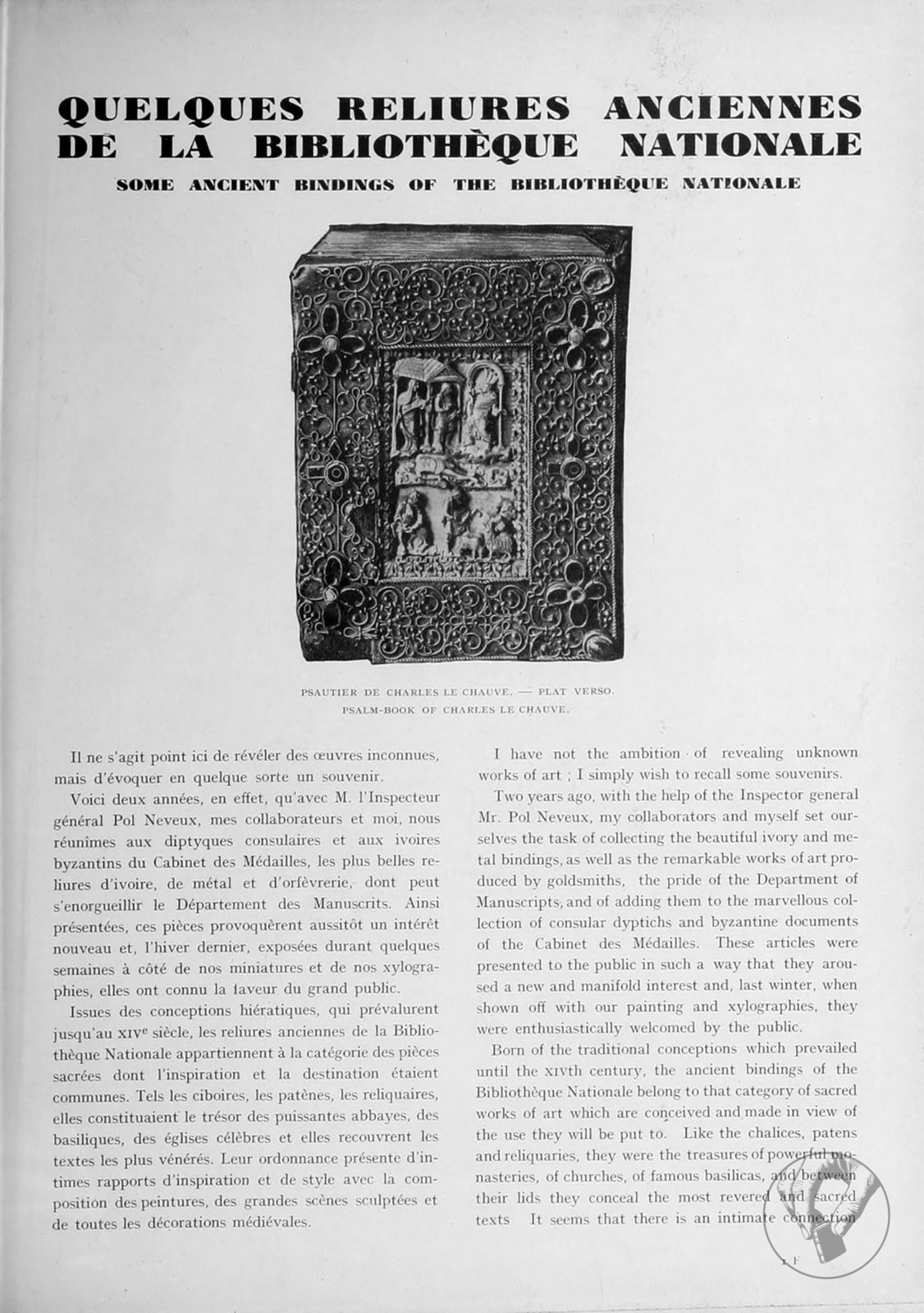
PSAUTIER DE CHARLES LE CHAUVE. — PLAT VERSO.
PSALM-BOOK OF CHARLES LE CHAUVE.
Il ne s'agit point ici de révéler des œuvres inconnues, mais d'évoquer en quelque sorte un souvenir.
Voici deux années, en effet, qu'avec M. l'Inspecteur général Pol Neveux, mes collaborateurs et moi, nous réunimes aux diptyques consulaires et aux ivoires byzantins du Cabinet des Médailles, les plus belles reliures d'ivoire, de métal et d'orfèvrerie, dont peut s'enorgueillir le Département des Manuscrits. Ainsi présentées, ces pièces provoquèrent aussitôt un intérêt nouveau et, l'hiver dernier, exposées durant quelques semaines à côté de nos miniatures et de nos xylographies, elles ont connu la faveur du grand public.
Issues des conceptions hiératiques, qui prévalurent jusqu'au xive siècle, les reliures anciennes de la Bibliothèque Nationale appartiennent à la catégorie des pièces sacrées dont l'inspiration et la destination étaient communes. Tels les ciboires, les patènes, les reliquaires, elles constituaient le trésor des puissantes abbayes, des basiliques, des églises célèbres et elles recouvrent les textes les plus vénérés. Leur ordonnance présente d'intimes rapports d'inspiration et de style avec la composition des peintures, des grandes scènes sculptées et de toutes les décorations médiévales.
I have not the ambition of revealing unknown works of art; I simply wish to recall some souvenirs.
Two years ago, with the help of the Inspector general Mr. Pol Neveux, my collaborators and myself set ourselves the task of collecting the beautiful ivory and metal bindings, as well as the remarkable works of art produced by goldsmiths, the pride of the Department of Manuscripts, and of adding them to the marvellous collection of consular dyptichs and byzantine documents of the Cabinet des Médailles. These articles were presented to the public in such a way that they aroused a new and manifold interest and, last winter, when shown off with our painting and xylographies, they were enthusiastically welcomed by the public.
Born of the traditional conceptions which prevailed until the xivth century, the ancient bindings of the Bibliothèque Nationale belong to that category of sacred works of art which are conceived and made in view of the use they will be put to. Like the chalices, patens and reliquaries, they were the treasures of powerful monasteries, of churches, of famous basilicas, and between their lids they conceal the most revered and sacred texts. It seems that there is an intimate connection
1 F
Page 2
LA RENAISSANCE DE L'ART FRANÇAIS ET DES INDUSTRIES DE LUXE
Une fois écrits et ornés les cahiers de parchemin étaient liés entre eux et l'orfèvre, l'artiste, les enfermait dans l'or, l'argent, le vermeil, le cuivre ou l'ivoire, qu'il appliquait sur des plats de bois, après un « travail » analogue à celui de tout autre objet destiné au culte. Conçues pour les maintenir et les protéger, les reliures rehaussaient ainsi les pages saintes d'une magnificence tutélaire.
Cependant il advint au cours des siècles, que les manuscrits qui s'y trouvaient enclos, furent mésestimés ou subirent d'irrémédiables atteintes. Il advint ainsi qu'on les remplaça et certaines de ces reliures contiennent des textes moins anciens qu'elles. D'autres, au contraire, recouvrent des parchemins d'une époque antérieure. Elles-mêmes furent parfois détériorées ou modifiées : intailles antiques, émaux byzantins, pierres neuves, fleurs de lys ont été substitués ou ajoutés aux ornementsations primitives et le temps seul adoucit les effets de surcharges aussi disparates.
Quoi qu'il en soit, les reliures exposées dans la salle du Grand Camée au Cabinet des Médailles témoignent, pour la plupart, d'une prestigieuse technique, et l'état général de leur conservation accroît encore leur prix.
Aussi bien, les travaux, dont elles ont déjà fait l'objet nous dispensent de recherches scientifiques nouvelles. Leur mise en évidence permanente importe seule. Jadis, dans les vitrines de la Galerie du Cardinal Mazarin, un exil plein d'ombres les dépréciait. Rassemblées actuellement au grand jour, elles s'ennoblissent et leur réunion met en pleine valeur les mérites de chacune d'elles.
L'Evangéliaire du Prieuré de Saint Lupicin (Jura) exécuté, sans doute, à Saint-Claude, vers le ve ou vi siècle, apparten longtemps au monastère du même nom et fut cédé à la Bibliothèque, le 21 août 1794, par décision du Conseil municipal de la commune. Il se compose d'un somptueux manuscrit du ix siècle en vélin pourpre, aux initiales d'or et lettres d'argent oxydées par le temps, que recouvrent deux tablettes formées de morceaux d'ivoire juxtaposés, joints à mortaise, sculptés et fixés, sous le règne de Louis XVIII, à un maroquin moderne, avec monogrammes du roi et fleurs de lys au dos. Les deux tablettes portent l'une l'image du Christ et des scènes de sa vie (1), l'autre, la Vierge tenant l'Enfant Dieu, divers épisodes de son histoire et l'entrée de Jésus à Jérusalem. Le style de la lourde couronne et des anges porte la marque d'influences antiques évidentes. Le bénédictin dom Martène signalait ce précieux évangéliaire dès le début du xviiie siècle, en le qualifiant d'Apocalypse, il est vrai.
La reliure du Psautier de Charles le Chauve renferme un riche manuscrit peint, œuvre du scribe Liuthard (842-869). Les deux ivoires sculptés datent vraisembla-
(1) Voir La Renaissance, février 1926.
between their disposition and their decoration, the latter being generally composed of paintings or carvings which reproduce important events.
Once written and illuminated, the leaves of parchment were bound together and the goldsmith, the artist, would then enclose them in gold, silver, gilt-silver or ivory. These materials were usually inlaid on wood after a « work » similar to that required by any other article conceived in view of religious use. Having first for object to protect them, these bindings finally enhanced the holy pages with a tutelar magnificence.
But it happened that in the course of centuries, certain manuscripts enclosed in these rich bindings were either undervalued or suffered irreparable injuries. They were replaced, and some texts are much more recent than their bindings. Others, on the contrary, are much older. The bindings too were sometimes deteriorated : ancient intaglios, byzantine enamels, new stones, fleurs de lys, were then substituted or added to the primitive decoration and time alone can assuage the effects of such incongruous over-decorations.
Be it as it may, the bindings exposed in the hall of the Great Cameo testify, for the most of them, to a fascinating mastership and their value is greatly increased by the fact that they are well preserved.
Many books have already been published concerning these bindings. They are so numerous and so explicit that we are dispensed with making new scientific searches. Let us only consider how very desirable a permanent exhibition of these bindings would be. They have been taken from the Galerie du Cardinal Mazarin, where their exile covering them with shadows could only depreciate them, and are now exposed in full light; they will thus have an added nobleness and enhance each other.
The Gospel-book of the Priory of saint Lupicin (Jura), was made no doubt at Saint Claude, towards the fifth or sixth century, and belonged for a long time to this monastery. It was given to the National Library on the 21st August 1794 by decision of the County Council. It is a rich manuscript of the ninth century, on purple vellum, the initials of gold and the letters of silver eaten away by time, and bound by two juxtaposed sheets of ivory, held together with mortise, carved, and fixed during the reign of Louis XVIII on modern morocco, with the King's monogram and the fleur de lys on the back. One sheet of ivory represents Christ and scenes of His life, the other the Virgin holding in her arms the Infant Jesus, and reproduces various episodes of her life as well as the entry of Jesus in Jerusalem. This heavy crown and the angels are evidently of an antique conception. The benedict Dom Martene noticed this Gospel book at the beginning of the xviiith century, calling it, it is true, the Apocalypse.
The Psalm book of Charles le Chauve is a richly pain-
Page 3
LA RENAISSANCE DE L'ART FRANÇAIS ET DES INDUSTRIES DE LUXE
ÉVANGÉLIAIRE A L'USAGE DE L'ÉGLISE DE METZ. — PLAT RECTO.
GOSPEL-BOOK FOR THE USE OF THE CHURCH OF METZ. — FACE.
Page 4
LA RENAISSANCE DE L'ART FRANÇAIS ET DES INDUSTRIES DE LUXE
blement de la même époque. Quant au cadre, épais plaquage d'argent doré, où sont sertis de lourdes pierres transparentes et des grenats, il remonte au xiiie siècle. La manière dont sont traités les personnages et les animaux témoigne d'une habileté remarquable. D'un côté l'artiste a symbolisé l'âme du roi David protégée par Dieu, et, de l'autre, le prophète Nathan reprochant au monarque le rapt criminel de Bethsabée : « un homme riche, pour son festin, vola la brebis d'un homme pauvre... ». Les chanoines de Metz, en 1674, firent don de ce Psautier à Colbert.
Deux crucifixions d'une inspiration semblable évoquent, par leur dessin, l'ampleur des motifs sculptés aux porches des églises romanes : l'Evangéliaire à l'usage de l'église de Metz (manuscrit du ixie siècle sur parchemin pourpré aux capitales d'or) entré à la Bibliothèque en 1802 et l'Evangéliaire pour les différentes messes de l'année provenant d'une église où se célébrait, le 3 octobre, la fête de sainte Menne, la vierge martyr de Fontenay, au diocèse de Toul (manuscrit du xve siècle). La tablette d'ivoire (xe-xiie siècle) du premier de ces évangéliaires comporte le développement du thème iconographique de l'évangéliaire de Gannat. Celle du second, dont certains détails laissent supposer une origine un peu antérieure, offre des analogies et des variantes, avec quelques surcharges du xiiie siècle. Sur l'une et l'autre, le Christ est représenté suivant une formule réaliste très poignante et, si leurs physionomies se ressentent encore d'imperfections et de rudesses, les personnages, revêtus de draperies aux plis larges, tels les évangélistes et les anges, la Vierge et saint Jean, la Religion et la Synagogue, la Mer et la Terre possèdent, pour la plupart, une noblesse de mouvement presque classique. Les caractères du style roman se révèlent dans les gestes des morts, qui sortent des tombeaux et dans les feuillages du pourtour. En outre, la bordure de l'Evangéliaire de Metz constitue un ensemble d'une somptueuse et rayonnante qualité : plaques métalliques décorées de perles, de pierres précieuses, d'émaux orientaux cloisonnés, de ciselles et d'une double lamelle d'or à inscription.
Autre chef-d'œuvre d'orfèvrerie : un Evangéliaire de l'Eglise de Metz, dont l'ivoire ajouré probablement du xiie siècle, (manuscrit attribué parfois à Louis le Débonnaire) porte trois épisodes : le baiser de Judas, Jésus devant Pilate et le Calvaire. Son exécution pleine d'aisance ne peut être comparée toutefois à celle du cadre formé de pierreries et de perles enchâssées dans des orbes de filigrane au travail délicat, souple et charmant. Les deux autres Évangéliaires messins, qui l'entourent et entrent également à la Bibliothèque en 1802, datent du xiie siècle. L'un renferme un manuscrit (xe siècle) d'une fraîcheur délicieuse et les scènes de la reliure, l'Annonciation, l'Adoration des Mages, le Massacre des Innocents sont d'une minutieuse sou- ted manuscript, work of the scribe Liuthard (842-869). The two carved ivory lids are most probably of the same period. As to the frame, a heavy plaque of gilt silver, where heavy transparent stones and garnets are set in, it is as old as the xiiith century. The way the people and the animals are reproduced, testify to a remarkable dexterity. On one side, the artist has symbolised the soul of David protected by God and, on the other, one can see the prophet Nathan reproaching to the monarch his criminal abduction of Bethsabée : "a rich man, for his banquet, robbed the sheep of a poor man..." In 1674, the canons of Metz presented this Psalmbook to Colbert.
Two crucifixions, of a similar inspiration, recall by their drawing, the fullness of the designs carved on the porches of romantic churches : the Gospel-book for the Church of Metz (manuscript of the ixth century on purple parchment with gold capitals) which entered the Library in 1802 and a book giving the "Gospels for the different masses of the year", which came from a church where it was the custom to celebrate on the 3rd day of October the feast of sainte Menne, the martyr virgin of Fontenay, diocese of Toul (manuscript of the xvth century), also entered the Library. The ivory tablet (xth and xith century) on the first of these two books, comprises the iconographic theme of the Gospel of Gannat. The ivory tablet of the second book, on which certain details lead one to think that it is a bit older, is similar in some ways to certain additions of the xiiith century. On both these plaques, Christ is represented in a poignant and realistic way and if the expressions are still imperfect and rough, the Evangelists and the Angels, the Virgin and saint John, the Religion and the Synagogue, the Sea and the Earth, have each a nobleness of movement almost classical in its perfection. The character of the romantic style can be seen in the gestures of the dead arising from their tombs and in the leaves which frame the design. Besides that, the edging of the gospel-book of Metz, both sumptuous and radiant, is decorated with pearls, precious stones, oriental enamels, carvings and a double golden line with inscriptions.
Another masterpiece is the Gospel-book of the Church of Metz of which the ivory (xith century, the manuscript is sometimes attributed to Louis le Débonnaire) represents three episodes : Judas' kiss, Jesus before Pilate and the Passion. This work, however skillful, cannot, nevertheless, be compared to the frame made of precious stones and pearls inset in filigreed orbes, of a very delicate and charming workmanship. The two other Gospel-books of Metz which are alongside, and which also entered the Library in 1802, are of the xith century. One of them is a manuscript of a delicious freshness ; the scenes depicted on the binding, the
Page 5
LA RENAISSANCE DE L'ART FRANÇAIS ET DES INDUSTRIES DE LUXE
ÉVANGÉLIAIRE DE L'ÉGLISE DE METZ, — PLAT RECTO.
GOSPEL-BOOK OF THE CHURCH OF METZ. — FACE.
plesse de trait, qui donne à chaque scène une animation extraordinaire. L'autre est formé d'un ivoire oriental et d'émaux cloisonnés du Rhin (du xiiie ou du début du xiiiie siècle) prélevés sur une reliure plus ancienne et appliqués au xive siècle contre un ais couvert d'argent massif semé de fleurs de lys en relief. Son manuscrit du xiie siècle s'orne de hautes figures de grand style peintes en pleines pages.
Très différent apparaît le Sacramentaire de Drogon. Le texte, que rédigea, entre 826 et 855, à Metz, l'évêque de ce nom, constitue un beau spécimen de l'écriture carolingienne, avec onciales d'or et nombreuses initiales historiées. Les deux ivoires qui le revêtent se divisent en 18 tableaux enserrés dans un cadre d'argent. Ils ne faisaient pas partie de la reliure primitive, que rehaussaient 78 pierres, et furent exécutés au xiiie siècle. Sur le plat recto, l'artiste a interprété les sacrements dont il est question dans le texte, et sur le plat verso les cérémonies de la Messe. Sobre et large, sa manière n'exclut ni la grâce ni le sens pénétrant de l'observation familière ; certaines scènes ont ainsi la valeur d'un document.
Les reliures des Evangéliaires à l'usage de Saint-Denis Annunciation, the Adoration of Kings, the Massacre of the Holy Innocents, are almost minute in their details. The other binding is made of oriental ivory with enamels of the Rhine taken off a much more ancient binding and inlaid during the xivth century in a massive silver leaf strewn with fleurs de lys in relief. The manuscript is of the xith century and decorated with painted figures.
Very different is the Sacramentary of Drogon. It was written between 826 and 855 in Metz by the bishop Drogon, and is a beautiful specimen of carolingian art, with golden uncials and many elaborate initials. The two ivory plaques which form the binding are divided in eighteen scenes and set in silver. They did not belong to the primitive binding, which had seventy-eight stones and was executed during the xiith century. On the upper surface, the artist has interpreted the Sacrements and on the back the celebration of Holy Mass. It is both graceful and accurate and the details give these plaques the value of historic documents.
The bindings of the Gospels for Saint Denis and the monastery of Poussay (diocese of Toul) are made of odds and ends. The one of Saint Denis has a manuscript of the ixth century with gilt and silver letters and
Page 6
LA RENAISSANCE DE L'ART FRANÇAIS ET DES INDUSTRIES DE LUXE
et de l'abbaye de Poussay (diocèse de Toul) sont formées de pièces disparates. Celle de Saint-Denis, qui recouvre un parchemin pourpré du IXe siècle à lettres d'or et d'argent, s'orne d'un cadre en cuivre exécuté au XVe siècle où sont sertis des émaux, des verroteries et des pierres gravées sans art. Il contient un ivoire byzantin avec figure de Christ. Sur l'autre plat, formé d'une plaque de métal, deux évangélistes du XIIIe siècle se trouvent traités dans un parti pris de stylisation accusé. Quant à l'Evangéliaire de Poussay (XIe siècle), cédé en 1844 par la ville de Mirecourt, il s'orne d'un ivoire également byzantin, la Vierge avec l'Enfant Jésus et de quatre figures de cuivre, le Christ, saint André, saint Pierre et sainte Menne, cependant que des rectangles et des losanges formés d'émaux cloisonnés décorent les coins de cette reliure très caractéristique, dans son ensemble, du style roman à influences orientales. Sur l'autre plat, revêtu d'une lame d'argent, Jésus-Christ tient la Croix et le Globe.
La précieux manuscrit, avec peintures et notations musicales en neumes, d'un Missel de l'abbaye de Saint-Denis date lui aussi du XIe siècle, comme la crucifixion de la reliure. Des figures d'ivoire, il ne subsiste malheureusement que la Vierge et saint Jean, dont la qualité d'exécution rend plus déplorable encore la perte du Christ que ne porte plus la croix. La riche bordure de vermeil repoussé (XIe-XIIe siècle), est l'œuvre d'un orfèvre maître de son art.
Enfin quatre Évangéliaires à l'usage de la Sainte-Chapelle complètent cet ensemble splendide.
La première reliure (XIIIe siècle) remonte au règne de saint Louis : elle est contemporaine du manuscrit. Déjà deux inventaires anciens (1480 et 1573) la mentionnaient comme un très beau texte d'Évangiles à couverture d'or semée de perles et de pierres. Mais le Christ manque aujourd'hui et quelques pierres subsistent seulement au plat verso.
La reliure du second évangélaire (XIIIe siècle) est intacte. La Résurrection d'une part (1), et la Crucifixion de l'autre constituent deux œuvres de maître émouvantes, fortes et simples. Elles atteignent l'art le plus haut, et le groupe des soldats endormis suffirait à classer hors de pair la scène où, au-dessus d'eux, entre deux anges, mains jointes et ailes hautes, le Christ surgit, bénissant et tenant la Croix, un pied encore dans la tombe, mais grand déjà de toute sa victoire sur la mort. Le manuscrit, en majeure partie, est contemporain de cette puissante reliure : ses peintures ont les plus rares mérites et retracent les principaux épisodes de la vie de Jésus. Moins ancienne, la bordure des deux plats est, par contre, d'une exécution subalterne.
Le troisième évangélaire (Évangiles et Messes des
(1) C. f. La Renaissance, février 1926.
is decorated with a copper frame where enamels, glass beads and ordinary stones are inlaid without any art. It contains a byzantine ivory with the face of Christ On the other lid, formed of a metal plaque, two evangelists of the XIIIth century are engraved. As to the gospel-book of Poussay, (xith century), given in 1844 to the town of Mirecourt, it is also decorated with a byzantine ivory, the Virgin and the Infant Jesus and with four figures made of gilt silver : the Christ, saint Andrew, saint Peter and sainte Menne, whilst enamel squares and lozanges decorate the corners of this very characteristic binding after the romanic style influenced as a whole by the Orient. On the other lid, covered with a sheet of silver, Christ holds the Cross and Globe.
The precious manuscript with paintings and musical annotations of a Missel of the monastery of Saint Denis is of the xith century, like the crucifixion of the binding. Nothing, unfortunately, has remained of the ivory figurines except the Virgin and saint John, and their execution makes one regret all the more bitterly the loss of Christ. On the rich border of gilt and chased silver (xi and xiith centuries) the work of a goldsmith who possessed his art to the utmost, the pearls and precious stones inlaid with filigree work unite with various figures of angels, prophets, patriarchs, the symbols of the evangelists and two big seraphims. More than three centuries older, the back plaque is made of a plaque of chased metal representing a martyr in full figure.
Finally, four Gospel-books for the Sainte-Chapelle complete this splendid ensemble.
The first binding (xiiith century) dates as far back as the reign of saint Louis ; it is of the same period as the manuscript. Two old inventories (1480 and 1573) mention this Gospel-book as a very beautiful text of which the golden binding is strewn with pearls and precious stones « with a crucifix, an image of our Lady, a saint John the evangelist and two angels ». But the Christ is missing to-day and a few stones only subsist on the back lid where Christ is represented in a quadrilobe.
The binding of the second Gospel-book (xiiith century) is untouched. The Resurrection on the one side and the Crucifixion on the other are two masterpieces, powerful and simple. They reach the summits of art and the group of sleeping soldiers alone would suffice to place above all the scene where, beneath them, between two angels, with their hands joined and their wings high up, Christ arises, blessing and holding the Cross, one foot still in the grave but great already of his victory over death. The manuscript is almost entirely of the same period as this binding ; the paintings are of the rarest quality and retrace the principal episodes of the life of Jesus. Less ancient, the border on both sides is, on the other hand, of an inferior workmanship.
Page 7
LA RENAISSANCE DE L'ART FRANÇAIS ET DES INDUSTRIES DE LUXE
SACRAMENTAIRE DE DROGON. — PLAT VERSO.
SACREMENTS-BOOK OF DROGON.
principales fêtes de l'année, etc...) se compose d'un ma-
nuscrit du xiiie siècle, que, sans doute, saint Louis
donna à la Sainte-Chapelle et d'une reliure en vermeil
repoussé, ouvrage d'un ciseleur parisien exécuté au dé-
but du xive siècle. Sur le plat recto se voient le Soleil
et la Lune, le Christ en croix entre la Vierge et saint
Jean. Aux pieds du Christ se trouvait enchâssée une
améthyste où était gravée la tête de Caracalla. Cette
pierre, conservée au Cabinet des Médailles a été rem-
placée par un fac-simile en pâte de verre. Dans un encadrement quadrilobé, Jésus-Christ nimbé, entre les symboles des quatre évangélistes, figure sur le plat verso. Les deux bordures furent refaites au xive siècle comme celles du précédent évangéliaire.
Copié en lettres d'or, entre 1002 et 1014, dans une église soumise à l'Empire, le texte du Livre des Quatre Evangiles ou Apocalypse (1), fut offert en 1379 par Charles V à la Sainte-Chapelle, comme l'indique une
(1) Ce manuscrit est conservé au Département du Manuscrit et la reliure se trouve au Cabinet des Médailles.
The third Gospel-book (Gospels and Masses of the principal feasts of the year, etc.) is composed of a manuscript of the xiiith century which, no doubt, saint Louis gave to the Sainte Chapelle, and of a binding in gilt and chased silver, the work of a clever parisian artist, executed at the beginning of the xivth century. On the back, one can see the Sun, the Moon, Christ crucified, the Virgin and saint John. At the feet of Christ there was inset an amethyst, the head of Caracalla ingraved, but it is kept at the Cabinet of Medals, and replaced by a fac-simile in glass. In a quadrilobed background, Jesus Christ surrounded by a halo, in the midst of the symbols of the four evangelists, is on the back part. The two borders were remade during the xvith century like those of the preceeding Gospel-book.
Copied in golden letters between 1002 and 1014, in a Church submitted to the Empire, the text or the Book of the Four Gospels, or Apocalypse (1), which is today in
(1) This manuscript is kept in the Manuscripts'Department and its binding is at the « Cabinet of Medals ».
Page 8
LA RENAISSANCE DE L'ART FRANÇAIS ET DES INDUSTRIES DE LUXE
LIVRE DES QUATRE ÉVANGILES A L'USAGE DE LA SAINTE-CHAPELLE. — PLAT VERSO ET PLAT RECTO.
BOOK OF THE FOUR GOSPELS FOR THE USE OF THE SAINTE-CHAPELLE. — FACE AND BACK.
inscription gravée sur la reliure exécutée au xive siècle. Celle-ci, malgré quelques dégradations du pourtour, (les 109 perles et les 84 cabochons ont presque tous disparu) constitue une pièce de premier mérite. D'un côté, en effet, l'artiste a reproduit, avec autant d'esprit que de soin une miniature du texte : saint Jean entre les symboles des quatre évangélistes. Conservant aux figures leur caractère archaïque et à l'architecture son style, il s'est contenté de semer le fond de fleurs de lys. Quant à la crucifixion du plat verso, elle compte parmi les ouvrages d'orfèvrerie les plus élégants que le Moyen-Age nous ait laissés : dans la Vierge et saint Jean se retrouvent, en effet, toutes les qualités de grâce et d'élegance qu'à produites l'Ile-de-France aux xiiiie et xive siècles. Il existe peu d'œuvres aussi précieuses.
Telles sont, sommairement décrites, les reliures qui se trouvent exposées désormais au Cabinet des Médailles. Certes nous nous garderions d'outrepasser la mesure, mais nous croyons ne commettre aucune exagération, en écrivant que la vitrine qui les contient, par sa richesse, sa valeur documentaire autant que par sa magnificence, peut justement paraître, aujourd'hui, comme unique au monde.
P.-R. ROLAND-MARCEL.
our Cabinet des Manuscrits, was offered in 1379 by Charles V to the Sainte Chapelle, and this is proved by an inscription one can see on the binding. This binding, although the edges are spoiled (the hundred and nine pearls and the eighty four cabochons have almost entirely disappeared) is remarkable. The artist has reproduced with great skill and intelligence a miniature of the text, st John surrounded by the symbols of the four evangelists. Leaving to the figures their archaic character, and to the architecture its style, he has been satisfied with strewing fleurs de lys on the back ground. As to the crucifixion of the back part, it is considered as one of the most elegant goldsmith works of the Middle Ages ; in the Virgin and Saint John one can indeed find the qualities of grace and elegance which the Ile de France produced during the xiith and xivth centuries.
Thus are, summarily described, the bindings which shall, from now on, be exhibited in the Cabinet des Médailles. We would in no way overstep the limit, but we do not think that we exaggerate when we say that the show-case, thanks to the richness and value of the documents, as well as to their magnificence, can be justly considered today as unique in the world.
P.-R. ROLAND-MARCEL.
Page 9
MUSÉE RODIN DE PHILADELPHIE
FONDATION MASTBAUM
MASTBAUM FOUNDATION — RODIN MUSEUM OF PHILADELPHIE
LES BÉNÉDICTIONS.
BLESSINGS.
Il est peu de gloires plus universellement prônées — au moins dans le domaine artistique — que celle de Rodin. Depuis neuf ans qu’il est mort, sa renommée, si considérable déjà pendant les quatre derniers lustres de sa carrière, prend chaque jour plus d’éclat et, de toute part, les manifestations de ce culte revêtent souvent, à cette heure, un caractère émouvant.
Du vivant même de ce magnifique génie les plus importants musées d’Europe avaient tenu à faire une place, aussi large que leur permettaient leurs ressources,
Few glories are more universally acknowledged — at least in the artistic sphere — than that of Rodin. In the nine years since his death his reputation, already so high during the last twenty years of his career, has grown in lustre from day to day, and from all parts, the manifestations of this appreciation assume quite a touching character.
Already in the life time of this genius the most important museum of Europe had at heart to make to his works as large a place as their financial condi-
2 F
Page 10
LA RENAISSANCE DE L'ART FRANÇAIS ET DES INDUSTRIES DE LUXE
CL. J.-K. BULLOZ.
LA PORTE DE L'ENFER.
THE DOOR OF HELL.
Page 11
LA RENAISSANCE DE L'ART FRANÇAIS ET DES INDUSTRIES DE LUXE
à ses œuvres. Grâce aux libéralités du statuaire et à celle d'un de ses modèles, M. Thomas F. Ryan, le Musée Métropolitain d'Art, à New-York, se composait une remarquable collection des sculptures du Maître. Puis, deux années à peine après la mort de l'artiste, ce fut un des grands constructeurs de cuirassés du Japon, M. Ko-
tions would permit. Thanks to the generosity of the sculptor and that of one of his sitters — Mr. Thomas F. Ryan — the Metropolitan Museum of Art of New-York then assembled a remarkable collection of sculptures by the Master. Less than two years after the death of the artist, one of the biggest builders of
L'ÉTERNELLE IDOLE.
THE ETERNAL IDOL.
jiro Matsukata qui, ayant prié mon regretté prédécesseur, M. Léonce Bénédite, d'acquérir pour lui une collection d'œuvres d'art françaises, tableaux et statues, destinés à constituer le Musée de Tokio, lui demanda de placer au premier rang de ses achats les plus belles pièces de Rodin.
Il était réservé aux Etats-Unis de rendre à l'auteur du Penseur, le suprême honneur que puisse connaître un artiste. Une des personnalités américaines les plus importantes du monde des affaires, Mr. Jules Mastbaum, s'est enthousiasmé pour le génie du sculpteur, au point de vouloir édifier à Philadelphie un Musée qui sera entièrement dédié à sa gloire. Après avoir acquis de magnifiques épreuves en bronze des œuvres principales de Rodin et commandé un exemplaire de la Porte de l'Enfer, il a chargé un des meilleurs architectes français de ce temps, M. Jacques Greber, d'édifier ce palais,
dreadnoughts in Japan, Mr. Kojiro Matsukata, requested my regretted predecessor, Mr. Leonce Benedite, to acquire for his account a collection of French works of art, pictures and statues, with a view to constituting the Museum of Tokio. In so doing, he asked him to have first in mind, when making purchases, the finest pieces by Rodin.
It was the lot of the United States to render to the author of the “Penseur” the supreme honour that an artist may Know. An important business personality in the States, Mr. Jules Mastbaum, became so enraptured with the genius of Rodin that he decided to have erected at Philadelphia a museum entirely dedicated to the glory of the great man. After purchasing an unequalled collection of the principal works of Rodin including a reproduction of the “Porte de l'Enfer”, he entrusted one of the best French architects