Extrait
Premières pages de l'ouvrage, en accès libre.
Page 1
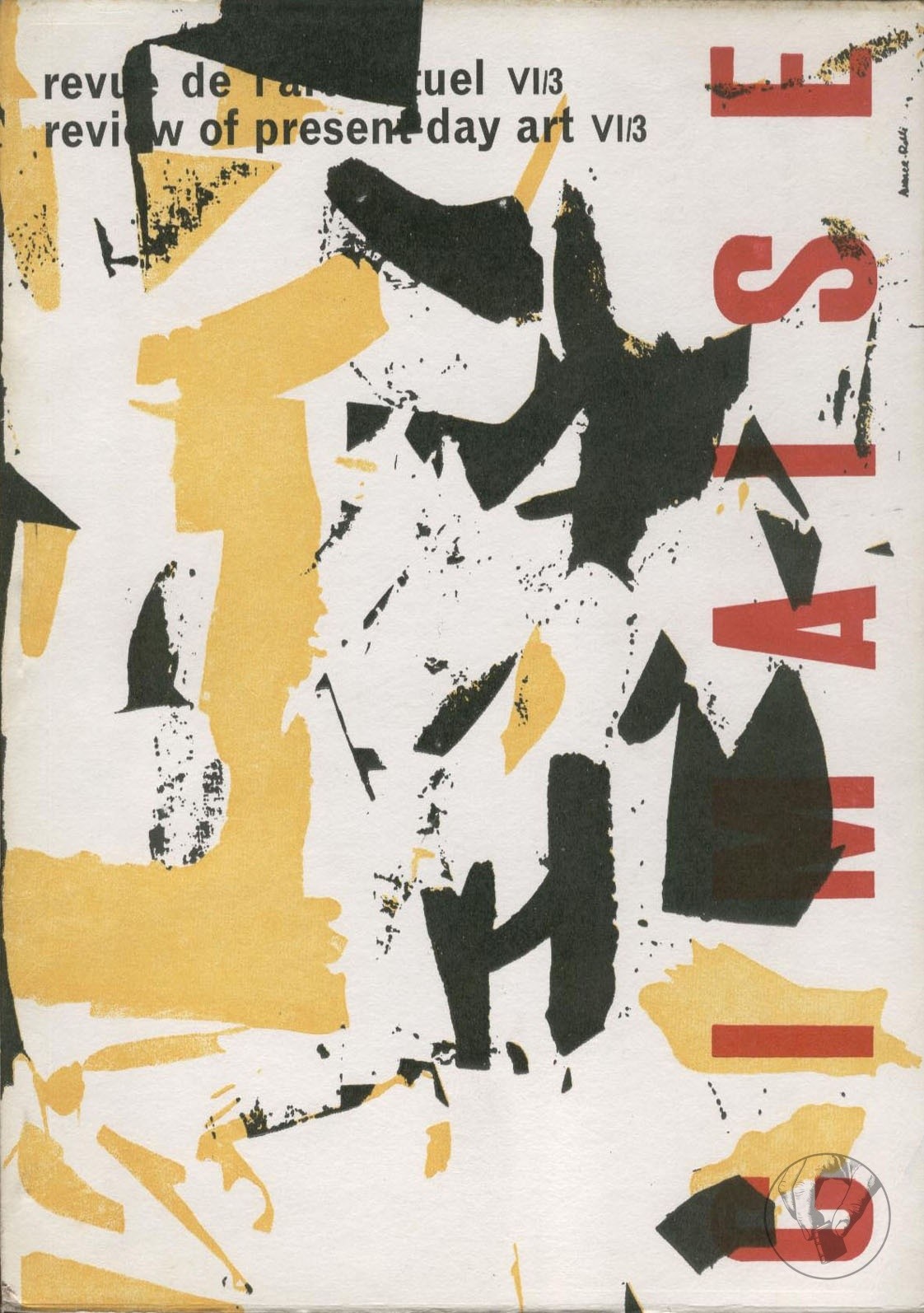
revue de l'art contemporuel VI/3
review of present-day art VI/3
$\mathcal{E}$
$\mathcal{S}$
$\mathcal{A}$
$\mathcal{L}$
$\mathcal{I}$
$\mathcal{M}$
$\mathcal{O}$
$\mathcal{P}$
$\mathcal{Q}$
$\mathcal{R}$
$\mathcal{T}$
$\mathcal{U}$
$\mathcal{V}$
$\mathcal{W}$
$\mathcal{X}$
$\mathcal{Y}$
$\mathcal{Z}$
Année 2014
Page 2
Galerie de France
3, rue du Faubourg Saint-Honoré Paris 8, Anjou 69-37
Gillet
10 février - 8 mars
Consagra
sculptures
10 mars - 4 avril
---
Galerie Le Gendre
31 rue Guénégaud, Paris 6, Danton 20-76
Francis Bott
gouaches
du 11 février au 4 mars 1959
Kantor
“Cracovie”
peintre de la Pologne d’aujourd’hui
du 6 au 28 mars 1959
Page 3
Galerie André Schoeller Jr
31 rue Miromesnil Paris 8, Anjou 16-08
Abidine
peintures
du 12 mars au 8 avril
---
Galerie Lara Vincy
47 rue de Seine Paris 6, Danton 40-96
Peter Clough
mars
Saussac
avril
---
Galerie Jacques Massol
12 rue La Boétie, Paris 8, Anjou 93-65
du 12 février au 7 mars
Lagage
du 12 mars au 4 avril
Key Sato
et en permanence
Andersen, Busse, Clerité, Cortot
Dmitrienko, J. Dufresne, Fagniez
Gastaud, Lagage, Germain
Maisonseul, Mannoni, Ravel
Key Sato
---
Pascale
20, rue Jacob Paris 6, Odéon 68-79
Halpern
Jean-Marie Queneau
Galerie Art Vivant
72 Bd Raspail Paris 6, Littré 99-61
Le Portrait
dans la peinture de
Cottavoz
de 1953 à 1959
du 3 au 21 mars
---
Page 4
Galerie La Roue
16 rue Grégoire-de-Tours, Paris 6, Odéon 46-70
Abboud
peintures
27 février-17 mars
Galerie Apollinaire
Via Brera 4, Milano Tel. 862821
Feito
mars
Fautrier, Schneider, Meloni, Bryen
Bellegarde, Bruning, Feito
Halpern, Helman, Laubiès
Romain Weingarten
11 rue des Beaux-Arts, Paris 6. Danton 63-62
Encadrements
---
Galerie Arnaud
34 rue du Four, Paris 6, Littré 40-26
Flavio S. Tanaka
5 février - 3 mars
en permanence :
Barré, H. A. Bertrand, Carrade
Coppel, Downing, Feito, Fichet
Gauthier, Guitet, Koenig
Panafieu, F. S. Tanaka
sculptures de :
Marta Pan
Première exposition en Europe
des œuvres récentes de
Tatsuhiko Heima
Paul Facchetti
17 rue de Lille, Paris 7
---
Page 5
Synthèse
66, Boulevard Raspail Paris, Lit. 47-32
Luc Lathion
du 24 février au 11 mars
---
Galerie Breteau
70, rue Bonaparte, Paris 6, Danton 40-96
janvier Igon, Jousselin, Lindstrom, Pellotier
peinture
février Karskaya, R. Fontené, Gillet
Klapisch-Moses, Marez-Darley
Poliakoff, Zack
peinture
avril Suzanne Rodillon
peinture
---
Galerie Bellechasse
266 Bd Saint-Germain Paris 7, Invalides 20-39
Ricardo Licata
peintures récentes
gravures
20 février-20 mars
---
Robert David
Téléphone Danton 16-26
Photographe
spécialiste pour photos de tableaux,
dessins, objets d'art
---
Cimaise
revue de l'art actuel
review of present day art
34 rue du Four, Paris 6
Directeur : J.R. Arnaud
Secrétaire général : John Koenig
Rédaction : G. Boudaille, M. Ragon, P. Restany
Herta Wescher
La rédaction reçoit sur rendez-vous
Abonnement (6 numéros) 2.000 frs
34, rue du Four, Paris 6, téléphone Littré 40-26
C.C.P. Paris 5542.39
Diffusion :
Allemagne :
Librairie Hanna Weber, H.-J. Niepel, Dusseldorf 1,
Grabenstrasse 11
Argentine :
Editorial Victor Leru, Cangallo 2233, Buenos-Aires
Autriche :
Arnulf Neuwirth, Paracelsusgasse 8, Vienne 3
Belgique :
Jean Milo, 28 rue de l’Arbre Bénit, Bruxelles
C.C.P. Jean Milo, Bruxelles 1591.50
Italie :
Le Noci, Via Brera 4, Milan
Danemark :
Meiners Kunstforlag, Peder Skramsgade 5, Copenhagen
Grande-Bretagne :
Alec Tiranti Ltd, 72 Charlotte Street, London W 1
Japon :
Meiji-Shobo, Surugadai, Kanda Tokyo
Norvège :
J.W. Cappelen, Sortimentebokhandel, Oslo
Suède :
Eric H. Olson, Upplandsgatan 3, Stockholm, 10 23 77
Suisse :
E. Genton, « L’Entr’acte », rue du Lion d’or 4, Lausanne,
C.C.P. II 144-56
U.S.A. :
Wittenborn and Co, 1018 Madison Ave, New-York 21
---
Sommaire
Série VI N° 3 - Janvier - Février - Mars 1959
Nouveaux regards sur l'art aux Etats-Unis
Another look at art in the States
Couverture de Marca-Relli
6 Michel Ragon : l'art actuel aux Etats-Unis
Art today in the United-States
36 Pierre Restany : U.S. go home and come back later
38 Dore Ashton : Hans Hofmann
46 Actualité
49 Bibliographie
Page 6
Michel Ragon
L'Art actuel aux Etats-Unis
Art today in the United States
Nous avons consacré un numéro spécial de Cimaise à l’Art actuel aux Etats-Unis, en novembre-décembre 1956. Rédigé par des critiques d’art américains (Dore Ashton, Kenneth Sawyer, Goldwater), il différerait de ce nouveau numéro spécial qui est le résultat du voyage récent de Michel Ragon aux Etats-Unis. L’abondance de la documentation rapportée, nous a fait délibérément écarter les reproductions d’œuvres de Pollock, Gorky, Motherwell, Still, Tomlin, Tobey, étudiés tout spécialement dans notre précédent numéro. Pour la même raison, nous ne ferons pas place ici aux peintres américains vivant à Paris, puisque nous avons l’occasion de commenter dans cette même revue leurs expositions. Il ne faudra donc pas s’étonner de ne pas voir reproduites des œuvres de Sam Francis, Claire Falkenstein, Jenkins, Levée, Childs, John Koenig, Don Fink, Downing, Kimber Smith, Chelimsky, etc.
CIMAISE
A la question : « Qu’est-ce que la peinture américaine? » on pourrait répondre : « Qu’est-ce que les Américains? ». Car il est en effet surprenant de voir catalogués artistes américains, dans les musées, Marcel Duchamp, Max Ernst, Tanguy, Lipchitz et autres artistes que nous considérons en général comme européens. Les Américains sont des Européens émigrés, tout le monde le sait. Par là même, l’Amérique est fatalement un épigone de l’Europe. Mais doit-on en conclure que l’art américain est un rameau de l’art européen? La peinture, aux Etats-Uns, est-elle une peinture provinciale parmi tant d’autres? Ou bien, un art nouveau, en réaction contre celui d’Europe, y
Two years ago, in the No. 2 of the 4th Series (Nov.-Dec. 1956), we dedicated a special number to the Art of Today in the United States. Presented by American art critics (Dore Ashton, Robert Goldwater, and Kenneth Sawyer) it was different from this new special number that resulted from Michel Ragon’s visit to the States. Due to the abundance of material that he brought back, we deliberately decided to leave out reproductions of Motherwell, Still, Pollock, Gorky, Tomlin, and Tobey, who were carefully studied in this preceding number. For the same reason, we will not speak of the American artists living in Paris, of whom we write during their shows here. Thus you must not be surprised to see no reproductions of Sam Francis, Claire Falkenstein, Jenkins, Levee, Childs, Koenig, Fink, Downing, Kimber Smith, Chelimsky, etc.
CIMAISE
In answer to the question: “What is American painting?,” we might ask in turn: “What is an American?” For it is nonetheless rather surprising to see listed as American painters in the different museums: Marcel Duchamp, Max Ernst, Tanguy, Lipchitz, and other artists that we usually consider as Europeans. Everyone knows that Americans are European immigrants. And because of this, America is by necessity an epigone of Europe. But must we conclude that American art is a branch of European art? Is painting in the States, just another type of provincial painting like so many others? Or has a new kind of art, in reaction to that of Europe, been
Page 7
a-t-il vu le jour? Est-il aussi important, ou plus, que l’art européen qui s’épanouit dans ce que l’on appelle l’Ecole de Paris? New-York est-elle une capitale des arts? Autant de questions que je me posais en allant aux Etats-Unis. Les réponses que j’en rapporte ne sont pas catégoriques, car rien n’est aussi simple que le oui et le non. Néanmoins, une constatation s’impose à New-York. Cette ville, qui compte cent cinquante galeries, deux musées d’art actuel d’une incessante activité, un quartier d’artistes en beaucoup de points semblable à celui de Montparnasse, n’est pas une province de l’Ecole de Paris. Avec ses défauts et ses qualités, l’Ecole de New-York existe. Existe-t-il une peinture spécifiquement américaine? Ceci est une autre histoire. Les critiques d’art américains s’obstinent à vouloir nous le démontrer. Mais leur nationalisme s’égare souvent. L’un d’eux, pour prouver la supériorité de Kline, n’hésitait pas à affirmer que Soulages n’avait fait qu’imiter ce peintre américain de premier plan. Malheureusement pour son argumentation, en 1947 Soulages possédait déjà son graphisme, alors que le graphisme de Kline date de 1950. Ce qui ne veut pas dire que Kline imite Soulages. Le fait que tous deux utilisent surtout du noir est trop simpliste pour que nous nous y attardions. Les problèmes de Kline et Soulages sont tout à fait différents. Mais peut-on démontrer que l’un est Américain et l’autre Français? Ceci est un problème qui me dépasse. Je crois que l’art actuel se situe en dehors de tous les nationalismes. A l’échelle européenne hier, il tend à devenir un langage international. La peinture « française » m’importe aussi peu que la peinture « américaine ». Ce qui m’intéresse beaucoup plus, ce sont les peintres qui travaillent à Paris, les peintres qui travaillent à New-York. Et les peintres qui travaillent à New-York valent souvent ceux qui travaillent à Paris. Je parle, bien sûr, pour la génération qui a quarante-cinq ans. Si nous remontons plus loin, aussi intéressant que soit Marin, il n’égale pas Matisse. Mais lorsque l’on sait l’admiration que je voue à l’œuvre d’un Poliakoff, il n’est pas indifférent de dire que je considère l’œuvre de Rothko comme tout aussi importante. Je crois aussi très sincèrement que de Kooning mis dans le plateau d’une balance, pèse beaucoup plus lourd que Manessier, Singier ou une dizaine d’autres « Français » placés dans le plateau opposé (1). Quant à la nouvelle vague, je pourrais citer un certain nombre de « jeunes » new-yorkais qui égalent nos meilleur jeunes « parisiens ». Je le ferai d’ailleurs plus loin.
Revenons encore, auparavant, à ce problème du nationalisme. A la rigueur, j’aurais pensé que Jackson Pollock pourrait constituer un exemple de « peintre américain ». Mais Kenneth Sawyer, qui parle beaucoup « d’art américain », écrit de Pollock qu’il est « le plus européen des expressionnistes abstraits et le plus original ». Et il cite comme sources de Pollock: le Picasso des années 30, Masson, Miró, Matisse et Hofmann. Cet Hans Hofmann, dont l’importance est
(1) Mais, par contre, beaucoup moins lourd que Dubuffet.
born? Is it as important, or more important, than the European art that flourishes in what we call the School of Paris? Is New York a capital of the Arts? All of these questions were in my mind when I left for the States. The answers that I found are not necessarily categorical, for nothing is as simple as a yes or no. Nonetheless, we must admit the evidence seen in New York. This city, with its 150 galleries, its two modern museums that are constantly active, with its artists’ quarter that resembles in many ways Montparnasse, is not a province of the School of Paris. With its faults and its qualities, the School of New York exists. Is it an art that is specifically American? That’s another story. The American critics insist in trying to show us this. But often their nationalism wanders astray. One of them, in trying to prove Kline’s superiority, asserted that Soulages was only an imitator of this first-rate American painter. Unhappily, evidence showed that in 1947 Soulages already was in full possession of his graphic treatment, whereas Kline’s dates from 1950. This does not mean that Kline imitates Soulages. The fact that both of them use black most of the time is too primary a fact to be taken into account. Kline’s and Soulages’ problems are completely different. But can you see that one is American and the other is French? This is something that leaves me perplexed. I believe that today’s art is something that is far above any simple question of nationality. Yesterday it was in a European context, today it tends to become an international language. “French” painting is no more important to me than “American” painting. What interests me much more are the painters working in Paris, and the painters working in New York. I am speaking, of course, of the generation that is about 45 years old today. If we go back farther, he is no equal for Matisse. But when you know how much I admire the work of Poliakoff, it is perhaps important to know that I consider the work of Rothko as something just as important. I very sincerely believe that when we put de Kooning on the scales, he weighs much more than Manessier, Singier, or a dozen other “French” painters, placed on the other side. (But, when it comes to Dubuffet, this is quite another story.) As to the “new wave,” I could name a certain number of “younger” New Yorkers who are equal to the best of our younger “parisian” painters. For that matter, I will name them later.
But let’s come back first to this problem of nationalism. Strictly speaking, I might have thought that Jackson Pollock would be the perfect example of “American painter.” But Kenneth Sawyer, who writes frequently of “American art,” says that Pollock is the “most European of the abstract expressionists, and the most original.” And he mentions as the sources of Pollock’s art: the Picassos of the thirties, Masson, Miró, Matisse, and Hofmann. The Hans Hofmann
Page 8
considérable aux Etats-Unis, qui est même à l'origine de ce que l'on nomme une peinture américaine, mais qui arriva d'Allemagne aux Etats-Unis seulement au début des années 30. Avec Pollock et Hofmann, la troisième influence capitale est celle de de Kooning. Et de Kooning est lui-même arrivé adulte aux Etats-Unis, apportant dans ses bagages cet expressionnisme flamand auquel il se relie encore aujourd'hui. Quant à Motherwell, dont le rôle de professeur est également considérable, Dore Ashton n'écrit-elle pas à son propos qu'il est « le descendant le plus fidèle de la tradition cubiste française »?
Il existe, bien sûr, des peintres et des sculpteurs nés aux Etats-Unis. Leur émancipation récente, tout comme le choix de Hofmann, de Kooning, Gorky, Okada, Gabo, Lipchitz, Duchamp, Guston (qui est de nationalité canadienne), Esteban Vicente, Yunkers, d'aller vivre à New-York plutôt qu'à Paris, est sans doute l'événement sociologique capital de la vie artistique depuis la guerre.
Rappelons que la première émancipation de l'Europe s'est faite aux Etats-Unis en regardant vers le Japon. On a beaucoup parlé d'Ecole du Pacifique. En fait, il n'existe qu'une Ecole de New-York en employant ce terme dans le sens où l'on parle d'Ecole de Paris. C'est-à-dire, lieu choisi par un grand nombre d'artistes pour y travailler, pour y vivre, pour y montrer leurs œuvres, et non pas Ecole autour d'une tendance particulière. S'il n'a sans doute jamais existé réellement une Ecole du Pacifique, il reste néanmoins exact, qu'aussitôt après la guerre, Clifford Still et Rothko vivaient en Californie et que Tobey et Morris Graves à Seattle exerçaient une certaine influence. Motherwell et Guston eux-mêmes ont passé leur jeunesse à Los Angeles, et Hofmann enseignait à l'Université de Californie dans les années 30. Dans ce climat privilégié de la côte ouest où, de plus, la population japonaise et chinoise est nombreuse, Clifford Still, Rothko et Tobey ont effectivement trouvé leur style (2). Mais en quoi ce japonisme digéré, transcendé, serait-il de l'art « typiquement américain »? Là, je ne comprends plus les raisonnements de mes confrères américains. D'autant plus que s'il existe chez cet artiste exceptionnel qu'est Rothko une influence japonaise, il a subi aussi (tout comme cet autre « père » de la peinture « américaine » qu'est Gorky) l'influence très grande aux Etats-Unis de Miro. Et peut-être, de plus loin, celle de Turner. Tout comme l'expressionnisme flamand (à travers de Kooning) et allemande (à travers Hofmann), sans parler de notre bon vieux fauvisme, sont à l'origine de cette manifestation juvénile plus typiquement américaine qu'est l'action painting (à mettre en parallèle avec le rock and roll et les crises hystériques déclenchées chez les teen-agers par la mort à toute vitesse de James Dean). Si nous prenons la sculpture, extrêmement abondante
(2) L'intense activité littéraire, musicale, picturale, etc., qui se manifeste sur la côte du Pacifique, se limite aux années 1946 à 1949. Voir, à ce sujet, l'excellent et précis article de Kenneth B. Sawyer, dans Cimaise n° 7, série 1, juin 1954.
who has a considerable importance in the United States, who we find at the beginnings of what is called American Painting, arrived in the States only in the early '30s. With Pollock and Hofmann, the third main influence is de Kooning. Even de Kooning came to the States as an adult, bringing as baggage the Flemish Expressionism to which he is still linked today. As for Motherwell, whose rôle as a professor was considerable, hasn't Dore Ashton written, “He is the most faithful offspring of French Cubist tradition.” Their recent outburst, just as the choice of Hofmann, de Kooning, Gorky, Okada, Gabo, Lipchitz, Duchamp, Guston (born in Canada), Esteban Vicente, Yunkers, to go live in New York rather than in Paris, is without doubt the most important sociological event in artistic life since the War.
Let's not forget that the American artists’ first attempt to free themselves from Europe was done in looking toward the Far East. Much has been said about the Pacific School. Actually, there only exists a New York School, if we use the term in the way that we speak of the School of Paris. That is to say, a place chosen by a large number of artists to work, to live, to show, and not a School around a certain particular tendency. If actually there has never really existed a Pacific School, it is nonetheless true that right after the War, Clyfford Still and Rothko lived in California, and Tobey and Morris Graves, in Seattle, exerted a considerable influence. Motherwell and Guston grew up in Los Angeles, and Hofmann taught at the University of California in the '30s. In the privileged atmosphere of the West Coast, where the Japanese and Chinese population is dense, Clyfford Still, Rothko and Tobey found their style (1).
But in what manner does this digested and transcended orientalism become a “typically American art?” It is here that I do not understand my American colleagues. And when we see certain oriental influences in the work of the exceptional artist, Rothko, we must also remember that he also felt (just as another “father” of “American” painting, Gorky) the great influence that Miró exerted in the States. And perhaps that of Turner. Just as Flemish (through de Kooning) and German (through Hofmann) Expressionism, while not forgetting our good old Fauve painting, are at the origin of the juvenile manifestation that is more typically American, called Action Painting (that we can compare with Rock and Roll and the hysterical outburst of the boby-sockers after the overdrive death of James Dean). If we look at the extremely abundant and very remarkable sculpture being done in the States, we must note from the beginning that Calder also was influenced by Miró
(1) The intense literary, musical and pictorial activity that took place on the Pacific Coast was mainly limited to 1946-49. See the excellent and precise article by Kenneth B. Sawyer in Cimaise No. 7, 1st Serie, June 1954.
Page 9
Mark Rothko : Yellow-Red and Blue 1953, Sidney Janis Gallery, New York
Page 10
Philip Guston : Nile, 1958, Sidney Janis Gallery, New York
Page 11
Seymour Lipton : Sorcerer, bronze, 1957 Whitney Museum of American Art, New York
Kline : peinture, Sidney Janis Gallery, New York