Page 1
revue de l'art actuel cinquième série numéro 4 mars-avril 1958 CILMAIS Prassinos 57
Premières pages de l'ouvrage, en accès libre.
revue de l'art actuel cinquième série numéro 4 mars-avril 1958 CILMAIS Prassinos 57
Galerie de France 3 rue du Faubourg Saint-Honoré, Paris 8, Anjou 69-37 Music peintures mai --- Galerie Le Gendre 31 rue Guénégaud, Paris 6, Danton 20-76 Corneille gouaches récentes du 25 avril au 17 mai
Galerie La Roue 16 rue Grégoire-de-Tours, Paris 6, Odéon 46-70 Paoli du 24 avril au 13 mai Pavlowsky peintures et gouachesdu 29 mai au 12 juin en permanence peintures de Bouqueton, Dahmen,Dumitresco, Kawun,Karskaya, Kreutz, Lacoste,Maria Manton, Jean Milo,Paoli sculptures de Gerdur Berggruen et Cie 70 rue de l’Université, Paris 7 Présentation du livre dePaul Eluard : “A toute épreuve” illustre de bois gravés deMiró du 25 avril - 17 mai --- Galerie Arnaud 34 rue du Four, Paris 6, Littré 40-26 Downing du 2 au 21 mai en permanence : Barré, H.-A. Bertrand, Carrade,Coppel, Downing, Feito, Fichet,Gauthier, Guitet, Koenig, Panafieu,Flavio Tanaka sculptures de Marta Pan Galerie Ariel 1 avenue de Messine, Paris 8, Car. 13-09 doucet à partir du 30 mai peintures non-figuratives ---
Galleria Del Naviglio via Manzoni 45, Milano, tél. 661.538 Directeur Carlo Cardazzo Dubuffet Fautrier Poliakoff En permanence Arp, Balla, Boccioni, Capogrossi, Crippa, Sonia Delaunay, Ernst, Fontana, Gentilini, Gorky, Jorn, Matta, Miro, Pollock, Scanavino, Wols --- Galerie Breteau 70 rue Bonaparte, Paris 6 Lindström peintures du 15 au 29 avril Jonas sculptures du 2 au 24 mai --- Galleria Apollinaire Via Brera 4, Milano, Tel. 862831 en permanence : Soldati, Fautrier, Licini, Hartung, Schneider, Meloni, Bryen, Helman, Laubiès, Bellegarde, Brüning, Halpern --- Revue internationale d'art moderne la grande revue internationale d'art moderne publiée au Palais des Beaux-Arts de Bruxelles. Quadrum 4 Extrait du sommaire : - C. G. Argan : La crisi di valori - Adrian Stokes : Form in art - L. Kochnitzky : Marc Tobey - R. V. Gindertael : Bissière - M. Bilke : Servranckx - Fitzsimmons : Jean Dubuffet - A. Ehrenzweig : Victor Pasmore's Architectural Constructions - G. Mazzariol: Cronaca di un Linguaggio, E. Vedova - F. Mathey : Le vitrail moderne en France - H. Seiler : Vier West-deutsche Privatsammlungen Documentation : Jeunes artistes, miscellanea, livres, expositions etc... - 15 planches en couleurs, plus de 150 reprod. en noir
Représentant exclusif des peintres américains : - Josef Albers - Willem de Kooning - Arshile Gorky - Philip Guston - Franz Kline - Robert Motherwell - Jackson Pollock - Mark Rothko --- Sidney Janis Gallery 15 East 57th Street New York --- Galerie Saint-Laurent 42 rue Duquesnoy, Bruxelles --- Goebel du 10 au 29 mai --- Rose Fried Gallery 40 E 68 St., New York april 1 - may 3 Adja Yunkers may 5 - 31 Lewittan, Loew, Vicente, Yunkers --- Martha Jackson Gallery 32 East 69th St., New York peintures de Norman Carton du 1 au 26 avril --- Gaston Bertrand Galerie la Roue 16 rue Grégoire de Tours, Paris 9 - 23 avril Galerie Les Contemporains Bruxelles 13 - 24 avril Stable Gallery New York janvier 58 --- Galleria Pater Via Borgonuovo 10 Milano --- Piero Manzoni dal 19 aprile al 2 maggio
Cimaise revue de l'art actuel 34 rue du Four, Paris 6 Directeur : J.R. Arnaud Secrétaire général : John Koenig Rédaction : G. Boudaille, M. Ragon, P. Restany Herta Wescher La rédaction reçoit sur rendez-vous Abonnement (6 numéros) 1.600 frs - Par avion : 2.800 frs 34, rue du Four, Paris 6, téléphone Littré 40-26 C.C.P. Paris 5542.39 Diffusion : Allemagne : Librairie Hanna Weber, H.J. Niepel, Dusseldorf 1, Grabenstrasse 11 Argentine : Editorial Victor Leru, Cangallo 2233, Buenos-Aires Autriche : Arnulf Neuwirth, Paracelsusgasse 8, Vienne 3 Belgique : Jean Milo, 28 rue de l’Arbre Bénit, Bruxelles C.C.P. Jean Milo, Bruxelles 1591.50 Italie : Le Noci, Via Brera 4, Milan Danemark : Meiners Kunstforlag, Peder Skramsgade 5, Copenhagen Grande-Bretagne : Alec Tiranti Ltd, 72 Charlotte Street, London W 1 Japon : Meiji-Shobo, Surugadai, Kanda Tokyo Norvège : J.W. Cappelen, Sortimentebokhandel, Oslo Suède : Eric H. Olson, Upplandsgatan 3, Stockholm, 10 23 77 Suisse : E. Genton, « L’Entr’acte », rue du Lion d’or 4, Lausanne, C.C.P. II 144-56 U.S.A. : Wittenborn and Co, 1018 Madison Ave, New-York 21 --- Robert David siège social : 31 faubourg Montmartre, Paris 9 Téléphone Danton 16-26 Photographe spécialiste pour photos de tableaux, dessins, objets d’art --- Sommaire Couverture de Prassinos Textes anglais 7 Some Views on Present-day Sculpture by Herta Wescher 8 Notes on a recent trip by Michel Ragon 9 Exploring Luis Feito by Georges Boudaille 10 Bellegarde by Pierre Restany Textes français 11 Regards sur la sculpture actuelle par Herta Wescher 21 Notes de voyage par Michel Ragon Visites d’ateliers 24 A la découverte de Luis Feito par Georges Boudaille 26 Claude Bellegarde par Pierre Restany 28 Staristsky par Herta Wescher 30 Lettre de New York par Dore Ashton 32 Notes milanaises par Pierre Restany 33 Les expositions par Georges Boudaille, René Déroudille, Michel Ragon, Pierre Restany, Herta Wescher Textes anglais 47 Staristsky par Herta Wescher 48 Report from New York by Dore Ashton --- H. Couignoux 24 rue de Charenton, Paris 12, Dorian 63-04 Fournitures générales pour les arts arrangements spéciaux pour les lecteurs de Cimaise --- Romain Weingarten 11 rue des Beaux-Arts, Paris 6 Encadrements
English translation by J. F. Koenig Some Views on present-day sculpture by Herta Wescher (p. 11) The rather ambitious plan of organizing an exposition of sculpture capable of showing a general view of the essential tendencies of our century, was realized in a striking manner recently at the Galerie Claude Bernard. The rooms of the gallery were perfectly arranged: shelves, bases, and show-windows were carefully placed about in order to isolate the different works from each other, and at the same time grouping them into living unities. The abundant use of light helped to enhance the richness of this ensemble, that comprised more than 60 sculptures of all sorts of styles and materials. Of course, the format was necessarily limited, but in most cases, the choice was discerning, clearly showing the personality of the creator. Side by side with the best renowned precursors were found the successors of all ages, and even though the artists of the School of Paris were more numerous than those of foreign countries, the panorama was complete enough to allow us to make certain conclusions not only as to the importance, from a present-day aspect, of certain masters, but also on the dominating currents of today's tendencies. We are grateful to the organizers to have centered this manifestation around the works of the leaders: Brancusi, Marcel Duchamp, Gonzalez, Gabo, Arp, Lipchitz, and Laurens, although the latter might better have shown his historical role with an older sculpture. The "Child's Head" of Brancusi really took on the form of a seed, for it contained within itself all of the possible openings for the renewal that was to take place in modern sculpture. Beside it, Marcel Duchamp's "Horse" seemed more closely linked to the cubist period, but in no ways did it seem to have lost Duchamp's visionary force, that was also to fecundate painting. Another renovator, Arp, showed one of his recent reliefs with its elementary forms, that for him have metaphysical meanings. The return to pure and simple forms, after Brancusi's and Arp's example, takes on a firm direction in the jumble of tendencies reigning since the war. Gilioli has conquered a prominent place here; he searches within the stone for its internal structure, rendering its mathematical rigidity by levelling off the plane areas, readjusting the curves and lines, subtly modelling the surfaces, although sometimes the elegance of the works prevails over the vital genius. This genius is more clearly lacking in the works of Signori, Jonas, or Effront who do not express a sufficient interest in the form capable of enchanting their material. Bloc distinguishes himself by the amplification of his volumes that gives real monumentality to his project. Belonging to the opposite current, the "Linear Construction in Space" of Gabo presents us with a final solution of the long research that this artist consecrated to the problem of liberating sculpture from its static immobility. He confined this function to light, that played upon the spherical segments, composed through the use of delicate nylon threads. Dating from 1948, this work comes directly from russian constructivism that Gabo joined just after the Revolution, and from which he and Pevsner drew most meaningful results. The initial program of this movement, that borrowed methods and materials from engineering in order to arrive at constructions of breath-taking balance, has never ceased, since this time, to excite sculptors' imaginations. It is still to be found in the present-day works of Descombin and Uhlmann, conceived to be incorporated into modern architecture. A symbol of perpetual motion, Bill's double knot, in polished brass, is full of suggestive power that leaves far behind the "Nuclear Form" in wood by Beothy, whose more complicated curve clearly grazes being an arabesque. In the same manner, the inventive freshness of Calder out-distances Linck's rather poor joke. Schoeffer's idea of giving an active part to the space traversing the metallic frame works of his spatio-dynamic constructions, is difficult to grasp when we are faced with works of limited dimensions, whereas this idea is clearly seen in the stereometrical bodies of stretched wire by Gerdur — seen elsewhere — whose expert joinings, slightly asymmetrical deviations and delicate elements of color give her sculptures a vibrant resonance. The airy volumes become still more expressive in Jacobsen's iron cages, where air can enter, but once inside, finds no exit. We would like to see this artist finally let himself go, when we see others, such as Chillida, let themselves be inspired by their imagination. Because of an excessive fantasy that floods over today's iron sculpture, certain doubts mingle in with the admiration that we have always had for Gonzalez' work. Although these ambiguous beings of the vegetal and technical kingdoms are quite fascinating, they have nonetheless given birth to an abundant spawn where nobility is watered down with bastards. Of course, Gonzalez is not the only father of this progeny; the painter-sculptors present are also responsible, although originally their works are just as authentic as his. One showcase of the exposition brought together moving examples of the three masters, Picasso, Braque, and Miro, each of them present with a little bronze piece illustrating each of their legends: the horned animal's head by Picasso that seemed to disguise a visionary self-portrait; the little horse by Braque, brought back from archaic epopees; Miro's Woman, a wry-faced elf of his native Catalonia. We were able to compare Max Ernst with them, for his sculptures are interesting when the symbolical forms dominate his anecdotal spirit. In the ghostly empire peopled by the creatures made by the younger generation of sculptors, the animal kingdom was represented, among others, by Chadwick's elegant Bat, and d'Haese's hideous monster; the vegetable kingdom by Isabelle Waldberg's dryade with heavy, mossy limbs; humans with a butchered ghost by César, the wreck of an uncomfortable iron age. Hajdu made a mistake by showing a work of an animalist style, an old work of 1942, the "Bird with eight wings", of a certain decorative tendency that is sometimes to be found in his stone sculptures, but completely banished from his metal reliefs, where human themes are transposed into an insistent abstract language. At the Centre Culturel Américain, David Hare, was found to have drifted away from spectacular surrealism that often marked his works, especially with the "Bush of Elephants", where the essential parts of this animal—the tusks, ears, trunk, and legs—are forged together in a sort of stylized ensign. The sharp-clawed harpy in the "Air and Water Birds" of Rhys Caparn, in the same American group, is curiously close to Penalba's "Spark" a work of a more tranquil homogeneusness, this perhaps being due to the melodious relationship of the different elements. If its forms remind us of leaves, this recollection only animates the composition's movement with a marvelous breath of life. Other sculptors find inspiration in nature today, grasping its vivacious rhythms: Cousins' delicate wire sculpture suggesting branches moving in the wind, but Coulentianos this time invents only a rather insignificant garland. But when we seek for artists capable of giving a truly sculptural power to their ideas, in this realm we will have to come back to Penalba, who is one of the most authentic sculptors of today, and we'll add Karl Hartung, who presented us an astounding bronze at Claude Bernard's, with winged forms marked with nervous groovings, united into a centrifugal movement that sweeps out into space. The show revealed also a certain renaissance of the human figure: Giacometti's Woman clearly dominating the works of the younger artists. The human being is shown here in its fatal entity: tough and fragile, proud and humble, hoping for heaven and bound to the earth. Among the english sculptors who, in the whole, have been influenced by Giacometti, Butler seems to have made a step backwards, coming back to anecdotal subjects, whereas Williams, with his patriarchal figure, seems to surrender to a rather easy symbolism, but this is the only work that we have seen by him. Armitage shows himself as more independent, obsessed as he is by his vision of men shut up within walls, no one able to escape without pulling out all the others. Paolozzi,
after having followed Giacometti, now is over on Dubuffet’s side, giving us a de luxe edition in bronze of these mannikins made of clinkers, who with their original creator, and their despicable material, pertinately proclaimed their miserable truths. As to the french artists, Chavignier was close to Giacometti with his thin figure in bronze: a personal statement with its slender abstract idea. Adam was also remarkable as a most curious outsider, presenting us one of his dolls with a geometric skeleton engraved into its surface: a work of a perhaps contestable sculptural value, but something from our time, situated on the frontier region where art and science mate. When we study the ensemble of today’s sculpture, it seems less interested in finding new conceptions than to use new materials and techniques. Particularly, iron-working has become of primary importance since artists have discovered that this material corresponds best to the spirit of our period, and that it obeys more obediently to spontaneous and unconstrained propositions. However, the enthusiasm for junk-iron seems to be diminishing, not only as far as the visitors are concerned, but also the artists, who seem to be getting bored with the whimsies furnished by the stuff found in the junk-yards. Tajiri was one of its promoters, but has changed over to a prettier type of thing, as we see with his little miracle-tree with its spiny branches. Robert Muller has given up the aggressivity usually to be found in his sculptures for a relief that we might qualify as being a floral emblem, its elements rounded off and ennobled by the bronze. We can salute Mirko, who with Consagra (difficult to appreciate here, because his conceptions smother when they are pushed flat against a wall), holds a leading role in young Italian sculpture: his little personage in sheet-metal rolling its cut-out shapes around itself like protective leaves, and entwining defensives gestures around itself. On the contrary, the open contour gives meaning to Kricke’s sculpture, composed of rods of different lengths, welded by thick knots one against the other, and rising up like a torn sail. Other works might show us the possibilities that the use of metal offers, such as the recent bronzes à cire perdue by Day Schnabel, born from her work in iron that she attacked with violent force, cutting out thick bands that twist about like wild vines; or Claire Falkenstein’s lattices, strange spinings of the Fatal Sisters, warping what kind of cloth? It is not astonishing to find that with the young generation, with their nervous ways and nervous hands, that stone is no longer in favor; it has an internal resistance to all the capricious changes of fashion. Evolution, with it, only takes place slowly, and works in it, although made by artists who are in no ways laggers, often seem to show the cubistic ideas of the pure relations between plane areas and volume. In this way, Haber’s marble pieces come as a direct suite to Laurens’ and Modigliani’s heads, although they give witness of an accentuated sensitivity through the delicate modelling of the surfaces, and the tenuous gashes that are only perceptible with the alternating light and shadow. The nobility of marble also animates Ipoustéguy’s sculpture, the hidden figurative meaning changing with the point of view. But if the smooth surfaces of the polished stones are used to hold in the themes, lava, such as Lipsi uses it, seems to become impregnated with them. It lends its porous texture in a way that the flat areas are discreetly rounded off, the lines and the curves lose all their rigidity, and the strict compositions change into living organisms. But even granite becomes flexible when Dodeigne’s creative will dominates it, hollowing it and making it bulge, wrestling great, sweeping forms from it. His former experience with wood is brought to use in stone, rendering it more supple without destroying its character of solidness because of this. We wonder why so few artists exploit the expressive qualities that are to be found in wood. The rare examples shown at the Galerie Claude Bernard were rather disappointing, but we must say that when they are too small, wooden sculptures easily become mere objects to be shut up in glass cases. The resonant purification of Anthoon’s tree-trunks becomes here exaggeratedly simplified, Etienne Martin’s embracing enigmatic forms suggest stylized relics. Stahly made an error in choosing a little Magdalenian Venus, for he knows how to express the present-day themes of structures and rhythms when he uses larger dimensions. It is Marta Pan who today seems to find the most audacious solutions for her work in wood, allowing the specific consistency of the different kinds of wood determine the direction of the forms, using the rhythm indicated in the veins as the point of departure, bringing to light the movements that are anticipated in the sculptures. She has stretched out the knobby branches of an old olive tree, covered with holes and thorns, into four long points that turn slowly on a metal stem, consciously dancing around a point, leaving Mother Nature in oblivion. Abstraction is pushed even farther with “Balance for Two”, made up of two equivalent pieces, placed one on top of the other on the exact point of equilibrium, and that, once they are placed in motion, start a fascinating duo of continual variations. Even better, these mobile works are able to suggest certain dances —as we saw with the ballet that Maurice Béjart created around “The Teak wood”—and now there is a new model for a sort of giant shell where the ballerina’s body will nestle when the curtain rises; she will lift herself up with movements that Marta Pan imagines as being supple and harmonious, all of this accompanied by the rocking of the sculpture, placed on an axis. But the interest that the artist has for different materials is broad, capable of using all kinds, that will correspond to interpretations of an entirely different spirit. More architectural conceptions have been made with sheets of aluminium, bent into beautifully designed curves, and utilizing the contrasting tones of the two sides, one smooth and the other sand-bitten. Her most curious experiments were with the introduction of leather into art, stretching it over hard, elastic, or hollowed-out forms, that invite the hand to feel its different modulations. Tactile impressions are thus added to the pleasures of the eyes, thus enlarging the possibilities (that Marta Pan would like to render infinite) of sculpture. Herta Wescher Notes on a recent trip (p. 20) by Michel Ragon In the Netherlands The Netherlands have become one of the most “modern” countries in Europe, one of those where we will soon have to go on pilgrimages to its museums. Influenced at the beginning of the century by Wright’s architecture, and having formed a national style of architecture later on with Dudok, Berlage, and J.J. Oud as the pioneers, the Netherlands is undoubtedly one of the only countries of Europe that built, after the war, a completely modern city: Rotterdam. With its broad avenues, its geometrical shopping-center, its sculpture by Zadkine in a public square that symbolizes the rebirth of the city, Rotterdam is proud to have built one of the most modern department stores in Europe: “De Bijenkorf.” Designed by Marcel Breuer, this windowless store is flanked by a metal sculpture by Gabo, that rises from the pavement to the top of the store, more than 25 yards high. Inside the station in Rotterdam is to be found a sculpture of Mastroianni. Zadkine has become almost a national sculptor in Holland. You can see his works in all of the museums. One of his sculptures is set into the façade of a store in Haarlem. In the Museum of Eindhoven, whose collection goes from cubism to present-day abstract painting, was being held a large show of Bissière such as we have never been able to see in France. It was interesting to be able to compare his figurative works of before the war with his abstract works of today. At the Rotterdam Museum, there was a Permeke retrospective. A strong, dense, earthy work, that shows clearly that there are sometimes things that take place outside of the School of Paris that we do not have the right to ignore. In what History of Art, published in France, can we find a place given to Permeke
as important as that of Vlaminck? And what History of Art, prior to the books on Abstract Art published in the last few years, even mentioned the Stijl or especially Mondrian, who finally has his proper place in Holland today, that is to say, one that equals Van Gogh’s. These are the two poles of dutch spirit: the expressionistic Rubens side, found again with Van Gogh; and a geometrical Vermeer side, found in Mondrian. And today it seems quite evident that the most dutch of the two is Mondrian; Mondrian is Holland bigger than life, the Holland of the canals, the polders, the tiles, urbanism and geometrical architecture, purism and cleanness. And Van Gogh is the cry of protest against this Holland, a flight towards the sun, frenzy, all sorts of violence. Neo-plasticism has entered so much into the life in Holland, and naturally, that the Gas Works of The Hague are painted on the outside with the colors and forms of Mondrian. Mondrian on the gas meter. A round Mondrian. Among the young generation, we have two golden boys who are a reaction towards Mondrian, who mess up their canvases, who butter on paint, who wreck all order: Appel and Corneille. In a room for sculpture in the Rotterdam Museum there are only two paintings : a Mondrian and a Corneille. It works out fine. In the Stedelijk Museum of Amsterdam, a Malevitch show. The first Malevitch show that we were able to see. We know that Malevitch (who became Polish with two little canvasses in the recent “Polish Abstract Precursors” at Denise René’s) was, nonetheless, born in Kiev (which, though being the capital of Ukraine, is nonetheless in Russia) in 1878. A “suprematist” abstract painter in 1913, a professor at the Moscow Academy in 1919, and later at the Academy of Leningrad, Malevitch only left Russia for one voyage. In 1926, he visited the artists of the Bauhaus, in Dessau. Already famous, he returned to Russia, where social-realist art had become compulsory, and his paintings, although not destroyed, were nonetheless piled up in the storage rooms of a museum. He thus entered into oblivion and legend. He was the man who had painted a white square on a white background, and who died in 1935 in Leningrad, buried with his arms crossed. Mr. Sandberg succeeded in finding the paintings that Malevitch had left in Germany, during his visit, that had remained all of this time in a cellar. Hung on the walls of the Stedelijk Museum, they look as if they find themselves at home. Mondrian is close by, along with Van Doesburg and Van der Lek. The exposition that was shown to us in Amsterdam is a very important one, for it shows us all of the different evolutions of Malevitch. First a fauve, than a cubist in a Léger style in 1911, he then goes on a total and purified abstraction, while still remaining essentially dynamic. What Malevitch wants to convey, with these elementary forms (the square, the circle, crosses, bars) and elementary colors, is the feelings that are always linked with the notion of space: “feeling of attraction,” “feeling of flowing,” “feeling of flight,” “feeling of movement and resistance.” His famous whites on white seemed to some people a wager, to others a joke, and for others they became a pretext for a decorative ripolin painting. But Malevitch’s white paintings are vibrant with a delicate matière that make it so that his whites on white are both unities and dualities. All of the geometrical painting that went on in France after the Liberation, that referred itself to Malevitch, seems to have set out from the beginning in a total ignorance of his work, that is totally different from what it was thought to be. Malevitch’s heir (even more so than he thought himself, for he never knew that certain Malevitch paintings were red ocher on white) is Martin Barré. To show this, there is a very meaningful painting in the Amsterdam show (see the reproduction). Here, Malevitch’s geometrism falls apart. Malevitch broke through the barriers that he had set up, and was going on towards new possibilities that he was unable to realize because he wasn’t allowed to; forty years later a young frenchman instinctively found the link, using it as the point of departure for his own work. In West Germany In West Germany, and more precisely between Dusseldorf and Cologne, an important artistic center has been created since the war. With the Galerie Parnass in Wuppertal where the architect Jahrling has showed Calder and numerous other avant-garde artists to his compatriots, with the Hagen Museum, the Krefeld Museum, the Recklinghausen Museum, etc... and the active galleries of Dusseldorf and Cologne, an intense artistic activity takes place today in the Rhineland. During my stay in Dusseldorf, the galleries were especially showing foreign art, since the Galerie 22 of J.P. Wilhelm was showing Benrath, the Galerie Schmela was showing Mathieu, Reg Butler was showing his sculptures somewhere else and a group of belgian abstract painters was in a fourth place. However, the 53 Group showed us a rather representative anthology of new painting in Western Germany. We found here Herbert Kaufmann, Gaul, Hoeme, Fürst, Kalinowski, Brüning, Dahmen... Most of whom worked in an informal style, or a search for structures, or an art of the spot or the sign. This is very much à la mode, being especially tenacious in Germany since these impastos, these splashes of paint, link up in their abstract fashion directly with the good old German Expressionism that is still holding ground, taking back the place that it had in the museums before the arrival of the Nazis. In this group, Gerhard Wind looks almost reactionary, and the art critic J.A. Thwaites writes that Wind has a place in West Germany similar to “that held in Paris by painters such as Barré, Ionesco and Yves.” Many people talked to me about Emil Schumacher who is, according to some of them, the chief revelation of post-war Germany. I saw a large show of Schumacher at the Karl-Ernst Osthaus-Museum in Hagen. He is, in fact, a very sensitive artist, and the best of the informal painters. But he reminds one too much of Wols. However, his reliefs are not uninteresting. He is soon to have a show at the Galerie Stadler in Paris. In the same museum was a show of Joseph Fassbender, a painter of the Galerie den Spiegel in Cologne. He is a good, although more traditional, abstract painter. His black and white works are especially of good quality. But all of this is not too personal. In post-war Germany, a strong personality is still lacking. Hartung, Wols and Max Ernst are in France. Hoffmann is in New York. This is already quite a number of great painters for one nation. Without naming Klee, Schlemmer, Franz Marc and the Expressionists. Even Nay, who figures as the greatest German painter of the post-war period, is nonetheless a pale image beside Nolde from whom he springs directly. In the Kunsthalle of Recklinghausen was held a very meaningful show of the drama of young German painting. Hans Werdehausen (born in 1910) had a retrospective show of his works. This all began with geometric paintings of 1953, ending up with tachism of 1957. A true repertory of the modes since the end of the war. The only truly striking personnality of the new Germany seems to me to be Sonderborg. Michel Ragon Exploring Luis Feito (p 24) by Georges Boudaille Feito’s painting belongs to this recent trend that makes each canvas a geological specimen, where the earth, the sand, the pebbles take the place of the traditional pigments and oil, and where chance, tricks and sleight of hand too often replace inspiration and conscious creation that I prize so much, following Paul Valéry’s example. Why then does each canvas of Feito hold my attention and my thought? Why am I so drawn by this poetry where the concrete idea blends into a fatalistic philosophy? How is it that I can sometimes see strange planets come forth from space, coming finally within man’s reach? In such circumstances, there was nothing like “going to inspect things closely.” In a hostile quarter of Neuilly, with
apartment buildings that look like strong-boxes, Feito lives in a tiny garret room. But perhaps an explanation of his art lies in this isolation and also in his being up close to the sky? Feito is exiled, and is searching for a new home-land: he’s a madrileno, still in love with the sterile earth of Castille, going back each year for a few months to steep himself in this country. But Paris, as indifferent as it may be towards young talent, still holds its power of attraction, and remains the smithy where all artists come to forge their talents. And it’s this black flame that lights Feito’s glance that gives the impression of an almost fanatic resolution to this still juvenile face, framed by his dark locks. “How” is not the same thing as “Why”, but it often leads the critic to an explanation. I examined with an inquisitive eye, the canvasses that marked the stages of a rapid affirmation. In 1954, the drawing still gives a hint of an immaterial reality, enclosing a richly colored surface in a tight network. In 1955, the drawing became purely a graphic treatment, coming forth from the background, suspended alone “in the air”. In 1956, we find only a few straight horizontal or vertical lines, sketching out curiously grouped quadrilaterals that try to work themselves into the paint. Some of these works tremble on the brink of the abyss where pictorial discipline and a functional rectitude are not able to mask the melancholy and the ascetic mysticism that seem to be the basis of his inspiration. Such a procedure leads logically towards either suicide or a violent new change. Happily, it was the latter solution that Feito took to clear away all the parasitical elements of his style. He abandoned all traces of drawing, and put himself to working his paint freely, triturating it in search of all of its possibilities for expression. He has kept a series of canvasses from this period: white and brown, white and ocher, earth tones with dark imprints, gray and black, all of which left him deeply unsatisfied. Their technical imperfections however didn’t prevent one from finding a very human kind of emotion and a disturbing sort of anguish expressed within them. One day Feito added a touch of red, and it was just as if Prometheus had stolen fire from heaven again. The picture found not only its life, but also the spark that set it ablaze. This is perhaps a very strange way of explaining the brief visit of inspiration, of his rapid insight of his true personality, but everyone will admit that it is with the canvasses with the touch of red that Feito discovered his personality and his original style. The many pots and tin cans that take over a rather large surface in his tiny room, that are filled with the different earth-colors, sand, pebbles, and glues, lost much of their interest for me, after I made this discovery. These things only make up the raw material that Feito chose instead of others in order to “fabricate” his paintings. But after all, they are only inert materials that actually hold no more secrets or mystery than a tube of cobalt blue from Lefranc’s. I even think that Feito could achieve the same intensity of expression with traditional procedures. For what is interesting in this painting is moreso what it has to say than its external originality. Feito’s true personality is to be found in his idea of space and the architecture of his surfaces. The real lesson and the essential merit of the red spot, was that of allowing him to discover the importance of the distribution of the empty spaces, these neutral zones of the pictures without which the essential part does not take on its full value. His paintings become planetary landscapes, and hope and fear melt together with menace and mystery. For him, it’s probably more a case of a symbol of the Spanish earth so often spattered with blood, and of his bleak and parched Castille. Feito lets himself be guided by his lyricism, and is indifferent to a plastic experience that is detached from all human context. For him, painting is a language. For me, it has the savage and mysterious poetry of the flamencos, and especially of these processional chants of Easter in Sevilla. A record plays while Feito shows me his most recent canvasses lit by the cold and pale light that filters through the window of the garret-room in Neuilly: > “The furrows I have plowed > are full of clods > and your head, Serrana, > is full of illusions, > all of them vain. > How many times > have your lips met mine? > What poison did you give me > that is wasting me away? > Why did you kiss me?” Georges Boudaille Bellegarde (p. 26) by Pierre Restany “A painting by Bellegarde slips through the network of critical exegesis. It’s an incantation and a mysterious philter.” I like to repeat these phrases of Waldemar George, that underline the secret discretion of an original procedure, the solitary adventure of a young outsider. The personage rebels against all sorts of summary investigations or definitive judgements. His real character is hidden behind a façade of contrasting appearances, where exaltation mingles with scepticism, where enthusiasm is followed by torpor. Only a long frequentation of the man allows one to appreciate the real affective richness of his personality, his deep sensitivity, and also the exactions that he makes on himself. A fundamental honesty shows itself as the primary characteristic of his art; from 1952 on, from the moment when Bellegarde’s pictorial means were affirmed, all of the different stages of his progress are determined by the constant refusal of facility and of the traps of intellectual comfort. From 1952 to 1954, the artist lived his “dramatic” period: an abstract expressionism that was characterized by experiments with jangling colors and the opposition of vibrant masses. A jungle of expression and the violent physical gesture that came as a counterpoint to the formal decision quite apparent in his water-colors: the spot of india ink utilized as a basic element. These water-colors of 1953-1954 (among which were those shown at the Galerie Arnaud in March 1954) show this deliberate will for a balance between the different formal elements and color, introduced through light touches, taking on the role of a complementary harmonics. There was a certain danger of estheticism here, but the painter realized that he mustn’t weaken: 1954 marked the date when Bellegarde found what I call “Space-depth”. A decision towards the cosmic extension of pictorial space thus takes place, in the line of Monet and Turner, and also that of the landscape-painters of the Song period. Parallel to this will for a spatial integration, a very conscious desire affirms itself in the artist for a spiritualization of the Act of Painting. Absorbed in an ocean of serenity, the canvas loses its boundaries, the gesture its aggressivity, and even the colors refuse to clash; we have come to the “white period.” Bellegarde went very far in this way towards purification and soberness, seeking to liberate himself from any anecdotic reference or emphasis, in order only to give to the canvas a pictorial atmosphere that was tenuous, but at the same time intense with all sorts of possibilities of resonance. This unending path towards the Elementary and the Fundamental, using bareness and refusing all pictorial recipes (a refusal to use thick paint, a voluntary restriction of the chromatic scale, the interiorization of the gesture), forcibly led him towards a whole series of frontier-situations that allowed Bellegarde to tie down the problem of space: it is no longer anything else than movement, vibration, pure sounds. In order to escape from time, the graphism of this movement must be the most (see p. 47)
Regards sur la sculpture actuelle par Herta Wescher Vue d'ensemble : de gauche à droite : Jacobsen, Marcel Duchamp, Takis, Delahaye, Stahly. Le projet, peut-être ambitieux de présenter une exposition de sculptures capable de donner une vue générale des tendances essentielles de notre siècle, a trouvé, dans la Galerie Claude Bernard, une réalisation très frappante. Les salles de la galerie ont été parfaitement aménagées : étagères, socles et vitrines étaient consciencieusement disposés pour isoler les œuvres les unes des autres, tout en les groupant en unités vivantes. L’abondant éclairage contribuait à mettre en valeur la richesse de cet ensemble, qui comprenait plus de 60 sculptures de tous les styles et de tous les matériaux. Certes, la limitation des formats était nécessaire, mais, en très grande part, le choix était judicieux, témoignant de la personnalité des créateurs. A côté des précurseurs les plus renommés se rangeaient les successeurs de tous âges, et même si les artistes de l’école de Paris l’emportaient en nombre sur ceux des divers pays étrangers, le panorama était assez complet pour nous permettre certaines conclusions aussi bien sur l’importance, vue d’aujourd’hui, des grands maîtres, que sur les courants dominants de l’évolution actuelle. On sait gré aux organisateurs d’avoir centré cette manifestation sur les œuvres des chefs de fils Brancusi, Marcel Duchamp, Gonzalez et Gabo, accompagnés aux murs par celles d’Arp, Lipchitz et Laurens, ce dernier, cependant, aurait mieux prouvé son rôle historique par une sculpture plus ancienne. La « Tête d’enfant » de Brancusi y tenait lieu de véritable forme de germe, contenant en elle-même toutes les éclosions
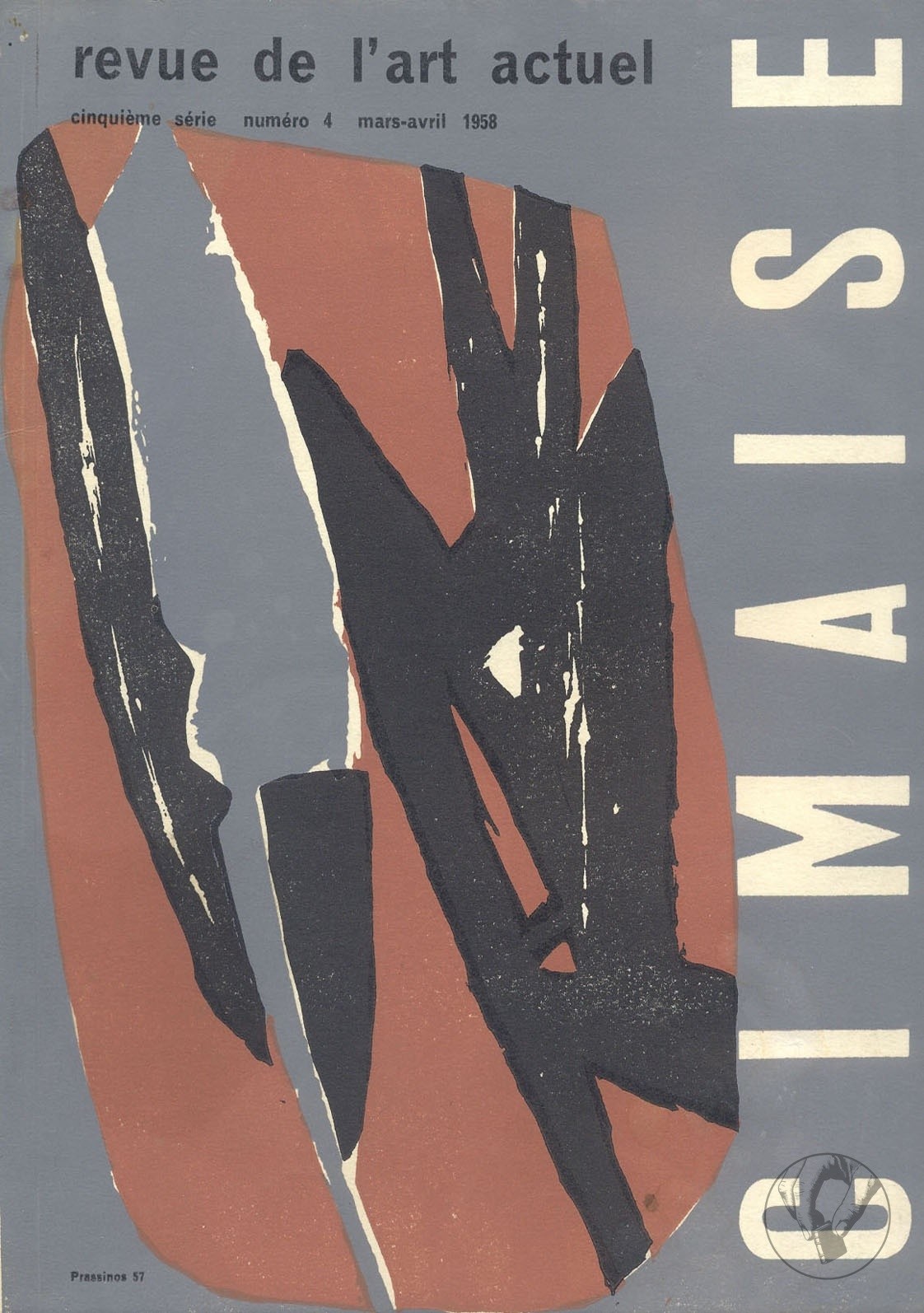
La revue "Cimaise" présente dans ce numéro des articles sur la sculpture actuelle, des notes de voyage, des visites d'ateliers d'artistes tels que Luis Feito, Claude Bellegarde et Staristsky, ainsi que des critiques d'expositions à New York et Milan. Elle inclut également des textes en anglais et en français sur ces sujets.