Page 1
revue de l'art actuel sixième série numéro 2 décembre 1958 MMMAISSE CCI
Premières pages de l'ouvrage, en accès libre.
revue de l'art actuel sixième série numéro 2 décembre 1958 MMMAISSE CCI
Galerie de France 3, rue du Faubourg Saint-Honoré Paris 8, Anjou 69-37 Décembre Hartung pastels janvier Gonzalez sculptures --- Galerie Jacques Massol 12 rue La Boétie Paris 8, Anjou 93-65 du 11 décembre au 10 janvier gouaches et aquarelles Busse, Clerté, Cortot, Dmitrienko Key Sato, Fagniez, Maisonseul Germain, Lagage, Ravel du 15 janvier au 5 février Mogens Andersen peintures récentes --- Galerie Le Gendre 31 rue Guénégaud Paris 6, Danton 20-76 du 18 décembre au 15 janvier argov, arnal, atlan, bott, camille clerc, chu-teh-chun, corneille doucet, dubuffet, fautrier kandinsky, kantor, leyden moisset, poliakoff, de staël sugai, villeri, vulliamy sculptures de chavignier à partir du 12 février gouaches de Francis Bott ---
Galerie Jordan 34 faubourg Saint Honoré Paris 8, Anjou 27-50 Altai, Arnal, Atlan, Coteau Corneille, Sugai, Tabuchi Wols, etc... décembre Pascale 20, rue Jacob Paris 6, Odéon 68-79 Halpern Jean-Marie Queneau Iris Clert 3 rue des Beaux-Arts, Paris 6, Danton 44-76 ...the most advanced art Gallery in the world expose à partir du 16 janvier 1959 Brô the most backward painter in Paris --- Galerie Ariel 1 avenue de Messine, Paris 8, Car. 13-09 du 20 janvier au 7 février Goetz peintures et pastels récents Anthoons, Bissière, Bitran, Deyrolle, Doucet Duthoo, Gillet, Goetz, Hartung, Manessier Maryan, Poliakoff, Pouget, Singier, Vieira da Silva Galerie Saint-Augustin 122 Boulevard Haussmann Paris Janson At the howard wise gallery of present day painting 11322 euclid avenue cleveland ohio u.s.a. Winter exhibitions 1959 18 Painters of the 1958 Pittsburgh International The Graphics of Pierre Soulages Recent Accessions Woodcuts by Ernest de Soto and Eline Mc Knight Selections from the Whitney Annual Woodcuts by Adja Yunkers ---
Galerie Saint-Augustin 122 Boulevard Haussman Paris Cardenas, Chavignier Duprey, Guino, Hiquily sculptures jusqu’au 10 janvier --- Galerie Breteau 70, rue Bonaparte, Paris 6, Danton 40-96 Templier gouaches du 12 au 30 décembre Feinstein, Fontené, Hanich Lindstrom, Pagès, Vielfaure Zwobada --- Galerie La Roue 16 rue Grégoire-de-Tours, Paris 6, Odéon 46-70 Juan Langlois peintures du 28 janvier au 11 février --- Galerie Lara Vincy 47 rue de Seine Paris 6, Danton 72-51 Seundja Rhee du 3 au 23 décembre --- Galerie du Haut-Pavé 3 quai de Montebello, Paris 5, Odéon 58-79 Selchow peintures du 28 janvier au 10 février --- Galerie du Dragon 19 rue du Dragon Paris 6, Tél. Littré 24-19 Hiquily, Hultberg, Philip Martin Masurowsky, Matta, Saby, Zanartu --- Sculptures Esquimaudes L’Académie du Feu 22 rue Delambre, Paris 14, du 19 décembre 1958 au 6 janvier 1959 vernissage vendredi 19 décembre de 17 à 24 heures ouvert tous les jours sauf le dimanche et les artistes du groupe du feu : Jamis, Altai, Tabuchi, Tanaka, Maduda Simada, Bella-Brisel, Parsons, Baram Cardenas, Kamper, etc… --- Galerie Bellechasse 266, Bd Saint-Germain Paris 7, Invalides 20-39 Petits formats d’artistes contemporains ---
Cimaise revue de l'art actuel 34 rue du Four, Paris 6 Directeur : J.R. Arnaud Secrétaire général : John Koenig Rédaction : G. Boudaille, M. Ragon, P. Restany Herta Wescher La rédaction reçoit sur rendez-vous Abonnement (6 numéros) 2.000 frs 34, rue du Four, Paris 6, téléphone Littré 40-26 C.C.P. Paris 5542.39 Diffusion : Allemagne : Librairie Hanna Weber, H.-J. Niepel, Dusseldorf 1, Grabenstrasse 11 Argentine : Editorial Victor Leru, Cangallo 2233, Buenos-Aires Autriche : Arnulf Neuwirth, Paracelsusgasse 8, Vienne 3 Belgique : Jean Milo, 28 rue de l’Arbre Bénit, Bruxelles C.C.P. Jean Milo, Bruxelles 1591.50 Italie : Le Noci, Via Brera 4, Milan Danemark : Meiners Kunstforlag, Peder Skramsgade 5, Copenhagen Grande-Bretagne : Alec Tiranti Ltd, 72 Charlotte Street, London W 1 Japon : Meiji-Shobo, Surugadai, Kanda Tokyo Norvège : J.W. Cappelen, Sortimentebokhandel, Oslo Suède : Eric H. Olson, Upplandsgatan 3, Stockholm, 10 23 77 Suisse : E. Genton, « L’Entr’acte », rue du Lion d’or 4, Lausanne, C.C.P. II 144-56 U.S.A. : Wittenborn and Co, 1018 Madison Ave, New-York 21 --- Robert David Téléphone Danton 16-26 Photographe spécialiste pour photos de tableaux, dessins, objets d’art --- Galerie Rivè Gauche 44, rue de Fleurus Paris 6, Lit. 04-91 --- Arnal, Bogart, Duncan Jorn, Mihaïlovich, Panafieu --- Sommaire Série VI N° 2 - Décembre 1958 Converture de Arnal 6 Voir l’art / Seeing art 23 Ecrits d’artistes / The Words of the artist : Marta Pan 27 Schneider 29 Ecrits d’amateurs d’art / The words of the collector : Marie-Louise Talsin, Paris 30 Giuseppe Panza di Biumo, Milan 37 Dore Ashton : L’automne à New York / Letter from New York 40 G. Boudaille : Les décorations de l’UNESCO 44 Actualité 50 Bibliographie --- Romain Weingarten 11 rue des Beaux-Arts, Paris 6. Danton 63-62 --- Encadrements Galerie Apollinaire Via Brera 4, Milano Tel. 862821 présente Fautrier 30 ans d’art informel janvier : Galerie Attico - Rome février : Galerie La Loggia - Bologne mars : Galerie Notize - Turin décembre - janvier : Les Femmes de Meloni préface d’André Verdet
Voir l'art / Seeing art Nous avons tenté, il y a un an (série V N° 1, septembre-octobre 1957), de dégager les lignes de force des tendances présentes de l’art, en esquissant « un mouvement tournant autour du fait plastique actuel ». Dans ce numéro-ci, notre préoccupation, bien que présentant le même caractère de généralité, est tout autre. Nous voudrions chercher à caractériser l’œuvre d’art en précisant les aspects différents qu’elle revêt selon la qualité de celui qui la regarde. Nous voudrions que ce numéro prenne l’aspect d’un miroir à trois faces dans lequel se reflèterait l’œuvre d’art, mais un miroir subjectif, chaque face donnant une image particulière de l’œuvre : — Tout d’abord, l’œuvre vue par l’artiste, le créateur, point de vue intérieur de celui qui fait l’œuvre. Nous avons donc demandé, à titre de témoignages, un texte aussi introspectif que possible, à deux artistes : un peintre, un sculpteur. — Ensuite, l’œuvre d’art vue par le spectateur, celui à qui, en définitive, elle est destinée et qui la voit, lui, de l’extérieur. Et nous nous sommes adressés à deux amateurs d’art, aussi différents que possible dans leur esprit et dans leurs goûts. — Enfin, il semble qu’il y ait une position médiane entre celle de l’artiste et celle du spectateur : c’est celle du critique, qui établirait une sorte de pont allant de l’un à l’autre. Plus prêt de l’artiste que ne l’est le spectateur, il s’intéresse souvent à la démarche autant qu’à l’œuvre accomplie. Plus proche du spectateur que ne l’est l’artiste, il juge l’œuvre faite. Pour leur permettre de préciser leurs positions respectives, nous avons établi un débat devant le magnétophone entre nos collaborateurs. Les illustrations qui accompagnent leur texte pour le rendre plus vivant ont été choisies de la manière suivante : Georges Boudaille : Dmitrienko, Dodeigne, Feito, Levee. Pierre Restany : Bellegarde, Brüning, Moreni, Saura. Michel Ragon : Barré, Fichet, Guitet, Kemeny. Herta Wescher : Carrade, Dumitresco, Moser, Penalba. J.R.A. — Je voudrais que nous instituions un débat pour préciser la position du critique, qui semble être une position médiane entre le spectateur et le peintre. Pourquoi est-il plus proche du peintre que ne l’est le spectateur? M.R. — La position du critique est une position ambiguë, étant donnés les rapports différents qu’il a A year ago, with the 1st November of the Vth Series (Sept.-Oct., 1957), we tried to make out the lines of force in the present tendencies of art, sketching out a “movement turning about the plastic fact of the present time.” In this number, our object is completely different, although it has the same character of generalization. We want to try to characterize the work of art in making precise the different aspects that it may take on according to the kind of person who may be looking at it. We want this number to be like a three-sided mirror in which the work of art would be reflected; but a subjective mirror with each side giving a special image of the work. — First of all we have the work as seen by the artist, the creator, from the internal point of view of the person that makes the work. So we have asked, as evidence, as introspective a text as possible from two artists, one a painter, the other a sculptor. — Then the work of art as seen by the spectator, for whom, in the end, it is destined, and who sees it from the exterior. We have asked two art lovers, as different as possible in their taste and their spirit, to give us their views. — Finally, believing that the critic has a middle position between the artist and the spectator, establishing a sort of bridge going from one to the other; nearer to the artist than is the spectator, being often as interested in the procedure as much as the accomplished work; nearer to the spectator than is the artist, and judging the accomplished work; we wanted our staff then to make their respective positions more precise, and so we had a debate transcribed on the magnetophone. The illustrations that accompany the text were chosen in the following manner: Georges Boudaille: Dmitrienko, Dodeigne, Feito, Levee. Pierre Restany: Bellegarde, Brüning, Moreni, Saura. Michel Ragon: Barré, Fichet, Guitet, Kemeny. Herta Wescher: Carrade, Dumitresco, Moser, Penalba. J.R.A. — I wanted this debate to take place in order to obtain certain precisions concerning the position of the critic, that seems to me to be in a place somewhere between the spectator and the painter. Why is he closer to the painter than the spectator?
Barré : Peinture, 200 x 120, 1957, collection S. R. Guggenheim Museum, photo R. David Levee : peinture, 212 x 185, 1958, photo Marc Vaux, Galerie de France
Fichet : La visitation, 55 x 25, 1958, collection Mr Mme Faux, Reims, photo R. David Moser : peinture, 1958, Galerie J. Bucher, photo R. David
avec son journal, avec les peintres, avec les galeries. On peut se demander qu'est-ce un critique d'art? Il peut être plus ou moins un journaliste, plus ou moins historien, plus ou moins sociologue, plus ou moins esthéticien. Il y a toutes sortes de critiques d'art. Certains sont théoriciens, aujourd'hui encore il en est pour lesquels peignent les peintres afin d'illustrer leurs théories. Pour prendre un exemple dans le passé, il en était ainsi pour Ruskin et André Breton, qui sont restés d'ailleurs plus célèbres que les peintres qui les ont illustrés. Personnellement, je prends la position d'un témoin. G.B. — Tu refuses donc de prendre parti et de défendre plus particulièrement un peintre? M.R. — Non, je suis un témoin de mon époque, qui s'emballle, dénigre, vit en un mot. Mais dans le témoin il y a le spectateur qui se rapproche du public, se promène, regarde. Mais le spectateur, lui, ne manifeste pas son opinion. Tandis que le critique possède un outil de travail, et pour se manifester doit bien posséder son langage. J.R.A. — Pourquoi, d'après toi, le critique d'art se trouve-t-il plus près du peintre que ne l'est le spectateur? M.R. — Le critique d'art doit posséder le don de sympathie. Les spectateurs, eux, éprouvent presque toujours de l'antipathie. Pourquoi la peinture rend-elle les gens furieux? La peinture moderne en particulier. Avant tout, le critique d'art doit entrer dans une exposition en éprouvant une certaine sympathie pour l'effort accompli. Ensuite, évidemment, s'il trouve que les résultats sont mauvais, sa colère peut éclater. Cette sympathie doit se transmettre au publique qui lit le critique d'art et, par là, aider à la compréhension du peintre. P.R. — Ce don de sympathie est d'ailleurs parfaitement conciliable avec les exigences du lyrisme individuel. Mes options m'engagent sur telle ou telle voie : c'est là que se manifeste mon activité communicatrice. J.R.A. — La plupart des critiques établissent des relations personnelles avec les peintres. Est-ce que ces contacts permettent une compréhension plus grande de l'œuvre? M.R. — Oui et non. Je crois qu'il est utile d'aller dans les ateliers. Pourtant le critique ne devrait connaître aucun peintre, pour rester libre de ses opinions, de ses jugements; mais évidemment c'est impossible. P.R. — Les relations personnelles avec les peintres découlent, pour une bonne part, des options fondamentales qui déterminent une personnalité artistique. Il y a, à la base de ce genre de rapports, une sympathetic idéologique, une communauté spirituelle, une certaine identité de vues : il ne faut ni aller, ni chercher plus loin. J.R.A. — Le critique ne doit-il pas s'intéresser non seulement à l'œuvre faite mais aussi à l'œuvre qui se fait. C'est-à-dire non seulement voir ce qui a été réalisé, mais aussi chercher à dégager la potentialité M.R. — The position of the critic is an ambiguous one, because of the different kinds of relations he may have with his paper, with the painters, with the galleries. We may even ask ourselves: what is an art critic? He may be more or less a reporter, or an art historian, or sociologist, or esthetician. There are all kinds of art critics. Some of them are theoreticians, and even today there are some for whom painters paint in order to illustrate their theories. To take an example in the past along this line, we have Ruskin and André Breton, who for that matter are more famous than the painters that proved their theories. For my part, I prefer the position of an onlooker. G.B. — Thus you refuse to take sides and defend one painter more than another? M.R. — No, I am a witness of my period, enthusiastic or sarcastic—in other words, a living witness. But in this witness there is the spectator who is close to the public, who strolls about, looking. But the spectator does not make his opinion manifest. Whereas the critic has a working implement, and in order to manifest his opinion must well know how to write. J.R.A. — According to you, why does the critic find himself closer to the painter than the spectator? M.R. — The critic must start off with a certain sympathy. Most of the spectators usually feel a certain antipathy. Why does painting make people angry? Especially modern painting? Before all, the critic must come to a show with a certain sympathy for the accomplished effort. Evidently, after this, if he finds that the results are disastrous, he can let loose his anger. But this initial sympathy must be transmitted to the public who read the critic, and through this, help them to understand the painter. P.R. — This gift of sympathy is for that matter completely in keeping with the exactions of individual enthusiasm. My choices put me into such or such a path, and it is here that my communicative activity will show itself. J.R.A. — Most of the critics establish personal relations with painters. Do these contacts allow a more complete understanding of the work? M.R. — Yes and no. I think that it is useful to go and see the studios. However, the critic should really not be acquainted with any painter, in order to keep his opinions and judgements free, but of course, this is impossible. P.R. — Personal relations with painters take place, for the most part, from the fundamental choices that have been undertaken, and which determine an artistic personality. The basis for this kind of relation stems from an ideological sympathy, a spiritual community, a certain identity of thought: then we must go no farther, search no farther. J.R.A. — The critic, it seems to me, must not only be interested in the accomplished work, but also the work in the making. That is to say, not only consider what has been already done, but also to try to dis-
d'une œuvre, ses éventualités, ses aspirations, en un mot les velléités du peintre? Et il ne peut les comprendre que par la fréquentation de l'artiste. M.R. — C'est là un des drames du critique. La fréquentation de l'artiste est nécessaire, mais peut devenir rapidement néfaste. Quand il est vraiment enthousiaste, le critique peut se lier d'une grande amitié avec l'artiste. Mais si l'artiste dans son cheminement varie, doit-on lui dire ce que l'on pense? Oui, certainement, mais l'on risque de perdre un ami, c'est une question assez grave. A côté de cela, combien de peintres sympathiques, gentils, mais mauvais, qu'on n'ose pas tuer. J.R.A. — Les relations personnelles, dans l'ensemble, ne sont donc pas bénéfiques? M.R. — Elles sont bénéfiques esthétiquement, mais négatives sur le plan social. J.R.A. — Qu'en pense Boudaille? G.B. — Si le critique est obligé de faire preuve de compréhension vis-à-vis de l'artiste, ce dernier, devenu une relation, un ami, doit aussi faire preuve de compréhension vis-à-vis du critique, et comprendre qu'il ne peut aliéner une certaine liberté de jugement à cause de cette amitié. Un cas de conscience se pose : le critique, par ses écrits, peut empêcher l'artiste de vendre, de gagner sa vie, et le mettre ainsi dans une position délicate. J.R.A. — Est-ce un argument qui doit jouer dans le rôle du critique? M.R. — C'est un argument humain. J.R.A. — Ce n'est pas un argument critique. G.B. — Ce n'est pas un argument critique, mais on peut toujours s'arranger, comme par exemple retarder le compte rendu jusqu'à la fin de l'exposition. Pour revenir à la question des relations personnelles, en ce qui concerne les jeunes, je pense que souvent l'entretien est indispensable. Un jeune peintre ne s'exprime pas forcément entièrement dans sa peinture dès ses débuts et, pour comprendre le potentiel de l'œuvre, l'entretien est important. P.R. — J'en ai fait maintes fois l'expérience : ce contexte humain, malgré les risques qu'il comporte, s'avère indispensable. Certains artistes se croient tenus de jouer un jeu dans ces cas-là. Leur comédie est, en elle-même, significative. H.W. — Au fond, je suis d'accord avec Ragon, et je pense que le mieux serait de ne pas connaître les artistes. L'essentiel d'une œuvre d'art se saisit par le regard et non pas dans la conversation avec les artistes. Connaître l'artiste peut permettre de faire un papier plus vivant, plus riche, plus anecdotique, mais l'essentiel se passe entre le critique et l'œuvre d'art. G.B. — Le critique doit mettre tous les atouts dans son jeu. Quand l'œuvre le laisse perplexe, il est préférable d'avoir le maximum de renseignements, mieux connaître le tempérament de l'artiste, et porter un jugement étayé même par des arguments non esthétiques, mais qui permettent parfois de faire un pari sur l'avenir, ce qui demeure notre rôle. J.R.A. — Il serait intéressant que vous donniez votre position vis-à-vis de la critique négative. Vous voyez engage the potentialities of a work, its eventualities, its hopes; in short, the impulses of the painter. And he cannot distinguish them without knowing the artist. M.R. — This is one of the dilemmas of the critic. Knowing the artist is a necessary thing, but this can have its drawbacks. When he is really enthusiastic, the critic can become quite friendly with the artist. But if the artist becomes side-tracked, must the critic tell him what he thinks? Yes, certainly, but he risks losing a friend, which is a serious thing. Besides this, there are many pleasant, kindly, but unfortunately bad painters, that you hesitate to execute. J.R.A. — In general, aren't these personal relations of any benefit? M.R. — In an esthetic manner, yes, but in a negative way when we come to the social side. J.R.A. — What does Boudaille think about this? G.B. — If the critic must try to understand the artist, the artist in turn, once he has become an acquaintance, a friend, must also try to understand the critic's position, and understand that he cannot alienate his freedom of judgement because of this friendship. This is a case for the conscience, since the critic, because of what he says can keep the artist from selling, from earning his living; this puts the critic in a delicate situation. J.R.A. — Should this argument have a certain weight for the critic? M.R. — It's a human argument. G.B. — It's not a critical argument, but things can always be arranged; for example, the article can be held back until the end of the show. But coming back to the question of personal relations; with the young painters, I think the contact is indispensable. A young painter does not necessarily express himself fully at the beginning, and to understand the potentialities of his work, an interview is very important. P.R. — Many times I have seen this; the human context, in spite of the risks it contains, proves itself nonetheless indispensable. Certain artists consider it necessary to play a rôle in this situation. Their comedy is, in itself, significant. H.W. — At heart, I agree with Ragon, and I think that the best thing would be to not know the artists. The essential part of a work of art can be seen with the eye, and not through conversation with the artists. To know the artist allows you to write a paper that is livelier, richer, warmer, but the essential thing takes place between the critic and the work of art itself. G.B. — The critic must try to have all the trumps in his hand. When the work leaves him perplex, it is preferable to have maximum information, to know the artist's temperament well, and base his judgement even with the support of non-esthetic arguments, but which allow him to place a bet on the future prospects, which all in all, is our rôle. J.R.A. — It would be interesting to hear your opinion on negative criticism. When you see a bad
Carrade : peinture, 113 x 73, 1957, collection particulière Paris photo R. David Brüning : peinture, 145 x 115, 1958, Galerie 22, Dusseldorf
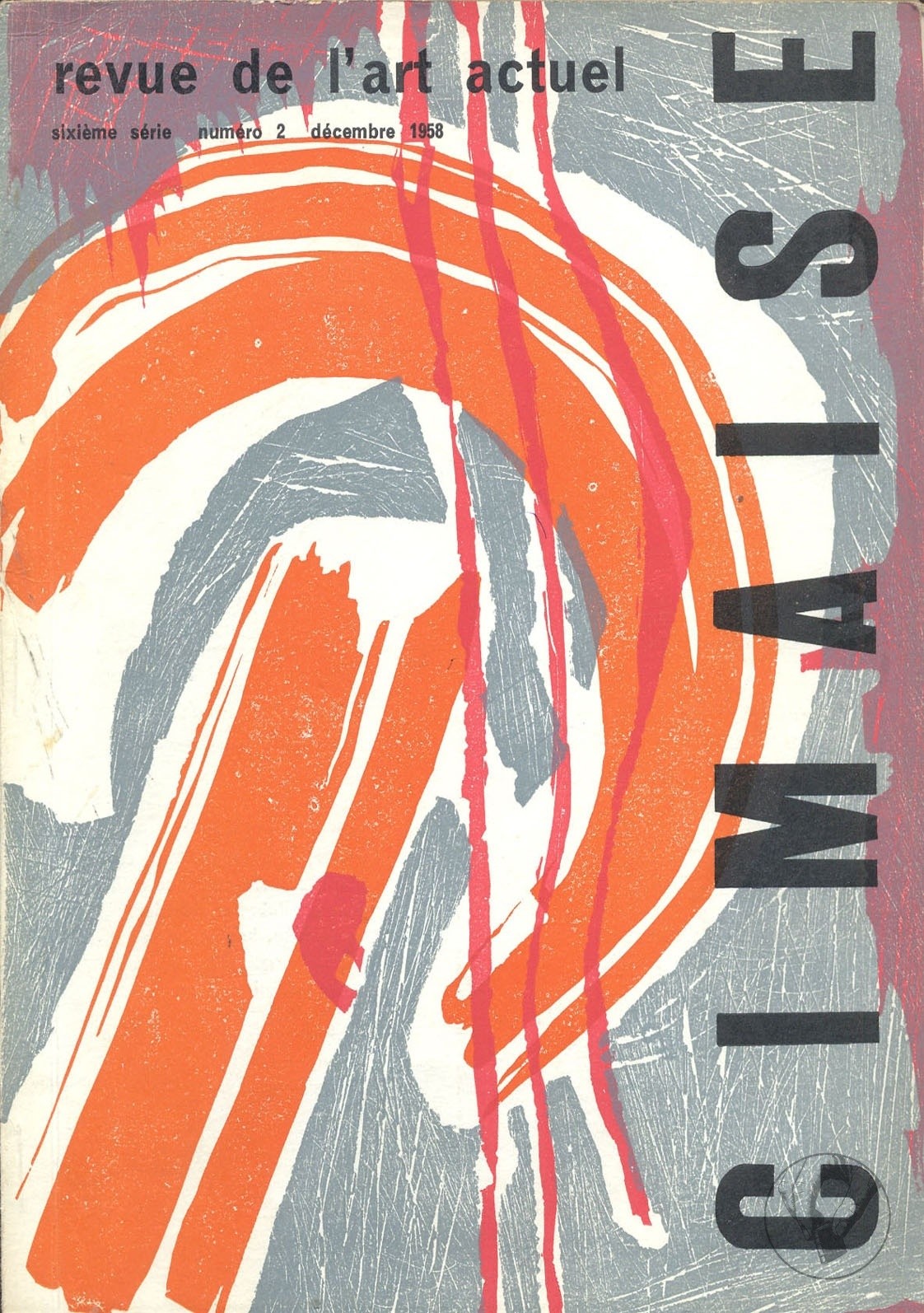
La revue d'art actuel "Cimaise" présente son numéro de décembre 1958. Ce numéro explore la perception de l'œuvre d'art sous différents angles : celui de l'artiste, du spectateur et du critique. Il inclut des témoignages d'artistes et d'amateurs d'art, ainsi qu'un débat entre critiques sur leur position médiane. Le contenu est illustré par des œuvres d'artistes tels que Dmitrienko, Dodeigne, et d'autres, et couvre des expositions d'art contemporain à Paris et à l'étranger.