Page 1
BROOK BRIAN
Premières pages de l'ouvrage, en accès libre.
BROOK BRIAN
BROOM AN INTERNATIONAL MAGAZINE OF THE ARTS PUBLISHED BY AMERICANS IN ITALY EDITOR, HAROLD A. LOEB APRIL, 1922 VOL. 2, NO I. TO A STARVING MAN — JOHN GOULD FLETCHER --- PAINTING — HENRI MATISSE --- THE NEW CONDITIONS OF LITERARY PHENOMENA — JEAN EPSTEIN --- GOLDEN FOX — EDGAR LEE MASTERS --- MOISSONS EN ILE-DE-FRANCE — ALICE HALICKA --- BLACK JACK KERRIGAN — ISRAEL SOLON --- THE MANSION OF PEACE — CARL ENGEL --- HEAVENS — LOUIS UNTERMEYER --- LES DISQUES — F. LEGER --- FISH — WILLIAM CARLOS WILLIAMS --- TWO UNIVERSITY PROFESSORS — JOHN DOS PASSOS --- NATURE MORTE — MARCOUSSIS --- IF YOU HAD THREE HUSBANDS — GERTRUDE STEIN --- THEATRE — JOHN RODKER --- PAYSAGE ANIMÉ — F. LEGER --- DEDICATED TO THE ENEMY — GORDON CRAIG --- PORTRAIT DE L’ARTISTE — ALICE HALICKA --- HOMAGE TO SIVA — ROMAIN ROLLAND --- COMMENT — H. A. L. --- The Editor of Broom will be pleased to consider mss. submitted to him, but all mss. must be accompanied by a self-addressed, stamped envelope. The Editor cannot hold himself responsible for loss of mss. in transit. Mss. from Europe should be sent to the Rome office; mss. from America to the New York office. The price of Broom is: For America, fifty cents the copy, and five dollars for a year’s subscription. For Italy, 10 lire the copy, and 100 lire for a year’s subscription. For France, 6 francs the copy, and 60 francs for a year’s subscription. For Great Britain, 3/6 the copy, and one pound and fifteen shillings for a year’s subscription. The contents of this issue are protected by copyright, January, 1922. Infringement of same will be prosecuted. --- HEADQUARTERS, 18, TRINITÀ DEI MONTI, ROME (6), ITALY. NEW YORK OFFICE, THREE EAST NINTH STREET. LONDON OFFICE, CECIL PALMER, OAKLEY HOUSE, 15-18 Bloomsbury St., W. C. I.
TO A STARVING MAN You haggard, ragged caricature of man Cowering alone upon the rain-swept pavement, Out of the mighty city I bring myself to you, Your wolf-like pallid face and matted hair are sacred; Sacred your lean grey throat, your knotted stringy hands. Your coat pinned at the neck, your frayed and mud-stained trousers, Your bulging shoes, through which the bare toes pass, Your dirty greasy hat shrouding the aching eyes, All these are beautiful; like a ruined city You watch, about you weeds and desolation, But in the midst of you a human soul. You who slip down the last glissade to death, Man starving without hope, whose empty heart Holds but the last despair, the dreadful peace of God; I who have wrought for fifteen years in song Come now and stand beside you; we are one. You will even hear the song I make of you, I will not even know the thoughts you hold of me; Let there be but between us now two pairs of eyes Gazing into each other’s depth; and night, and nothingness. JOHN GOULD FLETCHER
HENRI MATISSE. Courtesy Bernheim-Jeune Gallery — Paris. Painting.
THE NEW CONDITIONS OF LITERARY PHENOMENA The fact that the world has changed can only have a theoretical importance, furnish material for hypotheses, or pass unnoticed, a simple probability very likely true. It is our knowledge of the world that has changed. The sum total of errors, of approximations, of arbitrary or experimental opinions — with which thought weaves a net to cast over objects whose meshes then break and must be laced up again — that changes astonishingly in the course of ten years. It is true something remains of the old concepts, but those that were too much at variance with the new conditions of life have been expeditiously effaced, or at least sufficiently transformed so as no more to oppose events but to follow them. Literature, that automatic register of human sensibility, is no more stable: a weathercock, showing the actual wind from the lofty plateaux of intelligence, but unable to direct it on the dial of the compass. What are the new conditions of knowledge and life? The speed realized by man has given a new character to civilized life, spatial speed first of all. Cities are bound to each other by the close-woven network of the rails. Countries even more than cities. Automobiles roll along. Aeroplanes, in a line which is still more direct, leap over distances. Continents again, even to a greater degree than countries, extend mobile bridges to one another. Every ten years the kilometre, like a depreciated banknote, loses in value. The word "far" has not the same meaning today as yesterday, nor as it will have to-morrow. Waste lands become populous, cheap tracts quintuple in price because a tramway, and that feed wire from which it licks up the sap of amperes and volts, now passes through a suburb. We travel eight hundred kilometres to divert ourselves, three thousand to sell a stock of furs. A new race of men is born under the glazed waiting-rooms of the railroad stations and on the decks of ocean liners — the Cosmopolite. I not say do Internationalist. The Cosmopolite, notwithstanding the scorn with which some pronounce that word, can be as good a patriot and as bad a Chauvinist as another man who
has never left his county. The peoples know each other better, love and hate each other more, but in the same proportion now as in former times. We exchange customs, words, ideas. The possession of speed has spread the knowledge of foreign tongues. There is no one to-day who does not know a few words of English, of German, of Italian. The absolute mastery of these languages, a rarity two century ago, is to-day nothing unusual. To create astonishment now, it is necessary to know four or live languages at a time. The juxtaposition of dialects in the same brain means the juxtaposition of grammars. Grammar is the most simple, the most definite form of the logic peculiar to each people. These logics of expression, which hinder association, nevertheless influence, interpenetrate, sustain, combat and modify each other reciprocally. Thought little by little, changes its moulds. Besides, the beautiful legendary geography of the old books is dead. No more are there countries eternally lost in the mist, nor waste shores, nor mountains on which one picks up turquoises by the shovelfull. One has retraced a hundred thousand times the travels of Marco Polo, but they are no longer the same. Venice is less beautiful for being precisely so many hours and minutes from Paris. The acquisition of spatial velocity has progressively created geography. Thanks to it, white-haired astronomers run after eclipses and comets and catch them up. Did not spatial velocity take part in the formation of those first crystals of nitro-glycerine between Vienna and London? It modifies the language which neighboring peoples ornament with new words, alters the logic of utterance, grammar, thought; hence every brain. It carries contagions of ideas from one pole to another. It modifies commerce, the bank, that is to say the foundation of our civilization. Money, that blood of the world, circulates more rapidly because the heart of the locomotive beats more quickly. The earth is small. All this has modified literature, that mobile countenance of a people. Beside spatial velocity there is the velocity of thought. When we ask a question of several individuals, who are more or less cultivated, more or less intelligent, we receive at times the answer even before we have finished framing the question. At other times, we must wait several seconds. This delay, this time lost in understanding, is extremely variable. Its duration depends on the greater or lesser thought-speed of the individual under consideration. This mental rapidity not only shows individual variations, but national variations, from country to country, from race to race. If we wish to see the experimental demonstration of this phenomenon, we
can find it in the cinema. The fact is that the films register and measure thought-speed. The rapidity with which the episodes, the vicissitudes, and even the gestures succeed and are built upon each other on the screen — a rapidity which is controlled and proportioned by the producer in such a manner that his customary public can follow the scenario without either fatigue or boredom, a rapidity which corresponds to the average mental speed of his public — varies according to the country from which the film comes. Italian films can be taken as an example of those which reveal their meaning most slowly. They bore the French spectator, for instance, who does not know how to occupy his mind during those superfluous ten seconds during which the scene of mimicked conversation lasts, because he understood it ten seconds sooner than the average Italian spectator for whom the film was made. On the contrary, certain American films testify to considerable mental speed: in order to follow the action there is not truly three seconds to squander in distractions. Evidently, there are some spectators left behind, lost, who ask help of their neighbors. In literatures, the same difference is naturally evident, but the film presents this difference in the more definite fashion of a registering machine. On the other hand, one should not necessarily identify mental speed with general intelligence. Let us suppose a people “A” between two peoples “B” and “C” of whom one “B” thinks more quickly, and the other “C” more slowly. Spatial speed permits contact between these three peoples. If the middle people “A” interests itself in the products of the intellectual activity of its two neighbors, it will notice by degrees its superiority over the people “C”, whose slowness of thought becomes then a source of irritation. On the contrary, the thought-speed of the other people “B” obliges the people “A” to make an effort if it wishes to understand, to stay on a level, and not be a source of irritation in its turn. Certain lazy folk will abandon the pursuit. Others, will go into training and will attain a greater thought-speed, just as a coming man in the boxing game progressively acquires his maximum speed. Little by little, very slowly it is true, the picked few will be followed by the mass of onlookers or of readers. So it will happen that the thought-speed of the middle people “A” will grow. That mental speed in the past has increased cannot be doubted. Universal compulsory education, which is not perhaps the omnitherapeutic panacea, has at least done this, unless, instead of being the cause of this change, it has been only the simple consequence. Therefore, it is quite natural that certain kinds of modern French literature are veritable tours de force from the point of view of mental speed. The stenogram passes from the merchant to the poet. $\mathcal{S}$
Civilization, which is far indeed from being a simple word, presents for consideration an infinite number of views of the same object. Innumerable apparatuses, complicated and delicate, supplement the information about the world given us by our eyes, ears, and finger-tips. Just according to the number of the apparatuses by which we extend one or other of our senses — be there five or more — just so many new deformations are recorded by the intelligence. By deformation, I do not mean error or false deformation. All philosophies and all skepticisms lie in ambush for this word which I employ innocently. A line appears straight to my naked eye, and curved seen through a glass; this is a deformation. That is all I intend to say. One is not content with these deformations. As they differ from the perceptions of our bare senses, which we are astonished to see transformed when we wished merely to amplify their range — just as a cannon’s range is augmented in keeping very exactly the direction of the original trajectory — so we overlay these deformations with new deformations, on the pretext, perhaps legitimate, of correcting them. We take account in every experience, in every calculation, of the absolute error and the relative error, and thus we introduce the subtle, the imponderable, the uncontrollable error of the error, and the error of removing the error and believing it removed. All this the intelligence notes, tries to understand, feeds upon and digests in its belly, like the sly beast it is. The machine technology of civilization, the innumerable instrumentations that encumber laboratories, factories, hospitals, photographic studios, and electrical shops, the engineer’s table and the architect’s drawing-board, the aviator’s seat, the moving picture theatre, the optician’s show window and even the toolkit of the carpenter allows man an infinite variety of angles of observation. Optics especially — and what is there astonishing in this, in a civilization which is essentially optical — hangs its lenses round our necks like the amulets on the neck of an Indian chief. And all these instruments: telephone, microscope, magnifying glass, cinematograph, lens, microphone, gramophone, automobile, kodak, aeroplane, are not merely dead objects. At certain moments these machines become part of ourselves, interposing themselves between the world and us, filtering reality as the screen filters radium emanations. Thanks to them, we have no longer a simple, clear, continuous, constant notion of an object. Man has seen a landscape not only with his naked eyes while walking, but blurred by speed through the window of a train, with eyes bitten by wind and dust from the front seat of an automobile, from the height of an aeroplane, spread flat like a geographical museum reproduction, through field glasses, in a diorama, in photographs, taken from left, from right, in sunlight, in shadow, with or
without diaphragm, in the cinema, painted by a painter, drawn by another artist, sung by a poet; man has not one memory of this landscape; he has a thousand different ones, which may or may not resemble each other. The world for man today is like descriptive geometry, with its infinite planes of projection. Everything possesses hundreds of apparent diameters which never superimpose exactly. A voice heard naturally, then heard springing from the black graphite of the telephone, then finally resounding when the sapphire delivers it from the disc, is no longer, whatever one may say, the simple voice, the same voice. Nasal intonations reveal themselves, new sounds remain in the memory; henceforward one will listen to them differently. An historical reconstruction in a theatre or on the screen strikes out for a few half hours twenty centuries of time. The instantaneous photograph has discovered gestures which the eye now divines and the hand reproduces. We notice how suddenly a face on the screen shows itself to be different. A wrinkle appears that we failed to notice for twenty years: but from now on we shall have learned to see it. This unheard of complexity of perceptions which modern civilized life offers ordinarily to our intelligences, this intellectual surcharge whereby a hundred different images correspond to a single object has not been without influence on modern French literature. Arbitrarily, and to satisfy our mania for “here begins” and “there ends,” the domain of thought, of imagination, of kinesthesia, ourselves, even our brain, all that circumscribes and encloses the pale air-tight limit of skin is opposed to the domain of acts, of apparent gestures, and of things exterior to ourselves. Self-observation and auto-psychology exploit, as an inexhaustible quarry, this domain or interior kingdom as certain people rather pompously call it. Let us take the case of a man who fills a small office position. His exterior life is, so to speak, nothing at all. All day long with knees under the table, his chest barred by the front of his desk, he hibernates, muttering over columns of figures. His evenings are enlivened by the watering of his little garden; his Sundays by a cigar and a walk in the suburbs. He hasn’t been to the theatre for ten years. Once or twice he has traveled on an excursion train. Nevertheless, this man can be a philosopher, a poet, an observer, intelligent, cultivated. He reads. The walls of his room crumble away perhaps when he choses, and reveal the landscapes wherein he would have amused himself had he been allowed to live there. On a limitless stage, he is at once playwright, actor and partial critic. He may meditate on the august laws of the new theogonies. Miracles grow fertilely under the hands of this careful gardener and he trims in
diverse fashions the leafy trees of wisdom that their shade may be less dense. His shortsighted clerk’s eyes, blinking behind glasses, see the galloping unicorns pass, and sometimes he screws them up under the diaphragm of his pupils to mask an enormous and disdainful laugh. He listens to himself living, like a doctor bent over the stethoscope which trembles with the beating of a heart. His sensibility, which may even be exquisite, warns him of the passing of a thousand things which escape the athlete, whose life only swells his muscles, or the business man who recognizes as a warning nothing but the shrill ringing of the telephone, or the explorer who smothers nostalgia by a siesta. A discreet life is not always an empty one. To inhale existence sweetly through a straw can offer the palate richer feasts than gorging oneself with double mouthfulls. But it seems that civilization clearly orients life “inward” and not “outward.” General education, in spite of its frequent failure, puts self-observation within the reach of a greater number of people. The advertisements with which we now greet cancer, tuberculosis, sub-alimentation and epidemics counsel men to examine themselves, to listen to their kinesthetic sensations, to take fright at the least internal disorder, at the slightest alarm signal of the nervous system. Doctors are more numerous today than yesterday, and as they live one presumes they dont lack for patients. Not that there are more sick people — that would have to be proved — but because there are more people who know they are sick. The inquietude, doubtless unnecessary, created by statistics on the increase in the frequency of cancer is caused by this better self-observation as much as by the improvements in diagnosis. And the beginnings of illnesses are often insidious. How much attention is therefore given to kinesthesia. And I have had the occasion to show elsewhere what close relation, almost identity link the kinesthesia of an individual to his subconsciousness, and his subconsciousness to his religious feelings and his intelligence. Another cause, due to civilization, for the orientation of thought “inward” is manual laziness. Of course, longshoremen, athletes, carpenters still exist. But in how many trades have the arm, the hand, the shoulder, the foot been replaced by a transmission belt and a few gears and pulleys? More and more the workman, his hand on a lever, merely oversees the silent, regular, docile working of a machine. A wipe with a bit of waste now and then, a few drops of oil. Between times, in the intervals of muscular inactivity, what would one have the workman do but think, and think of himself and his life, of the means of bettering it? Other professions have become exclusively cerebral: the business man, the banker, the station master, the contractor, the broker, combine, reflect, wait, decide. To be sure, they do not always think of their inner life, but when by chance one day they do think of it, all their intellectual agility acquired in the course of their other exercises suddenly drills a well in them,
from which henceforth, Artesian, autopsychology spouts up like the liquid arc of petroleum in American landscapes. Books of philosophy and abstract speculation sell up to ten thousand copies. Publishers print them. Who has not his library today, not to mention his newspapers? This orientation of thought “inward” has had its extremely strong repercussion on modern French literature. I have sufficiently demonstrated that civilized life is above all cerebral, above all nervous. The banker, hanging on the telephone, his eyes on the stuttering Morse, remembers figures, calculates, interrupts himself to dictate an order to his stenographer, signs thirty signatures with a recalcitrant fountain pen, foresees to-morrow’s quotations, thinking of what they were six months ago, multiplies, divides, lunches quickly, gets into his auto, and goes back to his work. The locomotive engineer reads the slope of the gradients which obstinately vertical little posts hold out to him, guages the effort of the brakes, notes the speed of the train, its weight, foresees the curve, the tunnel, tries to make up over a run of fifty kilometers, the time that has been lost, watches the signals, the steam guage, the water level. The captain of the steamship must be at once astronomer, meteorologist, mathematician, engineer, electrician and sometimes judge. The storm, before taking place, lives in his brain. The possible iceberg, the ocean current which carries it along, the speed which exhausts the coal bunkers, the sudden call by wireless; he thinks of all these. And the engineer, the aviator’s mechanic, the photographer who is a chemist, and the chemist who verifies the alimentation of a city of five hundred thousand inhabitants, and prepares the exact explosion of a shell or blasts a rock nearly a cubic metre in size, and the pharmacist who weighs the chances of poisoning in tiny little scales, and the farmers who now understand the mechanism of their tractors, the chemistry of their fertilizers, the geology of their soil, veterinary therapeutics, meteorology and the botany of their crops, the physics of their drainage… Everybody knows how to read, write, calculate, drive an automobile, take a bicycle to pieces, clean a lock or a revolver, interpret the Stock Exchange returns, appreciate an altitude record. People read the Year Book of the Bureau of Longitude, the Manual of Bridges and Pavements, every one knows by heart the metric system, the solar system, grammar, the table of logarythms, the symptoms of fifteen maladies, the time tables, the characteristics of twenty makes
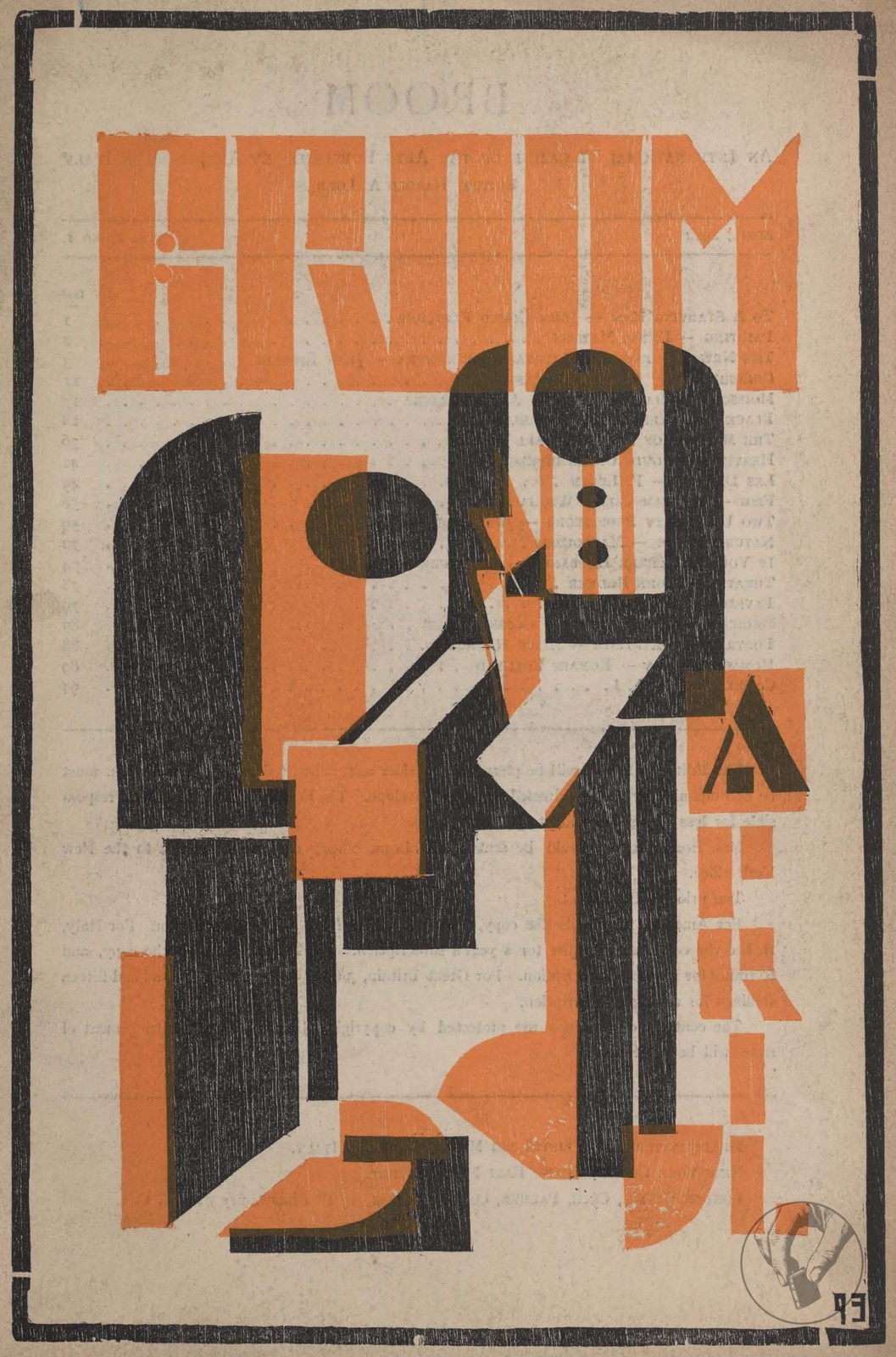
This issue of Broom, an international magazine of the arts, features a diverse collection of literary and artistic contributions. It includes poetry by John Gould Fletcher and Louis Untermeyer, essays on literary phenomena and the impact of speed on modern life by Jean Epstein, and contributions from artists like Henri Matisse and F. Leger. The magazine also presents works by Edgar Lee Masters, Gertrude Stein, and William Carlos Williams, exploring themes of art, culture, and societal change.