Page 1
BROOM $\mathcal{R} \in \mathbb{Z}$ $\mathcal{M} \in \mathbb{Z}$ $\mathcal{V} \in \mathbb{Z}$
Premières pages de l'ouvrage, en accès libre.
BROOM $\mathcal{R} \in \mathbb{Z}$ $\mathcal{M} \in \mathbb{Z}$ $\mathcal{V} \in \mathbb{Z}$
BROOM AN INTERNATIONAL MAGAZINE OF THE ARTS PUBLISHED BY HAROLD A. LOEB. EDITOR, HAROLD A. LOEB. MAY, 1922 APPEARS MONTHLY VOL. 2, NO 2. Page --- COVER DESIGN — KAWASHIMA. --- FOUR STEICHEN PRINTS — CARL SANDBURG. --- PORTO LONGONE — RICHARD SEEWALD --- MARCHE FUNÈBRE — LAWRENCE VAIL --- WOODCUTS — E. PRAMPOLINI. --- 101-121 --- THE WARDROBE WITH THE MIRROR DOOR — RAMON GOMEZ --- THE SON THAT I WOULD HAVE HAD— RAMON GOMEZ --- ONE HUNDRED ENVELOPES — RAMON GOMEZ --- THE POETS AND THE HOUSEWIFE — MARTIN ARMSTRONG --- MONKEY ISLAND — ROBERT MUSIL --- TANGLE-FOOT — ROBERT MUSIL --- THE MOUSE IN THE FODARA VEDLA — ROBERT MUSIL --- THE SNOW MAN — DONALD CORLEY --- FOUR ETUDES — MATTHEW JOSEPHSON --- GEORGE MOORE, AESTHETE — MARIANNE MOORE. --- SAILBOATS — RICHARD SEEWALD --- MOUNTAIN FARM — MALCOLM COWLEY --- THE RAKEOFF AND THE GETAWAY — CARL SANDBURG. --- ASCONA — RICHARD SEEWALD --- HE DECEIVED HER — FRÁNA SRÁNACK. --- THREE UNITED STATES SONNETS — E. E. CUMMINGS. --- HEAVENS — LOUIS UNTERMEYER --- OCTOBER — ANATOLY MARYNGOFF --- VILLAGE STREET WITH CAT — RICHARD SEEWALD --- PETALS — WILHELM KLEMM --- MODERN GERMAN LITERATURE — FRANZ BLEI. --- FOREIGN EXCHANGE — A. H. L. --- COMMENT. --- The Editor of Broom will be pleased to consider mss. submitted to him, but all mss. must be accompanied by a self-addressed, stamped envelope. The Editor cannot hold himself responsible for loss of mss. in transit. Mss. from Europe should be sent to the Rome office; mss. from America to the New York office. The price of Broom is: For America, fifty cents the copy, and five dollars for a year’s subscription. For Italy, 10 lire the copy, and 100 lire for a year’s subscription. For France, 6 francs the copy, and 60 francs for a year’s subscription. For Great Britain, 3/6 the copy, and one pound and fifteen shillings for a year’s subscription. The contents of this issue are protected by copyright, January, 1922. Infringement of same will be prosecuted. HEADQUARTERS, 68, VIA LECCOSA, ROME (9), ITALY. NEW YORK OFFICE, THREE EAST NINTH STREET. LONDON OFFICE, CECIL PALMER, OAKLEY HOUSE, 15-18 Bloomsbury St., W. C. I.
FOUR STEICHEN PRINTS The earth, the rock and the oil of the earth, the slippery frozen places of the earth, these are for homes of rainbow bubbles, curves of the circles of a bubble, curves of the arcs of the rainbow prisms—between sun and rock they lift to the sun their foam feather and go. Throw your neck back, throw it back till the neck muscles shine at the sun, till the falling hair at the scalp is a black cry, till limbs and knee bones form an altar and a girl's torso over the fire rock torso shouts hi yi, hi yee, h a l l e l u j a h. Goat girl caught in the brambles, deerfoot or foxhead, ankles and hair of feeders of the wind, let all the covering burn, let all stopping a naked plunger from plunging naked, let it all burn in this wind fire, let the fire have it in a fast crunch and a flash. They threw you in a pot of thorns with a wreath in your hair and the bunches of grapes over your head—your hard little buttocks in the thorns—then the black eyes, the white teeth, the nameless muscular flair of you, rippled and twisted in sliding rising scales of laughter; the earth never had a gladder friend; pigs, goats, deer, tawny tough-haired jaguars might understand you. CARL SANDBURG
Porto Longone — Elba RICHARD SEEWALD
EXTRAVAGANZAS MARCHE FUNÈBRE I was despondent that day — till I met the funeral procession. It was going my way, up the Boulevard Saint Michel. No reason, I argued, why I should turn aside. Never had I interfered with the dead. Why should I allow the dead to interfere with me? So I walked on the pavement, parallel to the mourners who walked in the middle of the street. How far, I wondered, will these black sorrowing ladies and gentlemen continue to follow a corpse? Perhaps to the gate of the cemetery, into the graveyard. Why not even further, into the grave itself? There was nothing to shock me in this supposition. For surely they must have tendencies towards death — those who follow the dead. Watch them — the mourners. See their dun sightless faces. Watch their gestures, listen to the noises they make. Right leg forwards. Left leg forwards. Right leg. Left leg. Sniff. Blow of the nose. Right leg. Sniff. Left leg. Blow of the nose. Right leg forwards. Left leg forwards. What does this prove? That they live? Not a bit of it. I know of toys sold on the Grand Boulevards at Christmas that can make at the same time five gestures and as many noises. You would not call them alive.
These mourners are dead. They follow the man in the coffin. Why? He is their chief. The chief of the dead. Of course there is a difference. He is ahead of them, beyond; in a rarer plane, higher; in a sublimated clique. Having attained he has ceased to aspire. Or rather he aspires at his ease. No moving of legs and blowing of noses in his sublime set. He has reached the silent, the motionless, the forever recumbent. Gloriously dead he is, flat on his back. Pettishly dead are the mourners, still on the march. But I, though despondent, was alive. I followed no dead chief. Instead I followed the sad and merry, random and often mechanical cross purposes of life. People around and about me, in front and behind, were also alive — everyone of them. That girl with the loaf of bread in her arms was alive. Later, she or someone else, would set live teeth into the crust. The priest with the small cruel eyes was alive; doubtless he was subtly compromising with the serpent as he muttered his Pater. That mason was alive, you had but to watch him brawnily mixing mortar and with disdain spitting. Alive those determined people deepening the rut to the workshop. Alive those less determined ones, those who looked at advertisements wistfully. Yes, all of us were alive. That moment I was almost glad. Up the Boulevard Saint Michel moved the funeral procession. First the black horses, like death lackadaisical. The coachmen, corpses rouged by the wind, parodying grimly, pianissimo, the gestures of the hack drivers of the living. The coach where the chief reposed in dead state. Then the mourners, on the apathetic march: Right leg forwards. --- Left leg forwards. --- Right leg. --- Left leg. --- Sniff. --- Blow of the nose. --- Right leg. --- Sniff. --- Left leg. --- Blow of the nose. --- Right leg forwards. --- Left leg forwards. ---
And along the sidewalk, a little in the rear of the dry eyed men who took off their hats and the women who made less precise gestures but looked more convincingly affected, almost gladly, I walked. Suddenly I remembered a thing I had done yesterday and would do tomorrow. And this thing was linked up to other things I had done in the yesterdays and would do in the tomorrows. Habits they were, common tricks, gestures, attitudes of thought, spleens, evasions, resignations, ways of being sorry and glad. It was an avalanche on me of commonplace memories. And suddenly my soul sickened. It tightened and snarled, made as though to vomit the customary memories. Now it was with a new eye that I regarded the funeral. With a new respect I glanced at the coffin. For he in the coffin was doing a thing unmatched in his memory. His journey up the street, the grandiose manner of it, was for him original and unprecedented. Bitterly, I envied him. I acted then in a manner peculiar. Very inconspicuously I climbed onto the coach, opened the coffin, removed the body. I settled myself on my back, comfortably. Then, taking my time, I quietly died. I am sure nobody noticed me, for through a crack in the boards I saw people walking up and down as they do when funerals go by. I even saw a man in a black overcoat who bore a striking resemblance
to me. Possibly this man was I. I was not sure then. I watched him bump into a man and apologize. Behind, muffled by the walls of my coffin, I heard the march of my mourners: Right leg forwards. --- Left leg forwards. --- Right leg. --- Left leg. --- Sniff. --- Blow of the nose. --- Right leg. --- Sniff. --- Left leg. --- Blow of the nose. --- Right leg forwards. --- Left leg forwards. ---
Now I was at home. Within and around me, my soul stretched itself, purred. I was content, satisfied. Without doubt I had a vocation for death. Now and then I looked out on the live world through the crack in my coffin. Men whom I did not know lifted their hats. Many of them were famous men, I was sure, who had never troubled about me during my lifetime. Women looked at me in their charming easily affected ways, sighed, crossed themselves. Good looking women, too, many of them. At last I was appreciated. But the supreme acknowledgement was in store for me. Suddenly, probably owing to some tangle in the traffic, the coach which bore me stopped. A man who had kept a little in the rear came up to my level. The same man wearing a black overcoat who had reminded me of myself some minutes ago. I examined him carefully, with that impartial thoroughness only practised by the dead. There was no mistaking him. That man was I. He stopped for a moment, lifted his hat, passed on. Suddenly I felt my soul in and around me swelling with a great pride and joy. This was the crowning gratification and homage. I had come into my own. LAWRENCE VAIL
104 
THE WARDROBE WITH THE MIRROR DOOR That mirrored wardrobe on the first floor faced the street and if one opened it a little, one saw the paved bed of a river through transparent and delicate waters. I am a swimmer ever going against the current, joining my hands like the mystic. Hop! I dive, hands in form of prow, into the water of the wardrobe mirror, as one who throws himself from the height of a spring-board into the sea. I find myself, all of a sudden, among some blouses which smell of clean women and vervain. My voyage had been like the most daring swim of the Channel, and it has remained a secret even to me how I crossed all the liquid glance of the mirror which united the street and the wardrobe like a bridge. How sweet the repose of this wardrobe! I touched everything in the obscurity. Silk stockings delicious to crumple, prayer-books bound in ivory, rosaries of mother of pearl, kid gloves exquisite as hands. Then like the swimmer who comes back to the street by the same way, I threw myself into the water of the mirror and I swam to the other shore, taking the pavement that I was following when I came upon the path of the fourth dimension in front of the mirror which reflected us both, me and the street.
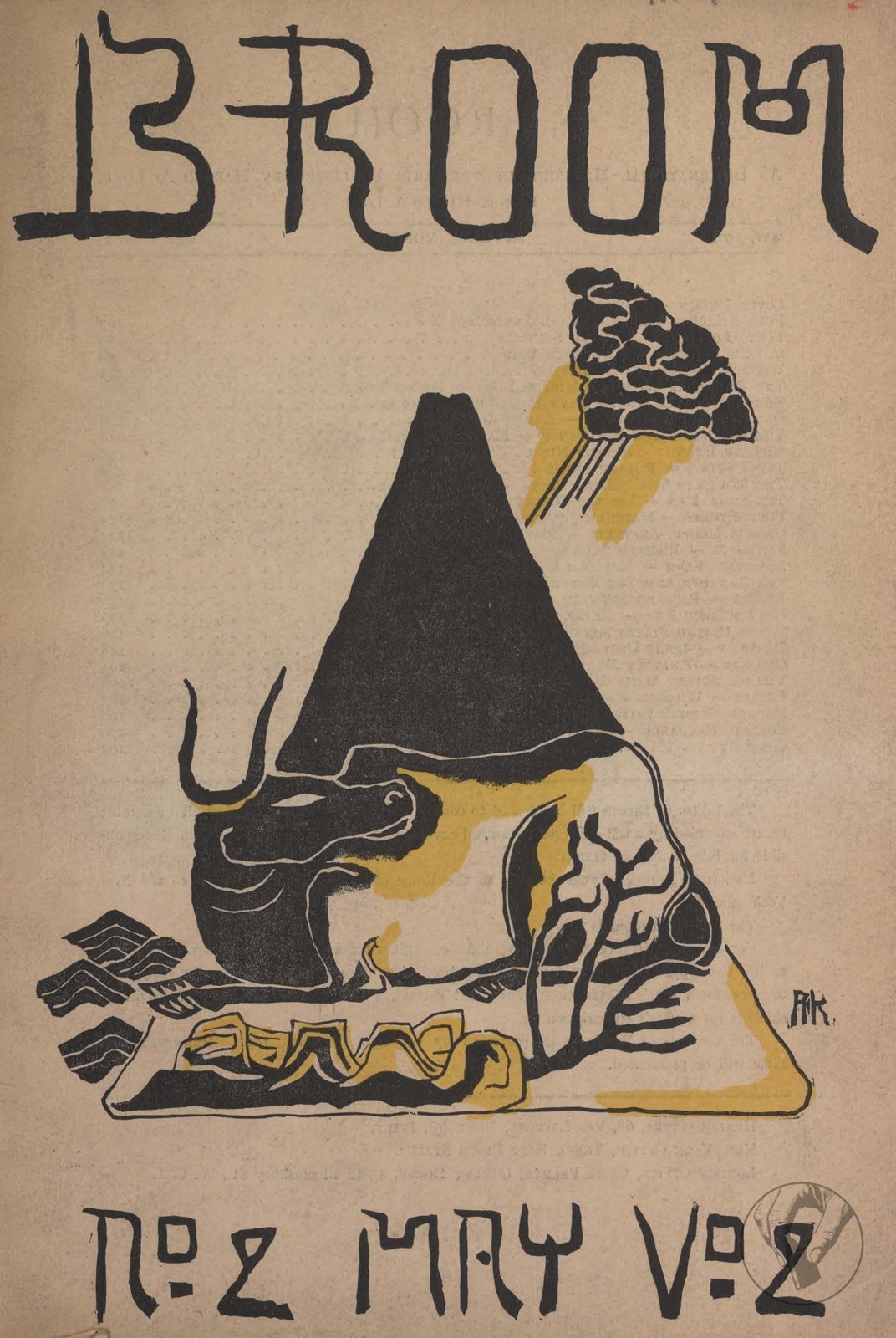
Broom is an international magazine of the arts published by Harold A. Loeb. This issue features contributions from various artists and writers, including KAWASHIMA, CARL SANDBURG, RAMON GOMEZ, ROBERT MUSIL, and E. E. CUMMINGS. The content includes art prints, literary works, and commentary on modern German literature.