Page 1
BROOK DECEMBER 1921
Premières pages de l'ouvrage, en accès libre.
BROOK DECEMBER 1921
BROOM AN INTERNATIONAL MAGAZINE OF THE ARTS PUBLISHED BY AMERICANS IN ITALY EDITORS, HAROLD A. LOEB, ALFRED KREYMBORG — ASSOCIATE EDITOR, GIUSEPPE PREZZOLINI. DECEMBER, 1921 VOL. II, No. 2. COVER DESIGN (WOODCUT) — E. PRAMPOLINI. --- Page --- PORTRAIT OF A GIRL — CONRAD AIKEN --- THE SWANS — JOSEPH STELLA --- THE HELPLESS ONES — FREDERICK BOOTH --- DESIGNS FOR AN IMAGINARY BALLET — HENRY BELLAMANN --- THE OLD PART OF VIAREGGIO — LORENZO VIANI --- ON PAINTING — JOSEPH STELLA --- TWO PAINTINGS — JOSEPH STELLA --- PROTEUS — PAUL CLAUDEL (TRANSLATED BY JOHN STRONG NEWBERRY) --- INTERIOR — HENRI MATISSE --- PARAGRAPHS CONCERNING THE PRINCESS VEHANA — HANIEL LONG --- TWO PAINTINGS — ROCKWELL KENT --- TWO POEMS — W. DE LA MARE --- THE CONTRACT — SHERWOOD ANDERSON --- NOTRE AMERIQUE — LEON BAZALGETTE (TRANSLATED BY H. A. L.) --- TWO POEMS — ALDO PALAZZESCHI (TRANSLATED BY A. K.) --- NUDE — LUCIANO FOLGORE (TRANSLATED BY A. K.) --- STILL LIFE — HENRI MATISSE --- HAZI, WIFE OF SENDER SURTUCK — KONRAD BERCOVICI --- THE BIRD WITH THE COPPERY, KEEN CLAWS — WALLACE STEVENS --- TWO POEMS — JEAN STARR UNTERMEYER --- ONE MOMENT ONLY — HAROLD MUNRO --- PELLEAS NIGHT — DONALD CORLEY --- SUNDAY MORNING — ADOLPH DEHN --- CHARCOAL DRAWING — WANDA GAG --- ANNE BARD — WALLACE GOULD --- BROOMIDES: COMMUNICATIONS FROM VACHEL LINDSAY, LEW SARETT, THOMAS PYM COPE --- The Editors of Broom will be pleased to consider mss. submitted to them, but all mss. must be accompanied by a self-addressed, stamped envelope. Mss. from Europe should be sent to the Rome office; mss. from America to the New York office. The price of Broom is: For America, fifty cents the copy, and five dollars for a year’s subscription. For Italy, 10 lire the copy, and 100 lire for a year’s subscription. For France, 6 francs the copy, and 60 francs for a year’s subscription. For Great Britain, 3/6 the copy, and one pound and fifteen shillings for a year’s subscription. The contents of this issue are protected by copyright, December 1921. Infringement of same will be prosecuted. HEADQUARTERS, 18, TRINITÀ DEI MONTI, ROME (6), ITALY. NEW YORK OFFICE, THREE EAST NINTH STREET. LONDON OFFICE, CECIL PALMER, OAKLEY HOUSE, 14–18 BLOOMSBURY ST. W. C. I
PORTRAIT OF A GIRL. This is the shape of the leaf, and this of the flower, And this the pale bole of the tree Which watches its bough in a pool of unwavering water In a land we never shall see. The thrush on the bough is silent, the dew falls softly, In the evening is hardly a sound... And the three beautiful pilgrims who come here together Touch lightly the dust of the ground, Touch it with feet that trouble the dust but as wings do, Come shyly together, are still, Like dancers, who wait, in a pause of the music, for music The exquisite silence to fill... This is the thought of the first, and this of the second, And this the grave thought of the third: 'Linger we thus for a moment, palely expectant, And silence will end, and the bird 'Sing the pure phrase, sweet phrase, clear phrase in the twilight To fill the blue bell of the world; And we, who on music so leaflike have drifted together, Leaflike apart shall be whirled 'Into what but the beauty of silence, silence forever?... ...This is the shape of the tree, And the flower and the leaf, and the three pale beautiful pilgrims; This is what you are to me. CONRAD AIKEN.
The Swans. JOSEPH STELLA.
THE HELPLESS ONES. Eddie Gordon sprawled face upward on the living room couch, asleep. His head was at the foot of the couch, hanging partly over the edge, and his shod feet lay nearly buried where the pillows and his overcoat were jumbled together. One arm hung over the side of the couch, and his hand, crumpled against the floor, lying limp in the shadow, resembled a castoff gray glove. He lay so still with his clothes all tumbled and his head turned and hanging back against one shoulder, one might have thought him dead. But he only slept. At six o’clock a lively step sounded in the hall. A key snapped in the lock. The door opened and Sally Gordon came in. She turned her head deliberately toward the couch as she closed the door. A sigh, rather tremulous but brief, whispered in the gloom. She went quickly to the table in the middle of the room, felt about for a match, and lighted the gas chandelier. Without looking again toward the couch she removed her overcoat and hat, went into the bathroom, turned high the gas and washed her face and hands, vigorously brushing the inkstains from her finger-tips. She turned from the bathroom into the bedroom, turned up the light there, and brushed her hair with soft, slow strokes. She touched her face rather indifferently with a powder puff, and stood then stroking her eyebrows with the tips of her fingers, looking long into the mirror. She gazed at her reflection and her face wore a look of pleasure. Once with her palm she smoothed back the hair from her forehead with a slow caressing stroke, as one would stroke back the hair from the forehead of a child. She regarded herself, steadily, with the unaffected and unconcealed tenderness with which she would have regarded a child. At last, reluctantly, she turned down the light and walked back into the living room. She stood by the couch and stared down at her husband. Her eyes had the peculiar intent look of a mother who watches her sleeping baby. Her eyes roamed the whole length of his body, looking at his untidy clothing, his uncombed hair, at his muddy boots that had muddied his overcoat and the pillows.
At last she slipped one arm under his shoulders and with a great effort pulled him up on the couch so that his head had a better resting place. She reached for a pillow and tucked it under his head. She picked up his limp hanging arm and laid it across his body, pulled his gaping coat together and buttoned the bottom button. She made quick sure movements, the movements of one who performs an accustomed human task. Having made him easier, less ungraceful in his inertness, she sat down on the edge of the couch and gazed intently into his face. Her eyes dwelt in turn on every one of his features and to every one she gave some sort of touch, his tousled hair a pat, his forehead a slow stroke, his closed eyes a touch of her finger-tips, and still in her face was that peculiar intent and anxious look, the look of a mother who dotes on her fragile treasure. Eddie Gordon slept, hardly breathing, not moving. His sleep was profound, sodden, the sleep of a hard and habitual drinker who gets drunk every night and sleeps until morning, drunk every morning and sleeps until night. His face had a greenish yellow colour about the forehead and eyes, was flushed at the cheeks and swollen at the mouth. Sally knew what ailed him. It was a daily event in her life, and she found herself reacting to it this time exactly as she had many times before, as she did every time she saw her husband lying so still and helpless, his heart barely beating, his breath barely stirring. Always when she saw him thus, so profoundly helpless, so utterly and mystically babelike, the feelings of a mother for awhile possessed her completely. It possessed her as one is possessed by a mood. It possessed her against her will, this common emotion that had not yet found expression in her life. She dreaded this slow welling up of morbid desire to fondle and nurse that helpless still baby, her husband. But it was not to be resisted, while it ran its course. In that desire, during its beginning and even during the moments of her surrender to it, was something that filled her with self-horror. She felt herself tricked and made worse than silly. She felt herself infected with moral decay. Always she had fought against it, as she had this time, with little devices, delays, as one in sleep fights the approach of a bad dream which comes on regardless. And always she surrendered, for awhile. Always, for awhile, something in her was glad to have this man even thus dependent, thus her own. So she sat, prinking her husband’s hair, straightening his disordered clothing, lost in this strange little orgy of motherliness. But after awhile a look of distaste ruffled a little her face. Little dimples puckered the middle of her forehead. The wide pupils of her eyes narrowed a little. She turned her face a little away, still looking, cocked her head a little sideways, bit her lip and drew her hands back, hesitating. The man’s mouth was sagging open, and impulsively, with a studious earnest air, like a child mo-
delling clay, she took his face in both her hands and firmly pressed his mouth shut, and for a moment held it so. But when she took her hands away his mouth again sagged open. He slept. She frowned and again put out her hands, but drew them back. She recoiled a little and turning her head swept his body from head to foot with one swift glance. She took his limp hand in hers, held it up to the light and looked at it narrowly. His hand was unclean all over and the nails were black. She flung it down hurriedly, and without getting up she turned her back to him, and bending over, her elbow on her knee, her mouth resting against her fist, stared at the floor a long while. The silence was absolute. Minutes passed. She arose and walked aimlessly about for awhile, tucking at her hair, rearranging the furniture. Once she glanced at her watch. She came and leaned back against the table, looking at her husband. Her hands arranged and rearranged a bunch of violets pinned between the buttoned lapels of her jacket. After awhile she called sharply, “Eddie! Eddie!” Silence. She bit her lip and shook her head slowly a long time, gripping the edge of the table and holding her body rigid. She lifted up her head and gazed at the ceiling. “Oh, God!” she whispered, as though she believed God might be in the room above. Her body sagged while she gazed at the ceiling. She sobbed without making a sound. Tears glinted in her eyes but did not roll down her cheeks. The man lay regardless. At last the woman smiled, a wry smile; looked at her watch; and turned toward her coat and hat. A step sounded in the hall, heavy and rather slow, coming toward her door. It stopped at her door, there was a wait, a firm rap. She opened the door at once. “You, Allen?” she exclaimed in an undertone. A tall man was looking in at her. He was rather angular and awkward. His eyes were deepset and gray, and his large, rather bony face had a sober look. “May I come in?” he said. She led the way into the room. He followed slowly, closing the door behind him. She looked at him with a question in her face. “I could not stay away any longer,” he said. “I never told you not to come,” she replied. He had not appeared to notice the man on the couch. Now, as if he had known all the time, he turned slowly and looked down at Eddie. After some moments he again faced her.
"The same as ever," he said. She shrugged her shoulders and a poor smile flickered on her lips. He looked at her steadily but not offensively, and she could not take her eyes from his face. The steady full breathing of this man could be heard in the room. He put out his great hand and stroked back the hair from her forehead, as she herself had done when she stood before the mirror in the bedroom. Her head was thrust a little back by the weight of his hand, but she continued to look up into his eyes. Her hands trembled on the edge of the table. "You've had enough," he said at last. "You're going away with me this evening. You are going now." The pupils of her eyes widened. Her face grew pale and her lips seemed brilliant by contrast. She put both of her hands against his shoulders. The quick gesture seemed to warn him not to come any nearer, yet the touch of her hands against his coat was almost like a caress. A sort of eagerness animated the face of the man, tempered by hesitancy and grave concern. The look of his face plainly said, "I want you, but I wouldn't hurt you." He held his head in an awkward fashion and moved his lips, searching for words. They gazed at each other without speaking. The man on the couch flung his head fretfully about, opened his eyes and blinked up at the light, turned his body a little more and raised himself on his elbow. His swollen lips made a grotesque attempt to draw themselves down, and failed; but the stare of his eyes was fixed, unwinking and terrible. He saw how her bare arm, the sleeve slipped back, gleamed like a bar of silver against the tall man's shoulder. He stared and then his face became dull. Quietly he laid himself down again. The tall man said at last, "Pack your suitcase and come away. I'm not asking you to... You know. You understand me, don't you, Sally? I love you. But that's not it, not entirely. I wouldn't try to break up your home, not if you had a home. I see you wearing yourself out here. This is breaking you, this business. You've said so yourself. Now it's time to cut it out, anyway for awhile. I saw that look in your eyes when I came in. Leave him a note. I'll take you anywhere you say. You can go to my mother's. Or you can go to a hotel. But you've got to have a rest, for awhile anyway. I saw that look in your eyes when I came in. Now you've got to give this business a let-up. Don't worry about him. Leave him a note and some money. Anyway I have always managed to look him up every day or so, I'll see to it that he gets along. You know that Eddie and I understand each other, Sally, I mean when he's sober. And I don't have to tell you, do I Sally, that I am honest about it with both of you, no matter how much I want you? You and Eddie and I,
we’ve always been friends and we always will be, no matter what happens. I’ll see him and I’ll talk to him straight out. It will be for the best all the way round, for him too. He’ll see the thing straight. He’s not so unreasonable, not when he’s sober. I know he will consent. I know it can be settled in the right way. Pack a suitcase and come away with me to-night.” His heavy manner, his blunt speech, his awkwardness, revealed the heaviness of his desire and his anxious earnestness. The woman had slowly drawn away from him. Now she leaned back against the table, one hand braced against the edge, the other hand smoothing down the lapel of her jacket. She held her head sideways and cast at the floor a troubled and pensive look, its pathos heightened by the whiteness of her face and supple neck. She thinned her lips and a frown puckered her forehead. “No,” she said slowly, in a small voice. “No, I couldn’t do that. You know I couldn’t, Allen. No. No.” The tall man looked at her with an expression of benign indecision and puzzlement. He turned his head toward the sprawled shape on the couch. He bit his lip. A deep flush mounted to his forehead and made the arteries in his temples swell. He stroked his chin, meditating. “Sally,” he said at last. The constraint in his voice made the woman look quickly up. “I’ll tell you, Sally, I haven’t talked to you about this thing the way I feel like talking. Now I’m going to talk the way I feel like talking. Maybe it’s brutal of me to do it, but I can’t help that. I have to say what I think. I’m that way and you know me well enough not to mind too much.” But he paused and studied her face, hesitating, half afraid. Then he said, “You loved me before you met Eddie, didn’t you Sally?” “Yes.” “I knew it.” His voice trembled a little, and he stopped for a moment because he did not want to show how pleased he was at her confession while he was still under the disadvantage of her resistance. His slow voice went on, “Yes, I used to feel almost sure of it. Even though it was presumptuous of me, I did think so. You were always straightforward. You were never ashamed of your feelings. But I couldn’t ask you to marry me, not then. You remember how things were with me — my kid sisters and all to be looked after. I had to wait.” “I understood,” said Sally in a low voice. “I knew you cared, and why you — didn’t say anything.” “But you married Eddie just the same! And it wasn’t because you didn’t care for me. I know why you married him. I’m going to tell you why you married him.”
“Don’t. You needn’t tell me. I know. I didn’t know then. I just felt something that was too strong for me. I didn’t know why I had to give in to it. I just had to. Now I know what it was. I know why I had to give in to it.” She paused, pressed the back of one hand against her mouth. She bent her head. Her hand trembled against her mouth and her shoulders trembled a little too. She took her hand away from her mouth and began to tug at one of the buttons of her coat. Her lips were white. She pressed her upper lip against her teeth to keep it from quivering. “I could have waited for you. I knew you would ask me some day. But there was one thing I couldn’t wait for. I was twenty-four, and natural. My whole feeling for life and people was full of a woman’s desires. I didn’t know it then but I know it now. I was strong, I could have waited if I had known it then. I know now that my whole feeling for Eddie was that I wanted to mother him. I had to mother somebody. But I didn’t know it was that, not then. I didn’t understand it at all. I used to be afraid and ashamed because I still loved you and here all the time Eddie and I were coming closer and closer together. I didn’t understand myself at all. Yes, I still loved you, but . . . I couldn’t have children then, it takes money to have children. Those days you were having your own struggles and I could barely make my living. I couldn’t even allow myself to think of having children.” She stopped, turned her head and looked at the sleeper on the couch. She knitted her brows and compressed her lips. The tall man moved his lips as if to speak; but she went on, “One night he came to see me. That was when he was on the The Sun, and he had made such a hit, you remember? He was drunk that night. He came to the house drunk. I used to wonder how he could get drunk — how he could — such a sweet boy. Now I know why. He got himself drunk so he could run away from responsibilities — so he would be helpless — so he could be a child, just as he is now. He was beautiful that night — drunk. He was beautiful partly because he was drunk. Can you understand that? Some men are that way. He was that way, then. His cheeks were flushed, his eyes sparkled, and his yellow hair stood up all over his head, glittering in the lamplight. He sat on the couch and drew up his knees so that his feet were on the couch too. He sat there and talked to me. He lisped when he talked. His head was unsteady on his shoulders, like a baby’s. He talked to me about his mother. You know she died when he was five. He had to grow up unfinished. He had become a man but he was still a child. He told me how beautiful his mother was and how he would have been different if she had lived. I was like her, he said. He sat there and talked to me just about as he would have talked to his mother, I suppose, if she had been there in my place. The
room was warm and after awhile he couldn't talk at all. But he was beautiful, as a child is beautiful. His yellow head fell over against me. I put my arms around him and pulled his head down and held him close to me. I didn't know what I was doing. Maybe I didn't want to know. "After that I couldn't resist him. I didn't try. I wouldn't let myself think about you. Eddie needed me. The whole thing with me was pity A woman must pity something! I told myself that Eddie needed me. I loved him for his weaknesses." The tall man slowly nodded his head. "I knew that was why you married him," he said. "I can see how a woman would do that." The woman went on, "After we were married I used to go out and hunt for him when he didn't come home. I still do sometimes. I hunt for him in the back rooms of saloons, at the bar, down at the Press Club. I go along the streets where I know he is likely to be. I lead him home by the hand. Yes, and he leans on me, and he babbles to me like a baby as we go along the streets, he says the same things over and over again the way a baby does. He comes with me through the streets like a child that was lost and is glad to be found again. And when I get him home I wash his face and feed him.* I put my arm around him and make him eat. I undress him and put him to bed. And he is glad of it. He is glad to be like a baby; then he can live that part of his life that was never finished. And I used to be glad too." "You used to be glad?" the tall man said. "That is hard to believe." "Yes, I think I must have been glad of his helplessness. Do you understand? His helplessness gave me an excuse to mother him. I had to mother somebody! The worst thing is, no good at all has come of our being married — no good to either of us. No, it has hurt us both." She turned her head, holding it a little sideways as she had when she sat on the couch by her husband, and looked at him again. There was something childlike in the expression of her face and in her pose. Her whole body expressed ingenuous bewilderment and trouble. She put her finger to her lips. The tall man, his hands at his side, studied her face. He said nothing. He waited for her to go on. She made a little gesture with her hand as if she were brushing something away. "See, now he has got to where he no longer wants even to be helped. Now he doesn't even want to be cared for." Her voice was tired and plaintive, the voice of a tired child. "To be a coddled baby doesn't satisfy him any more. He wants to be a sleeping baby. Sleep! Sleep! Only let him sleep! He gets drunk at night and sleeps till morning. He gets drunk in the morning and sleeps till
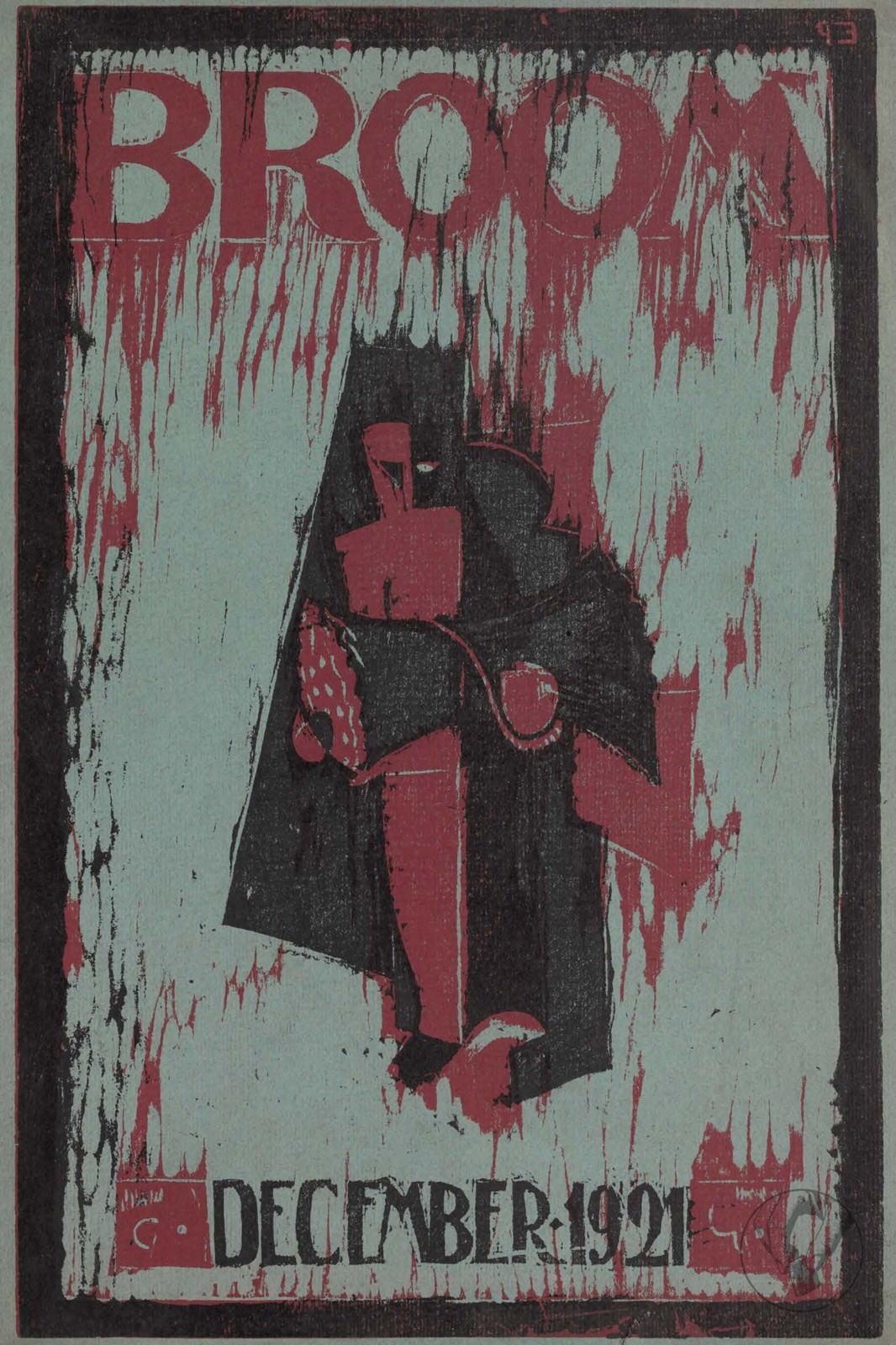
This issue of Broom, an international magazine of the arts published by Americans in Italy, features a diverse collection of literary and artistic works. It includes poetry by Conrad Aiken and W. de la Mare, short stories such as "The Helpless Ones" by Frederick Booth and "The Contract" by Sherwood Anderson, and essays on painting by Joseph Stella. The magazine also showcases visual art with contributions like Matisse's "Interior" and "Still Life," and a cover design by E. Prampolini. The editors express their methods for acquiring subscriptions and contributions, highlighting their international reach.