Page 1
BROOM GC FEBRUARY.1922
Premières pages de l'ouvrage, en accès libre.
BROOM GC FEBRUARY.1922
BROOM AN INTERNATIONAL MAGAZINE OF THE ARTS PUBLISHED BY AMERICANS IN ITALY EDITORS, HAROLD A. LOEB, ALFRED KREYMBORG — ASSOCIATE EDITOR, GIUSEPPE PREZZOLINI --- FEBRUARY, 1922 VOL. I, No. 4. --- Page --- SUBURBAN LANDSCAPE — P. SELVER --- CZECKO-SLOVAK PAINTING — JAN ZRZAVY --- A ROMAN NIGHT — PAUL MORAND (TRANS. BY H. A. L.) --- STILL LIFE — CARLO CARRÀ --- NEW YORK, A FAREWELL — EMMY VERONICA SANDERS. --- PRINCESS BRAMBILA DESIGNED BY JAKOULOFF --- A NOTE ON THE NEW RUSSIAN POETRY — LOUIS SOZOWICK. --- «L’ANNONCE FAITE À MARIE» COSTUMES — G. VESNIN --- A NOTE ON THE NEW RUSSIAN THEATRE — ELIE EHRENBOURG --- PROTEUS — PAUL CLAUDEL --- HELIOGRAPHS — BAYARD BOYESON --- ISHIJMA — PAUL ELDRIDGE. --- THE OFFERING OF PLEBS — JEAN DE BOSSCHÈRE --- YOU HAVE NOT SEEN THAT I AM THE POOR MAN — JEAN DE BOSSCHÈRE --- INSTITUTRICE ESTHÈTE — JEAN DE BOSSCHÈRE --- FOX TROT — OSBERT SITWELL --- CZECHO-SLOVACK PAINTING — JOSEPH ČAPEK --- CZECHO-SLOVACK PAINTING — JOSEPH ČAPEK --- THE COCKERELL — ALLARDYCE CROMARTIE --- DEDICATED TO THE ENEMY — GORDON CRAIG --- COMMENT — H. A. L. --- The Editors of Broom will be pleased to consider mss. submitted to them, but all mss. must be accompanied by a self-addressed, stamped envelope. The Editors cannot hold themselves responsible for loss of mss. in transit. Mss. from Europe should be sent to the Rome office; mss. from America to the New York office. The price of Broom is: For America, fifty cents the copy, and five dollars for a year’s subscription. For Italy, 10 lire the copy, and 100 lire for a year’s subscription. For France, 6 francs the copy, and 60 francs for a year’s subscription. For Great Britain, 3/6 the copy, and one pound and fifteen shillings for a year’s subscription. The contents of this issue are protected by copyright, January, 1922. Infringement of same will be prosecuted. --- HEADQUARTERS, 18, TRINITÀ DEI MONTI, ROME (6), ITALY. NEW YORK OFFICE, THREE EAST NINTH STREET. LONDON OFFICE, CECIL PALMER, OAKLEY HOUSE, 15-18 Bloomsbury St., W. C. I.
SUBURBAN LANDSCAPE. Pallid with heat, a taut metallic sky Is looped above the siding, drably scarred With rails that flank a sooty engine-yard, Ash-heaps and sheds and roofing all awry. Derelict mouse-grey trucks are mirrored by The sepia of a mute canal, where charred Gasometers squat sullenly on guard, And barges drowse and boilers faintly sigh. Tonight the arc-lamps, poised from slender stems, Will bloom like silvery fruits. Signals will gleam With shifting specks of jade and crimson gems. Then music: hiss and gasp of throttled steam, Staccato gamut of the shunted trains, And murmurous diapason of the cranes. P. SELVER.
JAN ZRZAVY. Czecho-Slovak Painting.
A ROMAN NIGHT. In the hotel garden, some cats were singing. A dog dispersed them with much barking; then came back hanging out his tongue, blue from having eaten blackberries or fountain pens. While we attacked our trunks, in chaotic disorder, the mother of Isabelle waited in the hall. She was a little woman, excessively preserved by milk of cucumbers and egotism; her wrinkles knotted behind her ears, her bosom sowed with a row of false pearls whose nautical originals she held in her hand in a little bag of crocodile skin. When she saw me she cried out: "I confide my daughter to you. Isabelle does not want to go back to France with me. She permits no constraint. She is like the air. Nothing matters to her. You, Monsieur, you are a scholar, a man of sense; watch over her. Where is she? She is here no longer. Gone God knows where, without a maid. She has carried off some bottles, a quilt, and a spade with which to kill lizards, saying that she hoped for nothing more from me and that my hypocrisy irritated her. This young lady drinks like a sink, and all liquors without distinction. Nothing which used to amuse us, the four step, Hungarian lace, the horse show, Venetian painting, interests her. Every thirty years the world sheds a skin and us with it. At your age, I tell her, I had five children. And she replies: 'That must have given you a pretty belly.' She is indifferent to clothes; she refuses to go out into society. My scruples and my prejudices enchant her. She endeavors to amuse herself with everything, but by ridicule. She knows nothing. No taste for art. That which she writes has no sense. Morally one would say that she has gone to pieces; she is everyone's prey; she congratulates herself on everything that happens or scoffs at it; she calls herself accursed but laughs about it. I shall miss my train. Truly a worm is in the fruit. Tell me what is this madness?" "It is a generation sacrificed, Madame; the men have become soldiers, the women, fools. Fate has again apportioned us a pretty lot of calamities." She stopped the motor which prevented our hearing one another. "Note that up to the age of fifteen there never was a better brought-up child," she said, entrusting me with the key of her room which she had omitted
to give back to the porter. (I myself forgot about this key until the heavy triangle of copper to which it was attached had made a hole in my pocket large enough for it to gain the street.) Graphological Study By Professor Ovide. Study No. 34. — ISABELLE. Handwriting of a young woman of refined and sufficiently mobile physiognomy. Strong constitution. Although she lives in luxury, it is doubtful whether she belongs by birth to an aristocratic milieu. Intelligence superficial; but quite adequate for pleasing; ideas personal without always being logical. Disposition difficult. More of a coquette than she would care to admit, she keeps to a fixed deportment and is antipathetic to that which is too licentious. More independent than proud; even to a fault in this regard. Expansive and amiable in society. Her sincerity is subservient to caution. Heart half dry, tender by fits. Need of authority and influence over persons loved. Sensuality, which exists, is not of a delicate character. Cunning on occasion. I reread this graphological study of Isabelle which I had asked Professor Ovide, of St. Mans-les-Fossés, to prepare on one of our first days. I used it to know her better, long enough to discover that the diagnosis was false. Experience left nothing of it but some half-humorous trifles in the lingo of mind-readers, at which she was the first to laugh. Isabelle had an impulsive temperament and a reserved character. I only had the leisure to find this out and to make her acquaintance in a general way after we had enjoyed together that pleasure which formerly was used to crown or to seal the affections. In truth, the night even of our first meeting, at the Teatro Valle, she told me that I looked like a sycamore, and we embraced each other in the carriage which brought us to her mother’s. The rules of the game were found to be much simplified. Passion lost thereby its graduated interest, but the sway of sentimental, magnetic and chemical exchanges ruled more freely and gained in verity; and we in lucidity. Isabelle confessed to me afterwards that she neglected no occasion to proffer this spontaneous gift of her person; she acted thus from an excess of modesty,
not hesitating to sacrifice her virtue; she rejoiced in it as an aid to her intelligence and to her sensitiveness. In reality her intelligence was mediocre and I doubt if her sensibility had ever corrupted this heart “half dry, tender by fits” that Professor Ovide had defined for me. At any rate here we found ourselves on the ground floor of a trusting intimacy which rarely is the privilege of people without prejudices. By a curious regression, which doubtless was the result of the manner in which we made each others’ acquaintance — so true is it that one cannot invert the natural order of things without danger — I was not slow in experiencing for Isabelle all the customary phases of sentiment, but in reverse order. In the beginning, indifference and fatigue followed by that tenderness which results from the pleasure of winning love, and ending in curiosity and play. We saw each other very often. Isabelle spent several long months in Rome, not that I was ever able to guess what held her in this unpicturesque and desolate town. When I asked her, jokingly, if she expected to end her days there: “Perhaps,” she said, “and before long.” Her pension looked out upon the old fortifications in the vicinity of the Porta Pia. My life looked out on a court from the second floor of the Palazzo Farnese, for I was a pupil of the Ecole de Rome. I kept there a card index, a ladder to reach the books on the highest shelves in the library, and a muddy inkwell. When six o’clock rang, I would take leave of my dear master in the corner room. He read low African authors seated in an armchair of emerald velvet, surrounded by Angoras and other cats the color of pumice stone, such as one finds around the Trajan Column. I have not forgotten his eyeglasses poised on his forehead like two great icicles, his white hair rebellious as the character underneath, nor his head like an old peasant Erasmus which stood out in silhouette against a milky Janiculus. Then I reached the court through several corridors ravaged by draughts. The concierge, the same who discreetly sold antiquities in the depths of his den and retailed the feet of the Farnese Hercules, inclined to me a smile hung from his silver stripes. On the shore of the Tiber, Isabelle waited for me. We returned on foot to the higher quarters. Her physique amazed in that country of women with long busts and short thighs. She had a minute head which she claimed was filled with water, to excuse her follies. She had never been capable of possessing a body. From her shoulders she instantaneously divided into two legs thin and pointed in the shape of a compass which moved her forward by pricking off the pavement. She wore on her left ankle a heavy slave bracelet of sculptured copper which made her limp.
Before a third party she quite willingly kept silent, but in tête-a-tête, let herself go saying everything she thought. She but little liked acquaintances, particularly those one meets in hotels and pensions, in which she was wrong — for anything is preferable to a friendship which endures and for the endurance of which one is obliged to espouse every form of a twofold hazard and become a hybrid monster, expensive, and greedy of sacrifices. When I warned her against asceticism: > “The true ascetics are the amateurs of society. My mother, for example. Vices and virtues. For them, the social world takes the place of everything.” Isabelle hated her mother, never missing an occasion of making her ridiculous and only praising her when she was absent. At table she seemed to lie in wait for a chance to pounce on her. She smiled, puckering her narrow eyes, as if to introduce her interlocutor to a complete idea and to invite a response; she ended her sentences by holding out her opened hands, the insides of which were painted a bright rose. Usually she was without wit, except, as with all women, in her letters. The fragments of her diary which she showed me seemed destitute of value. But she spit up blood, won money from me at poker by cheating, and had a lively taste for lies which contrasted with an extreme physical bravery. I have seen her, in the course of an accident, give first aid, forgetting to dress her own injuries. During thirty-six months of the war she drove a field ambulance at Noyon. In her room Isabelle ordered a drink, pausing over the glass, half empty; her eyes filled with tears, as if the draught had opened some mysterious and sensitive portal, then without lifting her face from the glass, she went on drinking. She seated herself tailor fashion on the carpet, crossing her legs underneath, not without dry arthritic crackings of her bony knees, and smoked without cessation with the air of a lazy cat. Thus she remained for hours, inactive, cynical and genital. In the spring, Isabelle made some acquaintances. She had lived alone all winter. > “What do you think of Igor?” I reproached him for his beauty, his venomous eyes, and for the clamour of the colored placards in which Igor, the great movie star, stood forth in a dress suit on desolate shores, or as a poor student in an upholstered vestibule, his irritating profile silhouetted against dormer windows, his sallow skin punctuated with stars, his hands pallid with cream beside those of teamsters telling fortunes in dives. > “He looks like a maple tree,” said Isabelle.
Igor is Greco-Irish. His father is a general in Greece and his mother the wife of a general in Ireland. The first time I met him at Isabelle’s, she weighed the two of us. “Life is a tissue of contrasts,” sighed she. This was the phase when Isabelle took to kidney-vetch, surrounded herself with prismatic crystals, breakfasted on ginger bread, acquired a Florentine cupboard bed; received each day a magnolia from an unknown hand, and gave strange orders to the servants; it was impossible for her to touch suède without fainting. She shut herself off from life by specious reasonings; she received me reclining on panther skins and her words became elliptical. One day she took me into her room. Above her bed were pinned an assortment of bills, letters, photographs of foot racers, and a placard on which I read: Do not forget to make love on Saturday with Igor. I felt I should not question her. But she looked at me: “Your eyes are dull,” she said. “The eyes of Igor are crystal. I don’t like resigned heroes.” “As for me I like women who make their own hats, and who speak of the deceptions of existence.” “As you like. But beware of falling of the womb.” She placed her glass on the disc of the phonograph and watched it turn to the sound of “Naples! I want to die, ’neath your enchanted sky.” “You . . .” “Don’t talk,” she interrupted. “I feel what you are going to say: ‘My God! that a woman who does not love me can be such a hussy.’ Or perhaps ‘Stick to me, you will see, I will bring you luck.’” Igor had a friend, Wanda. Isabelle introduced me to her: she was Polish and believed in ghosts. We made several nocturnal excursions to the site of Ostium. I sat on the bracket seat. Isabelle had Wanda on her right, Igor on her left, and held under her hands their similar fingers. Her sincerity disconcerted me. To keep from abuse, I joked: “I would rather be the first in my village than the second in Rome, or the third . . .” Under cover of my gracefulness and insolence I laid bare my lost and found sufferings. I would have wished to live near Isabelle and to love her as completely as when far away. But in the evening I found myself discovering in her that which I was obliged in the morning to detest, her imprudences and the promptitude and low character of her entertainments. Through Wanda, Isabelle learned to know the odor of red hair, the explanation of her afternoon melancholy, the best addresses for silk jerseys, unpublished
Levantine solitaire on a horoscopic base, and to kill bees in order to suck their honey. This was the regime of lemons, of shaddocks, of jujubes and of tri-colored bonbons. Isabelle painted lozenges and spirals on her trunks, searched far and wide for devices, sent anonymous letters to statesmen, bought mosaic brooches, wore chasubles, disturbed her quarter by nocturnal uproars, extolled poverty, and discovered she was afflicted by aortic lesion. During this period I was less unhappy. Isabelle summoned me to a meeting in the public gardens. On a bench she told me that she would commit suicide with gas, and that she did not wish to be carried into a drug-store. Laughable and pale, she repeated: “I am at a cross-roads . . .” To console her I cited these verses of the good La Fontaine of Ravignan street: Child Hercules found two roads on his route One leading to vice the other to virtue Continuing the first he would doubtless have found Some bifurcations which would have confused him. I met Wanda one morning.” It was on the Piazza S. Isidoro. In building a branch of the Banca Commerciale, they had excavated by chance a temple of Jupiter. The illustrated papers were taking photographs. It was an occasion for a promenade. It was raining. All mauve and green, Wanda was domiciled in an unsinkable waterproof. I upbraided her for her spirit of domination, her skillful fencing, her sweet and nasty habits, in a word, for the ambuscade into which Isabelle had fallen. “Don’t you know,” said she, “how I met Isabelle? My hair is red, but it is she who is jealous. She waited until morning in front of Igor’s door. It was I who came out. She spoke without knowing me.” “I want a word with you,” she said. “I led her away to my rooms. She remained there . . . We were more than a week without daring to confess to Igor.” Enclosed by a screen of reed cane, the sub-basements of the bank were visible among which a two-faced Jupiter had just been brought to life, frigid and dominating, the first vice-president. “My story doesn’t please you?” “It hurts me to see how all you women of today are disorderly and unproductive.” “Complain all you like . . . But believe me, all these vagrancies of Isabelle are only mortifying experiences destined to humiliate her pride.”
“You are but an amiable sophism,” I answered, and left her. Wanda called after me: “Do you really find that I look like a holly-oak tree?” Then Isabelle invented a mulatto. His name was Jock and his trousers hung from a nickel-plated belt. He inscribed on hardwood floors with the toe and heel of his polished shoes, magic characters which one wished to decipher. His nails like pink drops stopped at the ends of his fingers. Without apparent effort, either forward or backward, he could touch the ground with his woolly hair. He worshipped fetiches and adored ladies’ purses. One saw them together at the Palatino and at the Excelsior bar. Isabelle was about to sing his praises but I got in the first blow. “Don’t tell me that he looks like a wild rose tree.” In a little while she developed a taste for denatured alcohol, plug tobacco, clog dancing, the noisiest ragtime, vermilion tablecloths, gooseberry colored satin knickerbockers, a cloak made of patches placed end to end. “Jock loves me,” said Isabelle. “He has asked me for letters and photographs. His skin is crackled to imitate porcelain. He has prehensile feet and goes down trees like a cat, head foremost. He is enormous… How does Buffon put it in speaking of elephants, a monster of matter? He also knows how to forge signatures and pick locks. When he comes to see me he says: ‘I cannot leave you without carrying off something of yours.’” She added: “I love him also. We attracted each other at once like magnetized bars. His great black hand on my forehead, and headaches pass away; must I lose your esteem for this? And my mother claims I am unmanageable! A change of love works on me as a change of air on others. It performs miracles.” “What a queer couple! And never divided by boredom?” “Never. But all this is dangerous and complicated. I will explain it to you some day.” What was his hour at Isabelle’s? One never ran into him. But we received anonymous envelopes which contained monstrous photographs of our friend. Looking more closely, we noticed that the head had been cut out and glued on. I discovered in a pawnbroker’s on the Trastevere a bracelet that I had given her. Wanda told me. “Yesterday morning, I was in my room; I was dressing. Some one rang. Being alone, I did not open. “Who is there?”
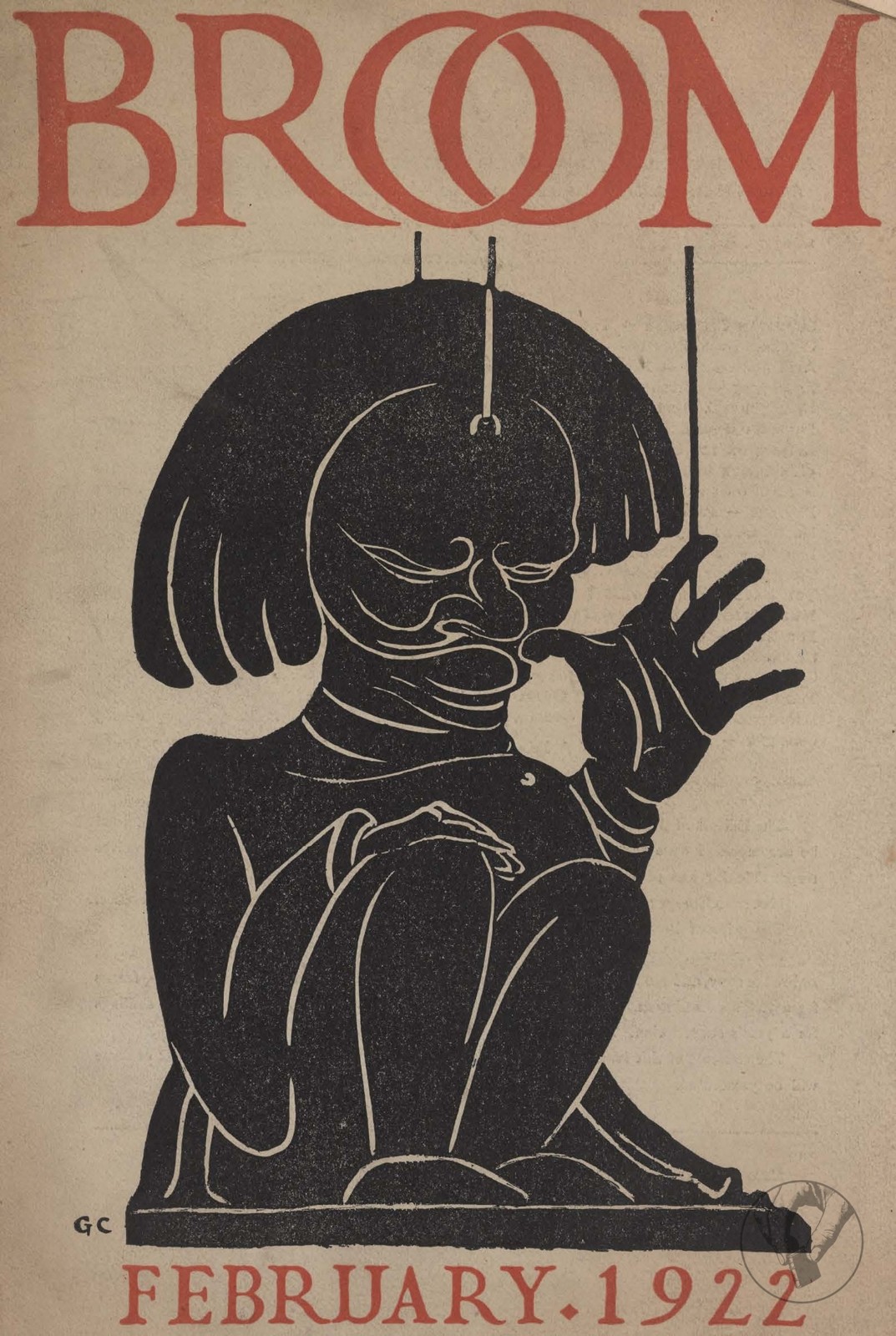
Broom is an international magazine of the arts published by Americans in Italy. This issue features contributions from various artists and writers, including works on Czecho-Slovak painting, poetry, and theatre, as well as literary pieces like "A Roman Night" and "Suburban Landscape." The magazine aims to introduce both unknown American talents and European innovators to a wider audience, with plans to explore material from Germany, Spain, Northern Europe, and newly created states in Central Europe.