Page 1
JUNE No 3
Premières pages de l'ouvrage, en accès libre.
JUNE No 3
BROOM AN INTERNATIONAL MAGAZINE OF THE ARTS PUBLISHED BY HAROLD A. LOEB. EDITOR, HAROLD A. LOEB. ASSOCIATE EDITOR, EDWARD STORER. AMERICAN EDITOR, LOLA RIDGE. JUNE, 1922 APPEARS MONTHLY VOL. 2, NO 3. COVER DESIGN — LADISLAW MEDGES. THE APOLLO OF VEII. HYMN FROM A WATERMELON PAVILION — WALLACE STEVENS ...
THE APOLLO OF VEII
HYMN FROM A WATERMELON PAVILION You dweller in the dark cabin, To whom the watermelon is always purple, Whose garden is wind and moon, Of the two dreams, night and day, What lover, what dreamer, would choose The one obscured by sleep? Here is the plantain by your door And the best cock of red feather That crew before the clocks. A feme may come, leaf-green, Whose coming may give revel Beyond revelries of sleep, Yes, and the blackbird spread its tail, So that the sun may speckle, While it creaks hail. You dweller in the dark cabin, Rise, since rising will not waken, And hail, cry hail, cry hail. WALLACE STEVENS
SIX CHARACTERS IN SEARCH OF AN AUTHOR A COMEDY IN THE MAKING ACT I. CHARACTERS OF THE COMEDY IN THE MAKING: THE FATHER — THE MOTHER — THE STEP-DAUGHTER — THE SON — THE BOY — THE CHILD — (The last two don't speak at all) — MADAME PACE. ACTORS OF THE COMPANY: THE MANAGER — LEADING LADY — LEADING MAN — SECOND LADY LEAD — L'INGÉNUE — JUVENILE LEAD — OTHER ACTORS and ACTRESSES — PROPERTY MAN — PROMPTER — MACHINIST — MANAGER'S SECRETARY — DOOR-KEEPER — SCENE-SHIFTERS. Daytime. The Stage of a Theatre. N. B. The Comedy is without acts or scenes. The performance is interrupted once, without the curtain being lowered, when the manager and the chief character withdraw to arrange the scenario. A second interruption of the action takes place when, by mistake, the stage hand let the curtain down. NOTE The spectators will find the curtain raised and the stage as it usually is during the day time. It will be half dark and empty so that from the beginning the public may have the impression of an impromptu performance. Prompter's box and a small table and chair for the manager. Two other small tables and several chairs scattered about as during rehearsals. The actors and actresses of the company enter from the back of the stage: first one, then another, then two together: nine or ten in all. They are about to rehearse a Pirandello play Mixing It Up. Some of the company move off to-
wards their dressing rooms. The prompter who has the « book » under his arm, is waiting for the Manager in order to begin the rehearsal. The actors and actresses, some standing, some sitting, chat and smoke. One perhaps reads a paper; another cons his part. Finally, the Manager enters and goes to the table prepared for him. His secretary brings him his mail, at which he glances. The prompter takes his seat, turns on a light, and opens the “ book ,.. THE MANAGER (throwing a letter down on the table). I can’t see (to Property Man). Let’s have a little light please. PROPERTY MAN. Yes, Sir, yes, at once (a light comes down on to the stage). THE MANAGER (clapping his hands). Come along! Come along! Second act of “ Mixing it Up ” (sits down). (The actors and actresses go from the front of the stage to the wings, all except the three who are to begin the rehearsal). THE PROMPTER (reading the Book). Leo Gala’s house. A curious room serving as dining-room and study. THE MANAGER (to Property Man). Fix up the old red room. PROPERTY MAN (noting it down). Red set. All right. THE PROMPTER (continuing to read from Book). Table already laid and writing desk with books and papers. Book-shelves. Exit rear to Leo’s Bedroom. Exit left to kitchen. Principal exit to right. THE MANAGER (energetically). Well, you understand. There is the principal exit. Here the kitchen. (Turning to actor who is to play the part of Socrates) You make your entrances and exits here. (To Property Man) The baize doors at the rear and curtains. PROPERTY MAN (noting it down). Right oh! PROMPTER (reading as before). When the curtain rises, Leo Gala, dressed in cook’s cap and apron is busy beating an egg in a cup. Philip, also dressed as a cook, is beating another egg. Guido Venanzi is seated and listens. LEADING MAN (to Manager). Excuse me, but must I absolutely wear a cook’s cap? THE MANAGER (annoyed). I imagine so. It says so there anyway (pointing to Book). LEADING MAN. But it’s ridiculous! THE MANAGER (jumping up in a rage). Ridiculous! ridiculous! Is it my fault if France won’t send us any more good comedies, and we are reduced to putting on Pirandello’s works, where nobody understands anything, and where the author plays the fool with us all? (The actors grin. The Manager goes to Leading Man and shouts).
Yes sir, you put on the cook’s cap and beat eggs. Do you suppose that with all this egg-beating business you are on an ordinary stage? Get that out of your head. You represent the shell of the eggs you are beating (Laughter and comments among the actors). Silence! and listen to my explanations please. (to Leading Man). The empty form of reason without the fullness of instinct, which is blind. You stand for reason, your wife is instinct. It’s a mixing up of the parts, according to which you who act your own part become the puppet of yourself.* Do you understand? LEADING MAN. I’m hanged if I do. THE MANAGER. Neither do I. But let’s get on with it. It’s sure to be a glorious failure anyway. (confidentially) But I say, please face three-quarters Otherwise, what with the abstruseness of the dialogue, and the public that won’t be able to hear you, the whole thing will go to hell. Come on! come on! PROMPTER. Pardon sir, may I get into my box? There’s a bit of a draught. THE MANAGER. Yes, yes. At this point, the door-keeper has entered from the stage door and advances towards the manager’s table, taking off his braided cap. During this manoeuvre, the Six Characters enter, and stop by the door at back of stage, so that when the door-keeper is about to announce their coming to the Manager, they are already on the stage. A tenuous light surrounds them, almost as if irradiated by them — the faint breath of their fantastic reality. This light will disappear when they come forward towards the actors. They preserve, however, something of the dream lightness in which they seem almost suspended, but this does not detract from the essential reality of their forms and expressions. He who is known as THE FATHER is a man of about 50: hair, thin at the temples, but not bald, hair reddish in colour, and with thick moustaches, falling over his still fresh mouth, which often opens in an empty and uncertain smile. He is fattish, pale; especially on his wide forehead. He has blue, oval-shaped eyes, very clear and piercing. Wears light trousers and a dark jacket. He is alternatively mellifluous and violent in his manner. THE MOTHER seems crushed and terrified as if by an intolerable weight of shame and abasement. She is dressed in modest black and wears a thick widow’s veil of crêpe. When she lifts this, she reveals a wax-like face. She always keeps her eyes down.ast. b1 THE STEP-DAUGHTER, eighteen, is dashing, almost impudent, beautiful. She wears mourning too, but with great elegance. She shows contempt for the timid half-frightened manner of the wretched
BOY (14 years old), also dressed in black. On the other hand, she displays a lively tenderness for her little sister. THE CHILD (about four) dressed in white, with a black silk sash at the waist. THE SON (22) tall, severe in his attitude of contempt for THE FATHER, supercilious and indifferent to the MOTHER. He looks as if he had come on the stage against his will. DOOR-KEEPER (cap in hand). Excuse me, sir. THE MANAGER (rudely). Eh? What is it? DOOR-KEEPER (timidly). These people are asking for you, sir. THE MANAGER (furious). I am rehearsing, and you know perfectly well no one's allowed to come in during rehearsals (turning to the Characters). Who are you please? What do you want? THE FATHER (coming forward a little, followed by the others who seem embarrassed). As a matter of fact... we have come here in search of an author... THE MANAGER (half angry, half amazed). An author? What author? THE FATHER. Any author, sir. THE MANAGER. But there's no author here. We are not rehearsing a new piece. THE STEP-DAUGHTER (vivaciously). So much the better, so much the better. We can be your new piece. AN ACTOR (coming forward from the others). Oh, do you hear that? THE FATHER (to Step-Daughter). Yes, but if the author isn't here (to Manager). Unless you would be willing... THE MANAGER. You are trying to be funny. THE FATHER. No, for Heaven's sake, what are you saying? We bring you a drama, sir. THE STEP-DAUGHTER. We may be your fortune. THE MANAGER. Will you oblige me by going away.? We haven't time to waste with mad people. THE FATHER (melli/luously). Oh Sir, you know well that life is full of infinite absurdities, which, strangely enough, do not even need to appear plausible since they are true. THE MANAGER. What the devil is he talking about? THE FATHER. I say that to reverse the ordinary process may well be considered a madness: that is to create credible situations, in order that they may appear true. But permit me to observe that if this be madness, it is the sole raison d'être of your profession gentlemen (The actors look hurt and perplexed).
THE MANAGER (getting up and looking at him). So our profession seems to you one worthy of madmen then? THE FATHER. Well, to make seem true that which isn't true without any need, for a joke as it were... Isn't that your mission gentlemen: to give life to fantastic characters on the stage? THE MANAGER (interpreting the rising anger of the Company). But I would beg you to believe, my dear Sir, that the profession of the comedian is a noble one. If to-day, as things go, the playwrights give us stupid comedies to play and puppets to represent instead of men, remember we are proud to have given life to immortal works here on these very boards (The actors, satisfied, applaud their Manager). THE FATHER (interrupting furiously). Exactly, perfectly, to living beings more alive than those who breathe and wear clothes. Beings less real perhaps, but truer. I agree with you entirely. (The actors look at one another in amazement). THE MANAGER. But what do you mean? Before you said... THE FATHER. No, excuse me, I meant it for you Sir, who were crying out that you had no time to lose with madmen, while no one better than yourself knows that nature uses the instrument of human fantasy in order to pursue her high creative purpose. THE MANAGER. Very well. But where does all this take us? THE FATHER. Nowhere. It is merely to show you that one is born to life in many forms, in many shapes, as tree, or as stone, as water, as butterfly, or as woman. So one may also be born a character in a play. THE MANAGER (with feigned comic dismay). So you and these other friends of yours have been born characters? THE FATHER. Exactly, and alive as you see (Manager and actors burst out laughing). THE FATHER (hurt). I am sorry you laugh, because we carry in us a drama, as you can guess from this woman here veiled in black. THE MANAGER (losing patience at last and almost indignant). Oh, chuck it! Get away please! Clear out of here! (to Property Man). For Heaven's sake turn them out! THE FATHER (resisting). No, no, look here, we... THE MANAGER (roaring). We come here to work you know. LEADING ACTOR. One cannot let oneself be made such a fool of. THE FATHER (determined, coming forward). I marvel at your incredulity, gentlemen. Are you not accustomed to see the characters created by an author spring to life in yourselves and face each other? Just because there
is no Book (pointing to the Prompter’s box) which contains us, you refuse to believe . . . THE STEP-DAUGHTER (advances towards Manager, smiling and coquettish). Believe me, we are really six most interesting characters sir; side-tracked however. THE FATHER. Yes, that is the word (to Manager all at once). In the sense, that is, that the author who created us alive no longer wished or was no longer able materially to put us into a work of art. And this was a real crime sir, because he who has had the luck to be born a character can laugh even at death. He cannot die. The man, the writer, the instrument of the creation will die, but his creation does not die. And to live for ever it does not need to have extraordinary gifts or to be able to work wonders. Who was Sancho Panza? Who was Don Abbondio? Yet they live eternally because — live germs as they were — they had the fortune to find a fecundating matrix, a fantasy which could raise and nourish them: make them live for ever.! THE MANAGER. That is quite all right. But what do you want here, all of you? THE FATHER. We want to live. THE MANAGER (ironically). For Eternity? THE FATHER. No, sir, only for a moment in you. AN ACTOR. Just listen to him. LEADING LADY. They want to live in us. JUVENILE LEAD (pointing to the Step-Daughter). I’ve no objection as far as that one is concerned. THE FATHER. Look here! look here! The comedy has to be made. (to the Manager) But if you and your actors are willing, we can soon concert it among ourselves. THE MANAGER (annoyed). But what do you want to concert? We don’t go in for concerts here. Here we play dramas and comedies! THE FATHER. Exactly. That is just why we have come to you. THE MANAGER. And where is the book? THE FATHER. It is in us (The actors laugh). The drama is in us, and we are the drama. We are impatient to play it. Our inner passion drives us on to this. THE STEP-DAUGHTER (disdainful, alluring, treacherous, full of impudence). My passion, Sir, ah, if you only knew! My passion for him! (points to the Father and makes a pretence of embracing him. Then she breaks out into a loud laugh). THE FATHER (angrily). Behave yourself! And please don’t laugh in that fashion.
THE STEP-DAUGHTER. With your permission, gentlemen, I who am a two months orphan, will show you how I can dance and sing. (Sings and then dances Prenez garde à Tchou-Thin-Tchou). Les chinois sont un peuple malin, De Shangaï à Pekin, Ils ont mis des écriteux partout: Prenez garde à Tchou-Thin-Tchou. ACTORS AND ACTRESSES. Bravo! Well done! Tip-top! THE MANAGER. Silence! This isn't a café concert you know (turning to the Father in consternation). Is she mad? THE FATHER. Mad? No, she's worse-than mad. THE STEP-DAUGHTER (to Manager). Worse! worse! Listen! Stage this drama for us at once! Then you will see that at a certain moment I when this little darling here (takes the Child by the hand and leads her to the Manager). Isn't she a dear? (Takes her up and kisses her). Darling! Darling! (puts her down again and adds feelingly). Well, when God suddenly takes this dear little child away from that poor mother there, and this imbecile here (seizing hold of the Boy roughly and pushing him forward) does the stupidest things, like the fool he is, you will see me run away. Yes, gentlemen, I shall be off. But the moment hasn't arrived yet. After what has taken place between him and me, (indicates the Father with a horrible wink), I can't remain any longer in this society to have to witness the anguish of this mother here for that fool... (indicates the Son). Look at him! Look at him! See how indifferent, how frigid he is because he is the legitimate son. He despises me, despises him (pointing to the Boy) despises this baby here because... we are bastards (goes to the Mother and embraces her). And he doesn't want to recognize her as his mother, she who is the common mother of us all. He looks down upon her as if she were only the mother of us three bastards. Wretch! (She says all this this very rapidly, excitedly. At the word "bastards", she raises her voice, and almost spits out the final "wretch!".) THE MOTHER (to the Manager, in anguish). In the name of these two little children, I beg you... (She grows faint and is about to fall). Oh God! THE FATHER (coming forward to support her as do some of the actors)! Quick a chair, a chair for this poor widow! THE ACTORS. Is it true? Has she really fainted? THE MANAGER. Quick, a chair here! (One of the actors brings a chair, the others proffer assistance. The Mother tries to prevent the Father from lifting the veil which covers her face). THE FATHER. Look at her! Look at her!
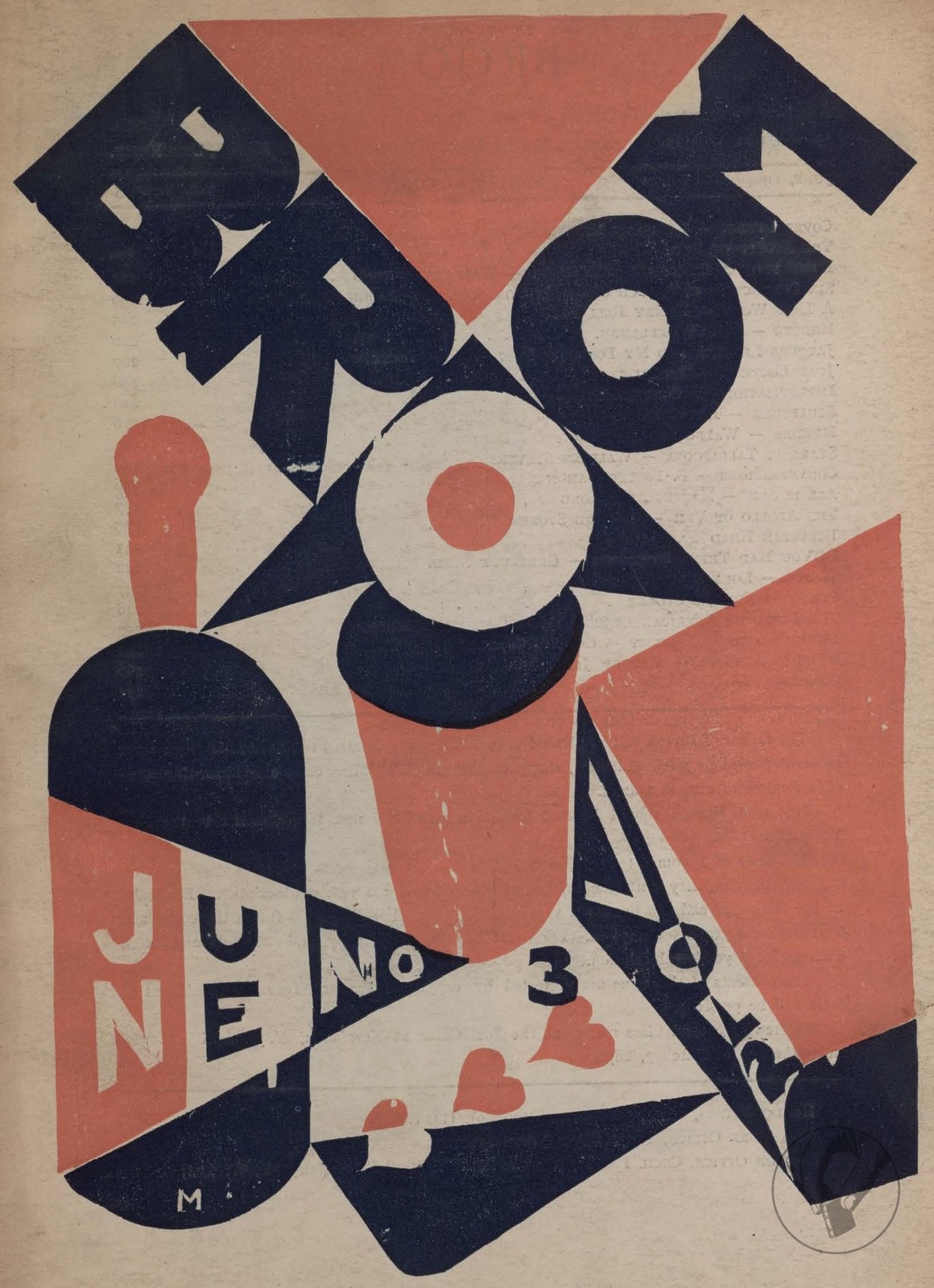
This issue of Broom, an international magazine of the arts, features "Hymn from a Watermelon Pavilion" by Wallace Stevens and the first act of Luigi Pirandello's play "Six Characters in Search of an Author." The magazine includes cover design by Ladislav Medgyes and advertisements for Venus Pencils, Max Schiling Florist, and the Daniel Gallery showcasing modern American and French artists.