Excerpt
First pages of the volume, freely accessible.
Page 1
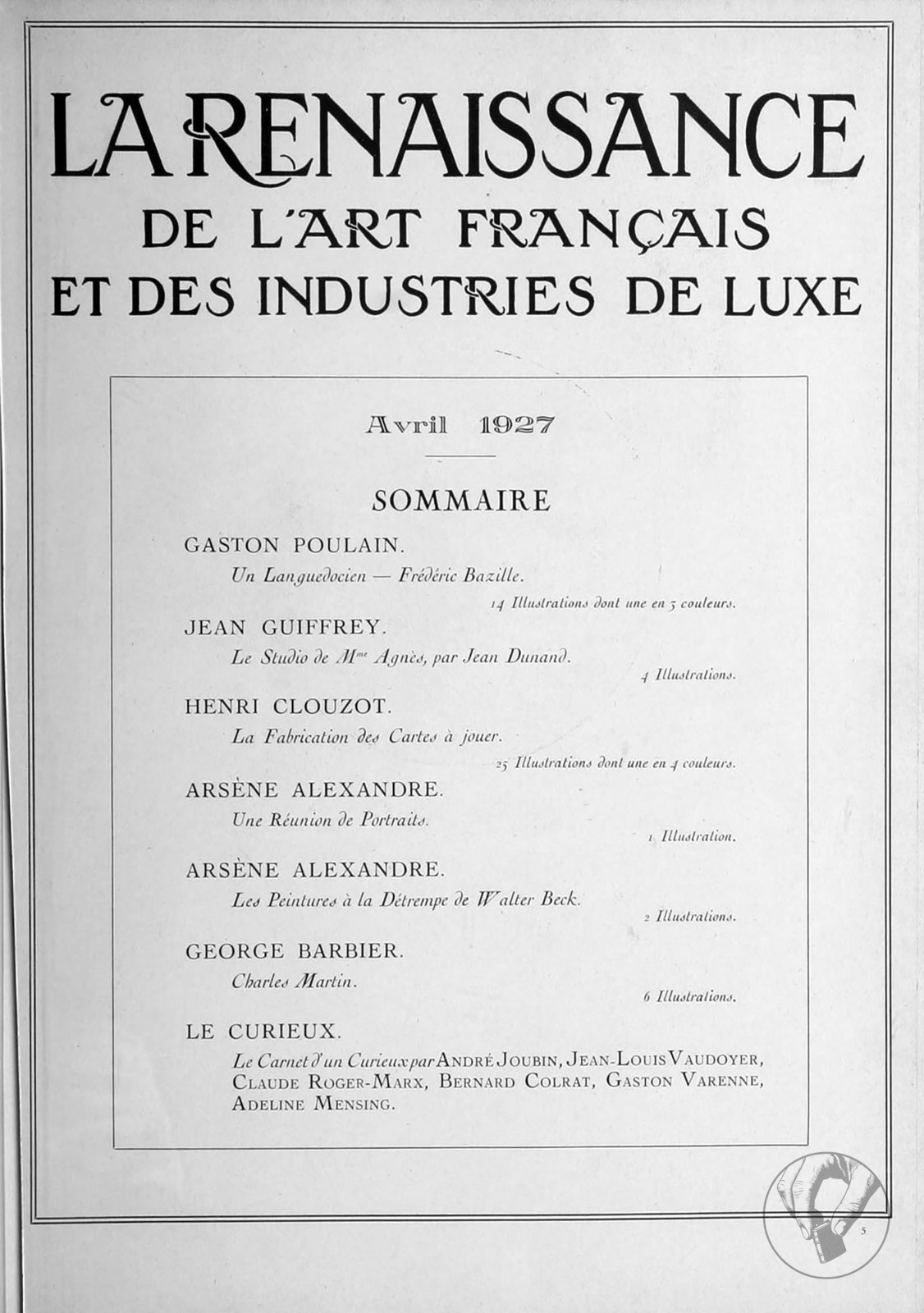
LA RENAISSANCE DE L'ART FRANÇAIS ET DES INDUSTRIES DE LUXE
Avril 1927
SOMMAIRE
GASTON POULAIN.
Un Languedocien — Frédéric Bazille.
14 Illustrations dont une en 5 couleurs.
JEAN GUIFFREY.
Le Studio de Mme Agnès, par Jean Dunand.
4 Illustrations.
HENRI CLOUZOT.
La Fabrication des Cartes à jouer.
25 Illustrations dont une en 4 couleurs.
ARSÈNE ALEXANDRE.
Une Réunion de Portraits.
1 Illustration.
ARSÈNE ALEXANDRE.
Les Peintures à la Détrempe de Walter Beck.
2 Illustrations.
GEORGE BARBIER.
Charles Martin.
6 Illustrations.
LE CURIEUX.
Le Carnet d'un Curieux par André Joubin, Jean-Louis Vaudoyer, Claude Roger-Marx, Bernard Colrat, Gaston Varenne, Adeleine Mensing.
Page 2
---
ΕΠΙΡΥΣΛΑΓΗΣ
---
ΠΕΙΔΟΛΗΜΑΝΙ
---
ΑΤΑΤΙΣ
SVE
---
Page 3
LES LAURIERS ROSES.
PHOTO LIBRAIRIE DE FRANCE
ROSE LAURELS
UN LANGUEDOCIEN
FRÉDÉRIC BAZILLE
En questionnant bien des compétences sur les peintres montpelliérains il nous sera loisible de remarquer une analogie savoureuse entre leurs réponses, et la notice non encore remaniée, publiée dès 1904, par le dictionnaire Larousse. Cinq noms : Fabre, Vien, Glaize, Bourdon, Alexandre Cabanel. Il semblerait donc, au premier abord, que nul enfant de Montpellier n’a tenu de place prépondérante dans l’évolution de l’Art Français, que tous, furent pompeusement honnêtes, incapables d’un geste rénovateur, alimentés, non point directement par la vie, mais par ces intermédiaires, les Musées.
Or, si de nombreux malheurs ont laissé jusqu’à présent incomplète, et à peu près méconnue, l’une des œuvres les plus hardies du xixe siècle, il n’en est pas moins vrai que Montpellier a donné le jour à un homme d’envergure extrêmement haute, précurseur magistral, Frédéric Bazille. Les quatre toiles de lui que possède le Musée du Luxembourg, les sept autres que conserve le Musée de sa ville natale, n’ayant jamais été l’objet d’études, étant restées pour la plupart inédites, l’on conçoit que la figure de Bazille ne s’attache guère qu’à celle de ses amis Claude Monet, Renoir, Fantin Latour, Manet, Sisley, Pissarro, l’auguste phalange, à la
If we discuss painting with authorities on Montpellier painters, we remark at once an amusing similarity between their answers and the article published in 1904 and not yet revised, in the Larousse dictionary. Five names : Fabre, Vien, Glaize, Bourdon, Alexandre Cabanel. Thus it would at first seem that no child of Montpellier has ever held an important place in the evolution of French Art, and that all were pompously honest, unable to start a life-giving movement, and sustained not directly from life, but through the medium of the Museums.
But, if numerous mishaps have hitherto left incomplete and almost unknown one of the boldest works of the xixth century, it is nevertheless true that Montpellier gave birth to a man who aimed exceedingly high and who was a masterly forerunner, Frédéric Bazille. As the four pictures by him owned by the Luxembourg museum, and the seven others preserved by the museum of his home town, have never been the subject of a study, most of them never having been published, it is conceivable that the figure of Bazille is confused with that of his friends, Claude Monet, Renoir, Fantin Latour, Manet, Sisley, Pissarro, this august band having in different circumstances, in the eyes of the public,
Page 4
162 LA RENAISSANCE DE L'ART FRANÇAIS ET DES INDUSTRIES DE LUXE
suite de diverses circonstances, ayant, aux yeux du public, absorbé presque complètement sa valeur personnelle.
L’heure est enfin venue de donner du rôle de Frédéric Bazille une définition exacte.
L’une des rares personnes qui lui survivent se souvient de l’avoir vu, au lycée de Montpellier, jeune garçon très beau, sensible, et d’une incroyable paresse. Pendant plusieurs années, le fils de Gaston Bazille, sénateur de l’Hérault, sera un collégien indolent et rêveur, la mémoire légère de formules algébriques, mais toute chamarrée des papillons dont il faisait collection et après lesquels il courait, radieux à cause du soleil, dans les garrigues languedociennes effrangées de lavande. En 1859, né le 6 décembre 1841, Frédéric Bazille passait son baccalauréat ès sciences. Quelques mois après, il entrait à la Faculté de Médecine. Il aurait voulu s’adonner à la peinture, mais ses parents ne toléraient ceci que comme un passe-temps : il fit donc de l’amateurisme sous la direction du modèleur Baussan. Mécontent, il travaillait peu. Lentement, l’idée d’aller à Paris s’imposait à l’étudiant comme un acte indispensable ; sentait-il que, là-bas seulement, il trouverait l’atmosphère nécessaire à la croissance de son talent ? Nous le supposons, si nous n’en avons point de preuve certaine. La Faculté de Médecine de Montpellier a toujours été une des premières du monde, Frédéric était heureux chez lui, pourquoi donc alors cette sorte d’exil, sinon le fait d’une volonté tendue vers l’art, que nulle affection n’entravera dans sa marche ?
Le 2 novembre 1862, il arrivait à Paris. Timide, il aurait passé inaperçu lors de son entrée à l’atelier Gleyre, si sa taille gigantesque ne lui avait attiré bien des quolibets : malgré son excellent caractère, il se sentait dépaysé dans ce milieu, si différent du sien, car les moqueries ajoutaient une amertume au désenparement qui le saisissait devant la solitude, inconnue jusqu’alors. Cette bohème, dont certains groupes étaient fréquentés par Mürger, effarouchait ce cœur délicat, si semblable à celui de Félicien du « Rêve », que nous sommes persuadés de l’authenticité de la légende qui attribue au héros d’Émile Zola la personnalité même de Frédéric Bazille.
S’il retrouva à la Faculté quelques relations de collège, Bazille ne découvrit pas, à l’atelier, la moindre sympathie. Il s’ensuivit que, séparé de ceux qu’il aimait, son tempérament et sa religion lui faisant mépriser les distractions sentimentales de Paris, une nostalgie lui vint, dont rien ne le distrayait Alors les évocations de son passé s’imposèrent à lui : il revit, d’autant plus nettement qu’il se trouvait plus isolé, son foyer, sa terre natale ; ainsi la lumière méridionale, qui sertissait ses souvenirs, se présentait continuellement à son esprit, et s’établissait en lui, éblouissante, écartant à jamais de sa vision l’influence des vues almost completely absorbed his personal value. The hour has come to give an exact definition of the part played by Frédéric Bazille.
One of the rare persons who have out-lived him remembers seeing him, at the public school of Montpellier, a very handsome boy, sensitive, and unbelievably lazy. For several years, the son of Gaston Bazille, senator for the Hérault department, remained an indolent and dreamy scholar, his memory free of algebraical formulas but bedizened with the butterflies which he collected and which he chased, joyous in the sunshine, across the Languedocian meadows, befriended with lavender. Born December 6, 1841, in 1859, Frederic Bazille obtained his degree of Baccalauréat ès sciences. A few months later, he entered the College of Medicine. He wished to devote himself to painting, but his parents only tolerated this as a hobby. He studied as an amateur under the guidance of the modeller Baussan but discontented, he worked little. Slowly, the idea of going to Paris forced itself on the student as indispensable ; did he feel that only there would he find the atmosphere proper to the growth of his talent? We suppose so, although we have no certain proof. The College of Medicine of Montpellier has always been one of the world’s best, Frédéric was happy at home, why then this sort of exile unless it proceeded from a mind which reaching out towards Art, would allow no sentiment to hinder its progress?
The second november 1862, he arrived in Paris. Timid, he would have passed unnoticed on entering the Gleyre studio, if his gigantic stature had not been the subject for many jokes : despite his excellent character, he felt stranded in this sphere so different from his own, for the jeers added bitterness to the lost feeling which gripped him in face of this loneliness, hitherto unknown. This Bohemian society, certain groups of which were frequented by Murger, terrified this delicate soul, so much like that of Félicien in the Rêve, that we are convinced of the authenticity of the story which attributes to Zola’s hero the very personality of Frédéric Bazille.
While he refound at the College some school friends, Bazille did not find the least sympathy at the studio. Consequently, separated from his loved ones, his temperament and his religion making him scorn the sentimental distractions of Paris, there was nothing to divert the home-sickness which came over him. Then he obliged himself to evoke his past life : he resaw, all the clearer for his isolation, his home, his birth place ; thus the Southern atmosphere which enwrapped his memories was continually present in his mind, and established itself in him, blinding him and driving forever from his sight the influence of the grey and foggy views of Paris. He hid his melancholy from his parents, out of shame and goodness of heart. His regrets are but half-
Page 5
LA RENAISSANCE DE L'ART FRANÇAIS ET DES INDUSTRIES DE LUXE
163
LA TOILETTE.
brumeuses et grises de Paris. Il cachait à ses parents, par pudeur et bonté, sa mélancolie. Ses regrets sont à peine formulés, sa sensibilité ne va pas jusqu'au mélodrame et il ne s'exprime clairement qu'une seule fois : J'ai un peu le mal du pays, j'ai bien envie de vous voir ainsi que mes amis et la campagne, j'ai une indigestion de murailles et de rues. Ces murailles et ces rues produisirent une réaction chez Frédéric Bazille, un amour inconcevable de tout ce qui manquait à la capitale, amour qui, grandissant parallèlement à ses qualités de dessin et à l'intérêt suscité en lui par un mouvement d'art naissant et encore mal défini, allait aboutir normalement à ses premières tentatives de peinture en plein air.
formed, his sensibility never becomes melodramatic, and only once does he express himself clearly I am a little home-sick, I so much want to see you and my friends and the countryside, I am surfeited with brick walls and streets. These brick walls and these streets produced a reaction in Frédéric Bazille, an inconceivable love of all that was missing in the capital, a love which growing side by side with his skill in drawing and with the interest which a budding and still un-shaped art movement aroused in him, was going to end normally in his first attempts at painting in the open air.
The months passed, almost monotonous, he had daubed his first canvas in oils, a copy of Rubens, and wor-
Page 6
LA RENAISSANCE DE L'ART FRANÇAIS ET DES INDUSTRIES DE LUXE
Les mois passaient, presques monotones, il avait barbouillé à l’huile sa première toile, une copie de Rubens et travaillait de plus en plus ; cependant, ayant à préparer des examens de médecine, il se plaignait de ne pouvoir dessiner selon ses désirs. Il attendait impatiemment le retour de l’été pour peindre des figures au soleil.
Il ne faisait à l’atelier que des connaissances, jusqu’au jour où il parlera, en 1863, d’un jeune homme du Havre nommé Monet.Un autre.perdu de vue, et Monet devenaient bientôt les seuls élèves de mon atelier que je fréquente assidûment, ils m’aiment beaucoup et je le leur rends.
Cette année 1863 marqua des progrès dans son œuvre, grâce au voyage qu’il fit à Chailly, avec Claude Monet. Dans la forêt de Fontainebleau, les deux artistes travaillèrent côte à côte, joyeusement, Claude,l’aîné qui est assez fort en paysage donnant à Frédéric d’utiles conseils. A partir de ce moment Bazille,s’attachait à son art de façon éperdue : Vous serez peut-être étonnés, écrit-il, de me voir bien moins paresseux que par le passé, et il lui tardait d’être délivré de ses examens pour s’adonner exclusivement à la peinture.Plus de vingt fois, il visita le Salon et contempla des heures entières l’Exposition Delacroix, qui lui fit écrire : Vous ne sauriez croire combien j’apprends à regarder ces tableaux.Une de ces séances vaut un mois de travail.Assidu à l’atelier, il devenait plus sérieux, plus intransigeant pour lui-même à l’exemple de ses intimes.Quant à ses examens de médecine, il les préparait, fournissant le labeur nécessaire sans aucune ardeur.Il aurait voulu quitter l’atelier Gleyre où le métier qu’on lui enseignait pouvait s’apprendre partout,mais l’inquiétude de son père à ce sujet retardait sa décision ; une discussion de Gleyre et de Monet brusqua les événements : Monet partit en trainant Bazille, Renoir et Sisley.
Ce pas vers la liberté rapprocha Frédéric Bazille de son grand rêve de toujours : être peintre et rien que peintre ; sa volonté s’affermissait, désagrégeait la résistance paternelle.En juillet 1864, Claude Monet appela son ami à Honfleur : Ici, mon cher, c’est adorable, et tous les jours, je découvre toujours des choses plus belles.C’est à en devenir fou tellement j’ai envie de tout faire... je suis assez content de mon séjour ici quoique mes études soient bien loin de ce que je voudrais ; c’est décidément affreusement difficile de faire une chose complète sous tous les rapports et je crois qu’il n’y a guère que des yeux qui se contentent d’à peu près.Eh bien, mon cher, je veux lutter, gratter,recommencer, car on peut faire ce que l’on voit et ce que l’on comprend... tout cela prouve qu’il ne faut penser qu’à cela,c’est à force d’observation, de réflexion que l’on trouve, ainsi piochons et piochons continuellement... Surtout, venez nous voir, je vous attends.
Frédéric rejoignit Claude et l’enchantement le gagna ; cependant,il souffrait d’être encore prisonnier de la méde- ked more and more ; however, with his examinations in medicine to prepare he complained that he was unable to draw as he wished. He awaited with impatience the return of summer in order to paint subjects in the sunshine.
At the studio he had only a few acquaintances until the day in 1863, when he speaks of a young man from Havre named Monet. Another, lost sight of, and Monet,soon becamethe only pupils of my studio with whom I am constantly, they are very fond of me and I of them.
This year 1863 marked a progress in his work, thanks to the journey he made to Chailly, with Claude Monet. In Fontainebleau forest, the two artists worked side by side, joyfully, Claude, the elder « who is fairly good at landscapes » giving useful advice to Frédéric. From this moment Bazille gave himself soul and body to his art « You will perhaps be amazed » he writes «to see that I am much less lazy than in the past » and he was impatient to be through with his examinations to be able to devote himself exclusively to painting. « More than twenty times ». he visited the Salon and looked for hours at the Delacroix Exhibition which made him write : You cannot believe how much I am learning to look at these pictures. One of these sittings is worth a month’s work. Regular at the studio, he became more serious, harder on himself after the example of his intimate friends. As to his examinations in medicine, he prepared them, supplying the necessary work without any fervency. He would have liked to leave the Gleyre studio where the profession that he was taught could be learned anywhere, but the uneasiness of his father on this subject delayed his decision ; a discussion between Gleyre and Monet hastened the event : Monet left, dragging after him Bazille, Renoir and Sisley.
This step towards liberty brought Frédéric Bazille nearer his eternal dream : to be a painter and nothing but a painter ; his will power grew stronger and broke down the paternal resistance. In July 1864, Claude Monet called his friend to Honfleur : Here, dear friend, it is delightful, and every day I discover more beautiful things. It is enough to drive one mad so much do I want to do everything... I am fairly pleased with my stay here although my studies are far from being what I desire ; decidedly it is terribly difficult to do something complete in every respect and I think that only the eyes can be almost satisfied. Well, dear friend, I want to struggle, scratch out, begin again, for one is able to do that which one sees and understands... all that proves that one must not only think of that, it is by observation and reflection that one makes discoveries, so let us slog at it and keep on slogging... Above all, come and see us, I am waiting for you.
Frédéric rejoined Claude and the enchantment gripped him ; however he suffered at being still prisoner of his
Page 7
CL. LIBRAIRE DE FRANCE
L'AMBULANCE IMPROVISÉE — PORTRAIT DE CLAUDE MONET.
THE IMPROVISED HOSPITAL.
Page 8
166 LA RENAISSANCE DE L'ART FRANÇAIS ET DES INDUSTRIES DE LUXE
cine et il écrivait à ses parents : Dès notre arrivée à Honfleur, nous avons cherché nos motifs de paysages, ils ont été faciles à trouver car ce pays est le paradis ; on ne peut voir de plus grasses prairies avec de plus beaux arbres... La mer ou plutôt la Seine élargie, donne un horizon délicieux à ces flots de verdure... je me lève tous les matins à cinq heures, et je peins toute la journée, jusqu'à huit heures du soir. Il ne faut pourtant pas vous attendre à ce que je rapporte de bons paysages, je fais des progrès... c'est tout ce que je demande. J'espère être content de moi dans trois ou quatre ans de peinture. Il va falloir rentrer à Paris et me mettre à cette affreuse médecine que je déteste de plus en plus... si je suis reçu, j'aurais l'agrément de me trouver en face d'un examen pour lequel il me faudra au moins six mois d'hôpital, c'est-à-dire six mois de dégoût, si ce n'est autre chose...
Comme il le prévoyait, il échoua, en fut sincèrement ennuyé à cause de son père qui, comprenant la force de sa vocation, s'inclina bientôt devant la ferveur de ses voeux et autorisa son départ de la Faculté.
Les années pendant lesquelles Frédéric Bazille séjournait dans les amphithéâtres, les hôpitaux, si elles lui furent désagréables, eurent du moins l'avantage de le familiariser avec l'anatomie et ainsi de l'obliger à raisonner sur la construction de ses figures, puis, par suite, sur l'architecture de ses paysages ; disséquant des corps humains il les analysait, il lui devenait impossible de ne pas discerner l'organisation sublime de tout être vivant.
Et ceci explique, avec son hérité protestante, la sévérité de son style, tandis que son écœurement des maladies, des plaies, des cadavres journallement approchés l'amenaît à la peinture saine, une toile exceptée, son premier chef-d'œuvre « l'ambulance improvisée ». Mais là, Frédéric Bazille a prouvé seulement quelle était sa bonté : Claude Monet ayant eu, à Chailly, en 1865, un accident, Bazille, se remémorant son stage à l'Hôpital de la Charité, surmonta sa répugnance, soigna fraternellement son ami blessé, peignant dans sa chambre pour lui tenir compagnie, le prenant pour modèle afin de le faire tenir tranquille, et forçant, par ce stratagème charmant, l'exubérance de Claude à se résigner à l'immobilité, facteur principal de guérison.
Enfin, délivré de ses préoccupations scolaires, prenant de plus en plus goût à mes travaux de l'atelier qui feront, sinon l'honneur, du moins le bonheur de ma vie il commençait par une « femme nue couchée » (Musée de Montpellier) la série des toiles qui lui donneront des droits à la gloire.
L'année 1865 eut pour Frédéric Bazille nombre d'instants inoubliables ; il occupait, 6, rue Furstemberg un atelier et un appartement, loués en commun avec Monet, auprès duquel il travaillait la journée entière. Sortant souvent ensemble, Claude fut amené par Frédéric dans le salon du Commandant Lejosne où ils furent medical studies and he wrote to his parents : On our arrival at Honfleur, we have looked for landscape subjects, they have been easy to find for this country is a paradise ; nowhere could one see richer meadows with more beautiful trees... The sea or rather the widened Seine makes a delicious horizon to these waves of greenness... I get up every morning at five and I paint all day until eight in the evening. Nevertheless you must not expect me to bring back any good landscapes, I am making headway... that is all I ask. I hope to be satisfied with myself after three or four years of painting. I shall soon have to go back to Paris to get on with that horrible medicine which I detest more and more... If I pass, I shall have the pleasure of facing an examination for which at least six months hospital will be necessary, that is to say six months of disgust, not to say more...
As he foresaw, he failed, was sincerely upset because of his father who, grasping the strength of his vocation, soon gave way before the ardour of his wishes and allowed him to leave the College.
The years during which Frédéric Bazille passed through the amphitheatres, the hospitals, if they were disagreeable for him, had at least the advantage of making him familiar with anatomy and thus forced him to examine the construction of his figures, and consequently, the architecture of his landscapes : dissecting human bodies he analysed them, it became impossible for him to overlook the sublime organisation of every living body.
And this explains, with his Protestant heredity, the severity of his style, while his disgust of diseases, of sores, of corpses seen daily, led him to healthy painting, one canvas excepted, his first master-piece « The improvised hospital ». But there, Frédéric Bazille only proved his goodness of heart : Claude Monet, having had an accident at Chailly in 1865, Bazille, recalling his stay at the Hopital de la Charité, overcame his dislike, cared for his wounded friend like a brother, painting in his bedroom to keep him company, using him as model in order to keep him still, and obliging the exuberant Claude by this charming stratagem to resign himself to remaining immobile, the principal factor in the cure.
At last, delivered from his scholarly preoccupations, getting more and more the taste for my work at the studio which will make if not the honour at least the happiness of my life he began by a « woman lying down — nude » (Montpellier Museum) the series of canvases which were to give him a claim to glory.
The year 1865 held for Frédéric Bazille a number of unforgettable moments ; he occupied, at N° 6, rue Furstemberg, a studio and an apartment rented in common with Monet, near whom he worked the whole day. Often going out together, Claude was taken by Frédéric to the house of Commandant Lejosne where they were
Page 9
FRÉDÉRIC BAZILLE — LA RÉUNION DE FAMILLE
MUSÉE DU LUXEMBOURG
Page 10
LA RENAISSANCE DE L'ART FRANÇAIS ET DES INDUSTRIES DE LUXE
présentés à Édouard Manet. Cette joie fut suivie pour les deux amis d'une autre, non moins vive : l'accueil de Gustave Courbet. Très simplement, le maître d'Ornans et le Dieu d'Olympia admirent Claude et Frédéric dans leur intimité, et se prirent pour eux d'une affection loyale, émouvante, immuable. Manet sera même le premier à rendre hommage à la mémoire du pauvre méconnu, en faisant figurer, dans ce but, à une exposition le portrait de Bazille par Renoir qu'il gardait alors jalousement.
Claude Monet songeait à peindre une œuvre exceptionnelle, à imposer par un argument puissant la compréhension du plein air ; dans cette intention il partit à Chailly ; Bazille toujours dévoué, lui avait promis d'aller lui servir de modèle, sa présence devait aussi guider Claude, le soutenir lors de son gigantesque effort. J'ai bien envie que vous soyez-là, je voudrais avoir votre avis sur le choix de mon paysage pour mes figures. J'ai quelquefois peur de me mettre dedans. Pour deux personnages, Frédéric posa et Claude créa « le déjeuner sur l'herbe ». Lorsque Monet n'avait pas besoin de lui, Bazille peignait ; il rapporta, outre L'ambulance improvisée, le Paysage à Chailly (Luxembourg) et d'autres études, aujourd'hui égarées, qui firent l'admiration de Renoir. Son dessin s'affermissait, ses volumes s'équilibraient et surtout ses couleurs s'éclaircissaient de jour en jour. La jeune fille assise dans un parc (Luxembourg) dont la joue et le bras ont été retouchés par un photographe maladroit, fait déjà pressentir La réunion de famille et La vue de village.
Chaque été, Bazille retournerait à Montpellier ; la crudité de la lumière languedocienne ne tolérant pas qu'un revêtement atmosphérique, sinon déformateur, du moins, élément d'indécision, puisse atténuer l'exactitude de l'aspect des hommes et des paysages, Frédéric Bazille se soumettait aux exigences de l'implacable soleil. Nulle brume ne lui brouillait la vue, l'air sec, d'une transparence parfaite, définissait toute structure sous son enveloppe, avec une franchise terrible, avivant les perspectives, clarifiant les couleurs, intensifiait son énergie, sa sincérité.
Tandis que Monet achevait Le déjeuner sur l'herbe Bazille peignait des poissons et la jeune fille au piano qu'il présenta au Salon de 1866 ; la première toile fut admise, et la seconde, perdue comme tant d'autres, refusée. A ce propos, il est curieux de lire la profession de foi que Bazille adressait à sa mère avant de tenter le Salon et après avoir reçu les compliments de Courbet : J'ai cherché à peindre de mon mieux un sujet aussi simple que possible. A mon avis, le sujet importe peu, pourvu que ce que j'ai fait soit intéressant au point de vue peinture. J'ai choisi l'époque moderne parce que c'est celle que je comprends le mieux et que je trouve la plus vivante pour des gens vivants et voilà ce qui me fera refuser. Si j'avais fait des Romains ou des Grecques, je serais bien introduced to Edouard Manet. This joy for the two friends was followed by another, no less keen : the welcome of Gustave Courbet. Very simply, the master of Ornans and the God of Olympia admired Claude and Frédéric in their friendship, and were seized with a loyal, touching and unchangeable affection for them. Manet was even the first to pay homage to the memory of the poor unrecognised artist, and to this end had placed in an exhibition, Bazille's portrait by Renoir, which he was then keeping jealously.
Claude Monet dreamt of painting an exceptional work, to force by a powerful argument the understanding of the open air ; with this intention he left for Chailly ; the ever-devoted Bazille had promised to go and to serve as model, also his presence was to guide Claude and to sustain him in his titanic effort. I very much wish you were there. I would like your advice on the choice of my landscape for my figures. I am sometimes afraid of making a mess of it. Frédéric posed for two figures and Claude created « The meal on the grass ». When Monet did not need him, Bazille painted ; he brought back, as well as the Improvised Hospital, the Landscape at Chailly (Luxembourg), and other studies now lost which were admired by Renoir. His drawing grew firmer, his balance improved and above all his colours grew clearer from day to day. The young girl seated in a park (Luxembourg) whose cheek and arm have been retouched by a clumsy photographer anticipated already The family meeting and View of the village.
Each summer, Bazille returned to Montpellier ; the rawness of the Landoguedocian light being intolerant of any atmospheric covering, which if not deforming is at least an element of indecision, and which could lessen the precision of the aspect of men and of landscapes Frédéric Bazille yielded to the exacting and implacable sun. No mist troubled his sight, the dry air, perfectly transparent, defined every structure beneath its covering with a terrible frankness, reviving the perspectives, clarifying the colours, intensified his energy and his sincerity.
While Monet finished The meal on the grass Bazille was painting fishes and the young girl at the piano which he entered for the Salon of 1866; the first was admitted and the second, lost like so many others, was refused. In this connection, it is curious to read the profession of faith that Bazille sent to his mother before attempting the Salon and after having been complimented by Courbet : I have tried paint as well as I could a subject as simple as possible. In my opinion, the subject matters little, provided that what I have done is interesting from a painting point of view. I have chosen the modern period because it is that which I understand the best and which I find the most living for living people and it is for that I shall be refused. If I had done Romans or Greeks, I
Page 11
LA RENAISSANCE DE L'ART FRANÇAIS ET DES INDUSTRIES DE LUXE
169
CL. BALLIVET
LA TIREUSE DE CARTES, 1867.
THE FORTUNE TELLER.
---
tranquille car nous en sommes encore là, on apprécie certainement les qualités que ma peinture peut avoir dans un peplum ou un trepidarium, mais on me refusera, j'en ai bien peur, ma robe de satin dans un salon... Les avis sur mon tableau sont diamétralement opposés, ce qui me fait grand plaisir... Si je suis reçu, je serai très certainement discuté et remarqué, tout le monde me le dit et, ce qui me le fait croire, c'est que personne ne m'a jugé avec modération. Pourtant, il s'attendait à son échec et parlait de signer des deux mains une pétition pour demander une exposition des refusés. Ce crétin de public se moquera peut-être de moi, mais, au moins, je verrai mon tableau au milieu d'autres ce qui est la meilleure manière de voir ce qu'il y aura de bien ou de mal pour me corriger une autre fois.
Il fut aussi refusé au Salon de 1867.
S'il se jugeait avec sévérité, lui, dont Pissarro disait qu'il était un des plus doués parmi eux, refaisant de fond en comble ses tableaux, les regrettant à peine terminés, Bazille adorait les œuvres de ses amis, trouvant Monet, comparé à Courbet, Corot, Diaz, Daubigny plus fort qu'eux tous poussant l'affection jusqu'à écrire : Monet m'est tombé du ciel avec une collection de toiles magnifiques... Avec Renoir voilà deux peintres besoigneux que je loge, c'est une véritable infirmerie, j'en suis enchanté. Pendant ce séjour, Renoir peignit un sobre et beau portrait de Frédéric (Luxembourg) qu'il offrit
---
should be quite at ease for we are still at that stage, they appreciate certainly the qualities that my painting might have in a peplum or a trepidarium, but I am afraid that they will refuse my satin dress in a drawing room... Opinions on my picture are diametrically opposed, which pleases me greatly... If I am accepted, I shall certainly be discussed and noticed, every one tells me so, and what makes me believe it, is that no one has judged me with moderation. However, he expected his defeat and spoke of signing with both hands a petition asking for an exhibition of the non-accepted. The idiotic public will perhaps laugh at me, but at least I shall see my picture among the others which is the best way to see what is bad or good in order to make corrections another time.
He was also refused by the Salon of 1867.
If he judged himself severely, he of whom Pissarro said that he was one of the most gifted of them all, remaking his pictures from top to bottom, regretting them when scarcely finished, Bazille adored the works of his friends, finding Monet, compared with Courbet, Corot, Diaz, Daubigny, abler than them all, his affection urging him so far as to write : Monet fell on me from the sky with a collection of magnificent pictures... With Renoir I am lodging two needy painters, it is in truth an alms-house, and I am delighted. During his stay, Renoir painted a sober and beautiful portrait of Frédéric
---
CL. BALLIVET
PORTRAIT D'EDMOND MAITRE, 1869.