Page 1
CIMAISE ISSN 0009-6830 art et architecture actuels N° 165 present day art and architecture 45 F.
First pages of the volume, freely accessible.
CIMAISE ISSN 0009-6830 art et architecture actuels N° 165 present day art and architecture 45 F.
galerie kutter Luxembourg-Ville, 17, rue des Bains JOHN FRANKLIN KOENIG “suite luxembourgeoise” avril – mai 1983 100e exposition personnelle
GALERIE JOACHIM BECKER 7, rue Bivouac Napoléon – 06400 Cannes Tél. (93) 38.20.48 - 94.51.25 LUIS LEMOS 2-30 juillet 1983
GALERIE JOACHIM BECKER 7, rue Bivouac Napoléon – 06400 Cannes Tél. (93) 38.20.48 - 94.51.25 art érotique --- WESSELMANN 6 août - 3 septembre 1983
Le lit est bleu - 1977 - 130 x 97 cm - Collection Fine - Photo Alain V. Gindertael, Paris.
Chambre verticale I - 1983 - Collection Galerie Faris - Photo Laurence Vidal.
Corps tragique - 1977 - 130 x 120 cm - Collection de l'Etat - Photo Ch. Marfaing. Il y a bien là qualité d’un genre pictural qui s’est épanoui à Paris dans l’après-guerre et qui compte encore de très brillants représentants quoique la mode n’ait plus d’attention à leur égard. Il s’agit d’une peinture pétrie de toute l’histoire de la peinture, nourrie de traditions esthétiques et artisanales mais soucieuse d’être nouvelle, d’apparaître à nos yeux en toute innocence comme chaque jour s’ouvre l’aube après la nuit. Une peinture qui aurait toujours la fraîcheur de la première jeunesse. Une peinture aussi qui tiendrait autant, quoi qu’il y puisse paraître, de la ligne figurative que de la ligne abstraite, d’une certaine représentation du monde extérieur que de l’expression d’un monde intérieur. Une telle attitude ne va pas sans ambiguïté, bien sûr, pour un qui s’est formé à la peinture à un moment où le débat abstraction / figuration était crucial en France. Mais une telle ambiguïté, Roger van Gindertael – qui fut un des critiques éminents autour des années 60 – s’en est expliqué en définissant ce qu’il appelait la Nouvelle Situation : “l’accomplissement In it there is definitely the quality of a pictorial genre which blossomed in Paris after the Second World War, and which still has its very brilliant representatives, even if current fashion no longer has time for them. It is a painting steeped in all the history of painting, nourished on esthetic and artisanal traditions, but concerned with being new, with appearing before our eyes in all innocence in the way dawn appears each day after night. Painting which always has the freshness of childhood. Painting which, no matter what it appears to be, also depends as much on figurative lines as on abstract lines, on a certain representation of the outer world as on the expression of an inner world. Such an attitude is not without ambiguity, of course, for one who was formed in painting at a time when the abstract / figurative debate was crucial in France. But such an ambiguity, Roger Van Gindertael – who was one of the eminent critics of the 1960’s – explained, in defining what he called the New Situation: “the accomplishment of a new
n'être plus, de n'être pas, ne peut se fixer dans un état accompli, ni se déduire logiquement et strictement de ses antécédents, mais elle doit être recréée à chaque époque." Autant dire – et c'est bien ce que voulait dire ici Gindertael – que chaque peintre a à inventer la peinture et a, par la peinture, à trouver lui-même son propre rapport au monde.
Peinture - 1977 - 71 x 55 cm - Collection Gholam Photo Alain V. Gindertael. figurative contradiction: “... painting, under the penalty of no longer existing, of not existing, cannot settle into an accomplished act, nor simply and logically deduce from its antecedents, but must be re-created in each era.” Or, to say – and it is what Gindertael wanted to say – that each painter must reinvent painting and must, through painting, find
L’expérience des autres, pour cela, n’est que peu utile et c’est seul que chacun s’avance en lui-même et en peinture. Ce que Gindertael a clairement exprimé à propos de Nicolas de Staël : “Staël n’a jamais cessé d’attendre du seul accomplissement de l’acte de peindre que les phénomènes naturels et toutes les sensations du réel, poussées à un degré extrême de subjectivité, à l’origine de l’œuvre, soient confondues avec l’œuvre réalisée pour atteindre naturellement au principe d’unité de la rencontre de l’être et du monde dans la peinture.” Lorsque Abboud a rencontré Gindertael au Tabac Vert qui faisait le coin du boulevard Raspail et du boulevard Edgar Quinet il ne savait pas encore que commençait une longue et chaleureuse amitié sous le signe de la peinture – ainsi considérée comme moyen sans cesse original de trouver un accord avec le monde. Le jeune peintre libanais, qui était venu à Paris pour se tremper dans l’art moderne qu’il n’avait connu chez lui que par des revues, sentait implicitement la justesse de cette conception de la peinture somme toute traditionnelle, qui avait été bien mise en pratique par l’impressionnisme et le cubisme mais qui paraissait d’une souplesse à toute épreuve, porteuse de toutes les possibilités d’un renouvellement perpétuel. Abboud qui courait les différents ateliers de la capitale avec une belle ouverture d’esprit et une indépendance certaine (Friesz, Metzinger, Lhote, Léger...) cultivait naturellement l’ambiguïté entre figuration et abstraction à une époque pourtant où la lutte était vive entre deux voies de la peinture qui s’opposaient à l’excès. Il put trouver auprès de Gindertael et du groupe de peintres qui l’entouraient une compréhension chaleureuse et une justification théorique – un encouragement surtout à rester fidèle à cette voie dans laquelle il avait trouvé intuitivement une manière d’être et de peindre. Gindertael présenta sa première exposition et suivit ensuite de près le chemin de cet artiste qui, alors qu’on parlait beaucoup de non-art et de fin de la peinture, lui envoya un jour ce télégramme : “Peinture encore possible”. Abboud est bien de ceux pour qui la peinture est encore et toujours possible, dans son acharnement à exprimer un rapport de l’homme au monde, dans sa lente et attentive pratique artisanale (il observe les recettes d’une technique traditionnelle à l’œuf), dans son effort persistant vers l’unité de l’être intérieur et de la réalité extérieure). Cet homme qui dit “se jeter sur la lumière et sur l’anecdote” et qui avoue adorer raconter des histoires évoque avec émotion cette grand-mère conteuse d’un village de montagne qui coupait les cheveux des enfants en les faisant se tenir tranquilles par la magie de sa parole et qui par elle aussi entretenait la mémoire du village. Abboud se raconte des histoires, mais des histoires de peinture et des histoires en peinture. Il croit avant tout en un fait pictural qui est au centre de sa vie et qu’il n’en finit pas d’explorer. Ainsi des images du monde, des morceaux de la réalité se font peinture. N’est-ce pas aussi que lui, né dans cette culture arabe qui a privilégié l’écriture sur l’image (l’arabe est sa langue maternelle), appartenait aussi à la religion orthodoxe qui, en l’icone, sacralise l’image ? N’est-ce pas aussi que cet homme qui a des racines à l’Orient en a plongé d’autres en terre occidentale ? Homme de carrefours, Abboud a cherché en peinture et par la peinture une unité dont il nous laisse de chaleureuses images, mais une unité qu’il lui faut sans cesse conquérir et forger au feu de la peinture. Comme si, condamné à toujours aller de l’avant, le peintre – cet amant fou de la lumière – n’avait jamais qu’à se poser cette question que j’emprunte à un ami d’Abboud, le poète Adonis : “Où, mais où trouver un nouveau jour ?” Gilles Plazy his own relationship with the world. The experience of others is but little useful for that, it is alone that each painter advances in himself and in painting. Which Gindertael clearly expressed, in writing about Nicolas de Staël: “Staël never stopped expecting from the very accomplishment of the act of painting that the natural phenomenon and the sensations of the real, pushed to an extreme degree of subjectivity, at the origin of the work, be merged with the realized work to attain naturally the principle of the unity and of the encounter of the being with the world of painting.” When Abboud met Gindertael at the “Tabac Vert”, at the corners of Boulevard Raspail and Boulevard Edgar Quinet, he did not yet know that a long and warm friendship had begun under the sign of painting considered as an unceasing means of finding an agreement with the world. The young Lebanese painter, who had come to Paris to discover the modern art he had only known about at home through magazines, felt implicitly the soundness of this rather traditional conception of painting, which had begun with impressionism and cubism but which seemed to have a constant suppleness, carrying all the possibilities of a perpetual renewal. Abboud, who visited the different ateliers of the capitol with an evident independence and openness of mind (Friez, Metzinger, Lhote, Leger...), naturally cultivated the ambiguity between figuration and abstraction at a time nevertheless when the fighting was furious between the two paths of painting which opposed each other excessively. Abboud was able to find in Gindertael and the circle of painters around him a warm comprehension and a theoretical justification – especially an encouragement to remain faithful to this path on which he had intuitively found a manner of being and of painting. Gindertael presented Abboud’s first exhibition and followed closely the course of this artist who, at a time when many spoke of non-art and of the end of painting, sent him a telegram one day: “Painting still possible”. Abboud is among those for whom painting is still, and always, possible, in his relentlessness to express a relationship between man and the world, in his slow and attentive artisanal technique (he follows the recipes of traditional egg technique), in his persistent effort towards a unity of inner being and outer reality. This man who says “I throw myself at light and at anecdotes”, and who admits he adores to tell stories, evokes with emotion the grandmother story-teller in a mountain village who kept the children still, while cutting their hair, through the magic of words, and who was also the keeper of the memory of the village. Abboud tells himself stories, but stories of painting and stories in painting. He believes before all in a pictorial fact which is at the center of his life and which he unendingly explores. In this way images of the world, pieces of reality, become painting. Is it not true that he who was born into Arab culture, which privileges writing over images (Arabic is his mother tongue), belongs also to the orthodox religion which, through icons, sacralizes the image? Is it not also true that this man who has roots in the Orient also planted other roots in occidental earth? A man of crossroads, Abboud searches for, in painting and through painting, a unity of which he leaves us warm images, but a unity which he must unceasingly conquer and forge in the smithy of painting. As if, condemned to always go forward, the painter – this crazy lover of light – had only to ask himself this question which I borrow from a friend of Abboud, the poet Adonis: “Where, oh where to find a new day?” Gilles Plazy
Lettre de Chine Voyage to China Au centre : Françoise Marquet et Zao Wou-Ki. De gauche à droite les trois sœurs de Zao Wou-Ki : Wou-Chan, Wou-Yien, Wou-Shung. --- LE TOMBEAU DU GÉNÉRAL KUO QULING Françoise Marquet THE TOMB OF GENERAL KUO QULING Vous savez bien, cher Jean-Robert, que je ne suis pas une grande voyageuse, surtout lorsque la langue m’est étrangère. J’ai le sentiment de ne rien comprendre aux mentalités. A la découverte d’autres ailleurs touristiques, je préfère le dépaysement des liens avec mes semblables ou la contemplation d’une œuvre d’art. Nul besoin pour cela de partir bien loin. Zao Wou-Ki voulait m’amener en Chine Populaire, son pays. J’étais impatiente de connaître mes trois belles-sœurs. Nous sommes donc allés à Pékin, très belle ville rigidifiée par la présence du pouvoir politique et de l’administration dirigeante, puis à Shanghai, énorme cité remuante et gaie où Zao Wou-Ki a retrouvé tous les amis qu’il avait connus à l’école des Beaux-Arts de Hang-Tchéou de 1935 à 1941. You well know, dear Jean-Robert, that I am not a great voyager, especially when I do not know the language. I have the feeling of understanding nothing of their mentalities. I prefer the disorientation of the bonds with my fellow beings or the contemplation of a work of art. No need to go far away for that. Zao Wou-Ki, wanted to take me to China, his country. I was impatient to meet my three sisters-in-law. So we went to Peking, a very beautiful city rendered rigid by the presence of the political party and the ruling administration, then to Shangai, an enormous, busy, and gay city where Zao Wou-Ki found all his old friends from the time he was at the Beaux-Arts between 1935-1941.
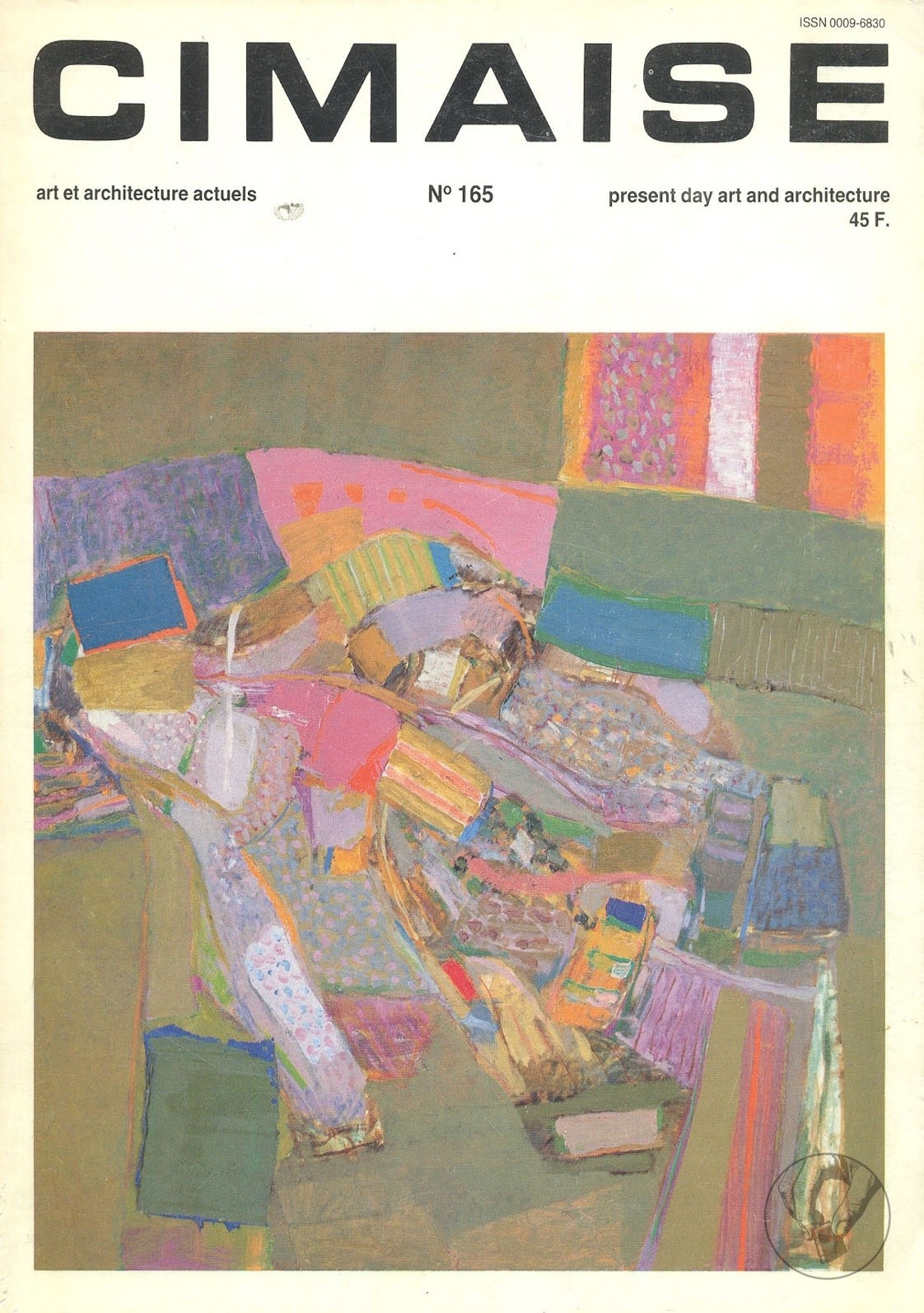
Cet ouvrage présente des expositions d'art contemporain. Il inclut des œuvres de John Franklin Koenig à la galerie Kutter en avril-mai 1983, et de Luis Lemos à la galerie Joachim Becker en juillet 1983. Il aborde également la peinture comme un genre en constante réinvention, influencé par l'histoire de l'art tout en cherchant la nouveauté, et mentionne la FIAC 83 qui s'est tenue à Paris en septembre-octobre 1983.