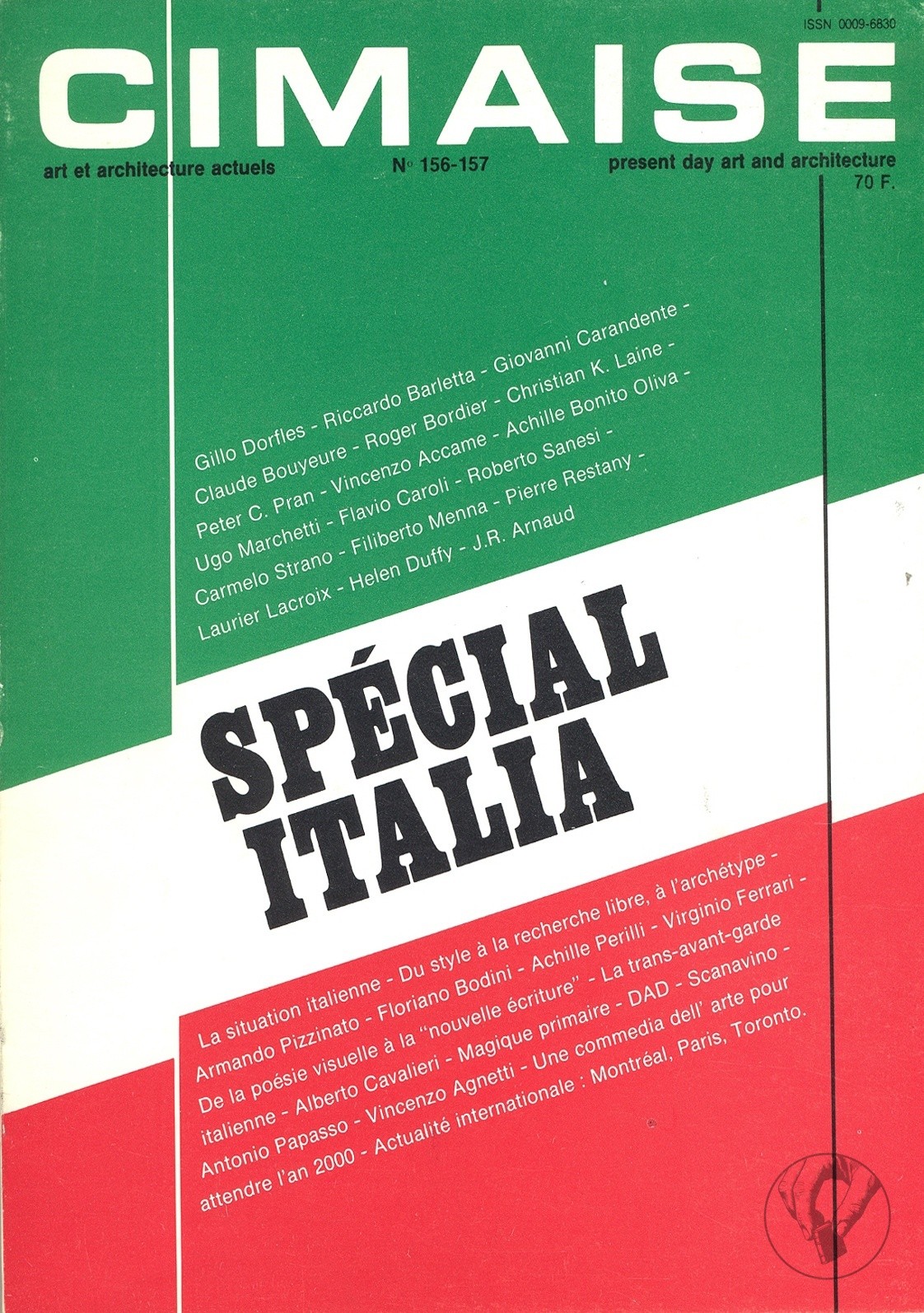
Excerpt
First pages of the volume, freely accessible.
Page 1
CIMAISE
art et architecture actuels
N° 156-157
present day art and architecture
ISSN 0009-6830
70 F.
Gillo Dorfles - Riccardo Barletta - Giovanni Carandente -
Claude Bouyeure - Roger Bordier - Christian K. Laine -
Peter C. Pran - Vincenzo Accame - Achille Bonito Oliva -
Ugo Marchetti - Flavio Caroli - Roberto Sanesi -
Carmelo Strano - Filiberto Menna - Pierre Restany -
Laurier Lacroix - Helen Duffy - J.R. Arnaud
SPÉCIAL ITALIA
La situation italienne - Du style à la recherche libre, à l’archétype -
Armando Pizzinato - Floriano Bodini - Achille Perilli - Virginio Ferrari -
De la poésie visuelle à la “nouvelle écriture” - La trans-avant-garde
italienne - Alberto Cavalieri - Magique primaire - DAD - Scanavino -
Antonio Papasso - Vincenzo Agnetti - Une commedia dell’ arte pour
attendre l’an 2000 - Actualité internationale : Montréal, Paris, Toronto.
Page 2
ZARATHIUSTRA
Arte incontro
20121 Milano Piazza San Marco 1
Tel. 6571770
mars 1982
MIGUEL YBANEZ
Juin 1982
galerie d’art international Paris
Page 3
galerie d’art international
12, rue jean ferrandi - paris 6e, tél. 548 84 28
hommage à bram van velde
avec la participation de
pierre alechinsky, pierre courtin, jean messagier
26 janvier - 23 février
adevor
Alvaro IV 80
2 mars - 24 mars
cavalieri
25 mars - 25 avril
Page 4
galerie d'art international
299, east ontario street, chicago, illinois 60611
tél. 19-1 (312) 664.28.48 - 664.28.49
franzheim
Anchor Man, 1981, 114 x 146 cm, huile.
rétrospective 1934-1982
5 février - 10 mars
messagier
12 mars - 8 avril
j.f. koenig
9 avril - 5 mai
Page 5
CIMAISE
ART ET ARCHITECTURE ACTUELS
PRESENT DAY ART AND ARCHITECTURE
29e année N° 156/157
Février-Mars-Avril 1982
Directeur-Rédacteur en Chef : Jean-Robert Arnaud
Conseillers : John Franklin Koenig, Ante Glibota
Adjoint à la rédaction pour le CANADA : Henri Barras
Administration-Rédaction : 8, rue Récamier, Paris-7e. Tél. 544-04-82
Impression : Société Mondiale d’Impression, 3, rue Maurice-Loewy, Paris 14e. Tél. 327-15-40
Secrétaire général : René Barzilay
Secrétaire de rédaction : Luis Lemos
Distributeur pour le Canada Art - Aire
1230 rue Bishop Montreal H3G2E3 CANADA
---
Prix
Le numéro:
---
Ce numéro double:
---
France
---
45 F.
---
Canada
---
18$Can. | France | 70 F. | Canada | 23$Can.
---
Europe
---
55 F.
---
U.S.A.
---
15$U.S. | Europe | 80 F. | U.S.A. | 20$U.S.
---
Autres pays
---
15$U.S. | | Autres pays | 20$U.S.
---
Abonnement
6 numéros:
France
---
210 F.
---
Canada
---
90$Can. |
| Europe | 280 F. | U.S.A. | 70$U.S.
---
Autres pays
---
70$U.S. |
---
NUMÉRO SPÉCIAL ITALIE
couverture graphique de : Michel Guillet
Gillo Dorfles
---
Introduction à la situation italienneIntroduction to the Italian Situation
---
Riccardo Barletta
---
Du style à la recherche libre, à l’archétypeFrom Style to Free Research, to the Archetype
---
Visites d’atelier
Giovanni Carandente
---
Armando Pizzinato : Une page ouverteArmando Pizzinato : An Open Page
---
Claude Bouyeure
---
Bodini ou le futur du passéBodini or the Future of the Past
---
Roger Bordier
---
La pensée peinte d’Achille PerilliThe Painting-Thought of Achille Perilli
---
Christian K. LainePeter C. Pran
---
Virginio FerrariVirginio Ferrari : Un sculpteur de premier plan à ChicagoA Leading Sculptor in Chicago
---
4145
---
Vincenzo Accame
---
De la poésie visuelle à la “nouvelle écriture”From Visual Poetry to the “New Writing”
---
Achille Bonito Oliva
---
La trans-avant-garde italienneItalian Trans-Avant-Garde
---
Visite d’atelier
Ugo Marchetti
---
Alberto Cavalieri
---
Flavio Caroli
---
Magique primairePrimary Magic
---
Visites d’atelier
Roberto Sanesi
---
Premiers éléments pour une lecture ethno-poetique des “présences” de ScanavinoFirst elements for an Ethno-Poetic Reading of the “Presences” of Scanavino
---
Carmelo Strano
---
Le “behaviorisme” de la sensibilité : à propos de Antonio PapassoThe “Behaviorism” of Sensitivity : A Propos of Antonio Papasso
---
Études
Filiberto Menna
---
Agnetti, l’Art oublié de mémoireAgnetti, Art Forgotten to Memory
---
Manifeste
Carmelo Strano
---
DAD, Nouvelles dimensions ontologiquesDAD, New Ontological Dimensions
---
Pierre Restany
---
Une commedia dell’ Arte pour attendre l’an 2000Commedia dell’ Arte While Waiting for the Year 2000
---
Actualité Internationale
Paris
J.R. Arnaud
---
Rétrospective de la Galerie Parnass de Wuppertal
---
Claude Bouyeure
---
“Ateliers” 81/82
---
Canada
Laurier LacroixHelen Duffy
---
Lettre de MontréalLettre de Toronto
---
101102
---
La traduction française des textes italiens est, dans leur grande majorité, de Luisella Bergna.
Les traductions anglaises sont de Astair McIurg et Jerome Reese.
Le prochain numéro, paraîtra le 20 avril 1982
Page 6
Gillo Dorfles
INTRODUCTION A LA SITUATION ITALIENNE
INTRODUCTION TO THE ITALIAN SITUATION
On ne peut, sans aucun doute, brosser de façon exhaustive en une seule fois un aussi vaste et complexe panorama que celui des arts visuels en Italie - peinture et sculpture -, même si les principaux courants y sont analysés avec soin. La présence en Italie de nombreuses tendances différentes et souvent contraires sont le reflet de la situation socio-politique du pays, mais aussi le rappel d'époques révolues qui ont encore une incidence sur la pensée et sur le goût d'une grande partie du public et des artistes.
Quelle est donc la situation actuelle de l'art en Italie? Elle est bien sûr peu différente de celle des principaux pays occidentaux. Avec toutefois quelques caractéristiques dues à l'évolution artistique dans la péninsule depuis l'époque du Futurisme et de la Peinture Métaphysique, ainsi qu'à la longue parenthèse fasciste durant laquelle la culture italienne fut, tout au moins en partie, occultée par la culture européenne.
Nous limitant aux deux dernières décennies, l'on peut affirmer que l'Italie - comme la France, l'Allemagne et l'Angleterre - a vu s'épanouir des expériences liées à l'Informel (au tachisme) et au Pop-Art mais, à la différence d'autre nations européennes, elle a vécu une importante parenthèse abstraite dans l'immediat après-guerre dont les chefs de file furent Fontana, Capogrossi, Burri, et qui se polarisa successivement dans des groupes tels que Forma 1 à Rome et MAC à Milan, se développant ensuite avec l'arrivée des artistes "objectuels" milanais et romains et des groupes cinétiques milanais et padouans.
Sans aucun doute, Castellani, Manzoni, Bonalumi, Nigro, Arico, Scanavino, etc., en Lombardie; Dorazio, Perilli, Turcato, Accardi et Scialoja à Rome, ont contribué à donner à l'art, en Italie, une forme particulière.
Même des artistes comme Baj ou Del Pezzo ne peuvent être qu'en partie seulement rapprochés du Pop-Art américain ou anglais. Mais, une fois terminée l'époque de l'art abstrait, géométrique, programmé ou cinétique (avec Mari, Alviani, Colombo, Varisco, Dadamaino), la tendance qui se développa le plus en Italie et qui peut être encore considérée comme la plus authentique "invention" artistique des années 60-70, s'appelle "l'Art Pauvre" - définition due à Germano Celant -. Tendance qui se développa surtout à Turin dans l'œuvre de Merz, Penone, Zorio, Pistoletto, Anselmo, Calzolari, Prini, Boetti, etc...
Si l'Art Pauvre se trouva à la limite entre les recherches abstracto-objectuelles et les recherches néofiguratives, menées par des artistes tels que Novelli, Adami, Tadini, Gianni Pisani, Schifano, Dova, Peverelli,
It would be impossible to paint a complete picture of so vast and complex a panorama as the Italian visual arts - painting and sculpture - even if its principal currents can be analyzed in detail. The presence in Italy of numerous different and often opposing tendencies is a reflection of the socio-political climate of the country, but also a reminder of elapsed epoches which still have incidence on the thought and taste of a great number of artists and of the public.
Therefore, what is the current artistic situation in Italy? It is of course little different from that of the principal european countries. With, however, several characteristics due to the artistic evolution in the peninsula since Futurism and metaphysical painting, as well as to the long fascist period during which Italian culture was eclipsed, at least in part, by that of its european neighbors.
Limiting ourselves to the last two decades, one can affirm that Italy, as France, Germany, and England, has seen a flowering of experiences linked to the Informal ("tachisme") and to Pop Art, but, differently from the other europeen nations, she has lived an important abstract parenthesis in the period just following the Second World War when its leaders were Fontana, Capogrossi, and Burri; who subsequently split off into such groups as Formal in Rome and MAC in Milan, who in turn evolved with the arrival of Milanese and Roman "objective" artists and Milanese and Paduan kinetic groups.
Without a doubt Castellani, Manzoni, Bonalumi, Nigro, Arice, Scanavino etc., in Lombardia; Dorazio, Perilli, Turcata, Accardi and Scialoja in Rome all contributed to the personal art of Italy.
Even artists like Baj or Del Pezzo can be linked only in part to American or English Pop Art. But, once abstract, geometric, programmed, and cinematic art had run their courses (Mari, Alviani, Colombo, Varisco, Dadamaino), the principal tendency that developed in Italy and which can perhaps still be considered as the most authentic artistic "invention" of the 1960's-1970's is called "Poor Art" ("l'Art Pauvre"), the definition belonging to Germaine Celant. This tendency developed essentially in Turin, in the work of Merz, Penone, Zorio, Pistoletto, Anselmo, Calzolari, Prini, Boetti, etc...
If Poor Art is at the limit between abstract-objectual experiments and neo-figurativism worked by such
Page 7
etc., il ne faut pas oublier pour autant que l’Italie contribua très tôt à l’avènement des courants conceptuels qui s’étaient entre temps développés aux U.S.A., en Angleterre et un peu partout en Europe, et même à l’Est : en Pologne, en Hongrie et en Yougoslavie. Agnetti, Calzolari, Vaccari et même Pistoletto, mais surtout Fabro, Chiari et Paolini peuvent à coup sûr se considérer comme les représentants les plus significatifs du conceptualisme italien, ainsi que des artistes plus liés au Body-Art et aux performances comme Vettor, Pisani, De Dominicis, Fabio Mauri, Kounellis. Ceci avec une caractéristique bien italienne : de nombreuses batailles conceptuelles y furent dès le début liées à une autre importante tendance florissante dans le pays, la poésie visible née surtout - en tant que conséquence de la poésie concrète - du groupe florentin 70 (avec Ori, Pignotti, Bonucci, Miccini), du groupe gênois (Carrega, Oberto) et de celui de Turin (Lora, Totino, etc.). Par contre, d’autres artistes comme Isgrò, Patella et le “musicien d’action” Giuseppe Chiari (lié aux concerts Fluxus) représentent très bien ce genre de médiation entre l’art du corps et du comportement, entre l’art conceptuel et l’écriture visible.
Cette “conceptualisation” de l’art visible, qui avait déjà trouvé dans de nombreux aspects de l’Art Pauvre une première ébauche, devait du reste se transférer aussi dans le domaine plastique. Tandis que la véritable “sculpture” languissait (malgré la présence de personnalités connues comme les frères Pomodoro et Cascella, Pietro Consagra, Melotti, Milani, Mirko, Ceroli et quelques autres...), diverses situations à mi-chemin entre la peinture et la sculpture se faisaient jour, entre l’Art Pauvre et l’art objectuel, dont les œuvres de Pardi, Carrino, Spagnuolo, Uncini, Antico, Staccioli, etc., sont encore aujourd’hui des exemples significatifs.
C’est à cette époque, c’est-à-dire autour des années 75 qu’en Italie, comme d’ailleurs dans beaucoup d’autres pays, de nouvelles impulsions devinrent plus évidentes, alliées dit-on au “post-modern” architectonique et au “radical design”, et selon d’autres considérés comme les courants autonomes d’une “trans-avant-garde” (Bonito Oliva). Impulsions basées surtout sur un retour à la figuration, après la longue parenthèse abstraite qui avait dominé la scène des dernières décennies, tout juste interrompue par quelques disciples d’un précédent néoréalisme comme Guttuso, Pizzinato, Francese, Vaglieri, etc... Impulsions basées aussi sur un intérêt renouvelé pour la pratique picturale. Il n’est plus question de “matériaux pauvres” ni d’excès de néologismes mais plutôt d’une volonté de narration, en partie ludique et ironique, et en partie naïve et primitive. Il est encore trop tôt pour juger si, dans l’avenir cette tendance néo-romantique et néo-imagerie prévaudra sur les autres courants contemporains qui trouvèrent un vaste champ de développement dans l’art conceptuel, le body-art et le narrative-art. Le futur nous dira si nous assisterons encore une fois, à l’avènement d’une enième avant-garde, première étape vers un Art de l’an 2000 désormais très proche, ou si nous devrons, au contraire, accepter un repli des forces artistiques sur les positions d’une récupération stylistique du XIXe tardif ou sur une sorte de “revival néo-impressioniste”, ou néo-expressionniste, (comme c’est le cas en Allemagne aujourd’hui), qui ferait place nette des nombreuses avant-gardes qui se font succédées pendant ces cinquante dernières années d’art riche en polémiques.
Gillo Dorfles
artists as Novelli, Adami, Tadini, Gianni Pisani, Schifano, Dova, Peverelli, etc., it must not be forgotten that Italy contributed very early to the advent of conceptual currents that established themselves in the U.S.A., in England, thoughout Europe, even in the East : in Poland, Hungary, and in Yugoslavia. Agnetti, Calzolari, Vaccari and even Pistoletto but especially Fabre, Chiari, and Paolini can be considered without a doubt as the most significant representatives of Italian conceptualism, as well as artists closer to Body Art and to performances such as Vettor, Pisani, De Dominicis, Fabio Mauri, and Kounellis.
All this with a decidedly Italian characteristic : numerous conceptual battles were tied from the start to another flourishing tendency in the country, “visible poetry”, born essentially from “concrete poetry” coming from the Florentine 70 group (Ori, Pignotti, Bonucci, Miccini), the Genovian group (Carrega, Uberto) and also the group from Turin (Lora, Totino, etc.). On the other hand, artists such as Isgrò, Patella, and the “action musician” Giuseppe Chiari (linked with the Fluxus concerts) represent very well the genre of mediation between Body Art and behavior, between conceptual art and visible writing (“l’écriture visible”).
This “conceptualisation” of visible art, which was first sketched in various aspects of Poor Art, was transferred as well to the plastic arts. While true “sculpture” languished (in spite of the presence of such personalities as the brothers Pomodoro and Cascella, Pietro Consagra, Melotti, Milani, Mirka, Ceroli and several others), diverse situations halfway between painting and sculpture came to light, between Poor Art and conceptual art, the works of Pardi, Carrino, Spagnuolo, Uncini, Antice, Staccioli etc., being the significant examples.
It is at this time, around 1975, in Italy as in numerous other countries, that new impetus became obvious, allied, it is said, to “post-modern” architecture and to “radical design”, considered by others to be autonomous currents of a “trans-avant-garde” (Bonito Oliva). Impetus based essentially on a return to figuration after a long abstract parenthesis which had dominated the scene for the last several decades, briefly interrupted by several disciples of a preceding neo-realism such as Guttuso, Pizzinato, Francesa, Vagliari, etc... Impetus based also on a renewed interest for pictorial representation. There is no longer a question of “poor materials” (or found materials) nor of excessive neo-logism but instead a narrative urge, partly ironic, partly naive and primitive.
It is still too soon to judge whether this neo-romanticism and neo-imagery will influence the other contemporary currents which find a large field of expression in conceptual art, Body Art, and narrative art. The future will tell us if we are witnessing the advent of yet another avant garde, first step towards the art of the ever-closer year 2000, or if, on the contrary, we are accepting a retreat of artistic forces back to late 19th century style, a “neo-impressionist revival”, or a neo-expressionism (as is the case in Germany); which would be a clean break with the numerous avant garde currents which have followed each other in these past fifty years rich in polemics.
Gillo Dorfles
Page 8
Riccardo Barletta DU STYLE A LA RECHERCHE LIBRE, A L’ARCHÉTYPE
FROM STYLE TO FREE RESEARCH, TO THE ARCHETYPE
Le panorama de l’art contemporain est normalement divisé en domaines stylistiques ou de recherche; il est alternativement représentatif de personnalités, groupes ou techniques. La critique ne se place pas sur le plan de la connaissance symbolique et iconologique, étant donné qu’en peinture et en sculpture, tout comme en politique, on privilégie les “courants” par rapport aux “contenus”.
Il est toutefois certain que l’histoire de l’art n’est pas simplement une somme d’événements catalogables, survenus dans le domaine des formes, mais plutôt une série de mises au point des repères de la conscience; grâce à leur capacité de rassembler toutes les énergies, ces données déterminent une dynamique “histoire des symboles”. Fritz Saxl écrivait : “expression d’une signification spécifique dans un temps et un lieu donnés, les images ont, une fois créées, le pouvoir magnétique d’attirer d’autres idées dans leur propre sphère.” (1).
Eh bien, cet article a pour but de focaliser - au-delà des styles et des recherches - un point essentiel, un aspect central du travail de certains artistes italiens d’aujourd’hui. Il s’agit de l’évolution de leur discours - différent selon les artistes, peut-être même contradictoire - à l’intérieur de la culture de l’archétype.
L’archétype? carl Gustav Jung le définit comme l’image primordiale de l’inconscient collectif, résultant des expériences précédentes de l’espèce humaine et transmise de manière héréditaire à tous les hommes. Dans la philosophie platonicienne c’est, au contraire, un modèle éternel : immatériel, immuable et parfait.
Dans l’art contemporain, l’archétype revêt avant tout une fonction d’ancrage de la pensée; son itération libère l’attention de l’artiste bloquée sur une vision multiforme et fragmentée du réel ou de l’imaginaire; il fixe la recherche formelle et la tension psychique dans un domaine apparemment très limité. Mais en fait, bien qu’il soit contraint à la répétition, l’archétype est un moyen d’approcher l’absolu.
Dans un passé encore récent, Giorgio Morandi et Massimo Campigli furent les deux grands peintres de l’archétype. Quelle fonction revêt la “culture de l’archétype”? Celle de focaliser les sensations, les sentiments, les intuitions, les concepts de l’artiste qui le crée, ou bien du public qui y recourt à travers toute la production esthétique, comme si l’archétype était dans une espèce de hortus conclusus, dans une enclave, apparemment à l’abri des secousses de l’Histoire privée ou collective.
En somme, dans l’art contemporain, l’archétype est un modèle au-dessus des choses, sans devenir pour autant immatériel, immuable et parfait comme chez les platoniciens. Il est, au contraire, tout à fait concret, en mutation perpétuelle et n’atteint jamais une perfection idéale. Tout comme l’archétype junguien, il est nécessairement primordial, même s’il ne revendique que “l’état primordial du présent”.
Style and research are, normally, the two main fields in the panorama of contemporary art; or, alternatively, the latter is representative of personalities, groups or techniques. The level of symbolic and iconological knowledge does not seem to be the most researched, since in painting and sculpture - as in politics - “movements” are favoured over “contents”.
However, it is certain that the history of art is not just simply an aggregate of classifiable events taking place in the realm of forms, but rather a setting of landmarks of the conscious which, thanks to their capacity to bring together all the energies, determine in the arts a dynamic “history of symbols”. Fritz Saxl wrote : “Expression of a specific signification in a given time and place, the images, once created, have the magnetic power to attract other ideas to their own sphere.” (1).
So, the aim of this article is to focus - beyond styles and researches - on an essential and central aspect of certain present-day Italian artists’ work. That is, the evolution of their reasoning - different, depending on the artist, perhaps even contradictory - within the archetype culture.
Archetype? Carl Gustav Jung has defined it as the primordial image of the collective unconscious, the hereditary outcome of previous remote experiences of the species, transmitted to all of mankind. In Platonian philosophy the archetype is, on the contrary, an eternal model of things : immaterial, unchanging and perfect.
In contemporary art the archetype takes on, above all, the role of anchoring the plastic thought; its iteration frees the artist from a multiform and fragmented vision of reality or of the imaginary. The archetype fixed formal research and psychical tension in an area seemingly very limited, but in fact, in spite of its compulsion to repeat itself, it is a bridge towards the absolute.
Giogio Morandi and Massimo Campigli were, in the recent past of Italian art, two great painters of archetype. What is the role of archetype culture? That of focalizing the sensations, feelings, intuitions and concepts of the artist that created it, or of the public who experiences it in the aesthetic production, in a sort of hortus conclusus, in an enclave seemingly sheltered from the collisions of history - whether private or collective.
In short, the archetype, in contemporary art, is indeed a model above everything but, contrary to the Platonian model, is neither immaterial nor unchangeable, nor perfect. It is very concrete, in perpetual transformation and never reaches and ideal perfection. Also, opposed to the Jungian archetype, it does not share its primordially, but claims the “primordiality of the present”.
Page 9
Autrement dit, l'archétype implique les pulsions mytho-poétiques de chaque individu dans une image-valeur; en raison de son caractère obsessionnel et au-delà de son choix aléatoire, l'archétype fait fonction de pôle d'attraction de l'inconscient collectif. Les différents archétypes produits par de nombreux artistes synthétisent ainsi une espèce de "paysage symbolique", une série de formations données comme des "vérités" ou des "absolus". Et ceci pour constituer des "garde-fous", des "limites" à l'évolution incertaine de l'homme d'aujourd'hui sur la route de la crise anthropologique.
Revenons à Morandi et à Campigli. Tous deux développent un très vaste champ pictural; qui repose entièrement sur des archétypes. De 1914 à 1964, Morandi peint des bouteilles, des vases, des boîtes. De 1928 à 1971, Campigli répète un monde de femmes. Leur archétype a un caractère "narratif". Ils répètent en fait un sujet unique, en le décrivant selon un goût tonal ou archaïque, dans des décors, des couleurs et des formes différentes. La corrélation existe aussi dans la signification : tout comme l'attirail de Morandi se réfère au symbole sexuel masculin et féminin, l'iconographie de Campigli identifie dans la femme-amphore une métaphore de la vie.
Après la guerre, l'archétype réapparaît solidement chez deux artistes. Giuseppe Capogrossi invente une forme "en peigne", composée d'un corps plus ou moins rond (à caractère statique) et de jambes ou de pattes (à caractère dynamique). Ces signes, pris en eux-mêmes déterminent un archétype "présentateur" - comme l'a dit Gillo Dorfles (qui tenait lui-même ce terme de Suzanne Langer) (2).
Lucio Fontana est le second artiste. Ses œuvres sont des toiles "trouées", "fendues", ou construites en "petit théâtre". Elles réalisent un archétype "spatial", au point de vue psychique et de la mythogénèse. Tandis que pour Capogrossi l'archétype produit un retour en arrière, vers l'origine, celui de Fontana détermine une poussée en avant, vers l'idée ou l'utopie du cosmique.
Ceci précède à peine l'histoire la plus récente. Il se développe en Italie depuis quelques décennies, une tendance à travailler à l'intérieur de la "culture de l'archétype". Une telle position est, d'une part, le résultat d'une évolution spécifique interne au langage choisi par chacun des artistes, de l'autre, le résultat d'une exigence généralisée. Choisir la voie de l'archétype a signifié "construire une symbolique de l'esprit", pour les raisons suivantes : tout d'abord, le support du style pris en tant que tremplin pour un leadership visible, s'est mis à manquer; ensuite on a trop laisser libre cours à la recherche (objet, comportement et conceptualité). Choix plus qu'autarchique, imperméable aux influx négatifs de la mode et de la consommation.
Analysons la position de quelques artistes qui diffèrent par l'âge et le langage, mais sont réunis par leur choix similaire de l'archétype. Le premier est le sculpteur Carmelo Cappello (Raguse, 1912) (3). Figuratif depuis les années 60, il part de l'idée du vol des oiseaux, s'attache à une forme circulaire dynamique, et ne l'abandonne plus. Il la vit dans sa spatialité articulée tout en y mêlant un sentiment très fort de la matière. Le marbre; le bronze poli, doré, argenté, nickelé; le laiton poli, anodisé; l'acier; le plexiglass. Souvent les formes sont rendues plus vives, plus changeantes grâce à un mouvement électro-mécanique. L'interaction entre les
In other words, the archetype developed in contemporary art implies every single individual's mytho-poetic pulsions on an image-value which, given its obsessional character and beyond its alleatory choices, acts as a pole of attraction of the collective unconscious. Thus, the different archetypes created by so many artists synthesize a sort of "symbolic landscape", a series of formations formulated as "truths" or "absolutes", as if to constitute the "bollards", the "limits" on the uncertain path of present-day man on the anthropological-crisis journey.
Let us come back to Morandi and Campigli. They both developed a wide pictorial archway very well articulated on archetypes. Morandi painted bottles, vases and boxes from 1914 to 1964. Campigli, from 1928 to 1971, iterated a world of women. Their archetypes had a "narrative" character. They in fact repeated a unique subject describing it in a tonal or archaic mood, in varying situations, colours and shapes. A correlation also exist in the meaning : as Morandi's paraphernalia refers to the masculine and feminine sex symbol, Campigli's iconography identifies in the woman-amphora a metaphor of life.
After the war, the archetype reappeared strongly in two painters. The first, Giuseppe Capogrossi, invented a "comb" form, composed of a body, more or less round (of a static nature), and legs or paws (of a dynamic nature). These signs, taken in themselves, determine a "presenting" archetype - as Gillo Dorfles called it (who in turn took this term from Susanne Langer) (2).
The second painter is Lucio Fontana. His works are canvases with "holes", "cuts", or built as "miniature theatres". They produce a "spatial" archetype, from the psychological and mythogenic points of view. Where as Capogrossi's archetype tends to go back towards the origin, Fontana's forces a move forward, towards an idea, or a cosmic Utopia.
All this precedes recent history. A tendency to work in the interior of the archetype culture has been developing in the last few decades among the most mature Italian painters. Such a position is, on the one hand, the result of a specific evolution internal to the language chosen by each artist and, on the other hand, the result of a generalized requirement. To choose the road of the archetype implied constructing a "symbolic expression of the spirit" for the following reasons : first of all, the style support taken as a springboard for a visible leadership started to lack; later, too much freedom permeated research (object, behaviour and conceptuality). The choice, more than autarkic, was impervious to the negative influxes of style and consumption.
Let us analyse the position of some emerging artists different in age and language, but unified by their similar choice of archetype. The first is the sculptor Carmelo Cappello (Ragusa, 1923) (3). Figurative up until the early 1960s, and later taken by the idea of the flight of birds, he holds to a dynamic circular form that he no longer leaves, living it in its articulated spatiality well welded with a strong feeling of matter. Marble; the polished, golden, silvery, nickel-like bronze; the polished, anodized brass; stainless steel; plexiglass. Often, forms are given more life, more movement by an electro-mechanical touch. Interaction between the
Page 10
Nicola Carrino : "Transformazione dello spazio/ellissi" - 1981.
Carmelo Capello : Architettura triangolare bronze - 1981 - 45 x 20.
Page 11
forces créatrices de l'énergie donne substance à l'archétype de Cappello. L'élément grec de la lumière qui se diffuse dans un temps infini, s'oppose à la matière technologique "froide", mais intensément aimée. Sculptures - lieu de pulsion plastique, lieu d'abstraction dynamique -. Dans son langage, plus rigoureux que rationaliste, Cappello a créé en définitive, un archétype "cosmique".
Pietro Consagra, lui aussi sicilien et sculpteur, (Mazara del Vallo, 1920) (4) fut d'abord post-cubiste. En 1957, il crée à partir de sculptures totem des formes qui s'affrontent entre elles, et qu'il appelle "conversations". La structure se fait ensuite toujours plus complexe; elle prend un caractère fermé et anguleux; sa surface est mise en évidence, mais en même temps elle est tourmentée par des creux, des fentes et des aspérités. L'archétype se confronte à des matériaux disparates : bois brûlé, marbre, alebâtre, granite, bronze, aluminium. Le magma du signe est parfois organique, parfois baroque; il se nourrit des matières avec lesquelles il est construit, et de leur épaisseur, en une sarabande de creux, de perforations, de superpositions. Guido Sallo a assimilé Consagra au classicisme présocratique; à celui des éléments primaires d'Empédocle. Mais peut-être, y a-t-il aussi une influence arabe dans ce "tourment formateur". L'archétype est "vitalisant - organique."
Voici deux peintres de même provenance stylistique : Di Salvatore et Dorazio. Nino Di Salvatore (Verbania, 1924) (5), participa au Mouvement Art Concret en compagnie de Soldati, Dorflès, Munari, Mazzon, Veronesi et s'en distingua en tant que pionnier des doctrines de la Gestalt. Il les appliqua aux structures psycho-perceptives de la géométrie abstraite. Dès les années 60, les formes précédentes géométrico-spatiales s'organiseront en un archétype, formé par la combinaison du cercle et du carré. Une telle image, répétée et combinée dans des agrégats différents, caractérisée par une vive couleur du timbre et par sa volonté d'émerger de l'espace alentour, fait preuve d'une fonctionnalité tant synthétique que transcendantale. En ce qui concerne la multiplicité des données sensibles, elle produit en fait une valeur opposée à celle de l'archétype "mythologique" de Fontana. C'est selon Kant, l'obstention d'un espace, pris comme puissance première, dans lequel se génère l'acte pur. Un tel archétype peut donc se définir "génétique".
Piero Dorazio (Rome, 1927) (6), n'avait que vingt ans lorsqu'il participa, à Rome, à la rédaction du Manifeste du Formalisme, auquel se joignit Consagra. Il se lia ensuite aux groupes concrets de Milan. Après une première phase d'expérimentation, il approche avec une progression tout à fait logique, une configuration d'images, "à structure cellulaire, résonnant par vibrations propagées", comme dit Umbro Apollonio (7). Les couleurs fondamentales s'opposent (rouge, bleu, jaune); mais quelques fois les couleurs complémentaires entrent aussi en jeu. La variété des "grilles", des combinaisons, des orientations (verticales, horizontales, obliques), ne modifient pas la donnée essentielle : cette peinture produit un organisme unique; en lui, la lumière pénètre et se synthétise avec la chaine chromatique; le tout constitue un espace énergétique. Si pour Di Savatore, l'attention porte sur le moment "génétique", ici se développe le moment qui succède à l'archétype-vie, le moment libérateur de la vitalité, à travers l'atomisation de pulsions. Par conséquent, un tel archétype est "énergétique".
energy-creating forces gives substance to Capello's archetype. The Greek element of light, diffused in an infinite time, opposes the "cold" but intensively loved technological material. Sculptures : places of plastic drive, places of dynamic abstraction. In his language, more rigorous than rational, Cappello has in fact created a "cosmic" archetype.
Pietro Consagra, also Sicilian and sculptor (Mazara del Vallo, 1920) (4), was at first cubist. In 1957 he created from totem sculpture, forms that faced each other, which he called "conversations". From then on the structure becomes always more complex; it takes on a closed and angular character; its surface is brought out but at the same time it is tormented by furrows, cracks and angular edges. The archetype confronts disparate materials : burnt wood, marble, alabaster, granite bronze and aluminium. The magna of signs is sometimes organic, sometimes baroque; it feeds on the material and thickness of which it is constructed in a jumble of hollows, perforations, superpositions. Guido Ballo assimilated Consagra with pre-Socratic classicism, that of Empedocle's primary elements. But perhaps there is also an Arab influence in this "formative agony". The archetype is "vitalistic-organic".
There are two other painters coming from an analogous stylistic origin : Di Salvatore and Dorazio. Nino Di Salvatore (Verbania, 1924) (5) participated in the Concrete Art Movement along with Soldati, Dorfles, Munari, Mazzon, Veronesi, and was a pioneer of the Gestalt doctrines. He applied them to the psycho-perceptive structures of abstract geometry. From the early 1960s, the previous geometric-spatial forms arranged themselves into an archetype, formed by a combination of the circle and the square. Such an image, repeated and combined into different aggregates, characterized by a lively timbric colour and by its imperative drive to enter the surrounding space, proves a twofold functionality, synthetic as much as transcendental. As for the multiplicity of sensitive data, the image produces in fact a value opposed to that of Fontana's mythological archetype. It is, in Kantian terms, an ostentation of a space taken as primary power, in which generates the pure act. Such an archetype can be defined as "genetic".
Piero Dorazio (Rome, 1927) (6) was only twenty years old when he participated, in Rome, in the drafting of the Manifesto of Formalism, to which Consagra also joined. He later established ties with the concrete art milieu in Milan. After a first phase of experimentation, and in a logical progression, he turned towards a configuration of images, "to a cellular structure resounding with diffused vibrations", as Umbro Apollonio (7) puts it. Fundamental colours impose themselves (red, blue, yellow); but sometimes the complementary colours also come into play. The variety of "grills", combinations, orientations (vertical, horizontal, oblique) do not modify the essential information : the painting gives a unique organism; light penetrates it and synthesizes itself with the chromatic chain. If for Di Salvatore emphasis leans towards the "genetic" moment, Dorazio develops the moment following the archetype-life, the liberating moment of vitality through the atomization of pulsions. Consequently, such an archetype is "energetic".