Excerpt
First pages of the volume, freely accessible.
Page 1
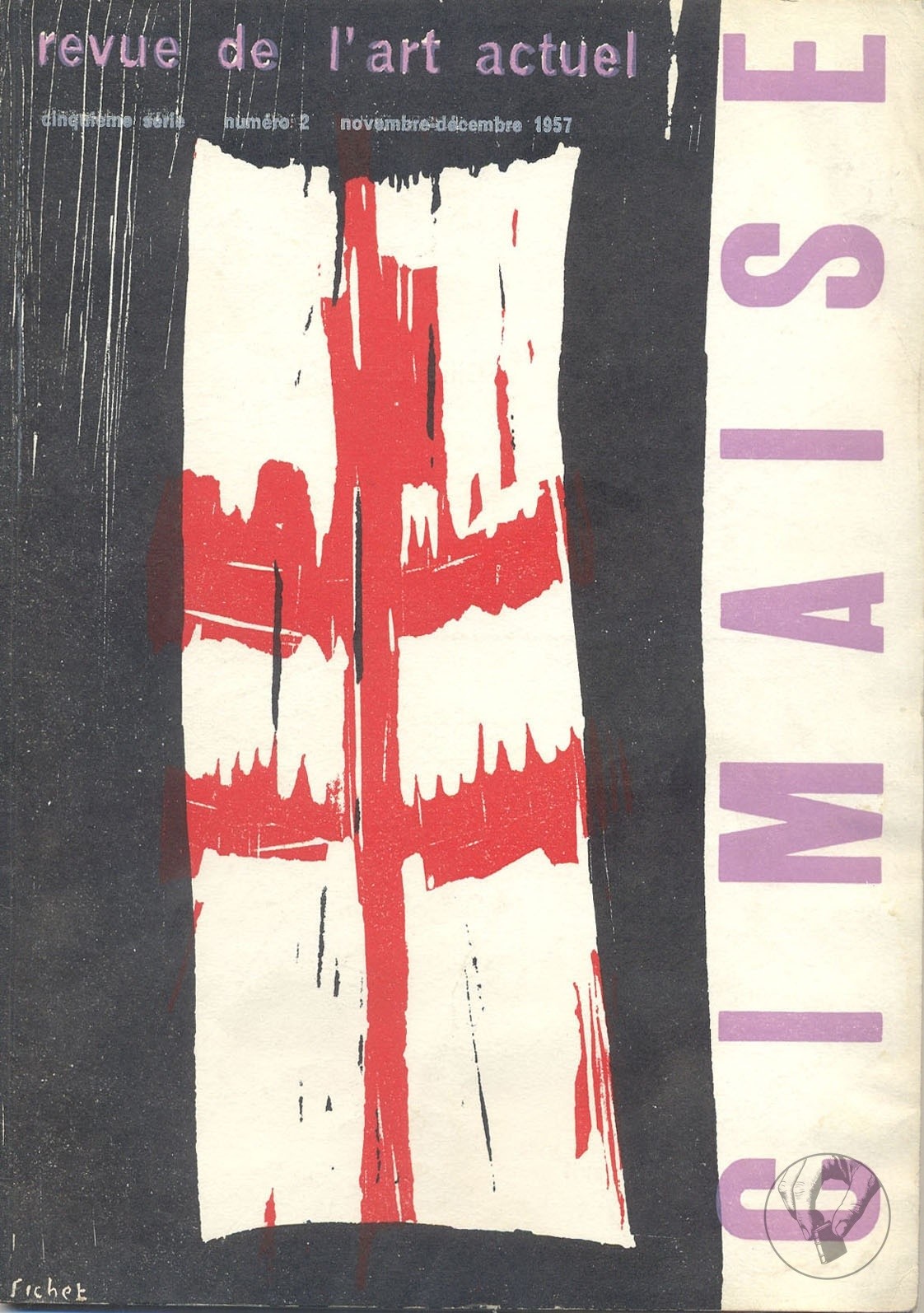
revue de l'art actuel
cinquième série numéro 2 novembre-décembre 1957
IMAIS
fichier
Figure Caption: Description of the figure.
---
References:
[1] Reference 1
[2] Reference 2
---
Citations:
[1] Citation 1
[2] Citation 2
---
Footnotes:
1. Footnote 1
2. Footnote 2
---
Page Numbers:
---
Headers:
Header 1
Header 2
---
Footers:
Footer 1
Footer 2
---
Figure Captions:
Caption 1
Caption 2
---
Diagrams:
Diagram 1
Diagram 2
---
Flowcharts:
Flowchart 1
Flowchart 2
---
Logos:
Logo 1
Logo 2
---
Symbols:
Symbol 1
Symbol 2
---
Icons:
Icon 1
Icon 2
---
Text Boxes:
Text Box 1
Text Box 2
---
Callouts:
Callout 1
Callout 2
---
Annotations:
Annotation 1
Annotation 2
---
Watermarks:
Watermark 1
Watermark 2
---
Stamps:
Stamp 1
Stamp 2
---
Signatures:
Signature 1
Signature 2
---
Forms:
Form 1
Form 2
---
Checkboxes:
Checkbox 1
Checkbox 2
---
Scientific Notation:
$E = mc^2$
---
Chemical Formulas:
H₂O
CO₂
---
Statistical Data:
Mean: 50
Standard Deviation: 10
---
Measurements:
Length: 10 cm
Width: 5 cm
---
Units:
Temperature: °C
Speed: km/h
---
Special Characters:
©, ®, ™
---
Formatting:
Bold Text
Italic Text
~~Strikethrough Text~~
`Code Text`
---
Column Layouts:
Column 1
---
Column 2
---
Data 1
---
Data 2
---
Data 3
---
Data 4
---
Borders:
Border 1
Border 2
---
Lines and Dividers:
Line 1
Divider 1
Page 2
Galerie de France
3 rue du Faubourg Saint-Honoré, Paris 8, Anjou 69-37
---
janvier
aquarelles et gouaches de
Gillet, Levee, Maryan
---
février
peintures de
Anna-Eva Bergman
---
Edouard Loeb
présente
Max Ernst
œuvres récentes
du vendredi 17 janvier au samedi 15 février 1958
---
Galerie Creuzevault
9 avenue Matignon, Paris, Balzac 36-35
vernissage vendredi 17 à 16 heures
Page 3
Galerie La Roue
16 rue Grégoire-de-Tours, Paris 6, Odéon 46-70
du 14 au 28 janvier
sculptures de
Gerdur
peintures de
Vala
du 29 janvier au 12 février
Lacoste
peintures
---
Galerie Dina Vierny
36 rue Jacob, Paris 6
André Bauchant
---
Degottex
Hantaï
Marcelle Loubchansky
Judith Reigl
Galerie Kléber
24 avenue Kléber, Paris 16
---
Galerie Arnaud
34 rue du Four, Paris 6, Littré 40-26
Huguette-Arthur Bertrand
Luis Feito, Oscar Gauthier,
John Koenig
en permanence
Barré, H.-A. Bertrand, Carrade, Coppel,
Feito, Fichet, Gauthier, Guitet, Koenig,
Laubiès, Panafieu, Flavio Tanaka
sculptures de
Marta Pan
Page 4
Prix de Paris
du 17 janvier au 15 février 1958
Peinture
Galerie Denise René
124 rue la Boétie, Paris 8
Prampolini
Sculpture
Galerie Rive Gauche
44 rue de Fleurus, Paris 6
Negrisin
---
Galerie Iris Clert
3 rue des Beaux-Arts, Paris 6, Dan. 44-76
Van Haardt
Verticales
novembre-décembre
---
Drian Gallery
7 Porchester Place, Marble Arch, London W 2
Van Haardt
Black and White
january 1958
---
Galleria Apollinaire
via Brera 4, Milano, Tél. 862821
Maîtres d'aujourd'hui:
Fautrier
janvier
en permanence
Wols, Soldati, Fautrier, Licini, Schneider, Hartung, Meloni, Bryen, Laubiès, Bellegarde Brüning, Halpern
---
Drian Gallery
7 Porchester Place, Marble Arch, London W 2
Judith Reigl, Adam Sjöholm, Baz, Van Haardt, John and Dennis, Rich, Peter Clough, Peter Reid, Clemente, Maurice Jadot, Halima Nalecz, Till May
---
Galerie Van de Loo
Munich, Maximilianstrasse 7
Décembre
Platschek
janvier
Serpan
Page 5
Revue internationale d'art moderne
la grande revue internationale d'art moderne publiée au Palais des Beaux-Arts de Bruxelles.
Quadrum 4 Extrait du sommaire :
- C. G. Argan: La crisi di valori
- Adrian Stokes: Form in art
- La 3ème Biennale de Sao Paulo
- L. Kochnitzky: Marc Tobey
- R. V. Gindertael: Bissière
- M. Bilke: Servranckx
- Fitzsimmons: Jean Dubuffet
- A. Ehrenzweig: Victor Pasmore's Architectural Constructions
- G. Mazzariol: Cronaca di un Linguaggio, E. Vedova
- F. Mathey: Le vitrail moderne en France
- H. Seiler: Vier West-deutsche Privatsammlungen
- Documentation: Jeunes artistes, miscellanea, livres, expositions etc...
- 15 planches en couleurs, plus de 150 reprod. en noir
---
Germaine Emery
39 rue de Constantinople, Paris 8, Lab. 06-15
---
Arts anciens
Chine et Japon
---
Le disque du monde entier
58 bis rue Chaussée-d'Antin, Paris 8, Trinité 96-83 (à 200 m de l'Opéra)
remise de 20 %.
Microsillons
Électrophones
Magnétophones
toutes marques
ouvert tous les jours de 9 h. 30 à 19 h. 30 y compris les deux derniers dimanches de décembre
---
Laubiès
par René Déroudille
édition limitée à 300 exemplaires, 1 lithographie originale, 10 reproductions, prix 800 francs En vente à la Galerie Arnaud, 34 rue du Four, Paris 6
Éditions : A la Tête d'Or, Lyon et Georges Wittenborn, New York
Page 6
Cimaise
revue de l'art actuel
34 rue du Four, Paris 6
Directeur: J. R. Arnaud
Secrétaire général: John Koenig
Rédaction: J. Alvard, M. Ragon, P. Restany
Herta Wescher
La rédaction reçoit sur rendez-vous
Abonnement (6 numéros) 1.600 frs - Par avion: 2.800 frs
34, rue du Four, Paris 6, téléphone Littré 40-26
C.C.P. Paris 5542.39
Diffusion:
Allemagne:
Librairie Hanna Weber. H.-J. Niepel, Dusseldorf 1, Grabenstrasse 11
Argentine:
Editorial Victor Leru, Cangallo 2233, Buenos-Aires
Autriche:
Arnulf Neuwirth, Paracelsusgasse 8, Vienne 3
Belgique:
Jean Milo, 28 rue de l’Arbre Bénit, Bruxelles
C.C.P. Jean Milo, Bruxelles 1591.50
Danemark:
Meiners Kunstforlag, Peder Skramsgade 5, Copenhagen
Grande-Bretagne:
Alec Tiranti Ltd, 72 Charlotte Street, London W1
Italie:
Le Noci, Via Brera 4, Milan
Japon:
Meiji-Shobo, Surugadai, Kanda Tokyo
Norvège:
J.W. Cappelen, Sortimentebokhandel, Oslo
Suède:
Eric H. Olson, Upplandsgatan 3, Stockholm, 10 23 77
Suisse:
E. Genton, «L’Entr’acte», rue du Lion d’or 4, Lausanne,
C.C.P. II 144-56
U.S.A.:
Wittenborn and Co, 1018 Madison Ave, New-York 21
---
Sommaire
Couverture de Pierre Fichet
Textes anglais
7 Max Ernst by Herta Wescher
9 The role, the dangers and the hopes of Abstract by F. A. Viallet
Textes français
11 Max Ernst par Herta Wescher
23 Rôle, dangers et chances de l’Art abstrait par François-Albert Viallet
31 Visite d’ateliers: Camille par Michel Ragon
33 Lettre de New York par Dore Ashton
35 Les expositions par Georges Boudaille, Michel Ragon, Pierre Restany, Herta Wescher
43 Bibliographie
Textes anglais
46 Camille by Michel Ragon
New York by Dore Ashton
Et comme dans chaque numéro: actualité, informations, bibliographie
Dans notre prochain numéro:
Une étude sur Jean Dubuffet par Michel Ragon
Aux sources de l’art actuel par Herta Wescher
Visites d’ateliers:
Delahaye par Pierre Restany
Don Fink par Herta Wescher
Page 7
Complete translation of the main articles
translation by J. F. Koenig
---
Max Ernst
by Herta Wescher
The great explorers of new worlds and experimenters of ingenious procedures are not lacking in the history of our century. But there are few adventurers as audacious as Max Ernst, who is always ready to throw himself headlong into the deep, without a lifebuoy or a diving-apparatus to protect him from the dangerous currents or the voracious monsters. The impetuous desire to find the fountainheads of the world that has guided him all during his life, has familiarized him with an agitated universe that ceaselessly transforms itself before his eyes, and from which he has brought us back alive a thousand and one images. Whereas his painting has always provoked great curiosity, the access to it is not easy, and I would often rather have magic spectacles—rather than a type-writer—to interpret it in a proper manner.
Max Ernst was born in the Rhineland, where the traditional democratic spirit has always opposed itself to the respect for authority that is to be found in the Prussian countries beyond the Rhine. The millenary catholicism of the “Saintly old city of Cologne” that is evident through the numerous romanesque churches erected long before the famous gothic cathedral, is inseparable from the famous Carnaval, a frantic holiday, where in old happy times the pawnshops all closed several days before the fun started in order to keep the people from hawking their beds and mattresses, which might have just multiplied the fun. The legends of yesterday that floated around the castles on the Rhine remained alive, and all of us kids saw with our own eyes the Lorelei sitting on her rock and combing her long golden hair. Thus Max Ernst disposes with the local imaginative heritage of vivid colors, which didn’t miss leaving some traces in this painting. Though he became cosmopolitan, at home in Paris as well in the Loire Valley, in New York or in the Arizona mountains, he never forgot the brogue of his native region, and to share this same “slang” with him perhaps helps me to understand him better.
Having already painted and shown, before and during the other war, his first real contact with the public only took place nonetheless when, after his demobilization when he was 27, he threw himself into the arms of Dada. With Baargeld, he formed the Cologne group which Arp, arriving from Zurich, soon joined. Their joint activity delighted in a complete anarchy, where anti-militarist, anti-religious and anti-artistic tendencies mingled together. Their first magazine, The Ventilator, edited by Baargeld and Max Ernst, distributed at the factory gates, was quickly suppressed by the British occupation forces because of its clearly subversive character. It was followed by another, of greater literary interest, The Drum Signal, whose sub-title cried “Wake up, you dilettantes!” The scandalous manifestations attained their high point with the famous show in the Winter beer-garden, where you came in through the toilets; Baargeld showed an aquarium filled with a rosy liquid with a hank of hair and a wooden arm floating on the surface, and Max Ernst had a wooden sculpture with an axe attached to it, with an invitation for all visitors to use it in order to demolish the work; this invitation was amply accepted by the public up until the time when the police closed the place.
But in the heart of these devastations, our artists—just as all the other dadaists—hadn’t abandoned the idea of a “new life that would blossom in the ruins,” and each one of them was in search of “another art” that would substitute itself to the anaemic traditionalism of the museums and the galleries of the time. In order to finish with the sentimental romanticism of a painting that was admired by the girls’ boarding-schools, they searched in scientific and technical realms for elements of an idiom that was alive and up-to-date. Close in spirit to the contemporary works of Duchamp and Picabia, Max Ernst made compositions that took birth from drawings and engravings of machines and architect’s drafts, that were cut up and re-grouped cunningly, such as the “Hypertrophied Trophy” that the committee of the Cubist show of the Golden Number, in Paris (where Ernst had installed himself in 1922), refused because it wasn’t done by hand. However, the abolition of the abusively individualistic style was one of the principal points in the program of the Cologne group who undertook works on a community level, one person continuing and completing the drawing of another, under the impulse of the moment: a procedure that is to be found later on in the so-called “exquisite bodies” of the surrealists. With Arp, Max Ernst did a series of “fatagaga” (fabrication of tableaux guaranteed as gasometric) collages where each one’s part remain indistinct. His collaboration with Baargeld took place in a more hallucinating climate; each of the painters discovered in the contribution of the other certain silhouettes that brought into being other objects, and thus the work progressed in a continual transformation.
The same chain associations gives the departure to the collage-paintings of Max Ernst that mark his real débuts as a painter. The account that he gives of the shock that opened the gates of the creative realms of the unconscious mind is too revealing to not tell it again: “One day in 1919, finding myself one rainy day in a town on the banks of the Rhine, I was struck by the obsession that the pages of an illustrated catalog full of objects for anthropological, microscopic, psychological, mineralogical, and paleontological demonstration practised on my irritated eyes. I found united here the elements of a figuration so far removed from one another that the very absurdity of this assemblage brought about within me a sudden intensification of my visionary faculties and brought into being a hallucinating succession of contradictory images, double, triple and multiple images, superposing themselves one upon the other with the persistency and rapidity that are common to amorous souvenirs and the visions of the waking sleep.” And Breton says in his preface for Max Ernst’s first collage show in Paris, in 1920, “But this marvelous faculty, without leaving the field of our experience, of attaining two distant realities, and by bringing them together, to draw a spark; to bring within the reach of our senses abstract figures brought to the same intensity, in the same relief as the others; and, in depriving us of a system of reference, to take us out of the environment of our own souvenirs, this is what, for the moment, engages him.”
In looking at the numerous works that correspond with this exciting analysis, they do not seem, at the onset, to be the result of a trance, but reflect moreso an active intelligence that produces strange and provoking combinations, capable of consternating the spectator not only by their images, but also by the abstruse texts that accompany them. On the contrary to the cubists’ pasted papers, that subjected the pieces of newspapers and other materials to the firm structures of their compositions, Max Ernst attaches his interest uniquely to the evident subject, and the prefabricated elements he uses present themselves in an almost embarrassing nudity. Their mechanical character prevails over the ensemble and the diverse elements keep their specific substance without garbing themselves with the poetic veil so characteristic of Schwitters’ collages.
The most lyric and most dramatic echoes, on the contrary, resound in the books of collages of the following years, (“La Femme 100 Têtes,” “Une Semaine de Bonté,” etc.), suites of montages composed of engravings that illustrated cheap novels. The decomposition of the figurative elements bring into life charming and hideous personages; innocent girls live extravagant adventures; fabulous beings mingle into family life in
Page 8
roles of irresistible seducers or vengeant gods. The action takes place in dreamlike landscapes or in the interior of a nightmare, at the meeting-place of desire and of fear.
The evolution of today’s art, in refusing all concrete and definite subjects, has estranged us from this world, and the young generation is no longer interested in this anecdotal idiom, be it highly savory. But if they do not have the same enthusiasm for these books that we elders once had, they are, at the present time, disposed to claim the Max Ernst of the Histoire Naturelle as their own, and to discover here the mysteries of a universe which is also theirs.
This universe was brought about by another technique that Max Ernst undertook with the aim to bring out the mottling in wood that had always dominated his dreams since he was a child, when he saw human figures and heads of birds appear in the panel of false mahogany placed opposite his bed. In rubbing a lead pencil over papers placed on planks, leaves or ravelled cloths, he brought forth the design of the grooves and the nervures which immediately took life, suggesting living beings, men, plants or animals. In this marvelous metamorphosis, the hedges became thick walls, the shells opened into flowers, plants beat their ornamental leaves into lamps, the pebbles heaped themselves into great diluvian beasts. The calqued structures that are at the origin of these drawings give them a singular transparency. Sometimes their sensitively undulant rhythms form desert landscapes or floating clouds, relinquishing all figurative motives that would limit the subject, and Max attains here certain themes which are surprisingly up to the moment.
He applied the same procedure with colors rubbed on the canvases which give us grounds that are just as evocative, stamped with mirages, coins, metal lattice-work. The abstract structures, of a more or less geometrical order, once withdrawn from their matrice, dictated the compositions that had to be filled in. Thus the miraculous images of the “tubular forests,” the “fishbone-flowers,” the “entire towns,” took form, with subtly tuned textures from which a few contours, and a few rather insistent forms came forth. The artist, in his work, reacted as under hypnosis, as the seismograph registers the “softest tremblings of the earth.” He tries, as he says himself, to restrain more and more his own active participation when developing his painting. He puts himself voluntarily into a sleeping state, leaving the thread of images to follow its course, which nonetheless seems directed by his desires and his passions. If in certain of his works he keeps himself from crossing the frontiers of consciousness, others give the appearance of something quite spectacular, with perfect achievement, and seem inconceivable without the aid of a wakeful mind. The climate of these canvases change with the progressive self-realization. The tempest rages in the violent embrace of the horses in the “Bride of the Wind,” but the calm and silent night bathes over the “Young Chimera.” To the anguishing crowd of the “100,000 Doves,” are opposed the smooth contours of the “Monuments to the Birds” that lift themselves into the air with a fine assurance. These images of birds, the artist’s totemic animal and one that he resembles, have haunted him all during his life, and he gives them the most diverse capacities and meanings.
Once a theme obsesses him, he doesn’t let it go, capturing the multiple aspects that these ghosts offer him. Thus, the series of a same subject follow him, changing their expressive character in the different periods. Around 1927, we have the savage hordes, monsters with black silhouettes who, hunting and hunted, give violent battle. But these visions of terror give way, ten years later, to the “Joy of Living” that harbors itself in the green thicket of luxuriant vines and marshy plants, peopled with frog-men and locust-women that keep company with sylphs and “the Nymph Echo.” These joyous jungles are preceded by the more sinister images of the “Gulp-airplanes Garden,” with bunches of exuberent flowers that transpierce stone terraces in order to devour airplane wreckage. During the last war, after Max Ernst got out of an internment camp,
and found refuge in the United States, he created works where the weight of destruction and extermination is expressed in far-off and anguishing landscapes. It is the world submerged under the deluge, from which only the eternal plants have escaped. As giant bastions, they rear up towards the sky, while the alluvium of mud cover the ruins that have fallen into rot, and where several ghosts wander. Titles such as “Europe after the rain,” “The benumbed city,” “The bewildered planet” conjure a topic of present interest of which these paintings keep the cosmic echoes.
But suddenly, Max Ernst searches in a clarification of the mathematical spirit an exit to this labyrinth that seethes with life. He rediscover Euclid, of whom he makes a portrait, rigged out nonetheless with a rather old-fashioned attire of a feather boa and a bonnet, with bird-roses on the lookout. Other portraits, of Beethoven and Schostakovich, and of the Portuguese Nun, go even farther in their deprivation, for he reduces their images to strict formulas of straight or curved lines of an ultimate sobriety but lit with a revealing irony. The radiance of “A marvelous day” now follows in the perfect order of luminous fascicles which, in crossing themselves, form a transparent mosaic of geometrical planes. But this enforced restraint of the imaginative faculties does not last long. After a few years, the determined plane areas round off, and are animated again with microscopic and biomorphic structures that superpose themselves in fabulous landscapes.
On coming back to France, where the climate, even if it is not always mild, suits him better than in America, Max Ernst’s painting enriched itself with certain elements, that it had previously neglected. The form, considered always as having a secondary interest, only useful for rendering visible the contents which alone was of any importance, come up from its second place, and the matter of the colors joins in active partnership in the reciprocal reinforcement of the expressive forces. Often rather rigid composing structures give their support to the fragile edifices of the fairy stories, and granulous impastos, that envelop the lines and the contours, intensify the messages that they communicate to us. In becoming more compact, the painting becomes still more suggestive.
There are never any foreseeable suites in this abundant creation. Today, as always, the artist obeys the spontaneous inspirations that may constantly take new directions. Sometimes he lifts the curtain of the sanctuary of his imagination, sometimes he closes it, and if certain subjects are hidden in the dim light, others present themselves in broad daylight, explaining themselves with a prodigious eloquence. Max Ernst can reveal exotic paradises to us that are vibrant with light, to bring us back to places that are impregnated with heavy and bitter perfumes. After having given free rein to all of the caprices of his invention, he finally comes back to the eternal theme of the human head to which he gives infinite dimensions.
Max Ernst’s activity is not limited to painting. It also extends into graphic works, etchings and lithos, made for the most part to illustrate books of which he is, from time to time, the author. Almost as sure a poet as he is a painter, his verbal language hardly differs from his pictorial idiom. He has tried, in the same spirit, to break up the habitual contexts, to decompose words in order to let the liberated elements enter into other alliances that are broader and more ambiguous. A sculptor, he has worked in wood, plaster, and stone, producing in the dada and surrealist periods certain equivocal objects, that were composed of heteroclite materials. Later, environed with blocks of granite, he contented himself only to bring to light the secret meanings that he found preconceived in them. If we could unite his immense production in its totality, we would be amazed at the unity that reigns in the midst of this diversity, Ernst’s personality marking everything that he takes up Living his time with all his nerve, grasping the universe with all the holds possible, he holds his role in our period as the chronicler of the myths that survive the passing centuries.
H. W.
Page 9
The rôle, the dangers and the hopes of Abstract
by François-Albert Viallet
The practise of abstract art can be likened to a element of irreducible faith. Seen in general, this is the conclusion that we can draw from the many conversations held with the artists engaged in the non-figurative and abstract movement. The following considerations, far from being any doctrinal pretensions, are proposed as an investigation, in the form of notes, of certain questions concerning the role, the dangers and the chances of Abstract. I will specially try to disclose certain relations existing between contemporary thought and the practise of non-figurative art, this seeming to me as a duty that is not only exciting but also worthy of the strictest attention of the critic.
As to the notion of Abstract, let me make it clear in advance in order to ward off all confusion well or ill-meant, I will include all sorts of pictorial or sculptural expression that offer us a universe other than that of the objects that are accessible to the senses. I will exclude nonetheless the half-way solutions, such as the deformation of the real object, whereas I do admit an evocative element; the materials of heredity, of the unconscious mind, of apprenticeship, of remembrances, subsist even in the work the farthest removed from the Concrete. It is useless to deny this evidence in a gratuitous concern for “purity;” nonetheless—I say this in order to correct the tenacious opinion of the professional humanists, always greedy for new elements to prove the inanity of any pretension towards pure Abstract—the subsistence of material of the outside world does not invalidate in any means the autonomy of the work of art. This would be the same as a refusal of the greek temple under the pretext that the row of columns “imitates” the trunks of the pinegroves; or declaring pure music impossible in claiming to find a hunting scene in a Brandenburg concerto.
In reality, the draught of the true non-figurative work is worked out by the means of a transubstantiation of the raw material in and by its creator. Such and such a resemblance is of little importance to us (we well know the bores who exclaim: “That reminds me of...” that break into our contemplation), provided the work is really a “new creature,” and authentic in itself.
Now, by what sign can we recognize the authentic work, and how can we justify it? In order to answer this, let’s begin with an apparent truism, which, for that matter, always constitutes the count of indictment in the trial brought up against Abstract.
The non-figurative is said to be detached from the real object. This remark will lose quite a bit of its banality, if we examine it in comparison with proceedings that are today quite common in the realm of science. Let us remember, for example, that the main part of Einstein’s theory was worked out on the blackboard and not in the laboratory. Thus, the brain-pool of the Earth (what Teilhard de Chardin would call the noösphere) has already come to a point beyond the concrete experience. Otherwise said: today, we dispose of such a quantity of information that, in many realms, it is permissible for us to skip over the verification of the object. As to the plastic arts, we can affirm without exaggeration that the quantity of knowledge and sensitivity acquired by some ten centuries of direct tradition and by several millenaries of retrospective art open up an almost unlimited work-yard to us.
In fact, one current or another has elaborated, in different sectors, the maximum possible information beyond which any progress is unthinkable. Certainly, we can still make infinite variations on the themes of chiaroscuro, on anatomic plasticity, on chromatic analysis... but we will remain continually, without going any farther, in the orbit of Leonardo,
Caravaggio, Rodin, Seurat... to only cite a few.
This state of saturation can also be noticed in the realm of pure thought of the humanist type. Thus, to indicate a major example of this, the contents of metaphysics (including its application in the defined religious systems) has recently become exhausted. The correlatives such as body-soul, matter-mind, grace-nature, God-and man, natural-supernatural... on the most part equations for expressing the relations between the intelligible and the perceptible... these correlatives have attained their paroxysm. After having furnished its maximum of information, the “euclidian” theology of Thomas Aquinas has completed its cycle. A thousand combinations are still possible (and even “atheist theologians,” such as Sartre fall into the mirage: “essence-existence,”) but all of these arrangements no longer bring us any broadening of our knowledge.
In our period which is that of micro-physics and of the universe in evolution lived as such, painting “unhooks itself” from the object, and religious thought breaks away from the God of macro-physics, of the God-object of Aristotle, of Thomas and of Descartes. While the plastic arts begin again at zero, leaving aside the technical riches acquired since the van Eyck brothers in order to spell out a new alphabet of quite simple notions: proximity, the “sign,” assemblage... a like process is taking place in metaphysics. Let me cite several names such as: Blondel, La Berthonnière, Teilhard de Chardin, and Henry Duméry on the catholic side; Paul Tillich, Bultmann, and Weinschedel on the protestant side, and scientists such as Schrödinger or Raymond Ruyer who are engaged with meta-physical questions; with all of these men whose tendencies are far from being homogenous is to be found the concern for the revelation of relations other than those of a macro-metaphysics and a macro-theology of the past that came from a universe of classical physics that found its historical correlative in representative art. To a God-Personage who sent winged messengers to earth in order to communicate his intentions to mortals, to such a God the apologetic imagery of Fra Angelico, the romanticism of Raphael and the pathos of Tintoretto fully rendered justice: Society combined itself with a heavenly creature in its own image and Man made himself the possessor of the features of a supreme being.
Today’s problem, impoverished of celestial apparitions in purple and gold but enriched with new dimensions of knowledge, appears in an entirely different manner.
The capital fact of universal Evolution situates us in a new vision of universal cohesion, of “proximity” and connexion. A key-word such as that of Teilhard: The earth matrix of thought, thought matrix of God upsets the millenary imageries including those of art, a function of conception. The Divine no longer has need of “objective” proof since, if it exists, its very notion stretches out far beyond the intelligible.
Thus in his recent work of a great audacity, “Le problème de Dieu en philosophie de la religion,” Father H. Duméry goes even so far as to expel the Divine completely from the created world and beyond the explainable frontiers: basing himself on Plotin, God is non-being, “zero,” One, pure spontaneity.
On the other side, the philosopher and biologist Raymond Ruyer reveals the circuits and the non-deterministic and para-physical organization in the biological processes; other scientists such as Schrödinger, Georges Matisse and the mathematician Fantappié show in nature the currents that oppose themselves to entropy, that is to say the energy that resists total death: we are here on the threshold of a physical faith in immortality.
In such a universe that prepares other wise new methods of knowledge (we are thinking for example of the very important “Traité de la Connaissance” by Louis Rougier) with the aid of polyvalent logics where contradictory systems may be veracious, in such a universe in unlimited expansion, artistic expression undergoes basic changes, and the postulate of new logics ascends with force.
In abandoning the object, the artist abdicates at the same
Page 10
time the ensemble of the methods of classical pictorial and sculptural “logic;” perspective, the golden number, the balance of volumes, the assembling of colors... as many elements of the macro-vision of the past that vanish. Let us be quite clear on the subject: between the two opposite means of expression, designated here by the terms macro-vision and micro-vision, there is not any lesser difference than between the cabinet-maker who cuts his board according to Euclidian geometry applying to solid objects and the scientist who considers the same rectangle under a bio-chemical aspect of vibration, and who treats it as a field of forces that can be shown under the form of an equation.
In the two cases, we find ourselves before the same raw substrat and also faced with two truths, or, if you prefer, two preoccupations.
Our example illustrates, by analogy, of course, the problem of Abstract: its substrat remains the World, that is to say the ensemble of the emotive and intelligible sensations. However, our preoccupation is no longer the same as it once was, in the humanistic and fixist universe. For the attentive observer, no doubt remains: the birth of abstract art corresponds with the biological birth and the psychogenical forward movement of the noösphere.
Others have already shown (notably Mr. Pierre Francastel) that the conquest of the third dimension in the realm of painting took place at the same time as the great geographical and mathematical discoveries of the Quattrocento. Perspective appears synchronically with the last great wave of human expansion. So, in taking over Teilhard’s idea according to which the dominant current of today would be that of a “totalization,” in other words, the “contraction” and the unification of the noösphere—this taking place with the aid of the techniques that shrink space-time and which are apt in aiding the liberation of social and affective energies (the “amorization” of the Earth) the way of today’s art becomes clear: Abstract, in all probability, is an adequate form for human totalization: in this sense, it shows itself as diametrically opposed to Figurative art, which gathers a maximum of information on the world in a “centrifugal” manner. Abstract works by selection, by renouncement, it makes a choice: thus we can speak of a centripetal or “compressive” movement, pointing out by this the voluntary limitation, the tendencies towards simplification, of reduction, of nudity. Don’t tell me—for no one contests this—that these elements are to be found in all artistic practises since the beginning of time. It’s clear to all that this “reduction” in the case of Abstract takes place in a very special manner.
In fact, the autonomous chromatic and plastic experiences made through an emotional or intellectual concern, bring us toward a new function of what we call “art”: we are no longer concerned with the description or the confirmation of an external order, be it terrestrial or celestial; the artist no longer considers himself as an interpreter, but wants to be a creator that fashions the world according to his peculiar intelligence and his peculiar sensitivity. Of course, he cannot go without “raw material” (that we mentioned earlier); in many cases, we have a right to recognize certain “connexions”: a Japanese may be impregnated with the millenary graphism of his ancestors; another painter, formerly a surgeon, may have reflexes of an anatomical order; another, fascinated by microscopical experiences, will delve into the micro-cosmos far beyond Zeiss’ magnifying-glass. However, the ensemble of this substrat-matter, appears to us as something going down to the tap-roots, pushed to its furthest limits: before us a universe “in itself” is erected, on a human scale, counter to the endeavours by an objectivistic (figurative) art to realize on canvas the image of infinity. Abstract is precisely the finite par excellence; it is not an idealistic world; it is not a metaphysics, but a singularly concrete art, and because of this a physical one. (This is why Marxists should delight in it rather than to fight it.)
However, this is not all: this art shows itself as not only more exacting but also more modest than that of the past:
more exacting, for even its most humble essay must be autonomous and auto-inventive; the artist doesn’t wait for a model, be it real or allegorical; he simply goes without one. On the other hand, Abstract is more humble, since the contemporary artists living in a universe full of exciting uncertainties show themselves as being less convinced with the importance of the human element that their predecessors; man, considered as a physical and intellectual phenomena, no longer appears to them as a individualistic royalty but as a link in an unlimited biological and social evolution; consequently, a plastic work or a canvas no longer claims to give an image of the universe in the fashion of the classical monad: the abstract work must be the element or the instrument of the experience. This is why the unity of the subject, which was formerly the pride of objectivist art, disappears, leaving its place to what we may call “ensembles”: we find ourselves before grouped elements, done so after a serial principle (the same element ceaselessly repeated under varying dispositions), or by assemblages that recall the great principle of biology and society: although he does not disappear, the individual shows himself as inserted in a universal procedure, enchased in the group, with the (social) ensemble excelling the individual. Everything takes place as if the artists were profoundly aware of the “totalization” of the noösphere that is taking place, and as if they were no longer able to express themselves than by the “ensemble.”
So, the question that must be asked now is: Is Abstract closer to emotionity or to an intellectual preoccupation? Or more simply: Is it principally the mind or the sentiment that subtends today’s art?
This is a scolastic and pedantic distinction, you may object. However I believe it useful to insist on this distinguo, for it includes two possibilities about which I am going to talk. Thus, since Abstract resists, for the time being, all attempts towards codification, we will proceed in the manner of negative theology which, in being unable to express God, indicates all what God cannot be.
In our case we will attack the problem by specially denouncing the temptations that lie in wait for the abstract painter at the crossroads of ideas, to which only the strongest know how to resist.
As to emotionity, taken as the criterion of a work, it loses all of its value if it isn’t ceaselessly trimmed down. And also, we must consider its two aspects: that of the emotion disengaged by the spectator, and, on the other hand, the emotion in which the work took birth.
The danger of confusion and gratuitousness is immense; here is an example of this: our sensitivity is capable of vibrating without difficulty when presented with a fire-blackened plank or with the broken fragment of a block of lava, in brief, with the “informal objects of nature.” However, what are we to say about the craftsman who, to tickle our emotionivity, reproduces in his workshop by mechanical means the facsimiles of burnt wood or broken stone? With a minimum of esthetic sense he will certainly succeed in finding successful effects that are capable of moving us. Such a practise, to which we will give the name of arrangement instead of that of a creation, allies the sculptor or the painter to the window-decorator; the criterion of emotion or excitement will be his lifebuoy that he will not let loose for fear of sinking. For that matter, it’s only the first step that is difficult; from a first incantious semi-creation where chance pushes the wheel around, to the big bluff capable of being commercialized there is only an inch. Here we run up against a veritable alienation of the concept of art: certainly there are “Arp-forms” in the brooks and in the informal marblings to old walls; already these crevices called up horse-charges to Leonardo’s mind; however, let us not confuse our watchful sensitivity with an act which is a work that engages the psycho-physical totality of a man. If the word “art” is to keep its contents renewed, we must not over use it. Let’s not confound emotion and its cause. One might object that all art is a free game that justifies itself precisely by it gratuitousness: “Inspiration is uncontrollable.” If this is true, it is also true
Page 11
Max Ernst
par Herta Wescher
Les grands explorateurs de terres neuves, les expérimentateurs aux procédés ingénieux ne manquent pas dans l'histoire de ce siècle. Mais il est peu d'aventuriers aussi audacieux que Max Ernst pour se jeter à corps perdu dans les eaux, sans ceinture de sauvetage ni cloche à plongeur qui le protégeait contre les courants meurtriers et les monstres voraces. Le désir impétueux d'aller aux sources vives de ce monde, qui l'a guidé toute sa vie, l'a familiarisé avec un univers mouvementé qui sans cesse se transforme devant ses yeux, et d'où il a ramené plus de mille et une images. Quoique sa peinture ait toujours provoqué la plus grande curiosité, l'accès n'en est pas facile, et l'on souhaiterait souvent des lunettes magiques — à la place de la machine à écrire — pour l'interpréter de manière juste.
Max Ernst est né en Rhénanie, où l'esprit démocratique traditionnel s'est toujours opposé au respect des autorités qui règne dans les contrées prussiennes au delà du Rhin. Le catholicisme millénaire de la « Sainte vieille cité de Cologne » dont témoignent les nombreuses églises romanes érigées bien longtemps avant la célèbre cathédrale gothique, ne se sépare pas du fameux Carnaval, jours de fête délirants, où aux temps heureux d'autrefois les monts de piété fermaient quelques jours avant les festivités pour empêcher les gens d'engager lits et matelas, ce qui aurait multiplié de quoi s'amuser. Les légendes d'antan qui entourent les châteaux en ruines des deux bords du Rhin, sont restées vivantes, et nous gosses avons tous vu de nos propres yeux la Lorelei assise sur son rocher peigner ses longs cheveux d'or. Max Ernst dispose donc d'un héritage local imaginatif aux couleurs vives, qui n'est pas sans avoir laissé des traces dans sa peinture. Devenu cosmopolite, chez lui à Paris comme dans la vallée de la Loire, à New-York comme dans les montagnes d'Arizona, il n'a jamais oublié le patois de son coin natal, et partager ce même « argot », aide peut-être à mieux le comprendre.
Ayant déjà fait de la peinture et exposé avant et pendant l'autre guerre, son premier grand contact avec le public n'eut lieu que lorsque, démobilisé à l'âge de 27 ans, il se jeta dans les bras de Dada. Avec Baargeld il forme le groupe de Cologne auquel Arp, venant de Zurich, se joignit bientôt. Leur activité commune se plaisait dans un anarchisme total, où se confondaient tendances antimilitaristes, antireligieuses et antiartistiques. Une première revue, « Le Ventilateur » éditée par Baargeld et Max Ernst, et distribuée aux portes des usines, fut vite supprimée par les autorités britanniques de l'occupation à cause de son caractère nettement subversif. Elle fut suivie d'une autre, d'un intérêt plus littéraire, « La Chamade », dont le sous-titre criait « Réveillez-vous, dilettantes! » Les manifestations qui faisaient scandale atteignirent leur point de culmination dans la fameuse exposition de la brasserie Winter, où on entrait par les W.C. Baargeld y exposa un aquarium rempli d'un liquide rose avec une mèche de cheveux et un bras flottant à la surface, et Max Ernst une sculpture en bois avec une hache attachée et l'invitation aux visiteurs de s'en servir pour démolir l'œuvre : invitation dont le public profita amplement jusqu'à ce que la police ferme le local.
Mais au cœur de tous ces ravages, les artistes — comme d'ailleurs tous les dadaistes — n'abandonnaient pas l'idée de la « vie nouvelle qui fleurit dans les ruines », et chacun était à la poursuite d'« un art autre » qui se substituerait à la place du pompiérisme exsangue des musées et des galeries. Pour en finir avec le romantisme sentimental d'une peinture à l'honneur dans les internats pour jeunes filles, on recherchait les éléments d'un langage vivant et actuel dans les domaines scientifique et technique. Proche de l'esprit des