Page 1
revue de l'art actuel quatrième série numéro 5 mai-juin 1957 ES MAIS CIC Feito
First pages of the volume, freely accessible.
revue de l'art actuel quatrième série numéro 5 mai-juin 1957 ES MAIS CIC Feito
Editions de la Galerie de France 3 rue du Faubourg-Saint-Honoré, Paris 8, Anjou 69-37 Vient de paraître Singier Album de six lithographies tirées en sept couleurs par Mourlot Tirage limité à 76 exemplaires : 60.000 frs Manessier La Hollande, 1955-1956 14 reproductions en couleurs Texte de E. L.I. de Wilde 1.500 frs --- Contemporary paintings Stable Gallery 924 7th Ave. (at 58th St.) New York, Cl. 6-3323
Galleria La Tartaruga Via del Babuino, 196, Roma aprile-maggo Turcato Perilli Scarpitta in permanenze, opere di Afro, Consagra, Corpora, Dorazio, Franchiua, Leoncillo, Mafai, Perilli, Scarpitta, Scordia, Turcato, Vedova Galerie Arnaud 34 rue du Four, Paris 6, Littré 40-26 Feito du 13 au 26 juin en permanence: peintures de Barré, H. A. Bertrand, Carrade, Coppel, Feito, Fichet, Gauthier, Guitet, Koenig, Laubiès, Panafieu, Flavio Tanaka sculptures de Marta Pan --- Rose Fried Gallery 40 E 68 St., New York, 21 RE 7-8622 opening in Mid-October with modern masters Arp, Balla, Marcel Duchamp (Disks), Gris, Kandinsky, Larianov, Léger, Metzinger, Nicholson, Picasso, Picabia, Pollock, Morgan Russell, Schwitters, Severini representing: Bucholz, Diller, Loew, Roesch, Fleischmann, Rothschild, Xceron, Yunkers Galerie Grange 21 rue Chaponnay, Lyon James Guitet du 7 juin au 4 juillet John Koenig expose à: La Galleria La Citadella Ascona, Suisse du 8 au 28 juillet La Galleria del Cavallino Venise, Italie du 15 au 24 juillet ---
Collection «Signe» Peintres et sculpteurs d'aujourd'hui, No 3 Nicolas de Staël par R. V. Gindertael Un volume de 48 pages in-16 raisin : 330 frs comprenant 34 reprod. (peintures et dessins) et un catalogue des œuvres principales de 1930 à 1950 Distributeur : Librairie Arnaud, 34 rue du Four, Paris 6, C.C.P. Selection Paris 5542.39 --- Vient de paraître : L'Art Moral ou La Répétition punie par Julien Alvard avec un portrait moral de Marie-Antoinette par F. Benrath tirage limité XXI exemplaires numérotés avec un dessin original, 1800 frs 979 exemplaires numérotés, 700 frs en vente à la galerie Arnaud --- au sound'hui art et architecture Une grande revue d'art Chaque numéro 100 pages largement illustrées nombreuses quadrichromies, une planche couleur d'un des meilleurs artistes actuels Parmi les problèmes traités : - L'art abstrait constructif - L'intégration des arts dans l'architecture Le numéro 900 frs. Abonnement 1 an, 6 numéros: France 4.500 frs, Etranger 4.800 frs Aujourd'hui: 5 rue Bartholdi, Boulogne-sur-Seine Téléphone: Molitor 61-80 et 61-81 C.C.P. Paris 1519.97
Vient de paraître Michel Seuphor Dictionnaire de la peinture abstraite précédé d'une histoire de la peinture abstraite 550 articles, 200 illustrations en couleurs, 40 dessins en noir Une source d'information inexistante à ce jour Prix : 2 700 frs Fernand Hazan, éditeur 35 et 37 rue de Seine, Paris 6 --- L’œuvre des peintres d’aujourd’hui Le Musée de Poche 12 reproductions en couleurs Manessier --- Jean Cayrol --- Bissière --- Max-Pol Fouchet --- Pignon --- Henri Lefebvre --- Vieira da Silva --- René de Solier --- Poliakoff --- Michel Ragon --- Atlan --- André Verdet --- Fautrier --- Michel Ragon --- La Jeune École de Paris (numéro spécial: 750 frs) --- Hubert Juin --- en préparation : Hajdu --- Robert Ganzo --- Zao Wou-Ki --- Claude Roy --- Singier --- Georges Charbonnier --- Soulages --- Hubert Juin --- 660 frs dans toutes les librairies Georges Fall, éditeur 58 rue du Montparnasse, Paris 14, Odé. 69-38 --- Revue internationale d’art moderne --- QUADRUM --- la grande revue internationale d’art moderne publiée au Palais des Beaux-Arts de Bruxelles. Quadrum 3 Extrait du sommaire: H. Michaux : Vitesse et Tempo (texte et dessins); Fr. Di Dio : D’un objet nocturne (les masques Kono); G. Marchiori : La Sculpture italienne; C. Habasque : Vasarely et la plastique cinétique ; Jean Cocteau et Georg Schmidt : Lucien Clergue; Etudes sur W. Lam K. Appel, G. Bertrand, Santomaso, Max Bill, K. Martin etc... 240 pages, 10 planches couleurs, 8 p. héliogravures La Diffusion Française, 96 Bd Montparnasse, Paris Danton 58-32
Cimaise revue de l'art actuel 34 rue du Four, Paris 6 Directeur: J.R. Arnaud Rédacteur en chef: Herta Wescher Secrétaire général: John Koenig Rédaction: J. Alvard, R.V. Gindertael, M. Ragon, P. Restany La rédaction reçoit sur rendez-vous Abonnement (6 numéros) 1.400 frs - Par avion: 2.800 frs 34, rue du Four, Paris 6, téléphone Littré 40-26 C.C.P. Paris 5542.39 Diffusion: Argentine: Editorial Victor Lern, Cangallo 2233, Buenos-Aires Autriche: Arnulf Neuwirth, Paracelsusgasse 8, Vienne 3 Belgique: Jean Milo, 28 rue de l’Arbre Bénit, Bruxelles C.C.P. Jean Milo, Bruxelles 1591.50 Danemark: Meiners Kunstforlag, Peder Skramsgade 5, Copenhagen Grande-Bretagne: Alec Tiranti Ltd, 72 Charlotte Street, London W 1 Japon: Meiji-Shobo, Surugadai, Kanda Tokyo Norvège: J.W. Cappelen, Sortimentebokhandel, Oslo Suède: Eric H. Olson, Upplandsgatan 3, Stockholm, 10 23 77 Suisse: E. Genton, «L’Entr’acte», rue du Lion d’or 4, Lausanne, C.C.P. II 144-56 U.S.A.: Wittenborn and Co, 1018 Madison Ave, New-York 21 --- Sommaire Couverture de Feito Textes anglais 7 Tal Coat by Pierre Restany 8 The Portraits of Artists of Denise Colomb by Herta Wescher New York, April 1957 by Dore Ashton 9 Marta Pan by Michel Ragon 10 Interview with Benrath by Julien Alvard Textes français 11 Tal Coat par Pierre Restany 19 Portraits d’artistes de Denise Colomb par Herta Wescher 26 Frankie des Batignolles par Jean-Robert Arnaud Peintres et sculpteurs d’aujourd’hui 28 Marta Pan par Michel Ragon 30 Entretien avec Benrath par Julien Alvard 33 New York, avril 1957 par Dore Ashton 34 Informations 35 Les expositions par Julien Alvard, R.V. Gindertael, Michel Ragon, Pierre Restany, Herta Wescher Texte anglais 45 Benrath (fin) par Julien Alvard Dans notre prochain numéro: Kandinsky par Maria Wetter Expressions nègres et art actuel par R. V. Gindertael Robert Delauney par Pierre Restany Réactions devant la peinture par le Docteur J. Menetrier Et comme dans chaque numéro: actualité, informations, bibliographie
Complete translation of the main articles translation by J. F. Koenig --- Tal Coat by Pierre Restany Pierre Jacob, better known as Tal Coat, was born in 1905: the conditions of his pictorial action will be those of this intermediary generation (those who were 30 in 1935), situated in this awkward position between the direct followers of Fauvism and Cubism, and the epigones of the second abstract generation (the painters of the 40’s, Bazaine, Estève, Manessier, Singier, whose slower evolution was to be less curt, more linear and coherent). But while Desnoyer, his elder by 11 years, was to try a synthesis between cubist geometry and the chromatic intensity of the Fauves, Tal Coat began his work under the sign of a post-symbolic expression, inspired by Gauguin. This son of Breton fishermen has always communicated with the forces of nature. The contact was established in his childhood, when he led this double life between the land and the sea, of the men of Armor. His adopted pseudonym reflects this duality: Tal Coat, which means a wooden fore-part, is not only the prow of the trawler, but also the main beam of the celtic farm-house. It is from Gauguin’s pictorial vision of Pont-Aven that the artist will draw the material for his first expression. Tal Coat’s Brittany will be assuredly that also of the Yellow Christ, the Pig Keeper, the Vision After the Sermon. At this time, Tal Coat’s way of working is that of partitionism, and syntheticism. We will find in his landscapes, such as this Burgundy landscape of 1953, a characteristic heightening of the flat decorative surfaces, the marked use of a partitioning graphic treatment (that encloses, in its track, certain pure tones, that are hence juxtaposed without hardly any transition), the radical suppression of naturalistic perspective and space. In his portraits, the tracing that draws the face attenuates the rigid sharpness of the outlines: the personage becomes indissociable from a certain affective environment that is made up by a surrounding atmosphere, a unique representative power affecting the general effect of the canvas. (The series of the Massacres, although violently expressionistic, remains significative of this spirit: the symbolic figuration of the blood—scarlet, carmine, incarnate, vivid, hot or dry—has taken over the work, and installed itself in the atmosphere in abrupt touches, or in coagulated outlines, the shreds of flesh sticking to imaginary walls and fouling the pompous garments). During an important manifestation in 1935 at the Galerie Billiet-Worms, Tal Coat took on the aspect of a conciliator. His more austere painting often showed witness of certain surrealistic reminiscences, and distant influences of the synthetical Cubism of Picasso. If he remained faithful to the concepts of an objective figuration, he differed considerably from a Humblot, for example, through his constant search for a specific density of space, the refusal of a classical perspective and the three dimensions, and of the traditional staging of the landscape. It is to this search of a spatial specificity that the artist will consecrate himself, that will lead him in the direction of a continual deepening of his affective intimacy with the essential nature of things. From 1935 to 1952 when his way of working finally became stabilized to a maximum degree of intense vacancy with such canvasses as “Behind Chateau-Noir,” “Sun on the Fissure,” or the “Big Sign,” Tal Coat will lead himself untiringly far behind the contradictory seductions of the immediate artistic past of his generation, from neo-cubism to expressionism and surrealism, to the empassioned and tenacious pursuit of the Elementary, which is only pureness, rhythm, and silence. From 1946 on, the partitioning gesture of Tal Coat is situated at the intersection of Juan Gris and Braque: the analytical structures of the Spaniard are to be found here softened and compensated, diffused in arabesques, and trace at the end of their paths the lyrical co-ordinates of a space-environment from which emerges, with the sharpness of a dagger, the symbolical sign of crossing fish. But this formal symbolism soon finds itself insufficient to translate the pact of intimate alliance and blending concluded between the artist and the cosmic universe. With the glaucous period that begins in 1948 (the “Ray-Fish,” for example), he will put himself to the rendering, always to the most profound degree, of the fundamental reversability of this fluid environment. On this level of his research, he will become conscious of the essential Unity of this elementary world, behind its different forms. Water is an element, Air is another, and Light also: median and perceptible manifestations of a single Whole. It is due to the solitude of Provence at Chateau Noir, and to his thoughts on Cézanne’s work that Tal Coat owes the foundations of his Royal Way. During the war, and specially immediately after the war, happenings took place more rapidly, the art world boiled over, movements and groups succeeding the different schools, manifestos following in series, and experiments swarming and multiplying. To the fickle whirlpool of Paris life, the artist preferred the solitude of the country around Aix-en-Provence, haunted by the souvenir of Cézanne. Alone with himself he humbly tried each day to find the menaced way towards the total blending of the Being with the Cosmos, the totological sense of this natura naturans, where the “curves of women are blended into the shoulders of hills.” Thus, bit by bit, the cosmic and universal vision installed itself, leading him, from 1951 on, to a metaphysical expression of the Praxis, stripped of any anecdote, of all epidermic notation. His paint will become thinner, color will fade away, the contours will corrode, to leave a place for a privileged space and a full spirituality, where the irresistible emanation of the elementary forces is written in immersible signs (close to those of Lascaux, their primitive brothers). We penetrate into what is behind the glance, into the vast domain of the contradictory shadows stuck to the petrified surfaces, of unsituated and omnipresent light, of interiorized distances. The incarnation of the sign, in this perfect ambiguity, consecrates the re-conquest of the fundamental Unity. Never more than during this period was Tal Coat closer to the total reversability and the perfect cosmic fusion of the Kai-Song landscapes or the last water-colors of Cézanne. His space, as Maldiney, the keenest of his analysts has remarked so well, is the “space of the landscape, not of the spectacle-landscape, but of an environment-landscape.” Reality is not an entity, subject to analysis, that one can show or describe. It is the full osmosis, the total impregnation, the strained emptiness. The rhythms that break through the limits of this emptiness constitute the essential manifestations of the very soul of things. The pulsing that pours through our arteries, the fever of our blood, here is the driving influx of this fundamental communication that is resolved on the canvas in a cluster of primary gestures, true ciphers of all beginnings, an origin and an end in itself. Tal Coat’s art is destined to play an essential role in the history of the landscape: his inalienable adventure retraces the poignant drama of the coexistence of the Being and the Universe. The full expansion of his work, from 1951 to 1955, gives immediate and fervent witness of this. But the artist’s spiritual evolution would not allow him to remain unoccupied in this “full” stage of his proceedings. His testimony remained, up until now, as an individual one, the reference of the cosmic universality of matter in movement was due to the Ego, to a creative Ego; even enlarged to the asymptotic limits of the universal transformation, the gesture guarded within itself the mark of one subjective intuition. From this time on, the creator has put himself to reintroduce, in this world of Elementary Unity, the vibration of the Human Collectivity. From the end of 1955 and the beginning of 1956,
the definitive signs of the Poiesis seem to animate themselves, in the series of precise collective themes: The Leap, the Race... Anthropomorphism reappears, coming to add itself to the pauses in this musical dialogue, continually put under question and begun again, that takes place between man and the world. These vague and uncertain forms are more than the projection of the artist’s social Ego, they illustrate the harmony of the human presence and the eternal Rhythm. The lack of synchronization, if it exists, is only the trembling confession of the immense pity of man. Color is also heightened, yellow and green earths, purples and cobalts, rich in the ascetic spirituality of the great preceding silence. In the transcendental religiousness of the communion of the Being with the intuitive forces of Nature, is to be found Tal Coat’s greatness, and also for wanting to usher in the frail song of his human brothers. Pierre Restany Portraits of Artists of Denise Colomb by Herta Wescher In the interview that Giacometti recently gave on the radio, a phrase showed, in a striking manner, the essential problems that exist today in photography. Giacometti was amazed at the number of artists who continue to show you family-album portraits, even though, as resolute abstract painters, they would consider themselves old-fashioned if they were to reproduce nature. However, if photography continues to be a mechanical process of reproduction—which explains the heart-rending resemblance of passport photos—it nonetheless tends to class itself as a major art, along side of painting and engraving, and seeing that it is a slave to the same exactions as the others, it must, like them, mark its products with the same creative stamp. It is up to photography, as for any work of art, not to imitate reality, but to interpret it in a manner where it reveals its unknown aspects, its hidden secrets to us. In order to accomplish this metamorphosis of the subject, the photographer-portraitist has many means at his disposal, based on the different angles of view and the way that he cuts his photos to determine his composition; on the lighting that determines the tone values, etc. He can insist on precise or sober forms, or hide the contours in a graduated scale of light and shade. If a portrait is to be a really living one, the photographer must avoid a strained immobility as well as a haphazard “candid” shot that, once it is printed, almost always becomes a ridiculous grimace; and who is not tired of the stereotyped smile of the movie star, each one identical in every magazine. If one of the advantages of the modern camera is that of its being able to show man in movement, one must know, nonetheless, how to capture just the right moment when the gestures have the power to call up memories in our imaginations. Denise Colomb has to her credit the way of working without a fixed or preconceived method, and lets herself be inspired each time by circumstances, thus remaining open to the most varied of solutions. As all of today’s photographers, she profits in the use of an easily transportable equipment when she goes to visit the artists in their studios, thus she gets to know the places where they live and work. She is interested in the person and in his art at the same time, and if some of her portraits reveal, before all else, her psychological intuition, others are based more on her familiarity with today’s painting, that allows her to interpret a particular atmosphere. When she photographs an artist, she takes time to observe him while he works and talks with her. She doesn’t try to divert his attention, nor on the other hand does she ask him to “pose,” as does a young german photographer, who claims that no one ever forgets the presence of the camera; but if he perhaps obtains less distorted results, he risks nonetheless a frozen expression. Between these two conceptions, Denise Colomb tries to create around her a relaxed atmosphere, in which she can direct her camera on the subject without disturbing him. Many of them face directly towards her, without seeming nonetheless to notice her, but seeming rather to be absorbed, thoughtful, in pursuit of their preoccupations. If we perceive a fleeting smile on Manessier’s face, if Zao-Wou-Ki frowns in a questioning way, it is because these expressions correspond to each of their dispositions, and are not mimical effects that have been provoked intentionally. Lansky’s glance seems strangely immobile and closed it on itself, because we have here a man who is not talkative, who doesn’t express himself with abrupt movements, but by the vigor of his painting, on which he relies. The backgrounds of all of these portraits are very consciously chosen, and Denise Colomb specially likes to discover structural affinities between the work and the face of the artist. Miro seems to be surrounded by kobolds that have taken on his silhouette, in the depths of this room full of engravings that hang from the ceiling. The entire intensity of this portrait lies in his wide-open eyes, whereas for that of Adam, the photographer has found a base in the ample movement of the sculptured curves, to which the attitude of the sculptor, reclining on his work, adapts itself. The studio of the artist reflects the character of its inhabitant, showing his love of comfort or asceticsm, the love of knick-knacks, of exotic objects, or of cats, the need of light, or a preference for gloom. Denise Colomb is quite vigilant to distinguish what merits being made evident, or should only be discreetly indicated. She succeeds in showing that the wall behind Manessier is as eloquent as the well-ordered line of canvasses that surround Magnelli, with his relaxed face. In her color photos, her sense of composition takes on even more magnificence. Denise Colomb knows how to produce extremely poetic images based on the most subtly regulated of values, that change in stronger or weaker lightings, that may be diffused or concentrated on a point of interest. And she also calculates the unexpected reflections of certain colors; the vivid red of a canvas can make the artist’s face flame, a dark blue can softly light the hair of another. Quite curiously, the chromatic procedure, that is capable of heightening the natural appearances of objects, lends itself, on the contrary, in her present-day work, to underline moreso the fantastic character of the general effect. Certain intermediary tones are lacking in the color scale, and the forms isolate themselves instead of blending together. A strange emptiness slides in between the figure and its surroundings, giving it an almost disturbing presence. Of course, all faces do not support such a confrontation, and Denise Colomb is clearly aware of this, taking care to let those who need it, live in a more serene, more protective atmosphere. Herta Wescher New York, April 1957 by Dore Ashton A sign of the wild proportions the hectic activity in the exhibition world has reached is the recent announcement by a prominent gallery that there would be no more vernissages. Not only have the painters found it impossible to rush from one gallery to the next rendering hommages to sometimes ten different artists opening on a single Monday evening, but they have discovered that the vernissage serves as a lure to countless people more interested in the mysterious ways of artists than the mysteries of their paintings. The epitome of the snob-appeal gallery opened this season with a fanfare worthy of the cinema. Hundreds of society people in evening dress crowded the World House Galleries, acclaimed beforehand by the art press because they were designed by architects Frederick Kiesler and Armand Bartos. Famous for his experiments in the ’20s, Kiesler has done little in the United States. The World House might have been a tangible evidence to support his American fame. But it is a sorry affair, fussy in its detail like the lobby of a Roman cinema, low-ceilinged, and ultra-chic in its appointments. The
very first evening a mink-coated lady is said to have tripped on the spindly cantilevered stair, plunging a hole into a painting. The idea of this department-store like, big business gallery has irritated most of the New York artists who find that art has become a fashionable commodity. Their ire was also raised by the beginning of construction of the new Guggenheim Museum designed as a cylinder by Frank Lloyd Wright. Characteristically, the painters published a petition protest just about two years too late, but they are at least on record opposing the building of a man who has asserted his contempt for contemporary painting. Another irritant to many has been the “embarras de jeunesse.” The Whitney and Jewish Museums both staged exhibitions of painters under thirty-five, many of whom scarcely warranted a museum showing. Room after room of mannered adaptations of abstract expressionism, mixed with the shoddiest of realistic work is an exasperating business. Certainly it would be far more beneficial to our young painters to hang them in exhibitions where quality, not age, is the criterion. The museums, always aware of public relations, keep seeking “hooks” to hang shows on, and the idea of youth, always appealing to Americans, seems to have crowded their imaginations. The middle generation however has made a good showing during the past six weeks. James Brooks, whose curvilinear abstractions have always had a distinctly natural rhythm, incorporating the roll of earth and sea, showed new paintings. They were ebullient, high-keyed canvases, less crowded with detail, with sharper contrasts and more free space. His work is pleasing, but he tends to be a good picture-maker rather than an adventurous and depthward artist. Jack Tworkov whose naturally graceful touch and delicate color has distinguished his work even during his extended years of stylistic wandering has at last found his voice. Recent paintings though still given to nuance (blended oranges, whites and blues in filmy mists) are fundamentally strong. At times there are apparition-like figures, slightly blurred as if seen through a glass. In other paintings, Tworkov uses a horizontal armature on which form is strung suspended with diagonals moving toward free borders, serving as horizons. Critics were unanimous in their praise of Adja Yunkers’ exhibition of tempera and pastel paintings. Writing in “Arts and Architecture” critic Kenneth B. Sawyer called Yunkers a “complete artist.” He remarked on the depth of hue, the strong submerged structure and the ubiquitous tensions in the new work. One of the good younger painters, Joan Mitchell, showed huge, rapidly executed abstractions suggesting landscape in their structure—complex, often chilly landscapes with cold streams penetrating their depths and menacing suggestions of storm lingering behind the picture plane. Although her paintings seem too hastily construed, Joan Mitchell is a true representative of abstract expressionism, using the free linearism and expansive space concepts with originality. Another younger painter, Lester Johnson, one of the very few figurative artists of quality, showed strange, heavy impastoed interiors and figures, all painted in a kind of oriental parallel-line perspective in dusty ochres and rich blacks. Sidney Janis staged a group show of “8 Americans” including recent paintings of de Kooning, Guston, Kline and Motherwell. There has been a lot of speculation about de Kooning’s new painting, a square abstraction in which the carefully delineated space is nearly classical cubist. There is a new sense of closure in this rich painting which even has a repoussoir and anchoring verticals. The brushwork, as always, carries the vitality, the movement, and with a new power and certitude. Guston’s new painting is also a sharp departure from his last year’s work. This is a large, excitedly painted work with rusty orange, green-black and green forms skidding in a central position like a ring of ritual dancers. Throbbing surfaces support the rumbling center. Guston, like a number of other painters, seems to be heading for more definite form and less of the sheer painterly effect. He is certainly one of the true avant-garde for he has not settled down in a formula autograph—the curse of so many of our painters. Mitchell, Brooks, Tworkov: Stable Gallery. Yunkers: Rose Fried Gallery. 8 Americans: Janis Gallery. L. Johnson: Zabriskie Gallery. Dore Ashton Marta Pan by Michel Ragon Marta Pan is one of the rare sculptors who have the privilege of living in a “house-built-for-a-sculptor,” and which is, besides this, a beautiful house, and a fine example of functional plastic art. In the solitude of the Chevreuse Valley, Marta Pan slowly edifies her original work, a work that is quite far removed from the production of the other sculptors. It is usual for people to mention eroticism in speaking of her sculptures, and the choreography that Maurice Béjart conceived for the Teak, only helped to accentuate this impression. But Marta Pan contests this interpretation, considering it as too limited. Each of her early non-figurative sculptures took root in a model of some sort (in general, a plant or a shell), of which she sought the essential form (often through a series of drawings, from a very realistic to a very abstract interpretation). Her sculpture is thus the result of a series of works. A figurative sculptor up until 1947, she found it necessary to take shells and plants as models, before taking on a completely non-figurative expression. Thus, one of her first sculptures with two elements, took its departure from a bulb of garlic. This form that comes apart, and that in the future will take on a personal interpretation, corresponds to all births, growths, multiplications. From the onset, in taking a plant as a model, Marta Pan took on one of the great problems of nature and of woman. Her first “Hinge,” of February 1952, was the result of the exploration of a shell that had been sawed in half. With this “Hinge,” Marta Pan discovered one of the things that is original to her: the detachable character of her sculptures, where everything fits together, is inserted or joined. This phenomena was pushed to its furthest consequence in her fourth “Hinge,” with six separate elements, of May, 1953. It would be difficult to go farther without taking the risk of making a sort of puzzle of the detachable elements. This suite of sculptures perfectly fulfilled Marta Pan’s wish that she made when she wrote, towards the beginning of 1950: “I like sculptures that have neither a ‘front’ nor a ‘base’, but those that you can turn in any direction, and in any position. Thus they become living and mobile in space, and take on the role of superior and almost useful objects.” Concerning the series of her four “Hinges,” Marta Pan wrote in 1953: “The hinge is found in the interior of a form. And in the interior of the hinge are other forms. When the hinge is closed, it must hide within itself these forms, enveloping them in its ample and sober form, indicating them just enough to make you want to open it. It is so, that when you open it, that these interior forms—that belong to it—appear as an awaited, although unexpected revelation. This economy of means in the complete, closed form gives, through its contrast with the living and vibrating richness of the inner forms, the emotional shock that justifies the spectacle.” “The movement of the opening and closing of the Hinge contributes to the effect of beauty and exactness by the path that is described by each point of the form in space.” Another capital element in Marta Pan’s evolution was the discovery of architecture and woodworking. When Wogenscky built their house near Chevreuse, Marta Pan designed the furniture, and went to supervise their execution in a large wood-working shop in Ajaccio. She even became an apprentice for a time, and learned to use all of the machines. Besides the “boxes,” door-knobs, and other utilitarian objects that she
conceived during this period, the Ebony was her first wooden sculpture, where the influence of wood-working and architecture joined together. Conceived after the system of measurements of the Modulor, and made for a determined spot in their home, the Ebony was Marta Pan’s first abstract sculpture, taking no departure from any morphological model. Then she conceived the Box-wood, whose idea came from the hinges, since it was a detachable sculpture, in the form of a T, whose equilibrium was very difficult to realize. This sculpture had again had a vegetal element as its point of departure: the line of a stem of a bunch of grapes. The Box-wood also attacked the problem of the Cross, a crucifixion where man and wood would intermingle, and which, when conceived, should be 5 feet 11 inches high, and to be looked at from the front. Marta Pan has a certain weakness (probably because it is the most difficult to show) for her sculpture that she calls the “Philippines.” It is like a box that you must open, inside of which a secret is hidden. Finally, after two months of preliminary drawings, the Teak, her most important work, took form. “Everything that I had learned in architecture, I put into the Teak,” Marta Pan says. The Teak is also the result of her wood-working, and she works rather as a joiner, even almost as a carpenter, rather than a cabinet-maker, since this time. This work resumes the detachable and mobile character that she wants to give to her sculpture. Even more so than for the others, one can speak here of a metaphysical obsession of the embrace, of this vital outburst (Marta Pan thought, in drawing the projects of the Teak, of the spans of certain bridges, fraught with tension), of this condensation of the vital forces of nature in certain elementary forms, that are found as well in the shell as in the plant, in the animal’s body as well as the leaf of the tree, in the hand as well as the branch. And the Teak has a bewitching, disquieting, almost monstrous presence, because it is more than a sculpture. It is close to the character of intense vitality of certain totems. It fulfills Marta Pan’s desire to make the form that she creates vibrate with her life, and to impregnate the substance with all of the intensity of her being. Michel Ragon P.S.—Since this “Studio visit” was written, Marta Pan has benefited by the wonderful experience of having seen one of her sculptures participate in a ballet. The problem of movement in sculpture has taken on even more importance, which can be clearly seen in one of her more recent works: Balance. In the new materials that she is trying out at the present time, are to be found her two recent preoccupations: movement, and the utility of sculpture. M.R. Interview with Benrath by Julien Alvard No form whatsoever. Nothing else but an invading movement without finality or cause, a painting that, without any more contour than a vague sentiment, nor the aid of any object or any figure, without the support neither of a style nor of a composition, neither desires nor knows how to find its way except at the instant of its emotional break-point. Benrath’s work is such at the present moment, and such are the instants that are to be found, or are still hidden, in the rapid upheaval of his gesture, such are the barrings-out of truth through which filters—one wonders how—the light of an impossible day. Alvard: When Madam du Deffand fell in love with Horace Walpole, she was 70 years old. She only knew his voice, for she was blind. He was young; she knew this specially because of the way that he was afraid that she was making fun of him. Cruelly wounded by the thousand impossibilities of this love, she nonetheless loved him until the end of her days, without ever having seen him. In her circle of friends, one wondered how a woman blessed with such a fine intelligence could harbor, at her age, such a violent stubbornness. They expected, moreso, that she would finally agree that Chamfort was right. But this was not the case, and Madam de Deffand, at 70, was no longer interested only in the exchange of two imaginations, or the contact of two skins. With the best-armed of minds, this habitué of the Regent’s suppers lost her head for good. Benrath: Madam du Deffand is excellent for a star role in the Romantic movement, since she joined it, without flowers or crowns, and against the general attitude of her century. But since she is here in the studio, she reminds me that at the same period, Diderot wasn’t better esteemed. He harbored paradoxical ideas whose strangeness has not been surpassed: “If I were to design the Place Louis XV,” he wrote, “I would certainly not have cut down the woods. I would rather have let its dark gloom be seen between the columns of a great peri-style.” If Madam de Deffand’s obstinacy is difficult to conceive, it is still more difficult to imagine the Place de la Concorde (today’s name for the Place Louis XV) without its great expanse, and abandoned to a prolific forest. A: What is interesting to note in both cases is that we find ourselves face to face with an internal disposition ready to stand up against the direst impossibilities of life, and far from refusing irreality, sustain it on the contrary to the point where the impostures of an abusive reality collapse. Thus, behind the sightless eyes of Madam du Deffand, on the same level as this obscure depth towards which Diderot turned himself, there emerges not a frail dream, nor a drama that becomes vulgar because of its eloquence, but a more living and tenacious reality than the fatal presence of the object. B: If we didn’t hesitate to implicate a third person in this affair, we might call on Malevitch, who defended, all during his life, the point of view of sentiment versus the object. In placing the adventure of art apart from any artistic ambiguity, Malevitch left far behind him not only the “little feeling” of Cézanne, but also the “internal necessity” of Kandinsky. A: That’s right, for if, as he says, “one must, always and everywhere, consider sentiment as the unique source of all creative essays,” then not only the quadrature that came from the appearances of cézannism is an error of interpretation, but even the internal necessity tempered by a Kandinsky, rather worried by the volatilization of principals, and all kinds of technical and symbolical reserves, is an artistic thermidor. B: What has always seemed extraordinary to me is Malevitch’s way of pivoting the problem of reality. One well sees that this (objective) reality, loses its meaning for him from the moment when it becomes inadequate for sensitivity. I think that for him, a public square might easily be completely inaccessible and completely dark. A: There is no doubt whatsoever on the matter, Malevitch believed only in what he was able to test. One well sees this in the way that he writes about matter: “Matter is, in itself, immutable, eternal; its indifference to life, and its impassability, are impenetrable.” But this indifference to life, this impassibility, this “objectiveness” allows the essential part of reality to escape; this is a failure and a discord. For Malevitch, “man and nature constitute two antagonistic terms, strained towards one another, and to whom comprehension and junction are refused. Thus Malevitch’s “sentiment” is in no way comparable to that of the 18th century. Nature in itself is not ideal, and man and society are even less so. You must fight the first, and shake awake the others. This struggle is a “combat without issue” between the energetic artist and “indolent society.” Thus, when we examine the different terms of Malevitch’s analysis, if matter and object are, in themselves, inert and neutral, if the creative act is entirely dependant on sentiment, and this creative act is a manifestation of energy, thus we see that man’s only strength lies in his sentimental energy. B: For that matter, this is just about what Lupasco also says on the subject of affectivity. A: With Lupasco, things are elevated to a kind of summit where Malevitch’s highly discredited obsession is broadened
Tal Coat par Pierre Restany Pierre Jacob, dit Tal Coat, est né en 1905 : les conditions de son engagement pictural seront celles de cette génération intermédiaire (les 30 ans en 1935) située en porte à faux entre les tenants directs du Fauvisme et du Cubisme, et les épigones de la deuxième génération abstraite (les peintres de 1940, Bazaine, Estève, Manessier, Singier, dont l'évolution plus lente sera moins brusque, plus linéaire et cohérente). Mais, tandis que Desnoyer, son aîné de onze ans, tentera une synthèse entre la géométrie cubiste et l'intensité chromatique des Fauves, Tal Coat, lui, débutera sous le signe d'un post-symbolisme inspiré de Gauguin. Ce fils de pêcheurs bretons a toujours communiqué en force avec la nature : le contact fut établi dès son enfance, où il a mené cette vie double, à la fois sur terre et en mer, des hommes d'Armor. Le nom de guerre qu'il a adopté reflète cette ambivalence : Tal Coat « front de bois », c'est aussi bien l'axe de proue du chalutier que la poutre maîtresse des fermes celtiques. C'est dans la vison picturale du Gauguin de Pont-Aven que l'auteur ira puiser la matière même de ses premiers élans. La Bretagne de Tal Coat est aussi, à n'en pas douter, celle du Christ Jaune, de la Gardienne de Porcs, de la Vision après le Sermon. La facture de Tal Coat tient alors du cloisonnisme et du synthétisme. On retrouve dans ses paysages, tel ce paysage de Bourgogne de 1933, une caractéristique exaltation des surfaces planes décoratives, l'usage marqué du graphisme cloisonnant (enfermant dans son cheminement divers tons purs, ainsi juxtaposés sans presque aucune transition), la suppression radicale de la perspective et de l'espace naturalistes. Dans ses portraits, le trait dessinant la figure perd la rigide acuité des contours : le personnage apparaît indissociable d'un certain milieu affectif qui constitue l'ambiance environnante, un même pouvoir représentatif affectant l'ensemble de la toile. (La série des Massacres, bien que très violemment expressionniste, demeure significative de cet esprit : la figuration symboliste du sang pourpre, carmin, incarnat, vif, chaud ou sec, a envahi l'œuvre et s'est installée dans l'atmosphère : en touches brusques ou en linéaments coagulés, la chair en lambeaux arrachée des visages colle à d'imaginaires murs et souille des habits d'apparât.) Lors d'une importante manifestation en 1935 à la Galerie Billiet-Worms, Tal Coat fait un peu figure de concilateur. Sa peinture, plus austère, témoigne parfois de réminiscences surréalistes et de lointaines influences du cubisme synthétique de Picasso. S'il demeure fidèle aux concepts de figuration objective, il se distingue toutefois d'un Humblot, par exemple, par la recherche constante d'une densité spécifique de l'espace, le refus de la perspective classique et de la tri-dimensionnalité, mise en scène traditionnelle de
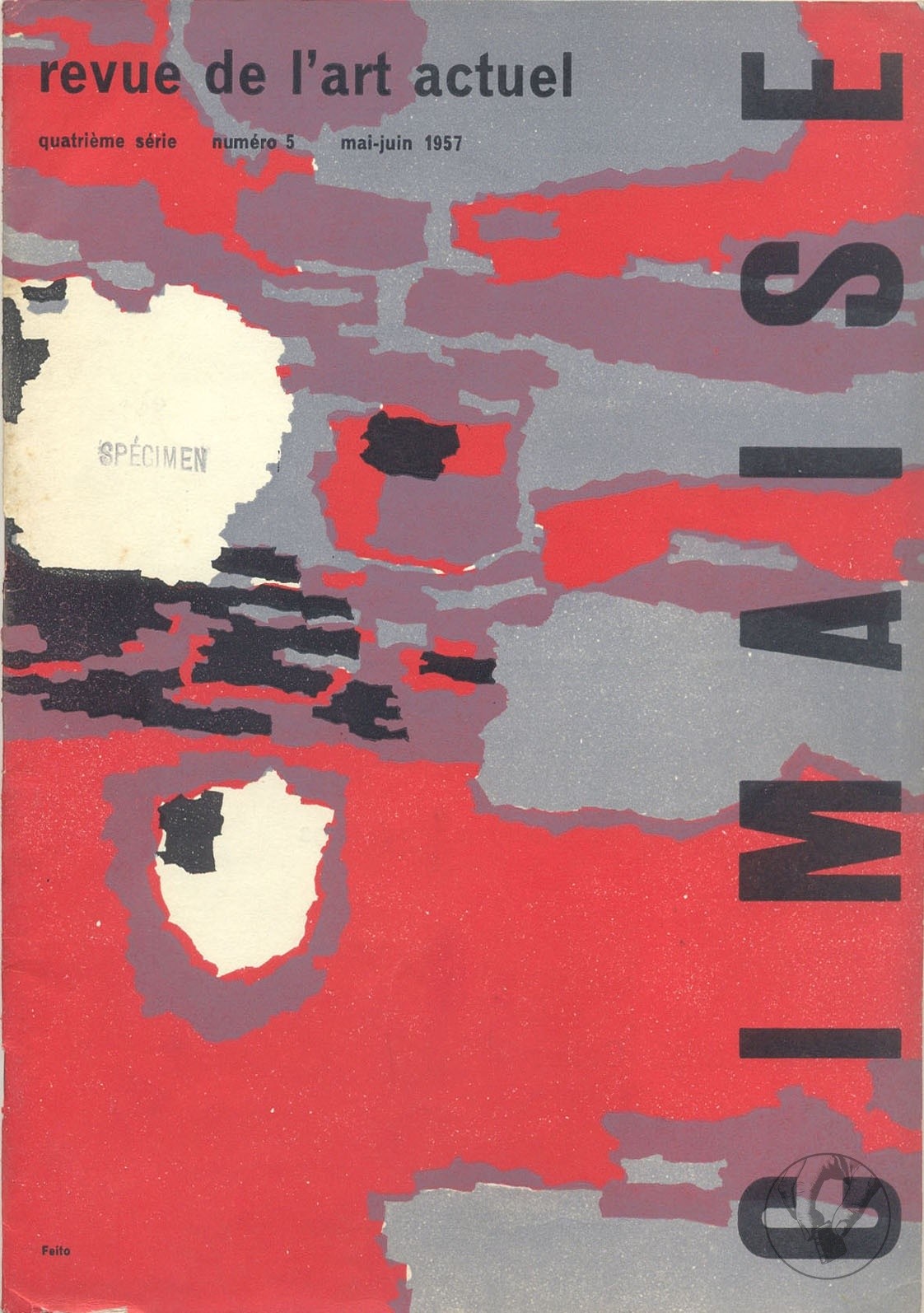
La revue "Cimaise" présente son numéro de mai-juin 1957, dédié à l'art actuel. Ce numéro contient des articles sur Tal Coat, les portraits d'artistes par Denise Colomb, et des critiques d'expositions. Il inclut également des textes en anglais et en français, ainsi que des informations sur les galeries d'art et les publications.