Page 1
Revue de l'Art Actuel Quatrième série - Numéro 4 Mars-avril 1957 --- Arp
First pages of the volume, freely accessible.
Revue de l'Art Actuel Quatrième série - Numéro 4 Mars-avril 1957 --- Arp
Galerie R. Creuze Salle Balzac, 12 rue Beaujon, Paris 8, Wagram 42-31 --- Cinquante ans de peinture abstraite du 9 mai au 12 juin vernissage le jeudi 9 mai
Galerie René Drouin & Cie5, rue Visconti, Paris 6, Danton 20-99 --- Galerie Simone Heller33 rue de Seine, Paris 6, Danton 89-62 --- Claude Georges --- Willy Anthoonssculpturees récentesdu 8 au 27 mars 1957 --- O. Le Corneur J. Roudillon51 rue Bonaparte, Paris 6, Danton 90-06 --- Galerie Arnaud34 rue du Four, Paris 6, Littré 40-26Olivier Le Corneur présenteAnalogiesExpressions nègres et peinture actuellepeintures deAtlan, Barré, H.A. Bertrand, Deyrolle, Feito,Guitet, Koenig, Magnelli, Music, Schneider,Soulages, Sugai, Staël, Flavio S. TanakaArtsKono, Bambara, Senoufo, Wobé, Baoulé,Bénin, Bakota, M’Bété, Bavili, Ba’Lunda, Fang.du 23 mai au 12 juin --- Arts anciensAfriqueAmériqueOcéanieHautes époques ---
Galleria La Tartaruga Via del Babuino, 196, Roma febbraio expositione di gruppo Afro, Burri, Scialoja marzo Leoncillo, Corpora, Mafai aprile Birolli, Turcato, Scarpitta --- H. Couignoux 24 rue de Charenton, Paris 12, Dorian 63-04 Fournitures générales pour les arts arrangements spéciaux pour les lecteurs de Cimaise --- Robert David siège social: 31, faubourg Montmartre, Paris 9 Téléphone Danton 16-26 Photographe spécialiste pour photos de tableaux dessins, objets d’art --- Alexandre Iolas Gallery 123, East 55, New York Laubiès peintures mai --- Wittenborn & Cie New address: 1018 Madison ave. New York, Laubiès œuvres graphiques 20 mai - 1er juin --- A.P.I.A.W. 1 place du Vingt-Août, Liège Collignon, Holley, Silvin du 23 mars au 5 avril --- Romain Weingarten 3 rue de Savoie, Paris 6 Odéon 81-11 Encadrements
Galerie l'Entracte Lausanne --- Garcia peintures du 1er au 14 juin vernissage le samedi 1er juin --- Galerie Breteau 70 rue Bonaparte, Paris 6 Dessins de sculpteurs du 30 avril au 13 mai Vielfaure à partir du 14 mai --- Rive Droite 82 fauboug Saint-Honoré, Anjou 02-28 Mattia Moreni --- Revue internationale d’art moderne QUADRUM 240 pages, 170 illustrations, 12 planches couleur, 16 pages en héliogravure, dépliant, 1 fac-simili Publié par A.D.A.C. Palais des Beaux-Arts de Bruxelles Diffusion française, Paris le no 2 vient de paraître --- Galerie A.G. 32 rue de l’Université, Paris 6, Babylone 02-21 Lydia Conti présente LAGAGE du 17 mai au 20 juin --- Galerie Raymond Duncan 31 rue de Seine, Paris 6, salle sud Abstraction-expression H. Oeltjen-Rustringen sous le patronage du Conseillé culturel de l’Ambassade de la République Fédérale d’Allemagne du 11 au 25 mai vernissage le 11 mai de 17 à 21 heures
Cimaise revue de l'art actuel 34 rue du Four, Paris 6 Directeur: J.R. Arnaud Rédacteur en chef: Herta Wescher Secrétaire général: John Koenig Rédaction: J. Alvard, R.V. Gindertael, M. Ragon, P. Restany La rédaction reçoit sur rendez-vous Abonnement (6 numéros) 1.400 frs - Par avion: 2.800 frs 34, rue du Four, Paris 6, téléphone Littré 40-26 C.C.P. Paris 5542.39 Diffusion: Argentine: Editorial Victor Leru, Cangallo 2233, Buenos-Aires Autriche: Arnulf Neuwirth, Paracelsusgasse 8, Vienne 3 Belgique: Jean Milo, 28 rue de l’Arbre Bénit, Bruxelles C.C.P. Jean Milo, Bruxelles 1591.50 Danemark: Meiners Kunstforlag, Peder Skramsgade 5, Copenhagen Grande-Bretagne: Alec Tiranti Ltd, 72 Charlotte Street, London W1 Japon: Meiji-Shobo, Surugadai, Kanda Tokyo Norvège: J.W. Cappelen, Sortimentebokhandel, Oslo Suède: Eric H. Olson, Upplandsgatan 3, Stockholm, 10 23 77 Suisse: E. Genton, «L’Entr’acte», rue du Lion d’or 4, Lausanne, C.C.P. II 144-56 U.S.A.: Wittenborn and Co, 1018 Madison Ave, New-York 21 --- Sommaire Couverture d’Arp Textes anglais 7 Arp’s Cosmos by Herta Wescher 8 Man and Architecture by André Wogenscky 9 Architecture an abstract art by Michel Ragon Textes français 11 Le Cosmos de Arp par Herta Wescher 24 L’homme et l’architecture par André Wogenscky 26 Architecture et art abstrait par Michel Ragon 29 Lettre de New York par Dore Ashton Peintres et sculpteurs d’aujourd’hui 30 Vulliamy par R.V. Gindertael 32 Guitet par Michel Ragon 34 Informations 35 Les expositions par Julien Alvard, René Déroudille, R.V. Gindertael, René Laubiès, Michel Ragon, Pierre Restany, Herta Wescher Textes anglais 44 Letter from New York by Dore Ashton Vulliamy by R.V. Gindertael 45 James Guitet by Michel Ragon Dans notre prochain numéro: Une étude sur Tal Coat par Pierre Restany Portrait d’artiste de Denise Colomb par Herta Wescher Peintres et sculpteurs d’aujourd’hui: Marta Pan par Michel Ragon Benrath par Julien Alvard Et comme dans chaque numéro: actualité, informations, bibliographie
Complete translation of the main articles translation by J. F. Koenig --- Arp’s Cosmos by Herta Wescher Among the illustrations of the “Blaue Reiter” that came out in 1912, two wood-engravings by Arp, one with clear and smooth forms, the other with nervous and imprecise contours, reflected, according to the avowal of the artist himself, the two principal tendencies that can be found throughout all of his work: one that imposes a willful precision to the forms, and the other that confides itself to the secret forces of chance. This double behaviour manifests itself during his whole life, that is divided between the need to observe and to produce, to read and to write, to meditate alone, and to discuss things with others. However, the two sources of the conscious and the subconscious mind do not, for that matter, contradict one another in any way, but interpenetrate, in order to give this special unity to his personality. Arp was particularly interested in wood-cuts during the decisive moment of his evolution (during the years of the 1st World War, that he passed in Switzerland); they are close to the spirit of Kandinsky, whom he had met in Munich in 1911. In the wood-cuts of both of them, expressionist art reaches a high point, where concrete figuration fades away, and visionary images come forth. Arp’s illustrations for his own poems, or for those of Tzara or Huelsenbeck, are characterized by the great spontaneity of the forms and the lines, that are nonetheless gathered together in central movements and rhythms. The violent contrasts of the black-and-white images create spatial relations of infinite dimensions. During this same period, Arp made the acquaintance of Sophie Taeuber, that placed him in the presence of a purified art, reduced to its most simple geometric forms, that had been undertaken in a revolt against the artificial decorations that had invaded painting and also the applied arts. As Arp himself said, the clear tranquillity of the horizontal-vertical compositions had an influence on the diagonal baroque dynamics of his own creations. The mutual research of the two artists tended toward “absolute” works, of a strict and symmetrical order; they used certain techniques of embroidery and collage, in order to eliminate from art any manual trace, whose imprint can inevitably be seen in drawings and paintings. But these rigidly-structured compositions are to be found during only a short interval in Arp’s development, for his instinctive nature flees from calculation. On the contrary, the ideal of an elementary and anonymous art, free from any frozen geometry, has not ceased from this time on to inspire his work, in many different ways. The Dada movement came to graft itself into these extremely serious experiments; it confessed to similar faiths, but used many strange kinds of camouflage to upset the ideas of the day. Arp, who was one of the promoters of Dada in Zurich, let loose in his poems especially; his titles were “The Path Made of Tents”, “The Cloud-Pump”, “The Pyramid Dress-Coat”—poems that were marked by their complete scorn for ordinary spelling and syntax. He tore words apart, tore their roots up, regrouped and completed fragments of vocables, insisted on the ambiguous sense of words. He adopted the most worn-out slogans and tag-lines of the newspapers to ironically make them into nursery-rhymes. He shook up letters in a magic dice-cup, played at heads or tails, and accepted without culling whatever turned up. All of these poems escape from any exact analysis, and should be taken only in their special modalities of sounds and rhythms, from which deep notes, and percussive phrases sometimes burst forth. To his authentic lyricism is mingled a witty humor, that is Arp’s first and specific quality. If he finds Schwitters like a brother in spirit, he is nonetheless different from the poets of the “Sturm”, just as August Stramm, also an author of a completely new and liberated language, through the impulsive need to exteriorize, without thinking about putting things into a definite form. Today, Arp very decidedly objects to the public opinion that sees only a royal fraud in the Dada movement, that was imagined by some extentric artists just to flabbergast the bourgeois. Nonetheless, the chronicals concerning the nights at the Cabaret Voltaire in Zurich, and the manifestations that took place under Arp’s and Max Ernst’s direction in Cologne, don’t make this legend a lie. Looking back at these things today, the destructive action is seen only as the secondary counter-part of this renovating outburst, undertaken as a “crusade towards the promised land”. A struggle was engaged against a civilization that had become sterile, decked out with purely spectacular artificial ornaments, with its mechanical age, and whose so-called progress had only led to war. Arp and his friends were interested in making a clean sweep of all these false values, that were dominant in politics as well as in art and literature, to free the clogged sources of creation, and to recover, behind the definite, the inexhaustible powers of the infinite. Religious ideas (that later led Hugo Ball, a partizan-writer of the Zurich group, to catholicism) were interpreted by Arp in their broadest meaning, tinted with mysticism, that attracted him during all of his life. The search for the Lost Paradise of simplicity and purety, slowly transformed his plastic work. The few Dada “objects”, conceived in the same spirit of the shock-remedy of the “ready-mades” of Marcel Duchamp—whose message had been brought from New York to Zurich by Picabia—were rather quickly abandoned for more meaningful reliefs. In the beginning, their compositions were related to the abstract language of the wood engravings, but whereas these were based on the multiplicity of the broken lines and forms, in the reliefs, a single motif came forth, taking on, in the cut-out forms, a more significant importance. Later, the images become more simple, and take on a symbolic meaning. Real objects, an anchor, a fork, the hands of a watch, show the realms of human existence, the desires and compulsions. The bird, with its pointed beak, represents the active, the masculine element, and becomes Paolo next to Francesca, whose rounded, passive form is bound in by its contours. In these reliefs, the impersonal character of the forms is underlined by their uniform shades, the neutral harmonies of blue, gray and black; similarly, the juxtaposition of the plane sections forbids any spatial determination. Under the title of “Constellations”, Arp groups the most simple of circles and ovals, each element having its position in strict relation with the others. An important thing is the fact that the archetypes no longer have any reference with geometry, but rather to biology, to the organic world in perpetual evolution. The navels, as Arp likes to name the round forms, contract or enlarge themselves, to invoke the original source, or the sun; these ovoids stretch out or become elongated, like growing embryos, or seeds that burst to form leaves or petals. It’s the internal development of the form, tending towards the expansion of volume, that seems to have led Arp into sculpture. He dedicated himself to it, however, only from 1932 on, at Meudon, where he had been living since 1926. Similar to the reliefs, the first sculptural works were composed of numerous elements, of small forms issuing from a principal volume, invoking offspring gathered around the maternal bosom. But we reach the heart of the Arpian creation with his “Human Concretions”, of single blocks of stone that suggest
indefinite torsos whose rudimentary limbs seem to embrace space. Explaining this title, Arp states the “concretion” means to him all of the natural procedures of condensation, manifested in the mass of stones, animals, man; and also those of dilation, that give birth to the earth and the stars. It is the idea of a unique universe, where the mineral, vegetable and animal species crossbreed in a constant transmutation, where grass grows in the sky, and the stars stroll among us, that emanates from this sculpture. From works of a double form (such as a root rising from a pyramidal base), others come into being, single blocks of a latent internal transformation: stones give birth to fruits, horsetail ferns are petrified into strange architectural columns. Man, in this world, is the a dominating master, but a creature among others, made of not same substances, born from the earth to become earth again, passing through all of the stages of the Genesis, whose days are marked in the torsos of marble or limestone. Even everyday objects participate in this metamorphosis, even to bread that turns back into the manna that contains all of the germ of secret seeds. For Arp, no dividing line separates the realms of the real and the spiritual. To the visible forces ruling over the cosmos, are mingled invisible forces, in which he confides when he speaks of the laws of chance that dictate his compositions. It is in the torn paper work that subconscious creation expresses itself the most spontaneously; gestures that are not deliberate produce accidental forms and contours, that he groups together, without any conscious decision on his behalf, as much as it is possible. Seeing in destruction a re-creative power, seeing good and evil as the two constitutive sides of our world, he grasps onto miserable materials, and trash, and even makes them by tearing up his drawings, and smudging them with ink or glue. And if the reconstruction of the fragments brings into being certain images that instead of being shocking, are moreso rather amusing, Arp accepts them even more readily. “A torn paper is the passage between Art and Nature”, he says. “It’s as beautiful as nature, as perfect, for to grow and perish are natural and non-tragic reflections of one another.” In this phrase, the refusal of tragedy characterizes his spirit, opposed to the pathetic, to the “sentimental”, and favoring the “naive”, in Goethe’s sense of the word, demanding that artistic creation be exempt from egocentric exaltations, and in harmony with the energetic forces of the universe. In his mature years, he abandoned himself more and more to the inspiration of dreams, working “with his eyelids closed”. “I let myself be guided by my work, and entrusted myself to it. I don’t think. While I work, friendly, strange, evil, unexplainable, mute, sleeping forms come into being. They take form within me.” It’s up to the artist to impose his decisive will on them. During the last ten years, one can distinguish works that correspond to two different attitudes. Many of the sculptures seem to develop from the block itself, elaborated and modeled in a manner where the forms hidden in the interior are brought to light; the human figure twists itself into gestures of protection or anguish, and recovers its significant role, either by disguising itself into lunar ghosts, or becoming incarnate in the form of an idol. In the massive volumes, Arp also discerns suggested movements, that he frees in an interplay of airy and enlaced curves; the “Ptolemy” of 1952 offers us the most perfect example of this. To the suggestive meanings of these works, however, other more firmly constructive tendencies are opposed, composed of dissimilar elements that are often superposed in miraculous towers. The precise contours of the geometrical forms that alternate with the vague and rounded forms, are to be found also in the bronze reliefs with their angular plane areas, where Arp calls back the constellations of yesterday, but in more mystical conceptions. Although in constant evolution, the work of Arp presents a real unity, for he always comes back to the same primary elements; these elements are totally evident to him, and have the solidity of building stones for the universe. Herta Wescher --- Man and Architecture by André Wogenscky A man is in the wilderness. It is raining. This man seeks a shelter. If he doesn’t find a natural shelter, he makes one for himself. He makes a roof. But underneath this roof the wind passes, the rain trickles. So he builds a wall around himself. In this envelope it’s dark, he smothers. He wants to breathe. He wants to see. He makes an opening, a window. He is cold, he wants to dry himself. He builds a fire, and organizes in this shelter a place for the fire, and a means of evacuation for the smoke. He creates the hearth. Now with a shelter, warm, dry, safe, he wants to move around. He has built his shelter too small. He only wanted to shelter himself. He built this envelope only to be able to hold him, still, close to the fire. Now he must enlarge his quarters. He pushes out the wall, enlarges the roof, and this container contains him, no longer motionless, but with his gestures. He arranges it to his scale. He lies down. And he sleeps in this container, sheltered, warm, dry, safe. He has begun to organize his shelter. On waking up, he inspects this dwelling, and desires to further perfect it. He enlarges it even more in order to have a place to easily prepare and eat his meal. Then this man take a wife. Then he wants to improve his dwelling even more. He enlarges it again so that it will not only be adapted to his needs, but for both of them, to the dimensions and the gestures of the couple. It must now shelter the sleep, the union, the ease of the couple. And the man wants to perfect his shelter, not only to enlarge it, but to equip it in order to be more at ease, so that everything will be easier and more agreeable for the both of them. Then the children come. So he has to perfect the shelter once more. Enlarge it and equip it for the babes, for their sleep, and in order to wash and feed them. Also, so that they can play, sheltered, in warmth and security. And it’s around all of these gestures, all of the actions of each of the members of the family, and of the family as a unit, that the shelter then takes its form, its dimensions, its proportions. Around the fire, each one sits silently. Each one feels close to the other. Each one thinks. This man has created the family. He has created the dwelling. He has created the home. He has also created architecture. For architecture takes its departure from this perpetual desire to improve, to adapt, to perfect, to better things. If this desire had never existed, there would be no architecture. We would still be living in caves or in primitive huts. And we would be satisfied. It’s our dissatisfaction that produced this. It’s this perpetual readaptation to the ever-changing conditions, it’s this irresistible need to always make things better, that brought about the construction, over the centuries, of the houses and cities in which we live. It’s this imperious desire that leads us to design the houses and cities that we would like to build today. And it is this that will lead our successors, soon, to find
them insufficient, out-dated. And this architectural desire does not exist only for personal reasons. The man we mentioned didn’t organize his dwelling merely in order to make it more practical. “Like that, it’s really fine,” he sometimes exclaimed. He had learned that with forms, dimensions, and proportions you can juggle. Also with materials and colors. You can create rhythm, cadence, counterpoint, harmony. You can play a spatial sort of music. You can make the house dance. He realized that he could create beauty. And he realized that all of these designs, these forms, these proportions, these rhythms, these materials, and these colors react on him, on his wife, on his children, on his family. They could cause them to be happy. He realized that these elements could incite his family to think. He realized that this dwelling could give them the taste for living. He realized that to organize was to create the place where you could think, all together. To create a temple. In each house there should be a bit of the shelter, the dwelling, and the temple. In true architecture, there is always the shelter and the temple. A place where it doesn’t rain, where you are warm, where you are safe. A place where you think, where you become conscious. “And the architect, what position does he have in relation to the man for whom he is to build?” He is a friend, an admirer. He knows him so well that doesn’t think “I know him,” but “I am fond of him”. A friend so sure, so powerful, that he can take this man and model him, while modelling his house and his city around him. A friend so lucid, that he knows, better than the man himself his needs, his wishes, his aspirations. An egotistical and uncompromising friend, who refuses to grant his little whims, his little hungers. A dictatorial friend who imposes what he knows is good. A generous, warm friend, because, as all artists, in his creation, he gives himself to others. André Wogenscky Architecture and Abstract Art by Michel Ragon If you take the term Architecture in its expression of synthesis that it takes on more and more, that is to say, not only the art of building houses, palaces and factories, but also ships, airplanes and everyday objects, that is to say, not only the art of building a house, but also that of installing this house, you will then see that abstract art has crept into our homes, that it has, without the slightest doubt, taken possession of the most modern spot in our dwelling—the kitchen—and even creeps into the living-room with the arm-chairs designed by abstract sculptors such as Bertoia, and if industrial design (we mention Hans Knoll and Loewy particularly) is a realization born from contemporary architecture, the idea was nonetheless brought about by the Bauhaus, just as was born at the Bauhaus (where we found Gropius, Kandinsky, Klee, Moholy-Nagy...) this new type of technician-artist that we call the designer. Did today’s architecture thus take form in the theories of abstract artists, or were these artists influenced by the new architecture? It seems—and this is the best sign—that the architect, the sculptor and the painter influenced one another by ricochets (1). For that matter, it is always thus that the plastic style of a period is born. Moreso than abstract art as such, it was the new conception of space brought about by Cubism that was at the origin of present-day architecture in Europe. When Le Corbusier wrote, “Today painting has preceded the other arts,” he was thinking of Cubism, However, around 1900, that is to say, well before the invention of cubism, the American architect Wright had built his first functional houses. They were little known in Europe, but Wright made a series of lectures on his architectural conceptions in Holland in 1911-12. When the review De Stijl came out five years later, in Leyden, under the influence of Kandinsky’s book “On the Spiritual in Art”, this review and group De Stijl, that was to have a great influence on abstract art, referred themselves also, not only to the Mondrian’s cubist experiments, but also to the already “advanced” dutch architecture that had certainly retained some of the essential ideas of Frank Lloyd Wright. Elsewhere, in Russia, Casimir Malévitch, also a pioneer of abstract art, wrote in 1923: “Painters have made a great revolution in painting that imitated the object, and they have come, at a certain moment, to a painting without the object. They have have found new elements that bring up, already today, the problems of tomorrow’s architecture.” (2) “Architects and painters must feel the awakening of the classical spirit that was smothered by the struggle for the perfection of the social structure and economic life. After the decadence of an art that copied the object (naturalism), the classical spirit has come back again.” Today’s architect has, in fact, come back to a classical spirit. Because of a mathematical necessity, architecture is abstract. Thus one can say that since its beginning, architecture has tended towards an abstract art, and that any successful architecture, of the past or present, conforms to the exactions of abstract art. It was the ornaments of the decorative arts that stifled architecture for a long while. One can well remember Adolphe Loos’ campaign against ornament, that was for him the sign of barbarity, just as the tattoos that primitive people love. A civilized man, a 20th Century man, who feels the need for ornament has the mentality of the primitive or the criminal, according to Adolphe Loos. Modern art replaced ornament with nudity, by the pureness of line, by the smooth, polished, straight surfaces. Its purity, its healthiness, its hygiene, opposed themselves to the complexities of the baroque intricacies. Now listen to what Mondrian has to say. This great classic of abstract art wrote in 1920, in his essay on Neo-Plasticism, published by Leonce Rosenberg: “The future of the new Plastic Art, and its realization in Painting resides in the Chromoplastics of Architecture. It commands the interiors as well as the outside of the building, with everything that expresses the color relations in the latter. No more so than the “New Plastic Art as a Picture” that prepares it, Chromoplastic Art is not a “decoration”. It is an entirely new painting, in which all painting, pictorial as well as decorative, is resolved.” (1) The finnish architect, Alvar Aalto, a friend of Léger, Arp, and Brancusi, wrote: “Before all, one can say that the abstract artistic forms have given a strong impetus to modern architecture. Assuredly, it was done in a roundabout manner, however, the fact cannot be denied. These impetus influenced one another, and on his side, the architect gave an impetus to abstract art. Hand in hand, the different men gave each other reciprocal aid”. (2) Malevitch constructed, around 1920-22, models for a “dynamic and suprematist” architecture.
“Decorative Arts disappear in Neo-Plasticism, just as the Applied Arts: furniture, pottery, etc., take form from the simultaneous action of the new Architecture, Sculpture, and Painting, and are automatically ruled by the laws of the new plastic art.” Alas, we are far from living in this new synthesis of Architecture, Sculpture, and Painting, and the applied arts... according to the laws of the new plastic art. On the subject of this synthesis of architecture with the other plastic arts, André Wogensky pertinently answered the inquiry that the Italian review Numero made, saying that this synthesis is not valid if each work takes form separately. “These works,” says Wogensky, “must be born together, as an inseparable whole, as a unity, as a Form or a Structure, in the full meaning of these terms, a form to which you can add nothing, nor take away anything without destroying it.” Few painters, few sculptors are ready for this great task. Doubtless, few architects also. Each one does his own job, in his own corner, and with this individualistic system that brings the artist back to the rank of a first-class artisan, our period risks well not to leave any of these ambitious, even a bit fool-hardy landmarks, but one where individuals have fully expressed themselves, surpassing themselves for a collective work that has the size of a century. To have Braque paint a ceiling in the Louvre is an absurdity. To have him paint a wall in a Palace of the Twentieth Century would have been more desirable. In the 18th Century, Lebrun didn’t make any decorations in a Romanesque chapel, next to frescoes of the 10th Century. He was given the walls of the Chateau of Versailles. It is shameful to have to be reminded that in principal, painting and sculptures are not made for museums. It’s also true that lions are not made for zoological gardens. It’s only because we can’t go to see these animals in their natural habitat, in Africa or in Asia, that we go to see them at the Zoo of Vincennes. It is also because we cannot contemplate the works of present-day artists in the Palaces of the 20th Century that might be the stations, the stadiums, landing-field buildings, etc... that we go to see them in the “store-rooms” of the museums. Museums should only exist for destroyed civilizations, for the arts of the past that are no longer functional. But to go to see the works of present-day artists in museums is as inhuman and as absurd as accepting the zoo as the ideal habitat for wild beasts. In being forced to make sculptures for apartments, for exposition halls, and for museums, the sculptors forget the parks. They end up by giving us an ambiguous art of model-makers. Some fall into the pitfalls of cabinet-workers, or the finishing of precious stones; others into that of making projects for monuments that are as pretentious as they are unformulated. This situation of pariah of the contemporary sculptor, has for an effect the rarity of really fine sculptural works in today’s art. But perhaps the sculptors would find themselves a role to play in the new city, if they adapted themselves to modern civilization, if they abandoned their romantic position of first class artisan, and studied the new materials that have been discovered by the chemists and engineers. We must not forget that contemporary esthetics has been created by engineers, through their dams, high-tension pylons, bridges, liners, factories, airplanes, cars, motos, refrigerators, etc. Heads of industries and artists ignore this fact much too often. Just as it hasn’t been enough stated that industrial design only created functional forms from the day when it ceased to be imitative, and became abstract. Thus, when the first engineers had the problem of constructing an airplane, they said to themselves that in order to make this machine fly, it would have to have the form of a bird. This was an error, and airplanes only became airplanes since the time when they no longer resembled birds, but since the time when they found their own form. The same thing happened with cars that were designed at first like hackney-coaches. Ugly and uncomfortable, they only became beautiful since the time when their form was perfectly adapted to their function. The prejudice of materials is well-anchored into the heads of artists. Thus for painters, canvas and oil-color are “noble” materials and thus are sacred. Some have tried timid essays towards painting on isorel, but dealers and collectors generally demand canvases. The artist that used oil and canvas in the 15th century, breaking with the tradition of tempera on wood, accomplished a revolution as difficult as that of present-day artists trying out new materials: aluminium, concrete, plastics. Few works follow the direction of the adaptation of the artist to the materials of his century. There is nonetheless the illustrious example of Calder with his “mobiles” and “stables,” the welded iron and brass sculptures of Pevsner, the steel sculptures of Hans Uhlmann. Doubtless, it isn’t by chance that these three sculptors are also engineers, or have studied engineering. After having shown the way to the architect, will the engineer show one also to the sculptor? This influence is notable also for sculptors such as Robert Jacobsen, Lardera, Lippold, as well as Schoffer, for whom tubular scaffolding constitute the key of his esthetics. Moholy-Nagy used plexiglass already in the Bauhaus, and give us today very beautiful sculptures in nylon. Finally Le Corbusier has given us, with his ventilation chimneys and other architectural elements of the roof-terrace of the Unité d’Habitation of Marseille, a magnificent example of functional sculpture in concrete, conceived by a sculptor who is also a painter, “a painter occupied with the invention of conditioned forms,” according to his own terms. Le Corbusier is doubtless one of the rare artists who realized this synthesis of architecture, sculpture and painting. The Chapel at Ronchamp is a wonderful example of this synthesis, but here again, this work has been realized by a single man. What would be desirable would be to have architects, sculptors, painters, and engineers collaborate together efficiently in the elaboration of new buildings. “Sculpture must be no longer the servant of Architecture, as it often was in the old conception of things,” wrote Mondrian in 1920. In an abstract and functional architecture, the painter and the sculptor evidently can no longer serve as “decorators”. Charles Blanc concluded in his study on the monuments of Antiquity that “Architecture, in its best respect, is not so much a construction that is decorated, as a decoration that is constructed.” In this construction, sculpture and painting cannot be added. It is the entire work that must be at the same time Architecture, Sculpture and Painting. And the sculptor probably will only find his social role when he leaves aside the marble of the old palaces, for the concrete of the new buildings, and if he thinks more of plastics than of bronze. The abstract painter can also find a social expansion in architectural polychromatic works. In fact, Mondrian’s esthetic theories are better suited to architecture than to easel paintings. And the traditional japanese houses, that have influenced european and american architects so much, are of a plastic art that is very close to Mondrian, but one that is developed in space. And Mondrian’s studio, that seemed so far-fetched in the Paris of 1930, is now “published” in millions of copies. Without realizing it, people live in Mondrian-kitchens. They light their homes with lamps inspired by Calder. They sit in armchairs that wouldn’t have been designed if Moore hadn’t existed. And it’s thus that the style of a period is born. When the influences come and go, when they are mixed together to the point where you don’t know any longer if it’s the architect who gives a lesson to the engineer, if it’s the engineer who guides the sculptor, if in his turn the sculptor or the painter influence the “designer”. In any case, all of these creators are to be found in a concept that belongs to our period: instead of plastically expressing the beauty of nature, as in the past, man creates a new beauty, an abstract beauty. Michel Ragon
Le Cosmos de Arp par Herta Wescher Parmi les illustrations du « Blaue Reiter », paru en 1912, deux gravures sur bois de Arp, l'une aux formes claires et lisses, l'autre aux contours nerveux, indécis, reflètent, de l'aveu de l'artiste lui-même, les deux tendances principales qui se retrouvent dans toute son œuvre : celle d'imposer aux formes une précision volontaire et celle de se confier aux forces secrètes du hasard. Ce double comportement se manifeste partout dans sa vie, partagée entre le besoin d'observer et de produire, de lire et d'écrire, de méditer seul et de discuter avec les autres. En fait, cependant, les deux sources de l'inconscient et du conscient ne s'opposent nullement, mais s'interpénètrent pour donner à sa personnalité son unité particulière. La gravure sur bois, dont Arp s'est préoccupé spécialement au moment décisif de son évolution — pendant les années de la première guerre mondiale qu'il a passées en Suisse — est proche en esprit des recherches de Kandinsky, qu'il avait rencontré à Munich en 1911. Dans les gravures de l'un comme de l'autre, l'art expressionniste atteint sa puissance culminante là où la figuration concrète s'estompe au bénéfice d'images visionnaires. Les illustrations de Arp pour ses propres poèmes, pour ceux de Tzara et de Huelsenbeck, se caractérisent par la forte spontanéité des formes et des lignes, qu'il rassemble, cependant, en des mouvements et des rythmes centrés. Les contrastes violents des noirs-et-blancs créent des rapports spatiaux aux dimensions infinies. A cette même époque, Arp rencontre Sophie Taeuber qui le met en face d'un art purifié, réduit aux plus simples éléments géométriques, acclamé dans la révolte contre la fausseté des décors illusionnistes qui, venue de la peinture, envahissait également les arts appliqués. Comme Arp l'a dit lui-même, la tranquillité claire des compositions horizontales-verticales exerçait son influence sur le dynamisme baroque et diagonal de ses propres créations. Les recherches communes des deux artistes tendent vers des œuvres « absolues », d'ordre stricte et symétrique ; ils ont recours aux procédés de la broderie et du collage pour éliminer de l'art les traces manuelles dont on voit, inévitablement, l'empreinte dans le dessin et la peinture. Mais ces compositions aux structures rigides ne forment qu'un court intervalle dans le développement de Arp, dont la nature instinctive s'écarte de tout esprit de calcul. Au contraire, l'idéal d'un art élémentaire, autonome, non figé dans la géométrie, n'a pas cessé depuis lors d'inspirer son travail sous les aspects les plus différents. Sur ces recherches extrêmement sérieuses se greffe le mouvement Dada, qui professe des croyances analogues mais au moyen des camouflages les plus bizarres, renversant le sens même des concepts mis au jour. Arp, qui en est l'un des promoteurs à Zurich, se déchaîne surtout en des poèmes — aux titres tels que « le Chemin de tentes », « La Pompe à nuages », « L'Habit de pyramides » — poèmes marqués d'un
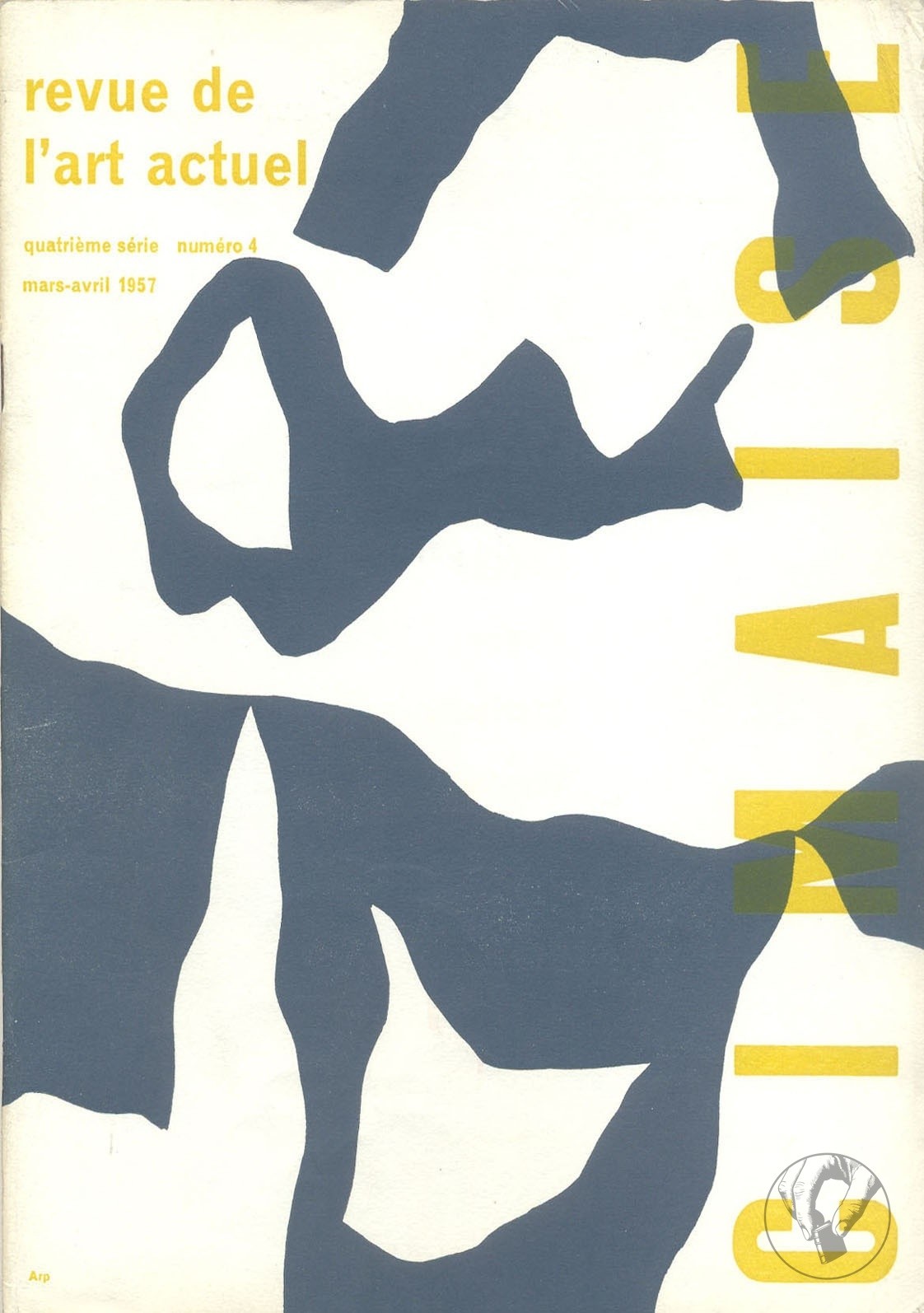
La revue "Cimaise" présente dans ce numéro des articles sur l'art abstrait et des artistes contemporains. Les textes abordent le "Cosmos" de Arp, l'homme et l'architecture, ainsi que l'architecture comme art abstrait. Des critiques d'expositions et des informations sur les galeries d'art complètent le contenu.