Page 1
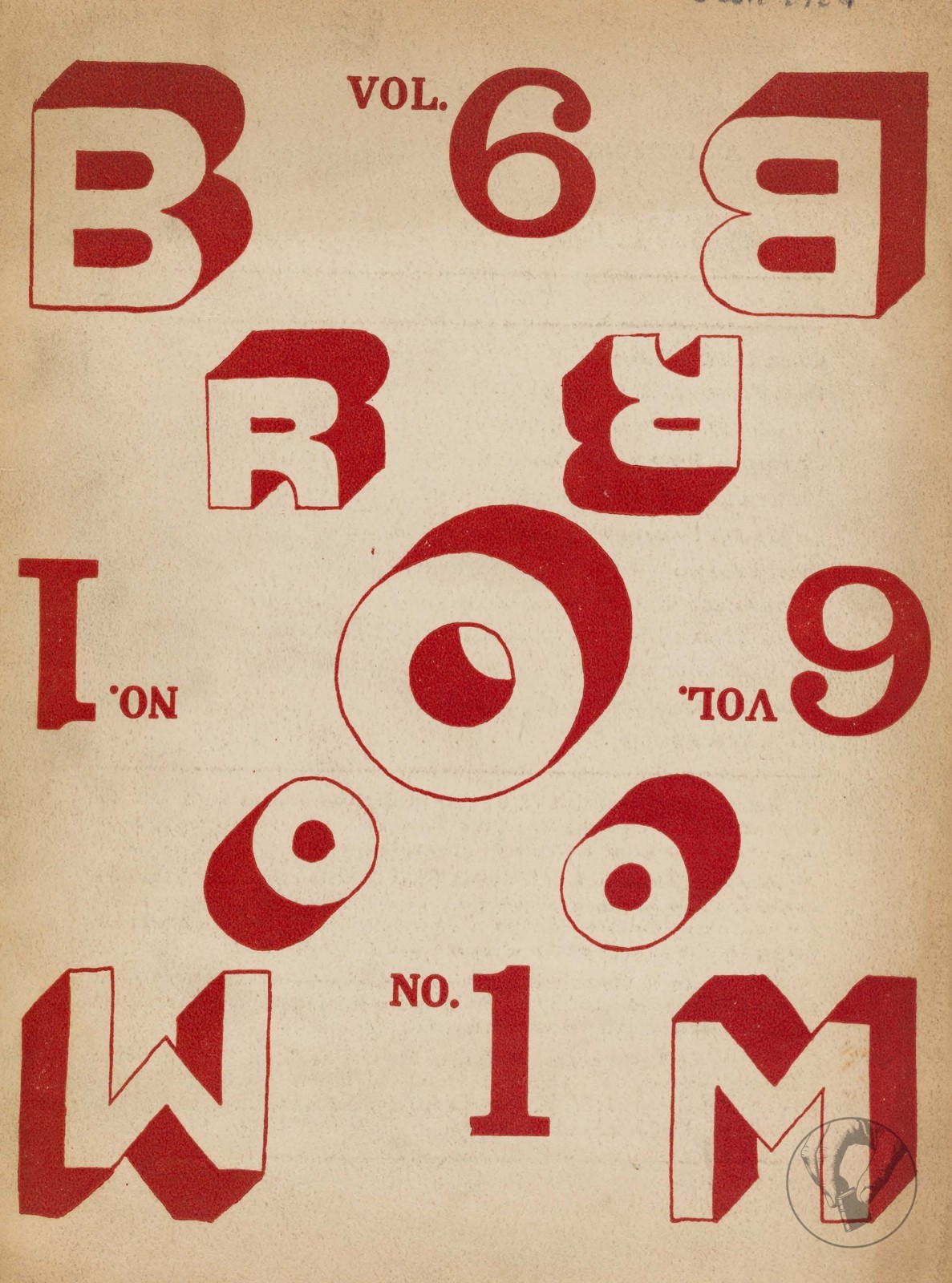
VOL. 68 BREI .ON 9 .TOA IOOM NO. 1 M
First pages of the volume, freely accessible.
VOL. 68 BREI .ON 9 .TOA IOOM NO. 1 M
BROOM AN INTERNATIONAL MAGAZINE OF THE ARTS Editors SLATER BROWN MATTHEW JOSEPHSON MALCOLM COWLEY HAROLD A. LOEB --- JANUARY, 1924 TWENTY-FIRST ISSUE VOL. 6, No. 1 --- COVER DESIGN—Lissitsky --- PAGE --- FOUR POEMS—E. E. CUMMINGS --- MY DEAR JEAN—PHILIPPE SOUPAULT --- MATTERS OF IMPORTANCE—RAMON GUTHRIE --- PRINCE LLAN—KENNETH BURKE --- SIR WALTER RALEIGH—WILLIAM CARLOS WILLIAMS --- BOOK REVIEWS: - TULIPS AND CHIMNEYS—SLATER BROWN . . . . . . . . . . . . 26 - THE THOMAS JEFFERSON BIBLE—ROBERT A. SANBORN . . . . . . 28 - THE STORY OF THE BIBLE—GEORGIA MARY SANBORN . . . . . . 29 COMMENT: OPEN LETTER TO THE DIAL . . . . . . . . . . . . 30 THE BROOM AWARD . . . . . . . . . . . . . . . . . . . . . 31 --- Beginning with January, 1924, the price of BROOM is reduced to 35 cents the copy and $3.00 for the yearly subscription. Subscriptions at the previous rate of $5.00 the year will be extended in ratio to the difference in price. Attention of readers is called to the fact that at times the publishers of BROOM are compelled, by the hazards of publishing a non-commercial review in America, to ship a month. In such cases subscriptions will be extended, and the publishers guarantee that they will be filled by number of issues instead of by months. The Editors of BROOM will be pleased to consider mss. submitted to them, but all mss. must be accompanied by a self-addressed stamped envelope. The Editors cannot be held responsible for mss. lost in transit. BROOM is published monthly at 45 King Street, New York, by The Broom Publishing Company, Inc. Entered as Second Class Matter, June 30, 1923, at the Post Office of New York, N. Y., under the Act of March 3, 1879. Copyright, 1923, by the Broom Publishing Company, Inc. --- $3.00 THE YEAR 35 CENTS THE COPY
FOUR POEMS ohld song you Know a fly and his reflection walking upon a mirror this is friday 1 what 3 a fly and her his Its image strutting (very jerkily) not touchH- ing because separated by an impregnable Because (amount of inter -vening) anyway You know Separated what i Mean (old song by ;neither you nor i and by the way) ,which is not fly i’d think “wonder if” if i were a child “we can see a bat in this twilight”) there one is look how it goes like a dream (and between houses, really a kind of r
mouse) but he has little wings and here’s my hotel this is the door (opening it i think things which were supposed to be out of my reach , they are like jam on the shelf everybody guessed was too high) look (it’s back again there therehere And) i say “won’t you” (remembering) knowing that you are afraid “go first” of dreams and little bats & mice (and you, you say “let’s” going in “take hands” smiling “going up these dark stairs. if (you are i why certainly the hour softly is in all; places which move seriously Together. let) us fold wholly ourselves smil- ing because we love, as doomed few alert (flowers and excellently upon whom Night wanders and wanders and) wanders Or since, in air
like bubbles Faces occur(shyly to one by bright brief one be)punc -tured:the,green nameless caterpillar of evening nib,ble,s Solemnly a whitish leaf of sky. Will i ever forget that precarious moment? As i was standing on the third rail waiting for the next train to grind me into lifeless atoms various absurd thoughts slyly crept into my highly sexed mind. It seemed to me that i had first of all really made quite a mistake in being at all born, seeing that i was wifeless and only half awake, cursed with pimples, correctly dressed, cleanshaven above the nombril, and much to my astonishment much impressed by having once noticed(as an infantile phenomenon) George Washington almost incompletely surrounded by welldrawn icecakes beheld being too strong, in brief:an American, if you understand that i mean what i say i believe my most intimate friends would never have gathered. A collarbutton which had always not nothurt me not much and in the same place. Why according to tomorrow’s paper the proletariat will not rise yesterday. Inexpressible itchings to be photographed with Lord Rothermere playing with Lord Rothermere billiards very well by moonlight with Lord Rothermere.
A crockodile eats a native, who in revenge beats it insensible with a banana, establishing meanwhile a religious cult based on consubstantial intangibility. Personne ne m’aime et j’ai les mains froides. His Royal Highness said “peek-a-boo” and thirty tame fleas left the prettily embroidered howdah immediately. Thumbprints of an angel named Frederick found on a lightning-rod, Boston, Mass. such were the not unhurried reflections to which my organ of imperception gave birth to which i should ordinarily have objected to which, considering the background, it is hardly surprising if anyone hardly should call exactly extraordinary. We refer, of course, to my position. A bachelor incapable of occupation, he had long suppressed the desire to suppress the suppressed desire of shall we say:Idleness,, while meanits opposite? Nothing could be clearer to all concerned than that i am not a policeman. Meanwhile the tea regressed. Kipling again H. G. Wells, and Anatole France shook hands again and yet again shook again hands again, the former coachman with a pipewrench of the again latter then opening a box of newly without exaggeration shot with some difficulty sardines. Mr. Wiggin took Wrs. Miggin’s harm in is, extinguishing the spitoon by a candle furnished by courtesy of the management on Thursdays,opposite which a church stood perfectly upright but not piano item:a watermelon causes indigestion to William Cullen Longfellow’s small negro son, Henry Wadsworth Bryant.
By this time, however, the flight of crows had ceased. I withdrew my hands from the tennisracket. All was over. One brief convulsive octopus, and then our hero folded his umbrella. It seemed too beautiful. Let us perhaps excuse me if i repeat himself: these, or nearly these, were the not unpainful thoughts which occupied the subject of our attention; to speak even less objectively, i was horribly scared i would actually fall off the rail before the really train after all arrived. If i should have made this perfectly clear, it entirely would have been not my fault. E. E. CUMMINGS
MY DEAR JEAN: This card, this picture that you addressed, I hardly know who sent them. Was it really you and did you wish me to seek your veritable face? Jean, I want to see you again. I hunt for you everywhere. I remember, and search furiously through the years as if to find a flower, a friend, a key. You watched everything which surrounded you as if in a mirror. It rained and you were gay. It rained, you had tears in your eyes, it rained, you smiled or raged. Trees, monuments, passers-by belonged to you as sincerely as did the clocks. I can see you once more in the streets, absent-minded, happy at the least incident, marching straight in front to find you didn't know what. You recognized the house you lived in because you had seen it on a postcard. All day you thought of the stars; you spoke to the stars, and at night you forgot to see them. Sometimes you followed women with the insistence of certain johnnies; not because they were pretty, but because you had seen a spot on their coat. Your best moments, you affirmed, were the lost moments, and you went about repeating continually that you had errands to run, important engagements, a "pile" of letters to dictate, an incalculable number of telegrams to send. You smiled without knowing why, you smiled as one takes a walk, merely to stretch. You spoke without wishing, and to announce events of a very relative importance. "I saw," you would say, "an astonishing automobile: it was green and blue. The chauffeur had a huge cap and was smoking a gold-tipped cigarette. Isn't it upsetting? I met Edward. He's gone completely mad. He bought a grey hat." You believed that everything which astonished you was of the highest interest. You would say constantly, "I saw, I heard, I read..." and when your interlocutor replied in turn, "I saw, I heard, I read," you were listening no longer. Your politeness was so ingenious as to be insulting, and suddenly for unknown reasons it was replaced by the most disagreeable vulgarity. One of your dear friends, one of those who thought they knew you, was discussing you a little before your departure. "Jean," he said, "is a disturbing personage. He cannot, without fear, affirm or deny. He likes without enjoying. He lives in the same fashion that he smokes. Hardly has he lighted his cigarette when he hurries to finish it so he can light another. One day I even noticed him forget that he had a cigarette between his lips already and carry a second there. He comes and goes with a disarming candour. He makes promises and never keeps them. He keeps the prom-
ises which he never made. Jean pretends not to understand the things one says to him. He doesn’t listen and yet his memory astonishes and revolts me. Most of the time he remembers only the minor details, with which he confounds you. I do not think that he is careless. To evoke a memory, any memory in front of him is to offend him surely. Memories wound him. Speaking only of the future he lives in the present, which in his case is the past of women who were once pretty. In spite of everything the moment disturbs and amuses him like the temperature. As soon as he meets some one he speaks of cold, rain, heat, but if you ask him bluntly what the weather is, he can make no answer.” I have had sufficient leisure to observe you, and am not astonished when your friends make such remarks. The least things were important in your eyes. You could throw away nothing, you preferred to put things to one side, but definitely, for it never entered your head to look for anything whatsoever. You did not file away, you hid. Dust accumulated without disturbing you, without even attracting your attention. We thought to give you pleasure and only irritated. You had the manias of a collector and the disgusts of a dilettante. Certain things pleased you: newspapers, cigarettes, inkstands, racehorses, boats. My dear Jean, I lived two years beside you, and saw you almost daily. Where are you? I can see nothing. The light is divided. It is day and night. You are there. The weather is grey, is sombre, is gay. These years are unbreakable toys, or colours without danger. Often we walked in the streets which are dear to you, these streets of Paris where the sun lighted every shop, every tree on our path. Certain cafes, your favourites, were obligatory stops. The waiters, whom you called Albert on principle, did not like you. They knew that brusquely the desire to leave would make you clap your hands and cry out to make them rush to be paid. The uneasy proprietor grouped his general staff to satisfy you. In winter you left “your cafes” definitely at the moment when the employees of the gas company were hanging night in the streets. We hurried through certain quarters with which you were deliberately unfamiliar, and which gave you the opportunity of being astonished at every step. In certain stationeries you demanded books that were rare or out of print, and when the stationer declared that he did not know this book, you protested energetically, accusing him of neglecting his interests. Sometimes at a hardware store you tried to buy cherries or live birds. You always chose laundries to offer oranges to
the laundresses, and you grew justly angry when the proprietor showed you the door. These walks always ended along the banks of the Seine, and it was there only, as you watched the river, that you began to speak. “I can think of nobody more stupid than bargemen. They run after the smoke of tugboats and their shadow in the water. These people are hardly more sympathetic than crows. Often I watch them hanging out their wash and cleaning the barge. As soon as they arrive at a destination they are homesick, but for what home? They don’t know how to laugh. . . . Did you see that old bird? I meet him ten, twenty times a day. He catalogues his dreams. He is a collector. . . . Every time I pass near these ambulant painters, as numerous as dead leaves in this corner, I laugh very loud to make them nervous. They become afraid that they are not copying the apse of Notre Dame with sufficient exactness. It changes colour every quarter of an hour, and the poor men can’t paint fast enough. Look at that woman, look at those people . . .” Without ever wondering if I were bored, you continued to talk about everything which surrounded you. About six o’clock we would go to your rooms. You threw your hat on a chair, your gloves on a table, your body on the lunge and your coat somewhere else. You repeated, “Old man, I’m dead tired. Why did you make me walk so far?” The tea was served. I have always heard you say that it was the most agreeable hour of the day for you, and you hastened to absorb several boiling cupfuls so as not to interrupt too long the succession of your cigarettes, the pain of your days, the only habit you possessed. In spite of your fatigue you leaped from your lounge to your bookcase, from your bookcase to your desk, to throw yourself back on the lounge with the brilliant ball of gas above your head. You chose a book at hazard, accompanying your comings and goings with “What trash! What an idiot!” Or again, “Astonishing! Astonishing! Read this! Read this!” Once more you poured tea into the cups, forgetting to drink as you skimmed through a magazine, a newspaper which lay there by chance. It was at this hour that you would speak of the future. I have said your conversation, so selfish and disjointed, was boring, and however, when you were thinking of tomorrows, your words as distant as stars took fire, twinkled. At the end of a day, abandoning the newspapers, you watched your hands: “The months of the past are as tragic as so many lost lives. We shall still walk proudly, a smile on the lips. I know that smiles are the true reflections
of the sun. Cold weather would suit us perfectly. There will be great shadows, great clouds, which will follow us step by step. And we shall watch the eyes of people to possess this dizziness at last. We shall find long cigarettes to gild our mouths, near trembling trees which you love, which I love, which we love. The weather will be dry, I tell you, and our steps on the sidewalk will tick off the seconds. Automobiles pass rapidly surrounded with a silence. Some one will follow us.” Why do I evoke these memories? Why do I speak of Paris which you are forgetting already? Only to recognize you, Jean, and to forget those who know you. I am surrounded by the people who did not wish to support your charming infirmities and who wonder at your absence so as not to complain of it. You must be smiling again. Jean, you are more earnest than all of us, more gay than all of us, and you are afraid. I am thinking of the clear days, of luncheons in the sunshine, of your headaches, old refrains which hang in your memory. Between us there is this forgetting, this deep well whose chain creaks like swallows. You do not know where you are going, red as a rooster, your eyes closed, a pipe between your teeth. Against the green and blue fields of spring, I see Jean, his hands in his pockets, stop to look at a pebble, a tree, his shoe. What is he thinking about? It is five o’clock, eight o’clock or noon? An escaped church bell makes the women hasten. The sun falls at your feet, Jean, and you descend from the hill with your hands in your pockets, pipe in your teeth, red as a rooster, your eyes closed. You are this fat man; you rise at dawn and walk without thinking. The animals are no longer afraid of you, the trees know you. You pass these men indifferently who think themselves your brothers. You remember us no longer. Can I believe truly that so much friendship, so much understanding, lead to this silence which you now must call the future? You continue to walk in these rays of the morning, along this nameless road. “One day,” you wrote me on the back of your portrait, “an ambulant photographer knocked at my door. I opened. He resembled you and I send my best regards.” I thank you for writing these few words and now excuse myself for having replied at so great length. My memories are nets from which I cannot escape. Affectionately yours, PHILIPPE SOUPAULT (Translated by Malcolm Cowley)
This issue of BROOM, an international magazine of the arts, features poetry by E. E. Cummings, prose by Philippe Soupault and Kenneth Burke, and book reviews. It announces a price reduction for the magazine starting January 1, 1924, and highlights its commitment to a definite artistic policy. The content includes a mix of literary works and commentary on the arts.