Page 1
BROOM SEPTEMBER N.2 Halicka VOLS
First pages of the volume, freely accessible.
BROOM SEPTEMBER N.2 Halicka VOLS
BROOM AN INTERNATIONAL MAGAZINE OF THE ARTS Editor, HAROLD A. LOEB Associate Editors, SLATER BROWN, MALCOLM COWLEY, MATTHEW JOSEPHSON --- SEPTEMBER, 1923 PUBLISHED MONTHLY VOL. 5, No. 2 --- COVER DESIGN—HALICKA Title --- Author --- Page --- THE “U. S. A.” CINEMA --- PHILIPPE SOUPAULT --- IN THE ORCHARD --- VIRGINIA WOOLF --- THE BARE BODIES --- GLENWAY WESCOTT --- THE FOUNTAIN OF ETERNAL YOUTH --- WILLIAM CARLOS WILLIAMS --- MOTION PICTURE DYNAMICS --- ROBERT ALDEN SANBORN --- MOTION PICTURE “STILLS” --- (facing) 80, 81, 96, 97 --- KABNIS --- JEAN TOOMER --- THE BRAIN AT THE WHEEL --- MATTHEW JOSEPHSON --- MEMPHIS JOHNNY --- MALCOLM COWLEY --- THE POET ASSASSINATED --- GUILLAUME APOLLINAIRE --- OVERTURE --- ISIDORE SCHNEIDER --- BOOK REVIEWS: Title --- Author --- Page --- THE PROBLEM OF SPACE --- EDWARD NAGLE --- JACOB’S ROOM --- THE VEGETABLE --- THE GENIUS OF AMERICA --- CRAFTSMANSHIP OF THE ONE ACT PLAY --- COMMENT—WILL BRAY Title --- Author --- Page --- A NOTE ON SCULPTURAL KINETICS --- SLATER BROWN --- The Editors of BROOM will be pleased to consider mss. submitted to them, but all mss. must be accompanied by a self-addressed stamped envelope. The Editors cannot be held responsible for mss. lost in transit. BROOM is published monthly at 47 West 34th Street, New York, by The Broom Publishing Company, Inc. Entered as Second Class Matter, June 30, 1923, at the Post Office of New York, N. Y., under the act of March 3, 1879. Copyright, 1923, by the Broom Publishing Company, Inc. --- Business and Advertising Office 47 WEST 34TH STREET NEW YORK Editorial Office 49 WEST 12TH STREET NEW YORK $5 A YEAR 50 CENTS THE COPY
THE "U. S. A." CINEMA Just when the eyes of Frenchmen were tiring of the eternal sameness of the realistic drama—"slices of life"—when only the music halls could touch for a moment our poor hearts dried up by poetry, the cinema was born. But soon the disillusionment was stronger than one could have imagined. The films were lamentable, insignificant, and boring. They were not even stupid enough to cry over; the scenario writers wished at all costs to reach the people, that public which is thrilled by melodramas and sentimental comedies. Consequently the intelligent directors in order to cause tears to gush forth, planted little blue flowers in the gelatine of the film. The result was to be expected. All the spectators began to cry, but of laughter. One saw a little girl stolen by wicked gypsies and recovered accidentally by her family, a poor mother and her dozen children, beaten by a brutal and intoxicated husband, and revenged at last by the demon rum and delirium tremens. As the old sad song has it: "It was lovely but it was sad, the fireman wept into his helmet." All possibilities were exhausted. The ennui of evenings which trail like the smoke of cigarettes and which stretch the arms to sleep took flower in the ardent life led by the younger people, my friends. We walked in the cold and deserted streets looking for an accident, a chance meeting, life. To distract ourselves we had to harness our imaginations to sensational dreams. The newspapers, which are even more brightly colored than maps, diverted us for a moment. For a few cents one travelled the whole world over and was present at marvellous and bloody dramas which illuminated for an instant certain points of the globe. We thirsted, thirsted terribly, for this strange strong life, this life that we drank like milk. One Jacques Vaché, the strongest among us, cried: "I should also be a trapper or a thief or a searcher or a hunter or a miner or a sheep-shearer!" One day we saw great long bill-posters stretched along the signboards like serpents. At each corner of the street a man, his face
covered with a red handkerchief, threatened the peaceful passers-by with a revolver. We heard galloping horses, chugging motors, screams and death-rattles. We dashed into the movie houses and realized that all was changed. The smile of Pearl White appeared on the screen, that almost ferocious smile announcing the upheaval of the new world. We began to understand finally that the cinema was not a perfected mechanical toy, but the terrible and magnificent flag of life. The little dark halls where we sat became the arena of our laughter, our rage and our great expressions of pride. We did not understand what was happening. We lived swiftly, passionately. It was a beautiful period. Without doubt, many other elements contributed to its beauty, but the American movie was one of its fairest graces. I have kept my memories of these films, which even today I find delightful to recall. For my pleasure I call to mind the following: THE MAN WITH CLEAR EYES—(William Hart) This man who runs and fights, halts at times in the clearings or on the high hills. At the edge of forests he throws a glance of scorn upon the plains. To cradle anyone in his arms or wring the neck of his enemy. Hatred is perhaps the only reason for existence for all men with clear eyes. But this man is too frank. He does not know the joys of leading a double life. It is much more delightful to shake hands with one’s enemy than to strangle him. The fights and clinches will always amuse us. Someone is going to die. Whose turn is it? WITHIN THE LAW The eyes of madwomen and their drunkenness are as butterflies. This woman who drinks knows only the light smoke of her desires. I love this gritting of teeth, these pale rages and this sudden anger. A correct gentleman brings you roses. Tear them apart with your two white hands, my mad darling, and throw them into the basket. You are going to kill somebody and
you hesitate. Open your huge eyes since your hand does not tremble. This film is ridiculous and sentimental. Why is this madwoman so beautiful? We shall go again to see “Within the Law,” eh, Andre Breton. But we did not yet know Charlie Chaplin. At that time we were not astonished at the restricted place accorded to Charlot, as he is called in France, but all of a sudden we began to comprehend the significance of his role. Charlie Chaplin has really freed the moving pictures from the morons. This was easy for him because he is a poet. Poetry is a more violent acid than any other known acid. Its presence ruins the richest, the most powerful combinations, demands totally new beginnings. The films of Charlie Chaplin do not escape this rule, and we have the impression that since “A Dog’s Life” the most celebrated or intelligent directors have only been able to mark time or stay in the same place. No one has ever fairly judged the superb trick of Chaplin that we poets call poetry. In his first films, Charlot was nothing more than a marvellous actor. As time went on, he became the author of dramas which were entitled, “A Night in a Music Hall,” “The Immigrant,” “The Floorwalker,” “Shoulder Arms,” and “A Dog’s Life.” Why not admit that these films are and will remain the only dramas of this dramatic period? Without fear of stating a paradox, how not write that his laughter is more tragic, more poignant than the spectacle of death itself? I imagine that I have suffered more from laughter than from sorrow, which is self-indulgent, and, after all, consoling. A few films of Charlie Chaplin have remained fast in my memory, and in thinking of them I have been led to write the following lines: “A DOG’S LIFE”—(Charlie Chaplin) At five o’clock in the morning or the evening, the smoke that fills the saloons takes you by the throat, you sleep in the light of the stars. But time passes. There is no longer a second to lose. Tobacco. At the street corners we cross the shadows; the pushcart peddlers are at the curb. We had better run: hands in pockets we stare at the sign. Café, Bar. At the door we hear the tin mechanical piano. The odour of alcohol sets the couples dancing.
They are here. At the edge of the tables, at the edge of lips, cigarettes are consumed: a new star sings an old sad song. You may turn your head. The sun is laid upon a tree and his reflections in the window panes are bursts of laughter. A story as gay as a French paint shop. “THE IMMIGRANT”—(Charlie Chaplin) The tossing of the ship and boredom rock the days to sleep. Enough of these promenades on deck: ever since our departure, the sea is colorless. Neither dice nor cards can make us forget the city we are approaching: life is at stake. The rain receives us in these deserted streets. Birds and hopes are far off. In every city the inside of restaurants is warm. You think no more; you look at the faces of the diners, or out through the doorway, at the light. Do you realize that you will have to go out and pay the bill? Does not the present moment suffice? There is nothing left to do but laugh at all this anxiety. And we laugh sadly like hunchbacks. With a stroke of his cane, such a smiling magician was he, Charlie Chaplin was able to give an extraordinary vigor, an incredible superiority, to the American movies. All the films which came out of the Los Angeles studios were successful. There were long rides on horseback without a word being spoken, without a useless gesture, sensational abductions. There were films of Douglas Fairbanks, of Rio Jim and of Tom Mix. There were complicated stories of banks, words, of gold mines. An immense silent office, and the head of a man armed with a cigar. He thinks and his thought becomes the whole United States, all America, the whole world. Near this head a telephone ringing quietly unites man with the universe. Does not this mute bell-ringing in the cinema present all the tragic desuetude of a horn playing in the quiet forests of our romantic Alfred de Vigny? Doors open and are closed, and red men, strong men, women desperately fine or frivolous enter and leave with misfortune or happiness in their hands. The “U. S. A.” cinema has thrown light on all the beauty of our time, all the mystery of modern mechanics. But the light it has projected was so simple, so natural, so little affected that it was hardly noticed. It was however one of the greatest and most important artistic discoveries. Everything was revivified with a single stroke.
This novel beauty, discovered so easily, so naturally, was accompanied by a technical perfection hitherto unknown. The directors in America understand all the drama that is hidden in a keyhole, in a hand, in a drop of water. The influence of this new power made itself felt immediately. I thoroughly believe that all French poetry underwent a profound transformation therefrom. The theatre, little by little, more slowly, it is true, is being transformed by contact with the movies. It will be noticed, in looking backward, that since the appearance of the first films made in the United States, an evolution has begun: I am certain that painting, which is always a little behind poetry, will yet learn to know the conditions imposed by the cinema. It must be stated, however, that at the present time, the “U. S. A.” cinema, although it has preserved all its charm, has made no further progress. It remains itself, but at the same stage. We can no longer be astonished and it is difficult to distinguish the revival of the 1920 productions from those of 1923. This is no cause for disillusionment. But neither must we deceive ourselves. Americans quick of comprehension have accorded great success to the German film, “THE CABINET OF DOCTOR CALIGARI.” Without doubt this film is very different from preceding productions, but though it bewildered for a moment, it marks a decisive move backwards. The Los Angeles directors above all need take lessons from no one. Whatever may be said, they are greater than the author of “THE CABINET OF DOCTOR CALIGARI,” who really employed all the processes of the theatre. The worst film of Charles Ray or of Jack Pickford is much superior to “THE CABINET OF DOCTOR CALIGARI.” The most important thing is not to go back on one’s tracks and look at things the wrong way. The theatre which will revive some day is as far from the cinema as poetry from music. Everything in its place, everything in its time, says the motto. The movies must not go aground on the rocks of “art” and of an antiquated novelty. After such an effort it is natural and right that for several months or even years, the “U. S. A.” cinema take cognizance of the ground it has covered. In reality I believe that at the present time we can only ask Los Angeles to continue to be the city of singular dreams and of tormenting realities. The “U. S. A.” cinema remains and will remain the “biggest in the world,” as we say in French. PHILIPPE SOUPAULT
IN THE ORCHARD Miranda slept in the orchard, lying in a long chair beneath the apple-tree. Her book had fallen into the grass, and her finger still seemed to point at the sentence “Ce pays est vraiment un des coins du monde où le rire des filles éclate le mieux . . .” as if she had fallen asleep just there. The opals on her finger flushed green, flushed rosy, and again flushed orange as the sun, oozing through the apple-trees, filled them. Then, when the breeze blew, her purple dress rippled like a flower attached to a stalk; the grasses nodded; and the white butterfly came blowing this way and that just above her face. Four feet in the air over her head the apples hung. Suddenly there was a shrill clamour as if they were gongs of cracked brass beaten violently, irregularly, and brutally. It was only the school-children saying the multiplication table in unison, stopped by the teacher, scolded, and beginning to say the multiplication table over again. But this clamour passed four feet above Miranda’s head, went through the apple boughs, and, striking against the cowman’s little boy who was picking blackberries in the hedge when he should have been at school, made him tear his thumb on the thorns. Next there was a solitary cry—sad, human, brutal. Old Parsley was, indeed, blind drunk. Then the very topmost leaves of the apple-tree, flat like little fish against the blue, thirty feet above the earth, chimed with a pensive and lugubrious note. It was the organ in the church playing one of Hymns Ancient and Modern. The sound floated out and was cut into atoms by a flock of field-fares flying at an enormous speed—somewhere or other. Miranda lay asleep thirty feet beneath. Then above the apple-tree and the pear-tree two hundred feet above Miranda lying asleep in the orchard bells thudded, intermittent, sullen, didactic, for six poor women of the parish were being churched and the Rector was returning thanks to heaven. And above that with a sharp squeak the golden feather of the church tower turned from south to east. The wind had changed. Above everything else it droned, above the woods, the meadows, the hills, miles above Miranda lying in the orchard asleep. It swept on, eyeless, brainless, meeting nothing that could stand against it, until,
wheeling the other way, it turned south again. Miles below, in a space as big as the eye of a needle, Miranda stood upright and cried aloud: “Oh, I shall be late for tea!” Miranda slept in the orchard—or perhaps she was not asleep, for her lips moved very slightly as if they were saying, “Ce pays est vraiment un des coins du monde . . . où le rire des filles . . . éclate . . . éclate . . . éclate . . .” and then she smiled and let her body sink all its weight on to the enormous earth which rises, she thought, to carry me on its back as if I were a leaf, or a queen (here the children said the multiplication table), or, Miranda went on, I might be lying on the top of a cliff with the gulls screaming above me. The higher they fly, she continued, as the teacher scolded the children and rapped Jimmy over the knuckles till they bled, the deeper they look into the sea—into the sea, she repeated, and her fingers relaxed and her lips closed gently as if she were floating on the sea, and then, when the shout of the drunken man sounded overhead, she drew breath with an extraordinary ecstasy, for she thought that she heard life itself crying out from a rough tongue in a scarlet mouth, from the wind, from the bells, from the curved green leaves of the cabbages. Naturally she was being married when the organ played the tune from Hymns Ancient and Modern, and, when the bells rang after the six poor women had been churched, the sullen intermittent thud made her think that the very earth shook with the hoofs of the horse that was galloping towards her (“Ah, I have only to wait!” she sighed), and it seemed to her that everything had already begun moving, crying, riding, flying round her, across her, towards her in a pattern. Mary is chopping the wood, she thought; Pearman is herding the cows; the carts are coming up from the meadows; the rider—and she traced out the lines that the men, the carts, the birds, and the rider made over the countryside until they all seemed driven out, round, and across by the beat of her own heart. Miles up in the air the wind changed; the golden feather of the church tower squeaked; and Miranda jumped up and cried: “Oh, I shall be late for tea!” Miranda slept in the orchard, or was she asleep or was she not asleep? Her purple dress stretched between the two apple-trees. There were twenty-four apple-trees in the orchard, some slanting slightly, others growing straight with a rush up the trunk which spread wide into branches and formed into round red or yellow drops. Each apple-tree had sufficient space. The sky exactly fitted the leaves.
When the breeze blew, the line of the boughs against the wall slanted slightly and then returned. A wagtail flew diagonally from one corner to another. Cautiously hopping, a thrush advanced towards a fallen apple; from the other wall a sparrow fluttered just above the grass. The uprush of the trees was tied down by these movements; the whole was compacted by the orchard walls. For miles beneath the earth was clamped together; rippled on the surface with wavering air; and across the corner of the orchard the blue-green was slit by a purple streak. The wind changing, one bunch of apples was tossed so high that it blotted out two cows in the meadow (“Oh, I shall be late for tea!” cried Miranda), and the apples hung straight across the wall again. VIRGINIA WOOLF THE BARE BODIES Simple as a snake to the eye, but curious in motions. . . . In this a savage peace of foothills piled as green melons, of rivers walked by snipe they start up from the blue-topped grass, the girl a straightened crescent, the man a wedge, marked with curled hair like corn-silk— alone timorous, by a cry startled, where the mares’ manes blow out like lace, where the bird sleeps. GLENWAY WESCOTT
THE FOUNTAIN OF ETERNAL YOUTH History, history! We fools, what do we know or care? History begins for us with murder and enslavement, not with discovery. No, we are not Indians but we are men of their world. The blood means nothing; the spirit, the ghost of the land moves in the blood, moves the blood. It is we who ran to the shore naked, we who cried, "Heavenly Man!" These are the inhabitants of our souls, our murdered souls that lie . . . agh. Listen! I tell you it was lucky for Spain the first ship put its men ashore where it did. If the Italian had landed in Florida, one twist of the helm north, or among the islands a hair more to the south; among the Yemasses with their sharpened bones and fishspines, or among the Caribs with their poisoned darts—it might have begun differently. When in the later year Ponce found his plantations going under for lack of slaves—no more to be trapped in Puerto Rico, rico! all ruined—he sought and obtained a royal patent to find more in the surrounding islands. He was granted the right to hunt out and to take the Caribs; the Caribs whom The Great Maker had dropped through a hole in the sky among their islands; they whose souls lived in their bodies, many souls in one body; they who fought their enemies, ate them; whose gods lived, Mabouya, in the forest, Oumekon, by the sea—there were other gods— His ship came into Guadeloup—the great sulphur cone back of the water. He had arrived straight from Spain, hot foot after niggers. Having much soiled linen aboard from the long trip he ordered his laundresses ashore, with a body of troops to guard them, where a stream could be observed coming down to the sea. It was a paradise. A stream of splashing water, the luxuriant foliage. A gorge, a veritable tunnel led upstream between cliffwalls covered by thick vines in flower attended by ensanguined hummingbirds which darted about from cup to cup in the green light. But the soul of the Carib was on the alert among the leaves. It was too late. Fierce and implacable we kill them but their souls dominate us. Our men, our blood but their spirit is master. It enters us, it defeats us, it imposes itself. We are moderns—madmen at Paris—all lacking in a
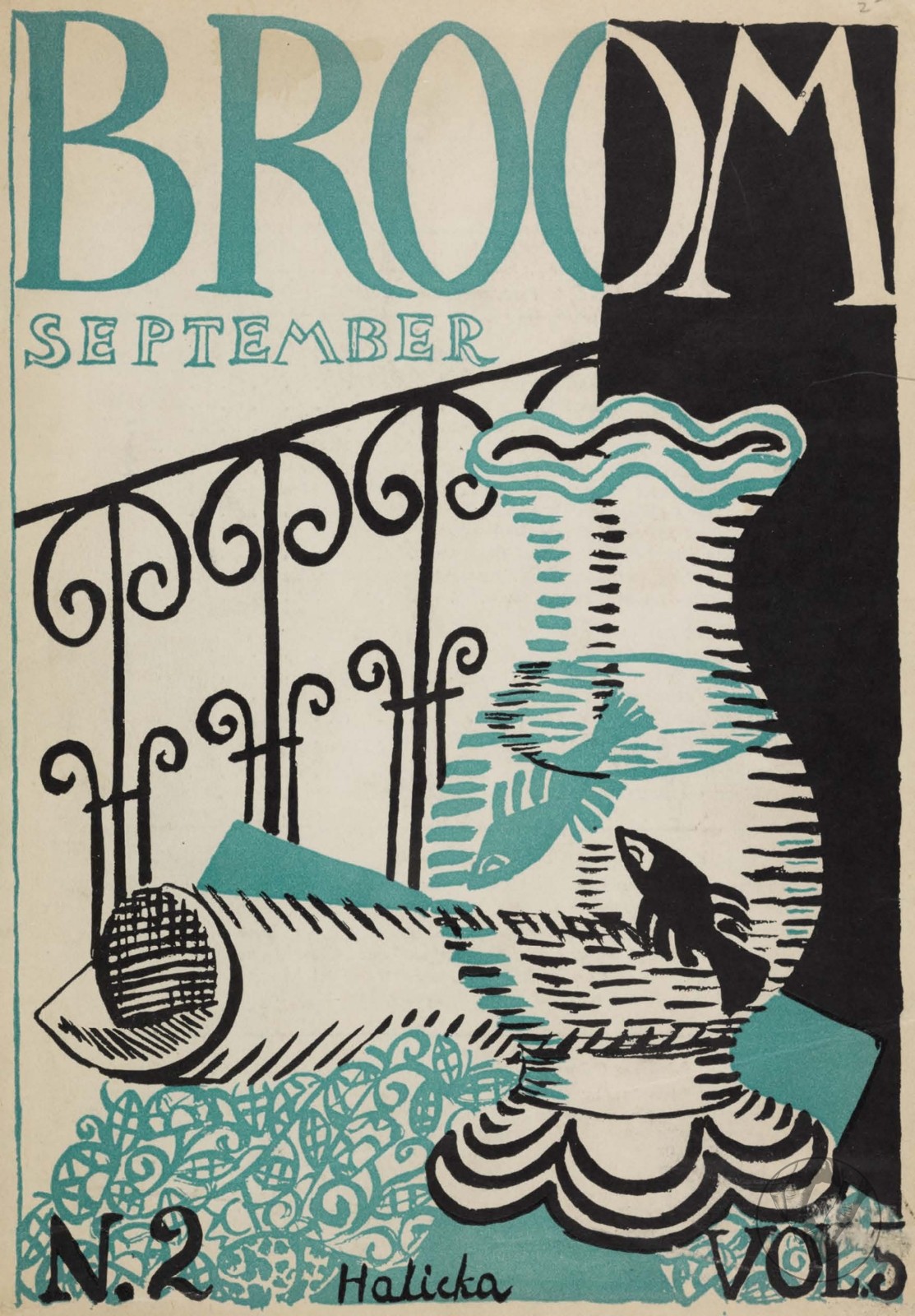
This issue of BROOM, an international magazine of the arts, features contributions on cinema, literature, and art. It includes an essay on the "U.S.A." cinema by Philippe Soupault, a short story "In the Orchard" by Virginia Woolf, and discussions on motion pictures and poetry. The magazine highlights its role in bringing European artistic sensibilities to America and its commitment to showcasing modern and emerging artists.