Page 1
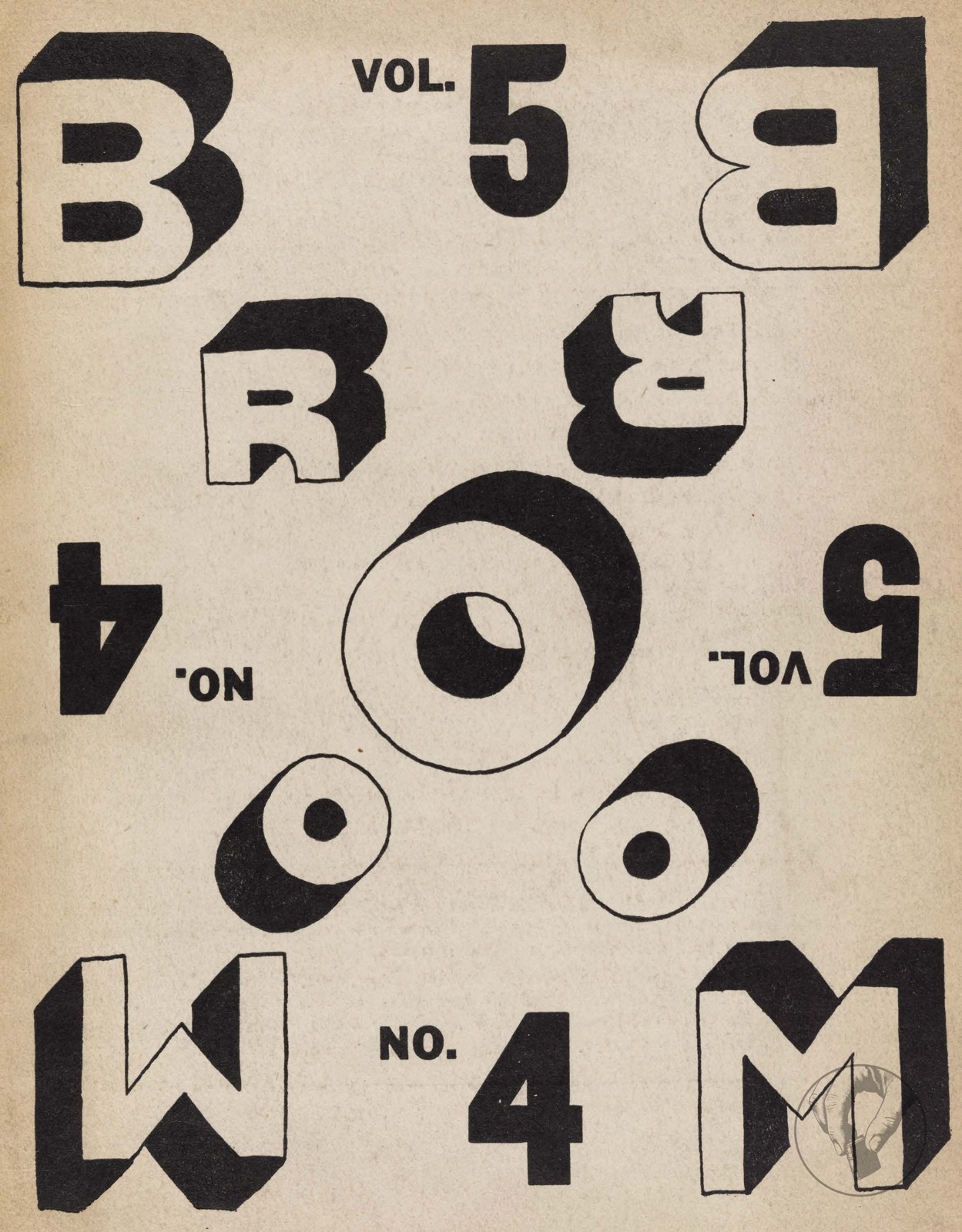
VOL. 5 B R t ON O W NO. 4 M VOL. 5 VOL. NO. 4
First pages of the volume, freely accessible.
VOL. 5 B R t ON O W NO. 4 M VOL. 5 VOL. NO. 4
BROOM AN INTERNATIONAL MAGAZINE OF THE ARTS Editor, HAROLD A. LOEB Associate Editors, SLATER BROWN, MALCOLM COWLEY, MATTHEW JOSEPHSON --- NOVEMBER, 1923 PUBLISHED MONTHLY Vol. 5, No. 4 --- COVER DESIGN—Lissitsky Page HESPERIDES, OR THE PLUNGER PLUNGES—SLATER BROWN . . . 193 DISCOURSE IN A CANTINA AT HAVANA—WALLACE STEVENS . . . 201 FOUR POEMS—E. E. CUMMINGS . . . . . . . . . . . . . . . 204 PLANS FOR ONE AND TWO STORY HOUSE—FINSTERLIN . . . . 207, 210 FOUR POEMS—WILLIAM CARLOS WILLIAMS . . . . . . . . . 208 THE EXTRA—LOUIS ARAGON . . . . . . . . . . . . . . . 211 TOWARDS A MORE PASSIONATE APPREHENSION OF LIFE—MALCOM COWLEY . . . . . . . . . . . . . . . 217 AN AWFUL STORMING FIRE—CHARLES L. DURBORAW . . . . 218 POISON (A DRAMA WITHOUT WORDS)—ROGER VITRAC . . . . 226 BOOK REVIEWS: LITERARY CRITICISM OF MUSIC—B. H. HAGGIN . . . . . . . 229 IMPURE SPLENDOR—GLENWAY WESCOTT . . . . . . . . . . 233 THE REAL STORY OF A BOOTLEGGER—ROBERT ALDEN SANBORN . 235 HARMONIUM, BY WALLACE STEVENS—M. J. . . . . . . . . . 236 --- The Editors of BROOM will be pleased to consider mss. submitted to them, but all mss. must be accompanied by a self-addressed stamped envelope. The Editors cannot be held responsible for mss. lost in transit. BROOM is published monthly at 45 King Street, New York, by The Broom Publishing Company, Inc. Entered as Second Class Matter, June 30, 1923, at the Post Office of New York, N. Y., under the act of March 3, 1879. Copyright, 1923, by the Broom Publishing Company, Inc. --- $5 A YEAR 50 CENTS THE COPY
HESPERIDES OR THE PLUNGER PLUNGES Snow was falling. Not the white snow that falls in winter, but the tin snow that falls in New and Wall streets. It is a sparse and agitated snow, continually whipped into flurries by the wings of pigeons, tossed and tortured as it drifts downward until the lower winds of the street seize upon it and fling it back to the roofs. But sometimes as it flickers across the windows of the office buildings, a flake twisting to the proper angle catches the light of the sun. It was at precisely 11:28 a.m. on the 17th of September, 1923 that one of these flakes turning as it fell, sent a tiny shaft of light into the left eye of Mr. Joseph J. Trackle. He, however, did not notice it. Leaning forward from the edge of his chair so that the torso of his body ran parallel to the floor, with his derby resting on the back of his head, with his left cheek glued to the glass breast of the sawed-off ticker, Mr. Trackle was far too immersed in quotations to receive the little message the flake of tin snow had so gently sent him from the sun. —The market is soggy, he whispered. Whereat the quotational pap which had faithfully fed him for more than thirty years, suddenly curdled. And thereafter the ticker maintained so absolute and dogged a silence that Mr. Trackle could hear his clerks mumble in the next room, or his watch tick in its little pocket over his appendix. After waiting for 67 seconds, and being no longer able to bear the silence, he began petulantly to yank and twitch at the tape. Whereupon the tape broke, as tapes do when they are yanked, and Mr. Trackle snarling to himself, slunk back into his chair, thrust his feet up on the ticker stand, shoved his derby forward over his eyes, and after performing a number of impatient flourishes in the upper left hand corner of a pad of paper, he wrote the following extemporaneous lyric:— A Rotten market. I have a head I have a head I have a headache LV Love is all truth Call Schuyler 649 $ \frac{1}{4} $ RBC is a good buy No more raw oysters for me. Schuyler 49 $ \frac{1}{4} $ RBC 50 $ \frac{3}{4} $ Rebecca Steel 52 good by Miss Pearly Mr. Mallet 49 $ \frac{1}{4}$ Rebec
—Mr. Mallet, cried Mr. Trackle, come in here (undertone) you sucker. Coughing rapidly to himself, Mr. Mallet scurried in. But before proceeding any further, let us consider the solipsistic poem which Mr. Trackle in his two minutes and thirteen seconds of leisure has composed on the sheet of yellow paper. For in splicing its lines, hauling up the incidents, memories and associations which produced them, by dredging, sounding and similarly employing ourselves, we may not only gain an insight upon the whirling fermentation of Mr. Trackle’s pysche, but we may also give the poem an organization which it now seems superficially to lack. Let us therefore jump into the ring and start milling at once. Item I. A Rotten market The analyses of this phrase must begin with the following query:—Why should Mr. Trackle, having just previously used the adjective “soggy” to describe the unfortunate condition of the market, now use the word Rotten to describe it? As there are four answers to this question, I will tabulate them as follows:— A. The Subject (Mr. Trackle) did not use the word “soggy” to describe the unfortunate condition of the market for the precise reason that he had already used it. Like Shakespeare, he was loathe to repeat. B. The Subject did not use the word “soggy” for the reason that he did not know whether it should be spelled with or without an E. This lack of surety would have retarded the free velocity of his pencil and would have doubtless produced that conflict which led him into so much difficulty later on. C. The Subject chose the word Rotten because it began with an R, the majuscule of which he took a secret pleasure in writing. D. Rotten described the condition of the market as well, if not better, than the word “soggy.” Item II. I have a head I have a head I have a headache From the phrase A Rotten market to the sentence I have a head seems a wide and inexplicable leap on the part of Mr. Trackle’s brain. But though it may be wide, it is certainly not inexplicable, as we will all see in a moment or two. It has already been noted that the word Rotten for dejastated reasons is the weightiest word in Item I. Such being the case it is natural that it should arouse from Our Subject’s unconscious, certain images, ideas, and memories of a recent date. This was in fact true. For no sooner had Mr. Trackle’s pencil produced the word Rotten, and even before it had completed the word market, there flashed into his mind a certain conversation he had held with his wife that morning before breakfast. The conversation was as follows:—
—Good morning, my dear husband, said Mrs. Trackle as she stepped into her husband’s bed-room clothed in nothing more than a Japanese kimono, a pair of mules, and a boudoir cap. —Are you in here again? replied Mr. Trackle who was lying in bed with the morning paper propped against his knees, while the valet arranged his breakfast beside him on a card table. —Why Joseykins my dear, exclaimed Mrs. Trackle, this is the first time this morning I’ve been in your room. —Did you ever see, asked Mr. Trackle of the valet, such a woman for bobbing in and out of a poyson’s privacy? Look at her, with her hair all down over her eyes. She hasn’t even washed yet. I can see streaks of dirt all up and down her filthy face. Get out of here you lazy-good-for-nothings. Phew, you stink! —Controllez-voo, controllez, cried Mrs. Trackle, I’ve just been using a depillatory. But I came in to see if my little Joseykins would like his wife to eat breakfast with him. —Well, he wouldn’t. Not on your life he wouldn’t, with such a dishevelled fatwoman as that. Get outta here. Mrs. Trackle flickered out. But she had hardly closed the door behind her when —Isabel! shouted Mr. Trackle. Come back here. Pat, lead that woman back into my presence. Mrs. Trackle’s nervous pastry face appeared again. —Isabel, whimpered Mr. Trackle, I didn’t sleep a wink last night. I had such a TERRIBLE headache. I was tossing and turning in my bed all night long. —Well, said Mrs. Trackle oozing in through the door, if you will sit UP to three and four in the morning drinking cocktails . . . —Is that all the sympathy I get after me tossing and turning in bed all night long? cried her husband. Is that what a loving wife should say to her husband when he hasn’t slept a wink? Is that the sort of heartless fatty bumbums you are? A wife should be gentle, soft, and affable’) and not go around hello making disorder everywhere. She shouldn’t breed disharmony. hello She should say to her husband, I’m so sorry Josey and is there anything I can do to alleviate you? But no. She wouldn’t say that. SHE’S nothing but a nervous fatwoman. Pretty good, eh Pat? —Very good Sir, replied the valet. —But I AM sorry, Joseykins. —Will you stop screaming in that raucous manner? I’m not at the other end of a bowling alley. —O Josey, DO control yourself. Pat, I’ll tell you. You have a little sign painted you know with ‘Control Yourself’ on it, only that ‘Control --- ¹) Note: Vide The Taming of the Shrew. Act II, Sc. 1.
Yourself' so you can show it to Mr. Trackle when you know, just a little sign that you can wear on the inside of your coat. Mrs. Trackle indicated the inside of her kimono. Mr. Trackle turned from page 10 of the Financial News to page 5 of the Sporting Section of the New York Tribune, September 17, 1923. —I will, Mrs. Trackle, said the valet. —Isabel, said Mr. Trackle, I don't think I'll go down to the floor to-day. I think I'll just lie up here in bed with this obnoxious headache. —Now that's the best thing you ever said, Josey dear. Especially after such a night. —That's it, always criticizing. Did you ever see such a woman? My God, will I ever get rid of this impediment? That's what you are, you're an impediment. —Well Josey, replied the impediment, if you keep this up I won't be. And you better remember what Dr. Rock said about alcohol and your blood pressure. —Dr. Rock's a sucker, replied Mr. Impediment Trackle. A cocktail or two can't disturb me. It's those damn oysters I ate. They rot in the intestines. Though the preceding conversation has been long, longer perhaps than I implied it would be some few pages back, it has nevertheless given us a clue, particularly in the words I have indicated by italics, to the correct association between Item I and Item II. For just as the word Rotten produced a flareback to the word rot in the conversation recorded above, thus precipitating upon the plane of Our Subject's conscious a vision of oysters putrefying in his intestines, so also did this vision in turn drag up the opinion (however specious) that his headache was alone due to the poisonous effect of these oysters upon his blood. He therefore wrote, I have a head; which though it was both literally and figuratively true, was not what he intended to write. For upon completing the first four letters of the fourth word; i.e. head, he was unable to remember whether to spell ache with a K or with an H. He therefore repeated the phrase in writing, but again found himself baffled. Again he tried, but suddenly recalling the word 'back-ache' and believing that there was some profound orthographical consanguinity between the two syllables of that word, he finally completed the sentence, misspelled as it now stands: I have a headache. Q.E.D. Item III. LV Immediately after Our Subject had completed the second line of his poem, the ticker buzzed. As he was short of three or four thousand shares of LV (Lehigh Valley) and rather nervous about them, Item III merely expresses his conscious or unconscious wish to read their latest quotation on the tape.
Item IV. Love is all truth The fundamental association of this item and the preceding one is based, I am pained to admit, on no more lofty or profound a substance than that of a pun. It is indeed a distressing thought that Our Subject whose mind has hitherto proven itself to be one of the great spiritual and creative products of Our Modern Era, should at this moment stoop to so vulgar a trick. But I am certain that if every one of us should peek over the edge into his subconscious and observe what a blustering host of assonances, double entendres, and puns are jostling and swaggering through our thoughts down there, we would all immediately retire to the mountains and spend a year in mental discipline. Be that, however, as it may. Now Our Subject having written the abbreviation of a stock (LV), naturally felt it should be followed by something. But being unable to follow it up with an accurate market quotation, since he had broken the tape, his mind at once started to reconnoiter in search of one chez that great fountain-head of quotations; William Shakespeare. But to aid him in his search Our Subject deftly inserted an O between the L and V of his stock with an E added to make it all the more clear. He thus formulated the word 'love' which, perching on his psychic wrist like a falcon, immediately flew up and caught him the following lines:— Love surfeits not, Lust like a glutton dies; Love is all truth, Lust full of forged lies.* Which quotation was, as he had many times remarked to his wife and friends, one of the most beautiful gems in all English literature. Item V. Call Schuyler 6491/4 Having written the above quotation, thoughts of Love began to frisk in Our Subject's head. At first he envisioned Love as an austere Goddess of Herculean proportions clutching a flaming torch. But no sooner was this statuesque fancy projected on the silversheet of his conscious, than it was immediately blotted out by the more distinct image of Miss Pearly. For be it known that Mr. T's concept of Love was far more limited by Corporeal Desire than, let us say, is that of Plotinus. For though Our Subject would be the first to admit that Abstract Love completely estranged from fleshly connotations did certainly exist and in all splendor, he nevertheless surrendered its fortune and contemplation to the hierarchy of poets and philosophers. As for him, he would contemplate Love in the more palpable guise of Miss Pearly, the little Brooklyn diving girl whose personal charm and physical perfection had so enraptured him at a party the evening before. Thus softly dreaming on her charms he began scribbling her telephone number on the pad. . . . *Note (Venus and Adonis. 1. 803-4.)
But hold! Why but her telephone number? Why not her name, her street address, her employment? Why her telephone number? Because, my dear fellow, when Mr. Trackle began dealing in terms of the Abstract, the Ideal, or the Prophetic, his mind immediately attached itself, or became the mouth-piece of some spectral telephone, at the receiving end of which God and His entire solar system respectfully listened. We have already witnessed a manifestation of this curious phenomenon in the conversation recorded under Item II, wherein Mr. Trackle while expanding upon the subject of the Ideal Wife, interspersed his discourse with loud telephonic cries of 'hello!' Why this peculiar relation between the telephone and Mr. Trackle should exist, is a problem I will leave for students of Anthropology, Ethnology, Theology, Pathology, and Mysticism to unravel. Nevertheless, such a relation existed, and the abstract idea of Love sifting through Miss Pearly's lovely body, was finally volitionally expressed by Our Subject in the concrete and telephonic form of Schuyler 649 $ \frac{1}{4} $ . But here again another problem awaits us. Why the substitution of $ \frac{1}{4} $ for the last figure of Miss Pearly's number which we know should be merely 4? This is more simple than appears on the surface. For Our Subject having written Call Schuyler, and having just started to make the lower quirk of the 6, certain inevitable fears began to assail him from all sides. These fears sprang fully armed from the grim realization of his age, for Mr. Trackle it must be understood, though I have not hitherto brought the student's attention to the fact, was not a young man. He was, on the contrary, a few years more than 50, and for that reason not so tireless and sturdy a warrior in the lists of Venus as, let us say, a dashing young blade of 25. This realization, having moreover a definite empirical basis, at once assumed so painfully dominating an aspect of Our Subject's relation to the little diving girl, that his mind in self-defense retreating from the Arena of Love to those fields of combat wherein age in no way hobbled his prowess, immediately galloped into the Stock Exchange. Whereupon he at once realized that the 49 in Miss Pearly's telephone number was significant only because, with the addition of a quarter, it represented the price he had paid for 500 shares of Republic Iron and Steel ten minutes previously. Item VI. RBC is a good buy Upon distorting the telephone number into a quotation for Republic Iron and Steel, Our Subject was minded of the hot tip Mr. Breen had sent up from the floor. This tip was scribbled on a small piece of paper, thus:— Roy says RBC is a good buy. Jim As the ticker abbreviation for Republic Iron etc. is RBC (intimately known as Rebecca Steel), Mr. Trackle in this item has merely copied that
section of Mr. Breen’s note which caused him to purchase, as I have already stated, 500 shares of RBC at the low price of $49\frac{1}{4}$ . Item VII. No more raw oysters for me. Between Item VI and the Item now under consideration, Our Subject belched. And this belch carrying a small quantity of chyle upward from the stomach, through the throat and esophagus, until it finally reached his palate, Mr. Trackle imagined or did actually receive the gustatory sensation of putrefying oysters, slightly flavored with sour coffee. Which horrible taste so prejudiced his mind and stomach against all present, past, and future raw oysters that he immediately struck down on paper that resolution which this Item so forcibly expresses. Item VIII. Schuyler $49\frac{1}{4}$ RBC $50\frac{1}{2}$ Rebecca Steel 52 Ah Mr. Trackle! Mr. Trackle! Schuyler again! How doth thine old mind root back to its young prey. How doth it lean again toward the lithe body of the diver. Ah well-a-day those black, slow-slugging eyes have beaten thee into a sorry pickle. And there is no help in thee. Thou art too froward in passion, Mr. Trackle; too gone i’ the flanks. For didst thou not yestereen, fearing the frost of thy years had nipped the striving petals of thine own fruition, fill thine old body with wine and thy guts with the aphrodisiacs of shell-fish? And didst not also, when thou hadst bought the harvest with thy purse, and e’en when thou beheldst it lie all gleaming before thee like a field of wheat, didst not thy scythe in that bright-bitter moment fail thee? And now, for we drop bridges across the symbols of thy confession, dost thou not finger thy defeat in pain? And dost thou not, twisting her yielded but ungathered body into a bartered stock, lay thine own body beside as her quotation? And dost thou not make that quotation rise progressively from $49\frac{1}{4}$ to 52, whilst in a mutual tempo burgeoning, Schuyler to RBC flowers into Rebecca Steel? Item IX. good by Miss Pearly This item is so welded into complex meanings and associations, so fused with fancies and ideas, that it would be bootless toil to chip it off into its various elements. But as these various elements spring from facts already mentioned in this absorbing treatise, any student who has carefully read, inwardly digested, and objectively deliberated upon everything I have hitherto written, will assuredly be able to grasp its manifold meanings, however intangible they may seem to be. If the student is a Bergsonian he should do it by a flash of Intuition, and thus save himself and me a great deal of trouble. But if the reader is not a Bergsonian; nor a student of occult psychology; nor in truth, has any intention of becoming either, and if moreover he has dashed through this treatise at break-neck speed, I will merely state ex cathedra for his benefit, two facts he can gulp down as he gallops on.
In the first place the good by refers this time not only to the prospective virtue of Rebecca Steel (vide Item VII), but also to the prospective virtue of Miss Pearly. Both would be good buys, yielding, should one go long of them, rich dividends and juicy profits. In the second place good by must also be understood in its connotation of farewell. For Mr. Trackle in the previous Item, having at last fused Miss Pearly with the Republic Iron and Steel Corporation, may for the nonce forget the little Brooklyn diving girl and trade his head off. Item X. $49\frac{1}{4}$ Rebec $49\frac{1}{4}$ , the price. Rebec, Rebecca Steel, the stock. It’s selling cheap. It’s a buy. Nab it. Don’t pass it up. Buy it. Buy RBC. It’s going up. It’s going up uP UP. Ah-h-h-h! MILLIONS OF DOLLARS Item XI. Mr. Mallet Having skipped over Item X in a light and rather impressionistic manner, let us now conclude the analyses proper with a brief consideration of this final item. It is evident something is going to happen. Mr. Trackle’s mind seems to be pressing on rapidly to some sort of resolution. His impatient pencil hastens to complete the last line of his poem. It leaves the T uncrossed and swoops down to the corner of the pad. His hand rises toward the derby and shoves it back from his forehead. His feet climb off the table. His body organizes itself erect in his chair. He is about to ejaculate. His mouth opens. —Mr. Mallet, cries Mr. Trackle, come in here (undertone), you sucker. $ \quad \$ \quad \ $ \quad \$ \quad \ $ $ We have travelled far, my fellow student, but the end of our long pilgrimage is at hand. Let us not hasten, for in the far mist lies New York like a jade toy. Already (but let us linger, my friend) already can we see the spire of the Woolworth Building stride into the sky, and incense steaming from the roofs of office buildings. And now we can hear the roar, the clash and shock of traffic, and now the iron teeth of a rivetter chattering in the red angles of its girders. Now we see the clotted streets, Broadway and Wall, the slimed facade of the Exchange. We hear the shouts of traders, the hoarse stutter of tickers, a gong clanging, a telephone. And now AVE! do we behold Mr. Trackle rising before Mr. Mallet. Hurry! Hurry! Please Hurry! Rising before Mr. Mallet, he clenches his fist as if to slam Mr. Mallet or some invisible opponent standing between them. He pauses. Mallet squares off. The gong. Kid Trackle’s fist sizzles through space. —BUY FIFTEEN THOUSAND REBECCA STEEL AT THE MARKET! (End of First Part.) SLATER BROWN
DISCOURSE IN A CANTINA AT HAVANA I. Canaries in the morning, orchestras In the afternoon, balloons at night. That is A difference, at least, from nightingales, Jehovah and the great sea-worm. The air Is not so elemental nor the earth So near. But the sustenance of the wilderness Does not sustain us in the metropoles. II. Life is an old casino in a park. The bills of the swans are flat upon the ground: A most desolate wind has chilled Rouge-Fatima And a grand decadence settles down like cold. III. The swans. . . . Before the bills of the swans fell flat Upon the ground, and before the chronicle Of affected homage foxed so many books, They warded the blank waters of the lakes And island canopies which were entailed To that casino. Long before the rain Swept through its boarded windows and the leaves Filled its encrusted fountains, they arrayed The twilights of the mythy goober khan. The centuries of excellence to be Rose out of promise and became the sooth Of trombones floating in the trees.
This issue of BROOM, an international magazine of the arts, features contributions from various artists and writers. The content includes literary pieces, poetry, and discussions on art and life, with contributions from Wallace Stevens, E. E. Cummings, and Louis Aragon, among others. The magazine also includes book reviews and editorial notes.