Page 1
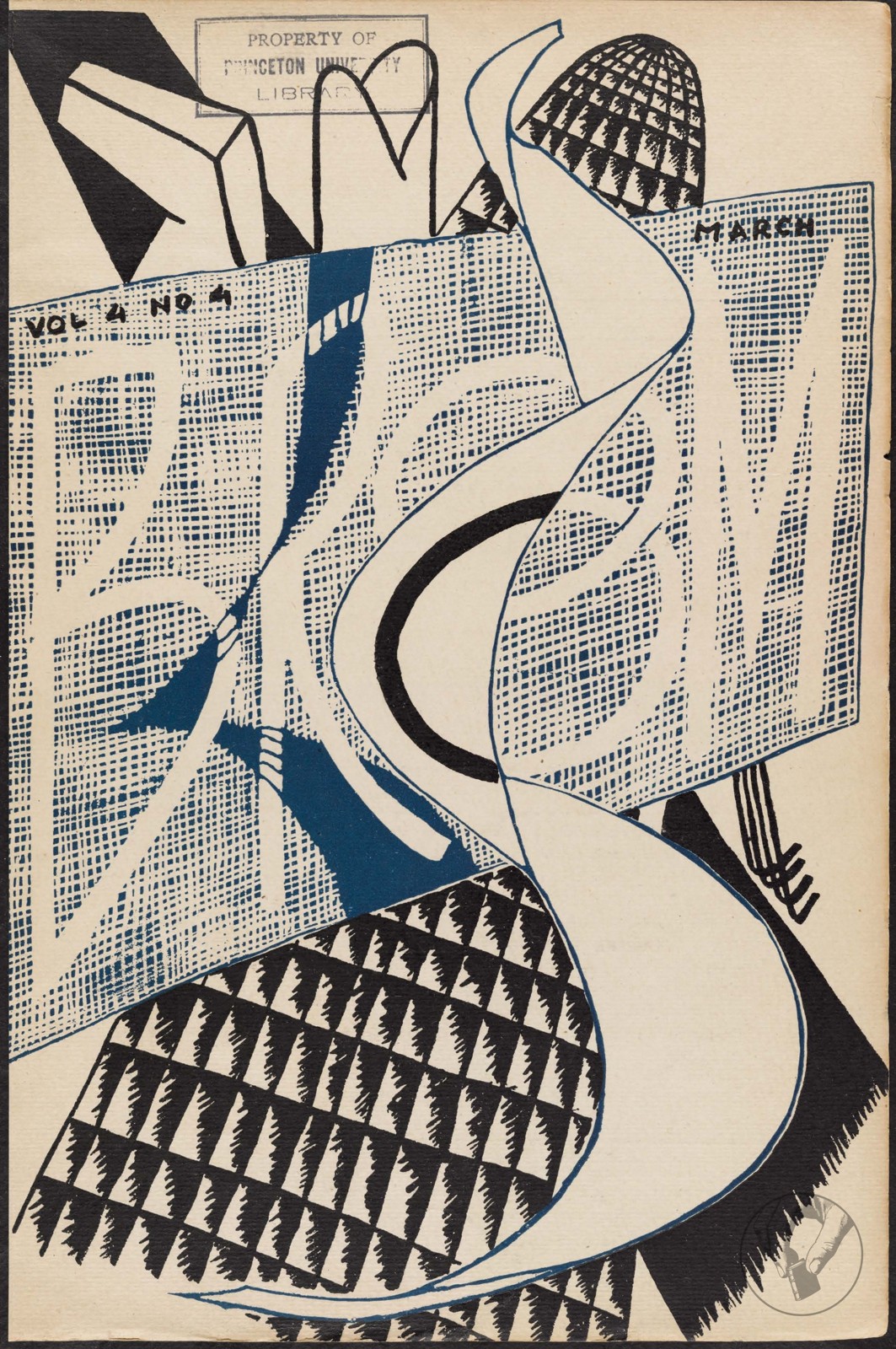
PROPERTY OF PRINCETON UNIVERSITY LIBRARY VOL 4 NO 4 March
First pages of the volume, freely accessible.
PROPERTY OF PRINCETON UNIVERSITY LIBRARY VOL 4 NO 4 March
BROOM AN INTERNATIONAL MAGAZINE OF THE ARTS PUBLISHED BY HAROLD A. LOEB. EDITOR, HAROLD A. LOEB. ASSOCIATE EDITOR, MATTHEW JOSEPHSON. AMERICAN EDITOR, LOLA RIDGE. ASSOCIATE ART EDITOR, LADISLAS MEDGYES. --- MARCH, 1923 PUBLISHED MONTHLY VOL. 4, NO. 4 --- Page --- COVER DESIGN — MAN RAY --- THE POET ASSASSINATED — GUILLAUME APOLLINAIRE --- PHOTOGRAPHS — L. MOHOLY-NAGY --- (FACING) 224, 225 --- LA RUMBA CUBANA — CHARLES GALWEY --- A BOTTLE OF LILAC PERFUME — DOROTHY HAMILTON --- PORTRAIT BY LYENDECKER — MALCOLM COWLEY --- PHOTOGRAPHS — L. MOHOLY-NAGY --- (FACING) 240, 241 --- DRAWING — L. LOZOWICK --- A LADY — EMANUEL CARNEVALI --- PORTRAIT — MAXWELL BODENHEIM --- THE COLLEGE GLEE CLUB — ROBERT ALDEN SANBORN --- AFFINITIES — JOHN CRAWFORD --- THE DISCOVERY OF THE INDIES — WILLIAM CARLOS WILLIAMS --- PHOTOGRAPHS — MAN RAY --- (FACING) 256, 257 --- DARKNESS GLITTERS — ROBERT COATES --- THE APOLLO OF VEI, STIGMATAE — CARLETON BEALS --- TRANSFORMATIONS — RICHARD HUELSENBECK --- PHOTOGRAPHS — MAN RAY --- (FACING) 272, 273 --- COMMENT: APOLLINAIRE — M. J. --- APOLLINAIRE (WOODCUT) — MARCOUSSIS --- LOCUS SOLUS — MALCOLM COWLEY --- LIGHT; A MEDIUM OF PLASTIC EXPRESSION — L. MOHOLY-NAGY --- The Editor of Broom will be pleased to consider mss. submitted to him, but all mss. must be accompanied by a self-addressed, stamped envelope. The Editor cannot hold himself responsible for loss of mss. in transit. Mss. from Europe should be sent to the Berlin office, mss. from America to the New York office. The price of Broom is: For America, fifty cents the copy, and five dollars for a year’s subscription. For Italy, 10 lire the copy, and 100 lire for a year’s subscription. For France, 6 francs the copy, and 60 francs for a year’s subscription. For Great Britain, 2 shillings the copy, and one pound for a year’s subscription. The contents of this issue are protected by copyright, January, 1922. Infringement of same will be prosecuted. Entered as Second Class matter at the Post Office at New York, N. Y., April 22, 1922 under the Act of March 3, 1879. --- HEADQUARTERS, SCHICKLERSTRASSE 5, BERLIN, GERMANY NEW YORK OFFICE, THREE EAST NINTH STREET.
WILL RANSOM MAKER OF BOOKS * A PRIVATE PRESS ISSUING HAND-MADE BOOKS IN LIMITED EDITIONS AND PRESENTING FIRST APPEARANCES OF / CONTEMPORARY AUTHORS / WRITE FOR INFORMATION AND SPECIMEN PAGES * 14 WEST WASHINGTON STREET, CHICAGO, U. S. A. --- SPECIAL OFFER BROOM ($5) AND THE NEW REPUBLIC ($5) FOR ONE YEAR FOR $8.50 // ADDRESS BROOM // 3 EAST NINTH STREET, NEW YORK --- THE DRAMA A monthly magazine of the allied arts of the theatre THE DRAMA will keep you informed of the most significant developments in drama and its production, both professional and amateur. Each issue contains two or more one-act plays; reviews of Chicago, New York and London productions; special articles by leading actors or other artists of the theatre, such as Otis Skinner, Margaret Anglin, Arthur Hopkins, E. H. Sothern and Mr. Fiske; illustrations of the latest stagecraft and costuming; accounts of the work of Little and Community Theatres, notes on new books related to the drama; advice to amateur groups, study courses and lists of plays. The editors of The Drama are Theodore B. Hinckley, Granville Barker, Barrett H. Clark, Walter Pridhard Eaton, J. Vandervoort Sloan and Jack Crawford. --- THE DRAMA · 555 ATHENAEUM BUILDING · CHICAGO I wish you to send me THE DRAMA $\left\{ \begin{array}{l} \text{for five months for \$ 1} \\ \text{for one year for \$3} \end{array} \right.$ Name: ___________________________________________________________ Adress: _________________________________________________________
THE POET ASSASSINATED I. RENOWN The glory of Croniamantal is today universal. One hundred and twenty-three towns in seven countries on four continents dispute the honor of this notable hero's birth. I shall attempt, further on, to elucidate this important question. All of these peoples have more or less modified the sonorous name of Croniamantal. The Arabs, the Turks and other races who read from right to left have never failed to pronounce it Latnamainorc, but the Turks call him, bizarrely enough, Pata, which signifies goose or genital organ. The Russians surname him Viperdoc, that is, born of a pet; the reason for this soubriquet will be seen later on. The Scandinavians, or at least, the Dalecarlians, call him at will, quoniam, in latin, which means, because, but often serves to indicate the noble passages in popular accounts of the middle ages. It is to be noted that the Saxons and the Turks manifest with regard to Croniamantal, a similar sentiment, since they refer to him by an identical surname, whose origin, however, is still scarcely explained. It is believed that this is an euphemistic allusion to the fact stressed in the medical report of the Marseilles doctor Ratiboul on the death of Croniamantal. According to this official document, all the organs of Croniamantal were sound, and the lawyer-physician added in Latin, as did Napoleon's aide Major Henry: partes viriles exiguitatis insignis, sicut pueri. For the rest, there are countries where the notion of the Croniamantalian virility has entirely disappeared. Thus, the negroes in Moriana call him Tsatsa or Dzadza or Rsoussour, all feminine names, for they have feminized Croniamantal as the Byzantines feminized Holy Friday in making it Saint Parascevia. II. GENESIS Two leagues from Spa, on the road bordered by gnarled trees and bushes, Vierselin Tigoboth, an ambulant musician who was coming on foot from Liège, struck his flint to light his pipe. A woman's voice cried: "Ho! Monsieur!"
He lifted his head and a wild laugh burst out: “Hahaha! Hohoho! Hihihi! thine eyelids are of the color of Egyptian lentils! My name is Macarée. I want a tom-cat.” Vierselin Tigoboth perceived by the roadside a young woman, brunette and formed of nice curves. How charming she seemed in her short bicyclist’s skirt! And holding her bicycle with one hand, while gathering prunelles with the other, she fixed ardently her great golden eyes on the Flemish musician. “Vs’estez one belle bacelle,” said Vierselin Tigoboth, smacking his tongue. “But, my God, if you eat all those prunelles, you will have the colic, tonight, I’m sure.” “I want a tom-cat,” repeated Macarée and unclasping her bodice she showed Vierselin Tigoboth her breasts, sweet as the buttocks of the angels, and whose aureole was the tender color of the rose clouds of sunset. “Oh! oh!” cried Vierselin Tigoboth, “As pretty as the pearls of Amblevia, give them to me. I shall gather a big bouquet of ferns for you and of irises, color of the moon.” Vierselin Tigoboth approached to seize this miraculous flesh which was being offered to him for nothing, like the holy bread at Mass; but then he restrained himself. MACAREE *They are the color of the moon And round as the wheel of Fortune.* VIERSELIN TIGOBOTH *If you fear not to catch the louse Then I should love to be your spouse.* And Vierselin Tigoboth approached, his lips full of kisses: “I love you! It is pooh! O beloved!” Soon there were nothing but sighs, the songs of birds and of russet and horned little hares, passing like elves, fleet as the seven-league boots, by Vierselin Tigoboth and Macarée, under the power of love behind the plumtrees. Then, Macarée was off on the old contraption. And sad unto death, Vierselin Tigoboth cursed the instrument of velocity which rolled away and vanished behind the terraced rotunda, at the same moment that the musician began to make water while humming a passacaglia. . . 1*
III. EXEGESIS Macarée soon became aware that she had conceived by Vierselin Tigoboth. "How annoying!" she thought at first, "But medicine has made much progress lately. I shall get rid of it when I want. Ah! that Walloon! He will have toiled in vain. Can Macarée bring up the son of a vagabond? No, no, I condemn this embryo to death. I should never even preserve this foetus in alcohol. And thou, my belly, if thou knewest how much I love thee since knowing thy goodness. What, wouldst stoop to carry such baggage as thou findest along the road? O too innocent belly, thou art unworthy of my selfish soul. "What shall I say, o belly? thou'rt cruel, thou partest children from their parents. No! I love thee no longer. Thou'rt naught but a full bag, at this moment, o my belly, smiling at the nombril, o elastic belly, downy, polished, convex, sorrowful, round, silky, which enobles me. For thou makest noble, o my belly, more beautiful than the sunlight. Thou shalt ennoble also the child of the Flemish vagabond and thou art worthy of the loins of Jupiter. What a misfortune! a moment ago I was about to destroy a child of noble race, my child who already lives in my beloved belly." She opened the door suddenly and cried: "Madame Dehan! Mademoiselle Baba!" There was a rattling of doors and bolts and then the proprietors of Macarée's lodging came running out. "I am pregnant," cried Macarée, "I am pregnant!" She was sitting up in bed, her legs spread apart, her skin looked very delicate. Macarée was narrow at the waist and broad-hipped. "Poor little one," said Madame Dehan, who had but one eye, no waistline, a moustache, and limped. "After confinement women are just like crushed snailshells. After confinement women are simply prey to disease, (look at me!) an egg-shell full of all sorts of rubbish, incantations and other witch-spells. Ah! Ah! You have done very well." "All foolishness," said Macarée. "The duty of women is to have children, and I am sure that their health is generally improved thereby both physically and morally." "Where are you sick?" asked Mademoiselle Baba. "Shut up! I say," exclaimed Madame Dehan. "Better go and look for my flask of Spa elixir and bring some little glasses."
Mademoiselle Baba brought the elixir. They drank of it. "I feel better now," said Madame Dehan; "After so much emotion, I need to refresh myself." She poured out another little glass of the elixir for herself, drank it and licked the last few drops up with her tongue. "Think of it," she said finally, "think of it, Madame Macarée . . . I swear by all that I hold sacred, Mademoiselle Baba can be my witness, this is the first time that such a thing has happened to one of my tenants. And how many I have had! My Lord! Louise Bernier, whom they nicknamed Wrinkle, because she was so skinny; Marcelle la Carabinière (the freshest thing you ever saw!); Josuette, who died of a sunstroke in Christiana, the sun wishing thus to have his revenge of Joshua; Lili de Mercoeur, a grand name, mind you, (not hers of course) and then vile enough for a chic woman, as Mercoeur put it: 'You must pronounce it Mercure,' screwing up her mouth like a chicken's hole. Well she got hers, all right, they filled her as full of mercury as a thermometer. She would ask me in the morning: What sort of weather do you think we'll have today? But I would always answer: 'You ought to know better than I . . .' Never, never in the world would any of those have become enceinte at my place." "Oh well, it isn't as bad as that," said Macarée, "I also never had it happen to me before. Give me some advice, but make it short." At this moment she arose. "Oh!" cried Madame Dehan, "what a wellshaped behind you have! how sweet! how white! what embonpoint! Baba, Madame Macarée is going to put on her dressing-gown. Serve coffee and bring the cherry cake." Macarée put on a chemise and then a dressing gown whose belt was made of a Scotch shawl. Mademoiselle Baba came back; she brought a big platter with cups, a coffee pot, milk-pitcher, jar of honey, butter cakes and the cherry tart. "If you want some good advice," said Madame Dehan wiping away with the back of her hand the coffee that dribbled down her chin, "You had better go and baptize your child." "I shall make sure and do that," said Macarée. "And I even think," said Mademoiselle Baba, "that it would be best to do it on the day he is born." "In fact," she mumbled, her mouth full of food, "you can never tell what may happen. Then you will nurse him yourself, and if I were you, if I had money like you, I should try to go to Rome before the confinement and get the Pope to bless me. Your child will never know either the
fatherly caress or blow, he will never utter the sweet name of papa. May the blessing of the Holy Father at least follow him all his life.” And Madame Dehan began to sob like a kettle on the fire boiling over, while Macarée burst into tears as abundant as a spouting whale. But what of Mademoiselle Baba? Her lips blue with berries, she wept so hard that from her throat the sobs flooded down to her hymen and nearly choked her. IV. NOBILITY After having won a great deal of money at baccarat, and already rich, thanks to Love, Macarée, whose corpulency nothing could conceal, came to Paris, where above all, she ran after the most fashionable modistes. How chic she was, how chic she was! * One night when she went to the Theatre Français a play with a moral was presented. In the first act, a young woman whom surgery had rendered sterile lamented the fatness of her husband who was dropsical and very jealous. The doctor went out saying: “Only a great miracle and great devotion can save your husband.” In the second act, the young woman said to the young doctor: “I offer myself up for my husband. I want to become dropsical in his stead.” “Let us love each other, Madam. And if you are not unfaithful to the principle of maternity your wish will be granted. And what sweet glory I shall have thereof!” “Alas!” murmured the lady, “I no longer have any ovaries.” “Love,” cried the doctor at this, “Love, madam, is capable of working great miracles.” In the third act, the husband thin as an I and the lady eight months gone felicitated each other on the exchange they had made. The doctor communicated to the Academy of Medecine the results of his experiments in the fecundation of women become sterile as a result of surgical operations. * Toward the end of the third act, someone shouted: “Fire!” in the hall. The frightened spectators rushed from the hall howling. In fleeing,
Macarée possessed herself of the arm of the first man she encountered. He was well dressed and fair of feature, and as Macarée was charming, he seemed flattered that she had chosen him as her protector. They made each other’s acquaintance at a cafe and from there went to sup in the Montmartre. But it appeared that François des Ygrées had negligently forgotten to take his purse with him. Macarée gladly paid the bill. And François des Ygrées pushed gallantry so far as not to allow Macarée to sleep alone, the incident at the theatre having rendered her nervous. * François, Baron des Ygrées (a doubtful baronetcy belonging to whoever claimed it) called himself the last offshoot of a noble house of Provence and pursued a career of heraldry on the sixth floor of an apartment in the rue Charles-V. “But,” he said, “the revolutions and the demagogues have rendered it so that arms are no longer studied except by ill-born archeologists, and the nobility is no longer tutored in this art.” The baron of Ygrées, whose coat of arms was of azur à trois pairles d’argent posés en pal, was able to inspire enough sympathy in Macarée for her to want to take lessons in heraldry out of gratitude for that night at the Theatre Français. Macarée showed herself, it is true, little given to retaining the terminology of heraldry, and one might even say that she did not interest herself seriously in anything but the arms of the Pignatelli who had furnished popes for the Church and whose coat-of-arms was adorned with kettles. However, these lessons were wasted time to neither Macarée nor François des Ygrées, for they ended by marrying. Macarée brought as her dot, her money, her beauty and her fatness. François des Ygrées offered to Macarée a great name and his noble bearing. Neither complained of the bargain and they found themselves very happy. “Macarée, my dear wife,” said François des Ygrées a few days after their marriage, “Why have you ordered so many robes? It seems to me that hardly a day passes without some modiste brings new costumes. They do, true enough, honor to your taste and to their skill.” Macarée hesitated for a moment and then replied: “Is it to our honeymoon that you refer, François!” “Our honeymoon, yes, I have thought of it. But where do you want to go?” “To Rome,” said Macarée.
"To Rome, like the bells of Easter?" "I want to see the Pope," said Macarée. "Very fine, but what for?" "That he may bless the child who lies under my heart," said Macarée. "Phew-ew-ew!" "It will be your son," said Macarée. "You are quite right, Macarée. We shall go to Rome like the bells of Easter. You will order a new robe of black velvet; and the dressmaker must not neglect to embroider our arms at the bottom of the skirt: of azur à trois pairles d'argent posés en pal." V. PAPACY "Per carita, baroness, (I had almost called you mademoiselle!) Ah! Ah! Ah! But the baron, your husband, he would protest. Ah! ah! quite true, you have a little belly which commences to become arrogant. They do their work well, I see, in France. Ah! if that fine country would only become religious again, the population decimated by anti-clericalism would at once, (yes, baroness) her population would increase considerably. Ah! dear Christ! how well she listens, the arrogantine, when one talks seriously, yes, baroness, you have the air of an arrogantine. Ah! ah! ah! so, you want to see the Pope. Ah! ah! ah! the benediction of a mere cardinal like me will not do. Ah! ah! tut-tut, I understand quite well. Ah! ah! I shall try to obtain an audience for you. Oh! no need to thank me, you can let my hand go. How well she kisses, the arrogantine, oh! Come here, again, I want you to carry away with you a little souvenir of me. "There! a chain, with the medal of the holy house of Lorette. Let me put it about your neck... Now that you have the medal you must promise me never to part with it. There, there, there! Come here so that I can kiss you on the forehead. Come, come, can she be afraid of me, the little arrogantine? Done! Now tell me why you laugh?... Nothing! Well! Now, one bit of advice! When you go to the Vatican, I warn you not to use so much odor, I mean so much perfume. Goodbye, arrogantine. Come and see me again. My compliments to the baron." * It was thus, that, thanks to Cardinal Ricottino, who had been to Paris as nuncio, Macarée obtained an audience with the Pope.
L. Moholy-Nagy
This issue of Broom, an international magazine of the arts, features a cover design by Man Ray and contributions such as "The Poet Assassinated" by Guillaume Apollinaire, "La Rumba Cubana" by Charles Galwey, and "The Discovery of the Indies" by William Carlos Williams. The magazine includes photographs by L. Moholy-Nagy and Man Ray, as well as drawings and other artistic and literary works. It is published monthly by Harold A. Loeb and discusses various aspects of art, literature, and culture.