Page 1
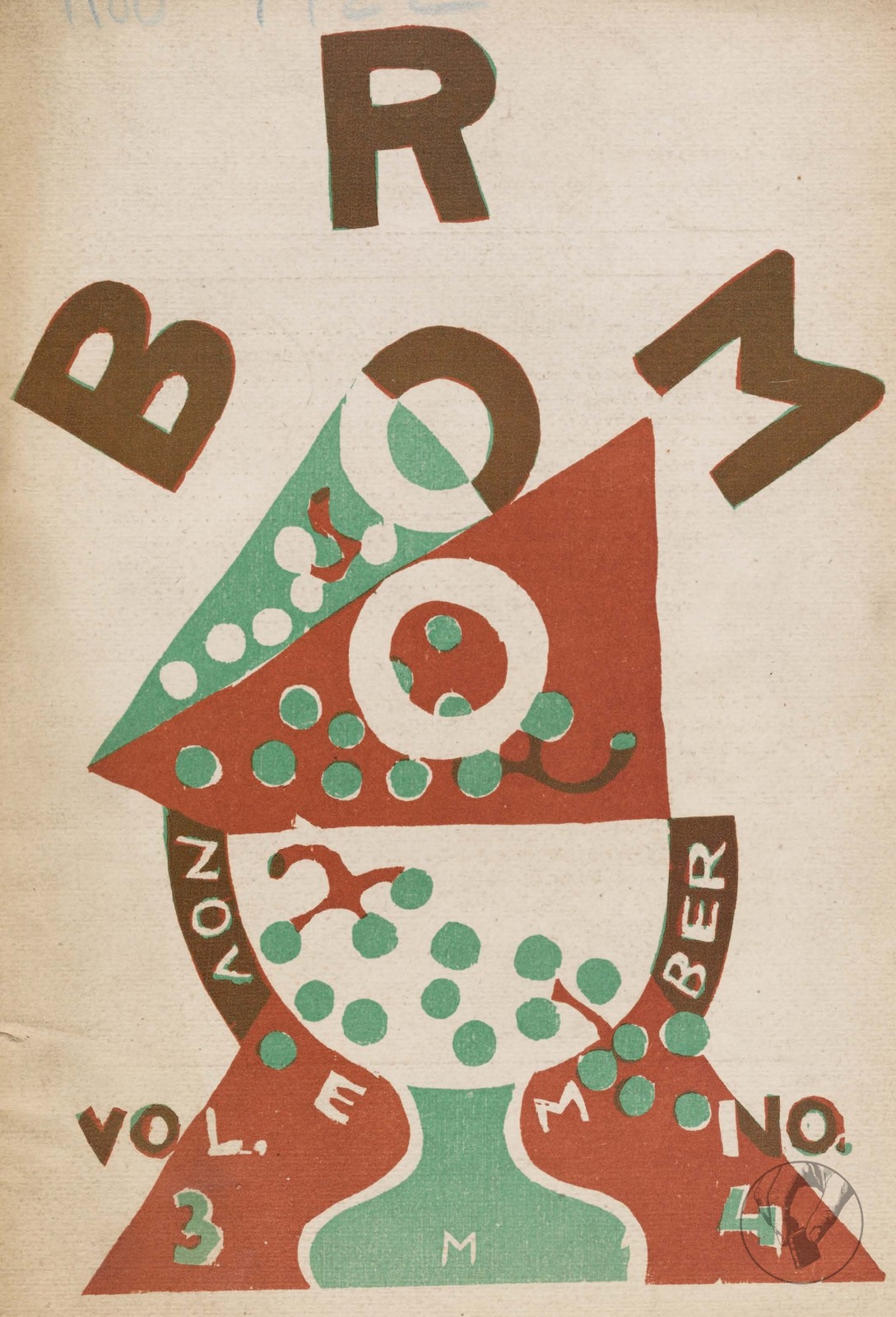
R B ZON VOL. 3 E BER NO.
First pages of the volume, freely accessible.
R B ZON VOL. 3 E BER NO.
BROOM AN INTERNATIONAL MAGAZINE OF THE ARTS PUBLISHED BY HAROLD A. LOEB. EDITOR, HAROLD A. LOEB. ASSOCIATE EDITOR, MATTHEW JOSEPHSON. AMERICAN EDITOR, LOLA RIDGE. --- NOVEMBER, 1922 APPEARS MONTHLY VOL. 3, NO 4. Page --- COVER DESIGN — (WOODCUT) — LADISLAS MEDGYES --- — --- PHOTOGRAPHS — PAUL STRAND --- (FRONTISPIECE AND FACING) 256, 272 --- WHEN ALL IS ENDED — LOUIS ARAGON --- VALUTA — MALCOLM COWLEY --- WOODCUT — GONTCHAROVA --- 249, 251 --- PHOTOGRAPHY AND THE NEW GOD — PAUL STRAND --- APOCALYPTIC HARVEST — YVOR WINTERS --- STAVROGIN’S CONFESSION — FEODOR DOSTOYEVSKI --- ON ENGLISH AND FRENCH FICTION — ARTHUR SYMONS --- MACABRE — CREMATORIUM — JAMES DALY --- 284, 285 --- THE LAY OF MALDOROR — COMTE DE LAUTRÉAMONT --- THE FLOWER-SPHYNX — HANS ARP --- THE GREAT AMERICAN BILLPOSTER — MATTHEW JOSEPHSON --- The Editor of Broom will be pleased to consider mss. submitted to him, but all mss. must be accompanied by a self-addressed, stamped envelope. The Editor cannot hold himself responsible for loss of mss. in transit. Mss. from Europe should be sent to the Rome office; mss. from America to the New York office. The price of Broom is: For America, fifty cents the copy, and five dollars for a year’s subscription. For Italy, 10 lire the copy, and 100 lire for a year’s subscription. For France, 6 francs the copy, and 60 francs for a year’s subscription. For Great Britain, 3/6 the copy, and one pound and fifteen shillings for a year’s subscription. The contents of this issue are protected by copyright, January, 1922. Infringement of same will be prosecuted. Entered as Second Class matter at the Post Office at New York, N. Y. April 22, 1922 under the Act of March 3, 1879. --- HEADQUARTERS, SCHICKLERSTRASSE 5, BERLIN, GERMANY. NEW YORK OFFICE, THREE EAST NINTH STREET. LONDON OFFICE, CECIL PALMER, OAKLEY HOUSE, 15-18 Bloomsbury St., W. C. I.
MIRRORS OF MOSCOW BY LOUISE BRYANT Word pictures of Lenin, Peters, Dzerzhinsky, Tchicherin and the Foreign Office, Lunadarsky, Kalinin, Mme. Kallontai, Trotsky, Enver Pasha, Tikon and others. With illustrations by Césare $ 2.50 --- THE NOVEL BY THE NEGRO AUTHOR CROWNED WITH THE PRIX GONCOURT The Whole World is Reading It --- BATOUALA BY RENÉ MARAN Living Age: “A tale so strange, so powerful, so unusual, that there is small difficulty in seeing why the ten members of the Académie Goncourt awarded it their prize.” St. Louis Argus: “There arises occasionally an epodal literary work, and René Maran, full blooded African Negro, has given the world a piece of literature which will be read 500 years from now.” $ 1.75 --- ESCAPE BY JEFFERY E. JEFFERY Author of “Side Issues” The story of a woman who tries persistently to free herself from the narrowness of a middle class existence. To escape from her family she marries, but finds that she has only lengthened her tether. Widowed when she is still under thirty, she sets herself to the acquisition of money as the first means to liberty of spirit. But neither the affluence which comes to her nor the passionate love affair which accompanies it, satisfy her. Disillusioned, she refashions her ideals under a nature wiser but not less eager than her own, and finds—Escape. $ 2.00 --- THE FRUIT OF THE TREE BY HAMILTON FYFE Author of “The Widow’s Cruse” In this novel Mr. Fyfe contrasts, with an ever-present humor and without taking sides, two types of women: the woman who seeks to avoid the burden of motherhood, and the woman who finds her chief happiness in children. He is an attentive social observer and sees that the growing distaste of the more intellectual kind of women for motherhood is bound to have disturbing consequences. He sets forth problems of personality which have a vivid application in the every-day lives of us all. $ 2.00 --- JEREMIAH BY STEFAN ZWEIG Romain Rolland says: “JEREMIAH is the most beautiful example that I know of, of the sublime melancholy that sees beyond the bloody drama of today the eternal tragedy of humanity. But there are defeats more fertile than victories and sorrows more resplendent than joys. Zweig’s poem presents them with grandeur.” $ 2.00 --- THREE NEW BOOKS BY D. H. LAWRENCE ENGLAND, MY ENGLAND A volume of short stories. $ 2.00 --- FANTASIA OF THE UNCONSCIOUS This remarkable book is a statement of Lawrence’s philosophy of life. It elaborates further his theory of the Unconscious as set forth in “Psychoanalysis and the Unconscious.” But it is far more than that. It is a discussion in essay form of the human problems of today, the problems dealt with as personal experiences in Mr. Lawrence’s fiction: “The Rainbow”, “Women in Love”, “Aaron’s Rod”, and “The List Girl”. $ 2.00 --- STUDIES IN CLASSIC AMERICAN LITERATURE Contains long essays on Walt Whitman and Hawthorne and studies of Herman Melville, Benjamin Franklin, Richard Henry Dana and other American writers. $ 3.50 --- THOMAS SELTZER-Publisher 5 W. 50 St. New York

WHEN ALL IS ENDED . . . A STORY WITH A MORAL My name is Grindor, Clement Grindor, and it seems that I was once the son of a man who stood in the public eye. Paris with its carriages, its ladies and its thousand lights per second lay sweetly upon my brows like a garland of flowers. I had a mistress, a rather will-o-the-wispish one, set free by special grace of the moon’s influence; the objects we found were transformed at the touch of her wand. A bouquet became a kodak and served to photograph the fugitive words which escaped at the pace of a mowing-machine encountered at the place de la Bourse (I forget just what it looked like) and I could cite many other instances of her wizardry. Eléonore F. had several lovers with whom I got along very well, and at times we all made excursions together to the outskirts of Paris where we lunched in the woods or on the banks of a river. One of these men was the famous B. . . whose history you are doubtless quite familiar with. “What! B. . .?” Yes, none other than B. . . He was unforgettable when he sang naughty ballads and would entertain us until far into the night when we passed on to philosophical discussions, in which Eléonore shone with extraordinary brilliance. Maurice, whom we nick-named Mau-la-Sagesse took pleasure in provoking us into personal confessions out of which he drew the most fascinating conclusions. The oldest of us was twenty years of age, and we all still retained the character assumed at school: one the enthusiast, another the skeptic, Mau, who treated us as his pawns, aroused mental conflicts which brewed trouble: nights, you know, when we lost all faith in the integrity of our system, and even the informed insolence of our youth and sound health failed us. These were crises from which we emerged most often only to be re-united by a tragic sense of our differences and of the dark instincts which a light whistle could summon up from the abyss. Each time our friendship hung in the balance, seemed lost forever; but our hunger for it was so great that we always came back to our first principles. This faith in each other, so precarious the while, came to be as vital to us as breathing. 1 241
We became so inured at this time to the atmosphere of drama that we came to love it and cultivate it for its own sake. There was not a move made, not a gesture, which did not serve to arouse our common mistrust and which we did not pass up without demanding the motive and justification thereof. Little by little that which we agreed upon in debate became dogma. We began to imitate each other’s way of thinking, a mental direction which multiplied the snares and fallacies about us. Thus, there was introduced into our existence an accelerated motion whose effect was not long to be awaited. There is nothing easier if there are eight of you, than to become convinced of the superiority of one form of life over another. We began to despise the long happy lives that we used to envy, and one night we held a trial of all human motives. The kind of terrorist sincerity that gripped us led us, naturally, to reject with horror all utilitarian motives, and since we denied all truth, we were dominated by a sense of absolute moral reality for which some of us were to pay some day with our lives. The only real things that seemed to persist were such personal accidents as the mind ignores: a birth mark on B. . .’s shoulder, Maurice’s way of swallowing the ends of his sentences when he spoke, and my habitual gesture before I sat down. We spent days observing what men called happiness and paid pedagogical visits to society, the Folies-Bergères, the Louvre, what-not. But finally we gave up these random investigations quite fatigued, and certain that we had seen it all before. This lassitude of ours, so easy for others to judge from outside, was not that which was called blasé twenty years ago. There was nothing sparkling about us at this time, but neither could we put out of mind the cruel intellectual plan by which all seemed futile and vain. Our judgments were constantly made upon a scale of the infinite, and this infiniteness crushed us. How could we have accepted the common happy lot of the people of our time who found in Auguste Comte the peace that came of rejecting all metaphysical problems? Born to prefer desperate adventures to the stolid patience which was soon to end in the election of a Raymond Poincaré as President of the Republic, we would have instantly thrown the fate of a thousand lives into the balance against the career of this citizen. It was thus that we launched ourselves into the affair of the automobile. We conceived it all rather vaguely at first and we pressed each other to make clear the exact nature of the plan. For several days we stood ready with all the weapons in our hands, but shuddered to hasten a doubtful catastrophe. . . . It was B. . . who took it upon himself to un-bolt the machinery. I tried to restrain him to the last.
“I am in the hands of destiny,” he said. “I am the princess sworn to find the needle in the haystack and peril incites me to tempt peril.” A great argument arose among us over the allotment of the various parts. Once more everything seemed about to fall apart. “Go”, cried B. . ., “your hearts are soap bubbles. I can see easily enough the cause of all the trouble: you do not fear half so much the outcome of this enterprise as you do the idea of a criminal act against everything you have been taught to revere since childhood. I have noticed before this, how, rather than follow your natural inclinations toward what you consider good, you make dogma of all I believe in; perhaps in the hope of some greatness to come. But how can you help recognizing in your hesitations, your remorse, the shameful return of traditional virtue?” It was Mau-la-Sagesse who replied to him: “If I did not love you as much as I do, how odious you would be to me! This eternal worry about analysis. The same old testing and questioning carried out, with all your well-known subtlety of perception. What about this tacit acceptance of all your acts which you condemn at the same moment that you demand it? You don’t want us to discuss this dangerous project at all, then. . .” “I do not mean” retorted B. . . fiercely, “to engage anybody to follow me: but how could we have the right to commit such an act if not by this sense of greatness of which I just spoke, which brings us every day nearer to this unfathomable, unseen end which is our only objective. Yes, and you know you all agree with me: cruelty, felony, audacity will change their meanings in the eyes of men; their opposites are weakness, weakness and weakness. Nothing but excess merits our enthusiasm and if it bring us nothing but hatred now, it will doubtless reward us sooner or later with a more durable love. Must our conduct always be determined by the reactions of others? I must feel sure that all of my words, that all of my deeds are lost to the world. With me the deluge!” This fury with which he rose against himself, which made him scorn his own interests for the sake of some absurd exploit, could scarcely leave us cold to his project. What an irresistible ascendance he held over us, even over Mau-la-Sagesse—that is what I wanted to show in giving to such length the words of B. . . on the eve of the decisive day. How could we abandon him? His smile was what ruined us. None of us could escape him when he made that inimitable gesture of the hand with which he shook off ideas and the ashes of his cigar. Like a new sun over the world, the yellow automobile rushed out suddenly along the rue Ordener: we mounted it with a drunken stoicism 1*
which swept aside all other considerations. With the murder of the receiving teller we entered into a strange light in which our life was intensified. You have read our history in the newspapers of the period, even though you were still a student then. But what they never told you about was the pause between two enterprises when we ate our repast, brimming with gaiety as we read the Petit Parisien, and what not? We shall not speak of the dreary moments. Sleep. Ever since the pillage of the Chantilly post-office B. . . became for us the hero that he was for historians of the time. You can scarcely imagine his sweetness and the tranquillity which followed his exaltations. We had no idea of how he was to die. He was an angel of destiny: he traversed the world like a flaming torch—of righteousness itself, one might have said. However, thanks to numerous aides we pursued our course as we willed and evaded the pursuit organized against us. A miracle of speed: we were drunk with our impunity. We left a trail of bloody encounters along our route. Out of the human seas, we drained, as we went, immense wealth, terror and an increasing tumult, a growing vertigo. On this mad course which did not last longer than to light up the world as with a ruddy flame, we lived a complete existence, never ceasing to be astonished at it, like people who are always conscious of having survived a dizzy equilibrium, miraculously re-established. France, Europe, and soon the two continents turned their eyes with anguish toward the corner of the earth where a meteor had exploded. Stupefaction succeeded the horror aroused at first by our early “crimes,” and then admiration itself. They began to feel vaguely what game we were up to: a handful of men on the globe had unleashed one of the greatest intellectual earth-quakes of history. The vast clamor of an outraged society could not drown the voice of Mau-la-Sagesse, whose doctrines were commented on even in the provincial cafes. The fatality of some mis-step, I could not help telling this to B. . ., would bring us the vague glory of heroes, the imbecilic lot bestowed upon us already by the “thinkers:” for at this time the dramatists preferred the glory of Catiline to the brilliance of the prix Montyon races. “Sooner or later you will become the hero of text-books, an example like all the others; posterity will remember you for your courage. Ultimately there will adhere to your aureole the moral elements which you sought to destroy. Beyond all regard for human life, generous sympathies will be created for you: you will be given shelter by free spirits. What a pretentious grandeur! We shall have been your fanatics. One more Christ in the picture. . .”
B. . . replied with unheard of violence, that he was quite sure that I was wrong, that the imminent catastrophe would be definitive, and that we had already sunk incredibly in the minds of men, and their opinion of us would never, never be revised. But I saw clearly that I had touched the sore-spot and that a new anxiety gripped my comrades. They suddenly doubted their profound motives. That night at the house of a girl who hid us I remarked the sombre air of our chief. B. . . suddenly threw himself upon our hostess, took her by the head, and opening her eyelids with his fingers, cried: “Tell me why you are not going to deliver us to the police?” You should have seen the savage expression on his face as he plunged his gaze into the suspect eyes. You should have seen this, to understand the dumb and secret joy that pulsed suddenly in my veins. Something was born in me which was soon to take shape. I had, all told, sacrificed my life. Nothing was dearer to me in this world than my companions in danger and our common ideals, not even my own life. It is, perhaps, well to keep this in mind. For a singular contradiction arose in me: I found it infinitely voluptuous to contemplate the destruction of all that I loved. Such a disaster (and as we became legendary figures of prey and our lives took the semblance of apostles) — such a disaster would have rendered me the mental freedom I had abjured. The desire grew in me to commit the act which would be truly indefensible from all points of view, and in shaking B. . .’s faith I had already tasted the perfidious alcohol, the exquisiteness of losing all that we cherish. These days B. . . never stopped talking of possible betrayals. It almost seemed that he did this intentionally. We scrutinized the people at whose mercy we occasionally found ourselves as with the hope of discovering the ultimate Judas. This spirit of hunted beasts that we bore became completely unbearable. Our raids became more frequent, more febrile, more ferocious. We became like muffled machines. But I, little by little, I, who felt growing in me the consciousness of offering myself in a supreme challenge of heroism, segregated myself from the collective body foraging in forbidden terrain, took note of the antipathy between my individuality and that of the others, in short, re-discovered my identity. One pleasant evening, I realized that a demon was nourished in me; the desire to betray. Faith, the basis of our adventure, seemed to me an ignoble idealism, a weakness after the manner of pity. This misunderstanding could not exist much longer. The stupidity with which the police permitted us to escape from the trap set at the house of someone’s mistress is well remembered. There were four days more during which every one of the words I dropped was a
marvel of dissimulation. I lived in a restrained exaltation. At last, the moment arrived. Through my aid, two of our numbers had already lost their lives, and the police came to lay siege to the estate of the millionaire anarchist who had given us refuge. When the assailants bursting from the shelter of their hay-wagon thought to have triumphed, fire robbed them of the body of the last survivor of the adventure, B. . . the Titan, who died like Joan of Arc, my dear sir, like Joan of Arc, as his enemies recoiled in horror. The Prefecture had promised to spare me, and helped me disappear. And so the trial of my confederates was carried out without my being even cited as a witness. I bore away with me my secret, the secret of the act without which, you can see, our whole enterprise would have amounted to nothing, nothing but a miserable comedy of revolt such as men are prone to undertake from time to time. As for myself, I bore in me the worm of all greatness. What should I do? Implore the world that I had assailed to restore me to a position that fitted me? I was given to understand that this was possible only under certain conditions. But I revolted at being confronted with such hypocrisy, which did not deceive me at all. In fact, all of my sympathies were with those whom I had betrayed, and I found my situation extraordinary enough: disdaining those who wished to aid me, unable to return to the few people whom I really respected, with no confidence in anybody I fell into a solitude more hopeless than ever man lost in a trackless desert had known. I maintained contact with the police, using them, and they me. They gave me powers which I enjoyed, and as for them they considered me a decoy. Thus began a strange career which embraced the lives of the most diverse men and women, and so mysteriously conducted that no one could follow my trail. I arrived here, and this passer-by whom I had never known saw his whole destiny altered by my hands. There developed in me a fearful taste for human experience. But what was it I sought? The same state of mind, the same tense moment, the same mechanism. Only one thing attracted me, fascinated me, and I would have given everything to evoke it continually. I desired to behold again and again the weakness I had experienced in myself, this supreme treason which was born, I was convinced, at the very moment when man’s instincts surpassed the limits of his affection for another. I left no stone unturned to observe men at this stage of sincerity. For years I penetrated into peaceful existences and sowed passions and fevers. Yes, I was a real decoy: the result mattered little to me, so long as I encountered along my route some child with a pure heart, an ardent heart; you can be sure that I was there to taste of it on the day when on his virtuous
face the stigma of that great weakness, treason, appeared. There was a young man who in the excess of his energy saw so deeply into things that he transcended the limits of good and evil: he refused to heed me, but how vast his projects were! Finally all his efforts were about to be crowned; wealth, a desperately lovely fiancée, fabulous honors. Success I saw, but hid from him, was destined to demolish all even the memory of his past irregularities. Then, then I insinuated a tiny doubt into his veins, and it twisted his whole destiny. What a sight: I attended the death-rattle of a human will. The young man renounced all that he had so avidly sought, for which he had not quailed at committing crimes. And all at once he accepted exile as a beggar to the possibilities of a disaster which in no case would have given him as much misery as he faced. Now that the serpent gnawed him, what was it he gave sneering to a wench of the provinces? It was the photograph of his fiancée which he had hid in his breast when he did not keep it to his trembling lips. Such men, my dear sir, I have known a hundred such as he. And the women, why, if my demands had been within reason very few of them would have resisted me. But it must needs be that the woman forsake all to follow me, that she be my own shadow, even the shadow of my shadow. What intrigues I resorted to only to see rise from the depths of her trusting pupils the spectre of doubt and treachery. If she knew me to be struggling with some terrible force, the police for example, I tasted at least the incomparable pleasure of her complicity. What a strange delight there is in love exasperated by danger and crime. Forgive me if I cannot pronounce that word without laughing. Certain of catastrophe, I read the passionate disbelief in those possessed eyes, the mental restriction of the instincts. Unto death, she said; but for herself, nothing but the prison. For ten years I could not grow tired of her; on her face there was the very same expression as that of my mistresses at the moment when the implacable fate knocked at the door. A gaze more charming than the fresh air of mountains: at this moment you become a strange and living personality to me. Three or four were so beautiful that I could not bear that they should survive this moment. What could they have given me after such a look? They could not extinguish themselves. And I still see them, strangled, with disheveled hair. Three, or four? To ask every one for a moment of his life — it was the cost of this practice that made me neither Lovelace nor Satan but Grindor. Clement Grindor, who, if he detaches his history from that of the generations to follow, will know himself an arch type. You have perhaps forgotten the Eléonore who introduced me to B. and to Mau-la-Sagesse? She had incurred nothing worse
Broom is an international magazine of the arts published monthly. This issue features contributions on literature, photography, and art, including works by Louis Aragon, Paul Strand, and Feodor Dostoyevski. The magazine also includes advertisements for other publications and books, such as "Mirrors of Moscow" and works by D. H. Lawrence.