Page 1
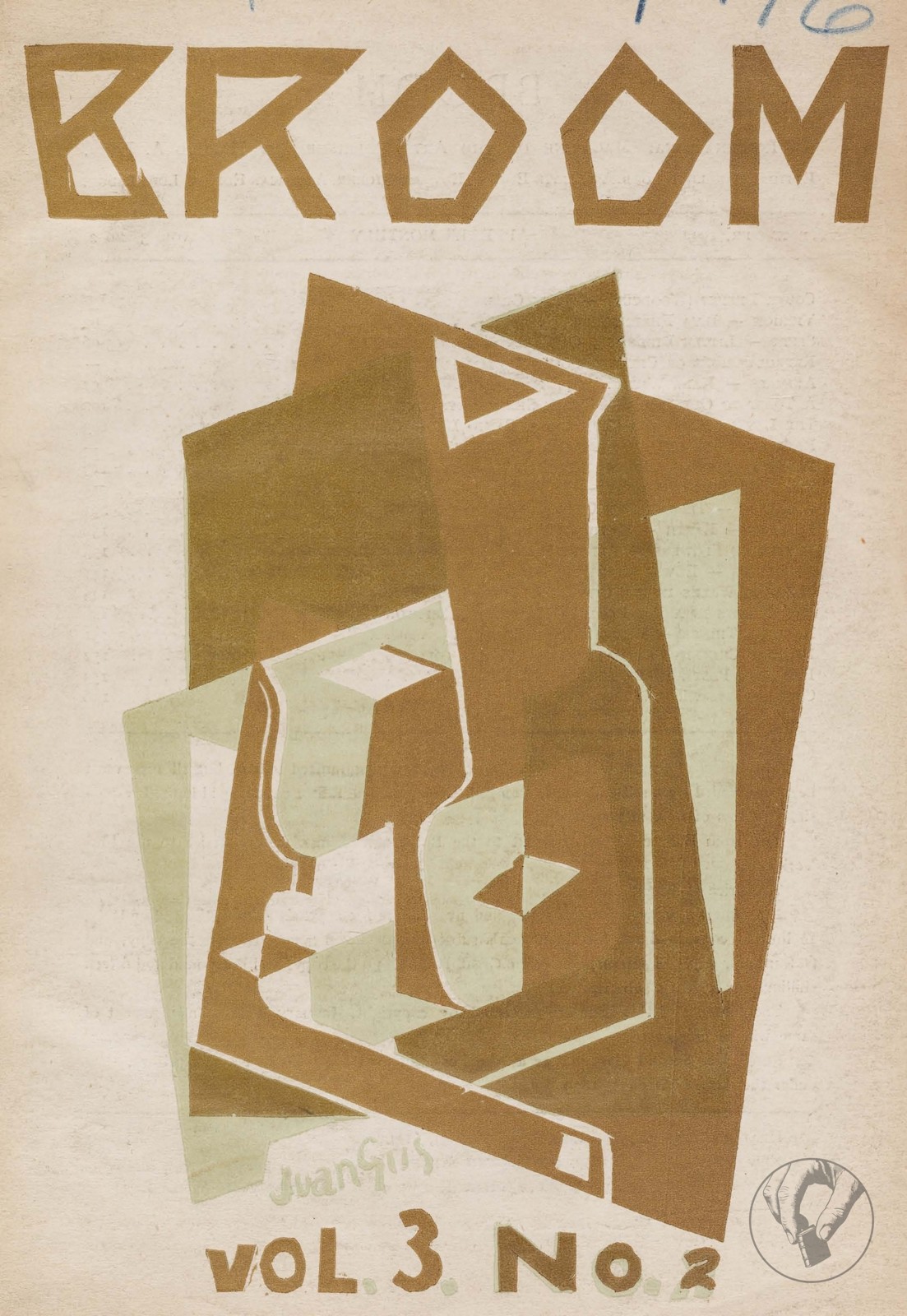
BROOM --- Juan Guts VOL. 3 NO. 2
First pages of the volume, freely accessible.
BROOM --- Juan Guts VOL. 3 NO. 2
BROOM AN INTERNATIONAL MAGAZINE OF THE ARTS PUBLISHED BY HAROLD A. LOEB. EDITOR, HAROLD A. LOEB. ASSOCIATE EDITOR, EDWARD STORER. AMERICAN EDITOR, LOLA RIDGE. SEPTEMBER, 1922 APPEARS MONTHLY VOL. 3, NO 2. COVER DESIGN (WOODCUT) — JUAN GRIS. --- Page --- VITRION — ILYA EHRENBOURG --- SLEEP — LITTLE BIRDS AND OLD MEN — LAWRENCE VAIL --- 95-96 --- REPRODUCTIONS OF CHINESE, SOUTH INDIAN AND JAVANESE SCULPTURE --- — --- ANIMALS — KARL WITH --- A TOAST TO OURSELVES — VADIM SHERSHENYEVITCH --- THE LAY OF MALDOROR (SELECTIONS, CANTO II) — COMTE DE LAUTRÉAMONT --- REPRODUCTIONS OF JAVANESE AND SOUTH INDIAN SCULPTURE --- — --- POEMS IN PROSE — PIERRE REVERDY --- THE MYSTICISM OF MONEY — H. A. L. --- ETCHINGS — THOMAS PYM COPE --- POPULARS — EARTH — KATHRYN WHITE RYAN --- BATTLE OF FLOWERS — ALBERT-JEAN --- APHORISMS — EDWIN MUIR --- MORNING WALKS IN THE CITY — I. SCHNEIDER --- 1001 NIGHTS IN A BAR-ROOM — MATTHEW JOSEPHSON --- NATURAL THINGS — WILLIAM ROSE BENET --- FACTORY CHIMNEYS AT DAYBREAK — ERNST TOLLER --- PAINTING, PAST AND PRESENT — DE FAYET --- COMMENT --- The Editor of Broom will be pleased to consider mss. submitted to him, but all mss. must be accompanied by a self-addressed, stamped envelope. The Editor cannot hold himself responsible for loss of mss. in transit. Mss. from Europe should be sent to the Rome office; mss. from America to the New York office. The price of Broom is: For America, fifty cents the copy, and five dollars for a year’s subscription. For Italy, 10 lire the copy, and 100 lire for a year’s subscription. For France, 6 francs the copy, and 60 francs for a year’s subscription. For Great Britain, 3/6 the copy, and one pound and fifteen shillings for a year’s subscription. The contents of this issue are protected by copyright, January, 1922. Infringement of same will be prosecuted. Entered as Second Class matter at the Post Office at New York, N. Y. April 22, 1922 under the Act of March 3, 1879. HEADQUARTERS, 68, VIA LECCOSA, ROME (9), ITALY. NEW YORK OFFICE, THREE EAST NINTH STREET. LONDON OFFICE, CECIL PALMER, OAKLEY HOUSE, 15-18 Bloomsbury St., W. C. I.
The Most Important Announcement Made By An American Publisher In Years THE CARRA EDITION OF THE WORKS OF GEORGE MOORE BOOKLOVERS and admirers of GEORGE MOORE have eagerly awaited the announcement of a collected edition of his works. We take great pleasure in announcing that we have completed arrangements for the publication of a definitive subscription edition of his writings, which will be the first unexpurgated and uniform collection of all of his books which he desires to perpetuate. The author has not only written an entirely new and characteristic preface, but has made textual changes, in most cases of considerable importance, in every one of the works reissued in this new edition. Two of these works, Modern Painting and The Brook Kerith, have been entirely rewritten; and there are two new books which will appear for the first time in this edition, In Strict Singleness and Peronnik the Fool, Daphnis and Chloe, etc. The set will include such heretofore privately printed titles as A Story-Teller's Holiday, Avowals and Heloise and Abelard, all of which are now very difficult to obtain, and only at high premiums. New Moore works are likely to be added in the same uniform format from time to time, and the original subscribers to this edition will have the privilege of purchasing them at the first subscription price. The Carra Edition is strictly limited to one thousand numbered sets for sale and twenty-five sets marked A to Y (not for sale). The first volume in each set will be signed by the author. The edition will be printed from special type on pure rag paper and bound uncut with vellum backs and paper board sides. The publishers plan to issue the books in groups of three volumes each, and the first group should be ready by October 1, 1922; the other groups will be published at intervals of two months. The price will be $8.50 per volume, and the publishers reserve the right to advance the price to $10.00 per volume after the first publication day. You are urged to place your subscription at once through your bookseller, or direct to the publishers. A special brochure will be mailed on request. In view of the limited number available, an early subscription is desirable to avoid disappointment. The Intimate Letters Series These volumes are octavo size, printed on English laid paper, with uncut edges, and handsomely bound in library buckram. The editions are strictly limited to 1,500 numbered copies. Each, $4.00. THE GEORGE SAND — GUSTAVE FLAUBERT LETTERS Translated by AIMEE McKENZIE Introduction by STUART P. SHERMAN These frank and affectionate letters, extending from 1866 to 1876, make an extraordinary fascinating volume. George Sand's family life at Nohant, the old bachelor's solitude at Croisset, meetings in Paris, adventures with publishers and theatrical managers, and pungent comment on such friends as Sainte-Beuve, Hugo, Gautier, and Turgenev, are here. ROBERT HENRI Edited by WILLIAM YARROW and LOUIS BOUCHÉ. This first volume in the American Art Library is a superb monograph on one of the foremost American artists, and combines a charming resume of his life and work with forty full-page reproductions of his paintings on the finest paper obtainable, without lettering, suitable for mounting. The edition is limited to nine hundred and ninety copies. Subscription price, $10.00. (Illustrated brochure on application). BONI & LIVERIGHT 103 WEST 40th St. NEW YORK CITY The Twenty Titles in the CARRA EDITION are: Lewis Seymour and Some Women The Mummer's Wife Muslin Spring Days Esther Waters Evelyn Inness Sister Teresa The Lake and The Untilled Field Avowals and Confessions of a Young Man Memoirs of My Dead Life Ave Salve Vale The Brook Kerith A Story-Teller's Holiday Heloise and Abelard In Strict Singleness Peronnik the Fool, Daphnis and Chloe, etc. Impressions and Opinions Modern Painting
Read the works of this great genius of our age D. H. LAWRENCE AARON'S ROD Love and Marriage in our day as Lawrence sees it Chicago Evening Post: "A story which deals with the deep secret experiences of life, told in words that glow and sometimes soar. Heavy with the mystery and perfume of night. A story of the age-old struggle between man and woman, each fighting bitterly for mastery, each loath to relinquish that last barrier of self which means complete understanding and complete surrender." New York Times: "A very unusual novel. A book for men and women who are mentally as well as physically grown up. Extraordinarily interesting." J. V. A. Weaver: "We are fascinated with Lawrence's work." $2.00 THE LOST GIRL A gripping story, centering around a strikingly original heroine and her escape from spinsterhood. Winner of the James Tait Black Memorial Prize as the best novel of the year, awarded by the Professor of Rhetoric and English Literature in the University of Edinburgh, H. J. C. Grierson. Francis Hackett in New Republic: "THE LOST GIRL is an absorbing novel, rich in substance, fascinating in background and powerful in its discernments." Sherwood Anderson: "A subtle and powerful book. Often in a single prose passage from the hand of this greatest of living English prose writers the impossible is all but achieved — the entire life of all men and women put into a passage." $2.00 WOMEN IN LOVE Douglas Goldring: "WOMEN IN LOVE is a masterpiece: Lawrence's most important work, an amazing book." John Macy: "No writer in this generation is more singular, more unmistakably individual than Mr. Lawrence, and none is endowed with his unfairly great variety of gifts." (Limited subscription edition) $15.00 FANTASIA OF THE UNCONSCIOUS A further elaboration of the author's theory of the Unconscious begun in his PSYCHOANALYSIS AND THE UNCONSCIOUS. A work of startling originality. $2.00 PSYCHOANALYSIS AND THE UNCONSCIOUS L. L. Buermeyer of Princeton University, in New York Evening Post: "In so far as PSYCHOANALYSIS AND THE UNCONSCIOUS directs attention to the need of bringing into fruitful interaction the discoveries of Freud and his co-workers and our moral ideas in general, it will have done for the psychoanalytic movement the greatest possible service, that of clarifying its issues and lending dignity and significance to its results." $1.50 SEA AND SARDINIA Illustrated with eight striking pictures in color by Jan Juta and with a whimsical map of Sardinia by D. H. Lawrence. Padraic Colum in The Dial: "This record of an excursion into an unknown island is written in a way that suggests the art of the most revealing of the modern painters. The writer makes patterns that draw us right into the thing looked upon. One must be delighted by a record that is so blithe, so full of significant suggestion. What a remarkable writer D. H. Lawrence is!" Heywood Broun: "Lit with extraordinary eloquence." John V. A. Weaver: "By all odds and without reservation the most interesting travel-book we have read in the last few years." $5.00 TORTOISES A BOOK OF VERSE Carl Van Doren in The Nation: "TORTOISES seems to me as powerful a poem as was ever written about animals and nearly as powerful as was ever written about love." With cover design in color $1.25 THE WIDOWING OF MRS. HOLROYD, A Play in Three Acts $1.50 TOUCH AND GO. A Play in Three Acts $1.25 THOMAS SELTZER Publisher 5 West 50th St. New York City
VITRION Gloom: window facing wall. Relief afforded by hole about the size of a head. Bielov was making ready to put in a stove. That is, a stove was promised him by Marya Ilyishna, the colonel's wife. She had got a big brick one from the State Publishing House. She promised to sell him her old stove for a twenty thousand spot. And the twenty thousand spot was promised him by Dober, a reliable man. To get it Bielov had only to botch up a poster: chimneys smoking; sun rising above them; workman, all muscle — main thing to emphasize the muscles — extending hand to middle peasant. Middle peasant, of course, middling — does not count. Appropriate inscription on bottom: BRING YOUR POTATOES! Bielov set to work stove in mind. But instead of chimney he got sticks, instead of muscles — distended commas. And as for the inscription — Ilyitch (1) himself would not understand it; Bielov rather guessed at it. There would not be any potatoes that was evident. Nor any stove. And he, foolishly had already broken a hole in the wall. No matter. More light anyhow. And flying visitors sometimes — thick-feathered white birds. The sun, aiming at hole, spat copiously making Bielov bray with joy like a donkey. A professor, his neighbour, a desperate "Counter" (2) busy with an illegal investigation on "the Symptoms of Mental Diseases among Criminal Elements," heard the braying. He scattered his cheap tobacco, rushed to a secret chink in the wall, got out his note book and jotted down rapidly: "Another case: lusty cries without reasonable cause." Bielov's bed — a hill. His chair shouting: "Attention! When you sit down lean over to the right to keep your balance." Cracked wash-basin covered with black icy bark. Slippery floor. Frozen since morning — Bielov had been washing. He was not cold, however — had on a fur jacket. Boys had got it for him. Stolen goods still bearing Army stamp. Had to be dyed. Not enough color — finished right sleeve with wax-dye. Therefore (1) Lenine. (2) Counter-revolutionary.
unapproachable. All winter: “Fresh paint!” Lydia Stepanovna, to make sure, would not allow him to get near her even from his dry honest side. Queer things in room: boards and, attached to them, sockets for electric lamps, a horse-shoe, cords all around, tin disks, glass, rusty wheel from clock, cigarette box, trash. All this not discarded rubbish piled up by accident, but carefully picked collection full of significance. Bielov was not a freak, not a rag-picker, but an artist-constructor. Remember the name: Vassily Bielov. Tough job getting materials. Though registered in the All-Russian Artists’ Union, he could get nothing. Received a card from the Section of Representative Arts. Went there: If you please, some tin, glass, wood and a few other small things. And in answer: “We have only paint in tubes. Would you like some Veronese Green?” Jackasses! He was forced to get everything by a sort of guerilla method, not free from danger sometimes. Electric lamp sockets could, of course, be simply unscrewed anywhere: in Soviet institutions or when visiting. One could always do it by ingenuously turning conversation to the “pyok” (1). Much worse getting tin. Not long ago he swiped a sheet from a burned down house on Zubov Boulevard. Militiaman saw him and was going to shoot. Barely escaped. Same with everything up to cord issued by wise chiefs. To top it all — time lacking. Bielov would therefore work at night, freeze — and work. Nothing else mattered then; the stove, the floor of the “Ice Palace”, the smell of cabbage soup — did not taste like soup but rags — all that was part of the daily grind not worth speaking of. Compass. Quantity. Circle great and splendid. No mistake there; nor passion; nor wretched foreign vanity. Existence cabbage-like, crinkled, rotten. Jaw of compass could seize it, measure it, reconstruct it: room then — a berth in sub-lunar regions; four senses forty-four continents. And an Object. There had been others: muzzle of dog inevitably in profile, camel driver in Arabia, fish, cross. Now simply an object. It could be constructed — with due regard to the laws of gravitation — so that it should revolve alone above earth, a new heavenly body among other heavenly bodies. Gloom — fiddlesticks. Only two objects mattered. Was begetting one now lying on hunch-backed bed supported by board for greater comfort. Stencilled inscription on board: “Attention! Biscuits.” New form. Weight of cylinder and sphere. Teeth of triangles darted forward reaching, grasping other parts. All revolving. Walking. Monument to new era. Could not stand still like scarecrow. Would have to be promenading from Strasteny Monastery over all boulevards in circle along car line “A”. Last jades would die with fright. Object would be stalking, step by step, marvelous, infallible. Could not pass unnoticed. Even the American special correspondent of the (1) Bread portion allotted by government.
"Chicago Tribune" born on the thirty-eighth floor and spitting every hour five thousand words over cable, even he, having seen, would fall prostrate, his yellow shoes pointing heavenward. Would be won over to faith in new era. Bielov had been at work two years. Sockets and tin. Project finished only today. Easy to construct — all calculated, measured, clear. Even name — Vitrion. Foolish name. As if some romantic trash were still astir under the cylinders of Bielov's vitals: Hence second object — more ordinary in appearance than self-moving angles — Lydia Stepanovna Barykova. Love — subject still somewhat dark, uninvestigated. Very hard to explain. Why should Bielov so contemptuous of emotion pay visits to this Soviet lady with hair dressed over ears, and cupid cameo, who would come playing pranks, ruffle him up, tease him, laugh her full at construction, just letting her lips skim over the steep knobs of Bielov's forehead fairly bursting with Vitriions? Why should he? How explain it? One thing — returning past midnight he would flop on his hunchbacked bed all exhausted. His eyes would no longer see a glorious sphere but dimples in cheeks, — imperfections, hair dressed on one side, pupil dim and pale from tenderness and anguish — disorder, splendid nonsense. He looked on without comprehending, while golden beetles were descending from the sky through the hole. Yes! One could construct an object that would revolve in the air — big, steel, unique. But nothing could be done with love: put it down and up it jumps; say "fly!" and it drops like stone and kills you. No one would accept the Vitrion. "Well, exhibit project... it has some graphic qualities." Other object born. Like fire, wheel, screw. Lured a big Communist, a fellow whose signature counted for more than any monograph. Every letter thereof in itself conclusion, criterion, mandate. He came, polite, sweet. And his voice, his watch chain, his golden hair — all rang and rang. "Construction forty-seven... provisional draught." At last, breathless, pointing out his child: "This? This is Vitrion." Here something disagreeable happened. The teeth of the triangles sank into the soft soul of the Communist. He became irritated, mad, once again irritated. Stopping his tears with a cough he cried: "Why do you do this? Was it of this I dreamed in Geneva? What we need is sunlight, beauty, grace! And this is prison, affliction! I am losing my sanity when I look at it, as if I were to blame that this compass had devoured the universe."
The “Counter” behind the wall held his breath. Why indeed breathe — plenty of time for that later. Now he was reporting in his notebook another first rate case. “Confession of criminal. Symptoms: pathological note in the voice, most probably a masochist.” Could not resist the temptation of looking in. “Tell me, have you ever a desire to touch these wheels?” “Yes! Often. I pat the globe. This is not art. This is an object.” Professor having forgotten danger of being detected, purred happily: “We’ll note: Communists are inclined to perversion known as fetishism.” Fearing he might forget it, he ran quickly to the stove. Most painful rebuff from Lydia Stepanovna. She did not laugh. She looked with loathing at Vitrion. “Tear it! Break it!” How could he betray the new object still unborn for the sake of the old one He threw at her the friendly phrase: “You’re a stand patter.” Yet quite often, at night, he would crumple the worn sheets, break the glass partitions and moan aloud like an old woman. The professor made no further notes. It was all so evident. He feared only one thing — infection. Then he, too, would get himself a globe, enroll in the party — in general go to the dogs. The high bulging forehead cooled off — has long been untouched by hot dry breath. Then suddenly, like a mushroom, appeared Tomilin the pupil of a ballet studio. In the first place he was a dancer — not a Vitrion. In the second place — his legs — Lydia Stepanovna had a soft spot for legs as if made by Eiffel. In the third place — in addition to the first two — he was an idealist, could do all things, play pranks, steal a kiss in the dark, describe the golden beetles beyond the wall with particular poetic gift. In the fourth place, in the fifth . . . In a word, the kick of Tomilin’s Eiffel leg frequently echoed in her talk now. “Bielov, you never portray love in your work.” No, of course not. He was creating something else, the other object. He was exposing love in all its nudity. Tomilin could leap to his feet, stand breathless, throw open his arms — everything according to print: “You are my own — for eternity!” Eternity fairly bursting from his very shoes. But a globe could exist all alone, and if well contrived and constructed could even move above and outside the earth. To give up then? To let Tomilin alone lose his head seek out the hungry, mad, happy glance. No, he could not give up. Walking. Looking. And suppressing his sorrow calmly continued constructing Vitrion. Lost patience and asked:
"Tell me frankly — is it Tomilin?" Gravely, sadly, eyes under lowered lashes like birds in a cage, she said: "No." Then — a pleasantry offensive enough to take one's breath away, to make one stamp one's feet: "I love only your Vitrion." Bielov wanted to understand but could not. And so it all remained unchanged — from golden down on nape of neck to tin and glass, from metaphysics of Tomilin to the sudden rustle of her passing hands. *** Lucky day. A certain Guguerman visited Bielov. Looked at Vitrion and became agitated. Guguerman was, of course, the man who had formerly been lawyer. He used to transact small law suits, consumed quantities of "booze", and, being of a melancholy disposition, would cogitate: did Raskolnikov have the right to kill the old woman? Was the love of Anna Karenina criminal from the standpoint of higher ethics? And so on. Then came October and its after results. Guguerman's father, a jewelry man, was done in by the Revolutionary Tribunal, probably on account of his all too many carats. Mother died from typhoid fever. And, in general, nothing was left — even his purse with monogram on it was swiped in a car. Left with neither family nor monogram. Guguerman was a man — and pants on him. Moscow, a city — and Lubiansky Square in it. Evidently one must live. And Guguerman landed a job — fate had its laugh at his melancholy — in the Circus Section of the State Theatre. He served conscientiously, was never swerved by Raskolnikov or "booze". He tried his best to harmonize the black clowns, the wrestlers bellowing "Mmm" with the eleven points of the resolution on the "Proletarian Spirit in the Modern Circus". sign orders from his three-legged Empire chair with a coat of arms on it, and received two thirds of the corresponding "pyok". Having looked at Vitrion, Guguerman first got frightened, then began to laugh; the big triangles were darting forward exactly like Chief Kiriushin the jealous attendant of all girl secretaries in the State Theatre. Quite amusing. What if the thing should be put into a Circus? Men, snakes, two piece elephants, living dolls — everybody already sick of that. This contrivance would provoke merriment at any rate; one could even slip in edgewise some idealism: the world proletariat awakening, stretching its limbs, rising, walking forward, destroying. "Would you want it in the Circus?" Queer. And yet... Well let it be the Circus. Main thing is to finish it. And then it would move of itself from
the stage to the boulevards; no member of the Revolutionary Tribunal would ever catch it. Decided. In the evening at Lydia Stepanovna’s. Success. She was silent. Would not even tease him. It was time for him to go, to work away full speed. “Good night.” “Vassia, stay a while . . . I can’t bear it.” First time “Vassia”. Laughing at him? Should he stay? But globe could not wait. Wanted to live, to move, to be born. “All this is moonshine. There is Vitrion waiting at home.” Dark on the stairs. Treacherous landing — he slipped. And straight into somebody’s arms. Tenderly and maliciously fur ear laps of Tomilin’s hat brushed his face. Dancer fearless, bent down, swung up his arms — like wings — one could see at once he was an idealist, and up over two steps to the top. *** In the Circus Section of the State Theatre work was in full swing. A new sketch “The Third International” was being rehearsed. Nations would come in tremendous masks. Make-up out of date. Masks indispensable. Mugs a foot long. Terrible mugs. Not only Australian and Kaffir, but even some nameless beasts came crawling up. Violet varnished muzzle — neither eyes nor nose only a black mysterious slit, an enraptured mouth shouting greetings. Tried it on. Everybody frightened. Looked like the behind of some baboon; one could not tell whether it was a face or something else. Came the horse rider, a negro. Sad. Coughing. “Pyok” had been reduced. Dressed in some nondescript pantaloons. Could not bear it any longer: “Wanna, go back to Marseilles.” Guguerman, reasoning with him. Splendid suit according to all rules of “Suprematism” (1). Driver cringing for shoes — toes sticking out, shame before horses’ hoofs. And on side, reader from Communist group spouting: “Circus must reveal the physical beauty of the proletariat. It’s all in the muscles.” Muscles to be sure not commas. But the negro insisted: “Pyok” reduced. Easy to say: muscles. Bones still held together in “Suprematist” pants — thank Heaven for that. Animals too — not men alone Vyssokov came up excited: “You want the bear to call nations together with drum? Tear the (1) School of Painting.
hydra of capital to pieces? I tell you he is going to croak. Can hardly walk. Give him the hydra — and he to lick it. How can you feed a big bear on a pound of bread a day? Do you think he’s a bourgeois? He’ll kick the bucket and you’ll be stuck with your hydra.” He could hardly be calmed. And the girl secretary tapped out: “Circus section of the State Theatre herewith issue orders to give Comrade Vyssokov a larger “Pyok” for the Circus bear in view of his arduous service.” Well, sketch finished. Waiting for Bielov to demonstrate Vitrion. Truth is — all were scared. The manager’s wife scared of her husband. Pious man he. Last summer she had to ride on army horse. No sooner had she mounted than horse took to dancing American dance. Trained horse Merimée. Husband was at the window. Poor wretch got mad with fright. Seized holy image and into yard to save wife. And Merimée, having finished dance did next number on program — fell on her knees. Right in front of the holy image. Husband made sign of cross. Won over to faith in wonder-working image. But wife was Communist — awkward situation. What would happen with Vitrion in action? Husband would repeat old trick and then — public scandal. Guguerman had neither husband nor wife to fear, but there was the Communist group. What if they suspected it all to be a hoax? Some figures are comprehensible to all: cross, star. But here was something mysterious: globe neither white nor red. Freezing poor thing though set on pipes. Arrived with some dark youth. Unpacked. Vitrion came to himself, rose, and went straight for the corridor. In the back, delegate from Penza at work on linen, fitting up a suit for Julius Caesar who had been forced to parade in Little Russian shirt. Twenty-five foot order. Suddenly something advancing without feet, without hands — with grinding intestines. Angles, globe, wheels, tin, trash. Though the delegate was party-man he fell back on superstition from great fright, and suddenly began to pray for the intercession of the Holy Virgin. Sat down on “Izviestia” (1) in a corner and whined: “Why did they ever send me to Moscow? — Assassins”. People came running from other rooms. Guguerman understood and shouted: “For the State Circus! Model of the world proletariat.” And in a twang: “Our latest.” Commander, a sailor, saluted. Everybody sang. Took to examining Vitrion Even the delegate picked up enough courage: “Would be fine thing to send us to Penza; trick like this for propaganda purposes. When everybody is out to look, have orator ready on Tax in Kind.” (1) Official paper of Soviet Government.
Broom is an international magazine of the arts. This issue features contributions such as "Vitrion" by Ilya Ehrenbourg, "The Lay of Maldoror" by Comte de Lautréamont, and "Poems in Prose" by Pierre Reverdy. It also includes reproductions of various sculptures and etchings. The magazine is published monthly by Harold A. Loeb and has offices in Rome, New York, and London.