Page 1
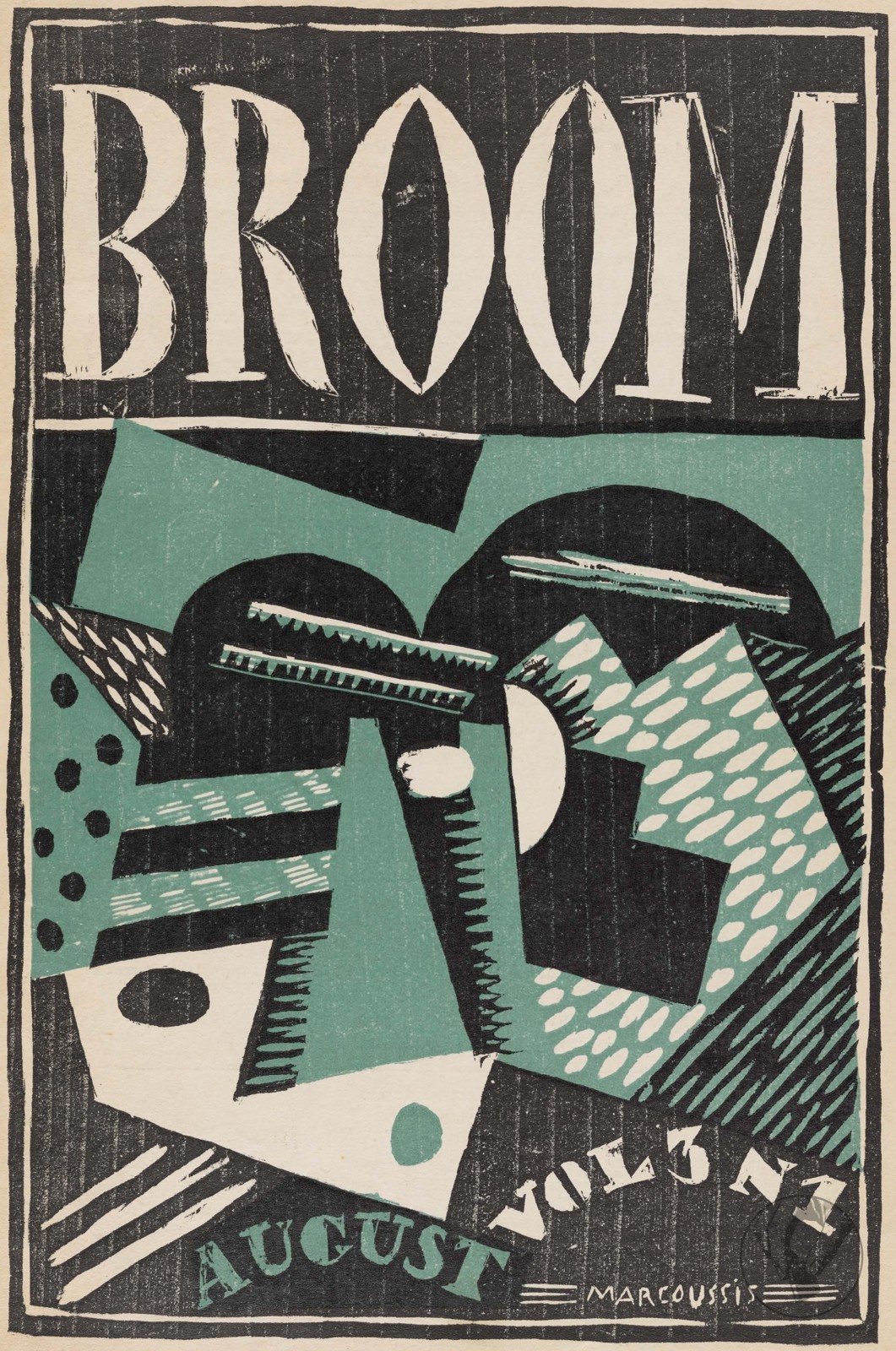
BROOM AUGUST VOLUME 3 MARCOUSSIS
First pages of the volume, freely accessible.
BROOM AUGUST VOLUME 3 MARCOUSSIS
BROOM AN INTERNATIONAL MAGAZINE OF THE ARTS PUBLISHED BY HAROLD A. LOEB. EDITOR, HAROLD A. LOEB. ASSOCIATE EDITOR, EDWARD STORER. AMERICAN EDITOR, LOLA RIDGE. --- AUGUST, 1922 APPEARS MONTHLY VOL. 3, NO I. --- COVER DESIGN — MARCOUSSIS --- Page --- EXORDIUM TO DUCASSE — WILL BRAY --- THE LAY OF MALDOROR — COMTE DE LAUTRÉAMONT --- WOODCUTS — MAX WEBER --- 14-75 --- NOVEMBERLEVENTH — JAMES DALY --- WOODCUT — ANDRÉ DERAIN (FROM “L’ENCHANTEUR POURRISSANT”) --- FRENCH LETTERS AND THE WAR — JACQUES RIVIÈRE --- POEMS — YVOR WINTERS --- AT 125 BOULEVARD ST. GERMAIN — BENJAMIN PÉRET --- PERIPATETICS VI & VEGETABLE CLASSIC — MATTHEW JOSEPHSON --- 41-42 --- WOODCUT — ANDRÉ DERAIN --- SIX CHARACTERS IN SEARCH OF AN AUTHOR. ACT III — LUIGI PIRANDELLO --- HULA-HULA — WILLIAM CARLOS WILLIAMS --- WOODCUT — ANDRÉ DERAIN --- AT THE DOORS — BORIS PILNIAK --- WOODCUT — ANDRÉ DERAIN --- LES NOCES DE CLYTE — JOHN CRAWFORD --- THE WOODPECKER — CORRADO GOVONI --- RUSSIAN BERLIN — L. L. --- The Editor of Broom will be pleased to consider mss. submitted to him, but all mss. must be accompanied by a self-addressed, stamped envelope. The Editor cannot hold himself responsible for loss of mss. in transit. Mss. from Europe should be sent to the Rome office; mss. from America to the New York office. The price of Broom is: For America, fifty cents the copy, and five dollars for a year’s subscription. For Italy, 10 lire the copy, and 100 lire for a year’s subscription. For France, 6 francs the copy, and 60 francs for a year’s subscription. For Great Britain, 3/6 the copy, and one pound and fifteen shillings for a year’s subscription. The contents of this issue are protected by copyright, January, 1922. Infringement of same will be prosecuted. Entered as Second Class matter at the Post Office at New York, N. Y. April 22, 1922 under the Act of March 3, 1879. --- HEADQUARTERS, 68, VIA LECCOSA, ROME (9), ITALY. NEW YORK OFFICE, THREE EAST NINTH STREET. LONDON OFFICE, CECIL PALMER, OAKLEY HOUSE, 15-18 Bloomsbury St., W. C. I.
The Most Important Announcement Made By An American Publisher In Years THE CARRA EDITION OF THE WORKS OF GEORGE MOORE BOOKLOVERS and admirers of GEORGE MOORE have eagerly awaited the announcement of a collected edition of his works. We take great pleasure in announcing that we have completed arrangements for the publication of a definitive subscription edition of his writings, which will be the first unexpurgated and uniform collection of all of his books which he desires to perpetuate. The author has not only written an entirely new and characteristic preface, but has made textual changes, in most cases of considerable importance, in every one of the works reissued in this new edition. Two of these works, Modern Painting and The Brook Kerith, have been entirely rewritten; and there are two new books which will appear for the first time in this edition, In Strict Singleness and Peronnik the Fool, Daphnis and Chloe, etc. The set will include such heretofore privately printed titles as A Story-Teller's Holiday, Avowals and Heloise and Abelard, all of which are now very difficult to obtain, and only at high premiums. New Moore works are likely to be added in the same uniform format from time to time, and the original subscribers to this edition will have the privilege of purchasing them at the first subscription price. The Carra Edition is strictly limited to one thousand numbered sets for sale and twenty-five sets marked A to Y (not for sale). The first volume in each set will be signed by the author. The edition will be printed from special type on pure rag paper and bound uncut with vellum backs and paper board sides. The publishers plan to issue the books in groups of three volumes each, and the first group should be ready by October 1, 1922; the other groups will be published at intervals of two months. The price will be $8.50 per volume, and the publishers reserve the right to advance the price to $10.00 per volume after the first publication day. You are urged to place your subscription at once through your bookseller, or direct to the publishers. A special brochure will be mailed on request. In view of the limited number available, an early subscription is desirable to avoid disappointment. The Intimate Letters Series These volumes are octavo size, printed on English laid paper, with uncut edges, and handsomely bound in library buckram. The editions are strictly limited to 1,500 numbered copies. Each, $4.00. THE GEORGE SAND — GUSTAVE FLAUBERT LETTERS Translated by AIMEE MCKENZIE Introduction by STUART P. SHERMAN These frank and affectionate letters, extending from 1866 to 1876, make an extraordinary fascinating volume. George Sand's family life at Nohant, the old bachelor's solitude at Croisset, meetings in Paris, adventures with publishers and theatrical managers, and pungent comment on such friends as Sainte-Beuve, Hugo, Gautier, and Turgenev, are here. ROBERT HENRI Edited by WILLIAM YARROW and LOUIS BOUCHÉ. This first volume in the American Art Library is a superb monograph on one of the foremost American artists, and combines a charming resume of his life and work with forty full-page reproductions of his paintings on the finest paper obtainable, without lettering, suitable for mounting. The edition is limited to nine hundred and ninety copies. Subscription price, $10.00. (Illustrated brochure on application). BONI & LIVERIGHT 103 WEST 40th St. NEW YORK CITY The Twenty Titles in the CARRA EDITION are: Lewis Seymour and Some Women The Mummer's Wife Muslin Spring Days Esther Waters Evelyn Innness Sister Teresa The Lake and The Untilled Field Avowals and Confessions of a Young Man Memoirs of My Dead Life Ave Salve Vale The Brook Kerith A Story-Teller's Holiday Heloise and Abelard In Strict Singleness Peronnik the Fool, Daphnis and Chloe, etc. Impressions and Opinions Modern Painting
Three Books that are current in the Intellectual Life of Today. Walter Lippmann's "Public Opinion" "The most sane and interesting discussion of the topics involved yet produced in America". — Chicago Daily News. A book that is being widely discussed by the thoughtful people of America. $2.75, by mail $2.90 * Evelyn Scott's "NARCISUS" A new novel by the author of "The Narrow House". Here is a novel that expresses in its insight into human nature, the loss of standards, the feverish turbulence of modern existence. Through the revelation of their mental life Mrs. Scott has created a group of characters who are unforgettable. $1.75. A New Book by Clive Bell "Since Cezanne" Clive Bell's brilliant and amusing criticism of modern art and aesthetics have made him one of the foremost exponents of the philosophy of the newer forms of art. His latest book is invaluable to the artist and to those who have a knowledge of art itself. $2.00 HARCOURT, BRACE and Co., 1 W. 47th St., NEW YORK. BROOM 3 EAST 9th STREET, NEW YORK CITY For the enclosed $________ please send me Broom for a year and the following book Name _______________________________ Address _______________________________
EXORDIUM TO DUCASSE The age has been far more reluctant to concede the genius of Isadore Ducasse (“Comte de Lautréamont”, 1850-1870), than is the case, perhaps, of any other of the extraordinary personalities of the past century. His writings, speciously damned as the maunderings of a madman, were regarded up to very recently as having little interest, save for the alienist. Spurned thus by the French, there would have been little enough opportunity for that considerable part of the world which reads English to judge of his case, were it not for the enterprise of Mr. Rodker in translating Les Chants de Maldoror. In France, however, the younger generation, which otherwise might well have been stifled by the sterile traditions of the preceding art-period, has taken Ducasse to its heart, and is producing a literature of great fertility, freedom, invention, agressiveness. It is postulated that the post-war period is, or is to become, a very pregnant one, an age of unrivalled physical attainments and of the desperation born thereof. To the period which has just set in, the personality of Ducasse, like that of Rimbaud, exercises a dominant attraction. These two were the vaticinal spokesmen for a state of mind whose brutality and beauty none could have foretold. The nineteenth century, again — it always serves as a point of departure — was enmeshed in a vicious cycle of quiddities and casuistries from which the spirit emerged into either an unhealthy Christianity or a hybrid Epicureanism. Ducasse, like Rimbaud, was neither pagan nor Christian. We are extricated from these dreaded categories as we are from the fruitless post hoc ergo propter hoc. The “Songs of Maldoror” form a legend on an heroic scale of the naked human passions working out their destinies. Since we have come to know more familiarly the cavernous recesses of the mind and the momentous play of the unconscious in the diurnal existence, the presumption of a Ducasse becomes pardonable. The contained, complex social nature of man drops off like an outworn robe. There is escape at last from the button-moulder who menaced Peer Gynt. The standard associations of thought are forsworn; the motivation verges from the most frightful niceties of observation to gestures of gigantic scope, while the human rôle in the drama of nature becomes that of Prometheus. Man is a beast again; his laughter, his weeping, his howling, are as insistent and clamorous as those of the other beasts in the jungle. With the nullification of human reason, the mind abandons itself to a sort of destructive sincerity, whereby all may be denied or posited, and nothing is impossible. The gift of song in man becomes atavistic again, chanting against pain, hunger and danger. In Maldoror the incantations assume the rhythm of the baying of hounds, the long swell of sea-waves, or the furious velocity of a life that is consumed like a flame across the sky. WILL BRAY --- $\text{Ex} \quad 0901$ $256199$ $v.3$ $787563$ --- $10-30-35 - \text{Relius H., Palmy - gpf - cl}^{\prime} 2\sigma$
THE LAY OF MAILDOROR First Canto May it please Heaven that the reader, emboldened and become temporarily ferocious like what he is reading, will find his sudden and savage way across the lonely marshes of these sombre and poisoned filled pages without losing himself; for unless he bring to his reading a rigorous logic and tension of spirit equal at least to his suspicion, the mortal emanation of this book will soak his soul as water does sugar. It is not a good thing for all the world to read the pages which are about to follow; a few only will, without danger, taste this bitter fruit. Therefore, timid soul, before penetrating further into such unexplored territory, direct your heels backwards and not forwards. Listen well to what I say to you: direct your heels backwards and not forwards; like the eyes of a son who respectfully turns away from the august admiration of the maternal visage; or rather, like a wedge of deeply thoughtful and chilly cranes, who under full sail, fly powerfully through the winter across the silence, towards a certain point on the horizon, whence comes suddenly a violent and strange wind, forerunner of the storm. The oldest crane, itself the ‘vanguard’, noting this, waves its head like a reasonable person, consequently its beak also is made to clap, and is not pleased (I too would not be happy were I in its place) while its aged neck, featherless and contemporary with three generations of cranes, moves in irritable undulations as presage of the storm which approaches nearer and nearer. After having looked several times coolly about her in all directions with eyes full of experience, the leader prudently (for she it is who has the distinction of showing her tail feathers to the other cranes, her intellectual inferiors) with her watchful cry as of a mournful sentinel; to repulse the common enemy, gracefully turns the point of the geometric figure (it may be a triangle, but the third side which these curious birds of passage form
like an experienced captain whether to port or to starboard is not seen) and manoeuvring with wings hardly larger than a sparrow’s since she is no fool, takes another and surer philosophical path. By moonlight, near the sea, in remote parts of the countryside, plunged in bitter meditations, one sees everything take on yellow, doubtful and fantastic shapes. Now quickly, now slowly, the trees’ shadows run, approach and approach again in every shape, flattening themselves, pressing closely to earth. In the past, when I was carried away upon the wings of youth, that made me dream, seemed strange to me; now I am used to it. The wind moans through the leaves with languorous notes, and the owl recites its solemn lament making the hair of those who hear it stand on end. Then the dogs, made savage, break their chains, escape from distant farms; fly through the countryside in all directions, a prey to madness. Suddenly they stop, examine all round them with ferocious disquiet; eyes blazing and like the elephants, which throw round them in the desert one last look at the sky, despairingly raising their trunks before dying, their ears hanging inert; so the dogs leave their ears inert, lifting their heads, puffing out their dreadful necks and in turn like a baby crying with hunger, or like a cat on a roof wounded in the belly, or like a woman about to bring forth, or like a plague-stricken moribund in hospital, or like a young girl singing a noble air; begin to bay the northern stars, the eastern stars, the southern stars, the western stars; the moon, the mountains resembling giant rocks, reclining in darkness; the icy air they inhale deeply from a distance, and which makes the insides of their scarlet nostrils burn, the nocturnal silence; the screech owl carrying off a rat or a frog in its beak, living food, tender for the living ones, in oblique flight brushing their muzzles; the hares disappearing in the twinkling of an eye; the thief who after his crime flies fast as hoofs will carry him; snakes disturbing the heather which makes their skin quiver and gnash their teeth; their own baying which
frightens them; the toads they crush with one snap of the jaw (why did they leave the marsh?); the trees whose gently waving leaves are so many uncomprehensible mysteries to them, which they wish to solve with their staring intelligent eyes; the spiders hanging among their long legs who clamber up trees to save themselves, the crows who could not find anything to eat during the day and who return to the nest with tired wings; the rocks of the shore, the fires which appear at the masts of invisible vessels, the hollow noise of waves, the great fish which, swimming show, their black backs, then disappear into the abyss, and man who enslaves them. After which they again rush through the countryside, leaping with bloody paws across ditches, roads, fields, passes and craggy stones. One would think them mad, seeking some waste lake to quench their thirst. Their prolonged baying terrifies nature. Woe to the belated traveller! The cemeteries’ friends will cast themselves upon him, will tear him, will eat him with blood-dripping fangs, for their teeth are not decayed. The wild beasts, not daring to approach and take part in the meal of flesh, fly trembling out of sight. After some hours, the dogs, harassed by running in all directions, and half dead, tongues hanging from their mouths, without knowing what they are doing, fall with an incredible swiftness, one upon the other, tearing each other into a thousand pieces. They do not behave thus out of cruelty. Once my mother said to me with glassy eyes, “When from your bed, you hear the baying of dogs in the countryside, hide under the blankets, nor mock their behaviour; they have an unquenchable thirst for the infinite, like you, like me, like the rest of humanity with long and pallid features. I even permit you to stand in front of the window to observe the spectacle, sublime enough.” Since then I have observed the dead one’s wishes. Like the dogs, I too feel the need of the infinite . . . I cannot, I cannot satisfy this need! According to what I have been told, I am the son of man and of woman. That astonishes me! For the rest, what does it matter whence I come? I thought more of myself. For myself, if it had depended on my own will, I would rather have wished to be the son of
the female shark, whose hunger is the friend of tempests, and of the tiger of well known cruelty; I will not be so malignant. You who look at me, go to a distance, for I exhale a poisonous breath. No one has yet seen the green wrinkles of my forehead, nor the projecting bones of my emaciated face, like the backbone of some great fish, or the rocks, covering the sea shore, or the abrupt alpine mountains, which I often travelled over, when I wore hair of a different color on my head. And when during stormy nights I prowl round the habitations of mankind, eyes burning, hair whipped by the storm wind, solitary as a stone in the middle of the road, I cover my withered face with a scrap of velvet, black as the soot which fills the insides of chimneys; it would not do for eyes to witness the ugliness that the Supreme Being with a smile of mighty hate, has put upon me. Every morning, when the sun rises — for others, scattering joy and salutary heat to all nature, while no one of my features moves, gazing fixedly into the space filled with shadow, crouching in the depths of my beloved cave, in a despair which intoxicates me like wine, I tear my chest in shreds with powerful hands, yet I feel that I have not got hydrophobia. Yet I feel that it is not only I who suffer . . . ! Yet I feel that I breathe! Like a condemned man who tries his muscles, meditating upon their fate, and who will soon mount the scaffold, upright upon my pallet, eyes closed, I turn my neck slowly from right to left, left to right during whole hours; I do not fall stark dead. From moment to moment, when my neck can no longer continue to turn in the same inertia, and stops in order to begin to turn the opposite way I see suddenly the horizon through the thick brushwood, which cloaks the morth: I do not see anything! Nothing . . . but for the countryside which dances in whirlwinds with the trees and with the long files of birds which traverse the sky. That upsets my blood and brain . . . Who is it then who hits me on the head with a bar of iron, like a hammer striking an anvil? I propose to declaim full-throatedly and unemotionally the cold and grave strophe you will hear. Be then attentive to its content and
protect yourself against the painful impression which it cannot fail to leave like a blemish on your troubled thoughts. Do not imagine me to be at death’s door, for I am not yet a skeleton, and age does not cling to my forehead. Put aside therefore any idea of comparison with the swan in that moment when his existence takes flight, but see before you some monster, whose face I am glad you cannot see; but that is less horrible than its soul. All the same, I am no criminal . . . Enough on this point. No great while has elapsed since I saw again the sea, and walked the bridges of ships, and my souvenirs are as lively as though it were but yesterday I left them. Be then, if you are able, at least as calm as myself in perusing this which I already repent of offering you, and do not blush at the thought of what the human heart is. Octopus, with the silky gaze! You whose soul is inseparable from my own, you the most beautiful of the terrestrial globe, lord of a harem of four hundred suckers, you in whom the tender communicative virtue and divine grace sit nobly as though at home, mutually agreeing and indestructibly united, why are you not with me, your mercury belly pressed to my aluminium chest, both resting upon some rock by the shore, and contemplating the view I love. Ancient ocean, whose waves are crystal, you resemble somewhat those azure marks to be seen on the bruised backs of cabin boys; you are an enormous bruise upon the earth’s body; I like this analogy. So at first sight of you, a prolonged sigh of sadness passes, which might be imagined the murmur of the suave breeze, leaving ineradicable traces upon the deeply moved spirit, and you recall to lover’s memories, often unknown to them, the crude origins of mankind; when it became acquainted with abiding sorrow. I salute you, ancient ocean. Ancient ocean, your harmoniously spherical form which delights the solemn countenance of geometry; but too well recalls to me the tiny eyes of mankind, similar to those of the wild boar for smallness, and to those of night birds in the circular perfection of contour. Nevertheless mankind has thought himself beautiful in all ages. But I
imagine rather that mankind only believes in his beauty out of conceit, and that he is not actually beautiful and suspects it; for, why does he look at the faces of his fellows with so much scorn? I salute you, ancient ocean! Ancient ocean, you are the symbol of identity, for ever equal to yourself. You do not essentially change, and if your waves are wild in one place, far off, in some other region, they are in utter calm. You are not like mankind, who stops in the street to watch two bulldogs seize each other by the neck, but does not stop when a funeral is passing; who is agreeable in the morning and bad-tempered in the evening; laughs to-day and cries to-morrow. I salute you, ancient ocean! Ancient ocean, it is not impossible that, as fabulous as futile utilities for mankind are hidden in your breast. Already you have given him the whale. You do not easily allow the greedy eyes of natural science to divine the thousand secrets of your hidden organisation: you are modest. Man prides himself without ceasing, and for trivialities. I salute you, ancient ocean! Ancient ocean, the diverse families of fish which you feed have not sworn brotherhood with each other. Each family keeps to itself. The temperaments and forms which vary in each of them, explain satisfactorily what at first appears only an anomaly. So it is with man, who has not the same excuse. If a scrap of earth, is inhabited by thirty million human beings, they think themselves bound not to interfere in the lives of their neighbours, fixed like roots in the adjoining scrap of earth. Descending from the great to the small, each man lives like a savage in his lair, rarely leaving it to visit his fellow, similarly crouched in another lair. The large universal family of humanity is a utopia worthy of the most mediocre logic. Besides, the sight of your fruitful dugs releases the idea of ingratitude, for one immediately thinks of all those numerous parents so ungrateful to the Creator as to abandon the fruit of their miserable union. I salute you, ancient Ocean. Ancient ocean, your material grandeur can only be compared
Broom is an international magazine of the arts published by Harold A. Loeb. This issue, Volume 3, Number 1, features contributions from various artists and writers, including "The Lay of Maldoror" by Comte de Lautréamont, "Exordium to Ducasse" by Will Bray, and "Six Characters in Search of an Author" by Luigi Pirandello. The magazine also includes woodcuts by Max Weber and André Derain, and literary pieces covering French letters, poetry, and Russian Berlin.