Page 1
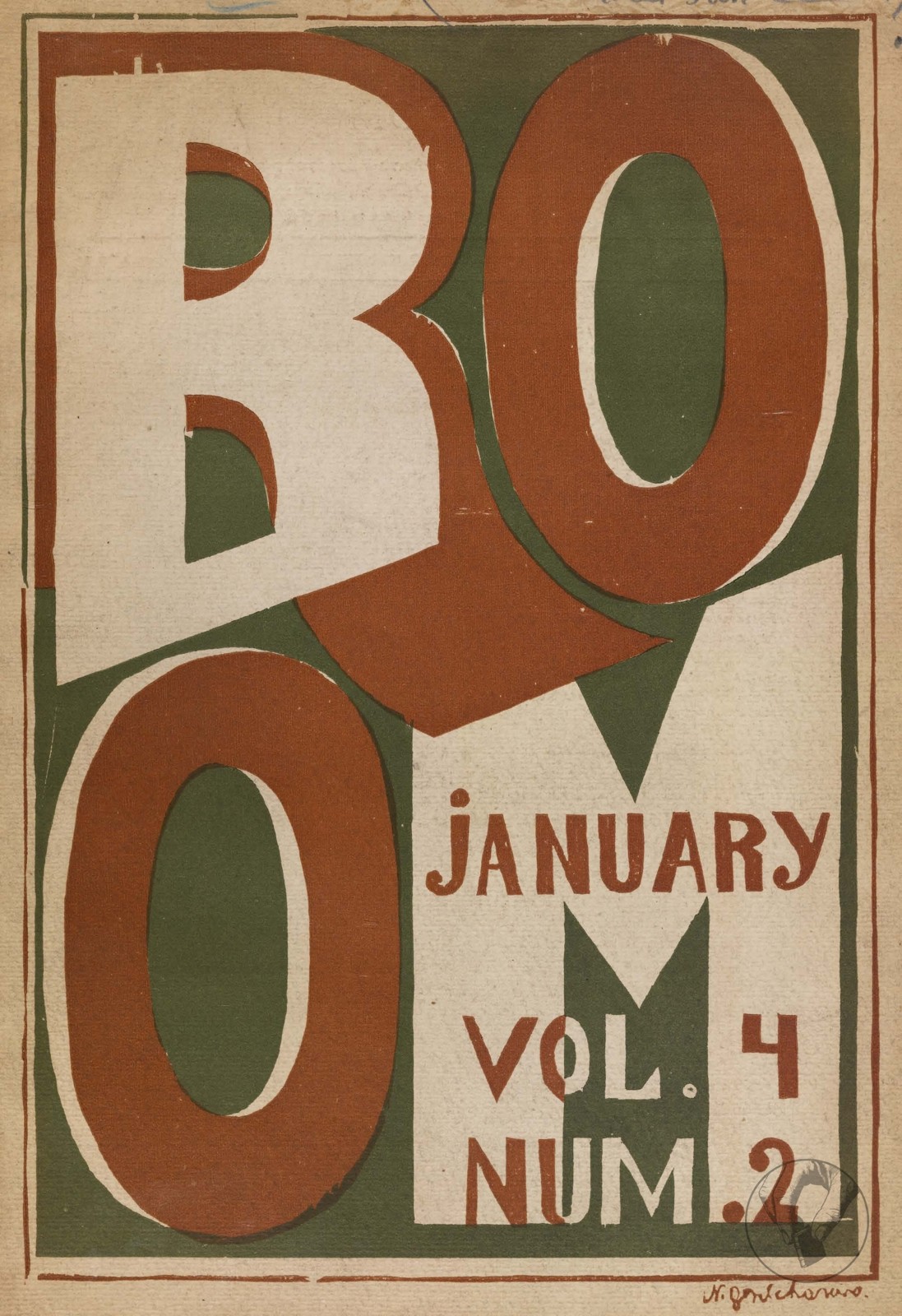
BOM JANUARY VOL. 4 NUM. 2 H. Gonschewo.
First pages of the volume, freely accessible.
BOM JANUARY VOL. 4 NUM. 2 H. Gonschewo.
BROOM AN INTERNATIONAL MAGAZINE OF THE ARTS PUBLISHED BY HAROLD A. LOEB. EDITOR, HAROLD A. LOEB. ASSOCIATE EDITOR, MATTHEW JOSEPHSON. AMERICAN EDITOR, LOLA RIDGE. ASSOCIATE ART EDITOR, LADISLAS MEDGYES. --- JANUARY, 1922 PUBLISHED MONTHLY VOL. 4, NO. 2 --- JOKE — HOLLING A. CLANCY --- MY DEAR MRS. WURTELBACH — KENNETH BURKE --- STADIUM CONCERT — CHARLES GALWEY --- KARINTHA — JEAN TOOMER --- MAYA ART — GEORGE SACKEN --- THE HOUSE OF CONOVER — ROBERT A. SANBORN --- PURSUIT — MATTHEW JOSEPHSON --- NIGGER — MARGARET EVANS --- THE DESTRUCTION OF TENOCHTITLAN — WILLIAM CARLOS WILLIAMS --- MORNING — KAY BOYLE --- FUGITIVES — CHARLES GALWEY --- CIRCLE — ELSA VON FREITAG-LORINGHOVEN --- THE HIGH HAT — LOUIS GILMORE --- WEAR — GERTRUDE STEIN --- THE SPRINGS OF GUILTY SONG — HART CRANE --- HYMEN — MARIANNE MOORE --- PASCIN’S AMERICA — MALCOLM COWLEY --- POEMS: MARIANNE MOORE, T. S. ELIOT — M. J. --- REPRODUCTIONS COVER DESIGN (WOODCUT) — GONTCHAROVA MAYA ARCHITECTURE AND SCULPTURE, FACING PAGES 88, 89, 104, 105, 120, 121, 128, 129 MAYA MOTIFS AND DESIGNS, THROUGHOUT. --- The Editor of Broom will be pleased to consider mss. submitted to him, but all mss. must be accompanied by a self-addressed, stamped envelope. The Editor cannot hold himself responsible for loss of mss. in transit. Mss. from Europe should be sent to the Berlin office; mss. from America to the New York office. The price of Broom is: For America, fifty cents the copy, and five dollars for a year’s subscription. For Italy, 10 lire the copy, and 100 lire for a year’s subscription. For France, 6 francs the copy, and 60 francs for a year’s subscription. For Great Britain, 2/6 d the copy, and one pound five shillings for a year’s subscription. The contents of this issue are protected by copyright, January, 1922. Infringement of same will be prosecuted. Entered as Second Class matter at the Post Office at New York, N. Y. April 22, 1922 under the Act of March 3, 1879. --- HEADQUARTERS, SCHICKLERSTRASSE 5, BERLIN, GERMANY NEW YORK OFFICE, THREE EAST NINTH STREET.
JOKE . . . Silver knives, Lanced on long winds Have killed the grass-bloom; A blue-chinned mountain Strokes his shag-beard . . . The dog is dead, And dry-rots over the rafters That rib up through cracked roof-mud . . . One Penitente whipped too long On the up-hill, and ripping fibre-thorns Sawed him from life . . . Crow-egg has pipped In a far pine’s fur — — — Dad crow flaps home With a fat, fresh horse-eye! HOLLING ALLISON CLANCY 1 73
MY DEAR MRS. WURTELBACH I. What if he had known Wurtelbach since the days when they had a tent in the back yard and played Old Maid if it rained? It was in the company of Wurtelbach that he had bought his first beer. Furthermore, he had roomed with Wurtelbach at the university. But as to Mrs. Wurtelbach, he had taken her limp hand and been assigned to a chair once, and another time he had been informed that her husband often spoke of him. As a consequence, the letter was written thus: My dear Mrs. Wurtelbach: How can I express my sympathy with you and little Dorothy over the loss of husband and father! I heard the terrible news this morning for the first time, and since then I have felt the need more and more strongly of writing a few words, however much they fail of conveying my deep condolence. At such times one is painfully aware of just how cruel fate can be, and how we are all called upon to bear our load of suffering. But surely it must be some consolation to you in your sorrow to realize that there are so many who knew and loved your husband. And then again, you must strive to remember that he himself would wish those whom he left behind to be as happy as possible. My mother asks me to assure you in her behalf how greatly she, also, enters in with you in your affliction. Wurtelbach dead! Wurtelbach pig-stewed . . . dead. Wurtelbach addressing the Chamber of Commerce with that artificial seriousness of his . . . dead. Wurtelbach sneezing . . . dead. All the little untied ends of Wurtelbach's experiences had just stopped being there to tie. In some closet or other the baggy trousers were hanging which Wurtelbach was going to put on next Sunday morning. His wife and child were no doubt crying in Sewickley. Charles did not cringe at sending the letter, any more than he had cringed at eating breakfast. If it had been Charles who had died, Wurtelbach would have sent a similar letter to his mother; indeed, somewhere in the letter he might even have situated Charles comfortably in Heaven and hinted that it is selfish of us to grieve the loss of one who has been Called Home. Charles realized that he could write it, and mail it, while the
fact of Wurtelbach’s death would remain on his hands in exactly the same way. The time he and Wurtelbach had . . . dead. Like lead, in bed, his dull, dull head (pause) . . . dead (one, two, three) . . . dead. “Hello . . . yes . . . oh, hello, Alice. I hoped you’d call. Yes, I got home all right . . . dead . . . rather late, of course, but I had a good night.” Now, concerning this matter of the Chicago Awto-Lite Company, why not write them and tell them to forward the photographs in any case, and if we found that we could not run the illustrations, we could either return them forthwith or hold them for a future article our editors might get up on accessories. Hanging up there lop-sided in the closet, all ready for next Sunday. The pump stopped; it’s all over when that convulsion stops down there under the ribs. Once, with a sudden freezing, Charles understood that he had lost dear old Wurtelbach. II. First Esther had stepped over the log, and then Miss Anderson had stepped over the log, and then Myrtle and Wurtelbach had stepped over the log, and then, after a long interval, Anne had stepped over the log . . . and then . . . over the log . . . the log . . . log . . . Then they were all gone. They had all gone ahead, leaving the log behind them, and fresh rips in the ferns growing out of the rotten leaves. Wurtelbach had avoided the cow-flops, as well as the eyes of the girls. What if he were to eat a cow-flop; Christ, what a stir! The girls’ legs carried them up, up the hill; Wurtelbach considered the masterful working of these mechanisms. Esther was a kid; that’s why she was first. Or more accurately, Esther was still a colt. Esther went on up the hill, without the least suspicion of the night Wurtelbach wanted to eat her. Esther was as useless as a sparrow. Her unhappy body was without significance. Wurtelbach agreed with a certain guilty awkwardness while she talked of climbing Hawkbill and yelling across to Chestnut Ridge. He was willing to drop, behind. Myrtle, gentlemen, was Queenly. With all her bones comfortably buried beneath a half-inch cushion of warm flesh, Myrtle could take up 1* 75
as much of your time as she cared to by talking deliberately. Myrtle could bathe in spring water without suffering; but the irrefutable fact remained that there was frequently a strong odor which came from Myrtle’s armpits. The general picnic spirit continued. They would be at Buckeye Spring in fifteen minutes. Oh, look, the columbines were still perfect! And they had seeded in the valley two weeks ago! The bull! The bull! . . . Wurtelbach promptly advanced, while the girls crawled back under the barbed wire nervously. The brute kicked up clods of grass and dirt over his swaying rump. Wurtelbach collected rocks with an inward emphasis. Then he began throwing, until one rock hit the bull on a protruding shoulder bone. The bull retreated back among the trees, vibrating and sending little pebbles rolling down the hill. Wurtelbach continued to throw, thus assuring safe conduct for his women. Then came half a mile of tangle, where the trail was nearly lost, until it broke into full view of the mountains. They rolled away blue-black, like the faithful backs of elephants. From across the valley they got the broadside of Craggy. Every one waited for Anne, and when she arrived she was chagrined at being waited for. You could plunge words deep into Anne. Some little half-uttered sentence with the man-and-woman about it . . . you could let it drop and feel sure that it would be picked up. Anne was like a deep pool: you could throw in a pebble . . . there would be a little ripple . . . and then the pebble would lie there. When Anne went into her room at night and shut the door, you felt that it was being shut with sullenness. Anne was not good-looking; it was generally agreed that she would never marry. When they reached the Flats, Wurtelbach sneaked away to observe the ridges. Thirty-seven could be seen from here on a clear day. Wurtelbach counted twelve before he thought to close his eyes. When he opened them again, he picked one little white roof five miles down the valley. Then he sailed from here to there in a bee-line, and among the ridges. The thin, dead air made him feel the pulse-beat in his ears. Two months after this Wurtelbach was dead. III. For a few notes the band chugged in unison, and then it broke away again, all the little parts flying off independently. That was jazz. The
piccolo wabbled on a three-bar spree; the violin tumbled down three octaves. The pianist bounced alternately from bass to high treble. (No use; everybody just ate.) The trombone saw its chance, and drawled blurtingly. The trap-drummer let loose all over, drums, bells, bones, cymbals. For a while each player ran his own little circle around the melody, existed by himself, felt recklessly assertive. (Five hundred crab meat salads were removed simultaneously, and five hundred roasted second joints of capon were brought in their place.) The band stopped to change the score, and there would have been dead silence if every one were not hearing his own jaws. After the nuts had been passed around, however, and breadcrumbs had been brushed secretly from the knees to the floor, and the cigars were lighted tentatively, one dealer from Buffalo, seated at table 36, offered a joke about a very stupid and very typical Englishman. This Englishman, while visiting his American cousin in California, being greatly impressed by the extended cultivation which was going on, had asked. “But bah Joove, ah say, what do you do with all this produce?” And the American had answered. “Oh, we can what we can, and what we can’t can, we can.” Now the Englishman was inordinately tickled with this, but later, while trying to repeat it back home, he blundered with characteristic stupidity, “Oh, we can what we cawn, and what we cawn’t can we put up in tins.” Table 36 laughed the fitting amount, and a dealer from a small town outside of Buffalo told one about a rather fast woman; and what is more, he followed it with one about a woman’s parts. Table 36 was now in a pleasant frame of mind, and when the band jazzed again, everybody joined in the chorus. The two men came out — fairies probably — and sang something or other. The five hundred gentlemen assembled did not listen. The two fairies melted away, and forty women appeared, which explains why certain tables were upset in the yowling rush toward the centre of the floor. Yaaing, these babies stood up on ladders, and oscillated the jelly of their breasts. For an hour, then, this tingling meat was examined. And when it left, the president of the All-American Corporation gave a speech: "Gentlemen . . . As I look over this glad assemblage . . . of more than five hundred . . . this evening . . . it takes me back nine years to the first annual banquet held under the auspices of the All-American
Corporation. . . . . . Stop to consider, gentlemen, what really tremenjous strides the All-American has made in these nine short years. . . . Transport yourself back to those uncertain days when our organization was making its first struggle for existence. . . . If I remember correctly, there were just . . . one . . . two, there were exactly fourteen dealers present at the first annual banquet of the All-American Corporation. “How little we expected then, when Mr. Hemmingway talked of moving his little hub factory to a larger city, that nine years from that day we should have . . . not one headquarters in a large city . . . not two . . . but representatives distributed over the length and breadth of the en-tire world! Little did we think at that time that civilization would develop such an insatiable hunger for our commodity. “Little did we think, I say. But that statement is unjust; for even at that early date the faith of the founder of our organization never wavered. For Mr. Hemmingway was a man of vision, a prophet, a seer. He could foretell, where we could not, what a great demand was to be created in the world for his invention. And today, thanks to the vision of that undaunted genius . . .” THE WORLD IS WITHOUT A TOY. Romance, realism, the inquisition, the City of God, geo-centricity . . . they have left us nothing . . . nothing but a wobbly art trying to hit us on the head with a club. Is there some life beyond the mucous membrane? Is there some significance beyond a little suburban home? As an adolescent, I carried vague possibilities in my groins; and now there is nothing left but to look at people. Christ, they have even burned out our pessimism! Ah! to have gotten up in the night, and to have noticed the door open and the light lit. And to have passed down the corridor . . . and nothing . . . nothing . . . to have returned, unchanged. What are we to do with the growing trees? And Mrs. Buckhorn yelling down the dumb-waiter shaft? Let me rise above . . . let me maintain . . . let me affirm . . . There is the epigram, and there is the epic . . . and I have squeezed big theoretical tears. If there is one pure joy left with us, it is to pass a tight jobby. David, my little man, sling your pebble at the universe. KENNETH BURKE
STADIUM CONCERT Welter of loveliness And cash net sixty days do it now. Splendors — And futilities earning dollars — The crowd The individual New York. Stone seats in tiers (Damn my back!) A semi-circle of brown Doric Jowled by cigar box tenements Blatant brick of Hebrew Orphan Asylum A many peaked rubble of bastard college Parodying Oxford and cathedrals With six windows that slit mild light. Straight scream of electric arcs. An orange flame mutters waveringly upward in the dim east city Below the dusty bastions of a park. The focus, a belly of sounding board, a stage, Fat bass fiddles, iron desk. Tables, lonely, barren, bereft of genial foams.
The central ten thousand huddle A self-drilled mob school. Some leech has let the blood Of outward loveable gayeties. Girl stenographers "going with" their men. Jew and Christian. Clerks salesmen buyers teachers Dwellers in hot perforations of vertical Rows of eyes that stare inanely Vertiginous identity. Exalted, beautiful, the Seventh Symphony, The sure reconcilers, brass, wood, strings, High a woman’s voice Flatterers Into an escape To emotions soft red, purple, rhythmic, Shading away constricted monotony Of cloaks suits hair nets hats stocks bonds schoolrooms Dry-goods advertising. Alone Two Where at the semi-circle ends Individuals vanquish the crowd. The woman, crouched head over knees Big hatted, Her mystery Poignant where the sounds Announce themselves in shadows.
The man, tiers under her Unmoving, straw hatted, Common cryptic solitary. INTERMISSION Program list of guarantors, Vaguely existent rich, the powerful ones, Givers of spiritualities out of dollars. FINAL ENCORE Showery clapping dispersed. A concert neatly fitted into the rut THE BOSS orders them back To clean bed rooms porcelain efficient kitchens Strap clutching subway stench, screaming "L" Sadistic slavery and return. Or a walk by the park benches Prescient the Phallic obscene Day hidden — Cackling inuendoes boys hug girls — They write their world in the scrawls of privies. Dust bare grass Electric glamor of tree boughs. Huge naked breast of water Saturated lead by sewers — Red and green glow of little boats in swarm — In it are sunk the stars. All obsessing electric capitals
Broom is an international magazine of the arts. This issue features poetry by Holling Allison Clancy, Kenneth Burke, and Hart Crane, as well as prose by Jean Toomer and Margaret Evans. It also includes reproductions of Maya art and architecture, and discussions on art criticism and artistic developments.