Page 1
2017 JULY
First pages of the volume, freely accessible.
2017 JULY
BROOM AN INTERNATIONAL MAGAZINE OF THE ARTS PUBLISHED BY HAROLD A. LOEB. EDITOR, HAROLD A. LOEB. ASSOCIATE EDITOR, EDWARD STORER. AMERICAN EDITOR, LOLA RIDGE. JULY, 1922 APPEARS MONTHLY VOL. 2, NO 4. COVER DESIGN — FERNAND LEGER. --- Page --- SUNSET — E. E. CUMMINGS. --- DRAWING — PICASSO. --- THE SUN RISES IN DARKNESS — ROBERT M. COATES. --- ILLUSTRATIONS — GEORGE SACHEN --- 276-278-281-284 --- FABLE — ELINOR WYLLIE --- Nike — EVELYN SCOTT. --- WOODCUTS — GALANIS --- 286-292-293 --- FOURTH OF JULY FIRE CRACKERS — EMMY VERONICA SANDERS --- THE WORD — PAUL ELUARD --- THE PRINCESS TAKES A POTION — JOHN MOSHER. --- THREE PORTRAITS — E. E. CUMMINGS --- WOODCUTS — LADISLAW MEDGYES --- 295-306-308-345 --- A NECESSARY AND SUFFICIENT LITERATURE — JEAN EPSTEIN --- DRAWING — PICASSO. --- DRAWING — MODIGLIANI --- OBScurity — JEANETTE MARKS. --- SIX CHARACTERS IN SEARCH OF AN AUTHOR, ACT II — LUIGI PIRANDELLO --- DRAWING — WILLIAM GROPPER --- REPAST AND REPOSE — S. FOSTER DAMON --- DEDICATED TO THE ENEMY — GORDON CRAIG --- AFTER AND BEYOND DADA — MATTHEW JOSEPHSON --- COMMENT --- The Editor of Broom will be pleased to consider mss. submitted to him, but all mss. must be accompanied by a self-addressed, stamped envelope. The Editor cannot hold himself responsible for loss of mss. in transit. Mss. from Europe should be sent to the Rome office; mss. from America to the New York office. The price of Broom is: For America, fifty cents the copy, and five dollars for a year’s subscription. For Italy, 10 lire the copy, and 100 lire for a year’s subscription. For France, 6 francs the copy, and 60 francs for a year’s subscription. For Great Britain, 3/6 the copy, and one pound and fifteen shillings for a year’s subscription. The contents of this issue are protected by copyright, January, 1922. Infringement of same will be prosecuted. Entered as Second Class matter at the Post Office at New York, N. Y. April 22, 1922 under the Act of March 3, 1879. HEADQUARTERS, 68, VIA LECCOSA, ROME (9), ITALY. NEW YORK OFFICE, THREE EAST NINTH STREET. LONDON OFFICE, CECIL PALMER, OAKLEY HOUSE, 15-18 Bloomsbury St., W. C. I.
SUNSET stinging gold swarms upon the spires silver chants the litanies the great bells are ringing with rose. the lewd fat bells and a tall wind is dragging the sea with dream -s E. E. CUMMINGS
PICASSO Courtesy Paul Rosenberg Gallery — Paris. Drawing Pleasures London 19 P
THE SUN RISES IN DARKNESS McDowell awoke in the darkness and lay thinking of the light. To be sure the day is a hard time, and tiring to the eyes, for all day long, and pinched in the bitter spray of sunlight, the eyeballs must be continually at work, striving to settle into order the swaying masses about. Battered shuttlecocklike as ray impinging on mirror-surface darts back to mirror-surface, the eyeballs must still be pushing — holding back the jostling houses — trying to prevent a man in a green overcoat from becoming a bubble of red-shot yellow as he reaches a corner — from merging into a tree that blooms indistinctly, elbowing its zig-zag into the declining angle of a wall when a great house of concrete, wood, stone, steel collapses as gently as a deflated balloon. The road that must be trodden heaving, huge purple masses poising over it, and he with his eyeballs straining and stinging, striving to hold a way open. At night, usually, the darkness abolished this; and at night usually, it was sweet to lie as if in space, unsurrounded, unsupported — to stare into the darkness and in that deep presence find the release of utter blindness. Yes, at night, usually, one could know the quiet comfort of the blind. And McDowell lay trying to grasp the thought, but to-night he could not. And though he struggled almost physically with it — besought it almost tenderly as an amorous intruder, with sweating disarray of the bed clothes, the darkness disappeared in the night and he cowered again, dwarfed before the towering walls of his room, the imminent ceiling above, the crowded, beetling houses without. He felt his heart quickening. With it the rythm of the masses clouded about him accelerated; swaying toward him; pending ba-
lanced over him... a breathless snatch of time... they were rushing back, back to a pin-point of distance to begin again the onset. The muscles of his eyeballs strained to combat them through the clouding shadows but he could not hold them and in fear he flung up his arms to ward off the crushing walls. He beat his hands into space above his head, striving to reach the ceiling that descended to an inch above his finger-tips. He could almost feel its weight settling against his braced arms, but it poised tantalizingly and swept up again with a rush that nearly sucked him after it. He was out of bed and pacing the room, knocking among the unsteady chairs. “I’ll get out of here,” he said. “I’ll get out of here.” McDowell found the street and it was the same as always. He could hold the houses near at hand — if his eyeballs smarted and cracked he could hold them. But what good if a block away the street twisted like wax in flame and blurred itself into flaring curves, swelling yeasty whorls turning dizzily on bubbling outlines evaporating smokily — window panes that would splinter before your fist hazily made out distending like taffy not a block away. And a man must make his way through. No need to mention the effect on a man’s head, but was everything under puffing pressure? Sky-high and weighing tons, no architect would admit that masses of concrete and stone could stand at such an angle and he defenceless must get under and through.
He had walked a long time. The moonlight was very acute. The darkness delivered a woman before him, standing looking at him. "Come with me, dearie?" she intoned, and tried to fasten their eyes together. He refused to be a hole for a buttonhook while he said, "Are you a prostitute?" and then found everything spinning on their rod-like glance as he met her eye. She answered candidly. "What were you thinking of in the darkness there, before I came along?" he asked. McDowell was a tall man, and the girl found that his gaze penetrated hers. She felt herself swept into his being, pulled on the line of his glance, enclosing on herself like a handkerchief tied at its center to a string. "Why," she hesitated in replying, "I don't know." "Of nothing, certainly," McDowell went on, not speaking to her, but gazing at her. "Do prostitutes ever have thoughts?" The woman saw no reason for replying and the tall man whose eye centered in hers went on speaking. "I should like to know. And why do you stand in the darkness?" — "I fear it," said the woman. — "I should certainly like to be a prostitute for a while. And I like to look in your eyes, for I can hold them steadily, though I cannot make out when your face is beautiful and when it is plain." He spoke further, but the woman had lost herself. She heard him say, "Why do I speak of myself so much? It must be that I love you," and when he took her hand she recognized the cool, crackling sensation she had expected with herself. "Come along with me," said McDowell, "I can't find my way very well alone." "Don't you know the city?" she asked as they started along, and anyone looking out of his window, perhaps to rest in the moonlight after dreaming, would have seen these two figures, black against
the white light of the moon, progressing up the shining street. He might have heard thinly the voice of McDowell replying: “I never know it well.” “Where, then?” “I have had too much of these white walls and black shadows. I want to find a place where it is all light or all darkness. We shall go to see the sun rise.” This perhaps before the little figures vanished. They were still walking hand in hand, when a man rose from beside a black pile and a red lantern. As far as McDowell was concerned, the man had been created there. “Look out there, you!” he cried suddenly. “You’ll fall in the hole.” “I see nothing but a patch of darkness,” McDowell replied. “I’ve had to walk through many of those. It makes you afraid, but you always get through all right.”
"Look out, I say!" the man shouted, beginning to climb over the pile. "Go around. It's ten feet deep." McDowell could not help laughing at this. "Who measured it?" he demanded. "You, fool? Are you a metaphysician, then? You need more courage, friend." He started forward and fell in the hole. The man rushed with the lantern to where the girl stood at the edge of the darkness. "Are you hurt?" he called. "Not yet," they heard McDowell reply. "But take that lantern away. It's dark here." ..."I wouldn't care," the man kept saying as they dragged him out, protesting testily. "But it's my job to watch here. I'd get fired here." McDowell was brushing his clothes, when he said to the girl at last, "Why didn't you come, too?" She had been expecting it. "I tried to, but your hand slipped and I was afraid. If you had held me." "You were afraid of the darkness?" asked McDowell. Before she could answer he spoke again. "I know what is in your mind. You know the joy I feel in looking in your eyes. And in the darkness you might lose me again." She nodded, and McDowell paused. "Well..." he said at length. "I hesitate to combat your theory. But it is undeniable that one projects one's self in the darkness unhindered by the influence of so-called reality. It follows, then, that the bottom of that hole would have been our supreme test. If we had each projected ourselves commingled with the other — if I am you equally as myself... Do you follow me?" he interrupted himself to ask. "Yes," she said. — "It's madness," he remarked joyously. — "I follow you there," she replied, and at the edge of the hole they embraced. "We are at the edge of the darkness," he whispered to her. "Come, let us make the test again — together." But the man with the lantern hastily interposed. "No you don't," he said surlily. "I don't care, but I'd lose my job."
McDowell was dumbfounded. “This changing thing they call reality,” he said to the girl with the accent of a Sunday School superintendent in his tall embracing figure. “That’s the madness of it. For example, here he is again!” “Complete light is the same thing as complete darkness,” the girl reached his ear to say. “That was settled years ago.” “I know,” McDowell nodded. “Extremes are the same point on a circle... Well, then,” he agreed. “Let us find the sunrise.—You come too,” he added, turning to the man with the lantern. “Evidently you were meant to influence me.” The man hesitated and was ashamed. “I’d lose my job,” he said, diminuendo. “I forbid that travesty, then,” McDowell was polite enough to say, and with a quick foot smashed the red lantern. “Admit your fear.” And taking the girls’ hand he started his long legs in vacillatory motion. ... The man with the lantern was a shadow that had ceased to exist when they heard a panting breath behind them. “Who is that?” asked McDowell, rolling his eyeballs toward the girl. “It’s me,” the man replied. “I’m coming with you. You said I needed courage and I got more than you ever thought of.” “Besides,” added McDowell maliciously in a low voice. “When I smashed your lantern.” The man’s voice rose menacingly. “By God! I’d smash your face.” “What good in that, friend? Death would make my understanding kinetic. I have you. Submit. And, to comfort you, we all have our symbolical red lanterns.” So the three of them were walking. A man in a high hat, opera cape and patent leather shoes was leaning over a bridge. He did not notice the three passersby, and even when the man (whose name was Cleary) ran up and knocked his hat off, saying “It glitters,” he continued to lean bareheaded over the stream.
McDowell went and leaned by his side, and the man in the opera cape heard him say, “It’s dark down there,” in an understandably satisfied tone. It was the first comprehensible thing he had heard in weeks among the concatenation of sounds he had been subjected to, and only lassitude kept him from replying. “But we are going to see the sun rise,” McDowell went on, showing that he undertood the unspoken reply. “Come along, too.” McDowell looked down on the city from a hill. Beyond the floating grayness of the valley it lay, indefinitely remote, a blurring glimmer of blooming surfaces, over which the remaining night lights circled and drifted lazily. One could not tell whether it had depth or height and it changed, so that one could only say that, in the heaving landscape, it was like some tentacled, scale-surfaced fish of unknown character, laxly billowing with the waves. It glimmered as it lifted, clouding as it dropped and, all floating it made one a trifle dizzy and he turned to the girl’s eyes for relief. “Did you ever wish you were blind?” he asked. “You know that I have,” she answered, and they sat down while the man in the opera cape conversed quietly with Cleary. “It’s nearly dawn,” said McDowell. “I’m not afraid,” said the girl. “You know how much I love to look in your eyes. It is because when my eye centers in yours the ray becomes the axis of the world.” ...There was a pause, in which the sky gradually paling made each
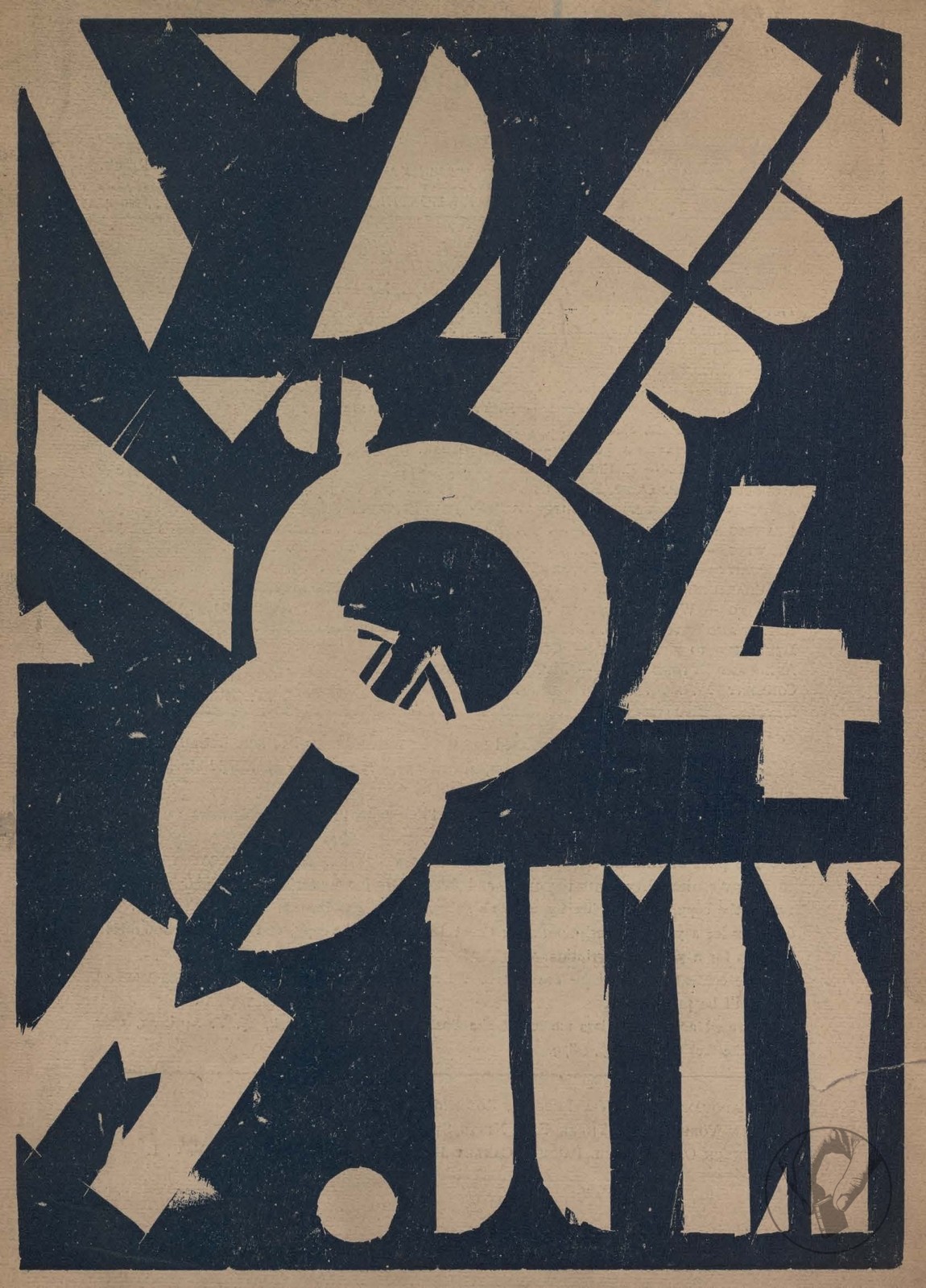
Broom, an international magazine of the arts, features a July 1922 issue with contributions from notable artists and writers. The content includes poetry by E. E. Cummings, drawings by Picasso and Modigliani, and a short story titled "The Sun Rises in Darkness" by Robert M. Coates. The magazine also discusses contemporary art movements like Dada and presents works by various American and French artists.