Extrait
Premières pages de l'ouvrage, en accès libre.
Page 1
LA PEINTURE A L'EXPOSITION DU XVIIIe SIÈCLE A VENISE
---
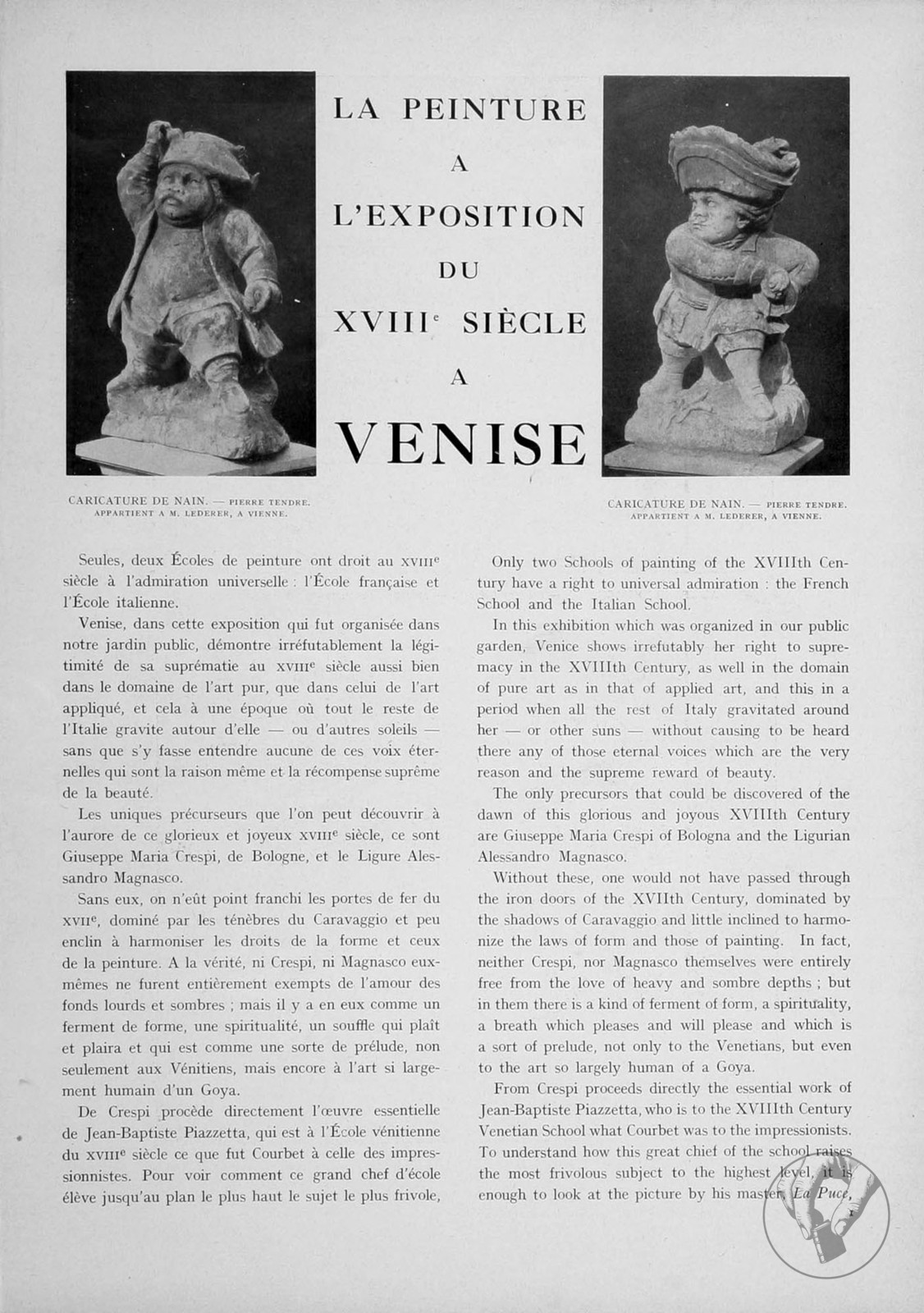
CARICATURE DE NAIN. — PIERRE TENDRE.APPARTIENT A M. LEDERER, A VIENNE.
---
CARICATURE DE NAIN. — PIERRE TENDRE.APPARTIENT A M. LEDERER, A VIENNE.
---
Seules, deux Écoles de peinture ont droit au xviiie siècle à l’admiration universelle : l’École française et l’École italienne.
Venise, dans cette exposition qui fut organisée dans notre jardin public, démontre irréfutablement la légitimité de sa suprématie au xviiie siècle aussi bien dans le domaine de l’art pur, que dans celui de l’art appliqué, et cela à une époque où tout le reste de l’Italie gravite autour d’elle — ou d’autres soleils — sans que s’y fasse entendre aucune de ces voix éternelles qui sont la raison même et la récompense suprême de la beauté.
Les uniques précurseurs que l’on peut découvrir à l’aurore de ce glorieux et joyeux xviiie siècle, ce sont Giuseppe Maria Crespi, de Bologne, et le Ligure Alessandro Magnasco.
Sans eux, on n’eût point franchi les portes de fer du xviie, dominé par les ténèbres du Caravaggio et peu enclin à harmoniser les droits de la forme et ceux de la peinture. A la vérité, ni Crespi, ni Magnasco eux-mêmes ne furent entièrement exempts de l’amour des fonds lourds et sombres ; mais il y a en eux comme un ferment de forme, une spiritualité, un souffle qui plaît et plaira et qui est comme une sorte de prélude, non seulement aux Vénitiens, mais encore à l’art si largement humain d’un Goya.
De Crespi procède directement l’œuvre essentielle de Jean-Baptiste Piazzetta, qui est à l’École vénitienne du xviiie siècle ce que fut Courbet à celle des impressionnistes. Pour voir comment ce grand chef d’école élève jusqu’au plan le plus haut le sujet le plus frivole,
Only two Schools of painting of the XVIIIth Century have a right to universal admiration : the French School and the Italian School.
In this exhibition which was organized in our public garden, Venice shows irrefutably her right to supremacy in the XVIIIth Century, as well in the domain of pure art as in that of applied art, and this in a period when all the rest of Italy gravitated around her — or other suns — without causing to be heard there any of those eternal voices which are the very reason and the supreme reward of beauty.
The only precursors that could be discovered of the dawn of this glorious and joyous XVIIIth Century are Giuseppe Maria Crespi of Bologna and the Ligurian Alessandro Magnasco.
Without these, one would not have passed through the iron doors of the XVIIth Century, dominated by the shadows of Caravaggio and little inclined to harmonize the laws of form and those of painting. In fact, neither Crespi, nor Magnasco themselves were entirely free from the love of heavy and sombre depths ; but in them there is a kind of ferment of form, a spirituality, a breath which pleases and will please and which is a sort of prelude, not only to the Venetians, but even to the art so largely human of a Goya.
From Crespi proceeds directly the essential work of Jean-Baptiste Piazzetta, who is to the XVIIIth Century Venetian School what Courbet was to the impressionists. To understand how this great chief of the school raises the most frivolous subject to the highest level, it is enough to look at the picture by his master, La Puce,
Page 2
ALESSANDRO MAGNASCO. — PAYSAGE (DÉTAIL). — APPARTIENT A M. ITALICO BRASS. VENISE.
ALESSANDRO MAGNASCO (1667-1749). — PAYSAGE ET MARINE AVEC PÊCHEURS. — APPARTIENT A M. ITALICO BRASS. VENISE.
ALESSANDRO MAGNASCO, EST LE PÈRE DE LA PEINTURE VÉNITIENNE DU XVIIIe SIÈCLE.
ON DEVINE L'INFLUENCE DE SEBASTIANO ET MARIO RICCI ET ON Y PRESSENT PIRANESE ET GUARDI.
Page 3
LA RENAISSANCE
il suffit de confronter le tableau de son maître La Puce et le sien. Alors que la belle paysanne occupée à sa chasse ne sert à Crespi que de prétexte à un intérieur d'un goût presque flamand, Piazzetta nous offre la vision simple, solide, d'une robuste jeune fille des champs.
Tout le monde sait aujourd'hui que Piazzetta fut le père de notre grande peinture c'est-à-dire de Jean-Baptiste Tiepolo, beaucoup mieux que Ricci, lequel ne fit que renforcer le goût inné de la décoration qui devait assurer le triomphe en Europe de notre grand Maître du XVIIIe siècle.
Autant Crespi a le sens du style monumental, autant Magnasco a celui du paysage et surtout du Caprice, avec ses étranges visions de tempêtes, de moines pénitents, de synagogues, tous ces tableaux ironiques, terrifiants où palpite encore l'esprit d'un Callot et où l'on pressent le rire amer d'un Daumier.
Nous avons pu l'admirer à l'Exposition de Venise dans toute une série d'œuvres qui datent, sinon des premiers pas décisifs dans la voie que suivra Piazzetta, tout au moins de l'annonce de sa manière la plus brillante et qui permettent de le suivre à travers toute sa longue activité. Autour de lui se groupe toute une pléiade de disciples, plus ou moins touchés par sa lumière. Francesco Fontebasso, collaborateur de jeunesse, avec sa Tentation de Saint Antoine qui, tout dernièrement, a donné lieu à de si vives discussions; le Lombard Ligari, auteur de Giuditta Rossello; Francesco Zugno, avec un Episode de l'histoire de Scipion; et surtout, son fils le mieux doué Jean-Dominique, avec La Femme adultère, à la Baronne d'Essen, les deux scènes de Abraham, à M. le Sénateur Albertini, le Menuet et le Charlatan de la collection Papadopoli, pour lesquels son père a peut-être fourni l'invention et enfin, et surtout, cette série
ALESSANDRO MAGNASCO. — POLICHINELLE JOUANT DE LA GUITARE. TABLEAU OU L'AUTEUR NOUS APPARAÎT PRÉCURSEUR DE GOYA ET DE DAUMIER. APPARTIENT A M. O. GATTI. — CASAZZA. VENISE.
and his own. While the pretty peasant devoted to her chase serves Crespi only as a pretext for an interior of an almost Flemish taste, Piazzetta offers us the simple, firm sight of a strapping young girl of the fields.
Every one knows to-day that Piazzetta was the father of our great painting, that is to say of Jean-Baptiste Tiepolo, much more than Ricci, who only reinforced the innate taste for decoration which was to assure the triumph in Europe of our great Master of the XVIIIth Century.
As Crespi has the sense of monumental style, so magnasco has that of landscape and above all in Caprice, with his strange visions of storms, of penitent monks, of synagogues, all those ironical pictures, terrifying or throbbing with the spirit of a Callot and in which the bitter laugh of a Daumier is heard.
We have been able to enjoy the Venice exhibition in a whole series of works that date, if not from the first decisive steps in the way that Piazzetta will follow, at least from the beginning of his most brilliant style, and which permit us to follow him through all his long activity,
Around him are grouped a whole constellation of disciples, more or less touched by his light. Francesco Fontebasso, fellow worker of his youth, with his Tentation de Saint Antoine, which has aroused such lively discussions of late; the Lombard Ligari, author of Giuditta Rossello; Francesco Zugno, with an Episode de l'histoire de Scipion; and above all his son the most gifted Jean-Dominique, with La Femme adultère, of la Baronne d'Essen, the two scenes of Abraham, of Senator Albertini, the Menuet and the Charlatan of the Papadopoli collection, for which his father perhaps furnished the inventive element, and finally, and above
Page 4
LA RENAISSANCE
de fresques de la villa de Zianigo — la propre villa de Tiepolo — où sa fantaisie libre et espiègle triomphe dans des scènes galantes et une histoire de Polichinelle d’un brio endiablé.
La peinture de figures possède son petit monde dans les scènes galantes de Pietro Longhi, qui s’y révèle moins bon dans la composition que dans la couleur, un artiste tout yeux, mais sans cervelle, bien différent de son fils Alexandre, si près de nous dans ses fresques de l’escalier du palais Grassi-Stucky, dans le Rhinocéros de la famille Salom et dans ses beaux portraits.
C’est le moment où l’art vénitien connaît une fortune, non seulement italienne, mais européenne. Voici autour de Longhi : le Napolitain Gaspard Traversi ; le fin et délicat Maître français encore inconnu qui a figuré à l’exposition avec sa Poupée mécanique ; son compatriote Joseph Flipart qui eut l’honneur de succéder à Tiepolo comme peintre de la Cour d’Espagne et à qui je n’hésite pas à attribuer la Dame et chasseur de la collection du professeur Grassi de Florence. Les Anglais eux-mêmes figurent ici, sinon avec le précurseur Richard Wilson dont la National Gallery possède un portrait daté et signé, provenant de Venise, tout au moins avec Nathanel Dance, auteur de cette Famille Sartorio qui appartient au Musée Civique de Modène et qui, jusqu’à l’heure actuelle, a couru comme anonyme d’exposition en exposition.
Autour de ces principaux représentants de la peinture de figures se groupent de bons compagnons et collaborateurs : J.-A. Pellegrini, Jacopo Amigoni, et surtout Sebastiano Ricci, dont l’importance s’affirme, même à côté de Tiepolo, à qui il ne donna pas sans, en échange, recevoir davantage ; Nicolas Grassi, l’excellent maître de Pittoni, représenté ici pour la première fois ; Pittoni lui-même ; Crosato ; et la trop vantée Rosalba Carriera.
Comme on le voit, les prophètes de la grande peinture
J.-M. CRESPI (1664-1747). — LA PUCE.
CRESPI PUT LE MAÎTRE DE PIAZZETTA ET DE PIETRO LONGHI.
MUSÉE DES OFFICES À FLORENCE.
all, that series of frescoes of the villa of Zianigo — the real villa of Tiepolo — in which his free and frolicsome fancy triumphs in gay scenes and a story of Polichinelle of a devilish spirit of fun.
Figure painting possesses its little world in the gallant scenes of Pietro Longhi, who there reveals himself less strong in composition than in color, an artist all eyes, but without intellect, very different from his son Alexander, so near to us in his frescoes of the stairway of the Grassi-Stucky palace, in the Rhinocéros of the Salom family and in his fine portraits.
Now it is the moment where Venetian art knows good fortune, not only Italian, but European. About Longhi are : the Neapolitan Gaspard Traversi ; the fine and delicate French master, still unknown, who figured in the exhibition with his Poupée mécanique ; his countryman Joseph Flipart who had the honor of following Tiepolo as painter of the Spanish Court and to whom I do not hesitate to attribute the Dame et chasseur of the collection of Professor Grassi at Florence. The English themselves figure here, if not with the precursor Richard Wilson, of whom the National Gallery possesses a portrait dated and signed, coming from Venice, at least with Nathaniel Dance, author of that Famille Sartorio which belongs to the civic museum of Modena and which, up to the present hour, has gone from exhibition to exhibition anonymously.
About these chief representatives of figure painting, are grouped good companions and fellow workers : J.-A. Pellegrini, Jacopo Amigoni, and above all Sebastiano Ricci, whose importance proves itself even beside Tiepolo, to whom he did not give, without receiving more in exchange ; Nicolas Grassi, the excellent master of Pittoni, represented here for the first time ; Pittoni himself; Crosato; and the overpraised Rosalba Carriera.
Page 5
J.-B. PIAZZETTA — LE PORTE-DRAPEAU.
TABLEAU D'UNE CONSTRUCTION MAGNIFIQUE ET D'UNE GRANDE RICHESSE DE COLORIS.
MUSÉE DE DRESDE.
J.-B. PIAZZETTA — PORTRAIT DE JULIE LAMA.
PRINTER IDENTIFIÉ PAR SON PORTRAIT PEINT PAR ELLE-MÊME QUI EST AUX OFFICES À VENISE.
APPARTIENT AU D’ LAO PLANISERG. VENISE.
Page 6
LA RENAISSANCE
J.B. PIAZZETTA. — LA PUCE, CHEF-D'ŒUVRE DE SCIENCE ET DE GRACE.
APPARTIENT A SIR HORACE RUMBOLD, AMBASSADEUR D'ANGLETERRE A BERLIN.
vénitienne sont largement représentés à cette exposition. Par malheur, nous avons à déplorer à côté d'eux une absence regrettable : celle de l'initiateur du paysage et du tableau de fantaisie, Marco Ricci, neveu de Sebastiano Ricci, d'une importance, dans son domaine, encore plus transcendante que celle de son oncle, pour l'évolution de l'art vénitien. Et cette absence est d'autant plus étrange qu'il était très facile de trouver en Italie les œuvres les plus significatives de ce Maître. Force nous est donc de passer de Magnasco à Zuccarelli et à Zais, en faisant remarquer que ce dernier est l'héritier direct de Ricci étant né lui aussi à Belluno comme celui-ci, et non à Trévise et quarante-et-un ans avant la date partout indiquée jusqu'ici.
Ce retour vers la nature et la fantaisie s'arrête avec le Canaletto qui appliquera la minutie méthodique de Van Vitelli, transmise par Carlevaris, artiste du Frioul à la lagune et à Venise. Le Canaletto, sous cette influence flamande, retrouve d'abord ce sentiment de l'atmosphère, de la couleur locale si vif chez les Vénitiens, depuis le temps de Gentile Bellini et de Carpaccio. Il a
As one sees it, the prophets of great Venetian painting are largely represented in this exhibition. Unfortunately, we must regret, beside them, a deplorable vacancy : that of the pioneer of landscape and of fanciful pictures, Marco Ricci, nephew of Sebastiano Ricci, of an importance in his domain still more transcendant than that of his uncle for the evolution of Venetian art. And this absence is so much more astonishing because it was very easy to find in Italy the most significant works of this master. We must then pass from Magnasco to Zuccarelli and to Zais, noting as we do that this last is the direct heir of Ricci, being born, he too, at Belluno as the other was, and not at Treviso, and forty-one years before the date always given down to this moment.
This return toward nature and fancy stops with Canaletto who applied the detailed method of Van Vitelli, transmitted by Carlevaris, artist from Frioul on the lagoon and of Venice. Canaletto, under that Flemish influence, found first that feeling for atmosphere, for local color, so strong among Venetians, from
Page 7
LA RENAISSANCE
J.-B. PIAZZETTA. — PETITE FLEUR D'AMOUR. — APPARTIENT A M. ITALICO BRASS. VENISE.
le sens intime, aigu de la poésie de sa ville natale et, par là, mérite toute notre admiration. Mais il n'est représenté à cette Exposition que par deux œuvres et non des plus caractéristiques : Le Fonteghetto de la Farine, à M.le Comte Giustinian Recanati et Le Grand Canal vers Sainte-Lucie, c'est-à-dire à l'endroit où habitait le consul anglais Smith, grand protecteur de l'artiste. A cette période délicieuse, le contact avec la réalité est encore discret et tout baigné de la poésie du pittoresque et de l'aérien. Point de perfection, éphémère hélas ! L'influence flamande, l'usage de la chambre noire, attesté par Mariette, et surtout ses voyages en Angleterre finissent par gâter la délicieuse vision du Maître. A Londres, le succès du sec et mécanique Jean Van der Heyden achève de le détourner de sa voie. Nous le verrons désormais devenir de plus en plus didactique, savant, méticuleux à mesure qu'il avance dans sa carrière ; et certes, cette décadence n'est que trop visible dans les tableaux qui figurent à l'Exposition.
Par contre, la froideur expérimentale du Canaletto ne fait pas tort à son neveu Bernardo Bellotto (encore qu'il s'inspire de la période anglaise de son oncle) car il l'adapte aux ciels gris et coupants des pays du Nord, où il passe presque toute sa vie, après avoir quitté tout jeune et pour toujours l'Italie.
La conception esthétique d'un Canaletto diminué,
the time of Gentile Bellini and of Carpaccio. He has the intimate feeling for his native city, full of poetry, and in that respect be deserves all our admiration. But he is represented in this exhibition by only two works and not the most characteristic : Le Fonteghetto de la Farine, of conte Giustinian Recanati, and Le Grand Canal vers Sainte-Lucie, that is to say in the region where lived the English consul, Smith, the great protector of the artist. In this delightful period, the contact with reality is yet restrained and all bathed in the poetry of the picturesque and of the atmospheric. Point of perfection, ephemeral, alas ! The Flemish influence, effect of the dark room, explained by Mariette, and above all his trips to England finally spoiled the delightful vision of the Master. In London, the success of the dry and mechanical Jean Van der Heyden was enough to turn him from his way. We see him becoming more and more didactic, scholarly, after that, careful ot be sure of advancing in his career ; and surely this decadence is only too evident in the pictures that figure in the exhibition.
On the other hand, the experimental coldness of Canaletto does mo harm to his nephew Bernardo Bellotto (although he is inspired in the English period of his uncle), for he adapts it to the gray and walled-in skies of the North country, where he passes almost
Page 8
ROSALBA CARRIERA.
PORTRAIT D'UN ÉTUDIANT. — FASTEL.
APPARTIENT AU COMTE ETTORE ZORZI.
VENISE.
C.-J. FLIPART. — DAME AVEC UN CHASSEUR.
CETTE ŒUVRE RAPPELLE LA MANIÈRE D'ALESSANDRO LONGHI.
JOSEPH FLIPART (1721-1797) SUCCÉDA À TIEPOLO
COMME PEINTRE DE LA COUR DE MADRID.
APPARTIENT AU PROFESSEUR LUIGI GRASSI. FLORENCE.
ALESSANDRO LONGHI.
PORTRAIT D'UN AMIRAL.
MUSÉE MUNICIPAL DE PADOUÉ.
INCONNU. — PORTRAIT DE LA FAMILLE SARTORIO. — NATHANIEL DANCE QUI PEIGNIT
SANS DOUTE CE TABLEAU VERS 1750, A LA MANIÈRE DE LONGHI, EST RESTÉ,
JUSQU'A CE JOUR, MÉCONNU DE LA CRITIQUE. — MUSÉE MUNICIPAL MODERNE.
Page 9
ALESSANDRO LONGHI. — PORTRAIT DE DAME VÊTUE À L'ORIENTALE
APPARTIENT À SON ALTESSE ROYALE LE LANDGRAVE D'ASSIA.
ALESSANDRO LONGHI. — PORTRAIT D'HOMME VÊTU À L'ORIENTALE.
APPARTIENT À M. ITALICO BRASS, VENISE.
Page 10
INCONNU. — LA POUFÉE MÉCANIQUE.
SANS DOUTE UN IMITATEUR FRANÇAIS DE F. LONGHI.
APPARTIENT A M. ITALICO BRASS. VENISE.
ALESSANDRO LONGHI. — LE RHINOCEROS.
CHARMANT EXEMPLE DE L'ESPRIT DE A. LONGHI, FILS DE PIETRO, A QUI, PAR ERREUR, CE CHEF-D'ŒUVRE A ÉTÉ ATTRIBUÉ.
APPARTIENT A LA COMTESSE ADÈLE SALONI DE CAROBBIO. VENISE.
Page 11
Les reproductions de cette page et des deux suivantes sont celles des fresques peintes par Domenico Tiepolo pour la villa Tiepolo, à Zianico, maintenant au Musée Correr, à Venise. Elles appartiennent à la série des «Polichinelle».
---
DOMENICO TIEPOLO.POLICHINELLE ET LA COURTISANE.
---
DOMENICO TIEPOLO. — POLICHINELLE ENDORMI.
---
DOMENICO TIEPOLO.LES SALTIMBANQUES.
---
DOMENICO TIEPOLO. — DAME AVEC CHEVALIERS SERVANTS.SANS DOUTE CÉCILE GUARDI, FEMME DE J.-B. TIEPOLO, AVEC SESDEUX FILS, LORENZO ET GIAN DOMENICO.
---