Extrait
Premières pages de l'ouvrage, en accès libre.
Page 1
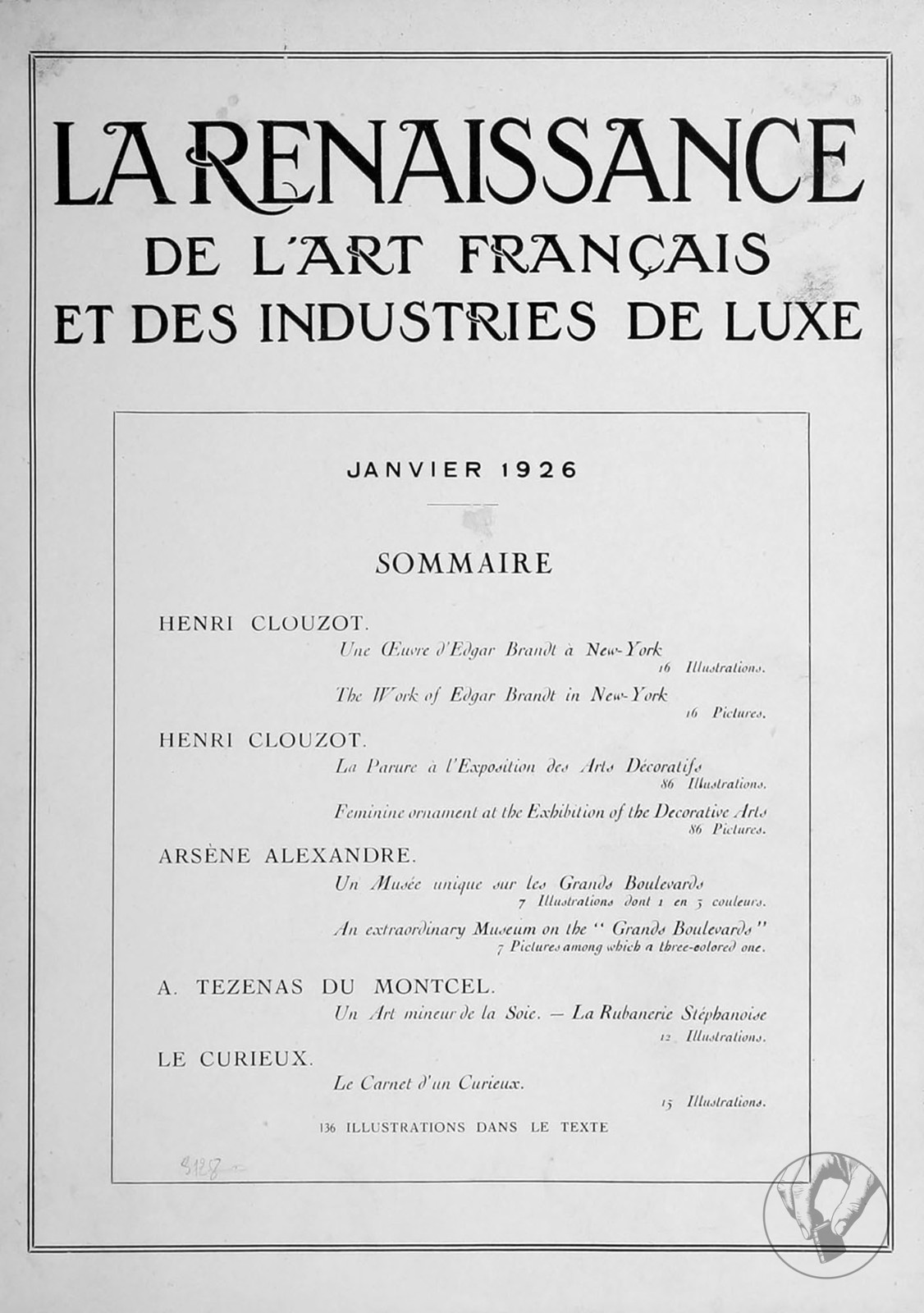
LA RENAISSANCE DE L'ART FRANÇAIS ET DES INDUSTRIES DE LUXE
JANVIER 1926
SOMMAIRE
HENRI CLOUZOT.
- Une Œuvre d’Edgar Brandt à New-York
16 Illustrations.
- The Work of Edgar Brandt in New-York
16 Pictures.
HENRI CLOUZOT.
- La Parure à l’Exposition des Arts Décoratifs
86 Illustrations.
- Feminine ornament at the Exhibition of the Decorative Arts
86 Pictures.
ARSÈNE ALEXANDRE.
- Un Musée unique sur les Grands Boulevards
7 Illustrations dont 1 en 5 couleurs.
- An extraordinary Museum on the “Grands Boulevards”
7 Pictures among which a three-colored one.
A. TEZENAS DU MONTCEL.
- Un Art mineur de la Soie. — La Rubanerie Stéphanoise
12 Illustrations.
LE CURIEUX.
- Le Carnet d’un Curieux.
15 Illustrations.
136 ILLUSTRATIONS DANS LE TEXTE
$\mathcal{S}127$
Page 2
Jeanne Lanvin
Couture, Mode, Fourrures, Lingerie
22, Faubourg Saint Honoré, Paris.
Page 3
UNE ŒUVRE d'edgar BRANDT A NEW-YORK
THE WORK OF EDGAR BRANDT IN NEW-YORK
THE 34th STREET WINDOWS.
LORSQU'on apprit en France que le Gouvernement de Washington renonçait à participer à la grande manifestation internationale des Arts Décoratifs Modernes, la surprise fut extrême ? Quoi ? la nation du monde qui a réalisé les plus audacieuses conceptions architecturales, qui a imaginé le gratte-ciel, ce gigantesque outil de la ville moderne, le pays où l'art de l'ingénieur a résolu tous les problèmes de résistance des matériaux et d'asservissement des forces naturelles, le peuple qui a su créer une civilisation nouvelle en face des traditions millénaires du vieux continent, ne se trouvait pas assez moderne pour se mesurer avec les aspirations de la France, de la Hollande, de la Suède, du Danemark, de la Tchéco-Slovaquie, de l'Autriche ? Ce fut une stupeur et l'on ne fut pas loin de chercher à cette carence des raisons de politique internationale.
La réflexion conduisit à de plus sages conclusions. Nous avons le tort chez nous de nous enfermer dans notre propre contemplation. Nous jugeons les nations étrangères — quand nous en trouvons le temps — d'après des clichés primaires et faciles. Le Japon c'est Mme Chrysanthème; l'Espagne Carmen, la Norvège les drames d'Ibsen et l'Amérique les films de Harold Lloyd.
Quand nous voyons à l'écran se profiler les masses géométriques des office buildings de New-York et de
WHEN we heard in France that the Government of the United-States had decided to take no share in the great international Exhibition of Decorative Arts, we felt extremely surprised. Why! the nation who realized the most daring architectural designs in the world, and invented the sky-scraper, the gigantic tool of a modern city, the country where the engineer's art made out every problem concerning the resistance of materials and the taming of natural forces, the nation who could create a new civilization beside the secular traditions of the old continent, did not deem herself modern enough to match with the aspirations of France, Holland, Sweden, Denmark, Tcheco-Slovakia and Austria? It was so astonishing that we felt inclined to explain that abstention by means of motives of international policy.
But reflection led on to wiser conclusions. The fault with us is to shut ourselves up in our own exclusive admiration. We judge foreign nations (when we find out time) after easy elementary stock notions. Japan is Madame Chrysanthème; Spain, Carmen; Norway, Ibsen's dramas; and America, Harold Lloyd's films.
When we see at the cinema the pictures of the geometrical masses of New-York and Chicago office buildings, those shapes the giddy ascensions of which makes
Page 4
LA RENAISSANCE DE L'ART FRANÇAIS ET DES INDUSTRIES DE LUXE
Chicago, ces formes dont la vertigineuse montée nous fait rêver d'une ville à l'échelle de la Tour Eiffel, comment pourrions-nous ne pas y reconnaître le plus parfait exemple de nouveauté architecturale ? Mais regardons-y de plus près. Nous nous apercevrons — et c'est une revanche de l'esprit latin — que les constructeurs de sky-scrapers n'ont pas senti la beauté puissante de leur œuvre. Ils ont créé un instrument économique, dynamique, pratique. Ils n'en ont pas su toujours dégager l'esprit par des masses claires et simples, par l'opposition des vides et des pleins, par la netteté des grandes surfaces, par le pur jeu des lignes géométriques dans l'espace. Ils ont souvent affublé leurs maçonneries titaniques d'ornements renaissance, gothiques, romans, analogues à la pâtisserie chère à nos architectes continentaux de la fin du siècle dernier, et ce n'est pas beau.
Même contradiction dans la décoration intérieure. Rien n'est jeune dans les appartements de ce plus jeune peuple du monde. Guillaume Janeau relevait naguère dans une revue américaine d'architecture ce compliment adressé au Gladstone de New-York : « Homelike atmosphere is obtained in the foyer by use of antique furniture and decorations ». On pourrait citer mille exemples du même goût. On compose de l'autre côté de l'Atlantique des décorations avec de vieilles tapisseries, de vieilles toiles de Jouy, et même de vieux papiers peints. On réalise des ensembles style colonial, reine Anne, Tudor, Chippendale, Adam, Louis XV, Louis XVI, Empire. Rien qui soit en accord avec le rythme de la vie moderne, et de la vie moderne la plus intense qui soit au monde. On comprend que le gouvernement américain plus clairvoyant que les gouvernements anglais et italiens, ait fait preuve de sagesse en n'affrontant pas une confrontation qui n'aurait pas été à l'avantage de ses artistes ni de ses industriels.
Un réveil du goût n'est cependant jamais impossible. Certains symptômes le rendent même probable. La publication de l'enquête « L'Art dans l'Industrie » du professeur Charles R. Richards (malgré les vignettes renaissance de son titre) est l'indice d'un esprit chercheur, qui s'est traduit l'an [passé par l'entrée au Metropolitan Museum of Art] d'œuvres significatives de Brandt, de Dunand, d'Henri Cros, de Metthey, de Marinot, de Lalique. Mais l'enseignement du livre et du Musée ne valent pas la présentation de l'art moderne en pleine rue, sur la façade d'un bâtiment de Madison Avenue, au centre même de la vie new-yorkaise et l'événement est d'assez grande importance pour qu'on le souligne.
Le 14 octobre dernier a été inauguré le nouvel établissement de Cheney Brothers, les grands manufacturiers en soie américains, à l'angle de la 34e rue et de la Madison Avenue, par un comité composé de notabilités de l'art, de l'industrie, de la finance, présidé par M. Harvey us dream of a city on the scale of the Eiffel tower, how could we not find there the most perfect example of architectural novelty? But let us consider further. We shall discover — and this is a revenge of the Latin spirit — that the builders of sky-scrapers have failed to feel the powerful beauty of their work. They have created an economical, dynamical, practical contrivance. They could not always enhance its spirit by clear, plain masses, the contrast of empty and solid parts, the neat large surfaces, the pure play of geometrical lines in the air. They too often muffled up their Titanic masonry in Renaissance, Gothic, Romance ornament like the cakes so dear to our own continental architects at the end of the last century, and it is not beautiful at all.
There is the same contradiction in interior decoration. Nothing young about the homes of the youngest people in the world. Guillaume Janeau lately quoted from an american architectural review this praise of the New-York Gladstone : « Homelike atmosphere is obtained in the foyer by use of antique furniture and decorations ». We could quote a thousand instances of the same taste. On the other side of the Atlantic Ocean they compose decorations with old tapestry, old Jouy cloths, and even old paper hangings. They realize sets in colonial, queen Anne, Tudor, Chippendale, Adam, Louis XV, Louis XVI, Empire styles. Nothing in accordance with the rhythm of modern life and the most intense modern life in the world. It therefore becomes evident that the american government more clear-sighted than the English and Italian governments, proved wise when declining a comparison which would not have been in favour of its artists or manufacturers.
Yet, a revival of taste is never impossible. Some signs make it even likely. The publication of the inquiry "Art in industry" by Prof. Charles R. Richards (in spite of the Renaissance vignettes of the title) is the mark of an inquiring spirit which expressed itself last year in the admission at the metropolitan Museum of art of characteristic works by Brandt, Dunand, Henri Cros, Metthey, Marinot, Lalique. But the teaching of book and museum cannot rival with the presentation of modern art in the very street, on the front of a Madison Avenue building, in the very heart of New-York life and the event seems worth enlarging upon.
On the 14th of October 1925, was opened the new building of Cheney Brothers, the great American silk manufacturers, at the corner of Thirty-fourth street and Madison avenue, by a committee composed of distinguished art, industry and finance personalities presided by Mr. Harven W, Corbett, the former chairman of the New-York architectural League.
Page 5
CHENEY BROTHERS
PORTE D'ENTRÉE
DES ÉTABLISSEMENTS CHENEY BROTHERS.
DESIGN FOR DOOR
OF MAIN ENTRANCE TO CHENEY BROTHERS.
Page 6
4 LA RENAISSANCE DE L'ART FRANÇAIS ET DES INDUSTRIES DE LUXE
W. Corbett, ancien président de l’Architectural League de New-York.
Il comprenait :
MM. Chester H. Aldrich, Président, « Groupe Americain de la Société des Architectes diplômés »; James Brown (Brown brothers and Company), banquiers; John H. Finley du New-York Times; Frederick P. Fish, Président, « National Industrial Conference Board »; Abraham Flexner, « General Education Board »; John Meade Howell, Président, « Beaux Arts Institute of Design »; Percy Johnston, Président, « Chemical National Bank »; Frederick Keppel, Directeur, « Carnegie Corporation »; Steward Prosser, Président du Conseil d’Administration, « Bankers Trust Company »; Charles R. Richards, Directeur, « American Association of Museums »; D. Everett Waid, Président, « American Institute of Architects »; Les Commissaires du Commerce des Etats-Unis près l’Exposition des Arts Décoratifs et Industriels Modernes de Paris.
La place occupée par la firme Cheney Brothers dans la grande industrie américaine, justifiait à elle seule un si brillant patronage. Mais cette réunion de notabilités avait une autre signification et c’est elle qui doit en France être l’objet de nos méditations. Pour la première fois en Amérique, des constructeurs faisaient appel au tempérament artistique d’un décorateur vraiment moderne et ce décorateur était un Français. Tout l’œuvre de forge, portes, encadrements de vitrines, agencement intérieur, avait été dessiné et exécuté par le maître ferronnier Edgar Brandt.
Rarement un artiste a le double bonheur d’être à la fois prophète à l’étranger et dans son propre pays. Brandt est Parisien, petit-fils d’Alsaciens et par conséquent deux fois Français. Dans la phalange des créateurs originaux qui ont assuré le triomphe de notre art national dans le grand tournoi de 1925, c’est un des plus significatifs, et à coup sûr un de ceux qui ont présenté les ouvrages les plus achevés et les plus nombreux. Porte d’honneur des Champs-Elysées, portes du Pavillon national monégasque, du Pavillon de l’Intransigeant, de La Renaissance, de la boutique de l’Illustration, portes et grilles d’intérieur du Pavillon du Collectionneur, clôture de la Cour des Métiers, lustres, lampadaires, écrans des Salons de l’Ambassade, sans parler du stand particulier du Maître dans la classe 7, Brandt était partout et partout il représentait l’art moderne français, original, pondéré, dépouillé de toute affectation d’excentricité, puissant et simple de lignes, varié à l’infini dans des motifs personnels et neufs, déployant une richesse de décor telle qu’on n’en avait plus rencontrée dans les ouvrages de forge depuis la belle époque du XVIIIe siècle.
Une telle activité créatrice n’a pu se donner carrière que grâce à une adaptation consentie aux nouveaux procédés techniques. Trop longtemps, la ferronnerie était restée en dehors de l’évolution qui a rénové au XXe siècle tous nos métiers d’art. A la suite de Robert, nos grands forgerons ne demandaient qu’au labeur hu-
Among the members were :
Messrs. Chester H. Aldrich, Chairman of the American Group of the “Société des Architectes diplômés”; James Brown (Brown brothers and Co) bankers; John H. Finley, of the “New-York Times”; Frederick P. Fish, Chairman, National Industrial conference Board. Abraham Flexner, “General Education Board”; John Meade Howell, Chairman, “Beaux-Arts Institute of Design”; Percy Johnston, Chairman, “Chemical National bank”; Frederick Keppel, Director, “Carnegie Corporation”; Steward Prosser, Chairman of the Board of trustees, “Bankers Trust Company”; Charles R. Richards, Director, American Association of Museums; D. Everett Waid, Chairman, American Institute of Architects. The United States Commissioners of Commerce to the Exhibition of modern Decorative and Industrial arts in Paris.
The place occupied by Cheney Brothers’ firm in the higher American industry could alone account for such brilliant patrons. But this meeting of eminent men had also another meaning which should in France call our attention. For the first time in America, builders had made an appeal to the artistic temperament of a truly modern designer and the latter was a Frenchman. All the iron work, doors, window-frames, interior arrangement had been drawn and carried out by the ironmaster Edgar Brandt.
Seldom does an artist enjoy this double happiness: to be at the same time a prophet abroad and at home. Brandt is a Parisian, the grandson of Alsatians and therefore twice a Frenchman. Among the phalanx of original creators who secured the triumph of our national art in the great tournament of 1925, he stands one of the most representative and to be sure one of those who exhibited the most perfect and numerous works. With the principal gate in the Champs-Elysées, the doors of the national Monaco Pavilion, of the Pavilion of “the Intransigeant”, of “the Renaissance”, of the shop of the “Illustration”, doors and inner gates of the collector’s Pavilion, enclosure of the Court of Trades, chandeliers lamp-posts, screens of the embassy drawing-rooms, not to mention the master’s own stand in 7th class, Brandt was everywhere, and everywhere represented the original French modern art, poised, free from any odd affectation, with powerful plain lines, variegated in the extreme in new personal motives, displaying such rich decoration as had not been met with since the grand epoch of the XVIIIth century.
Such creative activity could give itself full scope only thanks to voluntary adaptation to new technical methods. Too long had iron works kept outside the evolution which in the XXth century has renewed all our art crafts. After Robert, our great smiths relied but on human labour and hammering for the execution of their works. Brandt, resolutely adopting mechanical tools: blow-pipe, steam-hammer, press and so on, tur-
Page 7
PORTE D'ENTRÉE
DU MADISON BELMONT BUILDING
ENTRANCE OF THE
MADISON BELMONT BUILDING
Page 8
6 LA RENAISSANCE DE L'ART FRANÇAIS ET DES INDUSTRIES DE LUXE
main et au travail du marteau l'exécution intégrale de leurs ouvrages. Brandt, en adoptant résolument l'outil-lage mécanique : chalumeau oxhydrique, marteau-pilon, presse et le reste, a fait de son art une grande industrie, sans lui enlever aucune de ses qualités esthétiques. Il a su triompher des difficultés qui paraissaient insolubles avec les traditions millénaires du travail à la main. Il a déployé des décors d'une liberté et d'une ampleur inconnues. Il est entré résolument dans la production intensive, telle qu'elle convient à notre époque de grands problèmes constructifs qui réservent au fer des possibilités pour ainsi dire illimitées.
En même temps, cette technique nouvelle lui a permis de faire parler un langage nouveau.
Que diraient Lamour et les grands serruriers du passé s'ils pouvaient voir ces vastes cadres garnis d'ornements qui tiennent les uns aux autres par leurs seuls points de contact, sans le secours de barreaux ? Imagineraient-ils que ces fines résilles, ces motifs précieux, ces décors somptueux, qui auraient constitué de leur temps des tours de force prodigieux et n'auraient pu être obtenus qu'avec une dépense énorme de temps et de main-d'œuvre, deviendraient pratiquement et facilement réalisables avec les nouveaux moyens d'expression ?
Tout cela, à l'Exposition des Arts Décoratifs et dans les Salons annuels qui l'ont préparée, ne nous a peut-être pas assez frappés, peut-être parce que nous avions suivi étape par étape l'évolution de l'art de Brandt depuis cinq ans. Mais il n'en a pas été de même pour les étrangers, et leur impression a été telle qu'ils ont fait taire tout amour propre national, pour s'assurer la collaboration de notre ferronnier. Bel hommage à l'art français, et combien riche de promesses d'avenir.
Chose curieuse. C'est pour élever un palais à la soie que MM. Cheney Brothers ont songé à Brandt. Le fer, la soie. On ne voit d'autre rapprochement à tenter qu'une opposition entre la puissante armature du métal et les souples replis de la soie. Mais en y réfléchissant, le réseau aérien, la dentelle de fer de certains travaux de Brandt, la somptuosité de son décor, rehaussé d'or comme une soie brochée, n'évoquent-ils pas, transposés d'une manière à l'autre, la même impression de richesse, de beau dessin, de lignes souples et heureuses ? L'idée ne serait peut-être pas venue à un Parisien. Des New-Yorkais l'ont eue, et le résultat leur a donné raison.
Quatre des étages réservés à la maison Cheney Brothers, dans un building de dix-neuf étages que vient d'élever Robert Catts, le fameux spécialiste des gratte-ciel, sont entièrement aménagés et décorés par Brandt, en accord avec « Ferrobrandt », une société américaine se spécialisant dans l'édition des œuvres du Maître, et dont la direction à New-York est assurée par le distingué artiste belge, M. Jules Bouy, son collaborateur d'outre-mer.
ned his art into a great industry without depriving it of any esthetic qualities. He managed to overcome the difficulties which seemed unconquerable with the secular traditions of handiwork. He spread designs of unprecedented freedom and vastness. He resolutely entered upon intense production such as fits our epoch of great building problems which afford iron endless opportunities.
At the same time, that new technique enabled him to make iron speak a new language.
What would Lamour and the great ironsmiths of the past say if they could behold the large adorned frames which keep together by their sole points of contact without the help of any bars? Would they imagine that such fine nets, precious motives, sumptuous designs which in their time would have been so many prodigious achievements obtained only by dint of time and handicraft, could become practically and easily realizable with new means of expression?
All that, at the Exhibition of decorative arts and the annual Salons which paved the way for it, may not have struck us sufficiently perhaps because we had been watching every stage of the evolution of Brandt's art for the past five years. But this was not the case with foreigners whose impression proved such as to silence their national self-esteem in order to secure the contribution of our iron-master. A fine homage to French art and how hopeful!
Strange to say! It is to erect a palace for silk that Messrs. Cheney Brothers bethought themselves of Brandt. Iron, silk... There seems no other possible link than an opposition between the mighty metal structure and the lithe folds of silk. But on further reflection, do not the aerial net, iron lace of some works of Brandt's, his gorgeous decoration enriched with gold like figured silk, strike you (with a difference in manners) with the same richness, beautiful drawing, happy supple lines? Maybe the thought would not have occurred to a Parisian. It occurred to New-York men and the outcome showed they were right.
Four of the floors reserved for Cheney Brothers' firm in a building nineteen storeys high just erected by Robert M. Catts, the famous sky-scraper specialist, are entirely arranged and decorated by Brandt, together with Ferrobrandt, an American society dealing solely with the edition of the master's works, whose New-York head is the eminent Belgian artist Mr. Jules Bouy, his associate beyond the seas.
The finest and most artistic metal undertaking realized in New-York was wholly designed and carried out in Paris, and despite the difficulty to make our metrical measures agree with American inch scales, the fifty tons of iron were wrought with such precision that, at the time of adjustment, not a single mistake was discovered.
Page 9
VESTIBULE D'ENTRÉE OCTOGONAL
DES MAGASINS CHENEY BROTHERS.
OCTOGONAL VESTIBULE,
ENTRANCE TO CHENEY BROTHERS.
Page 10
MAUMÉJEAN FRÈRES.
LES ARTS. — VITRAIL.
MAUMÉJEAN BROTHERS.
THE ARTS. — STAINED-GLASS-WINDOW
INTÉRIEUR DES MAGASINS D'EXPOSITION
DE CHENEY BROTHERS.
DANS LE FOND ON
APERÇOIT LE VITRAIL CI-DESSUS.
INTERIOR OF THE SHOW ROOMS
OF CHENEY BROTHERS
IN THE DISTANCE CAN BE SEEN THE
STAINED-GLASS-WINDOW SHOWN ABOVE.
Page 11
MAUMÉJEAN FRÈRES.
LE LUXE. — VITRAIL.
MAUMEJEAN BROTHERS.
LUXURY. — STAINED-GLASS-WINDOW.
INTÉRIEUR DES MAGASINS
D'EXPOSITION DE CHENEY BROTHERS,
DANS LE FOND ON APERÇOIT
LE VITRAIL CI-DESSUS.
INTERIOR OF SHE SHOW ROOMS
OF CHENEY BROTHERS,
IN THE DISTANCE CAN BE SEEN THE
STAINED-GLASS-WINDOW SHOWN ABOVE.