Page 1
CIMAISE ART ET ARCHITECTURE BIMESTRIEL N° 148 PRESENT DAY ART AND ARCHITECTURE F : 40 ISSN 0009-6830
Premières pages de l'ouvrage, en accès libre.
CIMAISE ART ET ARCHITECTURE BIMESTRIEL N° 148 PRESENT DAY ART AND ARCHITECTURE F : 40 ISSN 0009-6830
Dans le cadre de la Foire Internationale d'Art Contemporain La Poindexter Gallery présente au Grand-Palais WHANKI œuvres de 1968 à 1974 POINDEXTER GALLERY 1160-5th ave. New York N.Y. 10029
Galerie Bellint 28 bis, boulevard Sébastopol - 75004 Paris Tél. 277.38.46 - 278.01.91 FIAC 1979 Grand-Palais, Paris 23 - 29 octobre FAGNIEZ 3 octobre - 3 novembre LABRUNIE en permanence : peintures de - Bazaine - Bellmer - Bryen - Bertholle - Boumeester - Collot - Downing - Droulers - Fagniez - J.F. Koenig - Lanskoy - La Serna - Luc Peire - Poliakoff - Salvado - Seiler sculptures de - Fenosa - Feraud - Dietrich Mohr - Subira-Puig --- GALERIE ARIEL 140, boulevard Haussmann - Paris 8e Tel. 562 13 09 en exclusivité --- en permanence --- Appel --- Alechinsky --- Bootz --- M. Andersen --- Debré --- Bissière --- Destarac --- Bitran --- Doucet --- Dubuffet --- Gillet --- Hartung --- Lindstrom --- Jorn --- Marfaing --- Messagier --- Mihailovitch --- Poliakoff --- Tabuchi --- Weidemann --- sculptures de --- Anthoons --- Subira-Puig --- FIAC 30 ans d’activité 18 novembre - 12 décembre MIHAILOVITCH Galerie Ariel 20 ans de peinture Galerie Erval 16, rue de Seine, 25006 Paris 326.22.32 gouaches récentes
galerie d'art international 12, rue jean ferrandi - 75006 paris téléphone 548-84-28 artistes exposant en permanence - rafael canogar - piero dorazio - elizabeth franzheim - ferdinand kulmer - robert malaval - jean messagier - edo murtic - achille perilli - armando pizzinato - charles pollock artists exposing permanently 28 octobre - 29 novembre achille perilli --- GALERIE KUTTER Luxembourg septembre JEAN-PIERRE JUNIUS LUXEMBOURG peintures récentes octobre LUCIEN WERCOLLIER LUXEMBOURG bronzes récents novembre Exposition 20e ANNIVERSAIRE ÉDITIONS ÉDOUARD KUTTER décembre MAURICE ESTÈVE œuvre graphique 1956-1980 17, rue des Bains, tél. 235 71
GALERIE DANIEL GERVIS 34, RUE DU BAC PARIS VII 261-11-73 lignes groupées Sur rendez-vous exclusivement Lika Mutal
CIMAISE ART ET ARCHITECTURE ACTUELS PRESENT DAY ART AND ARCHITECTURE 27e année n° 148 Septembre-octobre 1980 Directeur-Rédacteur en Chef : Jean-Robert Arnaud Conseiller artistique : John Franklin Koenig Secrétaire général : René Barzilay Secrétaire de rédaction : Luis Lemos Administration-Rédaction : 8, rue Récamier, Paris-7e. Tél. : 544-04-82 Impression : Société Mondiale d’Impression, 3, rue Maurice-Loewy, Paris-14e. Tél. : 327.15.40 Prix --- ce numéro : --- France --- 40 F --- Etranger --- 50 F --- Abonnement --- 6 numéros : --- France --- 180 F --- Etranger --- 240 F --- C.C.P. Cimaise 5542.39 --- Couverture de : Lika Mutal --- Editorial --- Jean-Robert Arnaud --- Chant du coqet autres rengainesThe crowing of the Cockand Other Catch-Phrases --- Visite d’atelier --- Jean-Clarence Lambert --- Lika Mutal --- Paule Gauthier --- La Biennale de ParisThe Paris Biennial --- Visite d’atelier --- Alain Bosquet --- Les justes milieux de FagniezFagniez’s true environment --- Visite d’atelier --- Claude Bouyeure --- Willaumezl’Impératif du rythmeImperative rhythms --- J.-R. Arnaud --- Livres d’art et d’architecture --- Paule Gauthier --- Fondation Nationaledes Arts Graphiques et Plastiques --- Prochaine Publication : 15 décembre 1980
Editorial Jean-Robert Arnaud CHANT DU COQ ET AUTRES RENGAINES The Crowning of the Cock and Other Catch-phrases --- La confusion régnante dans le domaine de l’art bat son plein, elle semble même atteindre au paroxysme en notre époque où les mots n’ont plus de sens ou chaque mot plutôt, a plusieurs sens, y compris les plus contradictoires, ce qui lui permet de ne plus rien signifier. Toute l’époque est à la fois paroxysmique, paradoxale et incohérente. L’ART UNIVERSEL Depuis au moins trente ans on ne cesse de parler de l’universalité de l’art et de la création, en invoquant pour l’expliquer, le rapetissement du monde, l’interdépendance des Etats, la multiplication et l’accélération des moyens de communication et d’information. La dernière création “nationale” fut l’américaine avec l’Expressionisme Abstrait des lendemains de guerre puis le Pop Art. Depuis, plus rien, des tentatives, vites avortées, d’un côté comme de l’autre de l’Atlantique: pêle-mêle, Minimal Art, Art Pauvre, Land Art, Art Conceptuel etc... L’art est international, on vous le dit, et c’est tant mieux. L’abstraction, qui a, un temps, dominé le monde, a tué le folklore, et l’on s’en réjouit. Qui oserait aujourd’hui parler de peinture “italienne”, “anglaise”, “belge” ou “française”? RECUPERATION NATIONALE Et c’est dans les mêmes temps, oh paradoxe, que les Etats ont tout d’un coup pris conscience de l’intérêt qu’il y avait à récupérer, à bon compte, et à des fins de politique nationale, l’état civil des artistes à travers le monde- --- The confusion which prevails in the sphere of art is at its height, it even seems to reach paroxysmal proportions, in ou epoch where words no longer have a meaning, or rather where each word has several meaning, including the most contradictory, which means that the word finally signifies nothing. The whole epoch is at once paroxysmical, Paradoxical and disjointed. UNIVERSAL ART For at least thirty years, one hasn’t stopped talking about the universality of art and creation, whilst invoking the “shrinking” of the world, the interdependence of States, the multiplication and acceleration of the means of communication and information in order to explain it. The last “national” creation was the american one, with the Abstract Expressionism of the days just after the war and then Pop Art. Since then, nothing, attempts, quickly aborted, made on both sides fo the Atlantic; pell-mell, Minimal Art, Poor Art (Art Pauvre), Land Art, Conceptual Art etc... Art is international you’ve been told that, and so much the better. Abstraction which has, for a while dominated the world, has killed folklore, and people are delighted at this. Nowadays, who would dare to speak of “italian” “english”, “belgian”, or “french” painting ? NATIONAL SALVAGE And it is in the same times, oh paradox, that the States have suddenly become aware of the advantages of salvaging (at a small cost, and with a national political objective in view) the civil status of artists across the
pour peu qu'ils aient atteint une certaine notoriété - pour en faire des peintres et des sculpteurs bien de chez eux. Et cela; sans vergogne, sans se soucier du lieu où l'œuvre s'est faite, ni pourquoi, ni comment. Ainsi en est-il, principalement, des grandes expositions internationales ou règne encore le compartimentellement par nations. C'est d'ailleurs de bonne guerre; et, pour les artistes, une relative revanche envers l'ignorance voulue que leur manifeste le paysou ils sont venus s'installer pour y travailler. Je parle ici, plus particulièrement pour la France, puisque c'est aujourd'hui encore là que viennent vivre, on se demande pourquoi, le plus grand nombre d'artistes "étrangers" dans des conditions de précarité croissante, au milieu de l'indifférence générale. Mais ces récupérations nationales ne sont qu'épisodiques, occasionnelles, fugaces, épidermiques et sans lendemain. Elles ne sont qu'un coup de clairon circonstanciel servant à masquer, temporairement, le manque d'un réelle politique artistique des Nations. Malgré les mouvements de menton et les chants du coq, malgré le bruit et la fureur déferlant, un jour, pour vanter le génie des uns ou des autres, rien n'est réellement fait, nulle part, par manque de moyens et par manque d'imagination. Les crédits alloués à l'art, en tous pays, diminuent en monnaie constante; les urgences sont ailleurs. CULTURE POUR TOUS Alors, pour faire illusion aux autres et à soi-même, on parle de statistiques, de quantités, faute de parler de qualité, du nombre grandissant de postes de télévision vendus (pour regarder quoi?), de tourne-disques (pour écouter qui?), de livres publiés (pour lire quoi?); on appelle cela la démocratisation de la culture. On cite Malraux à tort et à travers en faisant semblant de croire qu'il a rempli la mission qu'il s'était fixé: "rendre accessible les œuvres capitales de l'humanité et d'abord de la France, au plus grand nombre possible de Français; assurer la plus vaste audience à notre patrimoine culturel, et favoriser la création d'œuvres de l'art et de l'esprit qui l'enrichissent." Il y a loin de la coupe aux lèvres; et la crise des maisons de la culture et l'échec de l'animation culturelle ne font que souligner davantage le fossé, ou plutôt le géosynclinal qui sépare culture et masse. Il est de bon tonde parler avec dégoût et réprobation de l'élitisme culturel. Rassurons-nous, il est en voie de disparition, très bientôt, ce sera l'absence culturelle, le vide, le néant, alors là, égalitairement, dans tous les milieux, y compris celui autrefois coupable d'élitisme. Il y a quelques temps, lors d'une représentation de Phèdre, un groupe d'adolescents partait parfois de grands éclats de rire, toute cette histoire leur paraissait du plus haut comique m'assura mon jeune voisin, et de plus, dite en une langue tellement étrange et sybilline. Herta Wescher, historienne d'art, qui émigra d'Allemagne en France en 1933, me disait qu'elle ne comprenait pas toujours la langue elliptique pratiquée aujourd'hui en Allemagne. Michel Ragon me racontait l'autre jour qu'à l'Ecole des Arts Décoratifs un candidat-élève ne savait pas si Napoléon c'était avant ou après la Révolution Française etc... world-if ever they should make a name for themselves - in order to make nationalistic painters and sculptors out of them. And doing that; shamelessly, without worrying about the place where the work is carried out, nor why, nor how. Thus, it is chiefly a product of the big international expositions where compartmentalization by nations prevails. It is, moreover, quite fair; and, for the artists, a revenge relative to the way in which they are deliberately ignored by the countries to which they have come to stay in order to work. I speak here, of France in particular, since it is still there that the largest number of "foreign" artists come to live, one wonders why, in conditions of growing precariousness in the midst of general indifference. But these national salvage operations are only episodic, occasional, transient, epidermic and without a future. They are only a circumstantial bugle blast serving to mask, temporarily, the lack of a real artistic policy of the Nations. Despite the chin movements and the cock's crow, despite "the sound and the fury" unfurling, one day, to boast of everyone's genius, nothing is really accomplished, not anywhere, through lack of means and through lack of imagination. The grants allocated to art, in all countries, are decreasing constantly; the important problems are elsewhere. CULTURE FOR ALL And so, to deceive others and oneself, one speaks of statistics, quantities, instead of talking about quality, of the growing number of television sets sold (to watch what ?), of record-players (to listen to whom ?), of books published (to read what ?); that is called the democratization of culture. Malraux is cited without rhyme or reason, one pretends to believe that he has fulfilled the task that he had set himself: "to render the outstanding works of humanity, and firstly of France, accessible to the largest possible number of Frenchmen; to guarantee the largest possible audience for our cultural patrimony and to promote the creation of works of art and of the mind which enrich our patrimony". There's many a slip' twixt the cup and the lip; and the crisis in cultural establishments and the failure of cultural animation only stress the gap, or rather the chasm, which separates culture and the masses. It is considered good form to speak with disgust and disapproval of cultural elitism. Let's set our minds at rest, it is in the process of disappearing. Very soon, cultural absence will be upon us, the void, nothingness, but there again, equally in all circles, including the one which was once guilty of elitism. Some time ago, during a performance of Phèdre, a group of adolescents burst into laughter every now and then, the whole story seemed highly comical to them, so my young neighbour assured me, and what's more, told in a language which was strange and sibylline. Herta Wescher, an art historian who emigrated from Germany to France in 1933, told me that she didn't always understand the elliptical language practised in Germany today. Michel Ragon was telling me the other day that at the School of Decorative Arts, certain pupils did not know if Napoleon came before or after the French Revolution etc...
INCULTE ET POURQUOI PAS Ce qui frappe, aujourd'hui, plus encore que l'inculture, c'est le contentement qu'on en a. L'ignorance est un titre de gloire, on ne sait rien et on s'en vante. On ne veut pas savoir, c'est ennuyeux et inutile. Comme le disait (encore une anecdote) un ingénieur d'une usine atomique, au peintre Pierre Fichet, au cours d'une discussion : "ta peinture, à quoi ça sert ?". Nous n'en sommes plus à l'époque lointaine, où les Français "cultivés" croyaient que la culture ils la possédaient par osmose, sans effort et sans acquis, par voie intra-utérine en somme; L'héritage culturel, leur donnait compétence en la matière; avoir feuilleté un ouvrage de reproductions de Van Gogh leur donnait le droit de juger Kandinsky sans l'avoir jamais vu. Aujourd'hui, c'est fini, ils sont conscients de leur bon droit à l'ignorance. Alors comment tenter de faire naître une curiosité qui n'existe pas? Dans un monde où tant de choses bougent si vite, le problème qui nous occupe, lui, semble étrangement statique. Nos lamentations d'aujourd'hui ressemblent comme de pauvres petites sœurs aux pleurs que d'autres ont versé hier. On a parlé de divorce entre l'art moderne et le public. Mais pour qu'il y ait divorce, il faut qu'il y ait eu antérieurement union. On nous serine toujours les oreilles, une larme au coin de l'œil, avec le temps des cathédrales, le bon peuple était alors de plein pied avec sa culture. Il s'agit là d'un escroquerie intellectuelle. En ces heureux temps ou peu de gens se posaient peu de questions, l'art était utilitaire, au service de; et le bon peuple y allait de confiance, il n'y avait rien à comprendre, peu à regarder, tout à croire. Des nostalgiques de cette "union art/peuple" ont pensé alors que la faute en était aux artistes, qui ne savaient pas se faire comprendre, et leur ont enjoint de créer clair, de servir, comme au bon vieux temps, en somme. Les résultats, nous les connaissons, point n'est besoin d'en parler. PAS DE PROBLEME Mais sans doute, après tout, cela ne fait-il problème que pour quelques nostalgiques d'un monde toujours attendu et jamais entrevu. Personne ne nous forçait à attendre, personne ne nous forçait à y croire. Un quidam se promène dans la campagne (c'est une histoire juive), au bout du pays, il aperçoit un homme qui guette, l'œil fixé sur la ligne bleu de l'horizon. Intriqué il lui demande: — Qu'attends-tu ainsi? — je suis chargé de guetter la venue de Messie. — Ah, et tu es bien payé, c'est un bon emploi? — Non dit l'homme, mais c'est stable. --- UNPOLISHED AND WHY NOT That which stands out nowadays, even more than people being less cultured, is the satisfaction that one derives from it. Ignorance is a glorious quality, one knows nothing and one boasts about it. One does not want to know, it's boring and useless. As an engineer in an atomic factory said (another anecdote) to the painter Pierre Fichet, during a discussion: "your painting, what use is it?" We are no longer in the far-off age when "cultivated" Frenchmen believed that they possessed a culture through osmosis, without effort and without experience, through intra-uterine means, in short; cultural heritage gave them competence in the matter; leafing through a work of Van Gogh reproductions gave them the right to judge Kandinsky without ever having seen him. Today, that's all over, they are aware of their to be ignorant. And so, how to bring about a curiosity which doesn't exist? In a world where so many things move so quickly, the problem which we have to deal with seems strangely static. Our lamentations of today seem like the poor little sisters of tears that others shed yesterday. One has spoken of divorce between modern art and the public. But, for there to be a divorce, there has to have been union in the past. People are always filling our ears, a tear in the corner of their eye, with the age of the cathedral builders, when the good folk were in step with their culture. That is a case of intellectual swindling. In those happy times when few people posed themselves questions and those who did posed themselves few, art was utilitarian, in the service of; and the good folk went confidently ahead, there was nothing to understand little to watch, everything to believe. Some people, nostalgic of this "art/people union" have since thought that the fault lay with the artists, who didn't know how to make themselves understood, and have enjoined them to create clearly, to serve, as in the good old days, in short. The results, we know of them, so there's no need to talk about it. NO PROBLEM But without a doubt, after all, that only poses a problem for a number of people, nostalgic of a world which they are always waiting for and never catch a glimpse of. No-one forced us to wait, no-one forced us to believe in it. A fellow is out for a walk in the country (it's a jewish story), up ahead in the distance, he sees a man who keeps watch, his eyes glued to the blue line of the horizon. Intrigued he asks him: — What are you waiting for like that? — I must watch for the coming of the Messiah — Ah, and are you well paid? Is it a good job? — No, says the man, but it's stable. --- Jean-Robert Arnaud Jean-Robert Arnaud
LIKA MUTAL Jean Clarence Lambert
La vallée sacrée à Pisac (près de Cuzco).
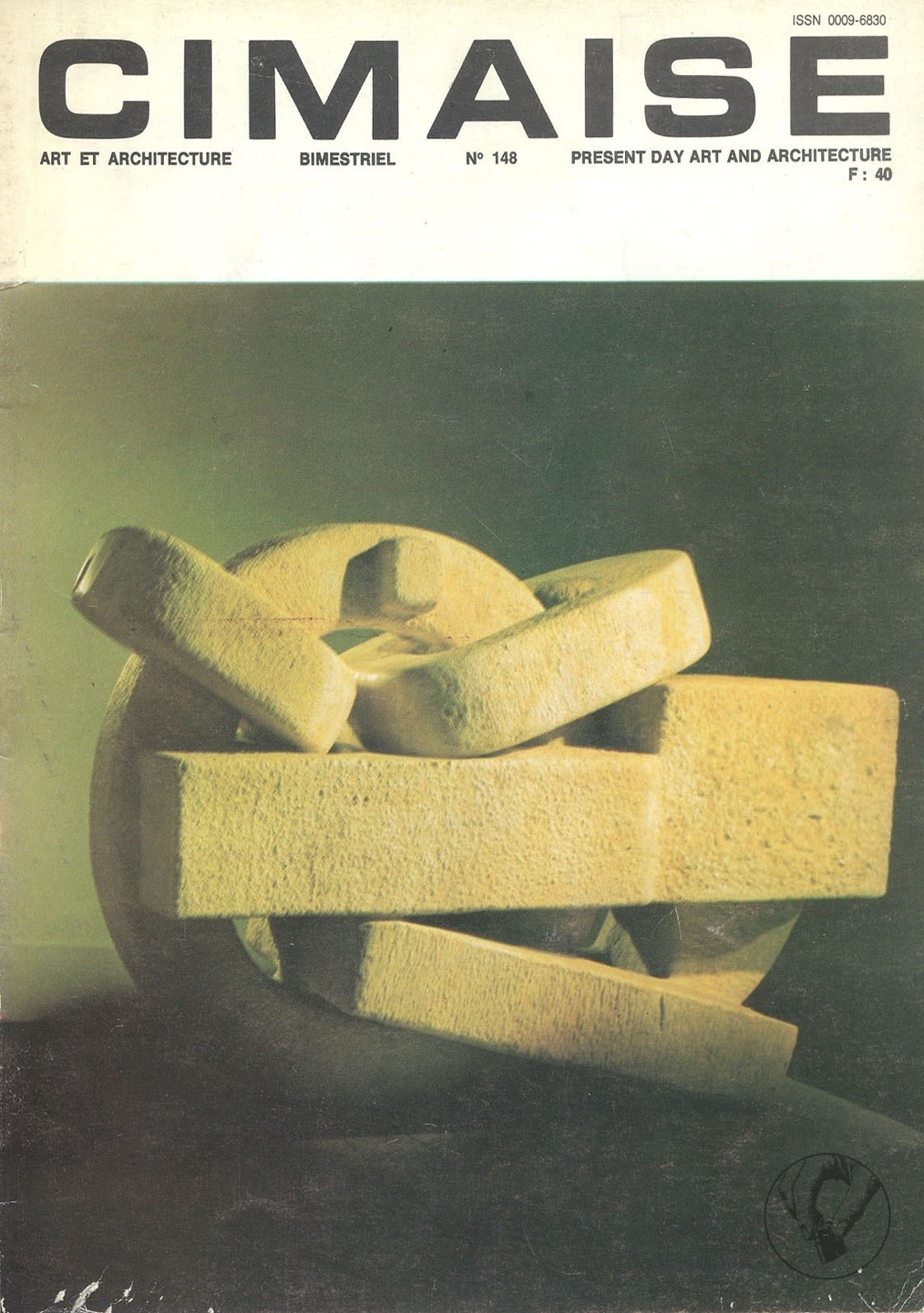
Ce numéro de la revue Cimaise, daté de septembre-octobre 1980, aborde la thématique de l'art universel face aux récupérations nationales. L'éditorial de Jean-Robert Arnaud questionne la perte de sens des mots dans l'art contemporain et la notion d'élitisme culturel. Il présente également des expositions d'artistes comme Whanki, Fagniez, Labrunie, Mihailovitch, Achille Perilli, Jean-Pierre Junius, Lucien Wercollier et Maurice Estève.