Page 1
CIMAISE ART ET ARCHITECTURE BIMESTRIEL N° 147 PRESENT DAY ART AND ARCHITECTURE F : 40 ISSN 0009-6830
Premières pages de l'ouvrage, en accès libre.
CIMAISE ART ET ARCHITECTURE BIMESTRIEL N° 147 PRESENT DAY ART AND ARCHITECTURE F : 40 ISSN 0009-6830
Galerie Bellint 28 bis, boulevard Sébastopol - 75004 Paris Tel. 277 38 46 278 01 91 POUGNY peintures 10 juin - 12 juillet 1980 en permanence: peintures de - Bazaine - Bellmer - Braque - Bryen - Bertholle - Boumeester - Debré - Downing - Droulers - Fagniez - Goetz - Kijno - J.F. Koenig - Lanskoy - La Serna - Luc Peire - Pelayo - Poliakoff - Salvado - Seiler sculptures de - Fenosa - Feraud - Dietrich Mohr - Subira Puig --- Elzbieta Violet dessins à la plume du 16 septembre au 18 octobre 1980 (de 15h à 20h30, sauf dimanche et lundi) NANE STERN 25, avenue de Tourville 75007 Paris 705 08 46
CIMAISE ART ET ARCHITECTURE ACTUELS PRESENT DAY ART AND ARCHITECTURE 27e ANNÉE - N° 147 Juin-juillet-août 1980 Directeur-Rédacteur en Chef : Jean-Robert Arnaud Conseiller artistique : John Franklin Koenig Secrétaire général : René Barzilay Secrétaire de rédaction : Luis Lemos Administration-Rédaction : 8, rue Récamier, Paris-7e. Tél. : 544-04-82 Impression : Société Mondiale d’Impression, 3, rue Maurice-Loewy, Paris-14e. Tél. : 327.15.40 Prix --- ce numéro : --- France --- 40 F --- Etranger --- 50 F --- Abonnement --- 6 numéros : --- France --- 180 F --- Etranger --- 240 F --- C.C.P. Cimaise 5542.39 --- Couverture de Furudoï --- Sommaire : Editorial --- Jean-Robert Arnaud --- Faits et méfaits culturelsCultural doings and wrong-doings --- Reportage en Chine --- Liliane Thorn-Petit --- Une armée en terracotta veille sur le repos éternel de l’Empereur unificateur de la ChineA Terra-Cotta army keeps watch over the eternal rest of the Emperor, unifier of Chine --- Visites d’Ateliers --- Pierre Restany --- Farhi, le Soleil pris au piège du plastiqueThe Sun caught in a plastic trap --- Gérard Xuriguera --- Jean Campa --- Claude Bouyeure --- E. Franzheim, une façon de recevoir les signesA way of accepting signs --- Actualité --- Paule Gauthier --- Panorama parisien des arts plastiques, année 80 --- Jean-Jacques Lévêque --- Une géographie artistique parisienne --- Prochaine publication : 15 octobre 1980
Gérard Montassier: “En France, depuis la dernière guerre et plus encore ces vingt dernières années, le monde de la culture aurait du être soulevé d’espoir…Il semble aujourd’hui que cet élan si prometteur soit retombé…certains vont jusqu’à se demander si la voie royale de l’accès à la culture pour tous n’est pas finalement une impasse”. Jean Leymarie: “Je ne connais vraiment que mon lieu d’origine et son environnement immédiat…mon goût de la peinture est organiquement de même source”. Sylvia Montfort: “Il faut sans nul doute donner une part importante à la connaissance de tout ce qui peut toucher la sensibilité et que l’on appelle encore art”. La culture, c’est, comme la langue, la meilleure et la pire des choses. Surtout si l’on prend le mot dans son acception la plus large, son acception actuelle. Avant guerre était culture ce qui relevait de ce qu’on appelait l’art, et qu’aujourd’hui Gérard Montassier appelle création. Quand Edouard Herriot disait “la culture c’est ce qui reste quand on a tout oublié”, il faisait référence à cette culture culturante, si j’ose ce néologisme, celle dont on nous enseignait vaguement les prémices à l’école, libre à chacun de l’acquérir, à partir de là, tout au long de sa vie. La culture c’était la fréquentation des arts, de la littérature, voire des sciences; il ne venait à l’esprit de personne de dire d’un quidam passionné du 100 mètres nage libre ou du saut en hauteur qu’il était un homme cultivé. La culture, aujourd’hui, si c’est encore Racine, Vuillard, Ionesco ou Beckett, c’est aussi une recette de cuisine, la mode ou le patin à roulettes. C’est en somme tout ce qui différencie l’homme de l’animal: la conscience, la mémoire pour le passé, l’imagination pour le présent, la mémoire et l’imagination pour l’avenir. C’est vaste, et sous cette optique notre culture va bon train, nous baignons dans un bain de culture. Ce n’est plus le fameux désert, le vide culturel qui est à craindre, mais bien, pour emprunter un mot célèbre le trop plein. D’un côté la culture, au sens étroit du terme (arts, Beaux-Arts, littérature), parente toujours très pauvre de tous les budgets étatiques ou autres, ignorée des grands moyens d’information, presse, radio, télévision, sétiole. Ce n’est pas le vide, c’est l’absence. De l’autre, le matraquage quotidien (le mot est faible) de ces mêmes moyens d’information avides d’“événements culturels”: vrais et faux jeux olympiques, voyages du Pape, faits divers. Là c’est le trop plein, le débordement, et par moments, l’écoeurement. Dire que l’on donne aux gens ce qu’ils demandent, ou à peu près, explique tout mais ne justifie rien. La grande presse ne parle pas d’art parce que cela n’intéresse pas ses lecteurs et donc ses annonceurs. La télévision ne consacre à l’art que de rares émissions, à quelques exceptions près, indignentes et ennuyeuses, parce que cela n’intéresse que peu son public. Et de toutes façons il est mauvais de vouloir faire de l’action culturelle, à tout prix, avec n’importe quoi, en toute ignorance de cause et une presque parfaite incompétence. Gérard Montassier souligne le fantastique impact de la télévision et parle avec émerveillement du nombre de spectateurs regardant l’émission “Au théâtre ce soir”, mais ils regardent quoi ? de très insipides pièces qu’on leur donne comme l’expression du théâtre contemporain. A tout prendre, il est (1) A propos du livre de Gérard Montassier “Le fait culturel” edition Fayard toutes les citations sont extraites du livres. --- Faits et méfaits Culturels$^{(1)}$ par Jean Robert Arnaud Cultural doings and wrong-doings.(1) Gérard Montassier: “In France, since the last war and even more so in the last twenty years, the cultural world should have been uplifted by hope. Today it seems that this so promising impetus has somewhat diminished…certain people go as far as to wonder if the royal highway leading to culture for all isn’t really a dead-end”. Jean Leymarie: “All I really know about is the place originated from and its immediate surroundings…my taste in painting comes organically from the Same Source”. Sylvia Montfort: “Without a doubt, one must make an important contribution to all that which can touch the feelings and which one still calls art.” Culture is, like a language, the best and worst of things. Above all if one takes the word in its largest sense, its present senses Before the war, culture was that which one culled from what was then called art and today is called, by Gérard Montassier, creation. When Edouart Herriot said “culture is that which remains when one has forgotten everything, he was referring to that cultivating culture, if I may use this pleonasm, the basics of which we were vaguely taught in school, and from then on, everyone was free to build on these basics throughout his life. Culture was the frequenting of the arts, of literature, even the sciences; nobody took it into their head to tell someone who was enthusiastic about the 100 metres free style or the highjump that he was a cultured man. Today, if culture is still Racine, Vuillard, Ionesco or Beckett, it is also a kitchen recipe, fashion or roller-skating-It is, in short, all that distinguishes the man from the animal: the conscience, memory for things past, imagination for things present, memory and imagination for things to come. It is all-embracing, and beneath this perspective, our culture is moving along at a good pace, we are wallowing in a cultural bath. It is no longer the famous desert, the cultural void which is to be feared, but indeed, to use a well-known phrase, the too full. On one side we have culture, in the strict sense of the word (arts, Fine Arts, Literature), which is always the poor relation of all the budgets, whether they be under state control or not, and is ignored by the large distributors of information, the press, the radio and television. And so it declines. This isn’t a void, it’s an absence. On the other side we have the everyday cudgelling (the word is weak) by these same distributors of information, hungry for cultural events: genuine or fake olympic games, the pope’s travels, diverse facts. There wa have the too full, the overflow; sometimes nauseating. To say that one (1)Concerning Gérard Montassier’s book “The cultural doing” Published by Fayard (All quotations are extracts from the book).
alors préférable, et moins nocif de regarder un match de catch. Et il faut répéter inlassablement de véritables truismes pour tenter de se faire un peu entendre. “Aujourd’hui, nous sommes entrés dans l’époque de la culture de masse, de la culture présente dans tous les foyers grâce à la télévision et à l’audio-visuel individuel…la télévision par elle-même ne change jamais, dans des proportions importantes le niveau de culture des téléspectateurs. Son effet est quantitatif…mais elle ne saurait avoir seule l’effet qualitatif qui ferait passer d’un niveau de culture à un autre. Précisément parce que l’apprentissage préalable est indispensable et qu’il se pratique ailleurs que devant l’écran familial”… “L’avènement de l’audio-visuel ne change donc rien au fait qu’aujourd’hui comme hier nous nous trouvons confrontés au problème de la formation des hommes c’est à dire l’acquisition d’une culture…L’école traditionnelle reste le lieu privilégié ou se conquiert la maîtrise des disciplines intellectuelles (1) qui entrent dans toute culture”. Et comme dit Sylvia Monfort: “Il est toujours trop tard, hélas! pour faire découvrir l’art aux enfants”. Car c’est bien à ce seul niveau que le problème se pose réellement dans toute son ampleur. Acquérir ou pas. Et pour ce faire, disposer des moyens intellectuels que seule l’école peut dispenser. Tout le reste n’est qu’action ponctuelle, dérisoire par rapport à l’enjeu. Pour que la culture soit diffusée, il faut qu’il y ait demande, pour qu’il y ait demande, il faut qu’il y ait besoin. Ce besoin là existe, au fond de l’homme. Mais sa satisfaction n’est pas vitale, comme celle de la soif, de la faim, du sommeil. On peut vivre sans, si l’on n’aide pas l’individu, c’est à dire d’abord l’enfant, à en prendre conscience et au delà d’un problème d’enseignement, c’est un problème de société qui se pose. Ce problème de société est, en somme, le sujet de toute la première partie du livre, à travers les témoignages qu’il a demandé à un certain nombre de créateurs exemplaires. Parmi eux, Milan Kundera, à partir d’une expérience vécue, parle de la “mort de l’Occident”. Mais son pessimisme n’est pas seul. C’est un peu le ton général de ces écrits. Jean Leymarie: “Le relativisme artistique a marqué la faillite des esthétiques normatives à référence unitaire…Pour les arts plus proches de nous, la “méthode de critique” pratiquement énoncée par Baudelaire…me semble encore valable sur toutes ces points…” D’après Balthus:“L’homme d’aujourd’hui a vécu une foule de bouleversements…mais le résultat qu’il ne perçoit pas toujours, est une sorte de trouble qui l’atteint jusqu’au fond de lui-même, se répercute dans ses capacités créatrices et le rend inapte à maîtriser l’écroulement des valeurs séculaires.” Peter Brook: “…en balayant toutes les valeurs nos contemporains se sont retrouvés face au néant avec l’angoisse qu’il entraîne.” Il est impressionnant de constater tant de concordances, les raisons qui justifient cette vision noire abondent. Mais exist-t-il des créateurs heureux ? Je vois là comme une antinomie entre les termes, et qu’heureux un créateur cesserait de créer. Non sans courage, Gérard Montassier tente une ana- (1) c’est moi qui souligne gives people what they ask for, or near enough, explains everything but justifies nothing. The main part of the press doesn’t mention art because that doesn’t interest its readers and therefore doesn’t interest its advertisers. Television rarely devotes a program to art, and when it does they are, apart from a few exceptions, poor and tedious because that only slightly interests their viewers. And in any case, it’s wrong to want to start a cultural movement at any price, with any available material, without knowing why one is doing so and doing so with an almost perfect incompetence. Gérard Montassier underlines the fantastic impact of the television and speaks with wonder of the number of viewers watching the program “Tonight at the theatre”, but what are they watching? Some most insipid plays that are shown to them as the expression of present day theatre. On the whole, it is thus preferable, and safer, to watch an all-in wrestling match. And one must tirelessly repeat some veritable truisms whilst trying to make oneself heard. “Today, we have entered into the age of mass culture, of culture present in all homes, thanks to television and to individual audio-visual…television in itself never changes, to any important degree, the viewers’ level of culture. Its effect is one of quantity…but it does not possess the qualitative effect which could make the transition from one level of culture to another. Precisely because the preliminary apprenticeship is essential and it is served elsewhere than in front of the family T.V. set. The arrival of audio-visual, therefore, in no way alters the fact that today, like yesterday, we find ourselves confronted by the eternal problem of the making of a man, that is to say the acquiring of a culture… The traditional school remains the privileged place where one wins the mastery of intellectual branches of knowledge (1) which enter into all cultures”. And according to Sylvia Monfort: “It is always too late, alas ! to help children to discover art.” For it is really at this level alone that the problem raises its head in all its amplitude. To acquire or not to acquire. And in order to do this, to have at one’s disposition all the intellectual means that only the school may give. All the rest is nothing but punctuated activity, ridiculous considering what’s at stake. For culture to be broadcasted, there has to be a demand, for there to be a demand, there has to be a need. This need exists deep inside man. But its satisfaction isn’t vital, like that of thirst, hunger or sleep. One can live without it, if one doesn’t help the individual, that is to say the child to begin with, to be aware of his need and beyond a teaching problem, it is a social problem which we have here. This social problem is, in short, the subject of all the first part of Gérard Montassier’s book, through the evidence which he has collected from a certain number of exemplary creators. Amongst them, Milan Kundera, drawing from personal experience, tells of the “death of the western world”. But he isn’t the only pessimist around. It is rather the general tone of these writings: Jean Leymarie: “Artistic relativism has tolled the bell for normative aesthetics with a common meaning. For the arts closer to use, the method of criticism poetically enunciated by Baudelaire…still seems to me to be valid in all its points of views…” According to Balthus: “The man of today has lived through a large number of upheavels… but the result, which he doesn’t always notice, is a kind of disorder which reaches right to the heart of him, repercussions follow throughout his creative capacities and render him unfit to deal with the collapse of age-old values”. Peter Brooks: “…in sweeping aside all values, our contemporaries have found themselves faced with nothingness and the anguish that comes with it”. (1) underlined this.
lyse des créateurs et de la création. “Rien n’est plus proche, dit-il, du créateur que l’artisan.” Pour lui, certains créateurs “ne peuvent s’exprimer qu’en créant leur propre monde parallèle au nôtre” tandis que d’autres “veulent intervenir dans notre propre monde.” Il pense que l’obsession de la perfection est dû au souci de la communication. Il affirme enfin “qu’on devient créateur par la rencontre du hasard et de l’obsession” et que “la création est une passion analogue à l’ambition”. Pourtant, de nos jours, et depuis longtemps déjà, l’autonomie créatrice de l’artiste est totale et ses liens avec l’artisan sont radicalement rompus depuis le romantisme et même avant. Les nombreuses tentatives qui ont été faites pour rapprocher les uns et les autres ont été peu convaincantes, et je me souviens encore de l’exposition de “l’objet”, il y a quelques années, au Musée des Arts décoratifs. Ce fut un échec assez général, les artistes s’étant montré incapables de “créer” des formes artisanales originales, se contentant, dans la plupart des cas, de contraindre leurs formes artistiques à s’allier laborieusement aux formes utiles. En ce qui concerne les créateurs, plutôt que de créer un monde parallèle au nôtre ou d’intervenir dans le nôtre, leur ambition, leur propos est de créer, simplement, si je puis dire, leur monde en soi, pour le mettre à la place de l’autre, le nôtre n’étant pour eux que source de conflits, de contraintes, d’agressions de toutes sortes. Quant à la recherche de la perfection, plus qu’un souci de communication, j’y vois une recherche de l’absolu, une tentative vouée à l’échec d’adéquation entre l’œuvre entrevue et le résultat obtenu, but jamais atteint, œuvre toujours recommencée, satisfaction jamais obtenue. On ne devient créateur que par nécessité, par besoin profond, on ne devient pas créateur, on naît créateur. La création ne se choisit pas, mais s’impose, et s’il y a obsession il n’y a ni hasard ni chance, et bien plus qu’une passion, une “difficulté d’être”, et l’ambition du créateur n’est que la manifestation des tentatives faites pour sortir de cet état. Mais, bien sûr, s’exprimer ne suffit pas, il faut un prise de conscience, et aussi une structure pour aller au delà du borborygme, du vagissement, de l’irruption spontanée, du magma chaotique. Il n’y a pas d’art inconscient. S’exprimer n’est pas créer, et Sylvia Monfort a raison de dire: “J’ai beaucoup entendu défendre le point de vue que chaque homme était créateur. C’est une idée dangereuse, car on n’est pas créateur parce que l’on s’exprime”. Il faut aussi une technique, ne serait-ce que pour l’oublier; et enfin du talent, ce quelque chose d’incernable, d’indéfinissable, mais d’indispensable. Cet espèce de noyau dur et d’inabordable que le créateur porte en lui, dont il ne sait que parler mal, et qui le rend différend des autres, et Gérard Montassier a raison de parler de “confusion naïve entre le besoin et la capacité”. Ces quelques réflexions incomplètes laissent dans l’ombre de grands pans du livre. C’est que les idées y foisonnent, s’y bousculent; et il y avait là matière sinon à plusieurs ouvrages, du moins à un livre en sa totalité. Quelque soit l’intérêt des textes des créateurs, et il est grand pour certains, publiés en première partie, ils auraient pu être publiés à part. Ils apparaissent là, un peu comme une caution dont Gérard Montassier n’avait nullement besoin. Jean-Robert Arnaud It is moving to discover so much agreement of evidence, the reasoning which justifies this black vision is abundant. But are there any happy creators in existence? I see here a contradiction between the words, and that if he was happy, a creator would cease to create. Not lacking in courage, Gérard Montassier holds an analysis of creators and of creation. “Nothing is closer, says he, to the creator than the craftsman”. For him, certain creators “can only express themselves by creating their own world parallel to ours” whilst others “want to intervene in our own world”. The thinks that the obsession for perfection is due to the care needed in communicating with others. He finally states “that one becomes a creator through the meeting of chance and obsession and that creation is a passion analogous to ambition”. However, nowadays and for a long time past, the creative independence of the artist is complete and his links with the craftsman have been radically broken since romanticism and even made to draw the artist closer to the craftsman have not been very convincing and I still remember the exposition of “the object”, a few years ago, at the Museum of Decorative Arts. That was an almost complete failure, the artists proving themselves incapable of “creating” original forms relating to crafts and being content, in most cases, to compel their artistic forms to combine themselves painstakingly with serviceable forms. In that which concerns the creators, rather than discrete a world parallel to ours or intervene in, our one, their ambition, their resolution is to create, simply, if I may say so, their world’s in itself, in order to put it in the other world’s place, our world only being for them a source of conflict, constraint and aggression of every kind. As for the search for perfection, more than worry about communication, I see here a search for the absolute, an attempt doomed to failure of adequacy between the work foreseen and the result obtained, a target never reached, work forever restarted, satisfaction never obtained. One only becomes a creator through necessity, because of a deep-felt need, one does not become a creator, one is born a creator. Creation isn’t chosen, but it imposes itself, and if there is an obsession there is neither chance nor luck, and much stronger than enthusiasm is a “difficulty to be oneself”; and the creator’s ambition is but the demonstration of attempts made to leave this state. But, of course, it is not enough to express oneself, it’s necessary to become aware and to have an arrangement of ideas in order to move beyond borborygmus, beyond wailing, spontaneous irruption and chaotic magma. There is no Such thing as unconscious art. To express oneself is not creation. And Sylvia Monfort is right in saying: “I have often heard the point of view defended that every man is a creator. This is a dangerous idea, for one is not a creator because one expresses oneself”. A technique is needed as well, if only to forget it; and finally talent, that indiscernible, undefinable, yet indispensable something. That kind of hard and inaccessible core which the creator carries within himself, of which he cannot tell much, and which makes him different from other people, and Gérard Montassier is right to speak of “naïve confusion between need and ability”. These few incomplete reflections leave in the shade some important parts of the book. Ideas abound there, push and shove each other there; and there was material there, if not for several works, at least for one book in its entirety. Whatever the interest in the creators’ texts should be, and the interest is strong in certain texts, published as the first part of the book, they could have been published separately. They appear there, a bit like a guarantee of which Gérard Montassier hadn’t the slightest need. Jean-Robert Arnaud
Une armée en terracotta veille sur le repos éternel de l’empereur, unificateur de la Chine... par Liliane Thorn-Petit --- A TERRA-COTTA ARMY KEEPS WATCH OVER THE ETERNAL REST OF THE EMPEROR, UNIFIER OF CHINA... Plus ou moins 7.000 soldats en Terracotta, figés en formation de combat, veillent depuis plus de 2.200 ans sur le repos éternel de l’empereur Chin Shi Huang Ti. (221-206 av. J.-Ch.) Comme si souvent, la découverte la plus sensationnelle, faite en Chine, est due au hasard, c’est en creusant un puits dans les champs près de Sian, que des paysans tombèrent — c’est le cas de le dire — sur une armée de 7.000 soldats à taille humaine, plus grands que les Chinois contemporains, saisis en « pleine vie », à l’exemple des gens ensevelis sous les cendres de l’éruption du Vesuve à Pompei... C’est la garde impériale, que le grand empereur Chin Shi Huang Ti a voulu mettre en formation de combat devant sa tombe, qui se trouve depuis plus de 2.000 ans sous un tumulus d’une hauteur de quelques 40 mètres, à quelques centaines de mètres de là. Depuis la découverte de l’armée de l’empereur défunt en mai 1974, on va de merveille en merveille, on a déterré non seulement des soldats officiers ayant chacun une expression personnelle, reflétant tantôt l’autorité tantôt l’ardeur au combat ou donnant tous les détails des uniformes, des coiffures, de l’armement, mais encore des chars d’assaut ou de chevaux, ces merveilleux chevaux Tang, dont de petits modèles appartiennent depuis longtemps au Musée Imaginaire de l’humanité. Depuis avril 1980, six de ces guerriers et deux chars à chevaux, font une tournée aux Etats-Unis d’Amérique dans le cadre de l’exposition des About 7,000 soldiers, terra-cotta soldiers, frozen in combat formation, have kept watch for more than 2,200 years over the eternal rest of the emperor Chin Shi Huang Ti (221-206 B.C.). As so often happens, the most sensational discovery made in China is due to sheer luck. In digging a well in the fields near Sian, the peasants fell—in a manner of speaking—upon an army of 7,000 soldiers, life-size yet bigger than the chinese people of today, frozen as if carrying out normal, everyday actions, as are the people buried under the ashes of the Vesuve eruption at Pompei... This is the imperial guard, which the great emperor Chin Shi Huang Ti wished to have placed in battle formation in front of his tomb, which has been, for more than 2,000 years, beneath a tumulus of some 40 metres in height, at a distance of a few hundred metres from the imperial guard. Since the discovery of the defunct emperor’s army in may 1974, each new discovery is more marvelous than the one before it, not only have fighting officers, each with a personal expression, sometimes reflecting authority, sometimes the ardeur of battle, or giving every detail of the uniforms, hair styles and equipment been unearthed, but also assault chariots or horses, those marvelous Tang horses, the little models of which have long been part of humanity’s Imaginary Museum. Since april 1980, six of these warriors and two horse-drawn chariots are “on tour” in the United States of America as part
Photo Revue - Jochen Herling L'armée ensevelie du premier empereur de Chine veille depuis 2.200 ans devant le tombeau de Chin Shi Huang Ti, grand unificateur de la Chine. Découverte par hasard en mai 74 par des paysans creusant un puits dans la province de Sian, ce site archéologique s'est révélé d'une richesse prodigieuse avec ses quelques 7.000 soldats, archers, conducteurs de chars en terra-cotta. Les fouilles sont recouvertes par un hall immense que quelques visiteurs privilégiés ont pu visiter à ce jour et il faut une visite d'Etat — comme ici le grand Duc et la grande Duchesse de Luxembourg pour avoir la permission de descendre dans la fosse et se « mesurer » aux gardes de Chin Shi Huang Ti... The buried army of China's first emperor has kept watch for 2,200 years in front of the tomb of China's great unifier. Chin Shi Huang Ti. Discovered by chance in may 74 by peasants digging a well in the province of Sian, this archeological site has proved to be of enormous value with its 7,000 terra-cotta soldiers, archers and chariot drivers. The finds have been covered over with an immense hall which some privileged visitors have since been able to view. A state visit is the only way in which one is allowed to descend into the tomb. As was the case for the Grand Duke and the Grand Duchess of Luxembourg. And to “measure” oneself against Chin Shi Chuang Ti’s guards.
« TRÉSORS DE L’AGE DE BRONZE EN CHINE ». Ils suscitent un intérêt prodigieux et fixent l’attention — au-delà du plaisir esthétique pour ses véritables œuvres d’art — sur la figure et la personnalité de l’empereur que Mao Zedong se plaisait à considérer comme son illustre prédécesseur... Depuis, les Chinois eux aussi sont convaincus de l’importance de leur découverte et c’est pour le 30e anniversaire de leur République qu’ils ont ouvert au public le hangar immense qui couvre le champ d’investigation archéologique, où seuls quelques 150 figurines ont été dégagées et nettoyées jusqu’ici. En fait les Chinois, gens prudents et sages, ont à cœur de ne pas répéter les mauvaises expériences qu’ils ont faites à l’ouverture des tombeaux Ming et c’est pour cette même raison qu’ils n’ont pas encore ouvert la tombe de l’empereur Chin Shi Huang Ti. Actuellement, on procède par petits bouts. En matière archéologique, comme en tant d’autres domaines, les Chinois ont une autre conception du temps et semblent avoir l’éternité pour eux ! Chin Shi Huang Ti a fait travailler quelques 700.000 Chinois pour sa demeure éternelle. Sa garde impériale devait garder l’accès de la tombe par deux rangées d’archers qui, des deux côtés, étaient tournées respectivement vers le soleil levant et le soleil couchant, armés d’arcs et de flèches en bronze. A l’intérieur du vaste rectangle se trouvaient les chars d’assaut, les soldats de l’infanterie, même des chevaux dans des sillons de quelques 200 mètres de long, séparés entre eux par de petits murs en terre. Ces figurines sont en parti cassées en raison de l’effondrement du toit qui s’ouvrait. On estime en effet que quelques trois années après le décès de l’empereur — 206 av. J.-Ch. — des profanateurs de tombeaux et des chercheurs de trésor, voleurs de grands chemins, devinait les richesses que l’empereur avait enterrées avec lui, avaient déjà essayé de violer sa tombe et avaient mis le feu aux toits de chaume qui recouvraient l’espace où se tenait cette « grande (armée) muette ». Le toit s’est effondré, couvrant les soldats, mais les soustrayant aussi pour plus de 2.000 ans au regard d’autres voleurs de grands chemins... Beaucoup d’armes en bronze cependant avaient disparu, de même, on suppose que le tombeau de l’empereur a déjà été dévalisé... Mais quel personnage était donc ce Chin Shi Huang Ti, qui se présentait lui-même « le premier sublime » de Chine ? Mégalomane, cruel, tremblant devant la mort Chin Shi Huang Ti a cependant été un grand empereur pour la Chine. C’est lui le premier qui réussit à unifier l’Empire du Milieu et à en faire un Etat moderne, centralisé, qui ne s’appuyait plus sur l’aristocratie privilégiée, mais sur des fonctionnaires dont les charges n’étaient pas héréditaires. Proclamé empereur à l’âge de 13 ans, il monta sur le trône d’un des sept royaumes de Chine. Pendant 16 ans ses armées se sont battues partout en Chine jusqu’à ce qu’il eut enfin réuni sous son sceptre toutes les parties convoitées qu’il avala « comme un ver de soie avale une feuille de mûrier » comme le note, un siècle plus tard, l’historien chinois Su-Ma Chien. A l’âge de 38 ans, Chin Shi Huang Ti est enfin empereur de toute la Chine et partant l’homme le plus puissant du monde. of the “BRONZE AGE TREASURES OF CHINA” exposition. They are arousing an enormous interest and draw attention—beyond aesthetic pleasure given by these true works of art—to the figure and personality of the emperor whom Mao Zedong liked to consider as his illustrious predecessor... The chinese themselves have also become convinced of their discovery’s importance and, for the 30th anniversary of their republic, they have opened to the public the immense building which covers the site of archeological investigation, where only some 150 figures have so far been unearthed and cleaned. In fact, the chinese, a wise and prudent people, strongly wish that the bad experiences from which they learnt after the opening of the Ming tombs should not be repeated and this is why they have not yet opened the tomb of the emperor Chin Shi Huang Ti. And so at present they are proceeding with small steps, bit by bit. When it comes to archeology, as in so many other fields, the chinese have a different idea of time and seem to have eternity for themselves! Chin Shi Huang Ti made some 700,000 chinese work on his eternal dwelling-place. His imperial guard was set to guard the entrance of the tomb, two rows of archers, on both sides of the entrance, were turned respectively towards the rising sun and the setting sun, armed with bronze bows and arrows. Inside the vast rectangle are assualt chariots, infantry soldiers, even horses in furrows which are some 200 metres in length and are seperated from each other by little walls of earth. These figures are broken in parts due to the collapse of the roof which covered them. It is actually thought that some three years after the emperor’s death—206 B.C.—tomb profaners and treasure seekers, highway robbers, guessing of the wealth which the emperor must have had buried with him, had already tried to profane his tomb and had set fire to the thatched roof which covered the area where this “great, silent army” was assembled. The roof caved in, covering the soldiers, yet at the same time hiding them for more than 2,000 years from the eyes of other highway robbers... However, many bronze weapons had disappeared, just as it is supposed that the emperor’s tomb has already been robbed... But what kind of person what this Chin Shi Huang Ti, who thought himself “the highest noble” in China? A megalomaniac, cruel, terrified of death. Chin Shi Huang Ti was nevertheless a very good emperor for China. He was the first person to succeed in unifying the Middle Empire and in making a modern, centralized state out of it, so that it no longer depended upon the privileged aristocracy but upon officials who did not obtain their duties by heritage. Proclaimed emperor at the age of thirteen, he ascended to the throne of one of China’s seven kingdoms. For sixteen years, his armies fought all over China until he had at last united under his sceptre all coveted regions which he swallowed “as a silkworm swallows a mulberry leaf” as noted, a century later, the chinese historian Su-Ma Chien. At the age of thirty-eight, Chin Shi Huang Ti was finally emperor of all China and consequently the most powerful man in the world. Even then he thought about the construction of his gigantic tomb, for he intended to triumph over death as he had triumphed over so many living
Photo Revue - Jochen Herling Les figures hautes de 1,80 m ont des traits individuels probablement pris sur le vif et nous livrent une foule de détails sur l'armement, les habits, les coiffures de l'armée impériale 2.200 ans avant J.-Ch. The figures, which are 1,80 metres in height, all have individual features, probably copied from real-life expressions, and give us a great number of details on the armament clothing and hair styles of the imperial army, 2,200 years before Jesus Christ.
Dès lors il pense à la construction de sa tombe gigantesque, car il entend triompher de la mort comme il a triomphé de tant de vivants. Ce sera aussi le début de sa déchéance puisqu’il deviendra un enjeu, une victime pour beaucoup d’intrigants, de charlatans, de diseurs de bonne aventure. Pour se procurer l’élixir de vie, il fait armer et équiper toute une expédition de quelques 3.000 hommes qui ne reviendra pas... Fascinante et déroutante personnalité que celle de cet empereur qui voulait à tout prix garantir son repos céleste dans les entrailles du Mont Ti, près de Sian, sa capitale. Il devait rêver de repos, cet infatigable constructeur et voyageur, ce dirigeant intrépide et clairvoyant que la peur tenaillait tous les jours de son règne... En cela il ressemblait à Hérode, de sinistre mémoire pour les lecteurs des Evangiles qui, lui aussi, était torturé par la peur d’un assassinat et tuait par réflexe de peur ! Chin Shi Huang Ti gardait secrets tous ses déplacements, ne dormait jamais deux nuits de suite dans le même palais et, de ce fait, en construisit un grand nombre, un peu partout. Trois personnes seulement savaient où joindre l’empereur, jour et nuit : son fils puiné, son premier ministre et le grand eunuque de sa maison impériale ! Ils garantissaient bien entendu sur leur vie le lourd secret. L’horrible peur, qui assombrit la vie de l’empereur, ne l’empêchait cependant pas d’œuvrer de façon efficace pour la plus grande gloire de son pays. Alors que l’Empire romain s’étendait vers l’Ouest, en l’an 210 avant J.-Ch., Chin Shi Huang Ti conquit une multitude de petits Etats autour du cœur de l’actuelle Chine, construisit la Grande Muraille ou plutôt : réunit les murs de fortifications fragmentaires qu’on avait élevé au fil des siècles pour faire barrage aux hordes venues des steppes d’Asie. Ce ne fut point une mince entreprise : la plus longue muraille de fortification du monde mesure quelque 5.000 km — aux dernières nouvelles — et coûta la vie à tant de milliers de travailleurs forcés qu’on l’appela « le plus grand cimetière du monde » ! Mais Chin Shi Huang Ti avait, lui aussi, ses ennemis privilégiés : les disciples de Confucius... déjà ! Il en fit décapiter — ou enterrer vivants — 460, à en croire les chroniqueurs de l’époque. Suspects parce que incitant à la réflexion, ces philosophes, à l’exemple de leur maître à penser, devaient être bien coupables aux yeux de ce grand constructeur et unificateur par devant l’Histoire, dont le pouvoir devait nécessairement se baser sur des « masses » dociles, ignorantes et bêtement disciplinées. L’intellectuel, pour Chin Shi Huang Ti — comme pour Mao Zedong, plus de deux siècles plus tard — était l’ennemi par excellence, l’élément subversif par définition, le semeur de trouble, le levain révolutionnaire... L’empereur prit soin également — cela allait de soi —, de faire brûler tous les livres de Confucius, coupable à ses yeux d’être un conservateur et un réactionnaire, suppôt de l’ancien système féodal ; et ce faisant, constituait un reproche pour le gouvernement autoritaire et centralisé de Chin Shi Huang Ti ; son image, comme sa pensée, devait donc être déracinée et détruite. Comme le fils ainé de l’empereur s’opposait à ces exécutions et à l’autodafé, le père, furieux, l’envoya en exil sans autre forme de procès. En fait, ses visées centralistes n’auraient pu supporter la con- people. This was also the beginning of his downfall since he became a victim of, in danger from, many schemers, imposters and fortune-tellers. In order to procure the elixir of life, he ordered that an army of 3,000 men should be armed and equipped, an army which would not return... Fascinating and disconcerting was the personality of this emperor who would go to any length to guarantee himself celestial rest in the bowels of Mount Ti, close to Sian, his capital city. He must have longed for rest, that tireless constructor and traveller, that fearless and clear-sighted ruler whom fear tormented all the days of his reign... In which he resembled Herod, with sinister memories for readers of the Gospel. Herod also was tormented by the fear of assassination and killed by reflex because of this fear! Chin Shi Huang Ti kept all his journeys secret, never slept in the same palace two nights running and for this reason a great number of palaces were built, almost everywhere. Only three people knew where to find the emperor, day and night: his youngest son, his Prime Minister and the great eunuch of his imperial household! Of course, they guarded the burdensome secret with their lives. The horrible fear that clouded the emperor’s life did not however prevent him from working in an efficient manner towards the greater glory of his country. Whilst the Roman Empire expanded out to the west, in the year 210 B.C., Chin Shi Huang Ti conquered a great number of small states around the centre of present day China, built the Great Wall or rather: joined together the walls of fragmentary fortifications which had been erected over the centuries to obstruct the hordes coming in from the asian steppes. This was no easy undertaking: the longest wall of fortification in the world measures some 5,000 km—at the last count—and cost the life of so many thousands of forced workmen that it was called “the biggest cemetery in the world”! But Chin Shi Huang Ti also had his own privileged enemies: the disciples of Confucius, even! He had them beheaded—or buried alive—460, according to the chroniclers of the time. Suspects because they incited people to think in depth, these philosophers, after the example of their master in the art of thought, must have seemed very guilty to this great constructor and unifier who is one of History’s most famous and for whom power was based essentially upon the docile “masses”, ignorant and easily controlled. The intelligentsia, for Chin Shi Huang Ti—as for Mao Zedong, more than two centuries later—was a particularly dangerous enemy, definable as the subversive element, the trouble-maker, the revolutionary leaven.... The emperor took equal care, quite obviously, to have all of Confucius’ books burnt, for in his eyes, Confucius was guilty of being a conservative and a reactionary, a supporter of the old feudal system; and in so doing, constituted a reproach to the centralized and authoritative government of Chin Shi Huang Ti; his image, like his thoughts, had thus to be uprooted and destroyed. As the emperor’s eldest son was opposed to these executions and to autodafé, the father, furious, sent him into exile without exchanging another word on the matter. In fact, his centralist ambitions couldn’t have held weight against the contestation of a handful of intellectuals. The
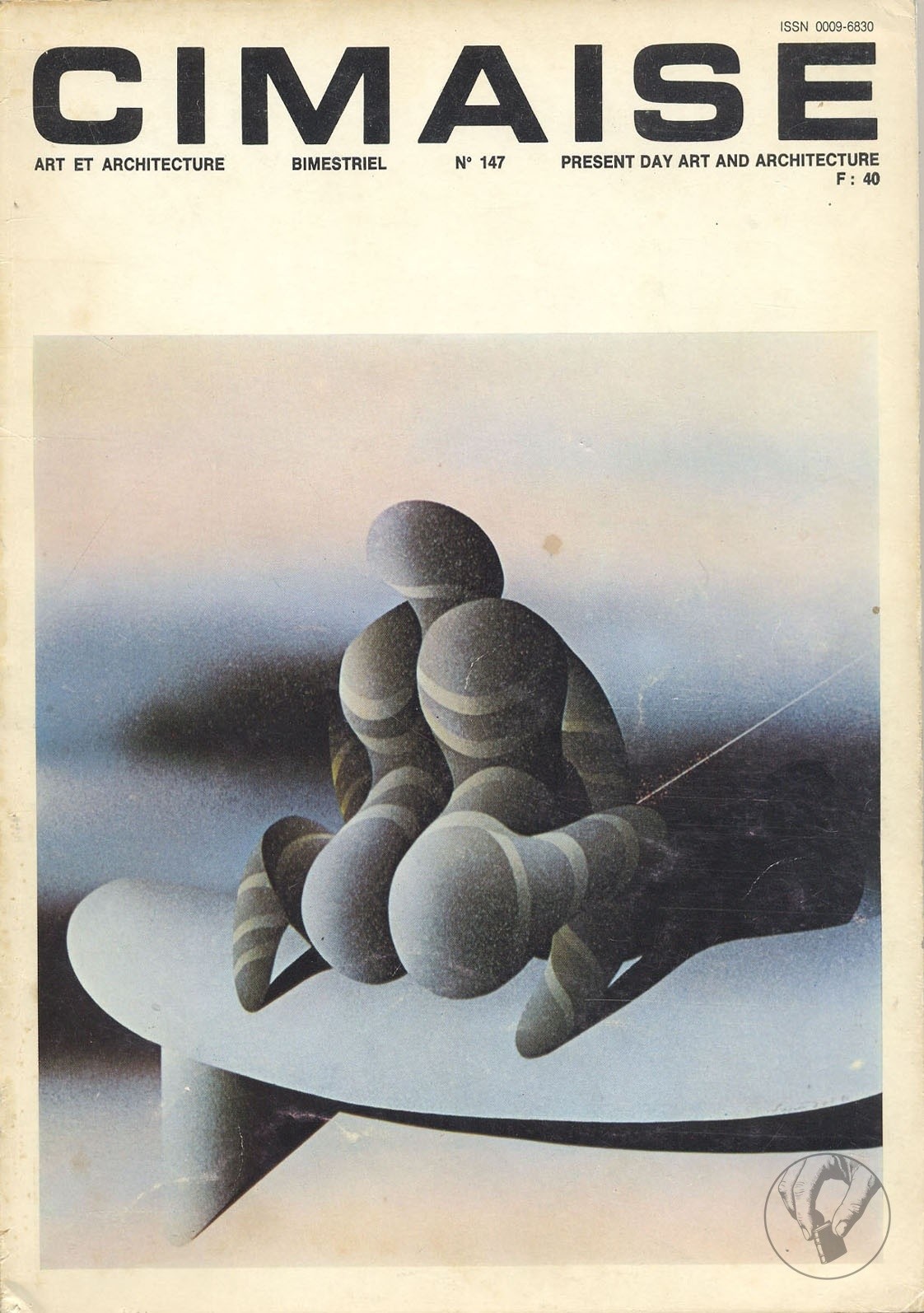
Ce numéro de la revue Cimaise présente des articles sur l'art et l'architecture contemporains. Il inclut un reportage sur l'armée de terre cuite de l'empereur Chin Shi Huang Ti en Chine, des visites d'ateliers d'artistes tels que Farhi et Jean Campa, ainsi qu'un panorama de l'actualité artistique parisienne. Le numéro aborde également des réflexions sur la culture, la création artistique et la perception de l'art dans la société contemporaine.