Page 1
CIMAISE ART ET ARCHITECTURE ACTUELS BIMESTRIEL N° 131-132 PRESENT DAY ART AND ARCHITECTURE 45 F Helene Nº. 44
Premières pages de l'ouvrage, en accès libre.
CIMAISE ART ET ARCHITECTURE ACTUELS BIMESTRIEL N° 131-132 PRESENT DAY ART AND ARCHITECTURE 45 F Helene Nº. 44
GALERIE DANIEL GERVIS DUBUFFET AUTOMNE 77 34 RUE DU BAC PARIS
foster/white gallery, seattle, usa JOHN F. KOENIG octobre/novembre 1977
GALERIE JEANNE BUCHER 53 rue de Seine, 75006 Paris - AGUAYO - KOSTA ALEX - AMADO - BARTHELEMY - JOHN BENNETT - BISSIERE - CARRADE - DUBUFFET - FIORINI - FROMANGER - ASGER JORN - MOSER - NALLARD - NEVELSON - REICHEL - GUILLERMO ROUX - GERARD SINGER - NICOLAS DE STAËL - SZENES - TOBEY - VIEIRA DA SILVA
GALERIE ARIEL 140, Bd Haussmann PARIS-8 --- TABUCHI oct.-nov. 1977 PULGA nov.-déc. 1977 --- les peintres de la galerie appel gillet bitran lindstrom bootz marfaing debré mihailovich destarac tabuchi weideman et nallard rocher doucet messagier sales alechinsky --- ARTISTI DELLA GALLERIA LORENZELLI BERGAMO PITTORI ASSE BAERTLING BILL BLOMSTEDT BONFANTI CHARCHOUNE COSTA COTTAVOZ DEWASNE DORAZIO EJELSON FEITO FRUHTRUNK GILLET GORIN GRIGNANI HOSIASSON KOENIG LATASTER LASKE MANSOUROFF MARFAING MUSIC NANGERONI NEMOURS PASMORE LUC PEIRE PULGA RADICE RODRIGUEZ SCHNEIDER SEUPHOR T. STEFANONI WICKAERT SCULTORI ANDOLFATTO BERROCAL CARDENAS KEMENY PIERLUCA TAVERNARI
AGAM BROGLIA DEWASNE DI TEANA FINOTTI JUANA FRANCES LINDSTROM PHILIPPE MORISSON MARTA PAN MAX PAPART JEAN-MARC PHILIPPE MICHEL SEUPHOR VISEUX PETER VOGEL galerie attali 159 bd St.-Germain - 75006 Paris tel. 548 58 93 / 548 37 80 Peintures sculptures contemporaines Editions gravures sérigraphies tapisseries art vidéo bijoux FIAC 77-Grand Palais, 22 oct/30 oct, stand A11
CIMAISE ART ET ARCHITECTURE ACTUELS PRESENT DAY ART AND ARCHITECTURE 24e ANNÉE - N° 131-132 Juillet - Octobre 1977 Directeur-Rédacteur en Chef : Jean-Robert Arnaud Conseiller artistique : John Franklin Koenig Secrétaire général : René Barzilay Administration-Rédaction : 212, boulevard Saint-Germain, Paris-7e. Tél. : 548-46-31 Impression : Société Mondiale d’Impression, 3, rue Maurice-Lœwy, Paris-14e. Tél. : 580.50.42 Prix --- ce numéro : --- France --- 45 F --- Etranger --- 55 F --- Abonnement --- 6 numéros : --- France --- 150 F --- Etranger --- 200 F --- C.C.P. Cimaire Paris 5542.39 --- Abonnements pour le Canada : --- PERIODICA, 5090, av. Papineau, Montréal 134, Canada --- Couverture : Aquarelle de Jean Hélion, 1944 (Galerie Karl Flinker, Paris) Les abonnements pris à partir du 1er novembre seront, pour 6 numéros : France 180 F, Etranger 240 F --- Editorial --- J.-R. Arnaud --- Etudes --- Michel Ragon --- L’art des formes impuresThe art of impure forms --- Paule Gauthier --- Retour des abstraits à la figurationThe return of abstract artists to figuration --- Visites d’ateliers --- Jean-Jacques Lévêque --- R.-F. Gillet --- Paule Gauthier --- Saura --- Daniel Marchesseau --- Ipousteguy --- Jean-Louis Pradel --- Gérard Fromanger --- Gérard Xuriguera --- Hugh Weiss --- Documents --- John-F. Koenig --- India Song --- Prochaine parution : fin décembre.
n° spécial De la figuration.. Nous avons souvent publié dans Cimaise des études consacrées à des artistes figuratifs, non seulement à ceux qui, tout en étant figuratifs, participèrent à tout le mouvement abstrait (tels Dubuffet, Fautrier, Corneille, Jorn, Cobra, Alechinsky, Bacon, Maryan, Pedersen, Cremonini, etc.), mais à d'autres encore tels Titus-Carmel, Klasen, Gafgen, Sandorfi qui appartiennent à de plus jeunes générations. Par contre, à quelques exceptions près (Michel Ragon, Georges Boudaille), nous avons consacré peu d'articles au problème de la figuration en lui-même. Notre propos, aujourd'hui, est de tenter, en y consacrant deux livraisons de la revue (n° double 131/132 et n° 133), de cerner la question du « retour » à la figuration, historiquement, théoriquement, et de compléter ces études par quelques articles consacrés à des artistes exemplaires qui en illustrent le propos. L'ensemble se présente ainsi : Etudes historiques et théoriques : Michel Ragon : « L'art des formes impures » (n° 131/132), article qui traite des artistes figuratifs inclus dans le mouvement abstrait. Paule Gauthier : « Le retour à la figuration », qui étudie le cas des artistes ayant eu une brève période abstraite et revenus à une expression figurative (n° 131/132). Paule Gauthier, encore, analyse dans un second article (n° 131) la situation des jeunes peintres dont l'expression fut d'emblée figurative, sans que pour eux l'abstraction fit problème. Enfin Roger Bordier traite du « regard ». Celui que l'artiste pose autour de lui et ce qu'il en advient ; celui aussi du spectateur et de ce qu'il voit (n° 133). Etudes personnelles : Un certain nombre de textes consacrés personnellement à des artistes illustrent le propos de ces différents articles, les confirment, les concrétisent, les singularisent. Dans le numéro 131/132 ce sont : P. Gauthier : Saura ; J.-J. Lévêque : Gillet ; Pradel : Fromanger ; Marchesseau : Ipousteguy ; Xiruguera : Weiss. Dans le numéro 131, Esteban traitera d'Aguayo, Sardouy de Botero ; on y parlera aussi de Monory, de Lindstrom, d'Aroyo, de Pasotti et d'autres encore. Nous ne prétendons naturellement pas ainsi faire le tour de la question, ce serait absurde, et ce n'est pas là notre propos ; mais seulement, en posant ces données, pouvoir servir à porter un certain éclairage sur une phase importante de la peinture actuelle. De temps en temps, il sied de tenter de prendre un peu de recul pour oser porter quelques jugements sans avoir peur des mots, surtout quand beaucoup les utilisent, de plus en plus, à tort et à travers, et que souvent, pour certains, le son tient lieu de sens. J. R. Arnaud --- About figuration.. We have often published in CIMAISE studies devoted to figurative artists, not only those who, even though they were figurative took part in the whole abstract movement (such as Dubuffet, Fautrier, Corneille, Jorn, Cobra, Alechinsky, Bacon, Maryan, Pederson, Cremonini, etc.) but to others still, such as Titus-Carmel, Klasen, Gafgen and Sandorfil, who belong to the younger generations. On the other hand, with very few exceptions (Michel Ragon, Georges Boudaille), we have devoted few articles to the problem of figuration as such. It is our purpose today to attempt, by devoting two consecutive numbers of the magazine (Nos. 131 and 132), to examine the question of a “return” to figuration, historically, and theoretically, and to round off these studies with several articles devoted to outstanding artists who are an illustration of this movement. The two numbers, then, in their whole content, will be as follows : Historical and theoretical studies : Michel Ragon : “The Art of Impure Forms” (No. 131), an article which deals with figurative artists, including those in the abstract movement. Paule Gauthier : “The Return to Figuration,” which studies the cases of artists who, having known an abstract period, returned to figurative expression (No. 131). Again, Paule Gauthier analyzes, in a second article (No. 132), the position of the young painters whose expression was, from the outset, figurative, and for whom abstraction was never a problem. Finally, Roger Bordier writes of the “regard,” The artist looking at the world, and what results from it ; and also the regard of the spectator, and what the spectator sees. Personal studies : A certain number of texts devoted to individual artists, illustrate the themes of these different articles ans confirm them, make them concrete and singular. In No. 131, these articles are as follows : Paule Gauthier : Saura ; J.-J. Lévêque : Gillet ; Pradel : Fromanger ; Marchesseau : Ipousteguy ; Xuriguerra : Weiss. In No. 132, Esteban will write on Aguayo, Sardouy on Botero : there will also be articles on Monory, Lindstrom, Aroyo and others still. We do not pretend that these two numbers will say all there is to be said on the question ; that would be absurd and beyond our aim ; but, merely by setting forth this data, we aim at casting a certain light upon an important phase of current painting. From time to time it is wise to try to take a certain distance, to dare to make some judgments, without fearing words, especially when everyone is using them, correctly and incorrectly, and when often, for many, the is more important than the meaning. J.-R. Arnaud

L'ART DES FORMES IMPURES Michel Ragon En 1947, un père dominicain prédisait : « Dans l’avenir, l’art figuratif ne sera plus que la propriété des médiocres. » Douze ans après, André Malraux constatait à Cannes : « La grande peinture n’est plus figurative. » Entre-temps, en effet, l’art abstrait avait symbolisé toutes les avant-gardes picturales. La rivalité entre l’art abstrait géométrique et l’art abstrait lyrique, Picasso, détrôné par Kandinsky et Klee, le surréalisme pictural récupéré par la publicité et l’étalagisme, Bernard Buffet considéré comme le dernier avatar dérisoire de la figuration, voilà on l’on en était. Dans les années 50, être figuratif ce n’était pas seulement être réactionnaire ; c’était ridicule. Comme toujours, lorsque les modes tyrannisent, chacun devient myope. On saluait Klee comme l’un des pères de la nouvelle non-figuration lyrique et l’on ne voyait pas ce qui crève les yeux : que c’est d’abord et surtout un peintre figuratif. Plus amusant, dans toutes les anthologies d’art abstrait qui se mirent à proliférer dans les galeries bien-pensantes et les musées officiels du monde entier, se trouvaient en général trois peintres aucunement abstraits, mais que l’avant-garde considérait comme de bons peintres : Dubuffet, Fautrier, Lapicque. Bien que, de toute évidence, ces trois artistes n’étaient pas abstraits, on les exposait quand même avec les abstraits. Puisqu’ils étaient des peintres d’avant-garde, ils ne pouvaient qu’être abstraits. Pareille aberration peut être remarquée dans l’anthologie des cubistes, par Apollinaire, qui y fourre en bonne place Marie Laurencin. Le même André Malraux, qui avait préfacé l’exposition des Otages de Fautrier, en 1945, galerie Drouin, déclarait donc, en 1959, que la grande peinture n’était plus figurative. 1959 ? Juste l’année qui précédait le Manifeste du Nouveau Réalisme, la naissance de la « nouvelle figuration » et bientôt le déferlement de toutes les figurations, dites d’avant-garde, des « mythologies quotidiennes » au pop ! Ce retour à la figuration, dans les galeries dites d’avant-garde et les musées officiels, retour tellement violent que l’art abstrait est devenu à son tour, et si rapidement, une « anomalie », ce retour, dis-je, serait incompréhensible si la cassure entre figuration et non-figuration avait été aussi absolue qu’on l’a dite, de 1947 à 1960. Or, il n’en a rien été. Pendant ces treize années, qui semblent, rétrospectivement, avoir été « la belle époque » de l’abstraction, peintres et sculpteurs non figuratifs ont mené un travail de sape contre une figuration traditionnelle toujours puissante. En 1955 encore, la revue Connaissance des Arts, ouvrant une enquête pour savoir quels étaient les « dix peintres en tête de la jeune école contemporaine », donnait les résultats suivants : 1. Bernard Buffet ; 2. Clavé ; 3. Lorjou ; 4. Manessier ; 5. Pignon ; 6. De Staël ; 7. Carzoux ; 8. Minaux ; 9. Marchand ; --- THE ART OF IMPURE FORMS In 1947, a Dominican priest predicted, “In the future, figurative art will be the domain of the mediocre.” Twelve years later, André Malraux acknowledged at Cannes, “Great painting is no longer figurative.” In the meantime, in effect, abstract art had been the symbol of all the pictorial avant-gardes. The rivalry between geometrical abstract art and lyrical abstract art, Picasso dethroned by Kandinsky and Klee, pictorial surrealism recovered by advertising and display, Bernard Buffet considered as a last derisory avatar of figuration — that was the state of affairs in which we lived. During the 1950’s, to be a figurative was not only reactionary, it was ridiculous. As always, when fashion tyrannizes, everyone becomes myopic. Klee was hailed as one of the fathers of lyrical non-figuration, and no one could see what hit them right in the eyes: that his painting was, first and foremost, figurative painting. Even more amusing was the fact that, in all of the anthologies of abstract art which began to flourish in right-minded galleries and official museums throughout the world, one found, in general, three painters in no way abstract: Dubuffet, Fautrier and Lapicque. Even though, it was clearly evident that these three artists were not abstract, they were nevertheless exhibited alongside the abstracts. Since they belonged to the avant-garde, they could only be abstract. Such an aberration may be noted in Apollinaire’s anthology of the cubists where we find, in a noteworthy position, Marie Laurencin. And the same André Malraux, who prefaced the Hostages exhibiton by Fautrier in 1945 at the Galerie Drouin, declared, therefore, in 1959 that great painting was no longer figurative. 1959 ? The very year which preceded the Manifesto of New Realism, the birth of “new figuration” and, soon thereafter, the great wave of figuration of all sorts, called avant-garde, from “daily mythology” to Pop ! This return to figuration, in the so-called avant-garde galleries and official museums — so violent a return that abstract art became, so rapidly, an “anomaly” — this return, I say, would be incomprehensible if the rupture between figuration and non-figuration had been as absolute as it has been made out to be between 1947 and 1960. In fact, it was nothing of the sort. During those thirteen years which seem, retrospectively, to have been “the Golden Age” of abstraction, non-figurative painters and sculptors carried on a sapping action against still-powerful figuration. In 1955, again, the magazine Connaissance des Arts, opening an inquest to find out who were the top ten painters of the young contemporary school, listed the following : 1. Bernard Buffet, 2. Clavé, 3. Lorjou, 4. Manessier, 5. Pignon, 6. De Staël, 7. Carzou, 8. Minaux, 9. Marchand, 10. Bazaine. Soulages appeared only in fourteenth place, Vieira da Silva in fifteenth. As for Wols, Poliakoff, Atlan, Mathieu, Hartung and Vasarely, they did not figure at all... --- FRANCIS BACON. Etude pour le corps humain, 1975/76, 198 × 147,5 cm.
10. Bazaine. Soulages n'arrivait qu'en quatorzième position, Vieira da Silva en quinzième. Quant à Wols, Poliakoff, Atlan, Mathieu, Hartung, Vasarely, inconnus. Ceci, précisons bien, en 1955. L’art abstrait n’avait plus à vivre que cinq ans d’un soi-disant triomphe. Déjà, en 1953, Nicolas de Staël, l’une des vedettes de l’art abstrait lyrique d’après-guerre, était « retourné » (comme on disait) à la figuration. En réalité, le succès public de l’abstraction d’après-guerre ne durera que cinq années : de 1955 à 1960. 1955 est en effet l’année où la galerie Charpentier, bastion de l’art figuratif traditionnel, accorde sa salle d’honneur à Hartung, Soulages, Atlan, Poliakoff, etc. La lithographie de l’affiche est faite par Atlan. L’année précédente, elle l’avait été par Lorjou. Reste à savoir si ce cadeau n’était pas empoisonné et si, en s’officialisant à partir de 1955, l’art abstrait ne se condamnait pas lui-même à la sclérose ? Donc, dans la dizaine d’années qui apparaît rétrospectivement comme celle du triomphe de la non-figuration, non seulement les artistes abstraits ont eu à lutter contre la peinture figurative traditionnelle, mais ils ont dû accueillir dans leurs groupes, de bon ou de mauvais gré, des artistes figuratifs hérétiques que l’on ne savait où « caser ». Et ces artistes figuratifs hérétiques étaient en fait beaucoup plus dangereux pour l’art abstrait que Buffet et Lorjou puisque si Buffet a terminé sa trajectoire comme il se doit à l’Institut, Dubuffet et Bacon ont été reconnus, eux, comme pères de la « nouvelle figuration ». En réalité, Fautrier, Dubuffet, l’Art Brut, Cobra, Bacon ont, de 1945 à 1960, poursuivi une œuvre hérétique au sein même de l’avant-garde artistique. Et c’est par eux, avec eux, en eux, que la figuration continuait son évolution créatrice. Alors que Lorjou et Buffet donnaient le change, amusaient la galerie, une révolution s’opérait au sein de la figuration, comme elle s’opérait au sein de l’abstraction. Un antagonisme ridicule entre art figuratif et non figuratif empêchait de s’apercevoir de ce phénomène qui devait être si lourd de conséquences. Il faut avoir connu le Salon des Réalités Nouvelles au temps d’Herbin pour savoir dans quels ridicules tombait l’art abstrait qui se voulait une Eglise. L’art non figuratif était alors considéré comme l’art des formes pures, ce qui sous-entendait que la figuration était impure. Dubuffet, Fautrier, Cobra, Bacon allaient revendiquer cette impureté. Personnellement, mes options pour Atlan, Hartung, Soulages, Schneider, Poliakoff, etc., ne m’ont pas empêché d’être un familier de l’Art Brut, d’écrire des monographies sur Fautrier en 1957 et sur Dubuffet en 1958, de participer au groupe Cobra et de l’introduire à Paris en 1951. Position singulière qui me fit souvent accuser de confusionnisme. And this occurred, let us note, in 1955. Abstract art had only five years of its so-called triumph still to live. Already in 1953, Nicolas de Staël, one of the stars of post-war lyrical abstract art, had returned, as they said, to figuration. In reality, the public success of post-war abstraction was to last for five only, from 1955 to 1960. 1955, in effect, was the year in which the Galerie Charpentier, bastion of traditional figurative art, devoted its principal salon to Hartung, Soulages, Atlan, Poliakoff, etc. Poster lithography was done by Atlan. The year before, it had been done by Lorjou. One may wonder if the gallery’s gift was not poison and if, by going official in 1955, abstract art did not condemn itself to sclerosis? Therefore, during the ten years which appear in retrospect to be the decade of the triumph of non-figuration, not only did abstract artists have to fight against traditional figurative painting, but they had to welcome into their number, whether they liked it or not, some heretical figurative artists whom nobody knew how to classify. An these heretical figurative artists were, in fact, much more dangerous for the abstract artists than Buffet and Lorjou since, if Buffet wound up his trajectory as might be expected at the Institute, Dubuffet and Bacon have, for their part, been recognized as the fathers of “new figuration.” In reality, Fautrier, Dubuffet, Art Brut (Raw Art), Cobra and Bacon have, from 1945 to 1960, pursued a heretical work in the very bosom of the artistic avant-garde. And it is through them, with them and in them that figuration continued its creative evolution. While Lorjou and Buffet put everyone on a false sent, played to the gallery, a revolution was taking place within the bosom of figuration, as it was taking place in the heart of abstraction. A ridiculous antagonism between figurative and non-figurative art prevented one from taking cognizance of this phenomenon, which was to have serious consequences. One has to have been acquainted with the New Realities Salon during the epoch of Herbin to know how ridiculous was abstract art which aspired to orthodoxy. Non-figurative art was then considered to be the art of pure forms, which implied that figuration was impure. Dubuffet, Fautrier, Cobra and Bacon were to assume responsibility for this impurity. Personally, my options for Atlan, Hartung, Soulages, Schneider, Poliakoff and others did not prevent me from being familiar with Art Brut or from writing monographs on Fautrier in 1957 and Dubuffet in 1958, nor from participating in the Cobra group and introducing it to Paris in 1951. A singular position which often go me accused of confusedness. The showing of the Hautes Pâtes of Dubuffet, in 1946, like that of Fautrier’s Hostages the year before, remain key dates for contemporary art. Not only did
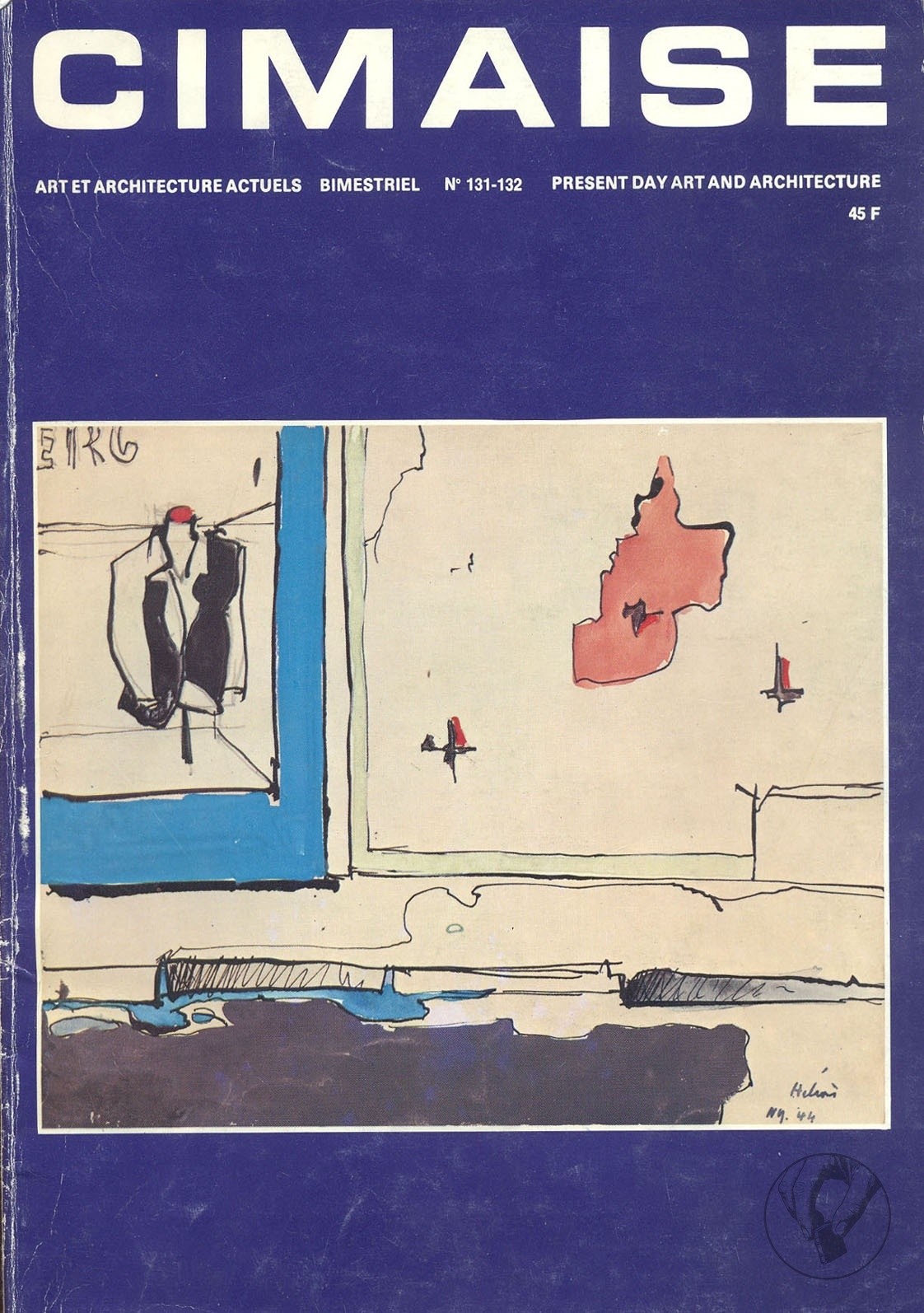
Ce numéro double de la revue "Cimaise" (n° 131-132) explore le thème du retour à la figuration dans l'art contemporain. Il comprend des études historiques et théoriques sur le sujet, ainsi que des articles consacrés à des artistes exemplaires illustrant ce propos.