Page 1
CIMAISE ART ET ARCHITECTURE ACTUELS BIMESTRIEL N° 125-126 PRESENT DAY ART AND ARCHITECTURE F.40
Premières pages de l'ouvrage, en accès libre.
CIMAISE ART ET ARCHITECTURE ACTUELS BIMESTRIEL N° 125-126 PRESENT DAY ART AND ARCHITECTURE F.40
LIKA MUTAL GALERIE DANIEL GERVIS 34 RUE DU BAC PARIS 7
GALERIE JEANNE BUCHER 53 rue de Seine, Paris-VI, 326.22.32 VIEIRA DA SILVA BISSIERE DUBUFFET JORN TOBEY SZENES REICHEL AGUAYO BARTHELEMY DADO NALLARD MOSER KOSTA ALEX FROMANGER AMADO SINGER FIORINI --- ISTRATI ET DUMI - TRESKO DU 3 JUIN AU 10 JUILLET 1976 ARTCURIAL 9 avenue matignon paris 8 256 70 70 ARTUEL
CIMAISE ART ET ARCHITECTURE ACTUELS PRESENT DAY ART AND ARCHITECTURE 23e ANNÉE - N° 125-126 Janvier - avril --- Directeur-Rédacteur en Chef : Jean-Robert Arnaud Secrétaire général : René Barzilay Administration-Rédaction : 212, boulevard Saint-Germain, Paris-7e. Tél. 548-46-31 Impression : Société Mondiale d’Impression, 3 rue Maurice Loewy, Paris-14e. Tél. 580.50.42 Prix --- ce numéro : --- France --- 40 F --- Étranger --- 50 F --- Abonnement --- 6 numéros : --- France --- 150 F --- Étranger --- 200 F --- C.C.P. Cimaise Paris 5542.39 --- Abonnements pour le Canada : --- PERIODICA, 5090, av. Papineau, Montréal 134, Canada --- Couverture de Gilioli --- Visites d’ateliers --- Roger Bordier --- Jean Deyrolle --- Michel Ragon --- Gilioli --- Jean Cassou --- Broglia --- Daniel Abadie --- Perricaud --- Daniel Abadie --- Rotterdam --- Bernard Lamarche-Vadel --- Marc Devade --- Michel Conil-Lacoste --- Paul Jenkins --- Document --- Michel Ragon --- De la littérature prolétarienne à la socialisation de l’architecture ---
Le long rêve de The enduring dream of JEAN DEYROLLE roger bordier Hervezene, opus 643 (1960) 60 x 120 coll. Musée de Dunkerque Aulnaye, opus 443 (1955) 116 x 89 coll. Olivier Le Corneur (Gordes) On est presque toujours surpris de se rappeler que, vers 1962, Jean Deyrolle se prêta, sous le contrôle d'une personnalité scientifique, à la technique du « rêve éveillé ». Nul doute qu'il en sût tirer, du reste, un très intéressant enseignement, et puis cela regardait à la fois son inspiration d'artiste et ses curiosités d'homme. Pourtant, l'on se dit que ce rêve éveillé, y compris d'ailleurs comme l'était celui-ci, dirigé, il le vivait et l'exprimait déjà, le portait en lui avec cette majesté discrète de ceux pour qui le monde des formes rejoint, en ses accents de fable, un sentiment naturel, et qu'en fin de compte c'est bien ce visage-là qui était connu à travers les œuvres. Dirigé ? Essayons, par exemple, de nous entendre un peu là-dessus, et remontons pour cela un itinéraire chronologique qui va nous faire retrouver le Deyrolle de la période triomphante de l'abstraction, celle du début des années 50 en particulier. Bien entendu, il It is almost always a surprise to recall that, around 1962, Jean Deyrolle devoted himself, under the guidance of a wellknown man of science, to the technique of the “waking dream.” There is no doubt, moreover, that this study left him with some highly interesting training, which concerned both his inspiration as an artist and his curiosity as a seeker. And yet, it is said that this waking dream, including the fact that it was directed, was something which he already lived and expressed, carried within himself with that discreet majesty of those for whom the world of forms makes a connection, in its accents of fable, with a natural sentiment, and that, when all is said and done, it is the face which was known through his works. Directed? Let us try, for example, to come to an understanding about the meaning of the word. To do so, we must go back in time and rediscover the Deyrolle of the triumphant age of abstraction, at the beginning of the 1950’s, in particular. Of course, he
9
Rouge, Noir et Ocre, opus 259 (1951) 90x75cm Galerie Denise René (Paris) est, dans ce milieu de pensée et parmi un groupe d’artistes tous aussi de grand talent, de ceux dont on parle le plus mais, venant d’un certain horizon critique, avec des réserves très significatives. Alors qu’une rationalité excessive, et surtout fort mal comprise, tend à imposer des vues dogmatiques, voire une espèce de scholastique, on lui reproche de n’avoir pas fait, dans le choix commun, un choix plus délibéré, de manquer de rigueur, de montrer encore trop de complaisance pour la touche, les vibrations, la liberté chercheuse du trait, de cheminer vers des compositions bien rythmées sans éviter toutefois, au passage, un lyrisme de l’inattendu ; bref, et s’il est vrai qu’il poursuit en effet ce rêve dirigé, de rêver beaucoup et de diriger trop peu. Curieusement, ce bon élève aime l’école buissonnière. Que faut-il faire : l’en guérir, le ramener dans la classe ou, après tout, le laisser s’échapper ? Vingt ans après, comme tout cela semble vain ! Il avait déjà gagné la partie mais ses censeurs ne le is, in this milieu of thought and among a group of artists of great talent, one of those who is spoken of most, coming from a certain critical horizon, with very significant reservations. Whereas an excessive rationality, and one which was above all poorly understood, tends to impose dogmatic views, or a kind of scholasticism, he is reproached for not having made, in the common choice, a more thought-out choice, reproached for a lack of strictness. He is said to show too much of a weakness for the stroke, for vibrations, for the seeking freedom of the line, to move toward compositions which possess an excellent rhythm but without avoiding, on occasion, the lyricism of the unexpected; briefly, even if it is true that he pursues, in effect, this directed dream, of dreaming too much and of directing too little. Curiously enough, this good student loves to play hooky. What’s to be done with him? Cure him, bring him back into the classroom or, after all, allow him to escape?
Perdoux, opus 876 (1967) 65 x 54, coll. Alain et Jacqueline Trutat, Paris
Malon, opus 347 (1953) 92 × 60 coll. Georges Richar. (Paris) savaient pas. Au demeurant, certains d’entre eux lui rendent hommage, aujourd’hui, en des termes d’amitié qui les honorent et que mérite sa mémoire. Moi aussi, je revois le merveilleux atelier de la rue Daguerre que des familiers se plaisent à évoquer souvent, et comme je le disais à Georges Richar, qui veille si heureusement sur l’œuvre de Jean Deyrolle, un détail m’y avait frappé, à un point tel que je l’ai d’ailleurs commenté dans un livre : l’emploi que l’artiste faisait des coquilles Saint-Jacques. Anecdote ? dira-t-on. Mais je pense bien. Seulement attention, nous sommes là dans un domaine où le moindre jeu anecdotique, apparemment inoffensif, prend avec le reste des dimensions de fable explicative. Il mélangeait ses couleurs dans ces fameuses coquilles Saint-Jacques parce que, disait-il, elles s’adaptent fort bien au creux de la main, mais il n’empêche qu’au-delà de ce choix pratique, qui est déjà poésie en soi, je leur trouve avec son œuvre, avec tout son univers de signes plastiques, je ne sais quelle parenté profonde, venue de loin et saisie au plus près, toujours singulière et toujours disponible, enfin quelque chose qui appartenait en propre à sa mythologie. C’est peut-être ici précisément que ce long rêve de Jean Deyrolle nous devient encore plus proche en se portant vers les qualités humaines d’un style et d’une réflexion, car il aimait passionnément la nature et lui restituait à sa manière, au fond, de toile Twenty years later, how vain all the above seems! He had already found his way, but his critics did not know it. And it is interesting to note, by the way, that some of them pay homage to him today in terms of friendship which is an honor to them and deserved by his memory. I too see again the marvelous studio on the Rue Daguerre which those close to him evoke so often with pleasure, and, as I said to Georges Richar, who watches over the work of Jean Deyrolle so well, there was one detail which struck me, to such a degree that I commented upon it in a book: the use made by the artist of scallop shells. Mere anecdote one might say. Of course. But, beware, that leads us to a domain where the slightest anecdotal play, apparently inoffensive, takes on the dimensions of the explanatory fable. He mixed his colors in those famous scallop shells because, he said, they adapt so well to the hollow of the hand; but, nevertheless, in spite of this practical choice, which is already poetry in itself, I find that they have a kind of deep relationship with all of his work, with his whole universe of plastic signs, a relationship which has come from afar and is seized up at close hand, always singular and always available, in short, something which belonged in itself to his mythology. It is perhaps precisely here that the enduring dream of Jean Deyrolle becomes even closer to us by moving toward human qualities of style and reflection, because he passionately loved nature and restored to it, in his manner, from canvas to canvas, those things which he had borrowed from it: a branch here, a leaf
Izaire, opus 675 (1961) 116 x 81 coll. Pierre Viala (Gordes) DIN
José, opus 693 (1962) 114 x 146 coll. Camille Corcos-Deyrolle (Paris) en toile, ce qu’il lui empruntait : cette branche, ce feuillage, ce galet travaillé ensuite, et le souvenir de ces longues promenades d’Auvergne en Bourgogne, de Provence en Bretagne. Il accumulait aussi les photographies, non de paysages à proprement parler, mais plutôt de détails, comme par exemple l’appareillage d’un mur. Les Cyclades, qu’il visita — et l’on pourrait s’en étonner — sans faire un seul dessin, lui fournissent ainsi les éléments concrets d’une valeur inspirante dont la quête, sans cesse à l’affût, ne se lassait de rien. Les îles grecques, dans leur incomparable lumière, purent solliciter son regard d’artiste, mais tout aussi bien cette partie d’évier qu’il s’ingénia à photographier un jour avec soin, parce qu’il y avait un peu d’eau, un peu de terre, des stries, un bout de légume, trois fois rien en somme si ce n’est l’essentiel : le passage d’un geste, un instant de chair et la mémoire des choses ; une autre trace humaine encore et tout un monde qui vivait là. Dès lors, ne faut-il pas se demander si la technique du rêve éveillé ne fit que confirmer — ou vérifier — des dispositions innées lorsque la série des expériences qu’elle exigeait aboutit en 1963 à une toile a priori abstraite au centre de laquelle devait cepen- there, a pebble—and the memory of those long strolls in Auvergne and in Burgundy, in Provence or in Brittany. He thus accumulated a great many photos, not of landscapes exactly, but rather of details, as, for example, the bonding of a wall. The Isles of the Cyclades, which he visited—an astonishing fact—without making a single drawing, furnished him thus with the concrete elements of an inspirational value, the seeking of which, constantly alert, never flagged. The Greek Islands, bathed in their incomparable light, solicited his artist’s regard, but no more than that part of a sink which he took the trouble to photograph one day because it was endowed with a bit of water, a bit of dirt, some scratches, a bit of vegetable nothing to speak of unless it is the essential: the trace of movement, an instant in the flesh and memory of things, yet another human trace and a whole world living in it. From this, must we not ask ourselves if the technique of the waking dream was not but a means of confirming—or verifying—the innate tendencies of the artist, when the series of the experiments which it called for culminated in 1963 in a canvas, a priori abstract, in the middle of which is seen in profile,
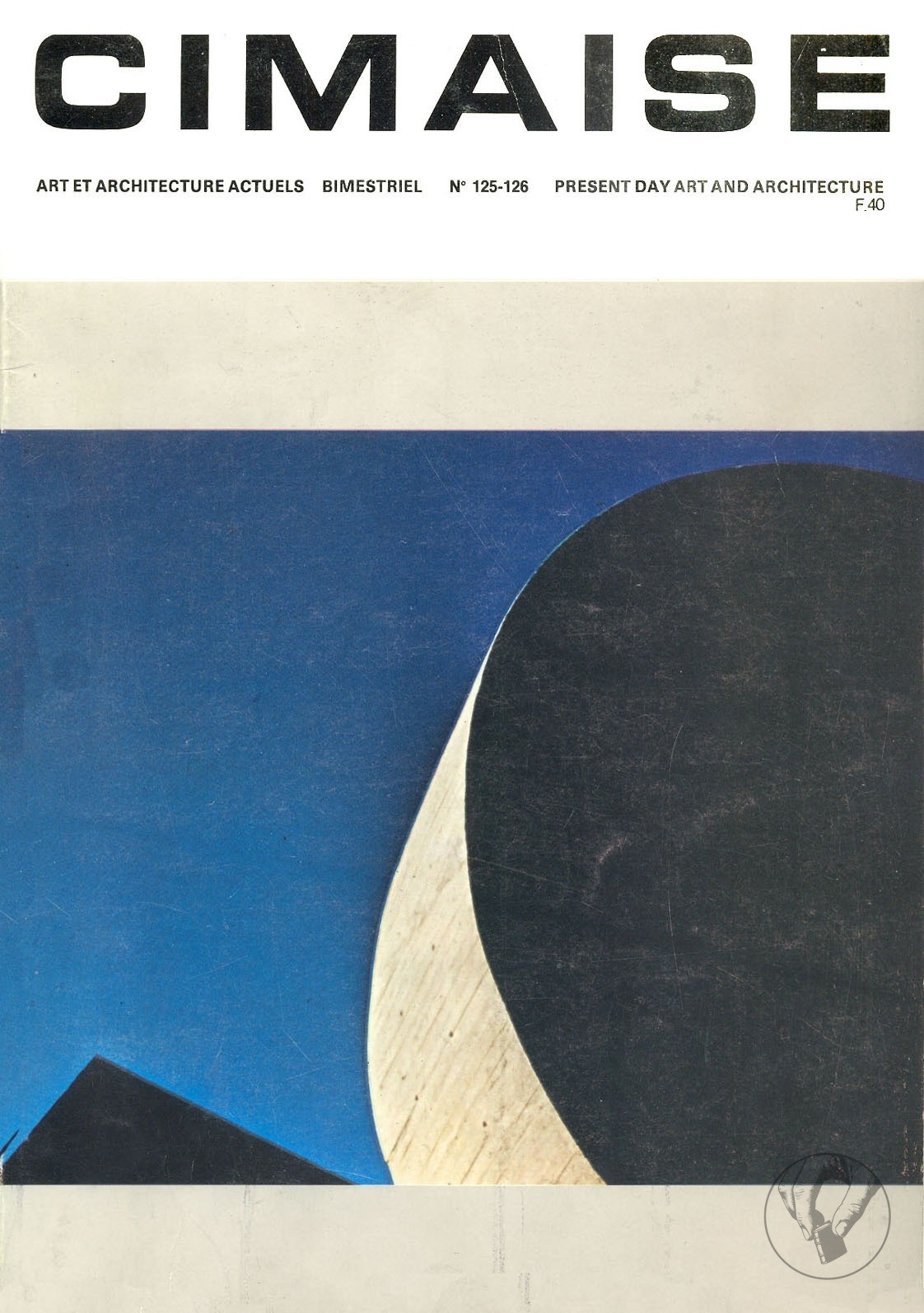
Cimaise, Art et Architecture Actuels, présente ce numéro bimestriel consacré à l'art et à l'architecture. Il inclut des visites d'ateliers d'artistes tels que Roger Bordier, Jean Deyrolle et Gilioli, ainsi qu'un document sur la littérature prolétarienne et la socialisation de l'architecture. Le numéro contient également des reproductions d'œuvres et des textes critiques sur des artistes comme Lika Mutal et Vieira da Silva.