Page 1
FIRST PART OF A NEW VOLUME THE · STUDIO An Illustrated Magazine of Fine & Applied Art FEB. 15 '98 VOL. 13 No. 59 5 Henrietta Street Covent Garden LONDON W.C Monthly $\frac{1}{2}$
First pages of the volume, freely accessible.
FIRST PART OF A NEW VOLUME THE · STUDIO An Illustrated Magazine of Fine & Applied Art FEB. 15 '98 VOL. 13 No. 59 5 Henrietta Street Covent Garden LONDON W.C Monthly $\frac{1}{2}$
THE STUDIO. EDITED BY CHARLES HOLME. Contents, Feb. 15th, 1898. SUPPLEMENTS:—A REPRODUCTION IN COLOURS after a Painting by FERNAND KHNOPFF, entitled "L'Étang de Menil"; A REPRODUCTION IN COLOURS after a Water-Colour Drawing by NICO JUNGMANN; Two SILHOUETTE TRANSPARENCIES FOR "OMBRES CHINOISES" by CARAN D'ACHE; and A PORTRAIT SKETCH OF SIR JOHN E. MILLAIS by CHARLES KEENE. THE WORK OF E. BOROUGH JOHNSON. By A. L. BALDRY. Ten Illustrations ...
FERNAND KENROFF
THE STUDIO THE WORK OF E. BOROUGH JOHNSON. BY A. L. BALDRY. There are few objects of study more fascinating than the work of a young artist who has done enough to prove his capacity, and yet has not advanced sufficiently far in his career to have arrived at an absolute conviction about the manner in which his aesthetic beliefs should be expressed. The immaturity of such a man is full of interesting possibilities. It has passed the stage of artistic childhood, when the one idea is to play at being old, or to assume an incongruous middle age that assorts almost grotesquely with the juvenile inexperience that cannot be concealed. It is no longer cramped and hampered by the notion that the pretence of being grown up is best supported by apeing the misunderstood manners of older men. What has come instead is the wholesome confidence of youth, the stimulating belief in powers which seem invincible because they have been newly acquired and have not as yet been defined by contact with inevitable limitations. At this period of his working life nothing is alarming to the young artist. He has studied devotedly and worked hard, and he has gained a practical knowledge of the details of his profession which enables him to record his observations with considerable certainty and accuracy of expression. He has learned, too, that the heroes whom in the recent past he had worshipped so faithfully are by no means infallible, and that even their happiest convictions may be improved upon. But what he does not know is how to use his own capacities to best advantage, nor in which direction lies the path that in a few more years he will find himself inexorably forced to follow. So, for a time, he is committed to a round of experiments. All that he has been taught, all that he has hitherto accepted and believed in, must be examined and tested by the light of actual effort. Nothing now can be taken on trust; his attitude PORTRAIT OF HIMSELF BY E. BOROUGH JOHNSON XIII. No. 59.—FEBRUARY, 1898.
The Work of E. Borough Johnson for a while must be one of inquiry and investigation; and if at the end of it all he is saddened by the discovery that the limitless field, which seemed at first to be open to him, is but a narrow space to which for the rest of his life he is to be confined, he has at least the satisfaction of knowing that he has also discovered how to gain the worthiest results from the exercise of his powers. No doubt, by then, remains to him as to the work he must do; some of his experiments have failed so obviously and completely that his error in hoping for good results from them is beyond question, but others have met with distinct and definite success, and in following them up he builds up the life record which fixes the position he is eventually to occupy in the art history of the world. But to the students of contemporary history he is most interesting, while he is most active in experiment. There is a peculiar freshness and speculative charm about the productions which mark the period during which the consciousness of himself is slowly developing into exact knowledge of the limitations by which his powers are bounded. Besides, everything that he does at this time is equally important, because it is impossible to say which of the many things he attempts is most significant or most likely to point the direction in which the effort of his later life will tend. Therefore he is worthy of attention as much on account of what he may do as of what he can do, and attracts no less by the actual value of his enthusiastic experiments than by the promise which he gives of future and more specialised mastery. It is because he has reached this stage in his career that the work of Mr. E. Borough Johnson claims at the present moment a degree of critical attention which is more often reserved for that of men who are by many years his seniors. He has already, young though he is, given quite convincing proofs of capacity sufficiently great to set him apart from the majority of his contemporaries; and in the matter of quality his comparatively limited achievement needs no apology. From the first he has shown himself to be possessed of a very well-balanced sense of technical necessities. His knowledge of the craft of painting is notably complete. He is an able manipulator, and a draughtsman of no mean skill; and he has also a gift of dramatic expression which has repeatedly stood him in very good stead. Everything that he has hitherto produced has been sound and sincere, marked by excellent STUDY IN LEAD PENCIL BY E. BOROUGH JOHNSON
The Work of E. Borough Johnson judgment, and carried out with a thoroughly earnest intention to gain a telling effect by legitimate means. He is now, at the age of thirty, well established as an artist from whom much may be expected; and he has shown in the first decade of his working life so much both of promise and performance that we have every reason to regard him as a painter certain to rank among the best of those that the latter part of this century has produced. His experience as a student has been of a kind to give him a more than ordinary breadth of view. His resolve to be an artist was formed early in life, but his first acquaintance with art-school methods was not gained until he was about eighteen years old. In 1885 he joined the Slade School, which was then under the direction of Professor Legros, but migrated thence, after only two terms’ work, to Bushey, to put himself under the tuition of Professor Herkomer. At Bushey he found apparently a more congenial atmosphere, for he remained there for nearly three years, working as a student in the school, and making from time to time successful efforts to embody in pictorial efforts the results of his study. The first picture which he exhibited at the Royal Academy, Her Daily Bread, was painted during this period. He was not more than nineteen when it appeared, but the fact that it found an immediate purchaser proved that even then he had the power of arresting popular attention. At the end of his three years’ work at Bushey he paid a visit to Paris with the idea of painting for a while in a studio there. But a very brief experience convinced him that the conditions of study in the French capital were hardly such as would assist him to learn those artistic details which he needed for the perfecting of his knowledge. He found there was too much disturbance, too many interruptions and distractions, for him to be able to devote himself to the quiet life for which he felt himself best adapted. So, in search of opportunity to work out in his own way the ideas that were in his mind, he returned to England, and established himself in a studio of his own at Bushey. He was there among surroundings that suited him, and was able to lead the existence that was in accordance with his inclinations. He busied himself with genre subjects, figure compositions of a realistic type in which there was always a dominant pathetic or dramatic note; and he met with a distinctly encouraging amount of success. Popular approval was freely bestowed upon his pictures, STUDY IN LEAD PENCIL BY E. BOROUGH JOHNSON
The Work of E. Borough Johnson which rarely failed to find purchasers as they appeared upon the walls of the various exhibitions in London and the provinces. More recently he has moved again from Bushey to a studio in Chelsea; and has added to his artistic responsibilities by undertaking the duties of art professor at Bedford College. By these varieties of experience he has made himself secure against the danger of becoming, by the want of material for proper comparison, limited in his views or narrow in his judgment of art; and he has given himself the mental training which is most likely to help him in developing those branches of his capacity that promise to lead him to the best results. In his technical methods he is equally free from any inclination to be stereotyped. He affects no tricks of execution, and uses no devices designed to conceal, under an affectation of mastery, actual want of study of necessary details. The characteristic of his executive style is its precision, an exactness of statement which is partly the outcome of his early training and partly an expression of his inclination towards close observation of form rather than colour. He learns thoroughly every detail of his subject before he attempts to put it into pictorial shape; and although in the actual painting he by no means relaxes his attention to facts, and works always with the model before him, he makes beforehand a large number of careful studies from life. He prepares himself, in fact, for his labour on the picture by mastering in preliminary drawings everything which he feels is likely to give him cause for thought; and he trusts to no happy accidents to save him from difficulties which he knows can be minimised by judicious precautions. His whole process is a deliberate one, exacting enough in its demands upon his time and energy, but the only manner of work which is possible to him, because by it alone can he gain the completeness of realism which is the motive and special aim of his art. In his choice of a medium he is habitually catholic. His more important pictures have necessarily been oil paintings, but he works largely in water-colours as well, and is an etcher of no mean skill. As a black-and-white draughtsman he has especial power, and he has gained, with work done at various times for The Graphic, The Pictorial World, and Black and White, a position of some prominence as an illustrator. The exceptional ability of his pencil drawings has been before recognised in these pages, PORTRAIT OF MISS MARGARET DOCKERILL BY E. BOROUGH JOHNSON
“A SALVATION ARMY SHELTER” FROM A PAINTING BY E. BOROUGH JOHNSON (By permission of the Committee of the Melbourne National Gallery)
The Work of E. Borough Johnson --- “EVANGELINE FINDING GABRIEL” FROM A PAINTING BY E. BOROUGH JOHNSON and is emphasised by the reproductions which accompany this article. They show, perhaps more vividly than anything else he does, how his instinctive realism is saved, by subtle perception of line and modelling, from ever degenerating into exaggeration or from being warped into caricature; and at the same time they reveal plainly the spirit and intellectual intention by which he is controlled. In such studies there is none of that tendency to make concessions to the popular fancy which he, like all sincere artists, recognises as one of the chief dangers in the path of the man who paints to exhibit and, as an almost inevitable sequence, to sell. Whatever may be the obligation which a painter feels to conceal, in his gallery pictures, his strongest convictions, because they may be out of harmony with the less educated views of his patrons, in his studies he almost invariably gives us his real self; and Mr. Borough Johnson in his pencil drawings has no hesitation and no wish to hide one atom of his beliefs. We may take them as the truest interpretation of his thoughts about art, and this gives them a value that cannot be over-estimated. Yet it can hardly be said that, even in his exhibition pictures, he has, so far, surrendered much of his individuality to please the taste of the people who do not think as he does. Sombre subjects are notoriously not calculated to meet with much approval from a public which prefers to be tickled and amused. The representation of the tragedies of low life, the exhibition of squalor and suffering, are less likely to excite the sympathies of the modern art lover than to affront his aesthetic convictions. But Mr. Borough Johnson, so far as his experiments have at present carried him, is essentially an illustrator of the grim and painful side of existence. He has studied and rendered, hitherto, in his figure-pictures, not much that would commend itself to the men who deny to art the right to be didactic by the exhibition of the startling contrasts between poverty and wealth. He has occupied himself largely with what may be called social
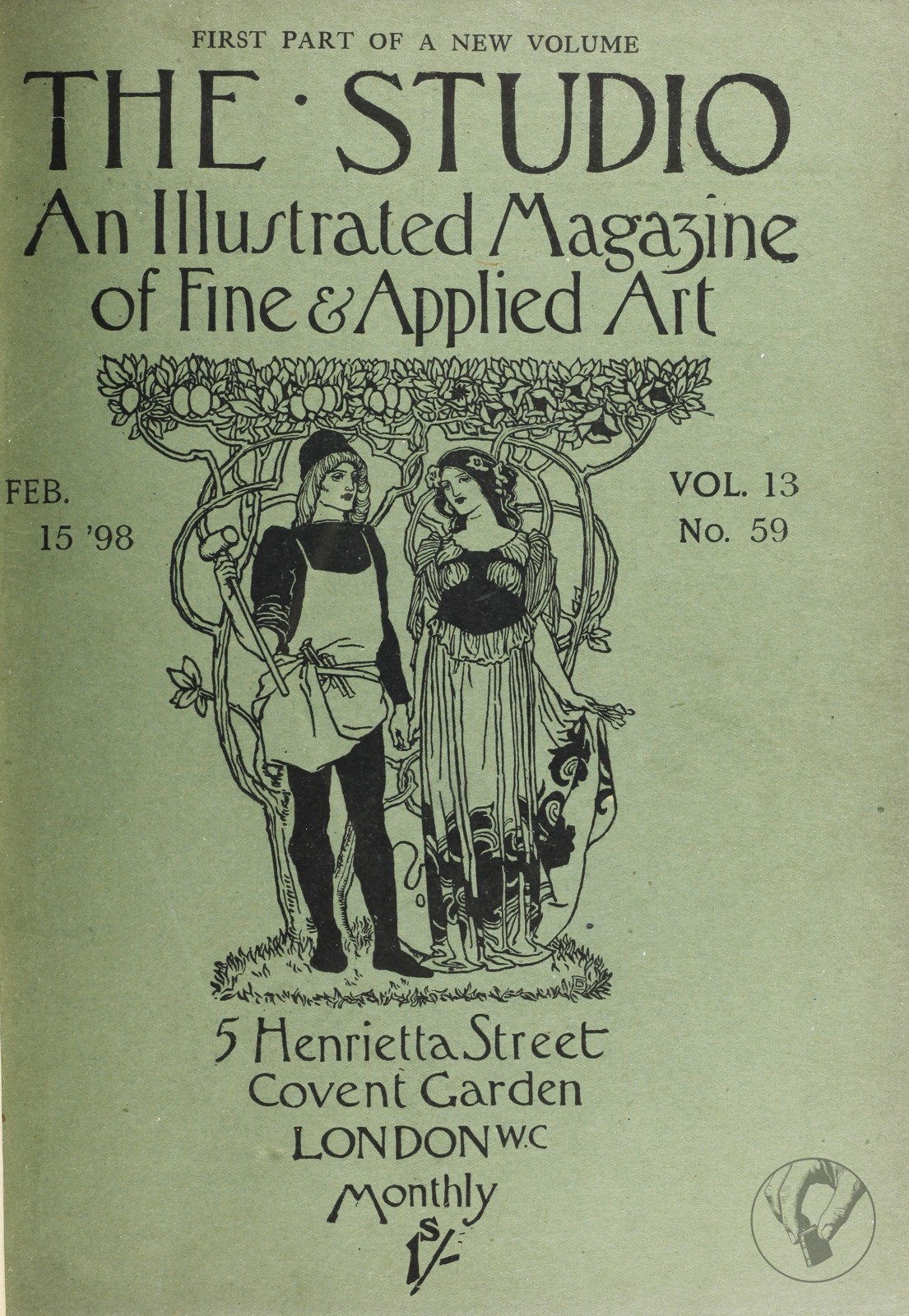
This bound volume of The Studio, a magazine of fine and applied art, contains the issues from February to May 1898. It features a variety of artistic content, including reproductions of paintings and drawings, silhouette transparencies, and a portrait sketch. The volume also contains an article on the work of E. Borough Johnson, accompanied by ten illustrations.