Excerpt
First pages of the volume, freely accessible.
Page 1
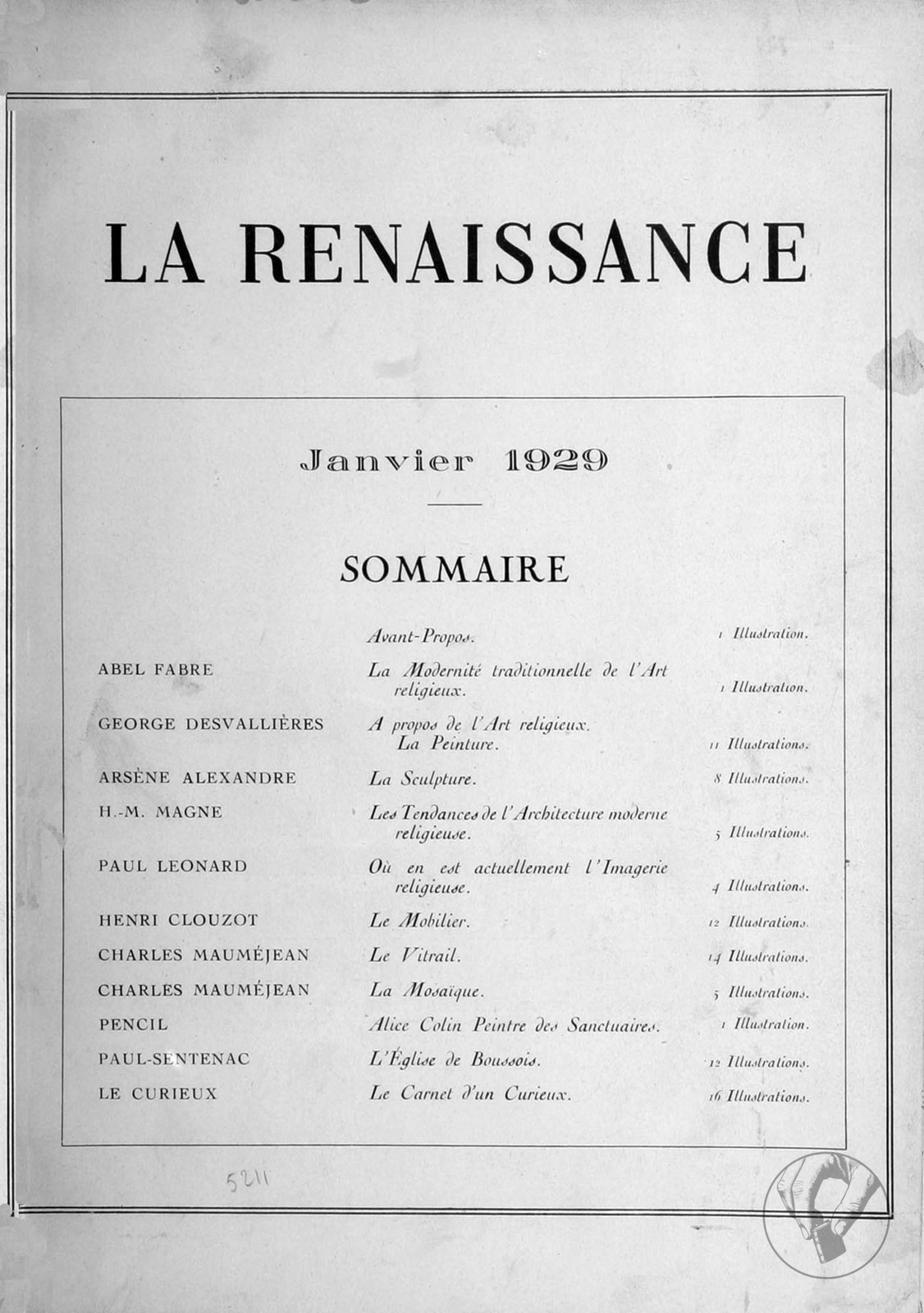
LA RENAISSANCE
Janvier 1929
SOMMAIRE
Auteur
---
Titre
---
Illustrations
---
ABEL FABRE
---
Avant-Propos.
---
1 Illustration
---
La Modernité traditionnelle de l'Art religieux.
---
1 Illustration
---
GEORGE DESVALLIÈRES
---
A propos de l'Art religieux. La Peinture.
---
11 Illustrations
---
ARSÈNE ALEXANDRE
---
La Sculpture.
---
8 Illustrations
---
H.-M. MAGNE
---
Les Tendances de l'Architecture moderne religieuse.
---
5 Illustrations
---
PAUL LEONARD
---
Où en est actuellement l'Imagerie religieuse.
---
4 Illustrations
---
HENRI CLOUZOT
---
Le Mobilier.
---
12 Illustrations
---
CHARLES MAUMÉJEAN
---
Le Vitrail.
---
14 Illustrations
---
CHARLES MAUMÉJEAN
---
La Mosaïque.
---
5 Illustrations
---
PENCIL
---
Alice Colin Peintre des Sanctuaires.
---
1 Illustration
---
PAUL-SENTENAC
---
L'Église de Boussois.
---
12 Illustrations
---
LE CURIEUX
---
Le Carnet d'un Curieux.
---
16 Illustrations
---
5211
Page 2
Jeanne Lanvin
Couture, Mode, Fourrures, Lingerie
22, Faubourg Saint Honoré, Paris.
Page 3
L'ART RELIGIEUX MODERNE
AVANT-PROPOS
Le présent numéro est consacré en grande partie à l’Art Religieux Moderne. On ne s’attendra pas, toutefois, à voir traiter à fond un sujet aussi vaste. En peu d’années les plus grands et les plus beaux efforts ont été tentés pour concilier ce qu’il y a de permanent et d’intangible dans le sentiment religieux avec une expression et des formes plus vivantes, plus pures, plus dignes en un mot des aspirations humaines vers toutes les beautés et celle qui les domine toutes, la beauté divine, que ne l’étaient devenues les images affadies, et en réalité mortes, que continuait à exploiter une tradition plus commerciale que mystique.
En ces dernières années, par le fait de la Grande Guerre, des églises se sont élevées sur le sol de la France, suivant des formules nouvelles, avec des matériaux et des effets nouveaux. Ce fut le point de départ de décorations également nouvelles, tout aussi respectueuses quant aux sujets eux-mêmes proposés à la piété des fidèles et conformes à la plus stricte orthodoxie. Ces tendances justement renaissantes étaient en somme conformes à celles de l’art de tous les siècles précédents.
D’ailleurs la cause paraît aujourd’hui jugée, malgré les résistances. Les plus beaux talents ont, en ces dernières années, créé un art religieux véritablement nouveau, sans pour cela porter la moindre atteinte aux plus légitimes scrupules. Loin de nuire à l’esprit religieux, ils l’ont au contraire exalté.
M. l’Abbé Abel Fabre, l’auteur des si judicieuses Pages d’art chrétien, a exposé la théorie du modernisme. M. Desvallières, le grand peintre mystique, a donné une page d’une éloquence entraînante sur les destinées modernes de l’art. Le R. P. Léonard a examiné la question sa importante de l’imagerie pieuse. M. Marcel Magne était un des plus qualifiés pour exposer l’état de l’architecture nouvelle ; M. Henri Clouzot pour passer en revue le mobilier de l’église ainsi que l’orfèvrerie et l’art décoratif ; M. Mauméjean enfin, l’éminent peintre verrier, a traité du vitrail et de la mosaïque.
Ces divers écrits formeront ainsi un attachant et précieux corollaire à des ouvrages détaillés sur la question, entre autres ceux de M. Maurice Brillant et de notre éminent collaborateur, M. l’Abbé Abel Fabre lui-même.
Nous avons tâché de présenter une illustration offrant, sinon tous les ouvrages remarquables qui se sont multipliés sur tout notre territoire, du moins quelques-uns des plus typiques et des plus beaux dans les diverses formes de l’art.
---
The present number is devoted chiefly to Modern Religious Art. One does not look for a comprehensive treatment of so vast a subject. During the last few years, the greatest and most beautiful efforts have been put forth to bring together what is permanent and intangible in religious sentiment and an expression and forms more worthy in a word, of human aspirations toward all beauty and that which dominates all, divine beauty; how many became faded and in reality dead likenesses, exploited by traditions more commercial than mystic.
During these later years, because of the great war, churches have been built on the soil of France, following new formulas, with new material and new effects. This was the point of departure for decorations equally new, respectful, as to subjects themselves, toward the piety of the faithful and in conformity with the strictest orthodoxy. These new born tendencies were, on the whole, in harmony with those of the art of earlier centuries.
A part from that, the case appears to be decided, today, in spite of the opposition. The finest artistic talents have created a veritably new religious art in these later years, without doing the least harm in that way to the most legitimate scruples. Far from doing injury to the spirit of religion, on the other hand they have exalted it.
M. l’Abbé Abel Fabre, author of the wise Pages d’art chrétien sets forth the idea of modernism. M. Desvallières, the great mystic painter, has given a page of winning eloquence on the modern destinies of art. The Reverend Father Léonard has examined the very important question of pious prints. M. Marcel Magne was one of the best qualified to describe the state of new architecture; M. Henri Clouzot, to pass in review church furniture as well as the plate and the artistic decoration; finally M. Mauméjean, the eminent stained-glass worker, has treated the window and mosaics.
These various writings will thus form an appealing and precious corollary to more detailed works, among others, those of M. M. Brillant and of our eminent contributor, Abbé Abel Fabre.
We have tried to present an illustration worthy of the subject; we should have been glad to do more yet; but it is complete in this sense, that it offers, if not all the remarkable works which have multiplied over our entire field, at least some of the most typical and of the most beautiful in the various forms of art.
---
GEORGE DESVALLIÈRES.
LE DRAPEAU DU SACRÉ-CŒUR PENDANT LA GUERRE.
LE DRAPEAU DU SACRÉ-CŒUR 1914-1948
Page 4
LA MODERNITÉ TRADITIONNELLE DE L'ART CHRÉTIEN
par ABEL FABRE
---
La modernité est une expression momentanée de tous les temps. Vivante pour les contemporains, elle ne représente plus, aux générations suivantes, qu'un passé défunt. La vie qui la soutient, lui vient d'un certain rapport entre l'œuvre d'art et l'homme, et ce rapport disparaît avec le temps.
Il s'ensuit qu'un certain relativisme, dans le temps comme dans l'espace, conditionne l'œuvre d'art, mais il apparaît, en même temps, que la distinction entre ancien et moderne n'est pas fondamentale. L'art d'aujourd'hui diffère de l'art d'autrefois comme nous différons, nous-mêmes, de nos aïeux. Ceux-ci sont morts et nous vivons. Il vaudrait mieux dire : l'art vivant. Toutes les œuvres, quelle qu'en soit la date, se soutiennent par des vertus ou des qualités communes, abstraction faite des variations de technique et de goût, en quoi, précisément, git la modernité.
Le progrès industriel et la transformation sociale peuvent changer le mode d'expression ; il n'en reste pas moins une fidélité foncière aux mêmes principes. Les bons exemples modernes demeurent fraternels des chefs-d'œuvre anciens. Rodin sent comme Donatello, et Bourdelle comme un imagier roman ou comme un sculpteur d'Egine ; Maurice Denis a la candeur de Fra would be truer to say : living art. All works, whatever their date, are upheld by common virtues or qualities, an abstract something made of variations of technique and of taste, in which, precisely, lies modernity.
Industrial progress and social transformation may change the mode of expression : there remains no less a basic fidelity to the same principles. Good modern examples are of the brotherhood of old masterpieces. Rodin seems like Donatello and Bourdelle like a Roman maker of images or like a sculptor of Egina ; Maurice Denis has the candor of Fra Angelico and the originality of our primitives ; Auguste Perret reasons like a carpenter of the Middle Ages. There is nothing new
---
Modernity is a characteristic expression of all periods. Meaning "today" for contemporaries, for later generations it stands only for a dead past. The life which sustains it comes from a certain relation between the work of art and man and that relation disappears after a time.
It follows that a certain relativity, in time as in space, conditions the work of art, but it seems, at the same time that the distinction between old and new is not fundamental. The art of today differs from the art of other days as we ourselves differ from our ancestors. They are dead and we live. It
---
ROUAULT. — MISERERE. CHRIST EN CROIX AVEC DISCIPLES.
Page 5
LA RENAISSANCE
Angelico et l'ingénuité de nos primitifs; Auguste Perret raisonne comme un charpentier du Moyen-Age. Il n'y a de nouveau que les instruments dont ils disposent et un certain goût qui montre que les âmes ont changé.
Longtemps cette philosophie de l'Art, plus sentie que raisonnée, a été la foi commune de nos artistes et nul ne songeait à leur en imposer une autre. Elle nous a valu un art chrétien, à la fois un et multiple, qui se déroule à travers les siècles, avec la régularité d'un phénomène naturel.
Depuis un siècle, tout est changé. A l'unité d'antan qui provenait d'une tradition commune, a succédé une variété de tendances et de goûts qui va jusqu'à l'incohérence. L'archéologie s'étant glissée dans l'art vivant où elle n'a que faire, il en est résulté divers genres d'archaïsme qui se parent indûment de l'épithète de traditionnel. L'esprit d'invention et l'esprit de tradition dressés l'un contre l'autre, le premier n'étant le fait que de quelques artistes et le second groupant le gros du public, tel est le drame qui se joue, depuis un siècle, au sein de notre art religieux.
Il ne lui est pas particulier. L'art profane, c'est-à-dire l'art officiel, l'art urbain et l'art civil ont passé par la même crise. A l'heure où les curés faisaient du faux-gothique, les bourgeois ont fait du simili-Henri II ou du pseudo-Louis XVI. Nos palais et nos hôtels du xixe siècle relèvent du même esprit que nos églises.
Il faut reconnaître, seulement, que la rénovation est venue de l'art profane, spécialement de l'art industriel, et que l'art religieux a suivi péniblement, avec un peu de retard, l'art civil. Mais on est habitué à cette allure traînante, depuis la Renaissance, époque où l'art a déserté les chantiers monacaux et épiscopaux pour aller aux princes, aux rois, aux financiers, aux riches amateurs, héritiers de la puissance économique de l'Église.
Le début du xx° siècle a marqué un renouveau catholique : en peinture tout d'abord, avec Maurice Denis, mais cet art, apprécié d'une élite, n'a pas conquis la masse dont l'antipathie a trouvé des interprètes pour s'exprimer. Le même étonnement, mêlé d'hostilité, s'est manifesté en architecture quand un pur logicien, comme Auguste Perret, a voulu réaliser, au Raincy, une église moderne en béton de ciment armé. Un certain type de beauté formaliste a alors empêché de voir l'intérêt des nouveaux essais.
La vitalité de certains milieux intéressants qui se rattachent, pour leurs origines, à la Société Saint-Jean, a alors amené la naissance de groupements, tous préoccupés de la beauté de la maison de Dieu. Devant ces multiples sociétés d'art chrétien, on a parlé de renaissance de l'Art religieux, mais le mot est excessif car les personnalités qui nous honorent, existaient antérieurement à ces « chapelles », et celles-ci sont encombrées de médiocrités. Une renaissance, oui, mais limitée à quelques individualités et à quelques œuvres.
but the instruments at their disposition and a certain taste which shows that their souls have changed.
For a long time that philosophy of Art, more felt than reasoned out, was the common faith of our artists and nobody thought of imposing any other on them. That gave us a Christian art, at the same time one and many, which unrolls across the centuries, with the regularity of a phenomenon of nature. In a century all is changed. The unity of other days, which came from a common tradition, has been followed by a variety of tendencies and tastes which go as far as incoherence. Archaeology having slipped into the art of the day, where it has no place, there is a consequent archaism, of various kinds, which merit the epithet " traditional ". The spirit of invention and the spirit of tradition stand in a hostile position, one opposed to the other, the first being defended by certain artists and the second drawing together the mass of the public, this is the drama which has been played for centuries, at the breast of our religious art.
That is not peculiar to sacred things. Profane art, that is to say official art, art of the city, civil art, have passed through the same crisis. At the time when curates took to the false Gothic, the bourgeois took to Henri II imitations or pseudo Louis XIV affairs. Our palaces and our mansions of the XIXth Century were build in the same spirit as our churches.
It should be recognized only that the renewal arose in profane art, specially industrial art, and that religious art unhappily followed civil art, with slight delay. But one is accustomed to that strong attraction, since the Renaissance, the period when art deserted the monkish and episcopal paths to go to princes, to kings, to financiers, to rich art lovers, inheritors of the economic power of the Church. The beginning of the XXth Century marked a catholic revival : first in painting, with Maurice Denis, but this art, appreciated by the élite, did not win the masses whose antipathy found interpreters to express it. The same wonder, mingled with hostility, was manifested in architecture when a pure logician like Auguste Perret desired to achieve at Raincy a modern church is solid concrete. A certain type of formalistic beauty then hindered the public from seeing the interest of new attempts. The vitality of certain interesting places which are related from their origins to the Society of St. John resulted in the birth of organizations wholly preoccupied with the beauty of the house of God. Before these multiplied societies of Christian art, one spoke of a renaissance of religious art, but the word is extreme, for the personalities that do us honor existed before these " chapels " and these are encumbered with mediocrities. A renaissance, yes, but limited to a few individualities and to a few works. It is enough to deserve a pause at this point, too little to give the benefit to all the brotherhoods.
Page 6
LA RENAISSANCE
C’est assez pour mériter qu’on s’y arrête, trop peu pour qu’on en étende le bénéfice à toutes les confréries.
Bien que celles-ci aient une part dans cette œuvre commune, l’intérêt va aux isolés, aux indépendants. Ni Bourdelle, ni Perret, ni Hubert et Ivanna Lemaître, ni Elisabeth Chaplin n’appartiennent à une société. De Desvallières et Denis à Charlier, de Jean Bellot à Droz, les bons artistes que nous avons, se suffisent à eux-mêmes, sans qu’il soit besoin de les étayer du nom d’un groupement. Ceux-ci par leur allure confessionnelle, ont contribué à répandre ce préjugé que la croyance et la pratique de la foi chrétienne sont indispensables à nos artistes. On oublie les leçons du passé où l’on voit la plus parfaite sensibilité chrétienne s’allier à une vie qui ne l’était pas. De Pérugin à Carrière, de Puvis à Bourdelle et à Perret, il n’a pas manqué d’artistes, étrangers aux pratiques religieuses comme à la foi chrétienne, qui ont pourtant œuvré, avec succès, dans le sens catholique. L’idéal reste évidemment un Fra Angelico, mais il ne faut pas en faire une nécessité métaphysique, sous peine de se condamner à Flandrin et à Bossan. Les grands papes de la Renaissance raisonnaient plus humainement. On demandait seulement aux artistes d’être des techniciens et de comprendre les programmes. C’est une question de sensibilité, non une affaire de foi et de mœurs.
Dans quelles limites, nos exigences enferment-elles la liberté de l’artiste ? Jusqu’à quel point, l’artiste peut-il être moderne, au regard d’une tradition qui l’oblige ? Il y a là une question à résoudre, une fois pour toutes, si l’on veut que nos artistes fassent quelque chose. Des esprits, ennemis par goût de toute nouveauté, formés par leurs études à l’admiration du passé, ont voulu, à l’aide d’un texte canonique, mal compris, faire triompher leur goût archaïque et leur néo phobie. Voyons donc ce canon 1164 du droit canonique dont on nous fait un épouvantail.
« Curent ordinarii, audito etiam, si opus fuerit, peritorum consilio, ut in ecclesiarum ædificatione vel refec-tione, serventur forma a traditione christiana receptæ et artis sacra leges. »
Qu’est-ce que ces formes traditionnelles qu’il nous faut conserver ? Ce sont, disent les archaïsants, les types qui se sont succédé à travers notre histoire, à savoir la basilique latine, l’église byzantine à coupole centrale, la cathédrale gothique, l’église cruciforme jésuite inaugurée au Gesù de Rome. Ainsi donc, l’ère d’inspiration serait close.
Cette interprétation ne vaut pas, car formes ne signifie pas types. Les formes traditionnelles, ce sont les dispositions du plan et de l’élévation que l’Église romaine a arrêtées, dans ces derniers siècles, comme étant les plus appropriées au culte. Qu’il s’agisse de l’église en général ou d’un détail comme l’autel et la chasuble, il existe un programme ecclésiastique, traduisible par un schéma,
Although these take part in this common work, the interest goes to isolated cases, to independents. Neither Bourdelle, nor Perret, nor Hubert and Ivanna Lemaître, nor Elizabeth Chaplin belong to a society. From Desvallières and Denis to Charlier, from Jean Bellot to Droz, the good artists that we have are sufficient unto themselves, without any necessity of supporting themselves by the name of an association. These, by their confessional appeal, have contributed to spread this prejudice that the belief in and the practice of the Christian faith are indispensable to our artists. One forgets the lessons of the past where one sees the most perfect Christian feeling joined to a life that was not of that sort. From Perugino to Carrière, from Puvis to Bourdelle and to Perret, artists were not lacking who were strangers to religious practices as to Christian belief who have, nevertheless, worked successfully in the Catholic sense. Evidently a Fra Angelico remains the ideal, but that should not be made a metaphysical necessity at the cost of being condemned to Flandrin and to Bossan. The great popes of the Renaissance reasoned more humanely. Artists were asked only to be technicians and to understand the programs. It is a question of feeling, not a matter of faith and of custom. In what limitations do our demands shut up the liberty of the artist? To what point can the artist be modern in regard to the tradition that governs him? There is a question to be answered, once for all, if it is desired that our artists accomplish something. Spirits that are enemies of all novelty, by taste, formed by their studies in admiration of the past, have determined, with the help of a misunderstood canonical text, to win victory for their archaic taste and their hatred of the new. Look at this canon 1164 of the canonical law of which a scarecrow is made.
« Curent ordinarii, audito etiam, si opus fuerit, peritorum consilio, ut in ecclesiarum ædificatione vel refec-tione, serventur forma a traditione christiana receptæ et artis sacra leges. »
What are these traditional forms that we must keep? They are, say the archaists, the types that have followed one another across our history, as in the Latin basilica, the Byzantine church with a central cupola, the Gothic cathedral, the cruciform Jesuit church devoted to Gesù at Rome. That being the case, the era of inspiration would be closed.
That interpretation is not valid, for forms do not mean types. Traditional forms are the arrangements of plan and of elevation to which the Roman church has clung in these last centuries, as being the most appropriate for worship. Whether it is a matter of the church in general or of a detail like the altar and the chasuble, there exists an ecclesiastic program translatable by a scheme which should be safeguarded.
Page 7
LA RENAISSANCE
qu'il faut sauvegarder. Là git exactement la recommandation pontificale. Elle laisse libre le jeu de l'Art. Il suffit que l'objet religieux, même renouvelé par l'esprit d'invention, demeure reconnaissable parce qu'on en aura gardé l'essentiel.
Appliquez cela à l'église du Raincy : vous devez convenir que cette réalisation moderne respecte le droit canon, car elle conserve sa figure d'église. Son chœur, sa table de communion, sa nef, son clocher, sa façade, son mobilier, tout enfin a les formes traditionnelles, celles auxquelles nos yeux sont habituées, mais traduites d'après une technique nouvelle.
Et ici, il importe de préciser que la tradition, recommandée par l'Église, est, non pas un usage ancien, démodé, mais une chose vivante qui se confond avec l'usage actuel. Celui-ci remonte au Concile de Trente qui, à la fin du xvie siècle, opéra la réforme de l'Art chrétien, à la fois par réaction contre le paganisme de la Renaissance et par détachement du Moyen Age fort malmené par les Protestants. On a appelé l'art qui suivit l'Art de la Contre-Réforme. Alors a pris naissance une imagerie nouvelle, peinte ou sculptée, dont nous vivons encore ; la plan de l'église a été remanié en vue de la chaire plutôt qu'en vue de l'autel, celui-ci étant reculé au fond du chœur et celle-là placée à proximité des fidèles ; l'autel a reçu ses derniers compléments et la chasuble, transformée en ornement, de vêtement qu'elle était auparavant, s'est vue transformée en deux rectangles raides où s'inscrit une croix latine. Cette question des vêtements liturgiques est la même, en plus petit, que celle des églises et elle l'éclaire d'un jour singulier. Là, comme pour les églises elles-mêmes, il existe quatre types historiques : 1o le modèle antique ; 2o le modèle gothique ; 3o le modèle romain ; 4o le modèle français. On bataille sur le choix à faire. Les prélats savants veulent revenir au modèle antique. Les religieux prêchent le modèle gothique, traitant de « violon » le modèle français. Or, en 1904, à la suite de la visite apostolique du diocèse de Rome, Pie X publia des instructions qui réprouvent les formes mesquines, maintiennent pour Rome le modèle romain et déclarent le modèle gothique recevable seulement. Depuis, il a été recommandé de ne pas multiplier ce dernier. Un fait récent a souligné la pensée pontificale. En 1925, les Clarisses de Mazamet ont voulu offrir un ornement liturgique au Pape et lui ont soumis, dans ce but, les quatre coupes usitées : le Pape a choisi le modèle français. Voilà qui éclaire le débat. Il ne s'agit pas de retourner en arrière mais de garder les habitudes reçues en les améliorant. Bien compris, le droit canon n'est pas un obstacle aux inventions de nos artistes. Ceux-ci peuvent œuvrer dans un sens moderne sans que l'Église leur oppose, au nom de la tradition, autre chose qu'un programme a remplir et un esprit à conserver.
There lies exactly the pontifical charge. It leaves free the play of Art. It is enough that the religious object, even renewed by the spirit of invention, remains recognizable, because the essential has been kept.
Apply this to the church of Raincy : you will see that this modern realization respects the canon law, for it preserves the form of the church. Its choir, its communion-table, its nave, its tower, its façade, its furniture everything has the old forms to which our eyes are accustomed, but translated after a new technique.
And it should be said definitely that the tradition approved by the Church is not demoded by an old custom, but is something living which mingles with the present usage. This goes back to the Council of Trent which, at the end of the XVIth Century brought about the reform of Christian Art, at the same time by reaction from the paganism of the Renaissance and by breaking away from the Middle Ages much reviled by the Protestants. The art which followed has been called the Art of the Counter-Reformation. Then was born a new imagery, painted or sculptured, in which we still live ; the plan of the church was brought into the sight of the pulpit rather than in view of the altar, this being withdrawn to the back of the choir and that beng placed next to the worshippers ; the altar received its final touches and the chasuble, transformed into an ornament, in place of the garment which it was before, is seen transformed into two fixed rectangles on which is a Latin cross. This question of liturgical vestments is the same, in smaller size, as that of churches and it has come out clearly into strong daylight. There, as for the churches themselves, four historic types exist : 1st, the antique model ; 2nd the Gothic model; 3rd the Roman model ; 4th the French model. Thre is a contest over the choice. The learned prelates would return to the ancient model. The very religious preach the Gothic model, treating as a “ violin ” the French model. Now, in 1904, following the apostolic visit of the Roman diocese, Pius X published instructions which disapproved of the poor forms, maintained for Rome the Roman model and declared the Gothic model only permissible. Since then, it has been urged that this last be not multiplied.
A recent fact has emphasized the pontifical idea. In 1925, the Clarisses of Mazamet desired to offer a liturgical ornament to the Pope and submitted to him, to this end, the four usual chalices : the Pope chose the French model. This sheds light on the debated question. It is a matter not of falling back, but of preserving the received customs in improving them. It goes without saying, the canon law is not an obstacle to the inventions of our artists. They can work in a modern direction without opposition from the Church, in the name of tradition, which is quite another thing than carrying out a program and preserving a spirit.
Page 8
A PROPOS DE L’ART RELIGIEUX
par GEORGE DESVALLIÈRES
MARCEL LENOIR
POLYPTIQUE.
PEINTURE.
FIGURE AU MUSÉE
MARCEL LENOIR
A RIBEAUVILLÉ, ALSACE.
CL. DIWLESKY
L’art est un des moyens que la Providence donne à l’homme pour lui permettre de s’épancher.
Le plus grand artiste est celui qui s’épanche le plus généreusement, et, en nous contant toutes ses misères, toutes ses joies, toutes ses espérances, nous éclaire sur nos propres misères, nos joies et nos espoirs.
C’est ainsi que tout art pur est à base de prière et que toute œuvre d’art porte en elle une force apostolique. C’est pourquoi l’art en servant Dieu seul, donne toute son expression, atteint à sa plus grande perfection.
Mais la véritable œuvre d’art ne dit pas que ce que l’artiste a voulu dire. L’artiste ne sait pas toujours le secret qu’il nous livre, le point d’interrogation qu’il pose, la sensibilité qu’il atteint en nous. L’on ne peut
Art is one of the means which Providence gives to man to enable him to express himself.
The greatest artist is he who pours out most freely and in telling us all his sufferings, all his joys, all his hopes, throws light for us upon our own sorrows, our joys and our hopes.
Thus all pure art is prayer at the foundation and every work of art carries in itself an apostolic force. That is why art in serving God alone, expresses herself completely, attains her greatest expression.
But the veritable work of art does not say what the artist chose to say. The artist does not always know the secret that he puts before us, the interrogation point that he writes down, the feeling he touches in us. Moreover, one cannot separate these two kinds of
Page 9
LA RENAISSANCE
d'ailleurs pas séparer ces deux expressions ! l'une cherchée, voulue, et l'autre, sorte de ricochet de la pensée émise, atteignant à l'infini, source de vie de l'œuvre d'art.
Mais encore une fois, c'est la pensée de l'artiste qui inconsciemment crée cette vie. Et prétendre par son œuvre atteindre à cette vie en supprimant la pensée qui la sus-
expression ! one sought for, desired, and the other the rebound of the thought given out, reaching up to the infinite, source of life and of the work of art.
But once more, it is the spirit of the artist that unconsciously creates that life. And the view that by his work he achieves that life, in suppressing the spirit which creates it, is one of the most singular of modern
ELISABETH CHAPLIN. — NATIVITÉ.
CHAPELLE NOTRE-DAME DE SALUT, PARIS 1927.
cite, est une des erreurs modernes, les plus singulières. Elle n'a d'intérêt que dans l'effort intellectuel qu'elle demande à l'artiste, et dans la réaction qu'elle amènera chez ceux-là mêmes qui sont les plus ardents dans ces recherches — car ils iront fatalement butter un jour où l'autre selon la pureté de leurs dons, au mur de l'impasse où ils se fourvoient. Et felix culpa, ils n'en retourneront que plus passionnément, j'en suis sûr, à l'œuvre d'art : prière.
Certes, l'artiste qui ne voit dans les scènes de l'Évangile qu'un prétexte à montrer sa science, faire valoir sa virtuosité, ne saurait mettre en mouvement notre sensibilité, nos facultés affectives, aussi bien qu'un petit coin de Ville d'Avray peint par Corot, quelques objets familiers peints par Chardin, une Nymphée de Claude Monet.
Ces artistes ne songeaient guère à Dieu cependant, ils ne voulaient que représenter la nature, mais ils étaient tellement humbles devant elle et l'aimaient d'un si grand amour que la « charité » ne peut pas être absente de telles œuvres et que la présence de Dieu s'y devine à qui sait Le connaitre.
Pour achever d'établir cette dualité d'expression dans l'œuvre d'art, suivons maintenant le Français le plus
errors. Life has no interest save the intellectual effort she asks of the artist and the effect produced on those who are the most ardent in these efforts — for they are fatally sure, some day or other, according to the purity of their gifts, to run into the wall of the impasse where they have been led astray.
And felix culpa, they will only go back, I am sure, more passionately to the work of art : prayer.
Certainly the artist who finds in the scenes of the Gospel only an excuse for showing his knowledge, for expressing his cleverness, does not know how to set in motion our emotional faculties so well as a little corner of Ville d'Avray painted by Corot, some familiar objects painted by Chardin, a Nymphée of Claude Monet.
These artists were not thinking specially of God, nevertheless. They desired only to represent nature, but they were so humble before her and loved her with so great a love that "charity" could not be absent from such works and the presence of God is there evident to him who knows how to recognize it.
In order to bring out this duality of expression, in the work of art, let us follow now the most ordinary Frenchman on his visit to one of our beautiful cathe-
Page 10
DUFRENOIS - LES ANGES EN PLEURS.
CHAPELLE DE PRADINES (VAUCIUSE).
CL. BERNÉ, MAROUTEAU ET C'
Page 11
LA RENAISSANCE
MAURICE DENIS.
DÉCORATION DE L'ÉGLISE SAINT-LOUIS DE VINCENNES. — LA GLORIFICATION DE SAINT-LOUIS.
CL. LIBRAIRIE DE FRANCE
authentiquement moyen dans sa visite d'une de nos belles cathédrales. Il entre avec un sourire. Oh ! il n'a pas de respect humain — il va là parce qu'il le veut, librement ; les curés n'y sont pour rien. Il est parfaitement ignorant d'ailleurs, mais il n'est pas insensible. En passant sous le porche, qui sont ces personnages qui s'inclinent vers lui ?... « on ne sait pas » — mais... il retire son chapeau. Dans la nef, il cesse de parler... Il regarde avec de grands yeux ahuris, interrogateurs,
drals. He enters with a smile. Oh ! he has no human reverence — he goes there because he wants to, freely ; curates are of no use to him. He is perfectly ignorant besides, but he is not without feeling. In passing through the entrance, who are these figures that lean toward him ?... “one does not know” — but... he takes off his hat. In the nave, he stops talking... He looks around with big eyes amazed, questioning, astonished at these windows, these pillars, these bas-