Extrait
Premières pages de l'ouvrage, en accès libre.
Page 1
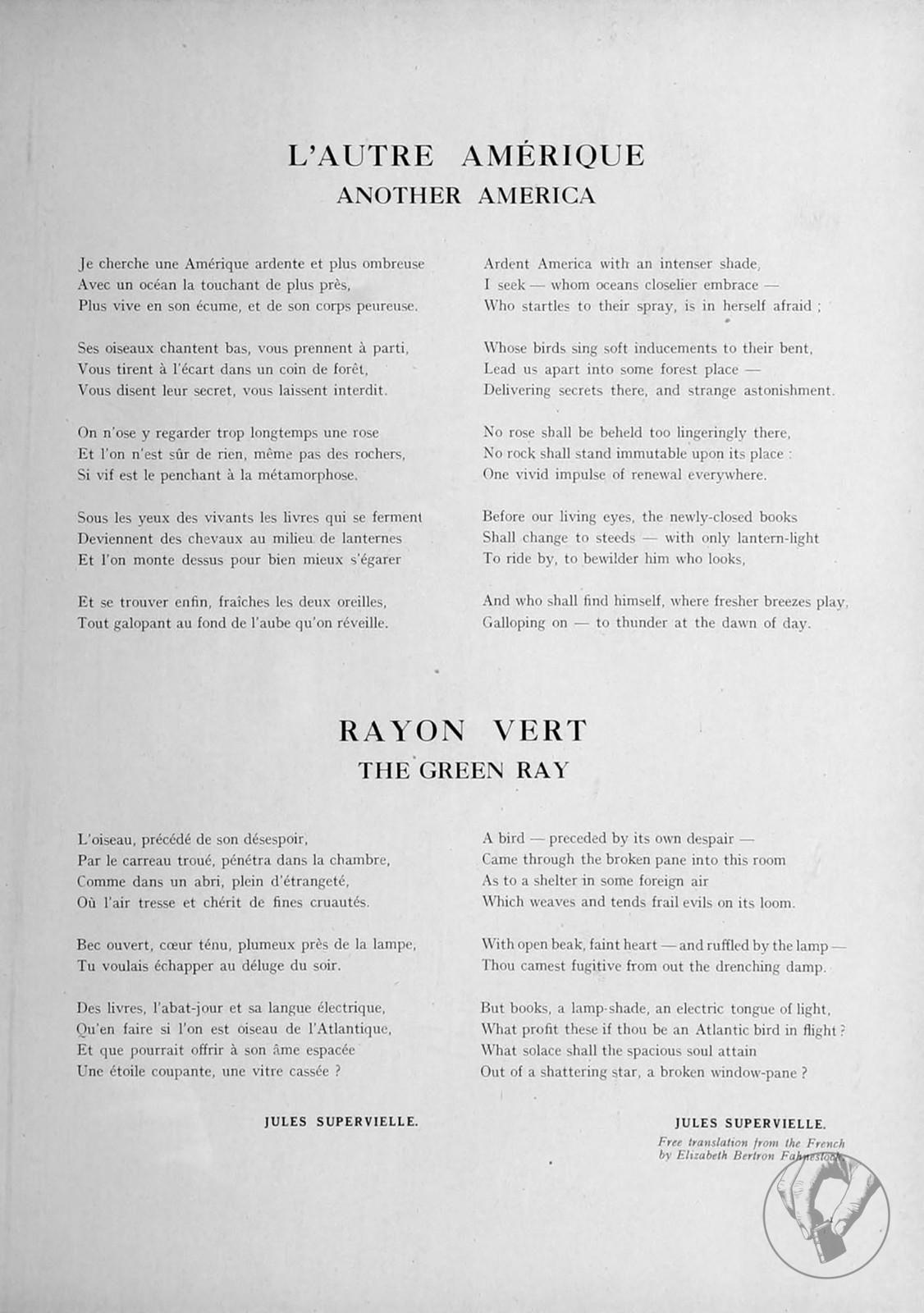
L'AUTRE AMÉRIQUE
ANOTHER AMERICA
Je cherche une Amérique ardente et plus ombreuse
Avec un océan la touchant de plus près,
Plus vive en son écume, et de son corps peureuse.
Ses oiseaux chantent bas, vous prennent à parti,
Vous tirent à l'écart dans un coin de forêt,
Vous disent leur secret, vous laissent interdit.
On n'ose y regarder trop longtemps une rose
Et l'on n'est sûr de rien, même pas des rochers,
Si vif est le penchant à la métamorphose.
Sous les yeux des vivants les livres qui se ferment
Deviennent des chevaux au milieu de lanternes
Et l'on monte dessus pour bien mieux s'égarer
Et se trouver enfin, fraîches les deux oreilles,
Tout galopant au fond de l'aube qu'on réveille.
Ardent America with an intenser shade,
I seek — whom oceans closer embrace —
Who startles to their spray, is in herself afraid ;
Whose birds sing soft inducements to their bent,
Lead us apart into some forest place —
Delivering secrets there, and strange astonishment.
No rose shall be beheld too lingeringly there,
No rock shall stand immutable upon its place :
One vivid impulse of renewal everywhere.
Before our living eyes, the newly-closed books
Shall change to steeds — with only lantern-light
To ride by, to bewilder him who looks,
And who shall find himself, where fresher breezes play,
Galloping on — to thunder at the dawn of day.
---
RAYON VERT
THE GREEN RAY
L'oiseau, précédé de son désespoir,
Par le carreau troué, pénétra dans la chambre,
Comme dans un abri, plein d'étrangeté,
Où l'air tresse et chérît de fines cruautés.
Bec ouvert, cœur ténu, plumeux près de la lampe,
Tu voulais échapper au déluge du soir.
Des livres, l'abat-jour et sa langue électrique,
Qu'en faire si l'on est oiseau de l'Atlantique,
Et que pourrait offrir à son âme espacée
Une étoile coupante, une vitre cassée ?
A bird — preceded by its own despair —
Came through the broken pane into this room
As to a shelter in some foreign air
Which weaves and tends frail evils on its loom.
With open beak, faint heart — and ruffled by the lamp —
Thou camest fugitive from out the drenching damp.
But books, a lamp-shade, an electric tongue of light,
What profit these if thou be an Atlantic bird in flight?
What solace shall the spacious soul attain
Out of a shattering star, a broken window-pane?
---
JULES SUPERVIELLE.
JULES SUPERVIELLE.
Free translation from the French by Elizabeth Bertron Fahnstock.
Page 2
INGRES ET LA CRITIQUE CONTEMPORAINE
Prix de Rome en 1801, le jeune montalbanais dût attendre cinq ans son départ pour la Ville Éternelle, en raison de la situation difficile du budget impérial. En 1806, il partit, enfin, pour Rome. Cette même année il exposait au Salon, cinq portraits : La Famille Rivière (trois portraits), Napoléon empereur, et son propre portrait à 24 ans.
Ces portraits suscitèrent une levée de boucliers contre l'élève de David. Les critiques les plus injustes et les pamphlets les plus désobligeants ne lui furent pas ménagés.
The young Montalbanian, who in 1801 received the Prix de Rome, had to wait five years before he could depart for the Eternal City, on account of the uncertain condition of the Imperial budget. At last, in 1806, he left for Rome. In the same year he exhibited five portraits at the Salon : The Rivière Family (three portraits), The Emperor Napoleon and a portrait of himself at the age of 24.
These portraits roused a veritable storm against this pupil of David's. He was not spared the most unjust
RÉPUBLIQUE DES ARTS
Duel à naissance entre M. Ingres, le Fils de la ligier, et M. Delacroix, le Prédileur de la couleur.
— Depuis trente ans, je crée partout que M. Ingres ait pris, et je suis qui as mort à elle seule. On ne peut donc plus compter sur vous en ce monde. Tout pis, je dirai maintenant qu'il se dessine pis.
INSTITUT
M. Delacroix, nommé membre de l'Institut, prend enfin place auprès de M. Ingres. — Fin de la querelle. — Un dernier coup de crayon, un dernier coup de pinceau, demain on n'en parlera plus.
QUELQUES CARICATURES CONTEMPORAINES DE INGRES
SOME CONTEMPORARY CARICATURES ON INGRES
LA SOURCE DE R. INGREY & COBBS.
Le directeur, journaliste et carrière. Versant des lettres... de lumières et de dessins et de couleurs. Sur ses abstraits élégiamment.
13443
Page 3
LA RENAISSANCE DE L'ART FRANÇAIS ET DES INDUSTRIES DE LUXE
403
Toutes ces critiques, tous ces pamphlets, qui voulaient être injurieux, irritèrent au plus haut point Ingres, qui comptait sur un accueil favorable du public.
« Je n'exposerai plus au Salon, tant que j'aurai de pareils juges, écrivit-il de Rome, à M. Forestier.
« Je ne suis pas assez sot de croire que mes ouvrages ne laissent à désirer. Mais je ne reconnais valables aucune des critiques, j'en excepte, comme vous pouvez le croire, celles de mes amis.
La rancune d'Ingres était immortelle. « Sa mémoire était si rancuneuse, dit une de ses parentes, qu'elle se souvenait des moindres mots hostiles écrits contre lui depuis cinquante ans ».
Ingres pensait encore à ses détracteurs, quand il conçut une composition pour laquelle il fit plusieurs croquis sommairement indiqués à la plume. Le Musée de Montauban en possède six. Le sujet est : La Médiocrité. Ces croquis portent des indications manuscrites : la Médiocrité gouverne le monde. L'Univers couronne la Médiocrité. Elle foule à ses pieds le vrai mérite.
Ces variantes sur la Médiocrité ont toutes une même couleur sombre et tragique et reflètent l'état d'âme du peintre méconnu. Les envois aux Salons continuent à être fraîchement accueillis par la
INGRES
LA MÉDIOCRITÉ. — MEDIOCRITY.
INGRES.
LA MÉDIOCRITÉ. — MEDIOCRITY.
INGRES.
LE JOURNALISTE. — THE JOURNALIST
criticisms and the most unkind pamphlets.
All these criticisms and all these pamphlets, intended to be insulting, irritated Ingres — who expected to be welcomed by the public — to the greatest degree.
“I will not exhibit at the Salon again, so long as I have such judges”, he wrote from Rome to M. Forestier.
“I am not stupid enough to think that my work is perfect, but I refuse to admit the value of any of these criticisms, excepting, as you may well believe, those of my friends”.
Ingres’ rancour was undying. “His memory was so malicious”, says a relative of his, “that he remembered every hostile word written against him in the course of fifty years.”
Ingres was still thinking of his slanderers when he conceived a composition for which he had made several sketches, rapidly traced in ink, of which the Montauban Museum possesses six. The subject is: Mediocrity. These sketches bear the following indications in the artist’s own hand: “Mediocrity rules the world. Mediocrity is crowned by the Universe. It tramples real merit under foot”.
These variations on Mediocrity are all filled with the same sombre and tragic colours and reflect the state of mind of the as yet unrecognized
Page 4
LA RENAISSANCE DE L'ART FRANÇAIS ET DES INDUSTRIES DE LUXE
INGRES.
L'AGE D'OR. — ÉTUDE POUR AÉCÉE. — THE GOLDEN AGE.
Presse. Après celui de 1819, où figurait le tableau de Roger délivrant Angélique, Ingres écrit à son ami Gilibert, de Montauban : « Landon est un brigand, qui ment par sa bouche ; il est au nombre de ceux que je peux avoir piqués et qui s'en vengent stupidement ; sa critique est le coup de pied de l'âne, et n'en est que plus dangereux ».
Ingres ne connaîtra le succès et les éloges de la Presse qu'en 1824, à son retour de Florence à Paris, où il artist. Work sent to the various Salons was coolly received by the Press. After the Salon of 1819, where appeared his Roger delivering Angelique, Ingres wrote to his friend Gilibert, of Montauban : “ Landon is a lying brigand; he may be among those whom I have stung and who revenge themselves stupidly; his criticism is that of a donkey — except that it is more dangerous ”.
It was only in 1824 that Ingres attained success, and praise from the Press — on his return from Florence to Paris, where he came timidly to judge of the effect produced by his picture : Le Vœu de Louis XIII.
“ There are no words to tell the flattering and glorious welcome which I have received here ”, he writes to a Montalbanian friend of his, “ nor what a high place is granted me ”.
At the Salon of 1833 Ingres had exhibited the portraits of Mme. de Vaucey and of Bertin senior — the latter a master-piece bequeathed to the admiration of all time, and of which the Museum of Montauban possesses the first sketch.
Bertin's portrait produced a sensation, and on this occasion the impatient critics neglected M. Ingres. Numerous writers praised the picture, but, according, to Ingres, were lacking in a suitable enthusiasm. Delescluze published a most flattering article in Les Débats — Ingres found it detestable. He vowed not to exhibit anything so long as Delescluze remained critic in the Salon for this review. Ingres, it is true, had already said : “ The pale praise of a beautiful thing is an offense ”.
Ingres hoped to strike a great blow the following year — to confuse his judges and to silence his slanderers. In 1834 he exhibited Le Martyre de saint Symphorien, ordered eight years previously by the state for the Autun cathedral.
This picture, of which the Montauban Museum possesses over 200 studies in colours and in pencil, met with a disastrous reception. Never had any other work of Ingres aroused such criticism, passionate as well as unjust.
Le Martyre de saint Symphorien was discussed by the best known painters of the day, “ but as they would have discussed Raphael or Rubens ” — writes one of his faithful friends, the painter Amaury Duval. “ He paints with a fog ”, said Delacroix. Writers and artists profited by this to arouse the ceaseless quarrel between Classicists and Romanticists. And it was Ingres who very unjustly, paid the penalty.
Victor Hugo, during this quarrel between the Classicists and the Romanticists, addressed to Ingres a famous epistle of which an extract is given here :
Grand Ingres ! qui pourrait décapiter ta gloire ?
Tant que le gris vivra dans l'humaine mémoire
Page 5
LA RENAISSANCE DE L'ART FRANÇAIS ET DES INDUSTRIES DE LUXE
est venu timidement pour juger de l'effet de son tableau : Le Vœu de Louis XIII.
« Je ne puis te dire l'accueil flatteur et honorable que je reçois ici, écrit-il à son ami montalbanais, et quelle belle place on me donne.
Au Salon de 1833, Ingres avait exposé les portraits de Mme de Vaucey et de Bertin l'aîné, celui-ci chef-d'œuvre légué à l'admiration des âges et dont le Musée de Montauban possède la première pensée.
Le portrait de Bertin fit sensation, et, pour cette fois, les zoiles impatients négligèrent M. Ingres. De nombreux écrivains louangèrent l'œuvre, mais, au goût d'Ingres, manquèrent d'enthousiasme. Delescluze avait publié dans les Débats un article très flatteur, Ingres le trouva détestable. Il jura qu'il n'exposerait plus tant que Delescluze ferait le Salon dans ce journal. Ingres, il est vrai, avait dit : « La louange pâle d'une belle chose est une offense ».
Ingres espérait frapper un grand coup l'année suivante, confondre ses juges et fermer la bouche à ses détracteurs. Il exposait en 1834, le Martyre de saint Symphorien, qui lui avait été commandé, huit ans auparavant, par l'Etat, pour la cathédrale d'Autun.
Ce tableau, dont le Musée de Montauban garde plus de 200 études peintes ou dessinées, reçut un accueil désastreux. Jamais aucune autre œuvre d'Ingres n'avait soulevé autant de critiques aussi passionnées qu'injustes.
Le Martyre de saint Symphorien fut discuté par les peintres les plus renommés du temps, mais comme on discute Raphaël et Rubens, écrit un de ses fidèles le peintre Amaury Duval. « Il peint avec du brouillard », disait Delacroix. Les écrivains et les artistes en profitèrent pour réveiller la querelle sans fin des Classiques et des Romantiques. Et c'est Ingres qui, très injustement, paya les frais de la querelle.
Edmond About ne craignit pas de dire que « les figures et surtout les figures de femme sont faites sans modèle vivant (sic), de convention, ou, si l'on veut, de mémoire ». Etrange appréciation, en vérité, si l'on songe au nombre important d'études du Musée de Montauban.
Théophile Sylvestre se distinguait parmi les écrivains les plus intransigeants. Aucun des tableaux de Ingres, d'ailleurs, n'avait trouvé grâce devant ce redoutable critique.
Victor Hugo avait adressé à Ingres, au cours de cette querelle des Classiques et des Romantiques, une épître célèbre dont voici un extrait :
Grand Ingres ! qui pourrait décapiter ta gloire ?
Tant que le gris vivra dans l'humaine mémoire
On parlera de tes pinceaux !
Et le jeune avenir, sans nous porter envie
Se dira : tout hélas ! n'est pas rose en la vie,
En contemplant tes froids tableaux.
INGRES.
ÉTUDE POUR STRATONICE. — SKETCH FOR STRATONICE.
On parlera de tes pinceaux!
Et le jeune avenir, sans nous porter envie
Se dira : tout hélas ! n'est pas rose en la vie,
En contemplant tes froids tableaux.
His slanderers asserted that Ingres was no colourist
They had made the discovery, for lack of more serious proof, that the anagram of his name was EN-GRIS.
Page 6
LA RENAISSANCE DE L'ART FRANÇAIS ET DES INDUSTRIES DE LUXE
The caricaturists abundantly ridiculed M. Ingres, but their pencils, though malicious, were never really unkind.
The draughtsman Cham, on the death of Ingres, sketched a gallant trooper, his arm encircled by a broad band of crepe — thus showing his own mourning for a man who cared so much fot the “line”. This “charge” was indeed in the taste of Dumanet.
After the moral carastrophy at the Salon of 1834, Ingres decided to leave France in order to seek peace. He asked for and obtained the direction of the French School in Rome, in place of Horace Vernet. He departed full of indignation and with a saddened heart. “I am not, and I do not want to be, an apostate of my time”, he wrote, with a nervous hand, at the head of one of his sketch-books.
Ingres remained six years in Rome, chiefly occupying himself with his directional functions. Not until three years after his arrival did he set to work, painting Stratonice, La Vierge à l’Hostie, Chérubini, and drawing a score of portraits. Exhibited in Paris, the picture of Stratonice was found by George Sand to be “charming, but remarkably silly”.
It was probably also in Rome that Ingres conceived the plan of a picture on the subject of “The Freedom of the Press”.
But if, for unknown reasons, Ingres left this “Freedom of the Press” in a sketchy state, he took exquisite pleasure in doing the portrait of the journalist, which is exhibited together with other drawings at the Montauban Museum.
Ingres signed the sketch, and so that there should be no misunderstanding, he also indicated the subject: “The journalist”, which for Ingres must have meant a man lazy, vain and frivolous.
This was, in fact, the only revenge ever taken in drawing by this awe-inspiring man, who so disliked the Press.
Ingres returned to Paris on May 6th 1841. The following years brought him great success. He occupied the highest official positions. The Universal Exhibition of 1855, where a whole room was reserved for him, was for Ingres a veritable apotheosis. The Jury awarded him a large medaille d’honneur and the Government gave him the order of Grand Officier de la Légion d’Honneur. In 1862, the Emperor named him senator. The next year, the Montalbanians, by a unanimous subscription, offered him a gold crown. Ingres was profoundly touched and could not help shedding tears before such an affectionate manifestation from his compatriots.
And thus the prophecy of Ingres, — that he counted on avenging himself in his old age — was realized at last
INGRES.
LE VŒU DE LOUIS XIII. — ÉTUDE POUR L’ENFANT JÉSUS.
THE VOW OF LOUIS XIII. — SKETCH FOR CHILD JESUS.
Ses détracteurs prétendaient qu’Ingres n’était pas coloriste. Ils avaient fait la trouvaille, à défaut d’arguments sérieux, que l’anagramme de son nom était : ENGRIS.
Les caricaturistes ont copieusement « chargé » M. Ingres. Mais leur crayon expressif de malice ne fut jamais désobligeant.
Le dessinateur Cham, à la mort de Ingres, avait crayonné un brave troupier, le bras cerclé d’un large crêpe et
Page 7
LA RENAISSANCE DE L'ART FRANÇAIS ET DES INDUSTRIES DE LUXE
manifestant ainsi son deuil pour un homme qui aimait tant la ligne. Certainement, cette « charge » était du goût de Dumanet.
Après cette catastrophe morale du Salon de 1834, Ingres résolut de quitter la France pour avoir la paix. Il demanda et obtint la direction de l'Ecole française de Rome, en remplacement d'Horace Vernet. Il partit le regard chargé de colère et le cœur attristé. « Je ne suis pas, je ne veux plus être de mon siècle apostat ! » a-t-il écrit, d'une main nerveuse, en tête d'un de ses cahiers.
Ingres resta six ans à Rome, peignit peu, se préoccupant surtout de ses fonctions directoriales. Il ne commença à travailler que trois ans après son arrivée, peignant Stratonice, La Vierge à l'Hostie, Chérubini, et dessinant une vingtaine de portraits. Exposé à Paris, le tableau de Stratonice fut trouvé « charmant mais d'une niaiserie bizarre », par George Sand.
C'est à Rome, vraisemblablement, que Ingres conçut le projet d'un tableau sur La Liberté de la Presse.
Mais, si pour des raisons ignorées, Ingres laissa à l'état de projet, cette Liberté de la Presse, il s'offrit le doux plaisir de dessiner le portrait du journaliste, qui est exposé avec les autres dessins au Musée de Montauban.
Ingres a signé le croquis, et, pour qu'il n'y ait pas de confusion, il a aussi indiqué le sujet : « Le Journaliste », ce qui, pour Ingres, devait signifier l'homme paresseux, léger et frivole.
Ce fut, en somme, la seule vengeance dessinée de cet homme terrible, qui n'aimait pas la Presse.
Ingres était de retour à Paris le 6 mai 1841. Les années qui suivirent lui apportèrent de grandioses succès. Il connut les plus hautes dignités officielles. L'Exposition Universelle de 1855, où toute une salle lui était réservée, fut pour Ingres une véritable apothéose. Le jury lui décerna une grande médaille d'honneur et le gouvernement lui conférait la plaque de Grand Officier de la Légion d'honneur. En 1862, l'Empereur le nommait sénateur. L'année après, les Montalbanais, par une souscription unanime, lui offrirent une couronne d'or. Ingres fut profondément touché et ne put s'empêcher de verser des larmes devant une aussi affectueuse manifestation de ses compatriotes.
La prédiction d'Ingres disant qu'il comptait beaucoup sur sa vieillesse pour le venger s'était enfin réalisée.
Mais le temps a fait plus que recueillir les lauriers de l'heureuse vieillesse du Maître. Les écrits passionnés, provoqués par les luttes d'Ecoles, les pamphlets ridicules, dictés par l'ignorance ou l'envie, ne sont plus maintenant qu'un très lointain souvenir dont l'écho n'a pu parvenir au fronton du portique d'or de l'Immortalité, élevé à la gloire de l'Artiste, par le Temps, ce grand juge suprême, harmonieux et puissant !
F. FÉLIX BOUISSET,
Conservateur du Musée Ingres.
INGRES.
HOMÈRE. — HOMER.
ÉTUDE POUR ALEXANDRE LE GRAND.
But time has done more than to assemble the laurels of the Master's happy old age. The impassioned article provoked by the struggle between Schools, the ridiculous pamphlets dictated by ignorance or envy, all these are now but a remote memory whose echo could not reach even the pediment of the gold portico of Immortality erected to the glory of the Artist by Time — that allpowerful judge, harmonious and supreme.
F. FÉLIX BOUISSET,
Curator of the Ingres Museum.
Page 8
JEAN BOUCHER
Gallieni revit sur l'Esplanade des Invalides, au cœur de ce Paris dont il a su écarter l'en-nemi. Jean Boucher, son sculpteur, se trouvait devant un problème nouveau, non seulement parce qu'en art tout problème est toujours nouveau, mais parce que les moyens par lesquels les sculpteurs évoquaient les grands hommes de guerre ont vieilli et sont devenus si disparates de la vie qu'on ne peut songer à les employer.
La guerre est scientifique et sa conduite de méditation. Puis, il fallait indiquer que Gallieni n'était pas seulement un militaire, mais un organisateur. Ainsi apparaît-il debout et prenant sa décision salvatrice sur le pavois de gloire, porté par les images symboliques des colonies où il a commandé, exploré, légiféré : Soudan, Tonkin, Madagascar, et de Paris qu'il a préservé.
Ce monument est des plus beaux qu'ait sculpté Jean Boucher. Cette parfaite réussite n'est point inattendue!
Il a cinquante ans. Tous les artistes connaissent sa silhouette robuste et jeune, la tête aux plans solides qui semble avoir été taillée par un imagier gothique dans le granit de sa Bretagne natale, le large front de réflexion, les yeux pénétrants et vifs sous la transparence des lunettes, son aspect de bonté et de volonté.
Son enseignement à l'Ecole des Beaux-Arts est très suivi. Sa simplicité, sa cordialité et la force de son art établissent entre ses élèves et lui des liens d'amitié respectueux et profonds chez eux, profonds et cordiaux chez lui.
Jean Boucher a des émules, il n'a pas d'ennemis. Comment être l'ennemi de qui est la cordialité même.
Sculpteur très maître de son art et du métier de son art, il est profondément original, sans emphase, sans manifester, mais foncièrement.
Essayons de spécifier sa place dans l'art d'aujourd'hui.
Notre sculpture actuelle, malgré les défaillances des uns, les routines académiques des autres est florissante, puisqu'on pourrait citer une dizaine de grands ou vrais sculpteurs, ce qui, pour une période d'art, est la richesse
JEAN BOUCHER. — GALLIENI.
Gallieni has come to life upon the Esplanade des Invalides in the very heart of Paris whose enemies he repelled. Jean Boucher in sculpting him faced a problem altogether new; not only because in art each problem is always a new one, but because the means by which sculptors used to represent great warriors have become obsolete, and so remote from real life that the use of them is no longer to be considered.
Modern warfare is scientific, and the direction of it lies for the most part in deliberation. Furthermore it was necessary to express that Gallieni was not only a soldier, but an organizer as well. Thus he appears to us standing, in the act of making the decision which brought salvation in its train — upon the noble bullwark which is supported by figures symbolic of the colonies which he had commanded, explored and governed: the Sudan, Tonkin, Madagascar — and that Paris which he saved.
This monument is one of the finest which Jean Boucher has done, although the successful outcome was in no way unexpected. The sculptor's works are already numerous, for he is a man now 50 years of age. Every artist is familiar with his young and sturdy silhouette—with the firm outlines of that head which seems as if carved by some maker of Gothic images in the granite of his native Brittany; the forehead wide with thought, the eyes penetrating and alive behind their glasses—the general appearance, one of kindness and of strength.
His classes at the Beaux Arts are very well attended, for his cordial simplicity and the vitality of his art establish a bond of friendship between his pupils and himself, which is on their side deep and respectful, while on his it is both hearty and profound.
Jean Boucher has rivals but no enemies — for what enemy can resist cordiality itself? He is a sculptor who is master of his art and of the technique of that art; he is intensely creative and sincerely so, without emphasis or display.
Page 9
LA RENAISSANCE DE L'ART FRANÇAIS ET DES INDUSTRIES DE LUXE
JEAN BOUCHER. — RENAN.
Ce qui distingue Jean Boucher de ses émules, c'est qu'il est, d'essence (et ici il faut risquer un néologisme) un monumentier.
Le sculpteur de monuments possède, plus que le sculpteur de morceaux, une vision picturale. Il n'est point besoin, pour cela, qu'il soit peintre ou s'il l'est, qu'il peigne souvent. Mais le sculpteur peut avoir le sens de la peinture, comme le poète, même s'il ignore le maniement d'un instrument, peut posséder le sens inné et manifeste de la musique.
Jean Boucher, trouve, tout de suite, d'instinct, non par le dessin, mais dans la glaise, l'idée la plus juste, la plus plausible, la plus générale, la plus frappante que puisse suggérer le thème accepté.
La première fois que je vis Jean Boucher ce fut à la présentation, chez le fondeur, de son monument à Renan.
Jean Boucher (bleu de Bretagne, rappelons-le) avait certes donné tout son cœur à cette œuvre rêvée et exécutée au moment de l'affaire Dreyfus, alors que dans toutes les Universités populaires et tous les meetings à intentions généreuses, quelque belle voix résumait la soirée par les phrases majestueuses de la Prière sur l'Acropole. L'instinct populaire avait sublimé Renan. Il n'était point question pour la masse (et par contagion
JEAN BOUCHER. — VICTOR HUGO.
Let us attempt to make clear the place which he fills in modern art.
What distinguishes Jean Boucher from his rivals is the fact that he remains essentially (although here we venture a neologism) — a "monumentist". He instinctively comes upon the clearest, most plausible, general and striking idea which any theme can suggest — and he reaches it not by drawings, but directly in the clay.
The first time I ever saw Boucher was at the unveiling of his monument to Renan, while it was still at the founder's. Boucher — a Breton, as we must not forget — must have put his whole heart into this work, done at the time of the Dreyfus affair — when in all the Universities and at all well-intentioned meetings some voice was sure to close the evening with the noble lines of the Prayer on the Acropolis. A popular instinct had as it were sublimated Renan into the image of a gentle thinker, who — above all clamors and the noise of facts — dreamed of an age of harmony.
Jean Boucher was asked to do a monument to Victor Hugo in Guernesey, which stands in a garden close to the Hauteville House, near the eagle's nest of the years of exile. This proved a formidable task.
Rodin had done an admirable bust of Victor Hugo—more intuitive than accurate, and therefore perhaps all
Page 10
410 LA RENAISSANCE DE L'ART FRANÇAIS ET DES INDUSTRIES DE LUXE
JEAN BOUCHER.
LE SOLDAT INCONNU.
pour l’élite) du rédacteur du Corpus, ni de l’historien du Christianisme, ni du poète de la Vie de Jésus, moins encore de l’aristocrate de Caliban, ni du passionnant psychologue de l’Abbesse de Jouarre. Tout s’était résumé en l’image d’un penseur doux, rêvant, au-dessus des clameurs et des faits, d’une époque d’harmonie.
On demande à Jean Boucher un monument à Victor Hugo qui doit s’élever à Guernsey. L’image se dresse dans un jardin vers Hauteville - house,
près du nid d’aigle des années d’exil.
Ici Jean Boucher rencontre un obstacle formidable. Rodin a donné de Victor Hugo un admirable buste, plus intuitif encore qu’exact et pour cela même, peut-être, plus vrai.
Puis, Rodin a érigé deux monuments à Hugo; mais ici le grand sculpteur a figuré Hugo-Dieu, Hugo-Prométhée. Les Océanides, à ses pieds, l’entourent de la couronne de beauté du monde. Hugo est nu, étant entré au paradis de la gloire. Rodin n’a pas trouvé dans l’anecdote d’Hugo une équivalence à cette robe de moine de Balzac, qui drape le romancier comme du halo vivant de son labeur.
Jean Boucher s’en tire par la vérité.
C’est aux Iles Normandes que Hugo a médité et écrit les plus beaux poèmes de la Légende des Siècles. C’est là qu’il a rêvé Cosette traînant ses petits pas dans l’ombre géante de Jean Valjean, qu’il a entendu Gilliatt jouer du bag-pipe, en même temps que se dressait, dans l’esprit du poète, l’image aurorale d’Eve et qu’il lançait le Satyre parmi les festins de l’Olympe.
Jean Boucher refait en esprit, une de ces promenades matinales que Hugo errait sur les grèves de l’Ile.
Hugo promeneur solitaire, est tout de même, un romantique.
Ce Victor Hugo est peut-être le chef-d’œuvre de Jean Boucher qui en doit la splendeur à son amour du verbe et à sa parfaite compréhension du poète.
Le monument aux volontaires américains de la place
the more real. Furthermore Rodin had erected two monuments to Victor Hugo — but here the great sculptor had rendered Hugo God-like, Promethean — standing naked, having entered into the paradise of Fame, while at his feet the Oceanides encircle him with a crown of the earth’s beauties. For Rodin never found out of Hugo’s history any equivalent for Balzac’s monk-like robe, which drapes this novelist like the living halo of his labours.
Jean Boucher found his solution in truth itself. Intuition — that flash which appears at the undertaking of a great task, and which is at once the mark of an aesthetic genius and of a creator of great works — intuition it was which guided him. And he flung himself into the labour of transposing this inspiration into the simplest and greatest conception possible.
It was in the Channel Islands that Hugo had conceived and written the finest poems of the Legende des Siècles — there that he visualized the child Cosette, toddling in the giant shadow of Jean Valjean.
So Boucher has retraced the vision of one of Hugo’s endless morning walks on the island shore — Hugo, walking solitary and romantic. And if Victor Hugo is perhaps the greatest masterpiece of Jean Boucher — it is because the sculptor possesses the love of words, and a perfect understanding of his poet.
The monument to the American Volunteers which stands in the Place des Etats-Unis is surmounted by a fine statue of Alan Seeger responding to the call of battle and to his Rendez-vous with Death.
The monument to the graduates of Saint-Cyr shows a statue in the act of being unveiled — a Victory shrouded since 1870 in mourning veils, which heroic warriors now tear asunder. At one corner of the monument, seated upon the base, two young Saint-Cyriens — picked soldiers — watch beside the Victory so that she shall never again be dimmed.
The complex ideas and visions which go to the making
JEAN BOUCHER. — STATUE D’ALAN SEEGER, MONUMENT AUX VOLONTAIRES AMÉRICAINS.
Page 11
LA RENAISSANCE DE L'ART FRANÇAIS ET DES INDUSTRIES DE LUXE
des États-Unis, se cime de la belle statue d'Alau Seeger répondant à l'appel du front de bataille et de la mort.
Le monument aux Saints-Cyriens: sur la large assise une statue qu'on dévoile, c'est la victoire enroulée dans ses plis de deuils depuis 1870. Des héros font tomber ce suaire éphémère. Au coin du monument, assis sur le socle, deux Saints-Cyriens veillent, jeunes soldats choisis, de garde auprès de la Victoire, pour empêcher qu'elle s'assombrisse à nouveau.
La complexité d'idées et d'images qui se presse dans l'exécution d'un monument de Jean Boucher, se réduit toujours en lignes simples. L'impression de la guerre, qui lui a donné le monument aux volontaires américains et le monument aux Saints-Cyriens s'incarne, avant l'hommage au Soldat Inconnu, dans cette vivante image du Poilu, l'arme au pied, si justement populaire et qui est l'ornement d'une place de Vitré.
D'avoir été hanté par ces grandes périodes où l'amour de la grâce et de la plénitude de la beauté physique ont créé des œuvres qui, plus que toutes autres, peuvent recueillir et réfléchir de la lumière n'empêche point Jean Boucher de ressentir toute la détresse humaine, de créer un Chemineau qui marche devant lui, la besace au dos, de ce pas lent et lourd qui se sait infatigable parce qu'il doit l'être, qui personnifie le destin inéluctable et sourd qui pèse sur les malchanceux; un chemineau dont les traits sont ceux d'un Tolstoi, moins la lumière, et il sait qu'il lui faut marcher, mais qu'au bout de sa marche, il ne trouvera qu'un gîte dont il devra repartir le lendemain.
Et cette contemplation de la détresse humaine, amenait récemment Boucher à formuler un Christ d'une extraordinaire vibration de pitié.
En résumé, une œuvre drue et forte marquée, presque tous les ans, par une grande création, plusieurs monuments, des plus beaux, parmi ceux qui ornent les places et les jardins de Paris, et un magnifique avenir pour un artiste profondément pathétique, profondément original et qui n'est dupe d'aucun système, vieux, neuf ou renouvelé, pour un des plus puissants trouveurs d'images qui comptent dans l'art actuel.
Et qu'est-ce que l'art, sinon une incessante trouvaille d'images neuves.
GUSTAVE KAHN.
JEAN BOUCHER. — LE CHEMINEAU.
of a monument by Jean Boucher may always be reduced to simplicity of line. The war impressions which produced the two monuments just mentioned are incarnated in the realistic Poilu, with his arms at his feet, which is so justly popular and stands in a square in Vitré.
At times Boucher remembers the past, where those whom he prefers to reproduce are the simple and great-hearted, like Michel-Colombe and Fra Angelico. This Fra Angelico is one of the glories of the Luxembourg ; the painter shrouded in his monk's robes and with palette in hand standing in contemplation of some holy vision.
Though he be haunted by the great epochs in which a love of proportion and of physical beauty created masterpieces better fitted than any others to hold and reflect the light — Jean Boucher is in no way insensible to the great scale of human suffering. He has created that Tramp who walks heavily and slowly with his wallet on his back — tireless because he must be so — the very personification of the overwhelming destiny of the unfortunate : a tramp whose features are those of Tolstoi without his illumination, and who is well aware that he must walk on though at the end he find but a temporary resting place from which on the morrow he must start out once more.
And this contemplation of human suffering has lately brought Boucher to formulate a Christ extraordinarily vibrant with this infinite compassion.
Then there are several busts, powerful in their emotional quality of Mme Jean Boucher, of his children, and — oh memories of childhood — of that Mme de Ségur (born a Rostopchine) who in her Bibliothèque Rose has left such imperishable vignettes in pink and white.
To summarize, we may say that this is work which is vigorous, and is marked each year by great creations — such as some of the finest monuments of the Public Gardens of Paris ; and it is, in addition, work which traces a magnificent future for an artist who is profound in feeling as in originality — no dupe of any system, whether it be new, old or remodelled — and who is in short one of the most powerful image-discoverers of our day. And what is art, if not an incessant discovery of images which are new ?
GUSTAVE KAHN.