Page 1
CIMAISE art et architecture actuels 30e année Nº 167 décembre 1983 present day art and architecture 50 F. ESPAÑA numéro spécial ISSN 0005-6830
Premières pages de l'ouvrage, en accès libre.
CIMAISE art et architecture actuels 30e année Nº 167 décembre 1983 present day art and architecture 50 F. ESPAÑA numéro spécial ISSN 0005-6830
EDITORIAL Jean-Robert Arnaud A PROPOS DE L’ESPAGNE Continuant notre politique des numéros spéciaux, et dans le cadre de ceux consacrés à un seul pays, voici après l’Italie (n° 157, février-mars-avril 1982) un numéro traitant de la peinture espagnole. La peinture seulement, et sans aborder la sculpture, parce qu’il fallait bien circonscrive notre sujet, et que même ainsi, étant donnée la richesse de la matière à traiter, les choix furent difficiles à faire. Par ailleurs, une revue s’inscrit dans le temps, un numéro, même spécial, ne parlant que d’un sujet défini, ne saurait se lire seul, en dehors de tout contexte. Une revue d’art, c’est d’abord une action continue, et c’est dans cet esprit que ce numéro doit être abordé afin de ne pas en fausser la lecture. Depuis 30 ans, d’artistes espagnols nous avons souvent parlé. C’est en tenant compte de ces études antérieures que nous avons conçu ce numéro “peinture espagnole”, dont il faudrait compléter, dans l’idéal, la lecture par celle des textes parus au cours des ans. De nombreux artistes espagnols, depuis le début du siècle ont participé, et participent aujourd’hui encore à la constitution du tissu artistique de Paris. C’est donc le moment et le lieu d’exprimer un regret : le Centre Pompidou a fait une série d’expositions thématiques : Paris-New York, Paris-Berlin, Paris-Moscou ; il nous paraît particulièrement injuste et regrettable de ne pas avoir consacré une exposition de la même importance à la présence et à la participation de l’art espagnol au contexte parisien. Depuis les maîtres du début du siècle : Picasso, Gris, Miró, Blanchard, Gargallo, Gonzalez, en passant par Dominguez jusqu’aux artistes d’aujourd’hui : Pelayo, Feito, Palazuelo, Subira-Puig, Saura, pour ne citer que quelques-uns, il y a là, semble-t-il, amplement matière à réaliser un panorama somptueux de cette présence. Jean-Robert Arnaud APROPOS OF SPAIN Continuing our policy of special issues, and in the context of those devoted to a single country, here, after Italy (no. 157, February-March-April 1982), is an issue on Spanish painting. And painting only, without taking up sculpture, because we had to delimit our subject, and even then, given the richness of the subject matter, the choices were difficult to make. Furthermore, a magazine inscribes itself in time; an issue, even a special issue, and speaking only of a definite subject, cannot be read alone, out of context. An art magazine is first of all a continuous action, and it is in this sense that this issue should be approached so as not to distort its reading. For thirty years we have often written about Spanish painters. It is in taking these past studies into consideration that we have conceived this issue on “Spanish Painting”, which ideally should be completed by the reading of the articles which have appeared over the years in the magazine. Since the beginning of the century numerous Spanish artists have participated, and still participate, in the constitution of the artistic tissue of Paris. It is therefore the time and the place to express a regret: the Pompidou Center has presented a series of thematic exhibitions: Paris-New York, Paris-Berlin, Paris-Moscow; it seems particularly unjust and regrettable to not have devoted an exhibition of the same amplitude to the presence and the participation of Spanish art in the Parisian context. Starting with the masters of the beginning of the century: Picasso, Gris, Miró, Blanchard, Gargallo, Gonzalez, to Dominguez and up to present-day artists: Pelayo, Feito, Palazuelo, Subira-Puig, Saura, to cite only a few, it seems that there is ample material here for the presentation of a sumptuous panorama of this presence. Jean-Robert Arnaud --- ÉTUDES CONSACRÉES DANS CIMAISE À L’ART ESPAGNOL 1955 (3e série n° 1 - octobre-novembre 1955 - épuisé)C.L. Popovici : L’art abstrait en Espagne - Abstract Art in Spain --- 1968 (n° 87 - juin-septembre 1968)G. Boudaille : Tapiès(n° 88/89 - novembre-décembre 1968)M. Ragon : Chilliida --- 1956 (série III n° 7/8 - juin-juillet-aout 1956 - épuisé)R.V. Gindertael : Gonzalez --- 1971 (n° 104/105 - novembre-décembre 1971)P. Gauthier : Subira-Puig --- 1958 (série V n° 4 - mars-avril 1958 - épuisé)G. Boudaille : Feito(série VI n° I - octobre-novembre 1958 - épuisé)P. Restany : Tapiès --- 1977 (n° 130 - avril-juin 1977)P. Gauthier : Saura(n° 133/134 - novembre-décembre 1977)G. Esteban : AguayoG. Lascault : Arroyo --- 1959 (n° 45/46 - septembre-octobre-novembre 1959 - épuisé)P. Restany : La jeune peinture espagnole rentre en scèneYoung Spanish Painting Comes back on Stage --- 1978 (n° 137 - juin-septembre 1978)R.J. Moulin : Juana Francès(n° 138/139 - octobre-décembre 1978)G. Xuriguera : Quero --- 1960 (n° 50 - octobre-novembre-décembre 1960)F. Mathey : Feito --- 1979 (n° 142 - mai-juin 1979)G. Plazy : TapièsS. Santreau : Taulé(n° 143 - juillet-septembre 1979)P. Gauthier : Jimenez-Balaguer --- 1961 (n° 51 - janvier-février 1962)F.A. Viallet : Voyage en Espagne - Travel in Spain --- 1981 (n° 155 décembre 1981)G. Xuriguera : Grau-Garriga --- 1962 (n° 57 - janvier-février 1962)J.F. Koenig : Gaudi et Montserrat(n° 58 - mars-avril 1962)P. Restany : Cuixart(n° 60 - juillet-aout 1962)P. Restany : ChilliidaM. Ragon : Pelayo --- 1982 (n° 159 - juillet-septembre 1982)Urrutia : Arco 1982(n° 190 - octobre-novembre 1982)P. Astier : Arroyo --- 1963 (n° 64 - mars-juin 1963)M. Ragon : Miró inconnu --- 1983 (n° 164 - avril-juin 1983)J.R. Arnaud : Arco 83 --- 1966 (n° 77 - septembre-octobre 1966)M.A. Levin : Feito --- 1967 (n° 83/84 - novembre-décembre 1967)G. Boudaille : Saura ---
Manrique : Peinture - 130 x 97 cm - Photo Manrique. Peintre, Manrique est aussi sculpteur et architecte. Nous aborderons, dans un numéro spécial, ces différents aspects de sa création. A painter, Manrique is also a sculptor and architect. In a special issue we will confront the different aspects of his creativity.
Vicente Aguilera Cerni L’ART ESPAGNOL ENTRE 1945 ET 1970 NOTE INFORMATIVE Si l’on tient compte des conditions traumatisantes dans lesquelles se développe l’art espagnol entre 1945 (fin de la deuxième guerre mondiale) et 1970 (début de la crise ouverte du régime franquiste, accompagnée parallèlement d’un durcissement des méthodes répressives), il est de toute évidence impossible de saisir son évolution sans faire appel à des données propres à la situation socio-politique de cette période. La fin de la guerre civile espagnole en 1939 donna naissance à une nouvelle période caractérisée par les ravages, la famine et la répression la plus brutale que l’on puisse imaginer, particulièrement dans les divers secteurs de la culture. Un isolement acharné faisait soupçonner dans tous les courants qui voulaient s’intégrer à la culture supranationale un danger social. Mais s’il est nécessaire de tenir compte de cette considération préalable, il n’est pas moins vrai d’observer que ses composantes essentielles n’impliquaient pas un rapport mécanique entre les faits propres à la culture artistique et ceux qui se produisent dans d’autres domaines. Ce qui n’empêche que l’éclaircissement de cette dialectique comporte une valeur explicative évidente. L’inévitable éclipse de la modernité s’est manifestée entre les années 1939 et 1945. L’Espagne était alors non seulement un --- SPANISH ART BETWEEN 1945 AND 1970 INFORMATIVE NOTE If one takes into account the traumatic conditions in which Spanish art developed between 1945 (the end of the Second World War) and 1970 (beginning of the open crisis of the Franco regime, accompanied by an intensification of repressive methods), it is obviously impossible to grasp its evolution without referring to the specific givens of the socio-political situation of the period. The end of the Spanish civil war in 1939 gave birth to a new period characterized by famine, ravages, and the most brutal repression one can imagine, particularly in the different sectors of culture. An evenomed isolation made any current which wanted to integrate itself into outside culture suspect of being a social menace. But if it is necessary to take this preliminary consideration into account, it is just as necessary to note that the essential components do not imply a mechanical relationship between the events proper to artistic culture and those which occur in other domains. Which does not prevent the clarification of this dialectic from having an evident explicative value. The inevitable eclipse of modernity was manifested during the years 1939-1945. At the time Spain was not only a ruined
pays ruiné mais aussi un lieu clos dans lequel régnaient des principes de type nazi-fascistes. La censure et une contrainte sauvage étaient à l’ordre du jour, et ceci dans tous les domaines. La “culture” d’inspiration officielle réserva le monopole de sa lettre de marque à un académisme désuet, anodin, conformiste. Ce furent les années de “l’autarcie”. Il suffit de rappeler qu’Eugenio d’Ors (le plus grand représentant, avec Ernesto Giménez Caballero, des bases culturelles du régime franquiste), ébaucha le premier signe d’une politique d’ouverture en fondant “La Academia Breve de Crítica de Arte” (Académie Brève de la Critique d’Art), dont la première “proclamation” affirmait : “Il est urgent de mettre fin à la honte de voir le public de Madrid, celui de presque toute l’Espagne – y compris ses critiques militants –, privé de la connaissance d’une seule page de l’art contemporain universel.” Le rôle que joua Eugenio d’Ors jusqu’en 1948, bien qu’essentiel, fut contradictoire. D’une part il fournit des bases culturelles à la situation de fait que subissait l’Espagne ; d’autre part, son “Academia Breve de Crítica de Arte” (fondée en 1941) et ses “Salones de los Once” (Salons des Onze – actifs entre 1943 et 1955, date de la dernière exposition en hommage posthume à d’Ors, disparu en 1954), ouvrirent une brèche à certains aspects de la modernité, parmi lesquels on remarque notamment la révélation d’artistes comme Rafael Barradas, José Caballero, Francisco Cossío, Angel Ferrant, Pablo Gargallo, José Guinovart, Manuel Millares, Joan Miró, Benjamin Palencia, Antoni Tapiès, Joaquín Torres Garcia, Daniel Vazquez Diaz, Rafael Zabaleta… L’absence éclatante de Pablo Picasso, Salvador Dali et Oscar Dominguez ainsi que la présence des chefs Joan Miró et Antoni Tapiès témoignent de l’électisme et du caractère fragmentaire des “salons”. Entre temps, en 1945, décédait José Gutiérrez Solana, personnage principal, peu connu hors d’Espagne, du réalisme indigéniste et critique. Une fois passée au niveau international la date charnière de 1945, survint en 1946 le départ des ambassadeurs étrangers en Espagne, geste de condamnation morale dont l’effet fut seulement celui de renforcer les positions des ennemis de l’ouverture et de durcir les pratiques répressives. Pourtant en 1948 se produisirent trois événements qui ont fortement révélé que les forces novatrices ne restaient pas inactives. Le premier – celui dont les connotations novatrices étaient les plus fortes – fut la formation à Barcelonne du groupe “Dau al Set”, composé d’Antoni Tapiès, de Joan Ponç, de Modest Cuixart et de Joan Josep Tharrats, avec les contributions littéraires et critiques d’Arnau Puig et Joan Brossa. A l’intérieur des diverses positions personnelles, le lien de parenté avec les avant-gardes dadaïstes et surréalistes de l’avant-guerre ainsi qu’avec les poétiques de Paul Klee, était évident. En reliant les textes de ses publications – des écrits présentés à titre personnel et non pas en tant que programmes –, on voit surgir fréquemment des allusions à Ortega y Gasset, ce qui pourrait indiquer la récupération du climat existant lors de la parution de “La Deshumanización del Arte” (Le Déshumanisation de l’Art), le témoignage théorique le plus influent de l’avant-guerre. De la même manière, on trouvait les traces qu’avaient laissé, depuis 1920, à Barcelonne, la Galerie Dalmau et Francis Picabia. Le deuxième fait qui eut lieu en 48 fut celui de la création de “l’École d’Altamira”, un indice net des efforts entrepris pour la reconquête des acquis de l’avant-guerre en faveur de la culture moderne au travers des témoignages comme “l’Exposition des Artistes Ibériques” (1925) ou le travail fondamental, jusqu’à la veille de la guerre civile, de la “Gaceta del Arte” (Gazette de l’Art) de Tenerife et d’Eduardo Westerdahl, son country but also a closed-in world where nazi-fascist type principles ruled. Censorship and savage constraint were the order of the day, and this in every domain. Officially-backed “culture” reserved its monopoly and its mark of nobility for a banal, conformist, obsolete academicism. These were the years of “autarky”. It is sufficient to remember that Eugenio d’Ors (the greatest representative, along with Ernesto Giménez Caballero, of the cultural bases of the Franco regime) drew up the outline of the first sign of a political opening in founding “La Academia Breve de Critica de Arte” (Brief Academy of Art Criticism) of which the first “proclamation” asserted: “It has become urgent to put an end to the shame of seeing the public of Madrid, that of all Spain – its militant critics included – deprived of knowledge of even a single page of universal contemporary art.” The role Eugenio d’Ors played until 1948, even if essential, was contradictory. On one hand he furnished the cultural foundations for the situation existing in Spain; on the other hand, his “ABCA” (founded in 1941) and his “Salones de los Once” (Salon of the Eleven – active between 1943 and 1955, date of the last exhibition, in posthumous homage to d’Ors, who died in 1954), created an opening for certain aspects of modernity, among which can be noted especially the revelation of artists such Rafael Barradas, José Caballero, Francisco Cossio, Angel Ferrant, Pablo Gargallo, José Guinovart, Manuel Millares, Joan Miró, Benjamin Palencia, Antoni Tapiès, Joaquín Torres Garcia, Daniel Vazquez Diaz, Rafael Zabaleta… The noticeable absence of Pablo Picasso, Salvador Dali, and Oscar Dominguez as well as the presence of leaders Joan Miró and Antoni Tapiès testifies to the eclectism and the fragmentary characteristic of the “salons”. Meanwhile, in 1945 José Gutierrez Solana, the principal character – little-known outside Spain – of indigenous and critical realism, died. Once 1945, crucial date world-wide, had gone by, came in 1946 the departure of foreign ambassadors in Spain, gesture of moral condemnation whose only effect was to re-inforce the position of the enemies of an opening and to intensify repressive tactics. And yet in 1948 three events occured which revealed forcefully that innovating forces were not remaining inactive. The first – whose innovating connotations were most evident – was the formation in Barcelona of the “Dau al Set” group composed of Antoni Tapiès, Joan Ponç, Modest Cuixart, and J.J. Tharrats, with literary and critical contributions by Arnau Puig and Joan Brossa. Beneath diverse personal positions, the parental tie with the pre-war dadaist and surrealist avant-gardes as well as with the poetics of Paul Klee, were evident. In rereading the texts of these publications – personal writings, and not presented as programs – one frequently comes across allusions to Ortega y Gasset, which could indicate a recuperation of the climate existing at the time of the arrival of his “La Deshumanizacion del Arte” (The dehumanization of Art), the most influential theoretical work before the Second World War. One also comes across traces left since 1920 in Barcelona by the Dalmau Gallery and Francis Picabia. The second event which occured in 1948 was the creation of the “Altamira School”, a clear indication of the efforts undertaken to recapture the pre-war attainments in favor of modern culture, through testimony such as the Exhibition of Iberian Artists (1925), or the fundamental work of the “Gaceta del Arte” (Art Gazette) of Tenerife and its principal inspiration, Eduardo Westerdahl, right up to the civil war. If one adds to
--- Salvador Soria : “Integracion Ferrea n° 5” - 1962 - 130 x 89 cm - Photo Perez Aparisi. --- Manuel Revera : “Metamorfosis” - 1962 - 100 x 63 cm. --- principal inspirateur. Si l’on ajoute à ces précédents celui que représente en 1932 les “Adlan” (Amis des Arts Nouveaux), on aura quelques uns des facteurs et des noms qui réapparurent sous le nom emblématique “d’Altamira” : Westerdahl, Alberto Sartoris, Angel Ferrant, Matías Goeritz, Willi Baumeister et Pancho Cossío, ainsi que Ricardo Gullón et Luis Felipe Vivanco. Le troisième événement de 1948 fut l’ouverture à Barcelonne du premier “Salon d’Octobre”, fondé par José María de Sucre, Jordi Mercadé, Fornells-Plá, López Obrero et Boadella, avec l’appui du collectionneur Victor Maria de Imbert. Les personnalités qui ont participé dans les salons successifs témoignèrent de manière générale de son importance positive : Rogent, Mercadé, Aulestia, Tapiès, Capdevilla, Tharrats, Cuixart, Garcia Llort, Fornells-Plá, Rafols Casamada, Subirachs, Serra, Guinovart, Guansé, Planasdura, Suros, Sucre, Todo, Ponç, Aleu, Muxart, Hurtana... De même à Barcelonne, dans le domaine des galeries d’art, les programmes de la “Layetanas” eurent de l’importance depuis 48 ; ils ont présenté des œuvres de Pablo Picasso, un hommage à Joan Miró, une anthologie de Torres García, des œuvres de Pancho Cossío, Benjamin Palencia, Rafael Zabaleta, Francisco Mateos, Eduardo Vicente, Grau Sala, Rogent, Tapiès, Alvaro Delgado et Luis García Ochoa, parmi d’autres... Entre temps, à titre individuel, le peintre Eusebio Sempere, récemment revenu d’un séjour à Paris, réalisa à Valencia en 1949 une exposition nettement moderne qui fut accueillie avec une hostilité agressive par la critique officielle de la troisième capitale d’Espagne. these precedents the one represented by the “Adlan” (Friends of Arts Nouveaux) in 1932, one will have several of the factors and names which reappeared under the banner of “Altamira”: Westerdahl, Alberto Sartoris, Angel Ferrant, Matias Goeritz, Willi Baumeister and Pancho Cossio, as well as Ricardo Gullon and Luis Felipe Vivanco. The third event of 1948 was the opening of the first “October Salon” in Barcelona, started by José Maria de Sucre, Jordi Mercadé, Fornells-Pla, Lopez Obrero and Boadella, with the help of the art collector Victor Maria de Imbert. Among those who participated in the successive salons, which testifies to its importance: Rogent, Mercadé, Aulestia, Tapiès, Capdevila, Tharrats, Cuixart, Garcia Llort, Fornells-Pla, Rafols Casamada, Subirachs, Serra, Guinovart, Guansé, Planasdurá, Surós, Sucre, Todó, Ponç, Aleu, Muxart, Hurtana... Also in Barcelona, in the domain of art galleries, the “Layetanas” exhibitions were important as of 1948; they presented works by Pablo Picasso, a homage to Joan Miró, an anthology of Torres Garcia, works by Pancho Cosio, Benjamin Palencia, Rafael Zabaleta, Francisco Mateos, Eduardo Vicente, Grau Sala, Rogent, Tapiès, Alvaro Delgado, and Luis Garcia Ochoa, among others... Meanwhile, on an individual level, the painter Eusebio Sempere, having recently returned from a sojourn in Paris, had a clearly modern exhibition in Valencia in 1949 which was met with hostile aggressivity by the official critics of the third city of Spain.
Le monopole orsien ayant été brisé en 1948 par l’effervescence modernisatrice croissante, la publication en 1950 du livre “Cahiers sur Velazquez et Goya” fut symptomatique ; dans ce livre Ortega y Gasset, au sommet de son prestige, réalisait un virage de quatre-vingt dix degrés par rapport à “La Deshumanizacion del Arte” écrit en 1925 : sans aborder le “nouvel art”, il adoptait des instruments méthodologiques mieux conçus pour le comprendre. Jusqu’ici les divers degrés d’hostilité, d’indifférence ou de méfiance avec lesquels le pouvoir observait les mouvements novateurs étaient évidents : leur développement impliquait une ouverture progressive qui contribuait à l’écroulement des murs de plus en plus fissurés de l’isolationisme. Dans cette situation, la première manifestation d’ouverture à caractère officiel eût lieu en 1951 : ce fut la “Bienal Hispanoamericana de Arte”, sous le ministère de Joaquin Ruiz Giménez. La Biennale, présentée comme un instrument complémentaire de la politique “d’hispanité” tournée vers l’Amérique Latine, accueillit pour la première fois, grâce à son caractère éclectique, les courants modernes qui existaient en Espagne. Cette nouvelle humeur coïncidait dans le temps avec la reconnaissance politique internationale du régime de Franco et facilitait l’apparition au premier plan d’artistes comme les peintres Vazquez Diaz, Cossio, Vaquero, Sunyer et Villá, à côté des sculpteurs Rebull, Clarà et Planés. Antonio Quiros, José Caballero, Francisco Lozano, Rafael Zabaleta et Godofredo Ortega Muñoz connurent une plus grande estime, ainsi que le sculpteur Cristino Mallo. Angel Ferrant et Francisco Mateos furent également valorisés. Les trois biennales réalisées accueillirent un vaste éventail de noms qui plus tard se définiront de différentes manières – parmi eux on trouvait des artistes indispensables aux tendances immédiatement antérieures et à celles qui allaient se réaliser : Mampaso, Cuixart, Tharrats, Tapiès, Ponç, Planasdura, Millares, Gastó, Lago, Valdivieso, Ibarrola, Basterrechea, Povedano, Vento, Manuel Gil Pérez, Feito, Canogar, Manrique, Labra, Clavo, Carlos Ferreira, Jorge de Oteiza… Le résultat alla jusqu’à la “récupération” – du moins au niveau informatique, et à l’exception de Picasso, Miró, Dali et Julio Gonzalez –, d’Oscar Dominguez, Francisco Bores, Ismael de la Serna, Antonio Clavé, Joaquin Peinado et Orlando Pelayo qui formaient, avec d’autres, le noyau artistique espagnol à Paris, une enclave favorable à l’émigration politique. Tout ceci a coïncidé avec le contact avec les exilés et les courants de la pensée européenne. A ces faits s’ajoutèrent en 1952 et 1953 la création à Barcelonne du “Groupe R” d’architectes et une exposition supranationale d’art abstrait à Santander accompagnée d’un cycle important de conférences dans le cadre des cours d’été de “l’Université Internationale Menéndez Pelayo”. On peut déjà voir qu’à partir d’angles très différents une vaste transformation commence à s’entamer, dont les résultats se profileront en 1957 grâce à l’activité de trois groupes et au début du rayonnement international de l’art espagnol de l’après-guerre. Ces noyaux furent le groupe “Parpallo” (créé en 1956, mais développé en 1957), le groupe “El Paso” et “Equipo 57”. Le groupe “Parpallo” qui rayonnait à partir de Valencia fut le plus représentatif des trois car c’était chez lui que cohabitaient des artistes proches de diverses tendances et spécialités. Parmi ses membres on peut remarquer Manuel Gil Pérez (disparu trop tôt à l’âge de 32 ans), des artistes remarquables comme Agustin Albalat (disparu très jeune lui aussi), José Vento, Eusebio Sempere, Salvador Victoria, Manuel Hernández Mompó, Salvador Soria, Amadeo Gabino, Monjalés, Andreu Alfaro, Luis Prades Perona, Salvador Montesa et quelques autres..., ainsi que l’auteur de cet article, les archi- The d’Orsian monopoly having been broken in 1948 by the growing modernizing effervescence, the publication in 1950 of the “Notebooks on Velasquez and Goya” was symptomatic; in this book Ortega y Gasset, at the height of his prestige, made a 90-degree turn from his “La Deshumanizacion del Arte” written in 1925: without discussing the “new art”, he adopted better methodological tools for understanding it. Until then the different degrees of hostility, indifference, or mistrust with which the government observed the innovating movements were evident: their development implied a progressive opening which contributed to the tearing down of the more and more shaky foundations of isolationism. In this situation, the first official manifestation of the opening was held in 1951: the “Bienal Hispanoamericana de Arte” under Joaquin Ruiz Gimenez’ ministry. The biennial, presented as a complementary instrument of the “hispanic” policy turned towards Latin America, welcomed for the first time, through its eclectic character, the modern currents which existed in Spain at the time. This new mood coincided with the international political recognition of the Franco regime and facilitated the arrival of artists such as the painters Vazquez Diaz, Cossio, Vaquero, Sunyer and Villá, with the sculptors Rebull, Clarà and Planés. Antonio Quiros, José Caballero, Francisco Lozano, Rafael Zabaleta and Godofredo Ortega Muñoz received more attention, as well as the sculptor Cristino Mallo. Angel Ferrant and Francisco Mateos also became more well-known. The three biennials welcomed a vast list of names which later became defined in different ways – among them were to be found indispensable artists from earlier tendencies and from those just beginning: Mampaso, Cuixart, Tharrats, Tapiès, Ponç, Planasdura, Millares, Gasto, Lago, Valdivieso, Ibarrola, Basterrechea, Povedano, Vento, Manuel Gil Pérez, Feito, Canogar, Manrique, Labra, Clavo, Carlos Ferreira, Jorge de Oteiza... The result even included the “recuperation” – at least on an informative level, with the exception of Picasso, Miró, Dali, and Julio Gonzalez – of Oscar Dominguez, Francisco Bores, Ismael de la Serna, Antonio Clavé, Joaquin Peinado and Oelando Pelayo who formed, along with others, the Spanish artistic circle in Paris, an enclave favorable to political emigration. All this coincided with contact with the exiles and with the trends of European thought. To these events was added the creation in Barcelona in 1952 / 1953 of the “Groupe R” of architects and a multi-cultural exhibition of abstract art in Santander accompanied by an important cycle of conferences in the framework of the summer courses at the “Menéndez Pelayo International University”. It can already be seen that from very different angles a vast transformation had begun, of which the results multiplied in 1957 thanks to the activity of three groups and to the beginning of the international recognition of pre-war Spanish art. These cores were the “Parpallo” group (created in 1956, but developed in 1957), the “El Paso” group, and “Equipo 57”. The “Parpallo” group, based in Valencia, was the most representative of the three because it was there that artists of different tendencies and specialities worked together. Among its members were Manuel Gil Pérez (who died an early death at 32), Agustin Albalat (who died young as well), José Vento, Eusebio Sempere, Salbino, Monjalès, Andreu Alfaro, Luis Prades Perona, Salvador Montesa, and several others... as well as the author of this article, the architects Pablo Navarro
Juan Genovés : “Ruptura” - 1965 - 100 x 100 cm Photo R. Bonache. Equipo Cronica - 1965. tectes Pablo Navarro et Juan José Estellés, le décorateur José Martinez Peris et le critique Antonio Giménez Pericás. Entre temps, à Madrid s’était formé le groupe “El Paso” dont la première équipe comprenait les noms de Rafael Canogar, Luis Feito, Juana Francés, Manolo Millares, Manuel Rivera, Antonio Saura, Pablo Serrano et Antonio Suárez, les critiques José Ayllón et Manuel Conde. Les artistes du groupe définitif (jusqu’à sa dissolution en mai 1960) furent Saura, Millares, Canogar, Feito, Manuel Viola, Rivera et Martin Chirino. “El Paso” a contribué, de manière décisive, à travers des publications et des expositions, à l’ouverture internationale du nouvel art espagnol, ses artistes nouant des liens à ce moment-là avec, principalement, les poétiques de l’“Informel” – alors à la mode. D’autre part, “Equipo 57” (formé principalement de Juan Cuenca, Angel Duart, José Duarte, Agustín Ibarrola et Juan Serrano), prenait une position radicalement opposée à celle de “El Paso” en proposant un art de recherche systématique de “l’interactivité de l’espace plastique”. Il faut remarquer dans cette période l’importance toute particulière de l’exposition “Art Abstrait Espagnol” (inspirée par le groupe “Parpallo”, organisée par l’Institut Ibéroaméricain de Valencia et patronnée par le Musée Espagnol d’Art Contemporain), avec la participation d’artistes comme Azpiazu, Chirino, Ferrant, Alcoy, Canogar, Farreras, Feito, Lagunas, Millares, Planell, Rivera, Saura, Sempere, Tharrats et Valdivieso... Et pour preuve de la véritable ouverture vers l’étranger qui était alors encouragée, eut lieu aussi à Madrid (cette même année 1957) l’exposition “Otro Arte” avec des œuvres d’Appel, Bryen, Burri, Falkenstein, Francken, Guiette, Hosiasson, Imai, Jenkins, Mathieu, Riopelle, Saura, Salles, Serpan, Tapiès, Fautrier, Wessel, Domoto, De Kooning, Pollock, Tobey, Wols, Fugedy, Tharrats, Vila Casas, Canogar, Feito et Millares. and Juan José Estellés, the decorator José Martinez Peris and the critic Antonio Giménez Pericas. Meanwhile, in Madrid the “El Paso” group was formed, of which the first version included Rafael Canogar, Luis Feito, Juana Francés, Manolo Millares, Manuel Rivera, Antonio Saura, Pablo Serrano, and Antonio Suárez, the critics José Ayllón and Manuel Conde. The line-up of the definitive group (which broke up in 1960) was Saura, Millares, Canogar, Feito, Manuel Viola, Rivera, and Martin Chirino. “El Paso” contributed in a decisive manner, through publications and exhibitions, to the international recognition of Spanish art, its artists linking up with, principally, the poetics of the “Informalists” fashionable at the time. On the other hand, “Equipo 57” (made up of Juan Cuenca, Angel Duart, José Durate, Agustin Ibarrola, and Juan Serrano) took a radically opposed position to that of “El Paso” in proposing a systematic art researching the “interactivity of plastic space”. The very specific importance of the “Spanish Abstract Art” exhibition (inspired by the “Parpallo” group, organized by the Iberoamerican Institute of Valencia, and sponsored by the Spanish Contemporary Art Museum) in this period must be noted, with the participation of artists like Azpiazu, Chirino, Ferrant, Alcoy, Canogar, Farreras, Feito, Lagunas, Millares, Planell, Rivera, Saura, Sempere, Tharrats, and Valdivieso... And as proof that a veritable opening towards the outside world was indeed being encouraged, there was also in Madrid the same year (1957) the “Otre Arte” exhibition with works by Appel, Bryen, Burri, Falkenstein, Francken, Guiette, Hosiasson, Imai, Jenkins, Mathieu, Riopelle, Saura, Salles, Serpan, Tapiès, Fautrier, Wessel, Domoto, de Kooning, Pollock, Tobey, Wols, Fugedy, Tharrats, Vila Casas, Canogar, Feito, and Millares.
Il faudrait également noter dans la même année 1957 deux événements de nature différente bien qu’importants tous deux : la remise du Grand Prix de la Biennale de Sao Paolo au sculpteur Jorge de Oteiza et le suicide à Paris d’Oscar Dominguez, un des plus grands représentants du surréalisme espagnol. De ces ouvertures, de ces contrastes, rien n’était étranger au contexte général des événements socio-politiques tels les agitations des ouvriers et des étudiants en 1956, la fin de l’autarcie et l’implantation de l’idéologie technocratique au niveau gouvernemental (ce qui ouvrait la voie à l’influence de “l’Opus Dei” et à la mise en marche, en 1958, du “Plan de Stabilisation Economique” qui permit de faciliter les échanges, même culturels, avec l’étranger, sans parler de l’élan obtenu grâce à l’émigration de la classe ouvrière et le début de l’accueil massif du tourisme étranger). De son côté, la tentative en 1960 de former un courant à partir des thèse de l’Art Normatif fut promptement mise en échec, malgré la présence de gens venus du groupe “Parpallo”, des équipes “57” et “Cordoba”, de José Maria de Labra, avec les apports théoriques d’Antonio Giménez Pericas et de l’auteur de cet article. C’est ainsi que l’inopportunité de brandir “l’idéologie du dessin” comme contrepoint “sociologique” de la position informeliste fut mise en évidence. Les choses se passaient tout autrement. De cette manière, la conjoncture a facilité des échanges, des positions critiques et des courants nouveaux entre 1962 et 1968. Le sculpteur Angel Ferrant, personnage exemplaire des avant-gardes espagnoles, était mort en 1961 ; et Alberto Sanchez, un autre chef des avancées de l’avant-guerre, mourait en 1962 à Moscou, où il était exilé. Entre temps, les dernières promotions posaient leur propre dialectique liée aux tensions dérivées de la politique d’ouverture naissante. C’est de là que surgirent – toujours au niveau de groupes et de courants – les activités de “Estampa Popular”, du groupe “Hondo”, la “Cronica de la Realidad” (Chronique de la Réalité) et les expériences de “Antes del Arte” (Avant l’Art). Dans le fond, des attitudes d’opposition au régime étaient idéologiquement marquées ; de même – sur le plan artistique – des positions liées à l’apparition des alternatives post-informelles, aux dérivations critiques du “Pop” et à la proposition d’une révision globale de la part de “Antes del Arte”. “Estampa Popular” fut significative (dès son début en 1960 jusqu’en 1962), car, suivant en partie l’exemple des graveurs de la révolution mexicaine, elle s’assura la collaboration de nombreux artistes de tendances diverses (on peut signaler particulièrement l’influence du réalisme social), et prôna la “vulgarisation” de l’objet artistique. Le groupe “Hondo” (formé en 1961 par le Chilien Gaston Orellana et les Espagnols Fernando Mignoni, Juan Genovés et José Jardiel), proposa le thème de la “nouvelle figuration” post-informaliste. Si le groupe “Hondo”, avec les dernières manifestations collectives ou individuelles actives depuis 1960, confirma la crise de l’informalisme et le renforcement d’une conscience de la fonction sociale de l’art, la “Cronica de la Realidad” surgit, entre 1964 et 1965, comme une riposte particulière à l’envahissement de l’art “Pop” international. Mais au moment de revoir de manière critique ces résultats, les causes ont été mises en question : la publicité, la consommation et les “médias”, tous des facteurs chaque fois plus puissants dans une Espagne transformée à toute vitesse grâce au premier “Plan de développement” mis en pratique entre 1964 et 1967, It must also be mentioned that in 1957 two other – important – events occured: the Grand Prize at the Sao Paulo Biennial went to the sculptor Jorge de Oteiza, and the suicide of Oscar Dominguez in Paris, one of the greatest representatives of Spanish surrealism. Of these openings, these contrasts, none were foreign to the general context of socio-political events, such as the agitation of workers and students in 1956, the end of the autarky, and the implantation of a technocratic ideology on the governmental level (which opened the way for the influence of the “Opus Dei” and the beginning of the Plan for Economic Stability in 1958, which facilitated exchange – cultural as well – with other countries, without speaking of the spark caused by the emigration of the working class and the beginning of massive tourism coming into the country). The attempt in 1960 to create a movement based on the theses of Normative Art promptly failed, in spite of the presence of people from the “Parpallo” group, the “57”, and “Cordoba”, of José Maria de Labra, and the theoretical support of Antonio Giménez Pericas and this writer. It is in this way that the lack of opportunity to brandish the “ideology of drawing” as a “sociological” counterpoint to the informalist position was made evident. Things were happening differently. In this manner, the conjuncture made exchanges, critical positions, and new currents easier between 1962 and 1968. The sculptor Angel Ferrant, important personality of the Spanish avant-garde, died in 1961; and Alberto Sanchez, an other avant-garde leader before the Second World War, died in 1962 in Moscow, where he was exiled. Meanwhile, the latest trends layed-down their own dialectics linked to the diverted tensions of the growing political freedom. It is from this that – on the level of trends and groups – the activities of “Estampa Popular”, the “Hondo” group, the “Chronicle of Reality”, and the “Before Art” experiences came to the foreground. Deep down, the attitudes of those opposed to the regime were demarcated ideologically; the same on the artistic level, with positions linked to the arrival of post-informal alternatives, the critical derivations of “pop art”, and to the propositions of a global revision by the “Before Art” group. “Estampa Popular” was significant (from its beginning in 1960 until 1962) because, partly following the example of the engravers of the Mexican Revolution, it had the collaboration of numerous artists from different tendencies (especially the influence of social realism), and extolled the “vulgarization” of the artistic object. The “Hondo” group (formed in 1961 by the Chilian Gaston Orellana and the Spaniards Fernando Mignoni, Juan Genovés, and José Jardiel), proposed the theme of the post-informal “new figuration”. If the “Hondo” group, with the collective or individual manifestations as of 1960, confirmed the crisis of informalism and the reinforcement of a conscience of the social function of art, the “Chronicle of Reality” surged forth between 1964 and 1965 as a specific response to the deluge of international pop art. But at the moment when the critics were examining these results, the causes were questioned: advertising, consumerism, the media, elements each time more powerful in a Spain abruptly transformed by the “Economic Plan” put into action between 1964 and 1967, which preceded the
Yturralde : "Estructura" - 1970 - 140 x 120 cm/55" x 47". Eduardo Arroyo : "Rettrato de Mussolini" 1963 - Photo P. Golendori
qui précédait le second “Plan” réalisé entre 1968 et 1971. Le processus d’industrialisation, coïncidant avec l’apogée du tourisme, élargit l’influence des méthodes modernes de contrôle social (le contrôle politique était une toute autre chose). C’est pourquoi la “Cronica de la Realidad” eut des caractéristiques distinctives dans le cadre international du “Pop” et de ses variantes plus ou moins cohérentes ; les différences étaient très bien marquées par le poids idéologique et par le traitement des images. On sait que dans le cadre de la “Cronica de la Realidad” participèrent “Equipo Cronica” (Rafael Solbes et Manuel Valdés), Juan Genovés, “Equipo Realidad” (Jorge Ballester et Manuel Cardells), Rafael Canogar et Eduardo Arroyo, parmi d’autres. En 1968, presqu’en même temps que le Mai parisien, eut lieu une autre expérience qui représentait, dans une certaine mesure, la renaissance de “l’Art Normatif”, quoique fortement corrigée puisqu’elle impliquait une contestation globale de “l’art”. D’où l’appellation “Avant l’Art” car elle se situe de manière hypothétique dans un stade antérieur à celui des formulations artistiques. Il s’agissait dans son programme d’un essai limité au champ méthodologique qui faisait abstraction de la recherche de résultats “artistiques” et qui rejettait, de manière implicite, ses mythologies. Il s’agissait, à partir du décalage qui existait entre l’état des sciences, l’information et les ressources utilisées par l’art moderne, de fournir des exemples solides et actualisés. Eusebio Sempere, Joaquin Michavila, Ramón de Soto, Francisco Sobrino et José Maria Yturralde, parmi d’autres, ont participé à cette tentative. Comme il était aisé de le supposer, cette expérience ne fut pas viable et resta totalement incomprise. Cette proposition méthodologique figurait de manière partielle dans les séminaires de recherche artistique organisés depuis 1969 par le “Centre de Calcul” de l’Université de Madrid où les ordinateurs furent mis à la disposition d’un groupe d’artistes, parmi lesquels se trouvaient quelques uns de ceux qui avaient participé aux expositions de “Avant l’Art”, tels Sempere et Yturralde. C’est ainsi qu’on arrive à la date de 1970, limite temporelle de cette note informative. Le lecteur a pu remarquer qu’en adoptant un critère chronologique pour la description des faits dans leur contexte historique, nous n’avons pas mentionné quelques noms (dont certains d’une grande importance : Eduardo Chillida, par exemple), tandis que d’autres (disons, Tapiès), sont apparus de manière épisodique sans que l’on éclaircisse convenablement leur rôle dans le contexte des courants, mais il est évident que nous n’avons pas eu assez d’espace pour faire les deux choses. Quoi qu’il en soit, cette période s’achève au seuil d’une crise. Comme nous l’avons déjà affirmé quelque part, le temps du délabrement économique était déjà là, l’arrêt de la croissance, l’augmentation du chômage, le recul de l’investissement privé, l’augmentation de la dette extérieure et la fuite des capitaux, tandis que, pour aggraver la situation, le pouvoir – avec des dispositions antiterroristes et répressives touchant l’ensemble du corps social –, est tombé dans le piège grossier qu’une microminorité lui avait tendu à travers une campagne criminelle et insensée d’attentats. De cette manière se fit jour une situation dramatique dans les domaines sociaux, politiques et culturels. Mais les artistes qui demeuraient actifs aux alentours de 1970 (date, aussi, du célèbre “Procès de Burgos”) avaient et ont toujours beaucoup à dire dans les évolutions ultérieures de l’art et de la culture artistique en Espagne, depuis l’aube de la transition jusqu’à l’avènement de la liberté. Vicente Aguilera Cerni second “Plan” from 1968 to 1971. The industrial process, coinciding with the development of tourism, increased the influence of modern methods of social control (political control being something else entirely). This is why the “Chronicle of Reality” had distinctive characteristics in the international context of pop and its more or less coherent variants; the differences were clearly demarcated by ideological weight and by the treatment of images. We know that in the context of the “Chronicle of Reality” participated the “I’Equipo Cronica” (Chronicle Team – Rafael Solbes and Manuel Valdés), Juan Genovés, the “Equipo Realidad” (Reality Team – Jorge Ballester and Manuel Cardells), Rafael Canogar and Eduardo Arroyo, among others. In 1968, almost coinciding with the Paris May riots, was another experience which represented, to a certain extent, the rebirth of “Normative Art”, even if very different because it implied a global contestation of “art”. From which came the title “Before Art”, because it situated itself in a hypothetical manner in a period anterior to artistic formulations. The program consisted of an essay limited to the methodological field which ignored the search for “artistic” results and which denied, implicitly, its mythologies. They were concerned, starting from the imbalance existing between the states of the sciences, information, and the resources utilized in modern art, with furnishing solid and actualized examples. Eusebio Sempere, Joaquin Michavila, Ramón de Soto, Francisco Sobrino and José Maria Yturralde, among others, participated in this attempt. As can be imagined this was not a viable experience and was totally misunderstood. This methodological proposition figured partially in the artistic seminars organized as of 1969 by the “Centre de Calcul” of the University of Madrid where computers were put at the disposal of artists, among which were several who had participated in the “Before Art” exhibitions, such as Sempere and Yturralde. And so we arrive at 1970, temporary limit to this informative note. The reader will have noticed that in adopting a chronological criteria for the description of events in their historical context, we did not mention several names (of which several are of great importance: Eduardo Chillida, for example), while other artists (Tapiès, for instance) appeared in an episodic manner even though their role in the context of the various movements could not be clarified, but it is evident that we do not have enough space here to do both things. Whatever happened, this period ended at the threshold of a crisis. As we already asserted, the period of economic recession was already a fact – the end of the boom, the increase in unemployment, the drop in private investment, the increase in foreign debt and the drop in domestic capitol; while, to make matters worse, the government – with anti-terrorist and repressive tactics touching all social classes – fell into the vulgar trap set for it by a micro-minority with its insane campaign of criminal and terrorist acts. In this way a dramatic situation in the social, political, and cultural domains came into being. But the artists active around 1970 (date also of the famous “Burgos Trail”) had and have always had much to say in the ulterior evolutions of art and artistic culture in Spain, from the dawn of the transition up to the arrival of freedom. Vicente Aguilera Cerni
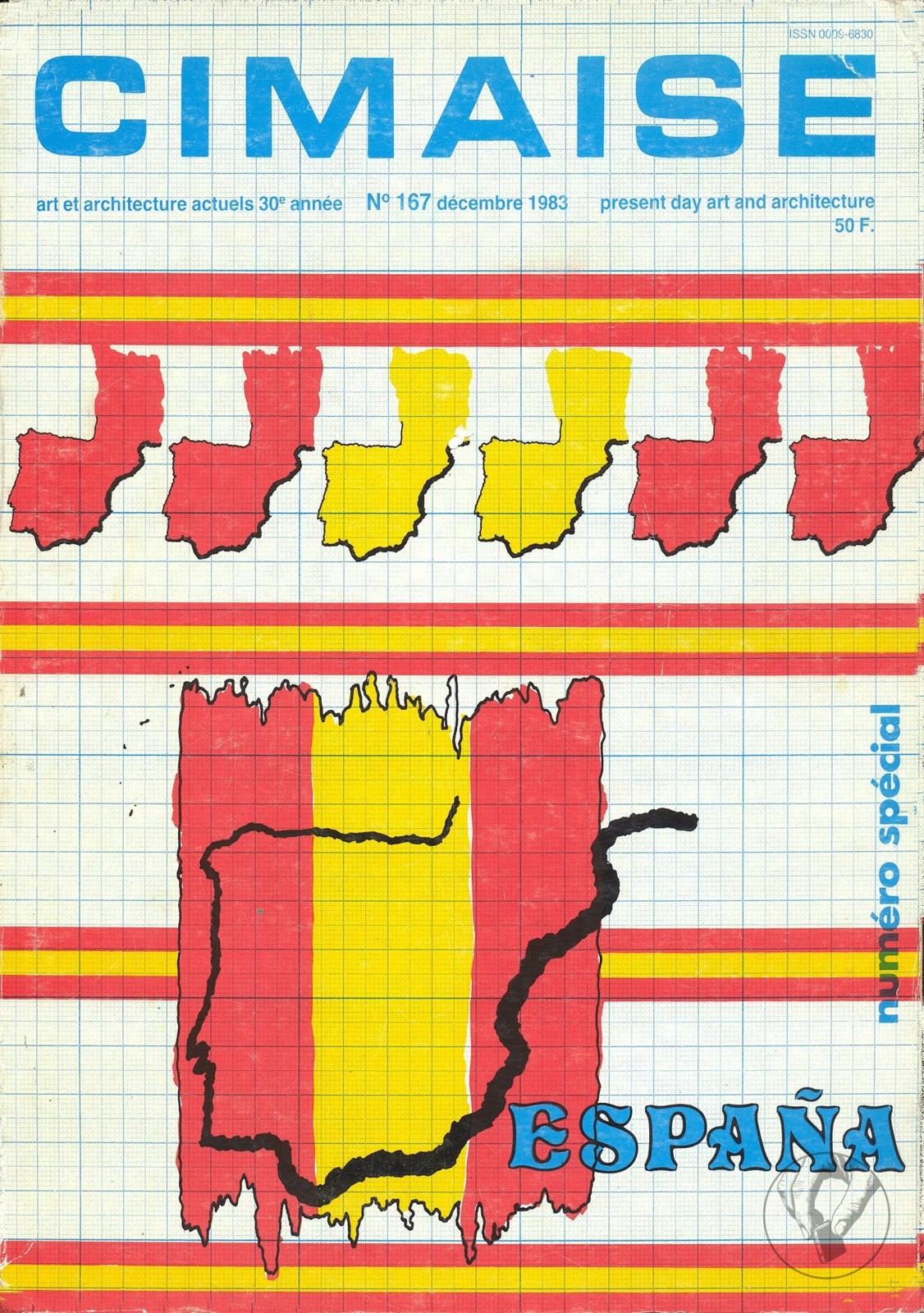
Ce numéro spécial de la revue "Cimaise" est consacré à la peinture espagnole, faisant suite à un numéro sur l'Italie. Il explore l'art espagnol entre 1945 et 1970, une période marquée par le franquisme, l'isolement et la censure, mais aussi par l'émergence de mouvements artistiques novateurs et une ouverture progressive sur la scène internationale. L'article détaille les groupes, expositions et artistes clés qui ont contribué à la transformation de l'art espagnol durant ces décennies.