Page 1
CIMAISE ART ET ARCHITECTURE ACTUELS 19e ANNÉE N° 104-105 PRESENT DAY ART AND ARCHITECTURE
Premières pages de l'ouvrage, en accès libre.
CIMAISE ART ET ARCHITECTURE ACTUELS 19e ANNÉE N° 104-105 PRESENT DAY ART AND ARCHITECTURE
GALERIE DANIEL GERVIS PARIS CONSTANT aquarelles gravures sculptures 21 mars — 6 mai 1972
TOUPIN MARS - AVRIL Galerie Arnaud 212 bd. Saint-Germain, Paris-7, Lit. 46.31
L GALLERIA LORENZELLI BERGAMO LICINI MAGNELLI PRAMPOLINI SCHNEIDER VERONESI RADICE BONFANTI NANGERONI BAUMEISTER PIERLUCA TAVERNARI MUSIC KANDINSKY SOLDATI BISSIER KLEE SEUPHOR POLIAKOFF DUBUFFET PASMORE NICHOLSON HOSIASSON CHARCHOUNE MANSOUROFF FRUHTRUNK FAUTRIER VASARELY PFEIFFER LEVEDAG BERROCAL FEITO J. F. KOENIG --- HENRI MICHAUX VISEUX JOAQUIN FERRER Œuvres récentes mars - avril 1972 LE POINT CARDINAL 12 rue de l’Échaudé-Saint-Germain 3 rue Jacob - 3 rue Cardinale PARIS VI
JEANNE BUCHER 53, Rue de Seine - Paris-6 Tél. 326.22.32 Les thermoformages de GÉRARD SINGER avril - AGUAYO - AMADO - BISSIÈRE - DADO - DUBUFFET - FIORINI - JORN - MOSER - NALLARD - NEVELSON - SZENES - TOBEY - VIEIRA DA SILVA --- LA BAGUETTE DE BOIS 44, Rue Lepic, Paris-18 - 606.36.80 La fabrique de la baguette et du cadre pour vos intérieurs modernes et anciens Dorure à l’or fin • TOUTES MOULURES DÉCORATIVES DE STYLE, BOIS ET PLASTIQUES • DIRECTEMENT DE L’USINE CHEZ VOUS CADRE GUILLOCHÉ ET ÉCAILLE Fermé le lundi --- Galerie Darthea Speyer Delfino jusqu’au 17 mars 1972 6 rue Jacques Callot, paris 6 Tél. 033 78-41
GALERIE DE FRANCE 3, Fbg Saint-Honoré 75-Paris 8 - 265.69.37 - 265.73.69 --- Gustave SINGIER œuvres récentes 8 mars - 15 avril 1972 --- PRASSINOS peintures, dessins et tapisseries récentes 20 avril - 20 mai 1972 --- en permanence peintures - sculptures - aquarelles - dessins lithographies - gravures - livres - catalogues ouvert tous les jours, sauf dimanche 10/13 h. - 14/19 h. samedi : 10/13 h. et sur rendez-vous --- Galerie ARIEL 140, Bd Haussmann PARIS-8 Tél : 227 - 13 . 09 à partir du 15 mars --- Carte Blanche à la Galerie Rinalto Rotta Milan qui présente BARGONI MESCIULAM SQUATRITI Appel - Bitran - Bootz - Corneille Debré - Destarac - Gillet - Lindstrom Marfaing - Messagier - Mihaïlovitch Tabuchi - Weidemann - Wyckaert Alechinsky - Bissière - Dubuffet Goëtz - Hartung - Jorn - Poliakoff Riopelle - de Staël - Vieira da Silva Sculptures de Anthoons - Erhardy - Subira-Puig
yvaral denise rené paris 124 rue la boétie 23 mars 72 denise rené rive gauche 196 bd saint germain paris - picelj 15 mars 1972 --- en souscription XIE Édition Annuaire international des Beaux-Arts La plus importante documentation sur la vie des arts de notre temps GUIDE UNIQUE ÉDITÉ EN QUATRE LANGUES POUR LE MONDE ENTIER --- LE VOLUME I VIENT DE PARAITRE Musées - Universités - Académies - Archives - Écoles d’Art - Sociétés culturelles - Associations - Artistes + Peintres, Sculpteurs, Graveurs, etc… - Collectionneurs. LE VOLUME II PARAITRA FIN 1972 Négociants d’Art et d’Antiquités - Galeries d’Art - Librairies Anciennes et d’Art - Hôtel des Ventes - Commissaires Priseurs-Experts - Editeurs d’Art - Journaux d’Art - Restaurateurs d’Art. --- PRIX SPÉCIAL DE SOUSCRIPTION - F. 145 HT + TAXES LÉGALES - LES DEUX VOLUMES --- Madame GRAD REPRÉSENTANT EXCLUSIF POUR LA FRANCE PARIS - 15e - 42, Avenue de Suffren - Tél. 783.92.89 CANNES - 06 - Château Vallombrosa - Tél. (93) 99.23.85 Éditeur - 1 Berlin 61 - Dessauer Str. 6-7 - Allemagne
cimaise art et architecture actuels present day art and architecture 19e année - N° double 104-105 Nov. Déc. 1971 - Janv. Févr. 1972 Ce numéro : France : 25 F Etranger : 30 F Directeur - Rédacteur en chef : Jean-Robert Arnaud Secrétaire général : René Barzilay Administration - Rédaction : 212, boulevard Saint-Germain, Paris 7, tél. : LITtré 46-31 Imprimé par la Société Mondiale d’Impression 41, rue Héricart, Paris 15 Abonnement France : 1 an, 6 numéros 75 F Le numéro : 15 F Etranger : 1 an, 6 numéros 100 F Le numéro : 20 F C.C.P. Cimaise Paris 5542.39 Abonnements pour le Canada : PÉRIODICA 5090 Av. Papineau Montréal 34, Canada --- NUMÉRO SPÉCIAL: VISITES D’ATELIERS Couverture originale de Geneviève Claisse --- Eric Michaud --- Gérard Singer --- Jean-Louis Majewski --- Ado --- Claude Bouyeure --- Adami --- Roger Bordier --- Cruz-Diez --- Michel Ragon --- Kim Hamisky --- Sabine Marchand --- Remington --- Paule Gauthier --- Subira Puig --- Claude Bouyeure --- Toledo --- Raoul-Jean Moulin --- Tyszblat --- Gilbert Lascault --- Titus-Carmel --- Paule Gauthier --- Robert Wogensky --- John-Franklin Koenig --- Les Ballets --- Jacques Lassaigne --- La Biennale de São Paulo --- Jean-Louis Majewski --- La Biennale de Paris --- Georges BoudailleJean-Robert Arnaud --- Dialogue sur la Biennale de Paris ---
Eric Michaud Gérard SINGER Q. - Gérard Singer, on qualifie parfois, et vous qualifiez vous-même votre production d'art technologique, voulant signifier par là qu'elle relève d'une pratique spécifique qui la démarquerait des autres pratiques artistiques. Pouvez-vous expliciter davantage cette notion d'art technologique et sa spécificité ? R. - Il faudrait dire : « qui la démarquerait des autres pratiques technologiques » plutôt qu’« artistiques ». Je crois qu’il y a, du point de vue de la production, deux périodes : celle des matériaux spécifiques à l’art, et celle, relativement récente, des emprunts de matériaux à l’industrie, celle du détournement, ou plutôt de l’appropriation, qui commence avec les ready made. Mais, en fait, on utilise ces produits à la fin de leur processus de production, au moment où ce sont des produits finis : ils ne permettent donc de s’exprimer que par l’assemblage. On reste donc tributaire de la forme primaire de ces matériaux, ou bien, comme ils sont déjà « chargés » symboliquement, on utilise cette valeur de choc symbolique. Mais, pour moi, le problème est d’intervenir avant la fin du processus de production du matériau : mettre en œuvre différemment cette matière première pour produire quelque chose qui n’existe pas parallèlement dans l’industrie, mais qui pourrait — comme critère de spécificité — être pratiquement exposable au conservatoire des Arts et Métiers. Q. - Est-ce que vous considérez que l’emploi de matériaux nouveaux traités par des techniques nouvelles suffit à déterminer ce caractère technologique, ou bien pensez-vous que ce caractère spécifique est lié davantage à l’objet produit qu’aux conditions de sa production ? Peut-on enfin séparer l’objet produit de son mode de production ? R. - On va me prêter des intentions qui ne sont pas les miennes. Je ne sais pas si ce mot de « technologique » me convient, car je veux en fait me démarquer des produits de l’art qui s’intitule technologique, qui, pour moi, n’est encore qu’une forme de ready made. J’ai utilisé ce mot en tant que « art, secteur de la technologie », de la recherche, et non comme « technologie, secteur de l’art ». C’est très différent. Si l’on remplace le mot art par le mot intuition, disons : l’intuition comme secteur de la technologie, mais non pas la « chose » comme étant déjà revêtue d’une étiquette artistique, ce qui prêterait à confusion par le biais de la notion d’appropriation. En fait, il ne faut pas définir : les gens vont se battre sur les mots ! Alors que les artistes visualisent les mots, les concepts et les étiquettes ne sont pas visualisables. Q. - Vous affirmez que dans le processus de votre travail, « l’intervention matérielle précède son commentaire », que « l’acte précède la théorie ». Il s’agit pourtant là d’une théorie — articulée ou non — qui semble déterminer votre travail. Comment expliquez-vous ce paradoxe. R. - On se trouve à un moment-clé historiquement : la chose et son commentaire. Ceux qui ressentent les choses n’ont pas besoin de mode d’emploi. Q. - Gérard Singer, your production is sometimes called, and you call it yourself, technological art, which means that it is the result of a specific practice which sets it apart from other artistic practices. Can you give us a clearer notion of technological art and its specificity? A. - It would be more correct to say: that which sets it apart from other “technological” rather than “artistic” practices. From the production point of view, there are, I believe, two periods: that of materials which are particular to art, and that, relatively recent, of borrowings of materials from industry, the confiscation, or rather the appropriation, which begins with the ready-mades. But, in fact, one uses these products at the end of the process which produces them, when they are finished products. They permit, therefore, expression only through their assembling. One remains, as a result, dependent upon the primary form of these materials, or else, as they are already symbolically “laden,” one utilizes this value of symbolic shock. But for me, the problem is one of intervening before the end of this process of production of the matter: to make a different usage of this raw material to produce something which does not have its parallel existence in industry, but which could — as a criterion — be almost exhibitable in a museum of arts and crafts. Q. - Do you consider that the employment of new matters treated with new techniques is sufficient to establish this technological character, or do you think that this specific character is more linked to the object produced than to the conditions of its production? In summary, can one separate the object produced from its mode of production? A. - I am going to be accused of intentions which are not mine. I do not know whether this word “technological” suits me, for I would like to distinguish myself from those art products which are entitled technological, which, for me, are still only a form of ready-made. I have used this word as “art, a sector of technology,” of research, and not as “technology, sector of art.” And this is quite different. If we replace the word art with the word intuition — or, shall we say, intuition as a sector of technology, but not the “thing” as if it already bore an artistic label — this would lead to confusion through the notion of appropriation. In fact, we must not make a definition, or, People will come to blow over words! While artists visualize words, concepts and labels are not possible to visualize. Q. - You maintain that, during the course of your work, “material intervention precedes its commentary,” that “the act precedes the theory.” And yet there is a theory — stated or not — which seems to determine your work. How do you explain this paradox? A. - Historically speaking, we are living in a key moment: the thing and its commentary. Those who
Gérard Singer : "La Girouette romaine", 1966 Marseille, quartier de la Timone. Réalisé en époxy et son moule négatif en polystyrène expansé
12  
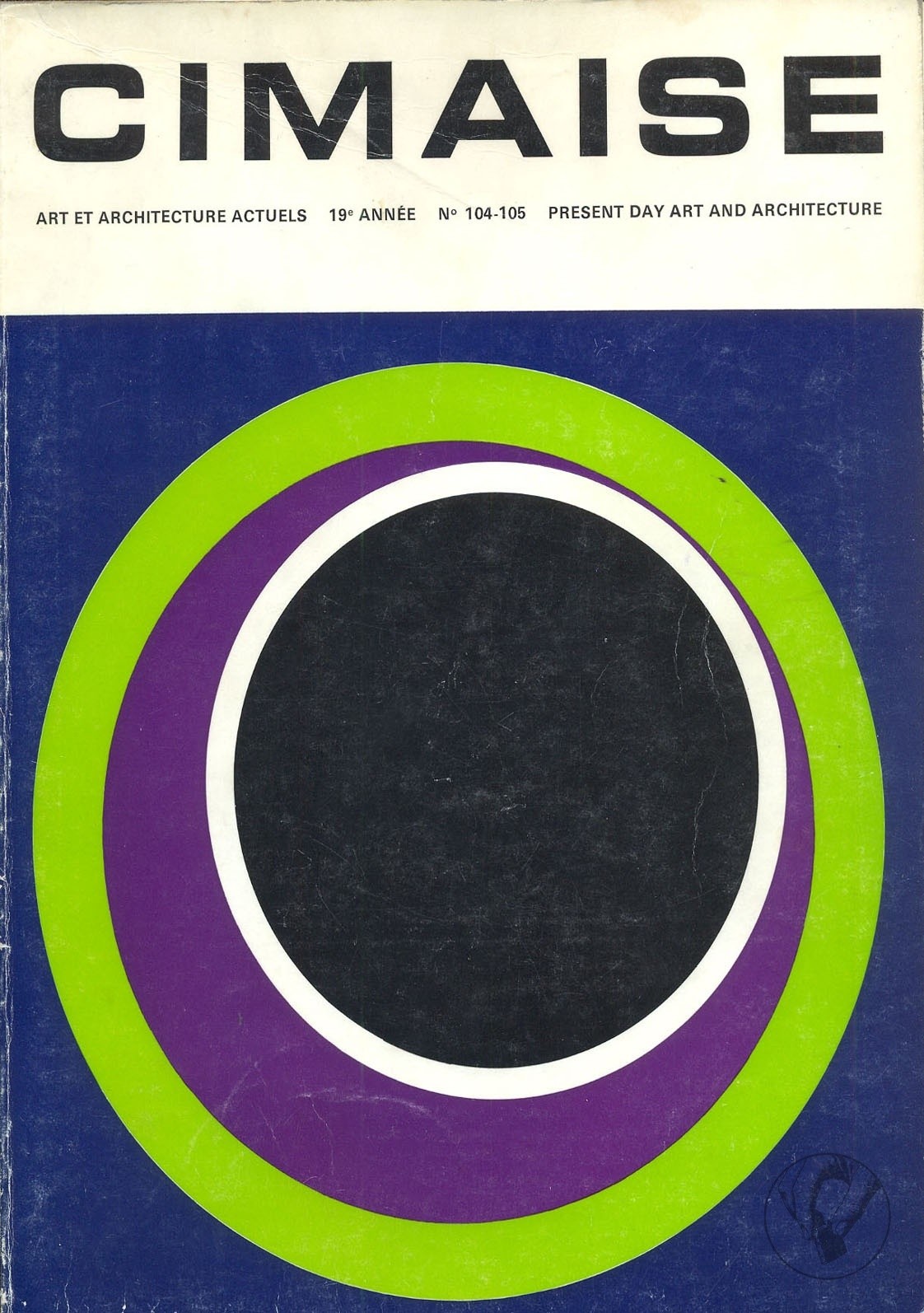
Ce numéro double de la revue "Cimaise" présente des expositions d'art et d'architecture actuels qui se sont tenues à Paris et à Milan entre mars et mai 1972. Il inclut des articles sur Gérard Singer, des expositions de peintures, sculptures, gravures et tapisseries, ainsi qu'une section sur les visites d'ateliers d'artistes et des critiques sur les Biennales de Paris et de São Paulo.