Page 1
CIMAISE ART ET ARCHITECTURE ACTUELS 17e ANNEE N°97 PRESENT DAY ART AND ARCHITECTURE
Premières pages de l'ouvrage, en accès libre.
CIMAISE ART ET ARCHITECTURE ACTUELS 17e ANNEE N°97 PRESENT DAY ART AND ARCHITECTURE
ÉDITIONS DANIEL GERVIS 34 rue du Bac Paris 7 548.20.59 --- MONTYN GRAVURES 30 SEPTEMBRE 30 OCTOBRE 1970 BENRATH - BLOMSTEDT - DAHMEN - DUBUFFET - DUMITRESCO - HOSIASSON HUNDERTWASSER - ISTRATI - JENKINS - MANSOUROFF - MONTYN - BENGT OLSON ORTIZ - SITTER - SONDERBORG - TOLEDO
--- depuis 1557, à Vidalon-les-Annonay, tous papiers artistique et industriel vendus sous la marque : Les Papiers Canson BOITE POSTALE 31 - 07-ANNONAY --- GALERIE DE FRANCE 3, Fg St-Honoré - Paris 8 - 265.69.37 PEINTURES DE: --- ALECHINSKYBERGMANCAMPIGLIROBERTA GONZALEZHARTUNGLEVEEMAGNELLIMANESSIERMUSICNIETOPIGNONPRASSINOSSINGIERSOULAGESZAO WOU-KI --- SCULPTURES DE: --- COLVINCONSAGRAJACOBSENLIBERAKIROBERT MULLERREINHOUD --- SUCCESIONS DE: --- JULIO GONZALEZJUAN GONZALEZ --- Lithographies, Gravures, Catalogues Salles du rez-de-chaussée ouvert tous les jours sauf dimanche de 10 à 13 h. et de 14 à 19 h. --- A. Gattegno 13 et 15, rue de la Grande Chaumière, Paris 6 - DAN 63.18 Cadres - Chassis - Toiles Couleurs Françaises et Étrangères ---
Hamisky 8 Octobre - 7 Novembre GALERIE ARNAUD 212 bd Saint-Germain Paris 7 548 46.31
SOTO GALERIE DENISE RENE JUIN - JUILLET --- GRAVURES ET LITHOGRAPHIES ORIGINALES D'ARTISTES CONTEMPORAINS - APPEL - BALLIF - BITRAN - CARCAN - CÉSAR - DORNY - FEITO - GILLET - HASEGAWA - J.F. KOENIG - LABISSE - LINDSTROM - LOUTTRE - MARFAING - MATTA - PIZA - SEGUI - SURVAGE - TABUCHI - TRÉMOIS - VELICKOVIC - WALKER - WITOLD K. A. FRANCOIS FOLON SEARLE TOPOR --- Edition Empreinte en permanence à : LA POCHADE 157 bd St-Germain - Paris 6 Tél. 548 00.14 --- GALERIE STADLER 51 rue de Seine Paris 6 Danton 91 - 10 - N. Bluhm - Boillé - Damian - Naves - Saura - Zenderoudi en permanence Bijoux de Braque
--- depuis 1557, à Vidalon-les-Annonay, tous papiers pour le dessin artistique et industriel vendus sous la marque : Les Papiers Canson --- BOITE POSTALE 31 - 07-ANNONAY --- GALERIE DE FRANCE 3, Fg St-Honoré - Paris 8 - 265.69.37 PEINTURES DE: --- ALECHINSKYBERGMANCAMPIGLIROBERTA GONZALEZHARTUNGLEVEEMAGNELLIMANESSIERMUSICNIETOPIGNONPRASSINOSSINGIERSOULAGESZAO WOU-KI --- SCULPTURES DE: --- COLVINCONSAGRAJACOBSENLIBERAKIROBERT MULLERREINHOUD --- SUCCESIONS DE: --- JULIO GONZALEZJUAN GONZALEZ --- Lithographies, Gravures, Catalogues Salles du rez-de-chaussée ouvert tous les jours sauf dimanche de 10 à 13 h. et de 14 à 19 h. --- A. Gattegno 13 et 15, rue de la Grande Chaumière, Paris 6 - DAN 63.18 Cadres - Chassis - Toiles Couleurs Françaises et Étrangères ---
Hamisky 8 Octobre - 7 Novembre GALERIE ARNAUD 212 bd Saint-Germain Paris 7 548 46.31
SOTO GALERIE DENISE RENE JUIN - JUILLET --- GRAVURES ET LITHOGRAPHIES ORIGINALES D'ARTISTES CONTEMPORAINS - APPEL - BALLIF - BITRAN - CARCAN - CÉSAR - DORNY - FEITO - GILLET - HASEGAWA - J.F. KOENIG - LABISSE - LINDSTROM - LOUTTRE - MARFAING - MATTA - PIZA - SEGUI - SURVAGE - TABUCHI - TRÉMOIS - VELICKOVIC - WALKER - WITOLD K. A. FRANÇOIS FOLON SEARLE TOPOR --- Edition empreinte en permanence à : LA POCHADE 157 bd St-Germain - Paris 6 Tél. 548 00.14 --- GALERIE STADLER 51 rue de Seine Paris 6 Danton 91 - 10 - N. Bluhm - Boillé - Damian - Naves - Saura - Zenderoudi en permanence Bijoux de Braque
cimaise art et architecture actuels present day art and architecture 17e année - N° 97 Mai - Juin - Juillet - Août 1970 Ce numéro : France : 10 F Etranger : 12 F Directeur - Rédacteur en chef : Jean-Robert Arnaud Secrétaire général : René Barzilay Administration - Rédaction : 212, boulevard Saint-Germain, Paris 7, tél. : LITtré 46-31 Imprimé par la Société Mondiale d'Impression 41, rue Héricart, Paris 15 Abonnement France : 1 an, 6 numéros 50 F Le numéro : 10 F Etranger : 1 an, 6 numéros 60 F Le numéro : 12 F C.C.P. Cimaise Paris 5542.39 Abonnements pour le Canada : PÉRIODICA 5090 Av. Papineau Montréal 34, Canada --- Couverture originale de Soto Étude --- Patrick d’Elme --- La logique de SotoSoto’s logic --- Visites d’ateliers --- Michel Ragon --- Philippe Hosiasson --- Raoul-Jean Moulin --- Tabuchi --- Architecture --- Michel Ragon --- André Gomis --- Actualité --- Jean-Jacques Lévêque --- Des structures et des mœursStructures and manners --- Les livres --- Michel Ragon --- Livres d’art et d’architecture ---
LA LOGIQUE DE SOTO Patrick d'Elme SOTO'S LOGIC Il faut, quand on parle de Soto, employer les termes les plus simples. Lui-même exige que l’artiste s’ex- prime au moyen d’une écriture lisible, afin « d’en- trainer le spectateur », et convient que ce n’est pas chose aisée. Or, depuis le XVIIIe siècle, c’est la parti- cipation intellectuelle du regardeur qui a été de plus en plus sollicitée : la conséquence en a été la consti- tution d’un public d’autant plus restreint qu’il était qualifié. En plaçant au premier rang de ses préoccu- pations la participation sensible, physique pourrait-on dire, des hommes aux œuvres d’art, Soto prend parti pour la collectivité. Ne serait-ce que par ce biais, il relie notre époque à celles qui ont connu les plus grands développements artistiques. Une biographie anecdotique de Soto ne s’impose pas : il n’a aucun trait du peintre folklorique ou naïf. Ainsi, qu’il soit né au Venezuela, à Ciudad Bolivar pour être précis, dans une famille pauvre et nom- breuse, ne nous renseigne nullement sur son œuvre. Celle-ci ne porte pas les marques d’une terre ancestrale (ou d’une classe sociale), parce que, résolument moderne, elle témoigne bien davantage d’une vérité universelle semblable, par exemple, à celle qu’appré- hendent les mathématiques. Mais le long chemin qu’il a suivi, signe d’une infatigable logique et proche à bien des égards de l’apreté au combat d’un Mondrian, est, par contre, nécessaire à décrire pour ne pas se méprendre sur le sens actuel de ses travaux et sur les quelques conclusions provisoires qu’il peut se per- mettre aujourd’hui de formuler. Très jeune, il dessinait. Il était même un véritable amoureux du pinceau et se fit « peintre en lettres » à Ciudad Bolivar, « puisque la profession d’artiste- peintre n’existait pas ». Encouragé par des amis, il partit, en 1942, pour Caracas où se trouvait une impor- tante Ecole des Beaux-Arts : huit cents kilomètres qu’il parcourra en quinze jours, avec des moyens financiers extrêmement réduits, au terme desquels il va connaître sa première grande déception. « On m’a donné deux chaises, une pour m’asseoir et une pour poser ma planche en bois avec une grande feuille de papier et un tas de craies de cou- leurs. Sur une couverture délavée, il y avait une triste céramique avec, posés dessus, quelques petits fruits. Un professeur très gentil m’a expliqué qu’à partir de là, je pouvais faire de l’art. J’ai trouvé ça minable et j’ai eu envie de partir. Mais cette école était la pre- mière du pays. Je n’avais pas le choix. » (Preuves, premier trimestre 1970.) Soto must be spoken of in the simplest terms. He himself insists that an artist express himself by means of legible writing in order to “draw the spectator into it,” and he agrees that it is not an easy matter to do so. Ever since the Eighteenth Century, that which was most solicited from the viewer was his intellectual participation; as a consequence of this, there was constituted a public as limited as it was qualified. By putting in the first place among his concerns the sensitive, or the physical, one might say, participation by man in works of art, Soto took his stand for the collectivity. If it were but for this prejudice alone, he links our epoch to those which have known the greatest artistic developments. An anecdotal biography of Soto is not called for; he has nothing in common with the folkloric or naive painter. Thus, the fact that he was born in Venezuela, at Ciudad Bolivar to be specific, in a big and poor family tells us nothing about his work. His work does not bear any trace of ancestral earth (or of a social class) because, resolutely modern, it witnesses much more to a universal truth, similar, for example, to that seized by mathematics. But the long road he has followed, which is a sign of tireless logic and not unlike, in many ways, the harsh combat of Mondrian, is, on the other hand, necessary to describe if we are not to be mistaken about the current meaning of his works and the small number of conclusions which we may be permitted to formulate at this time. At a very early age he used to draw. He was even a genuine lover of the paintbrush and became a sign- painter in Ciudad Bolivar “because the profession of artist did not exist.” Encouraged by his friends, he left in 1942 for Caracas, where there was an important School of Fine Arts. He covered eight hundred kilo- meters in fifteen days, with extremely limited financial means, at the end of which time he knew his first great deception. “They gave me two chairs,” he says, “one to sit on and one upon which I could place a wooden board, a huge sheet of paper and a pile of colored chalk. A dismal ceramic dish holding several little pieces of fruit was placed upon a washed-out piece of cloth. A very nice professor explained to me that starting with these I could create art. I found that pitiable and felt like leaving. But this school was the best in the country. I had no choice.” (Preuves, First Trimester 1970).
Monochrome Orange 1970. 150 x 200 cm
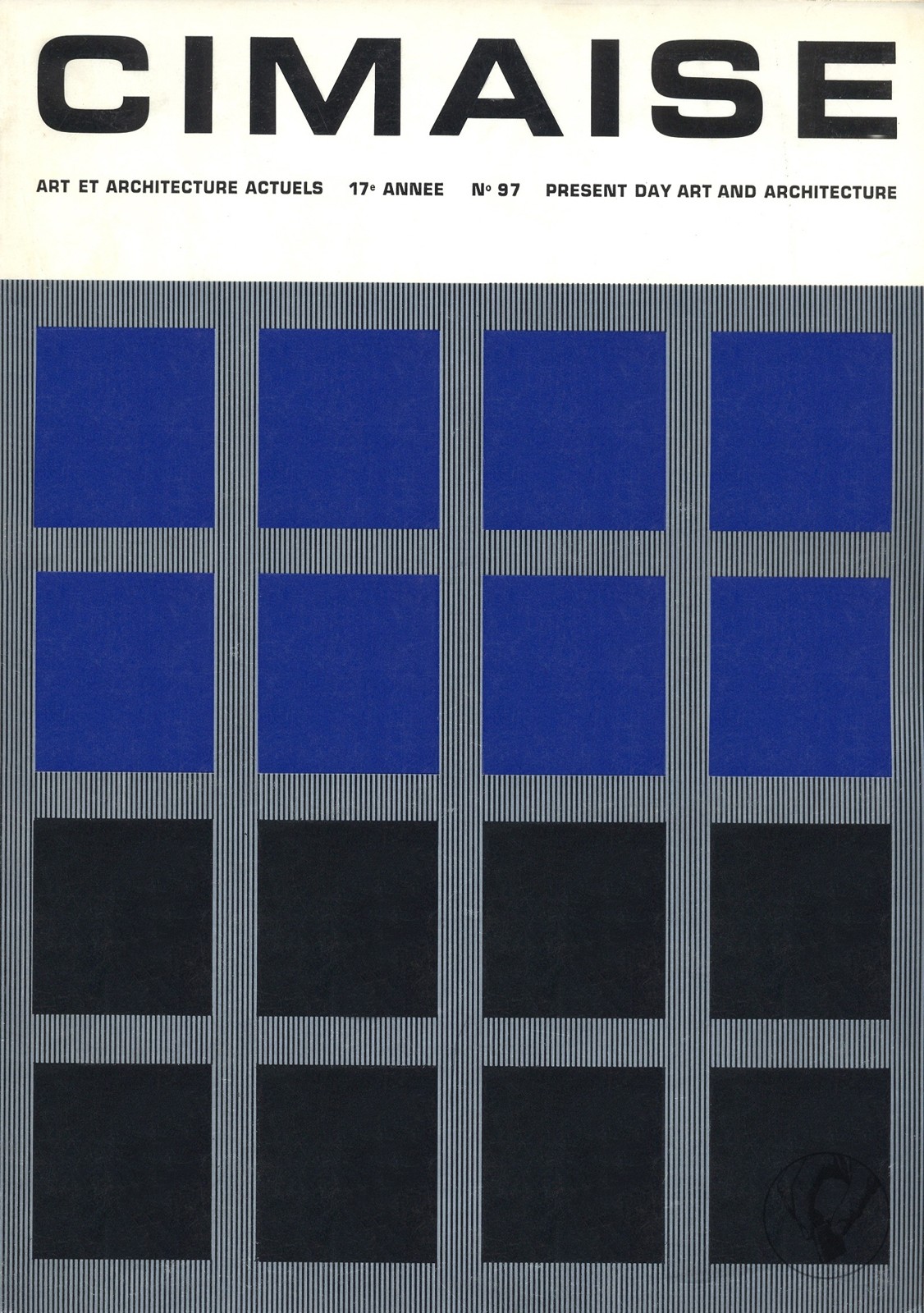
Cimaise est une revue d'art et d'architecture actuelle. Ce numéro présente des gravures de Montyn, des peintures et sculptures à la Galerie de France, des œuvres à la Galerie Arnaud, ainsi que des gravures et lithographies d'artistes contemporains à la Galerie Denise René et à la Galerie Stadler. Il inclut également des articles sur Soto, des visites d'ateliers d'artistes comme Philippe Hosiasson et Tabuchi, et une section sur l'architecture.